
- Google Business Profile and organic SEO deliver the highest ROI with a blended cost per lead of $0-25 and close rates of 30-45%. Paid channels like Google Ads cost $40-80 per lead but produce calls within 24 hours.
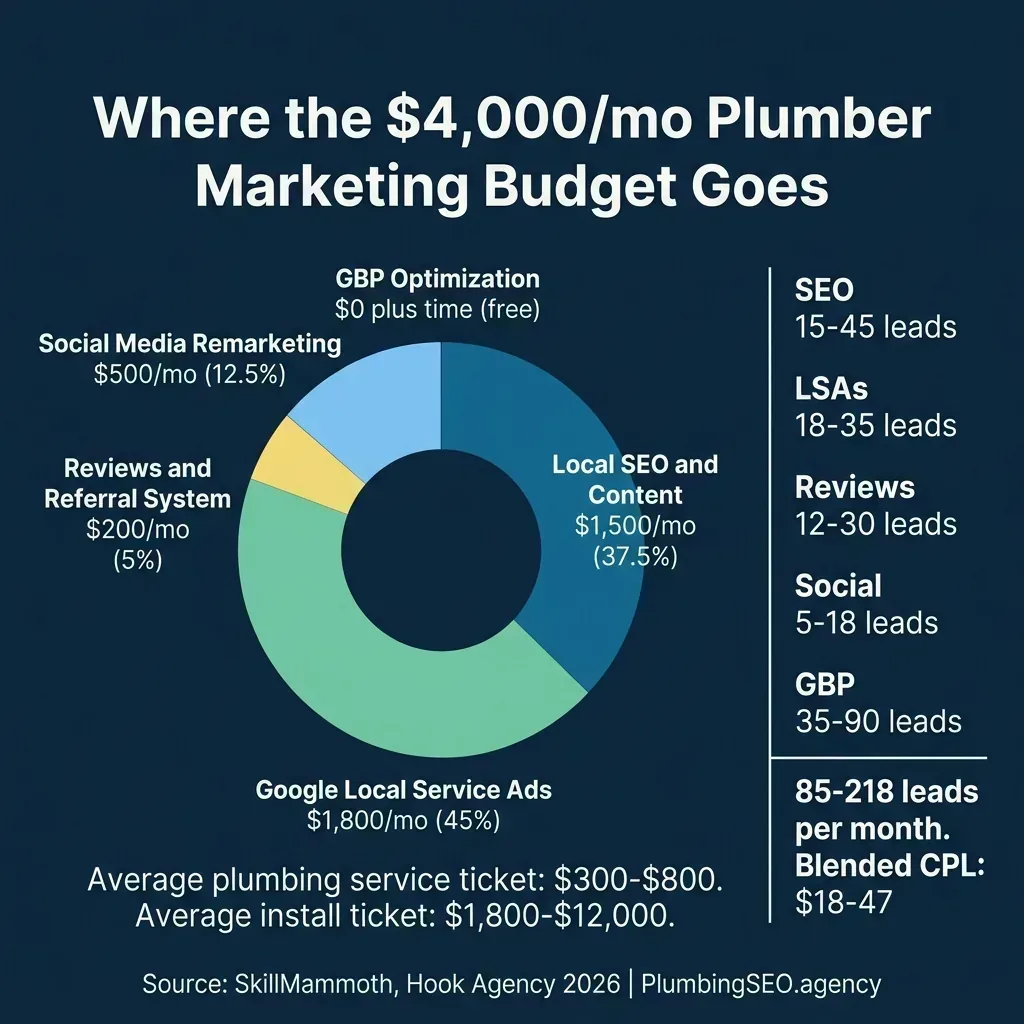
- Most plumbing companies should spend 8-15% of annual revenue on marketing, or $2,000-$8,000/month. A $4,000/month starter stack across SEO, LSAs, reviews, and remarketing can produce 85-218 leads per month at a blended CPL of $18-47.
- This guide ranks every plumbing marketing channel by real-world ROI and links to our deep-dive posts on each topic. Use it as your home base for building a marketing plan that gets trucks rolling and phones ringing.
Why Most Plumbing Companies Get Marketing Wrong
Here is the pattern we see over and over. A plumbing company owner knows they need marketing. So they sign up for HomeAdvisor, run some Google Ads, maybe pay an agency $3,500 a month for "SEO" they cannot explain. Six months later, the phone is not ringing any more than it was before, and they have burned through $20,000 with nothing to show for it.
The problem is not that plumbing marketing does not work. The problem is that most plumbing companies pick channels randomly instead of ranking them by what actually produces calls and booked jobs. They chase the newest shiny platform instead of mastering the boring channels that compound over time.
This guide fixes that. We rank every marketing channel for plumbers by cost per lead, close rate, and real-world ROI. Each section links to our detailed guide on that channel so you can go deeper on the ones that matter most to your business. Think of this page as your marketing playbook table of contents.
1. SEO: The Long Game That Pays the Most
If you could only invest in one marketing channel for your plumbing company, this is the one. Search engine optimization is not the fastest path to calls. Google Ads and LSAs will ring your phone this week. But over 6-12 months, SEO delivers the lowest cost per lead of any channel: $10-25 per lead once rankings mature, compared to $40-80 for Google Ads.
The reason is compounding. Every service page you build, every Google Business Profile post you publish, every review you collect adds to a foundation that keeps producing leads without additional spend. A plumbing company running Google Ads pays $30 every time someone clicks "water heater repair near me." A plumbing company ranking organically for that same term gets the click for free. Multiply that across 15-20 service keywords in your city and the math gets lopsided fast.
For a complete walkthrough, our step-by-step plumber SEO guide covers the entire process from scratch.
What SEO Actually Includes for Plumbers
SEO is not one thing. It is a stack of activities that work together. Here is what each layer looks like and where to go deeper:
- Google Business Profile (GBP): Your Map Pack listing drives 35-90 leads per month when optimized. Read our guides on Google Maps SEO for plumbers, writing a GBP description that ranks, the 7 essential GBP photos, and our weekly GBP post template. If your profile gets suspended, our recovery guide walks you through reinstatement.
- On-page SEO and keywords: Every service you offer needs its own page targeting the right keyword. Our keyword strategy guide and complete plumbing keywords list show you exactly which terms to target and where to put them.
- Technical SEO: Site speed, mobile responsiveness, schema markup, and crawlability. Our 15-point technical SEO checklist and schema markup guide cover the technical foundation.
- Local citations and backlinks: NAP consistency and local link building. Our top 50 citation directories and local backlink strategy show you how to build authority without begging.
- Multi-location SEO: If you serve more than one city, our multi-location SEO guide and city pages guide cover hub-and-spoke architecture.
- AI and future-proofing: Google AI Overviews are changing search. Our guide on what AI Overviews mean for plumbers and the best AI tools for local SEO keep you ahead of the curve.
SEO Costs and What to Expect
Plan for $1,500-$5,000 per month for professional SEO. The investment compounds over time, and by month 6-12, SEO typically becomes your top lead source by volume and your cheapest by cost per lead. If you are evaluating what to spend, our plumbing SEO pricing guide breaks down what is reasonable and what is a rip-off. For budget planning, see how much a plumbing company should spend on SEO.
Thinking about hiring an agency versus doing it yourself? Our comparison of agency vs. in-house SEO, our agency vetting checklist, and our ranked guide to the best SEO providers help you make the right call. You can also see what a real SEO audit looks like so you know what to expect before signing anything.
For the data behind these claims, our 75+ plumbing SEO statistics and 80+ local SEO benchmarks give you the hard numbers.
2. Paid Advertising: Google Ads, LSAs, and When PPC Makes Sense
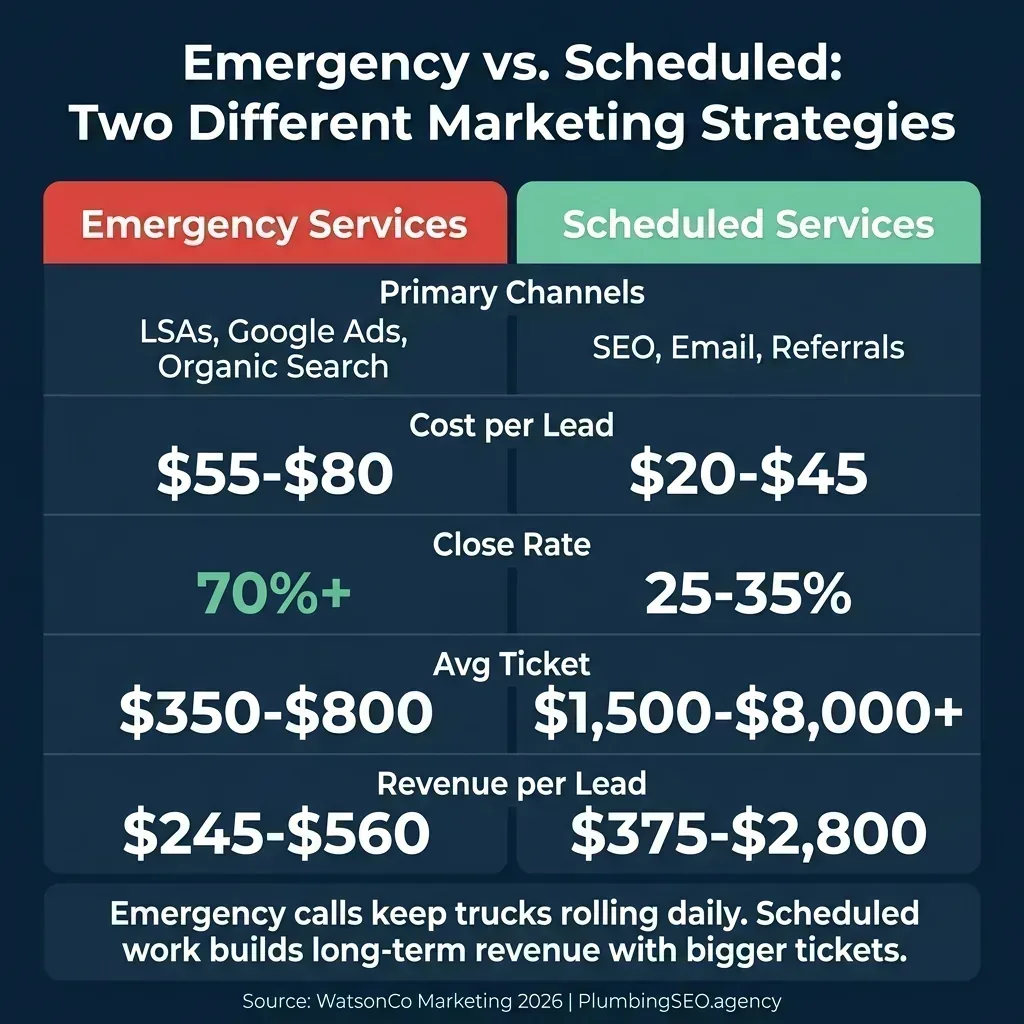
If SEO is the long game, paid advertising is the short game. Google Ads and Local Service Ads can put your phone number at the top of search results within 24-48 hours of launch. That speed has a cost: $40-80 per lead for standard Google Ads and $20-55 per lead for Local Service Ads. But for a plumbing company with open truck capacity and no organic rankings yet, paid ads fill the schedule while SEO compounds in the background.
Local Service Ads (LSAs): Start Here
If you are going to spend on advertising, start with Google Local Service Ads. LSAs appear above standard Google Ads, carry the green "Google Guaranteed" badge, and charge per lead instead of per click. That means you do not pay for tire-kickers who click your ad and leave. You pay only when a homeowner actually calls you or sends a message through the ad.
For plumbers, LSA cost per lead typically runs $20-55 depending on your market and service types. Our complete LSA guide walks through setup, optimization, and common mistakes that inflate your CPL.
Google Search Ads (PPC): Layer on After LSAs
Standard Google Ads (pay-per-click) give you more control over targeting, ad copy, and landing pages than LSAs, but they cost more. Average CPC for plumbing keywords runs $22-30, with competitive terms like "emergency plumber near me" spiking to $60-90 per click. At a 15-25% conversion rate, that puts your cost per lead at $40-80.
The best play is running PPC alongside LSAs for the first 6 months while your SEO builds. Our Google Ads for plumbers service page explains how we structure campaigns to keep CPL under control.
SEO vs. PPC: Not Either/Or
We get this question constantly: should I invest in SEO or Google Ads? The answer is often both, but the ratio changes over time. Our SEO vs. PPC deep-dive breaks down exactly when to lean into each channel and how to shift budget as your organic rankings grow.
3. Reviews and Reputation: The Trust Engine
Reviews are the one marketing channel that makes every other channel work better. A plumbing company with 200+ Google reviews and a 4.8-star average can out-convert a competitor with better rankings and fewer reviews. The data is clear: referrals and reviews have the highest close rate of any channel at 50-70%, and the cost per lead is effectively $0-15 (the cost of review management software).
Reviews also directly impact your Google Maps ranking. Google's local algorithm weights review quantity, recency, and response rate as ranking factors. More reviews mean better rankings, which mean more clicks, which mean more calls. It is a flywheel.
Building Your Review Machine
The plumbing companies with the most reviews are not lucky. They have a system. Our 5-star review system guide covers the exact workflow: when to ask (at point of payment, while the customer is still happy), how to ask (text with a direct link), and how to make it a habit for every tech on every job.
For understanding how reviews directly affect your SEO, our Google Reviews and plumbing SEO analysis connects the dots between review volume and Map Pack rankings with real data.
Handling Negative Reviews
Every plumbing company gets negative reviews. The ones that handle them well actually build more trust than companies with a perfect 5.0 rating (which looks fake). Our negative review response guide with copy-paste templates shows you exactly what to say and what not to say.
Monitoring Your Reputation
You cannot respond to a review you do not know about. Our guide to setting up Google Alerts for reputation monitoring takes 10 minutes and ensures you never miss a mention of your company online.
4. Your Website: The 24/7 Sales Rep
Every marketing channel drives traffic somewhere. If that somewhere is a slow, confusing, or ugly website, you are paying for leads and then fumbling them at the one-yard line. Your website is not a brochure. It is a conversion tool. Most important pages should have one job: get the visitor to call or fill out a form.
Typical investment for a professional plumbing website is $5,000-$30,000 for the initial build, but a well-built site pays for itself within months when the calls start rolling in.
What a High-Converting Plumbing Website Looks Like
Our plumbing website anatomy guide breaks down every element of a homepage that converts: phone number placement, hero section, trust signals, service cards, and CTAs. If your current site is not producing calls, our diagnostic guide on why plumber websites fail to generate calls identifies the most common conversion killers.
Mobile Matters More Than Desktop
Most plumbing searches happen on phones. Someone's pipe just burst, they grab their phone and search "plumber near me." If your site is slow, unreadable, or hard to navigate on mobile, they hit the back button and call your competitor. Our mobile readiness guide shows you exactly what to fix.
Pages That Convert
- Service pages: Our guide on how we build service pages that rank shows the template we use to build pages that satisfy both Google and homeowners.
- About page: The most underrated conversion page on a plumbing website. Our about page guide shows you how to build trust with real photos, real team bios, and a story that connects.
- Communication tech stack: Once a lead hits your site, what happens? Our tech stack guide covers chat widgets, call tracking, form builders, and automated follow-up sequences that prevent leads from falling through the cracks.
5. Social Media, Direct Mail, and Other Channels
These channels are not the core of a plumbing marketing strategy, but they play supporting roles. The mistake is making them the centerpiece of your plan. The right move is using them to reinforce the channels that actually drive calls.
Social Media: Trust Builder, Not Lead Generator
Nobody scrolls Facebook looking for a plumber. But when a homeowner Googles your company after seeing your LSA, and they find a Facebook page with regular before-and-after photos, crew spotlights, and community engagement, that tips the scale toward calling you instead of your competitor with no social presence.
The cost per lead for social media ads runs $35-75 with a close rate of 10-20%, making it the most expensive and least efficient direct lead channel. But for remarketing (showing ads to people who already visited your website), social ads are cheap and effective. A $500/month remarketing budget keeps your name in front of homeowners who were not ready to call the first time.
Seasonal Marketing
Plumbing demand is seasonal. Water heater calls spike in winter. Drain cleaning peaks in spring. Outdoor plumbing picks up in summer. Our seasonal marketing calendar maps every month of the year to the right promotions and content so you are never caught off-guard by a slow season.
Email Marketing: The Cheapest Channel You Are Not Using
Email has the second-lowest cost per lead of any channel at $2-8, and it has a 45-60% close rate because you are marketing to past customers who already trust you. A simple monthly email with seasonal reminders, maintenance tips, and a special offer keeps your company top-of-mind and drives repeat business. The problem is most plumbing companies never build a list. Start collecting emails at every job and every form fill, starting today.
The Big-Picture Marketing Strategy
If you want a framework for how all these channels fit together, our 7 overlooked strategies post covers the tactics most plumbing companies skip. And our 2026 emerging trends report covers what is changing this year. For a step-by-step first-year plan, our first 90 days of plumbing marketing guide is the playbook we would follow if we were starting a plumbing company tomorrow.
Direct Mail
Not dead, but very specific use case. Direct mail works for annual maintenance plan renewals mailed 60 days before the due date, targeted neighborhood mailings around big install jobs, and older demographics for maintenance program enrollment. CPL runs $50-300. Do not use it as your primary lead channel in 2026. It is a supplement, not a substitute.
6. Measuring What Works: Marketing ROI for Plumbers
The biggest mistake in plumbing company marketing is spending money without tracking what it produces. Impressions do not pay for pipe fittings. You need to know cost per lead and cost per booked job by channel, and then shift budget toward what works and cut what does not.
The Three Numbers That Matter
- Cost per lead (CPL): Total spend on a channel divided by total leads from that channel. If you spent $1,500 on Google Ads and got 25 calls, your CPL is $60.
- Close rate: Percentage of leads that become booked jobs. For organic SEO leads this is typically 30-45%. For shared leads from HomeAdvisor, it drops to 4-8%.
- Customer lifetime value (CLV): One plumbing customer is not one job. If your average customer calls you 3 times over 5 years, their value might be $2,000+. CLV tells you how much you can afford to spend to acquire that customer.
Tracking Setup
Our call tracking guide shows you how to assign unique phone numbers to each marketing channel so you know exactly which ad, page, or campaign produced each call. And our complete ROI measurement guide walks through the formulas, dashboards, and red flags that tell you when your marketing is working and when it is wasting money.
For ongoing performance monitoring, our Google Search Console guide teaches you how to read the free reports Google already gives you about your site's search performance.
Red Flags in Your Marketing Spend
- Your agency reports impressions and clicks but not booked jobs.
- Your CPL is over $80 and nobody can explain why.
- You are paying for "SEO" but do not rank for "[your city] plumber" after 6 months.
- Facebook Ads are your primary lead source (they should not be for plumbing).
- You are buying shared leads from HomeAdvisor/Angi with a 4-8% close rate.
7. Every Plumbing Marketing Channel Ranked by ROI
Here is the big picture. Every channel ranked by the numbers that actually matter for a plumbing company: cost per lead, close rate, and how quickly it produces results.
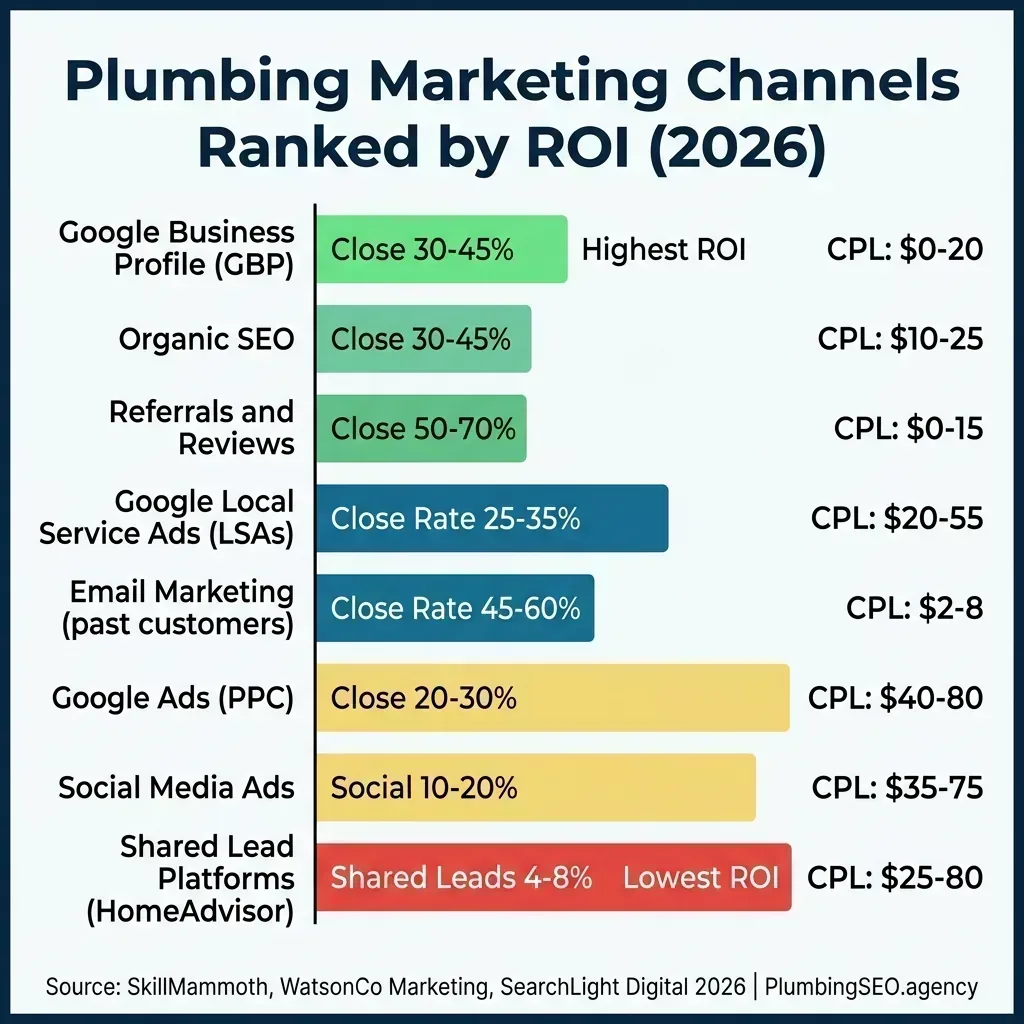
| Channel | Cost per Lead | Close Rate | Time to Results | ROI Rank |
|---|---|---|---|---|
| Google Business Profile | $0-20 | 30-45% | 2-4 weeks | ★★★★★ |
| Organic SEO | $10-25 | 30-45% | 3-6 months | ★★★★★ |
| Referrals and Reviews | $0-15 | 50-70% | 2-3 months | ★★★★★ |
| Email (past customers) | $2-8 | 45-60% | Immediate | ★★★★☆ |
| Google Local Service Ads | $20-55 | 25-35% | 24-48 hours | ★★★★☆ |
| Google Ads (PPC) | $40-80 | 20-30% | 24-48 hours | ★★★☆☆ |
| Social Media Ads | $35-75 | 10-20% | 1-2 weeks | ★★☆☆☆ |
| Direct Mail | $50-300 | 10-20% | 2-4 weeks | ★★☆☆☆ |
| Shared Leads (HomeAdvisor) | $25-80 | 4-8% | Immediate | ★☆☆☆☆ |
The $4,000/Month Starter Stack
If you are a 3-5 truck plumbing operation spending $3,000-$5,000 per month on marketing, here is where to put the money for the best blended ROI:
Timeline to Results
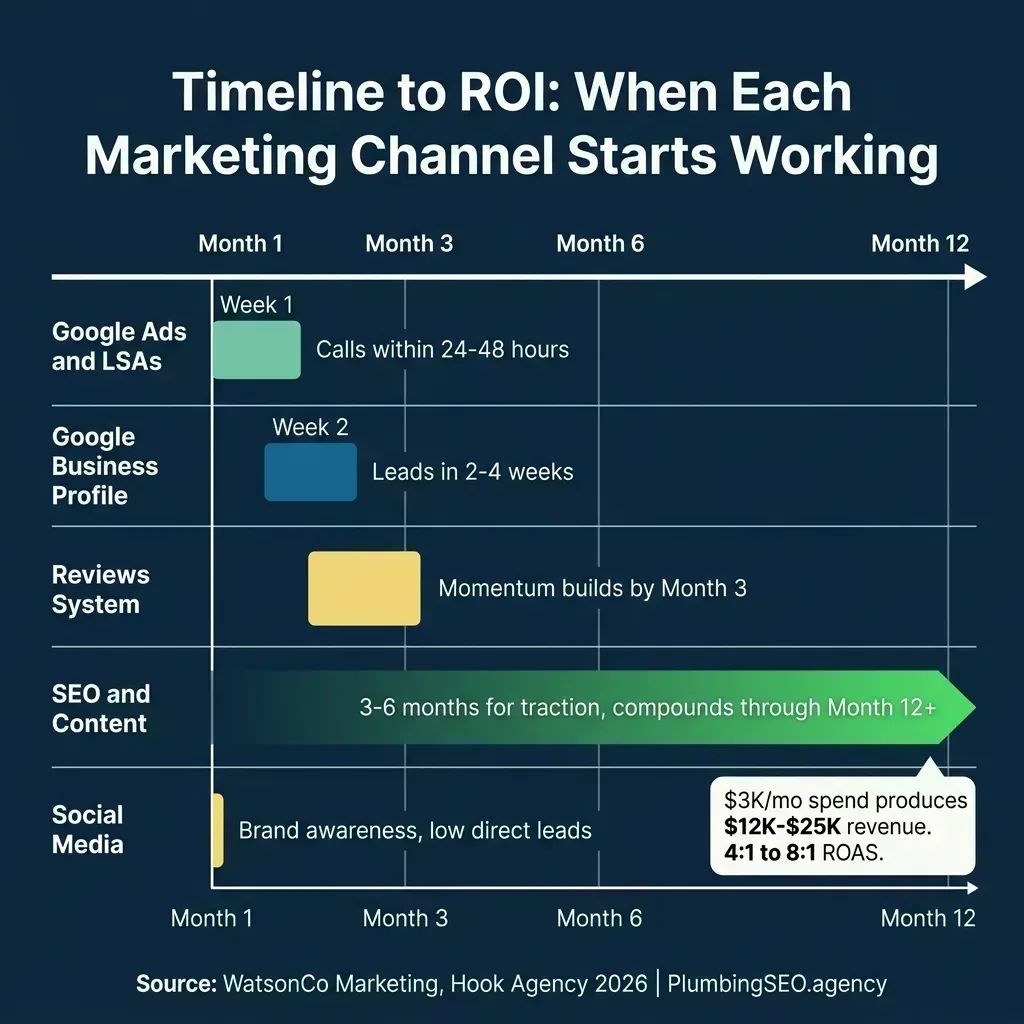
One of the biggest frustrations in plumbing marketing is not knowing how long each channel takes to work. Paid ads produce calls within 24-48 hours. SEO takes 3-6 months for initial traction but compounds through month 12 and beyond. Here is what a realistic timeline looks like:
What to Do This Week
- Audit your Google Business Profile. Most plumbers find 5+ things to fix in 30 minutes. Use our GBP audit checklist.
- Set up Google LSAs if you have not already. About 2 hours of setup. Fully optimize the profile. The difference between a lazy LSA setup and a tight one is 30-40% on CPL.
- Start a review SOP. Every tech asks for a review at point of payment. Send a text with a direct Google review link.
- Check your website on your phone. If it is slow or hard to read, you are losing calls right now.
- Cancel any shared-lead subscriptions you cannot prove a 30%+ close rate from.
Frequently Asked Questions About Plumbing Marketing
How much should a plumbing company spend on marketing?
Most plumbing companies should spend 8-15% of annual revenue on marketing. For a company doing $500,000 per year, that is $3,300-$6,250 per month. Companies in growth mode should lean toward 12-15%. Companies protecting existing market share can maintain at 8-10%. The key is consistency — sporadic spending produces sporadic results.
What is the best marketing channel for plumbers?
Google Business Profile optimization and organic SEO deliver the highest long-term ROI for plumbing companies. GBP drives 35-90 leads per month at near-zero cost when fully optimized. For immediate results, Google Local Service Ads produce calls within 24-48 hours at $20-55 per lead. A strong strategy combines both: paid ads for short-term volume and SEO for long-term compounding.
How long does plumbing SEO take to work?
Google Ads and LSAs produce calls within the first week. SEO takes 3-6 months for initial traction and 6-12 months before it becomes a top-3 lead source. GBP optimization can produce leads in under 2 weeks. By month 12, most plumbing companies see a 4:1 to 8:1 return on their marketing investment when SEO compounds with paid channels.
Are HomeAdvisor and Angi leads worth it for plumbers?
For most established plumbing companies, no. Shared-lead platforms sell the same lead to 3-5 plumbers simultaneously, resulting in 4-8% close rates compared to 30-45% from organic leads. Emergency plumbing callers do not shop — by the time the shared lead reaches you, the customer has already booked someone else. Exception: brand new plumbing companies with zero pipeline who need any leads to start building review velocity.
Should I do Google Ads or Local Service Ads first?
LSAs first. They show higher intent, have capped pricing per lead instead of per click, and appear above traditional Google Ads in search results with the "Google Guaranteed" badge. Once LSAs are saturated in your market, layer on standard Google Search Ads for additional volume. Run both alongside SEO for the best blended cost per lead.
What is a normal cost per lead for plumbing companies?
Blended cost per lead across a healthy channel mix is about $45 for service calls and $50-150 for install leads. Broken out by channel: LSA leads run $20-55, Google Ads leads cost $40-80, organic SEO leads drop to $10-25 once rankings mature, and email campaigns to past customers generate leads at $2-8 each. If your overall CPL is consistently above $80, your channel mix is broken.
When should a plumber hire a marketing agency?
DIY works for the first $5,000 per month in marketing spend. Above that threshold, the opportunity cost of your time plus the technical depth required (LSA bid management, SEO content velocity, GBP optimization at scale) usually means an agency pays for itself. The first agency hire should cover SEO, website, and GBP — the compounding work that is hardest to undo if done badly. See our agency vetting checklist before signing anything.
Stop Guessing. Start Getting Calls.
Our free plumbing SEO audit shows you exactly where your marketing is leaking leads — and which channels will produce the fastest ROI for your specific market. No contracts, no jargon, just a clear action plan.
Run My Free SEO Leak Check