
- AI chatbots and voice agents are recovering $11,800+ per quarter in missed after-hours leads for plumbing companies that install them.
- 58-65% of Google searches now end without a click. If your Google Business Profile is not optimized, you are invisible to most of your market.
- Short-form video, automated review systems, and speed-to-lead workflows are no longer optional. They are the baseline for plumbing companies that want to keep growing.
The Marketing Landscape Is Shifting Under Your Feet
If your plumbing company is still running the same marketing playbook from three years ago, here is the honest truth: the ground has moved. Not a little. A lot.
The U.S. plumbing market hit roughly $169.8 billion in 2026. Revenue keeps growing at a 3.2% CAGR. Demand for emergency plumbing, water heater replacements, and sewer work is not slowing down. But the way customers find, choose, and call a plumber has changed completely.
54% of homeowners now research and hire a plumber in under four hours. 78% of entry-level plumbers use some form of digital technology on the job. And while 550,000 plumber positions are projected to go unfilled by the end of 2026, the shops that figure out marketing are pulling further ahead of the ones that do not.
Here is what the numbers look like right now:
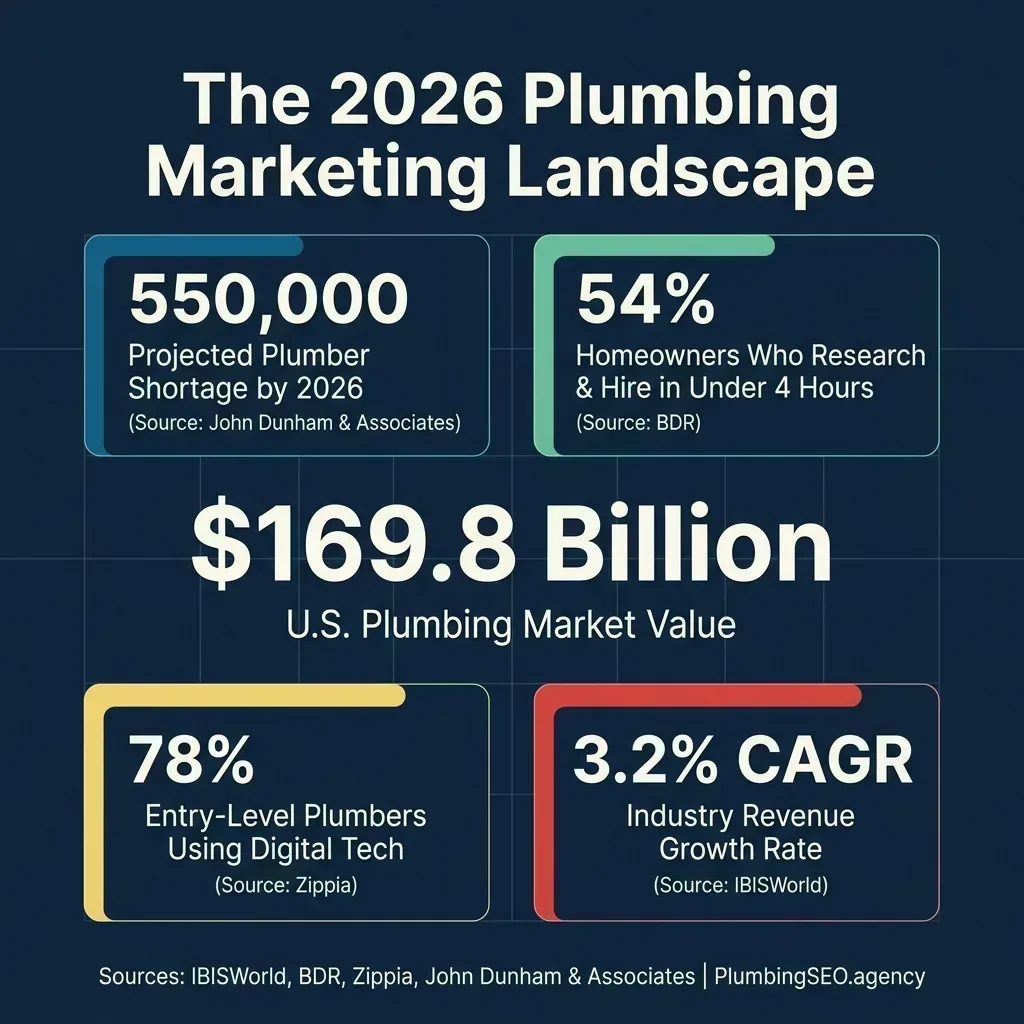
Sources: IBISWorld, BDR, Zippia, John Dunham & Associates
None of this means marketing got harder. It means marketing got different. The tactics that worked five years ago, a nice website and a Yellow Pages ad, are not going to keep the trucks moving in this environment.
So what is actually working right now? Here are seven trends that are reshaping how plumbing companies get found, get trusted, and get calls.
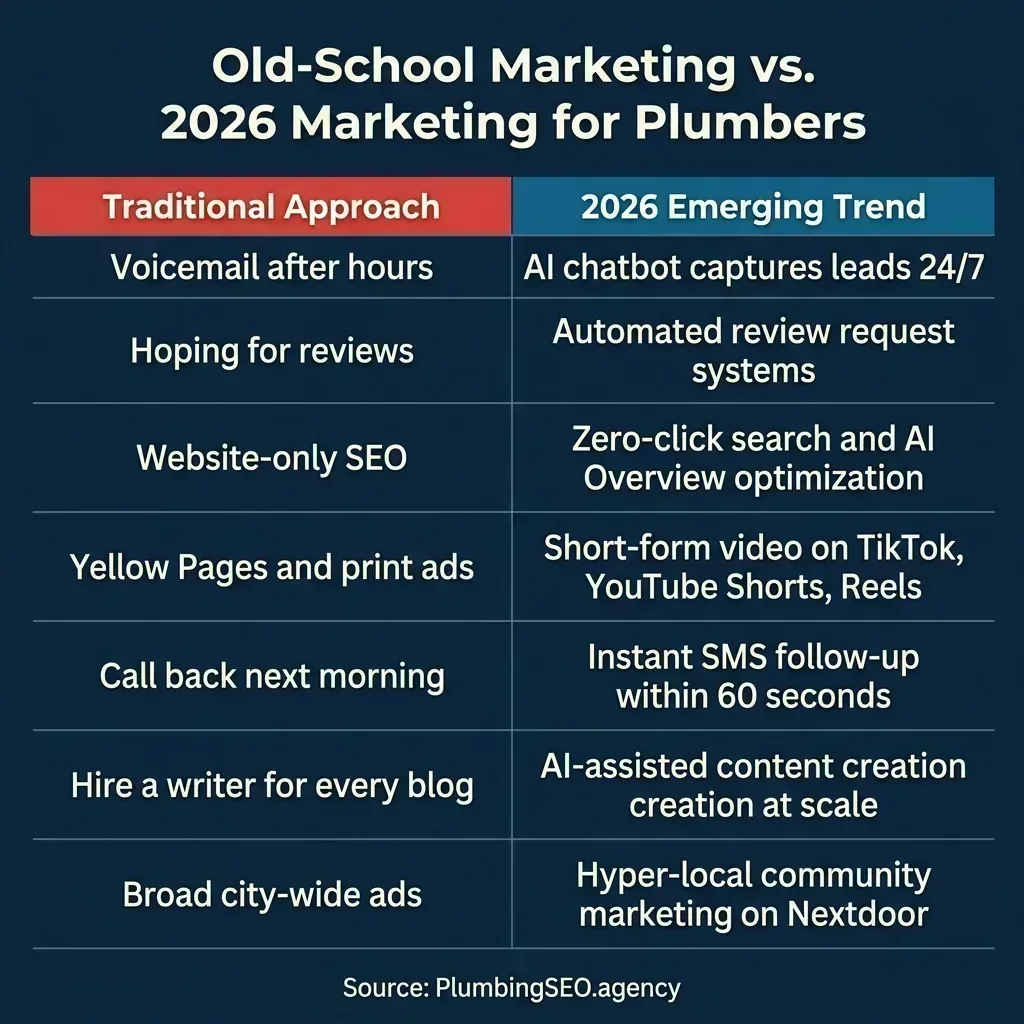
Source: PlumbingSEO.agency
1. AI-Powered After-Hours Lead Capture
This one is the biggest missed opportunity in the industry right now, and most plumbing owners do not even realize it is happening.
According to CallRail's 2026 Home Services report, only 48% of home services businesses respond to after-hours inquiries right away. The other 52%? They wait until the next morning. By then, the customer with the burst pipe has already called someone else and booked the job.
Think about what that means for a plumbing company running Google Ads. You are paying for every click. Every call. And more than half of the evening and weekend calls are going straight to voicemail.
Here is how the new system works:
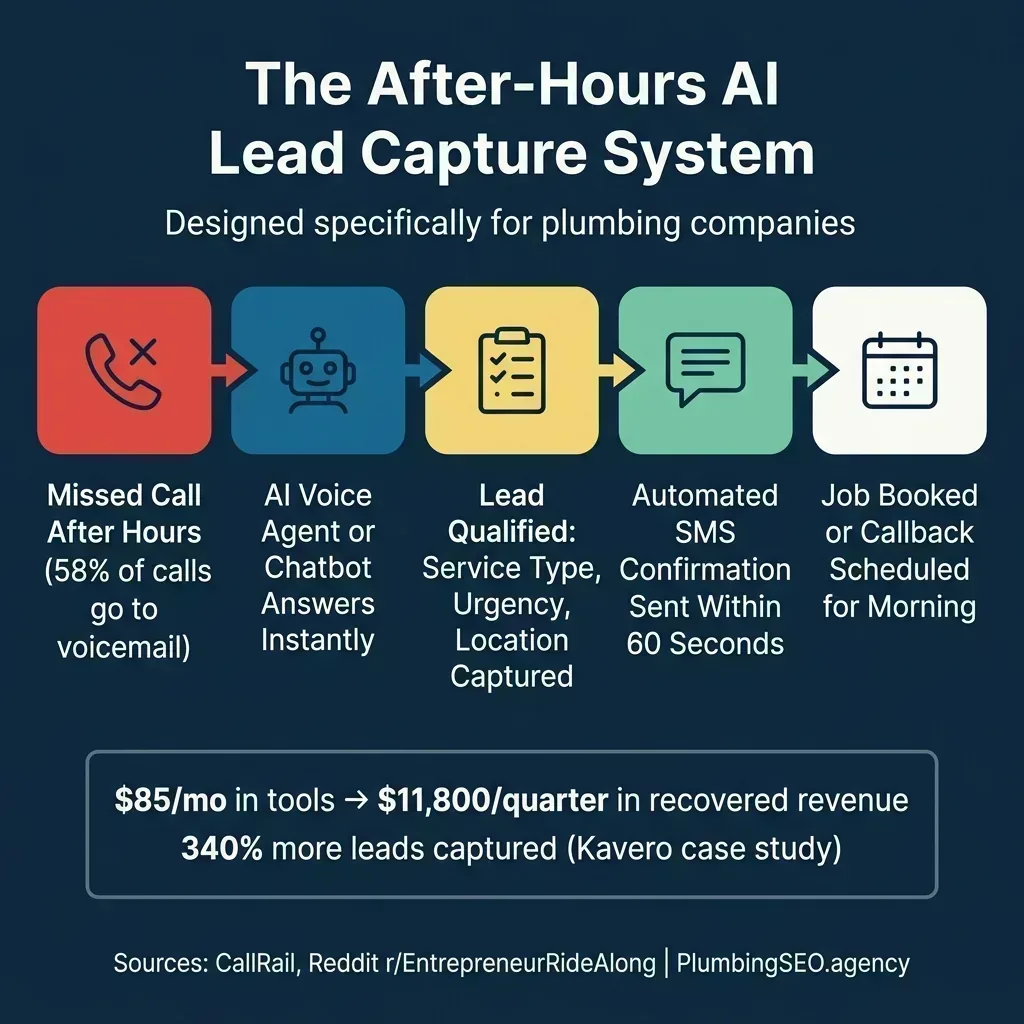
Sources: CallRail, Reddit r/EntrepreneurRideAlong
One plumbing company owner shared on Reddit how an after-hours AI capture system stopped them from losing 60% of their evening calls. The tools cost $85 per month. The recovered revenue hit $11,800 per quarter.
A separate case study from Kavero showed a 340% increase in leads within 90 days after deploying an AI chatbot on a plumbing company's website. The company had been missing 60-80% of after-hours calls before the system went live.
The technology is not complicated. An AI voice agent or website chatbot answers the call or chat, captures the service type and urgency, sends an automated SMS confirmation, and either books the job or schedules a morning callback. The customer feels heard. The lead does not disappear. And you come in Monday to a full list of warm leads instead of a stack of voicemails nobody listens to.
As one Reddit user put it: "A plumber who responds at 9pm when the pipe just burst becomes a hero. One who calls back at 9am the next morning is competing with 3 other quotes."
If you are spending money on ads and not capturing after-hours leads, you are paying for calls and then ghosting them. Fix this first.
2. Short-Form Video Marketing
Short-form video is the fastest-growing content format in marketing right now, and most plumbing companies have not touched it.
According to HubSpot's 2026 Marketing report, short-form video is the top content type used by marketers at 49%, with 75% of marketers now using AI to help create video and image content. That is not a niche trend. That is the mainstream.
For plumbers, the opportunity is wide open because so few are doing it. A one-minute video showing a before-and-after drain cleaning, a quick tip about water heater maintenance, or a walkthrough of a sewer camera inspection does more for trust than a hundred blog posts. People see your face, your truck, your work. That is trust you cannot fake.
The numbers back it up. Video marketing for field service companies delivers 300-400% ROI at modest investment levels. 85% of social media videos are watched without sound, so captions are essential. And the sweet spot for educational short-form content is 45-90 seconds.
One plumber on Reddit described how posting plumbing videos with voiceovers has become his main growth channel: "For context I post plumbing videos, videos of me doing plumbing work and I do voice overs on it and people seem to enjoy it." No fancy editing. No script. Just real work on camera.
Where to post:
- YouTube Shorts for search visibility. YouTube is the second-largest search engine. People search "plumber near me" on YouTube too.
- TikTok for reach. The platform still pushes content to audiences aged 16-34 who are starting to make their own home service decisions.
- Instagram Reels for local community. Pair it with location tags and local hashtags.
- Google Business Profile for direct search impact. You can upload videos directly to your GBP listing and local searchers see them before they even visit your website.
You do not need a production team. A phone, decent lighting, and a 60-second clip of real work is enough to start. Record three videos this week, caption them, and post. See what happens.
3. Zero-Click Search and AI Overviews
This is the trend that is quietly rewriting the rules for every local business, and most plumbing companies have not caught on yet.
According to Semrush's latest research, 58-65% of all Google searches now end without a single click to any website. On mobile, where most homeowners search for plumbers, that number climbs to 75-77%. Industry analysts project the overall rate will exceed 70% by mid-2026.
What does that mean in plain language? Most people searching for a plumber right now never make it to your website. They get their answer directly from Google, whether that is your Google Business Profile listing, an AI Overview summary, or a featured snippet at the top of the results.
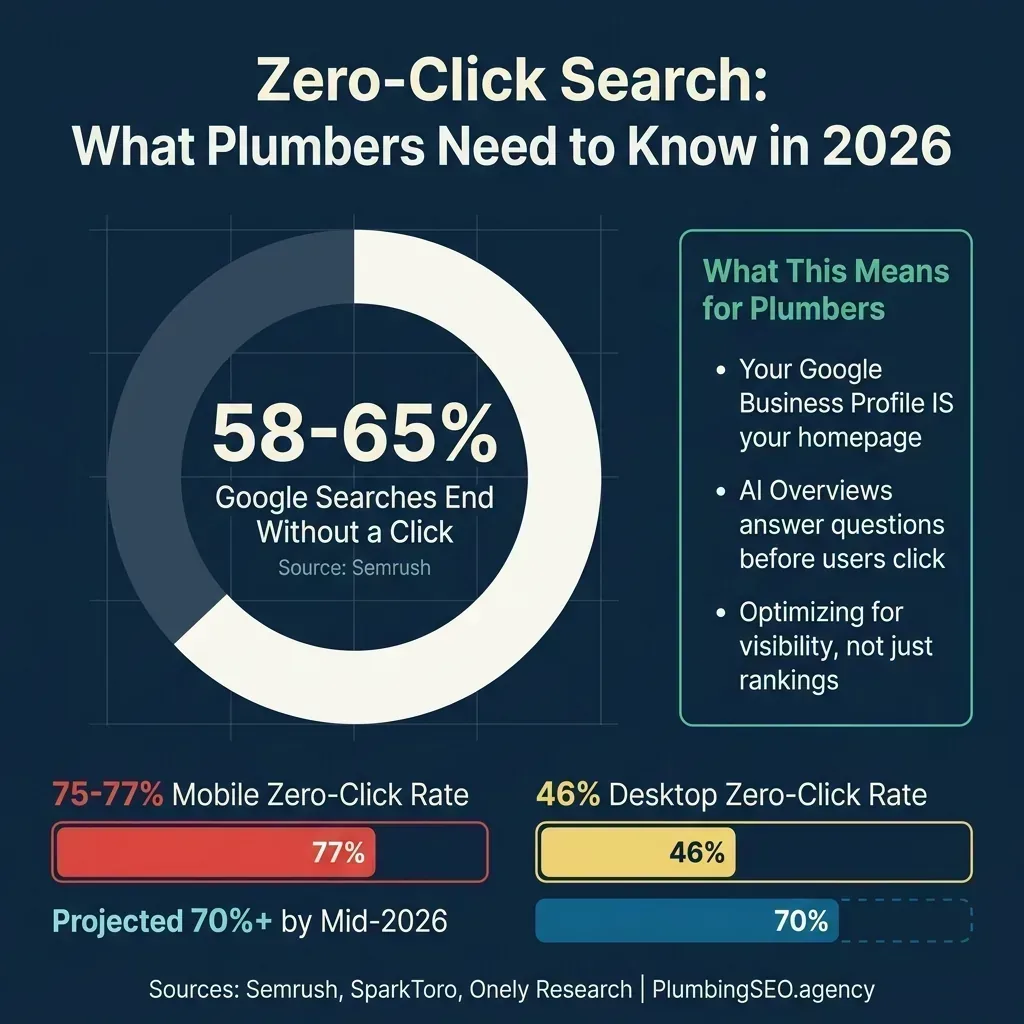
Sources: Semrush, SparkToro, Onely Research
For a plumbing company, this changes the game entirely. Your Google Business Profile is not just a listing anymore. It is your homepage for the majority of potential customers. If your profile has outdated photos, two reviews, and no posts, you are invisible to the people who never scroll past the map pack.
Google's AI Overviews are making this even more pronounced. When someone searches "how much does it cost to fix a leaking pipe," Google now generates an AI summary right at the top. If your website's content is not structured in a way that AI can pull from, you are not part of that conversation. Your competitors are.
The way I see it, optimizing for zero-click is not about giving up on your website. It is about making sure your business shows up in the answer, even when nobody clicks. That means:
- Keeping your Google Business Profile fully optimized with fresh photos, weekly posts, and complete service descriptions.
- Writing content that directly answers common questions so Google can feature it in AI Overviews and snippets.
- Building your review profile aggressively. Reviews show up in zero-click results and directly influence map pack rankings.
- Adding structured data (schema markup) so Google can understand your services, service area, and ratings.
The businesses that treat their GBP like a second website and structure their content for AI are the ones that will keep showing up. Everyone else will wonder why the phone stopped ringing even though they "have a website."
4. Automated Review Generation Systems
Reviews have always mattered. But in 2026, the gap between companies that actively manage reviews and companies that hope for them has become a canyon.
Here is the stat that tells the whole story: only about 6% of customers will write a review on their own. But when you actually ask them, that number jumps to 70%. The difference between a plumbing company with 47 reviews and one with 300+ reviews is almost never about the quality of the work. It is about whether someone asks.
86% of local consumers read online reviews before selecting a service provider. With zero-click search pushing reviews to the surface, your star rating and review count are often the only things a customer sees before they decide to call or keep scrolling.
The smart plumbing companies in 2026 are not leaving this to chance. They are running automated systems:
- Post-job SMS review requests. The tech finishes the job, the customer gets a text within 30 minutes with a direct link to leave a Google review. No friction. One tap.
- QR codes on invoices and business cards. Scan and review in under 10 seconds.
- AI-powered review responses. Tools that draft reply templates for every review, positive and negative, so no review sits unanswered for weeks.
- Review monitoring dashboards. Alerts when a new review drops so you can respond same-day. Google notices response speed.
The companies that maintain a 4.8+ rating with consistent review velocity are the ones that dominate Google Local Service Ads and the map pack. The ones waiting for reviews to happen organically are losing ground every week.
Build the system. Make it automatic. The reviews will follow.
5. Hyper-Local Community Marketing
Broad, city-wide advertising still has its place. But the plumbing companies that are growing fastest in 2026 are the ones that go neighborhood by neighborhood.
Platforms like Nextdoor have become the digital version of word-of-mouth for home services. When a homeowner posts "anyone know a good plumber in South Tampa?" and three neighbors recommend your company, that lead is practically pre-sold before they ever call.
Here is what hyper-local looks like for a plumbing company:
- Nextdoor business presence. Claim your profile, respond to recommendations, and run neighborhood-level ads. These are not expensive, and the intent is extremely high.
- Facebook community groups. Join local homeowner groups, neighborhood groups, and HOA pages. Do not spam them with ads. Answer plumbing questions. Be helpful. The calls come naturally.
- Local sponsorships. Little league teams, community events, charity runs. These generate local backlinks that help SEO, put your name in front of homeowners, and build trust that no ad can buy.
- Neighborhood-specific content. Blog posts like "Our Favorite Projects in [Neighborhood Name]" or "Common Plumbing Issues in Homes Built Before 1980 in [City Area]" show you know the community. That matters.
The difference between a broad Google Ad and a Nextdoor recommendation is trust. One is a company trying to sell you something. The other is your neighbor telling you who to call. In 2026, building those local connections at the neighborhood level is one of the most cost-effective marketing strategies available.
6. Speed-to-Lead Automation
This is not a new concept. But in 2026, the speed gap between the companies that respond fast and the companies that do not has become the single biggest factor in who wins the call.
CallRail's 2026 data shows that 66% of home services businesses say lead follow-up and conversion are their biggest operational challenge, and 57% point to gaps in sales and customer service training. The issue is not that the phone does not ring. It is what happens after it rings.
Here is the reality: after 5 minutes, the booking rate on an inbound lead drops by roughly 80%. A homeowner with a clogged drain at 7pm is not going to wait until tomorrow for you to call back. They are calling the next number on the list.
The plumbing companies pulling ahead in 2026 have built systems that make speed automatic, not dependent on whether someone is available to pick up the phone:
- Instant SMS response. A missed call triggers an automated text within 60 seconds: "Thanks for calling [Company Name]. We got your message. What kind of plumbing issue are you dealing with?" This one message keeps the lead warm while your team catches up.
- CRM-based follow-up workflows. Every new lead enters a pipeline with automatic touchpoints. No lead falls through the cracks because someone forgot to check voicemail.
- Lead scoring by urgency. Emergency calls (burst pipes, sewer backups, no hot water) get flagged and routed immediately. Estimate requests can wait. But both get a response within minutes, not hours.
- Re-engagement sequences for past customers. One contractor shared on Reddit that intentionally re-engaging past leads through automated follow-up closed an additional $200,000 in new business in a single month.
As one home services marketer put it: "The hardest part of follow-up is finding the balance between full automation and human execution. If you automate everything, you are not sure the messaging is landing. If you rely only on people, you lose the consistency that actually converts."
The answer is both. Automate the first response to buy time. Let the human close the deal. Speed-to-lead is not about replacing your team. It is about making sure they never lose a job because the response took too long.
7. AI-Assisted Content and Ad Creation
Most plumbing companies know they should be creating content. Blog posts, social media updates, ad copy, email campaigns. But between running the business, managing the crew, and handling calls, content creation usually falls to the bottom of the list.
That is where AI tools are changing the game for small plumbing businesses in 2026. Not by replacing the owner's voice, but by removing the blank-page problem that stops most content from getting created at all.
Here is how plumbing companies are actually using AI right now, based on what real business owners are reporting:
- Blog post outlines and drafts. One small business owner on Reddit described the process: "I use ChatGPT to write outlines for blog posts, then I write the content and have it grammar and spell check." The AI gets the structure started. The owner adds the real experience and voice.
- Ad copy variations. Instead of writing one Google Ad headline and hoping it works, AI can generate 10 variations in seconds. You test them all and keep the winners.
- Review response templates. Responding to every Google review takes time. AI drafts the response, you edit it for tone, and it goes out same-day.
- Social media captions. Turn a job photo into a post with a caption in under a minute. Consistency matters more than perfection on social.
- Email sequences. Seasonal maintenance reminders, follow-up campaigns, and re-engagement emails can be drafted and automated. This is marketing that runs in the background while you run your business.
The key word is "assisted." AI creates the draft. You bring the experience, the voice, and the knowledge of your customers. The plumbing companies that are winning with AI content are not the ones publishing raw chatbot output. They are the ones using it to get started faster, produce more consistently, and stay visible without hiring a full-time marketing team.
As one contractor put it: "AI is like power tools for your business: fast, effective, but still needs a skilled operator."
Where Does Your Plumbing Company Stand?
These seven trends are not predictions. They are already happening. The plumbing companies adopting them are booking more calls, converting more leads, and building stronger local reputations. The ones waiting are falling behind, even if the quality of their work has not changed.
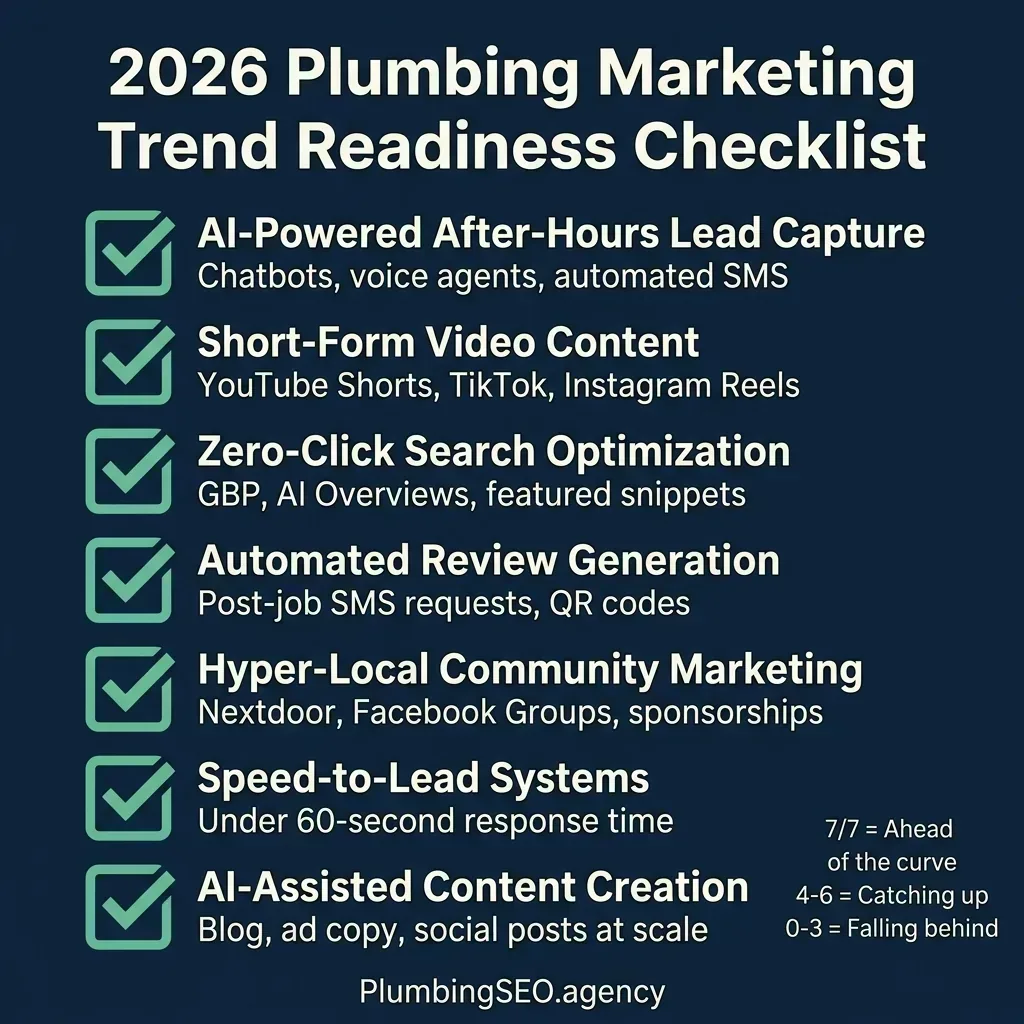
Here is a quick check to see where you stand:
Source: PlumbingSEO.agency
If you checked off most of these, you are ahead of the curve. If you are at three or four, you are catching up but there is work to do. And if you are looking at this list thinking "we do not do any of this," that is actually the most important realization. Because the gap between plumbing companies that adopt these trends and those that do not is only going to get wider.
You do not need to implement all seven at once. Pick the one that plugs the biggest leak in your current marketing. For most shops, that is either after-hours lead capture or automated review requests. Start there. Build the system. Then move to the next one.
The plumbing companies that will thrive in 2026 and beyond are the ones that treat marketing the same way they treat their work: systematically, consistently, and with the right tools for the job.
Frequently Asked Questions
What are the most important marketing trends for plumbers in 2026?
The seven most impactful trends are AI-powered after-hours lead capture, short-form video marketing, zero-click search optimization (including AI Overviews), automated review generation systems, hyper-local community marketing on platforms like Nextdoor, speed-to-lead automation, and AI-assisted content creation. These trends are already being adopted by the fastest-growing plumbing companies and are quickly becoming the baseline for competitive local businesses.
How can AI help my plumbing business get more leads?
AI helps plumbing companies in three primary ways. First, AI chatbots and voice agents capture after-hours leads that would otherwise go to voicemail, with case studies showing up to 340% more leads captured. Second, AI tools can draft blog posts, ad copy, review responses, and social media content much faster than doing it manually. Third, AI-powered CRM systems can score leads by urgency, automate follow-up sequences, and ensure no prospect slips through the cracks.
Is short-form video worth it for a plumbing company?
Yes. Short-form video is the top content format in marketing as of 2026, used by 49% of marketers according to HubSpot. For plumbers, it is especially powerful because so few competitors are doing it. A 60-second before-and-after video of a drain cleaning or a quick plumbing tip builds trust faster than written content. Field service companies report 300-400% ROI on video marketing at modest investment levels. You do not need professional equipment. A phone, decent lighting, and captions are enough to start.
What is zero-click search and how does it affect plumbers?
Zero-click search means a user gets their answer directly from Google without clicking through to any website. Research shows that 58-65% of all Google searches now end without a click, and on mobile the rate is 75-77%. For plumbers, this means your Google Business Profile, reviews, and structured data are often the only things a potential customer sees before deciding to call. Optimizing for zero-click means treating your GBP as a second website and structuring your content so AI Overviews can reference it.
How fast should a plumbing company respond to leads?
As fast as possible, ideally within 60 seconds. After 5 minutes, the booking rate on an inbound lead drops by approximately 80%. CallRail's 2026 data shows that only 48% of home services businesses respond to after-hours inquiries immediately, while 34% wait until the next morning. Setting up automated SMS responses for missed calls and CRM-based follow-up workflows can ensure every lead gets a response within seconds, even when your team is on a job.
How do I get more Google reviews for my plumbing company?
The practical approach is building an automated review request system. Customers rarely leave reviews without a prompt, but review volume usually improves when you ask at the right moment. Set up post-job SMS messages that send a direct Google review link soon after completing a job. Add QR codes to invoices and business cards. Use AI tools to draft response templates so reviews get timely, professional replies. Consistency and automation are the keys to building a strong review profile.
Not Sure Where Your Marketing Is Leaking?
We will run a free plumbing SEO audit and show you exactly where calls, trust, and visibility are slipping. No contracts. No agency jargon. Just honest answers.
Run My Free SEO Leak Check