
- Most plumbing companies pour 80%+ of their marketing budget into Google Ads and SEO while ignoring strategies like past-customer outreach, referral programs, and direct mail that often deliver higher ROI at a fraction of the cost.
- Referral programs generate 4x higher ROI than digital ads, yet fewer than 1 in 5 plumbing companies run a formal one. Direct mail pulls a 4.4% response rate, 37 times higher than email marketing.
- The plumbing companies growing fastest are not spending the most. They are tracking every lead source, marketing to people who already know them, and building systems that keep the phone ringing without chasing fresh leads every month.
The Marketing Blind Spot Most Plumbing Companies Share
Here is what I see over and over again. A plumbing company owner sits down with their marketing person, their agency, or their own gut feeling, and they pick two or three channels. Usually Google Ads, maybe some SEO, maybe a Facebook page that gets updated when someone remembers. Then they pour money into those channels month after month.
The phone rings some. The trucks go out. But the owner never quite feels like the marketing is working. And the frustrating part is, they are probably right.
It is not that those channels are bad. It is that they are only covering part of the picture. The strategies that often deliver the best returns, the lowest cost per lead, the warmest prospects, those are the ones that never make it onto the whiteboard.
One plumber anecdote on Reddit put it simply: "I was spending thousands a month on ads and getting only a handful of decent calls. Then I started texting past customers seasonal reminders and got more work from that one change than the ads gave me all quarter." Treat that as a real-world example, not a universal outcome.
That is not unusual. Here is a look at how these overlooked strategies stack up.
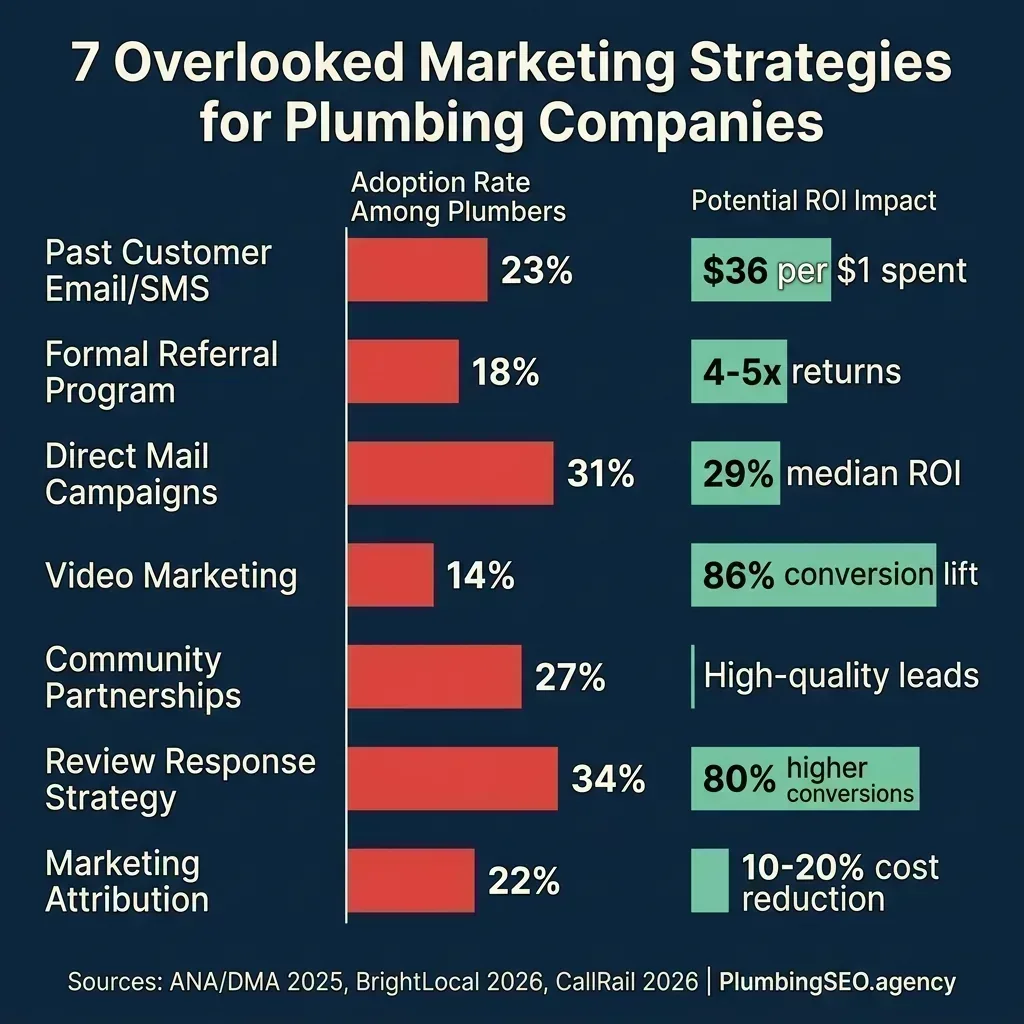
Most of these strategies are used by fewer than a third of plumbing companies, yet they consistently outperform the channels getting the lion's share of budget.
The numbers tell a clear story. The strategies most plumbing companies lean on hardest are not always the ones that pay back the most. And the strategies they skip entirely often cost less, convert better, and bring in the kind of customer who already trusts you before they pick up the phone.
Let us walk through all seven.
1. Marketing to Your Existing Customer Database
This is the one that surprises people the most, because it feels too simple. You already have a list of people who have hired you. Their names are in your CRM, your invoicing software, maybe a spreadsheet someone started three years ago. You have their phone numbers, their emails, their addresses.
And most plumbing companies never reach out to them again.
Think about that for a second. You did good work for someone. They paid you. They were happy. And then you just... disappeared. You went right back to spending $50 or $100 per click trying to find brand new strangers to convince.
Meanwhile, your past customers are sitting there with aging water heaters, dripping faucets they have been ignoring, and a sump pump that has not been checked since you installed it. They already trust you. They already know your name. The only thing missing is a reminder.
Email marketing returns an average of $36 for every $1 spent. For home services specifically, it is high-ROI channels available, because you are not paying to get in front of someone new. You are tapping a relationship that already exists.
Here is what a basic system looks like:
- Seasonal reminders: "Winter is coming. When is the last time someone checked your water heater?" Send that in October and watch the phone ring.
- Annual maintenance nudges: If you installed a tankless unit two years ago, a simple text saying "Time for a flush" costs you nothing and books a job.
- Exclusive past-customer offers: 10% off drain cleaning for existing customers. They feel valued, you fill a slow Tuesday.
You do not need fancy software. A basic email platform and a text messaging tool are enough to start. The point is to stop treating past customers like closed files and start treating them like what they are: the warmest leads you will ever have.
If you are already tracking where your leads come from, you will see this channel light up fast.
2. Running a Formal Referral Program
Every plumber knows word of mouth matters. But there is a big difference between hoping customers mention you to a neighbor and building a system that makes it happen consistently.
Most plumbing companies rely on organic referrals. Someone does a good job, the customer tells a friend, maybe a call comes in. That is nice when it happens, but it is not a strategy. It is luck with good intentions.
A formal referral program turns that luck into a repeatable engine. And the data backs it up.
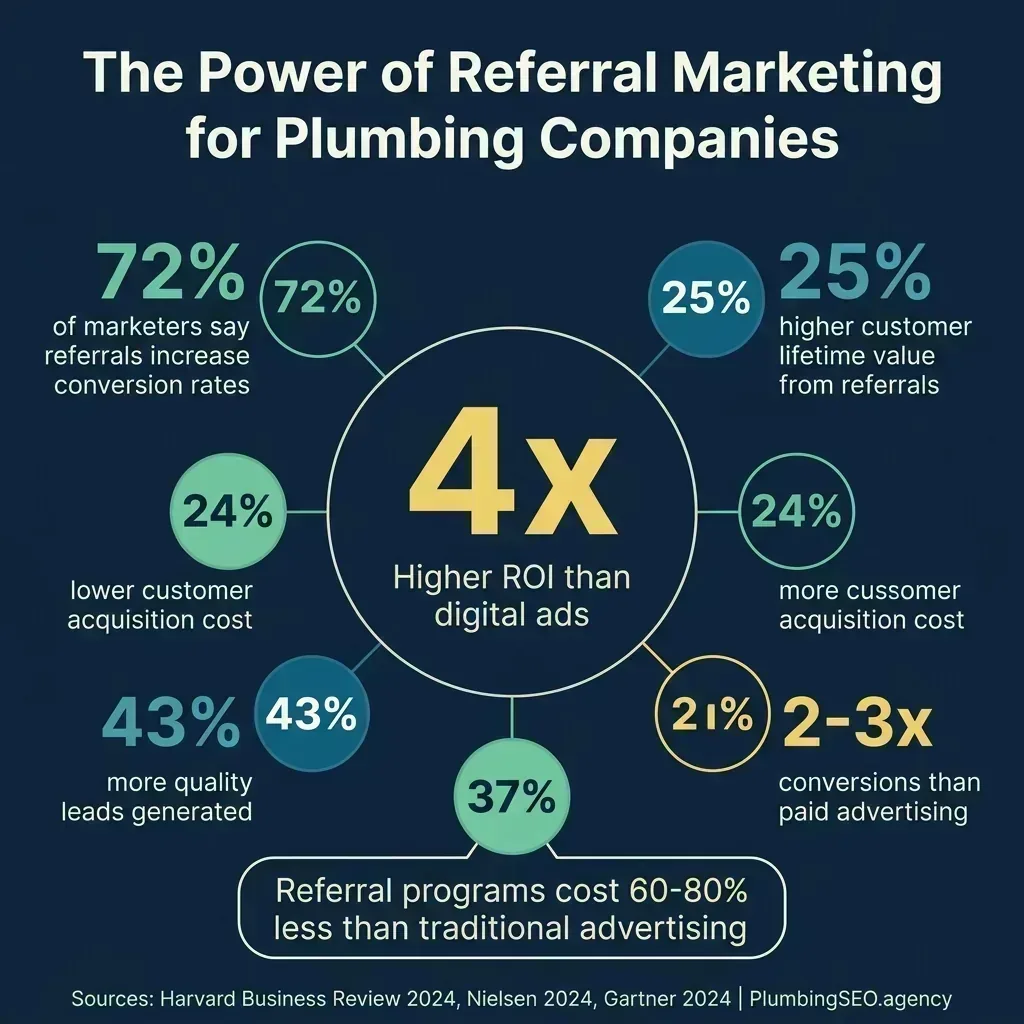
Referred customers spend more, stay longer, and cost less to acquire. The math is hard to argue with.
Here is what stands out: referral programs deliver 4x higher ROI than digital ads, and referred customers have a 25% higher lifetime value. They also cost 60-80% less to acquire than customers from traditional advertising.
Yet fewer than 1 in 5 plumbing companies run a structured referral program. That is a massive gap between what works and what people actually do.
A good referral program does not need to be complicated. Here is a simple framework:
- Offer a clear incentive. $25-$50 off their next service, a gift card, or a credit on their account. Research shows consumers expect a reward of at least $21 or an 11% discount before they will refer.
- Make it easy to share. Hand them a referral card at the end of every job. Text them a link they can forward. The fewer steps, the better.
- Follow up. When a referral comes in, let the original customer know. "Hey, your neighbor called us. Thanks for the recommendation. Here is your $50 credit." That closes the loop and encourages them to do it again.
One Reddit user in r/smallbusiness summed it up: "BNI and word of mouth is the best and cheapest way, but you can't just show up and not put any effort in. Just like you can't start a new marketing channel and not put some work into it."
The effort is real, but it is small compared to the return.
3. Direct Mail in the Digital Age
This one gets dismissed constantly. "Nobody reads mail anymore." "It is a waste of money." "Everything is digital now."
The data tells a completely different story.
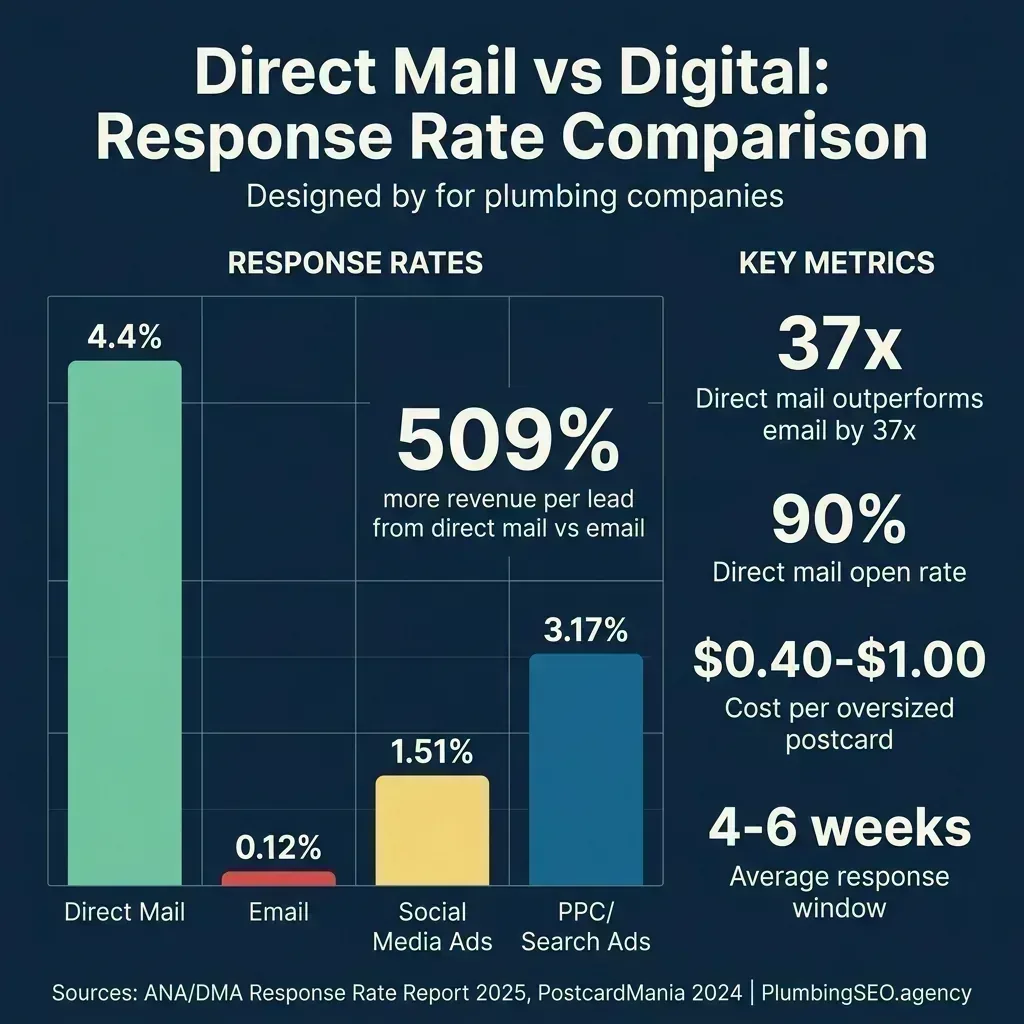
Direct mail's response rate is not slightly better than email. It is 37 times better.
According to the ANA/DMA 2025 Response Rate Report, direct mail pulls a 4.4% response rate compared to 0.12% for email. It generates 509% more revenue per lead. And direct mail open rates can reach 90%, a number email marketers can only dream about.
For plumbing companies, the play is simple: oversized postcards to your service area.
An oversized postcard (6x9 or 6x11) costs $0.40-$1.00 per piece and delivers a 2-4% response rate. Run the math on 1,000 postcards at $0.75 each. That is $750. At a 3% response rate, you get 30 inquiries. Even if only a third of those become booked jobs, you just landed 10 customers for $75 each. Your average plumbing job is probably $300-$500 or more.
Here is what makes it work for plumbers specifically:
- Geo-target your routes. Mail postcards to neighborhoods where you already have customers. You are nearby anyway. The drive time is minimal.
- Seasonal offers. "$50 off water heater inspection before winter" or "Spring drain cleaning special" give people a reason to act now.
- Add a QR code. Link it to a landing page or your Google Business Profile so you can track responses.
- Consistency wins. One mailer does not build a brand. Monthly or quarterly drops to the same areas compound over time. It takes 6-12 months to really see the full effect, but the plumbers who stick with it swear by it.
One plumbing business owner on Reddit said it plainly: "Direct mail is the second best marketing effort you can do. It is just about consistency. It takes 6 months to a year to start working." That tracks with the data. Direct mail is not a quick fix. It is a compounding investment.
And here is the thing most people miss: 84% of Gen Z and Millennials say they value brands that blend technology with physical experiences. Younger homeowners are not anti-mail. They are anti-boring. A well-designed postcard with a clear offer and a QR code? That stands out in a mailbox full of credit card offers.
4. Video Marketing (Even Simple Stuff)
Here is a stat that should get your attention: landing pages with video can boost conversions by up to 86%. Viewers retain 95% of a message when they watch it in video form, compared to just 10% when they read it as text.
And yet, fewer than 15% of plumbing companies produce any kind of video content.
I get why. You are busy. You did not get into plumbing to become a YouTube creator. The idea of standing in front of a camera feels awkward and unnecessary when there are jobs to run.
But video for plumbers does not mean polished, scripted productions. The commonly effective videos in this industry are simple:
- Before and after job clips. 30 seconds. Show the problem, show the fix. Post it on your Google Business Profile, Instagram, or Facebook page. People love seeing the transformation, and it builds trust faster than any written testimonial.
- Quick tips. "Here is how to tell if your water heater is about to fail." 60 seconds, shot on your phone while you are standing next to one. This positions you as the expert and gives people a reason to save your page.
- Customer testimonials. After a good job, ask the homeowner if they would mind saying a few words on camera. Most people are happy to. A 20-second clip of a real person saying "they showed up on time and fixed it right" is worth more than 50 five-star reviews to someone who is on the fence.
- Team and truck introductions. Show your crew. Show your fleet. Show the real people behind the phone number. This is especially powerful for your About page and Google Business Profile.
The key insight here is that video does not replace your other marketing. It makes everything else work harder. A service page with an embedded video converts better than one without. A Google Business Profile with video clips gets more engagement. A social media post with video gets 2-3x more reach than a static image.
You do not need editing software or a production crew. Your phone, good lighting, and a clean job site are enough. The bar is low. Most of your competitors have not even stepped over it yet.
5. Strategic Community Partnerships
When most plumbers think about networking, they think about BNI groups, chamber of commerce lunches, and shaking hands at local events. Those can work, but they are surface-level versions of a much more powerful strategy.
Strategic community partnerships are about building real, ongoing relationships with people who are already talking to your ideal customers. Not one-off handshakes. Real give-and-take partnerships that send work both ways.
Think about who is already in the homeowner's orbit when plumbing comes up:
- Real estate agents. They need reliable plumbers for pre-sale inspections, post-inspection repairs, and recommendations for their buyers. Find 2-3 high-producing agents in your area and become their go-to. One busy agent can send you 5-10 jobs a year without you spending a dime on advertising.
- Property managers. They manage dozens or hundreds of units and need fast, reliable plumbing service. Get on their preferred vendor list and you have a steady pipeline of repeat work.
- HVAC and electrical contractors. When an HVAC tech is on a job and the homeowner mentions a leaky faucet, you want your name to come up. Build referral relationships with complementary trades. You send them work, they send you work.
- Home inspectors. After an inspection reveals plumbing issues, the buyer asks, "Do you know a good plumber?" Be the answer to that question.
- Insurance restoration companies. Water damage claims need plumbers. Get connected with restoration companies in your area and you tap into a steady stream of larger, higher-ticket jobs.
One plumber on Reddit described the approach perfectly: "Find a couple high producing real estate agents and make friends with them. That can have a huge impact on home services."
The beauty of this strategy is that it costs almost nothing. A lunch, a phone call, a commitment to show up on time and do good work. The leads that come from these relationships are pre-qualified and warm. The homeowner already trusts the person who recommended you. That means less selling, less price shopping, and more booked jobs.
This also feeds directly into your local backlink strategy. Partnerships with real estate companies, chambers, and supplier directories often come with a link back to your website, which helps your SEO at the same time.
6. A Real Review Response Strategy
Most plumbing companies know reviews matter. Ask any plumber and they will tell you they want more five-star reviews. Some have even set up a system to ask for them after every job. That is good. But it is only half the picture.
The part almost everyone skips? What happens after the review is posted.
According to BrightLocal research cited by CallRail, businesses that respond to at least 32% of their reviews see an 80% higher conversion rate compared to businesses that reply to just 10%. And 88% of customers say they are more likely to choose a business that responds to all feedback, both positive and negative.
That is not a small difference. That is a massive competitive advantage hiding in plain sight.
Here is the thing: potential customers are not just reading your reviews. They are reading your responses. They want to see how you handle a complaint. They want to see if you are engaged, professional, and accountable. A thoughtful response to a negative review often does more for your reputation than ten unanswered five-star reviews.
A solid review response strategy looks like this:
- Respond to every review within 24-48 hours. Positive or negative, every single one. Thank people for positive feedback. Address concerns in negative ones.
- Be specific, not generic. "Thanks for the great review!" is better than nothing, but "Thanks for choosing us for the water heater install, Mike. Glad everything is running smoothly" shows you actually care.
- Handle negative reviews with accountability. Do not get defensive. Acknowledge the issue, explain what happened if appropriate, and offer to make it right. The next customer reading that response is deciding whether to call you or your competitor right now.
- Set up Google Alerts for your company name so you catch reviews and mentions across platforms, not just on Google.
Consumers now spend an average of 13 minutes and 45 seconds reading reviews before deciding to trust a local business. That is nearly a quarter of an hour where your review responses are doing the selling for you. Or not.
If you want a deeper dive into the mechanics, our guide on how to respond to negative Google reviews includes ready-to-use templates that keep things professional without sounding robotic.
7. Actually Tracking What Works (Marketing Attribution)
This is the strategy that ties everything else together. And it is the one most plumbing companies get completely wrong, or skip entirely.
Here is the honest truth: if you cannot tell me exactly how many calls came from your Google Ads, how many came from your Google Business Profile, how many came from referrals, and how many came from past customers, you are flying blind. You are spending money on marketing without knowing which dollars are actually bringing in jobs.
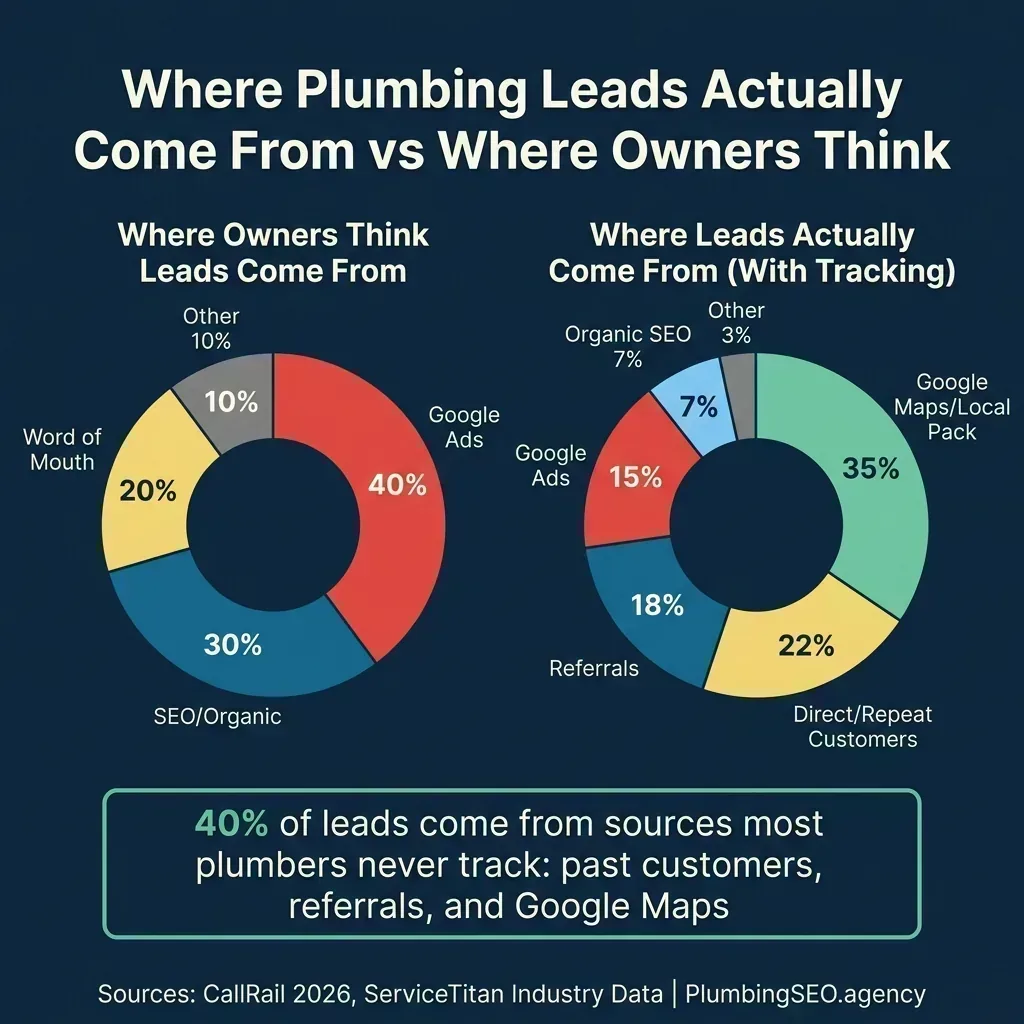
Without tracking, most plumbing owners dramatically overestimate how much their paid ads contribute and underestimate how many leads come from Maps, referrals, and repeat customers.
The gap between perception and reality can be significant. When plumbing companies start tracking properly, they often discover that a meaningful share of leads come from sources they were not measuring well: Google Maps, direct/repeat customers, and referrals.
That changes everything. Because now instead of dumping more money into ads hoping for more calls, you can invest in the channels that are actually performing, and stop wasting money on the ones that are not.
According to CallRail's 2026 data, home services businesses that use call tracking reduce their cost per lead by 10-20%. They also see a 7% increase in lead-to-close rates, because understanding what is said on the phone helps them train their team to convert better.
Here is what basic attribution looks like for a plumbing company:
- Call tracking. Use dynamic number insertion or dedicated tracking numbers for each channel. Google Ads gets one number, your website gets another, your postcards get a third. Now you know exactly where every call originates. Check our complete call tracking guide for plumbers or compare call tracking platforms for plumbers to find the best fit.
- Google Business Profile Insights. This is free and built in. Check how many calls come through your GBP listing, how many people request directions, and how many click to your website.
- Ask every caller. "How did you hear about us?" is the simplest attribution tool there is. Have your team ask and record it. The answers will surprise you.
- Monthly review. Sit down once a month, look at where leads came from, and compare it to what you spent. If Google Ads cost you $3,000 and brought in 15 calls, and your past-customer email campaign cost you $50 and brought in 12 calls, the math speaks for itself.
The plumbing companies that grow steadily are not necessarily the ones that spend the most on marketing. They are the ones that know exactly which marketing dollars are turning into booked jobs, and they keep adjusting until the numbers make sense.
As one industry expert put it: "The report may look good, but the phone tells the truth." If your agency sends you a beautiful report showing impressions and clicks but you cannot connect those numbers to actual calls and jobs, something is broken. And if you need help figuring out what those reports actually mean, our plain-English guide to reading Search Console reports is a good place to start.
Where to Start
You do not need to implement all seven of these at once. That is a fast way to burn out and do none of them well.
Here is the priority I would suggest, based on what gives you the quickest return with the least effort:
- Start responding to every review today. This costs nothing and the impact on conversions is immediate.
- Set up basic call tracking. You cannot improve what you do not measure. Even asking "How did you hear about us?" on every call is a start.
- Send one email or text to your past customers this month. A seasonal maintenance reminder or a simple "We appreciate your business" with a small discount. See what happens.
- Build one community partnership this quarter. Take a local real estate agent to lunch. Drop off cards at a property management office. Plant one seed.
- Shoot one video this week. Before and after. 30 seconds. Post it on your Google Business Profile.
- Create a referral card. Hand one to the next happy customer and see if it comes back.
- Plan a postcard drop for next month. Pick one neighborhood, one offer, 500 postcards. Test it.
The plumbing companies that are growing the fastest right now are not spending the most money. They are covering more bases. They are marketing to the people who already know them. And they are tracking every lead so they know exactly where to put the next dollar.
That is not complicated. It just takes a little effort in places most owners are not looking yet.
Frequently Asked Questions
Start with what costs nothing: respond to every Google review, ask happy customers for referrals, and post before-and-after photos on your Google Business Profile. These three actions build trust and visibility without spending a dollar on ads. Once you have budget, high-ROI channels for plumbers are past-customer email/SMS outreach ($36 return per $1 spent), a formal referral program (4x ROI vs digital ads), and geo-targeted direct mail postcards (4.4% response rate). Focus on one channel at a time, measure the results, then add the next.
Many successful plumbing companies treat marketing spend as a percentage of revenue, but the exact percentage matters less than attribution and return. A plumber spending across several channels with proper tracking can often outperform one spending heavily on one channel with no tracking. Start by measuring cost per booked job for each channel, then shift dollars toward whatever is working best.
Yes, and the data strongly supports it. Direct mail has a 4.4% response rate compared to 0.12% for email, making it 37 times more effective by response rate. It generates 509% more revenue per lead than email. For plumbing companies, oversized postcards ($0.40-$1.00 per piece) with seasonal offers and a QR code, mailed consistently to neighborhoods in your service area, can deliver a strong ROI. The key is consistency. It takes 6-12 months of regular mailings to build recognition, but the compounding effect is real.
Move from hoping for referrals to building a system. Offer a clear incentive ($25-$50 off next service or a gift card), hand referral cards to every customer at the end of a job, and follow up when a referral comes in to thank the person who sent it. Research shows consumers expect at least a $21 reward or 11% discount before they will actively refer. Building partnerships with real estate agents, property managers, and complementary trades (HVAC, electrical) also creates a steady referral pipeline that does not depend on individual customers remembering to mention your name.
Keep it simple. Useful plumber videos include before-and-after job clips shot on a phone, quick maintenance tips, customer testimonials, and team or truck introductions. Video can improve landing-page engagement and social reach, but results vary by audience, production quality, and promotion. You do not need editing software or a production crew. Your phone and a clean job site are enough.
Use a combination of call tracking numbers (a different number for each channel: ads, website, postcards), Google Business Profile Insights (free, built-in), and simply asking every caller "How did you hear about us?" Home services businesses using call tracking reduce cost per lead by 10-20% and see a 7% improvement in close rates. Review your numbers monthly, comparing spend to leads per channel. This reveals where your money is actually working and where it is being wasted, so you can redirect budget to what drives real booked jobs.
Not Sure Which Marketing Channels Are Actually Working?
We will audit your plumbing company's online presence, show you where leads are leaking, and build a plan that covers the bases most shops miss. No contracts. No jargon. Just a clear picture of what to fix first.
Run My Free SEO Leak Check