
- Google Business Profile is day-one priority. It is free, it is the fastest path into the Map Pack, and it is where 44% of local service clicks go.
- Budget $2,250 to $5,200 per month across LSAs, SEO, and a solid website. Most plumbing companies spend 8 to 15% of revenue on marketing.
- Speed-to-lead beats everything. The plumber who responds in under 30 seconds books the job 78% of the time. The one who calls back after lunch loses it.
Why This Post Exists
We get this question a lot. "If you had to start a plumbing company from scratch, what would you actually do for marketing?"
Not what sounds good on a webinar. Not what looks impressive on a sales deck. What would you actually spend your time and money on, week by week, if the phone was quiet and the schedule was empty?
So we sat down and mapped it out. Every priority. Every dollar. Every decision. From the morning you file the LLC to the day the schedule is full enough that you have to start thinking about hiring help.
This is the 90-day marketing playbook we would follow. It is built on real data, real cost benchmarks, and lessons from working with plumbing companies that started exactly where you are now.
The 90-Day Framework: Foundation, Fuel, Compound
Here is how we think about the first three months. Not as a single sprint, but as three phases that stack on top of each other.
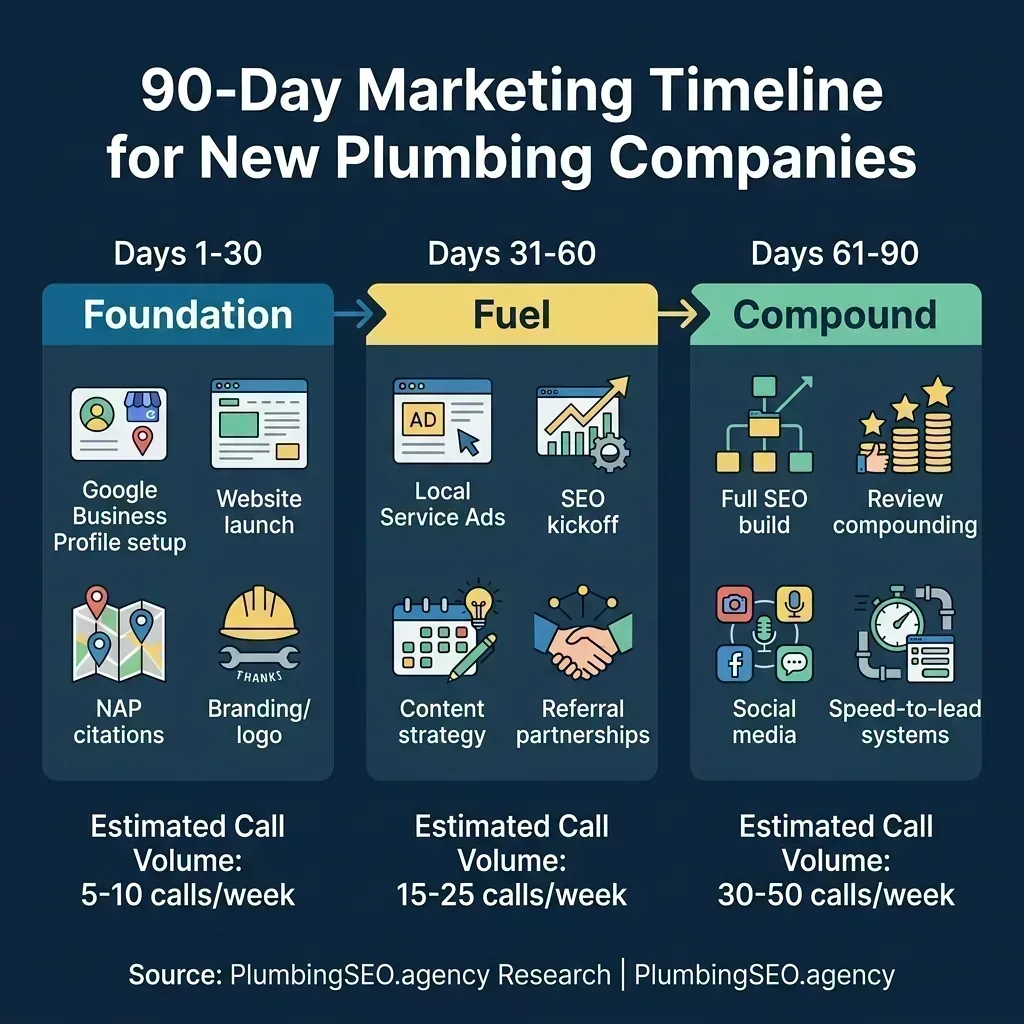
The three phases of startup plumbing marketing, each building on the last.
The math is simple. Days 1 through 30 are about getting the foundation right so Google even knows you exist. Days 31 through 60 are about pouring fuel on those foundations with paid channels and partnerships. Days 61 through 90 are where everything starts to compound, where organic SEO, reviews, and word of mouth begin stacking on top of your paid efforts.
Most new plumbing companies skip straight to "run some ads" without ever laying the foundation. That is like sending a truck to a job site without tools in the back. You will get there, but you will not get much done.
What This Actually Costs: The Startup Marketing Budget
Before we get into the week-by-week breakdown, let us talk money. Because every plumber we have worked with asks the same question: "How much do I actually need to spend?"
The industry benchmark is 8 to 15% of revenue on marketing. For a startup that has not generated revenue yet, that number does not mean much. So here is what we would actually budget.
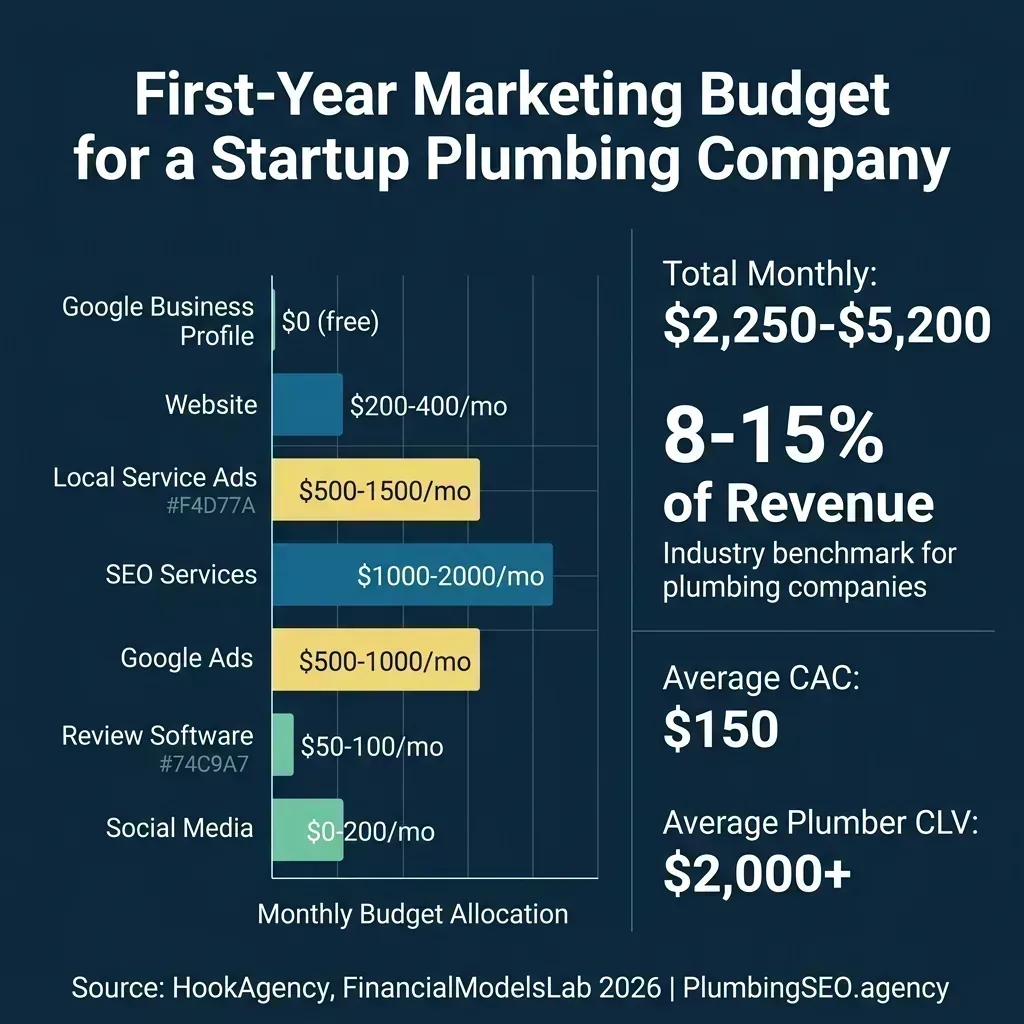
How a startup plumber should allocate marketing dollars each month.
One number worth paying attention to: the average customer acquisition cost for a new plumbing company is about $150. That means for every $150 you put into marketing, you should be getting one new customer. And since the average plumbing customer is worth $2,000 or more over their lifetime (repeat calls, referrals, maintenance), that $150 is not a cost. It is an investment that pays back more than ten times over.
A plumber on Reddit put it this way: "I'd say most plumbing companies invest between 5% to 15% of their revenue into marketing. A company bringing in $10k a month could invest 10% or more to help scale." That tracks with what we see across our clients.
Days 1 to 30: The Foundation
The first month is not glamorous. Nobody is going to make an Instagram reel about setting up your Google Business Profile. But this is the work that makes everything else possible.
Week 1: Google Business Profile (Day 1, No Excuses)
This is one of the most important thing you will do in your first week. Not your website. Not your business cards. Your Google Business Profile.
Here is why: the Google local 3-Pack captures 44% of all clicks for local service searches. That is nearly half of all the people searching for a plumber in your area, clicking on one of three businesses. If you are not one of those three, you are fighting over scraps.
What to do on day one:
- Claim and verify your profile. Use "Plumber" as your primary category. Add secondary categories like "Drain Cleaning Service" and "Water Heater Installation Service."
- Set service areas, not a physical address. You go to your customers. Adding service area towns instead of a street address means you show up for searches across those areas.
- Fill out every single field. Business hours, services offered, a 750-character description packed with your services and cities. Businesses with a complete profile get 7x more clicks than incomplete ones.
- Upload real photos. Not stock images. Your truck, your tools, finished jobs. Plan to add new photos every week.
Week 1 to 2: Get a Real Website Up
Your website does not need to be fancy on day one. It needs to work. That means:
- A click-to-call button on every page (most homeowners are searching on their phones)
- Service pages for your core offerings: drain cleaning, water heater repair, leak detection, emergency plumbing
- Your service areas listed clearly
- Your license number displayed prominently
- Mobile-friendly design that loads in under 3 seconds
As one web developer on Reddit who works with plumbing companies put it: "If you have a bad website with poor scores, it may struggle to rank well on Google and people may struggle to convert to customers." He is right. You can test your site's performance with Google's PageSpeed tool. A score below 80 is a problem.
Week 2 to 3: NAP Citations and Directory Listings
NAP stands for Name, Address, Phone. And it needs to be identical everywhere. Google cross-references your business information across the internet, and inconsistencies hurt your credibility.
Start with the top 20 directories that matter most for plumbers: Google, Bing Places, Yelp, Angi, HomeAdvisor, Thumbtack, BBB, Facebook, Nextdoor, Apple Maps. These are the ones Google actually pays attention to.
Week 3 to 4: Set Up Your Review Machine
Reviews are not something you get around to later. They are marketing infrastructure you build from day one. Every single job you finish should end with a review request.
Here is the system that works:
- Finish the job. Make sure the customer is happy.
- Text them a direct link to your Google review page within 30 minutes of completing the work.
- Follow up with a thank-you message the next day if they have not left one yet.
One plumber on Reddit shared that after implementing a tree-planting review program ("we plant a tree for every review"), they collected over 2,000 reviews. Their Google Business Profile became their single biggest driver of sales. You do not need a gimmick, but you do need a system.
Aim for 30 to 60 reviews in the first 90 days. That is the competitive threshold for showing up in the Map Pack in most markets.
Days 31 to 60: Pouring Fuel
By now your Google Business Profile is live, your website is working, and you have a few reviews starting to come in. The foundation is set. Now it is time to spend some money in the right places and start building relationships that bring work through the door.
Week 5: Turn On Local Service Ads
If you only run one paid channel as a new plumbing company, make it Google Local Service Ads. Here is why.
LSAs sit at the very top of Google search results, above regular ads, above organic listings. They come with the "Google Guaranteed" badge. And you only pay when a customer actually contacts you, not when someone clicks your ad and then leaves.
The numbers tell the story. Here is how cost per lead compares across marketing channels for plumbers in 2026:
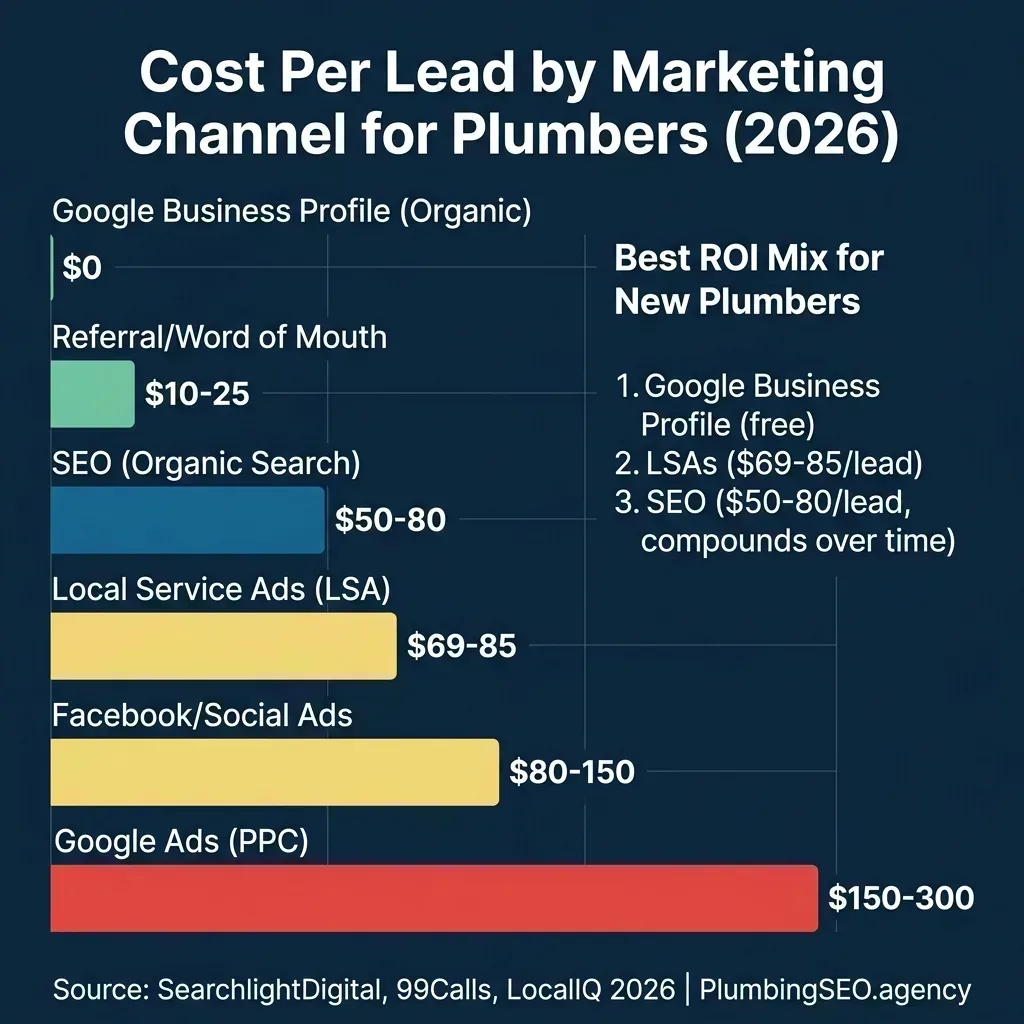
Not all marketing channels are created equal. LSAs consistently deliver the best paid ROI for local plumbers.
At $84 per lead on average, LSAs are roughly half the cost of traditional Google Ads for plumbers. And because LSA leads are phone calls, not website clicks, the conversion rate is significantly higher. You are talking to someone who already wants to hire a plumber, not someone browsing blog posts.
In my opinion, LSAs are the best "buy time" play for a new plumbing company. They fill the gap while your organic SEO builds. The leads come in fast, and you can scale your budget up or down weekly based on how full your schedule is.
Week 5 to 6: SEO Kickoff (The Long Game Starts Now)
Here is where most new plumbers make a mistake. They see that SEO takes 3 to 6 months to deliver results and decide to "do it later." That is backwards. SEO compounds. The sooner you plant the seeds, the sooner you harvest.
What we would prioritize in month two:
- Service pages with real keyword targeting. Not just "Drain Cleaning" as a page title. "Drain Cleaning in [Your City]" with pricing context, FAQs, and trust signals.
- City pages for your top 3 to 5 service areas. Each one unique, each one targeting "[Service] + [City]" keywords.
- Schema markup. LocalBusiness, Service, FAQ, and Review schema. This is the technical stuff that helps Google understand exactly what you do and where you do it.
- Technical SEO basics. Sitemap submitted to Google Search Console, robots.txt configured, page speed optimized, mobile responsiveness verified.
The way I see it, SEO is the only marketing channel where your cost per lead actually goes down over time. LSAs and Google Ads cost the same next month as they do today. But a service page that ranks organically? That page brings in calls month after month without costing you another dollar.
Week 6 to 7: Build Referral Partnerships
This is the part most marketing guides skip, and it is a high-ROI activities for a brand-new plumbing company.
Talk to people in adjacent trades. HVAC contractors, electricians, general contractors, property managers, real estate agents. These people run into plumbing problems all the time and need someone reliable to send their customers to.
One Reddit user nailed this approach: "Go out to real estate agent offices and offer services. They usually know people who have portfolios. Go to local hotels during the day when the GM is there. Talk to businesses and see what their issues are." That is old-school, face-to-face networking, and it still works better than most digital marketing for building early pipeline.
Another angle worth exploring: water damage restoration companies. When they get a 1 AM call about a burst pipe, they need a plumber to send. Being their go-to referral is steady, high-margin work.
Week 7 to 8: Content That Builds Trust
You do not need to become a blogger. But you do need content that proves you know what you are doing.
Start with three types of content:
- Before-and-after photos on your GBP. Post them weekly. It takes 10 minutes and keeps your profile active in Google's eyes.
- A blog post answering your most common customer question. "How much does it cost to unclog a drain in [Your City]?" This is the content that ranks for long-tail searches and brings in qualified leads while you sleep.
- Short video clips of jobs. You do not need professional production. A 30-second clip of a drain camera inspection or a before-and-after of a water heater install builds more trust than any marketing copy ever will.
Remember: 94% of all web pages get zero traffic from Google. The goal is not to publish content for the sake of it. The goal is to publish content that answers real questions from real homeowners in your service area.
Days 61 to 90: The Compound Effect
This is the phase where things start to click. Your GBP is getting reviews. Your service pages are getting indexed. Your LSAs are generating calls. Now the job is to make all of those pieces work together and start building momentum that feeds itself.
Week 9 to 10: Speed-to-Lead Systems
Here is the problem nobody talks about. You can have the best marketing in the world, and if you do not pick up the phone fast enough, none of it matters.
A plumber on Reddit shared this story: he was losing 70% of his leads simply because he could not respond fast enough. His booking rate sat at 10 to 15%. Then he set up an automated system that texts leads within 30 seconds of contact. His booking rate jumped to 45%. Same skills. Same truck. Same pricing. The only thing that changed was response time.
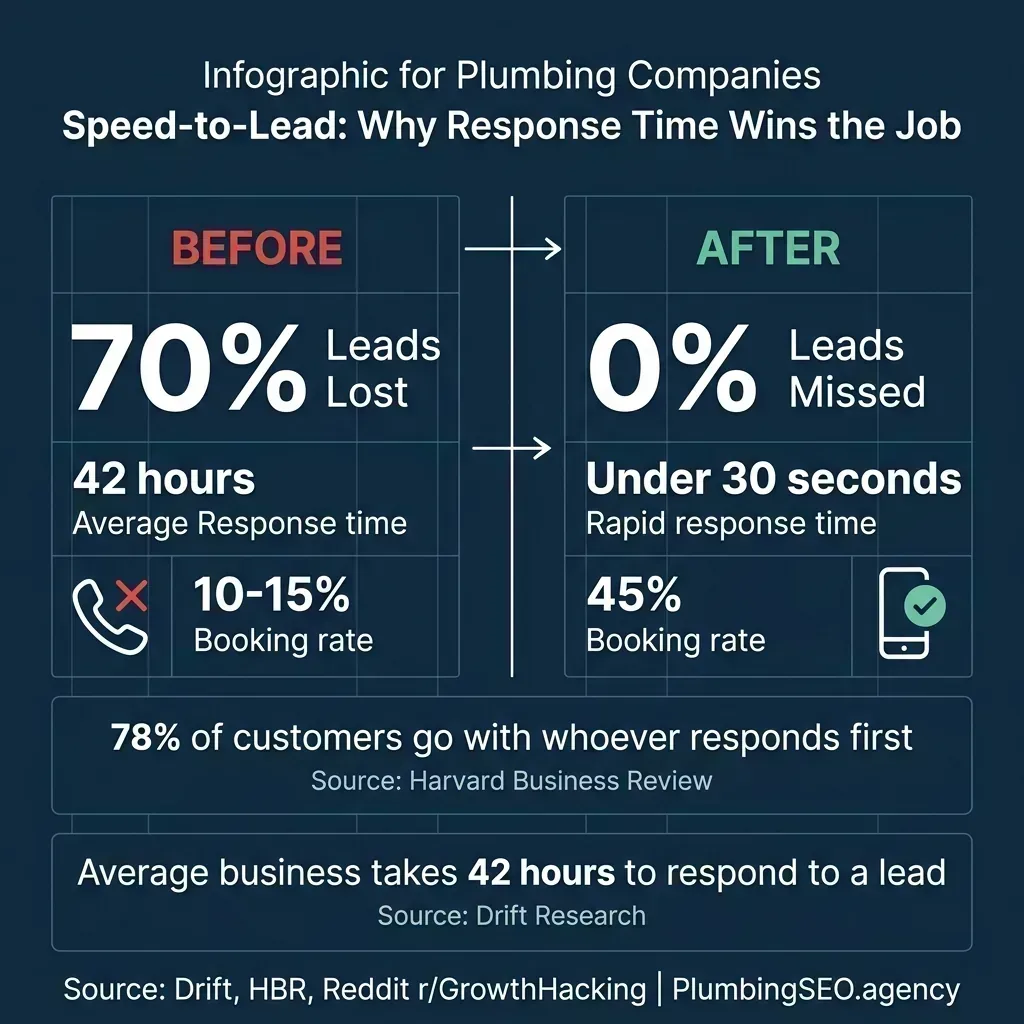
The fastest plumber to respond often wins the job. That is not opinion. That is data.
According to Harvard Business Review, 78% of customers go with whoever responds first. And Drift research shows the average business takes 42 hours to respond to a lead. For emergency plumbing, even 30 minutes is too late. The homeowner with a burst pipe at 10 PM is not waiting for you to check your voicemail over breakfast.
What to set up:
- Missed-call text-back. If you cannot answer, an automated text goes out within seconds: "Thanks for calling [Your Company]. We got your message and will call you back in the next 5 minutes."
- Online booking. 70% of consumers prefer booking services online. Give them a way to schedule a visit without waiting for you to call back.
- Call tracking. You need to know where every call is coming from. Is it your GBP? LSAs? Your website? Without this data, you are guessing which marketing is working.
Week 10 to 11: Review Compounding and Social Proof
By day 60, you should have 20 to 40 reviews if you have been consistent with asking. Now is when that investment starts paying compound interest.
Google's local ranking algorithm weights three things heavily: relevance, distance, and prominence. Reviews are the single biggest prominence signal. More reviews, more recent reviews, and reviews that mention specific services ("great water heater installation") all push you higher in the Map Pack.
This is also the time to start sharing your best reviews on social media. Screenshot a 5-star review, post it on Facebook and Instagram with a thank-you note. It takes 2 minutes and it does two things at once: builds social proof and keeps your social profiles active.
Week 11 to 12: Double Down on What Is Working
By the end of month three, you should have enough data to see what is actually driving calls. This is where you stop guessing and start optimizing.
Look at your call tracking data. Which channel is bringing the most calls? Which calls are converting to booked jobs? Which service areas are generating the most demand?
Common patterns we see at the 90-day mark:
- LSAs are usually the top performer for new companies. If they are working, increase the budget.
- GBP is generating organic calls. If you see calls coming through your Maps listing, that is your reviews and profile optimization paying off.
- Certain service areas outperform others. Double down on city pages and LSA targeting for those high-performing areas.
- Emergency keywords convert best. "Emergency plumber [city]" often has the highest conversion rate. Make sure your website and ads are targeting these terms.
What We Would NOT Do in the First 90 Days
This is just as important as what we would do. In the first 90 days, here is what we would skip:
- Billboards and print ads. You cannot track them, you cannot measure them, and they are expensive. Save them for when you have a budget you can afford to experiment with.
- Broad Google Ads. At $183 average cost per lead for non-branded plumbing PPC, regular Google Ads are too expensive for a startup without a proven conversion funnel. LSAs at $84 per lead are a better bet until you have the data to optimize PPC effectively.
- Social media advertising. Organic social is fine (post your work, share reviews). But paid Facebook or Instagram ads are not where plumbing customers go when they have a leak. That money is better spent on channels with intent, people who are actively searching for a plumber.
- Fancy branding projects. A clean logo and professional website, yes. A $10,000 rebrand with custom truck wraps? That can wait until you have steady cash flow.
- SEO agencies promising first-page rankings in 30 days. If someone guarantees that, they are either lying or using shortcuts that will get your site penalized. Real SEO takes 3 to 6 months to show results and 9 to 12 months for the full effect. Anyone who tells you otherwise is not being honest.
The Honest Truth About the First 90 Days
Let us be straight with you. The first 90 days are hard. The phone will not ring every day. Some weeks you will wonder if the marketing is even working. That is normal.
Here is what we have seen across dozens of plumbing startups:
- Month 1: Expect 5 to 10 calls per week, mostly from LSAs and your personal network. You are laying groundwork.
- Month 2: Expect 15 to 25 calls per week as LSAs ramp up, your GBP starts showing in local results, and referral partners begin sending work.
- Month 3: Expect 30 to 50 calls per week as everything compounds. Reviews are building trust, SEO is starting to bring in organic traffic, and you have enough data to optimize your spend.
The companies that succeed are the ones that treat marketing like they treat plumbing. Check the work. Double-check for leaks. Make sure everything is covered. And do not panic when things take a little longer than you expected.
Bad marketing is a lot like a slow drain. You can ignore it for a while, but eventually it backs up somewhere ugly.
The plumbing company that lays the right foundation, spends money in the right places, and responds to leads faster than the competition does not need a miracle. They just need 90 days of consistent, focused effort.
The phone starts ringing. The schedule fills up. And then you have a whole new set of problems to solve, like figuring out how to expand into new service areas without losing quality.
But those are good problems to have.
Frequently Asked Questions
Plan to spend $2,250 to $5,200 per month across your core channels: Google Business Profile (free), Local Service Ads ($500 to $1,500/mo), SEO ($1,000 to $2,000/mo), and your website ($200 to $400/mo). The industry benchmark is 8 to 15% of revenue. For a startup, the important number is your customer acquisition cost, which should average around $150 per new customer.
Most plumbing companies start seeing measurable SEO results in 3 to 6 months, with stronger rankings and consistent lead flow around the 9 to 12 month mark. Local SEO (Google Maps, GBP optimization) tends to show results faster, often within 60 to 90 days. This is why we recommend running LSAs for immediate calls while SEO builds in the background.
Set up and fully optimize your Google Business Profile on day one. It is free, it puts you in front of local searchers immediately, and the local 3-Pack captures 44% of all clicks for service-related searches. No other marketing channel gives you this much exposure for zero cost.
Yes. LSAs are the best paid channel for new plumbing companies. At an average cost of $84 per lead (compared to $183 for regular Google Ads), they deliver calls from people actively looking for a plumber. You only pay for actual leads, not clicks. And the Google Guaranteed badge builds trust with customers who do not know your company yet.
Aim for 30 to 60 reviews in your first 90 days. This is the competitive threshold for appearing in the Google Map Pack in most markets. Reviews are the single biggest prominence signal in Google's local ranking algorithm. Build a system: ask every customer, text them a direct review link within 30 minutes of finishing the job, and follow up the next day.
Skip billboards, print ads, broad Google Ads (PPC), paid social media ads, and expensive branding projects. These either cannot be tracked, cost too much per lead for a startup, or target people who are not actively looking for a plumber. Focus your budget on channels with high intent: Google Business Profile, LSAs, and SEO. Save the experimental spending for after you have steady cash flow.
Starting a Plumbing Company? Let Us Build Your Marketing Foundation.
Get a free SEO audit that shows you exactly where to start. No contracts, no agency jargon. Just a clear picture of what is working, what is not, and what to fix first.
Run My Free SEO Leak Check