
- Ranking in multiple cities requires a hub-and-spoke site architecture, not dozens of copy-paste city pages with swapped names.
- Each city needs its own Google Business Profile, localized content, and city-specific reviews to compete in that market's Map Pack.
- A realistic 5-city SEO budget runs $2,800-4,500/month, but the cost per lead drops to $25-45 compared to $75-150 with Google Ads.
Why Most Plumbing Companies Only Rank in One City
You run a plumbing company that serves five cities. Your trucks roll across city lines every day. Your technicians fix water heaters in Dallas on Monday and clear drains in Fort Worth on Tuesday. But when a homeowner in Fort Worth searches "emergency plumber near me," your business is invisible.
This is the single most common frustration for growing plumbing companies, and it shows up in every local SEO forum. As one plumber on r/localseo described it: the challenge is getting traction in nearby cities when Google keeps defaulting to competitors with a physical address in that zip code.
The reason comes down to how Google's local algorithm works. The proximity factor heavily weights businesses that are physically located near the searcher. If your office is in Dallas, Google treats your Fort Worth visibility as secondary unless you give it strong, specific signals that you actively serve that market.
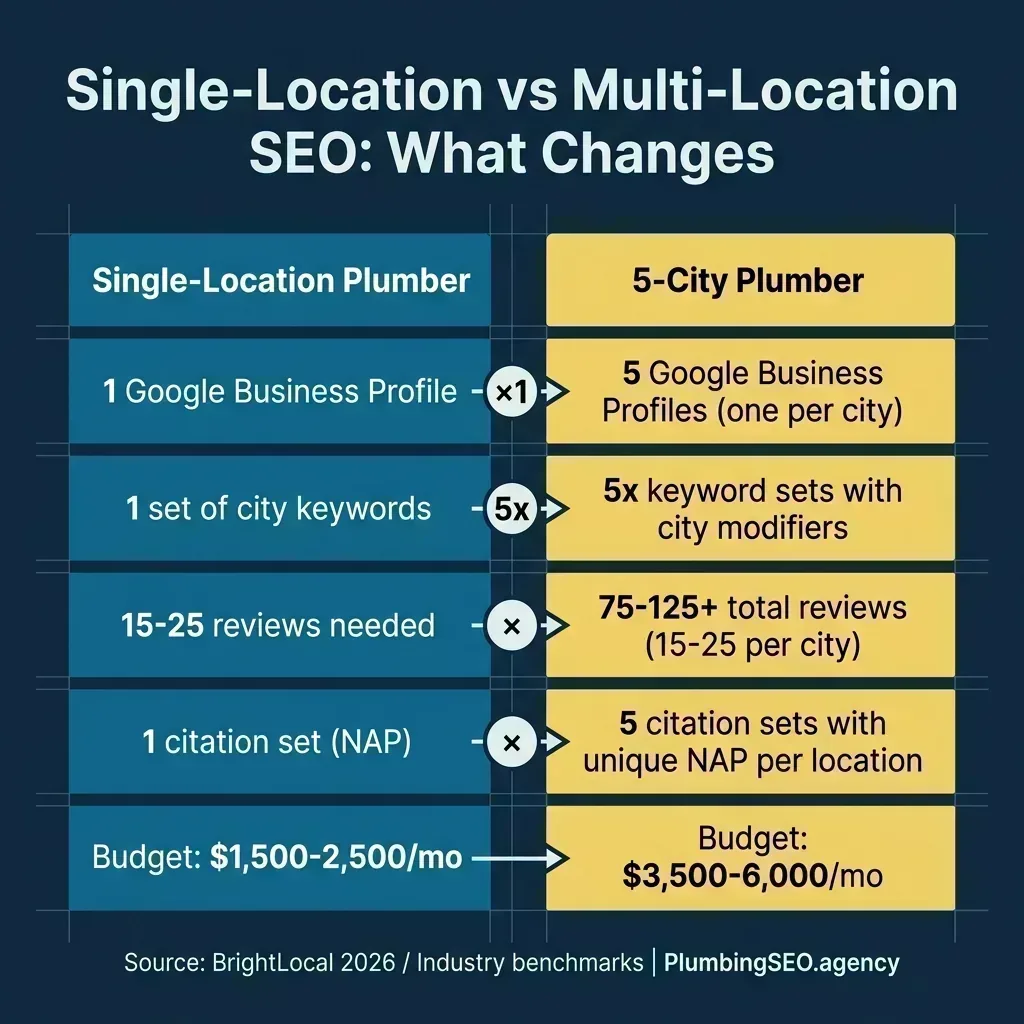
The scaling challenge surprises most plumbing company owners. Everything you did to rank in your home city needs to be replicated, with local variation, for each additional market. But here is the good news: you do not need to 5x your budget. The infrastructure work (website, technical SEO, brand authority) carries across all locations. What multiplies is the localization work, and that is exactly what this guide covers.
Those numbers from BrightEdge explain why multi-city SEO is worth the effort. Nearly half of all searches are local, and three out of four of those searchers act within a day. If your plumbing company is not showing up in the Map Pack for a city you serve, you are leaving calls on the table every single day.
The Hub-and-Spoke Architecture: How to Structure Your Website for 5 Cities
The most common mistake plumbing companies make when expanding to multiple cities is the "find-and-replace" approach: duplicate the homepage, swap "Dallas" for "Fort Worth," and call it a city page. In 2026, Google treats these thin, duplicated pages as spam. Multiple practitioners on Reddit's r/localseo warn that "thin city pages just ruin your site structure over time."
A common architecture for multi-city companies is called hub-and-spoke. Your main website acts as the authority hub. From it, dedicated city pages (the spokes) branch out for the markets that deserve their own page, each one functioning as a mini-homepage for that specific market. These spokes connect back to the hub and to each other through intentional internal linking. A smaller single-town plumber may not need this full architecture; a larger company serving multiple cities usually does.
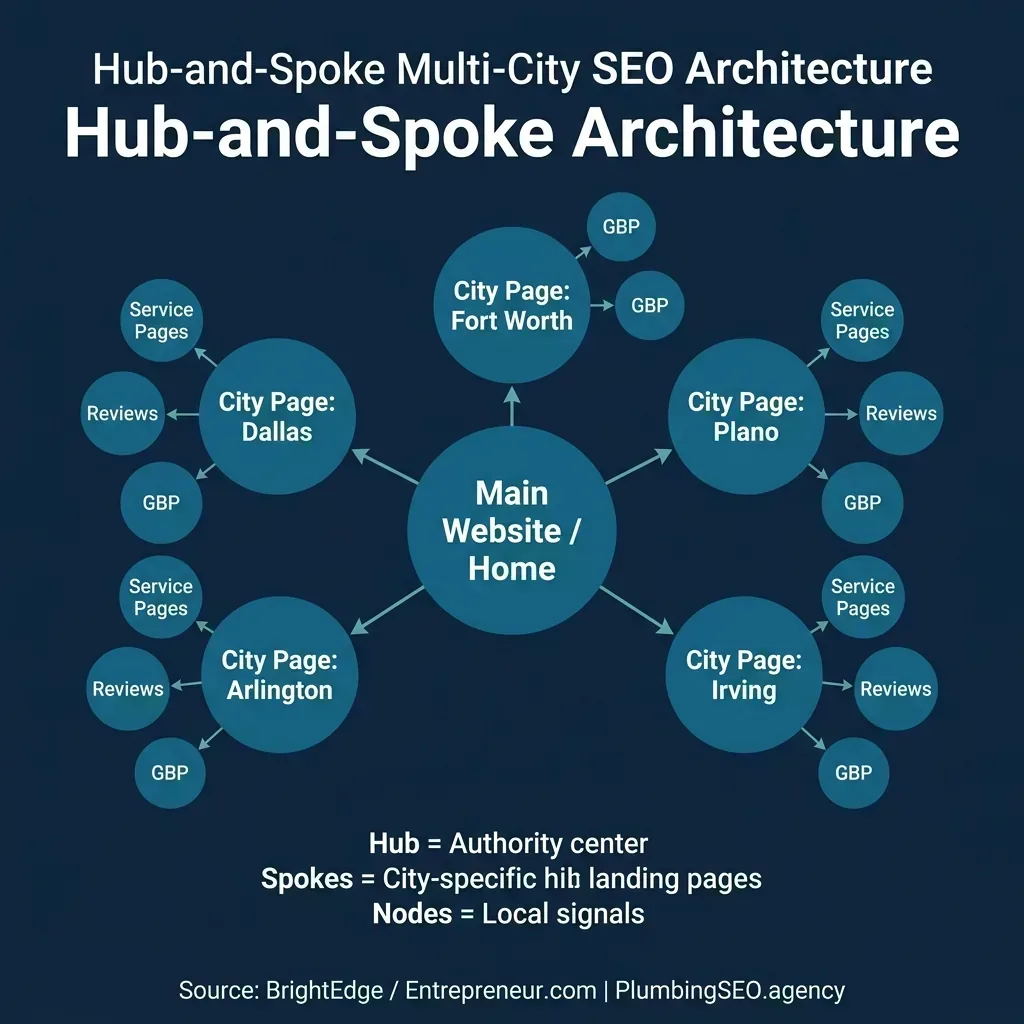
What makes this structure work is how authority flows. Your homepage and core service pages accumulate domain authority from backlinks and brand searches. The internal links from those high-authority pages pass that strength down to your city pages, giving each one a competitive advantage over a local-only competitor with a weaker domain. As one experienced SEO put it on r/localseo: "Google doesn't care about URL structure. It cares about link structure."
The URL Structure Debate
One of the most heated discussions in multi-location SEO is whether to use /location/service/ or /service/location/ URL patterns. The Reddit community is genuinely split on this. After reviewing dozens of threads and case studies, here is what actually matters:
| URL Pattern | Best For | Watch Out For |
|---|---|---|
/dallas/drain-cleaning/ |
3-5 locations, location-first businesses | Can create hundreds of pages at scale |
/drain-cleaning/dallas/ |
Service-authority focused, topical depth | Harder for users to browse by city |
/areas-we-serve/dallas/ |
Simple setup, easy to maintain | Weaker service keyword signals |
/dallas-drain-cleaning/ |
Flat structure, proven for small teams | Can look messy in sitemaps at scale |
The honest answer? For a plumbing company serving 5 cities with 6-8 core services, any of these patterns will work if you execute the fundamentals. Pick one, commit to it, and focus your energy on the content quality of each page. If you want our recommendation for most plumbers: /areas-we-serve/[city]/ for city hub pages, with service details integrated into each city page rather than creating a separate page for every city-service combination. That keeps your site manageable while still sending strong local signals.
For deeper guidance on how to choose and organize your service-area keywords, our plumbing keyword strategy guide walks through the exact page structure that works for local rankings.
What Goes on a City Page That Actually Ranks
Creating a city page is easy. Creating one that Google considers worth ranking is a completely different challenge. The difference between a page that sits on page 7 and one that enters the Map Pack comes down to local specificity. Google's algorithm can tell the difference between a page written for a real local audience and one that was templated for SEO purposes.
A practitioner on r/localseo summarized the problem perfectly: "Traditional SEO wisdom says multiple city pages (Nashville, Franklin, Brentwood plumbing) will cannibalize your rankings." The reality is more nuanced. City pages cannibalize each other when they contain the same content with swapped city names. They complement each other when each one earns its place through genuinely localized content.
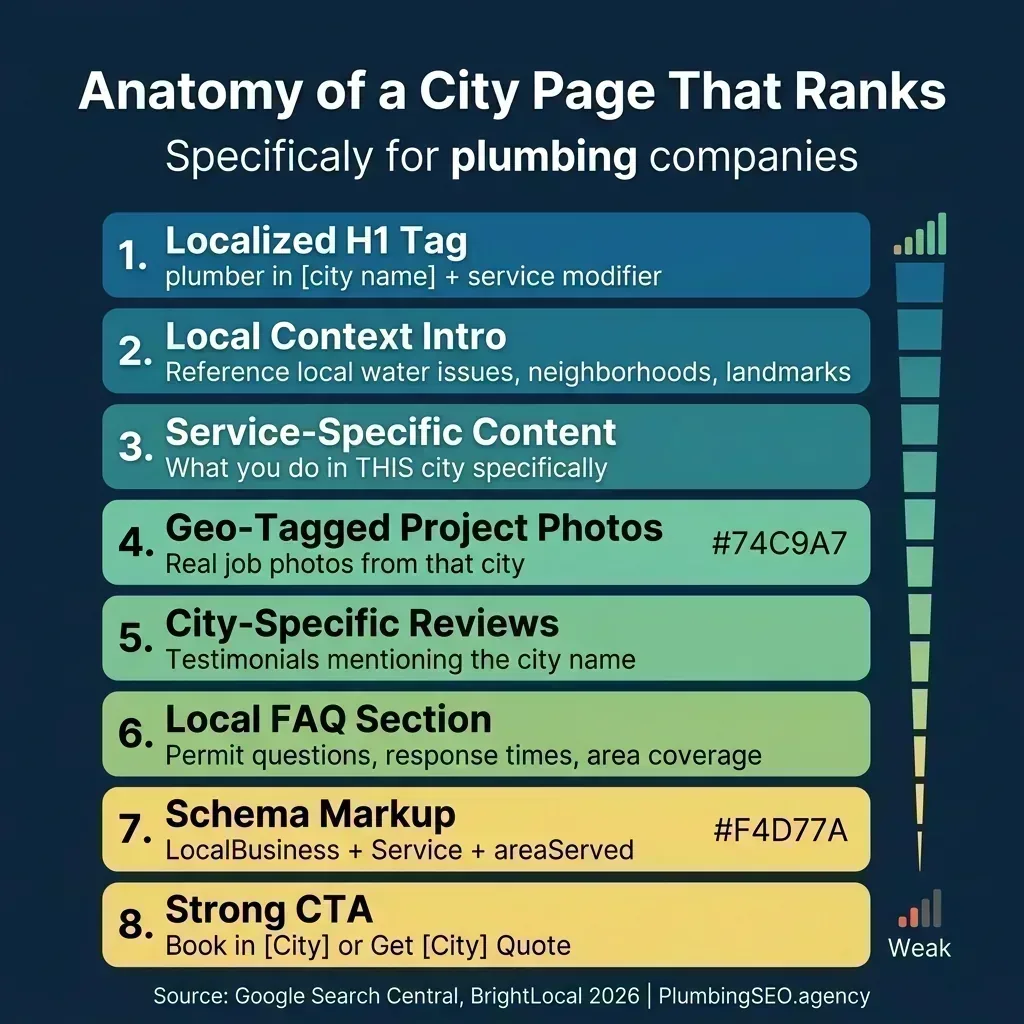
The project gallery element deserves special attention. According to a detailed analysis by Construction Marketing Services, geo-targeted project galleries are one of the strongest ranking signals for multi-city service businesses. A photo of a water heater installation in Fort Worth, tagged with geographic data, creates proof that your company actually operates in that city. Google's algorithm treats this as verification of your service area claims.
The Content That Separates Winners From Spammers
Here is a practical example of how two plumbing companies might approach the same Fort Worth city page:
- Generic intro: "We provide plumbing services in Fort Worth"
- Same service list as every other city page
- No local testimonials or project photos
- Identical meta description with city name swapped
- No mention of neighborhoods, landmarks, or local issues
- References Fort Worth's hard water issues and older pipe infrastructure
- Mentions specific neighborhoods: Fairmount, Arlington Heights, TCU area
- Includes 3-4 project photos from actual Fort Worth jobs
- Features customer reviews that mention "Fort Worth" naturally
- Local FAQ: "Does Fort Worth require a permit for water heater replacement?"
The rich page takes more work upfront, but it is the only approach that scales sustainably. Once you build a template for rich city pages, your team can populate each new city with genuine local content as they complete jobs there. This is where your technicians become your content team: every job photo, every customer interaction, and every local detail they bring back is fuel for your city pages.
If you want a deeper look at how to structure service-area content without triggering duplicate content penalties, our guide on NAP citations for plumbers covers the directory and citation side of the equation.
Google Business Profile Strategy: One Profile Per City, Managed Like Five Businesses
Your Google Business Profile is one of the most important ranking factor for the Map Pack. For a multi-location plumbing company, your GBP strategy makes or breaks your visibility in each city. The challenge is that Google has strict rules about how service-area businesses can create profiles, and violating them can get your listings suspended.
When You Can (and Cannot) Create Multiple GBPs
| Scenario | Can You Create a GBP? | Best Approach |
|---|---|---|
| Physical office in each city | Yes - one per address | Create and fully optimize each profile |
| One office, serve 5 cities | One GBP only | Set service areas; use city pages for organic reach |
| Satellite offices or co-working spaces | Risky - must have staff present | Only if a team member is physically at that address during business hours |
| Technician homes in different cities | Against Google guidelines | Do not use residential addresses as business locations |
The most important distinction: Google demands a real, staffed physical address for each GBP listing. As Adwave's multi-location guide explains, service-area businesses (like plumbers who go to customer homes) can only have one GBP tied to their office address, with service areas defined to cover additional cities.
This does not mean you are stuck. If your company is growing and you open a legitimate satellite office in a second city (even a small one with a dispatcher), that office qualifies for its own GBP. Many plumbing companies that successfully rank in 5+ cities have gradually opened small office spaces in their target markets specifically for this reason. The $500-800/month cost of a small office can pay for itself many times over through the Map Pack visibility it unlocks.
The Weekly GBP Maintenance Checklist (Per Location)
A GBP that was set up and forgotten will be outranked by competitors who actively maintain theirs. The Entrepreneur playbook calls this keeping each location "alive, not static." For each GBP, your team should handle these items weekly:
- Post a Google Business update with a photo from a recent job in that city
- Respond to every new review within 24 hours, mentioning the city and service naturally
- Upload 2-3 new photos of completed work, your van in the area, or team members
- Answer any Q&A questions that appear on the listing
- Check category accuracy monthly to ensure primary and secondary categories match your services
When you multiply this across 5 locations, GBP management becomes a real operational commitment. This is one of the strongest arguments for working with a specialized plumbing SEO company that can manage these profiles systematically rather than asking your office manager to juggle it alongside dispatch.
Reviews and Link Building: The City-by-City Trust Signals
Your website architecture and GBP setup create the foundation. But the signals that actually push you into the Map Pack in each city are reviews and local backlinks. These are the hardest to scale because they require genuine community presence in each market.
Review Strategy for Multiple Locations
Review velocity (how many new reviews you collect per month) matters more than total review count. A case study from Culture Cube found that a plumbing company that built a consistent review system saw a 40% increase in organic and Maps calls and a 67% improvement in their Google review score.
For multi-location plumbing companies, the review challenge is directing reviews to the right GBP listing. If you have separate profiles for Dallas and Fort Worth, a Fort Worth customer's review needs to land on the Fort Worth profile, not the Dallas one. Here is how to manage this:
- City-specific review links: Generate a unique Google review shortlink for each GBP listing and store them in your CRM or dispatch software
- Automated routing: When a technician marks a job complete in Fort Worth, the follow-up SMS should include the Fort Worth review link
- Encourage city mentions: Train techs to say "if you could mention Fort Worth in the review, it helps other homeowners in the area find us"
- Target 3-5 new reviews per location per month to maintain competitive velocity in each market
For the complete system on how to collect reviews efficiently, our guide to getting 5-star reviews covers SMS templates, automation tools, and the exact timing that converts at 15-20%.
City-Specific Link Building
Backlinks from locally relevant websites tell Google that your business is a trusted member of that community. A link from the Fort Worth Chamber of Commerce signals Fort Worth authority. A link from a Dallas food blog does not. For each city you want to rank in, pursue these local link sources:
- Chamber of Commerce membership in each target city ($200-500/year typically)
- Local sponsorships: youth sports teams, school fundraisers, community events
- Neighborhood-specific digital newsletters that accept business features or sponsored content
- Local business associations and trade groups with member directories
- Local news coverage: pitch plumbing-related stories (winter pipe freeze warnings, water quality reports) to city-specific media
The key insight: you do not need dozens of links per city. Even 3-5 high-quality, city-specific backlinks can move the needle significantly because your competitors in the secondary cities often have none. This is where multi-city plumbing SEO becomes a competitive advantage. While the local single-location plumber in Fort Worth has stronger proximity signals, they rarely invest in intentional link building.
What 5-City Plumbing SEO Actually Costs: Budget Breakdown
The single biggest question plumbing company owners ask about multi-location SEO is "what does this cost?" The honest answer is that it costs meaningfully more than single-city SEO, but the per-lead economics get dramatically better as you add cities to your footprint.
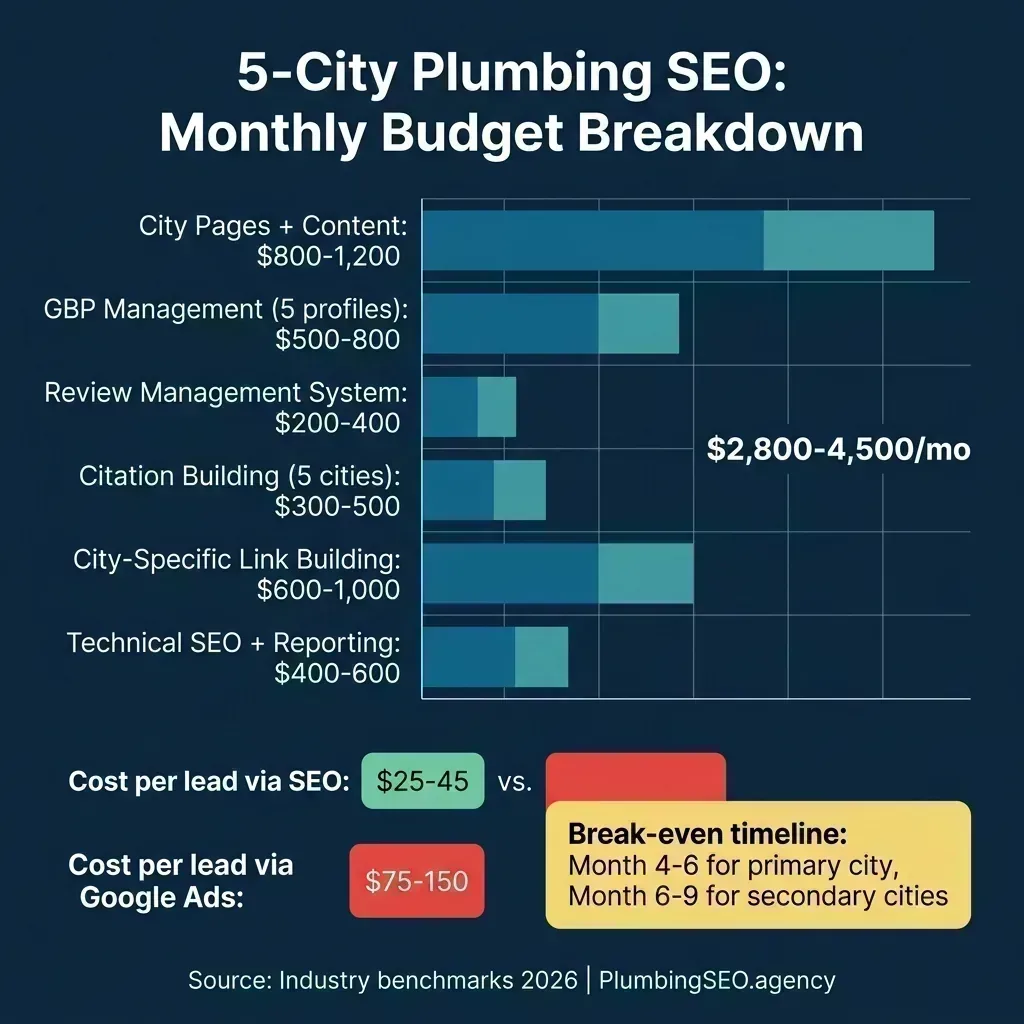
The ROI picture is where multi-city SEO shines. Once your city pages are built and ranking, the ongoing cost per lead through organic search runs $25-45 compared to $75-150 for Google Ads clicks in competitive plumbing markets. A plumbing company doing 10 jobs per week across 5 cities, with an average ticket of $350, generates over $180,000 in annual revenue from those markets. The $2,800-4,500/month SEO investment pays for itself within the first quarter.
The Timeline Reality Check
Multi-city SEO does not produce instant results. Here is a realistic timeline based on industry case studies, including a Dallas plumbing company that achieved 306% organic growth over 12 months:
| Month | What Happens | Expected Results |
|---|---|---|
| Month 1-2 | Foundation: site architecture, city pages built, GBPs optimized, citations submitted | Little visible change; Google is indexing new pages |
| Month 3-4 | Primary city improvements, review velocity building, initial backlinks acquired | Primary city starts gaining organic visibility |
| Month 5-6 | Secondary cities begin ranking, local content deepening, link building ramping | 2-3 cities generating organic leads |
| Month 7-9 | All 5 cities showing organic traction, review systems fully operational | All 5 cities producing measurable call volume |
| Month 10-12 | Optimization phase: doubling down on what works, pruning what does not | Mature traffic; cost per lead drops below $30 |
The smart approach is to stagger your city rollout. Launch your primary city and one adjacent market first. Once those are showing results (usually month 3-4), add the next two cities. This lets you learn what works before investing in all five simultaneously. It also spreads the content creation workload and avoids the "everything launches half-finished" problem.
For a detailed breakdown of what reasonable SEO pricing looks like and how to spot overcharges, our plumbing SEO pricing guide covers the full spectrum from budget-friendly to premium agency engagements.
Not Sure If Your Website Can Support Multiple Cities?
We will audit your current site architecture, GBP setup, and local rankings across your service areas. You will get a clear roadmap for which cities to target first and what it will take to rank.
Get My Free Multi-City AuditFrequently Asked Questions
Start with a hub-and-spoke website architecture when your company genuinely serves multiple distinct markets: your main site acts as the authority hub, with dedicated city pages branching off for locations that have enough demand, job proof, and local content to support their own page. Each city page needs unique, localized content (not copy-paste with city names swapped), its own Google Business Profile only if you have a physical address there, and city-specific reviews and citations when available. A solo plumber in one small town may only need a clear service-area section instead of separate city pages.
Yes, but with limitations. You can rank in organic search results through strong city pages with localized content, local backlinks, and geo-tagged project galleries. However, ranking in the Google Map Pack (the top 3 local results) is significantly harder without a physical address in that city, because Google's proximity factor weighs physical location heavily. Many growing plumbing companies solve this by opening small satellite offices in their highest-value secondary markets.
Only if the pages are thin and duplicated. When each city page targets a distinct "[service] in [city]" keyword and contains unique localized content, they do not compete with each other. Cannibalization happens when multiple pages target the same keyword with similar content. The solution is to make each city page genuinely different: unique testimonials, local project photos, city-specific FAQs, and neighborhood references.
Both work. The SEO community is genuinely split on this, and there is no definitive winner. For most plumbing companies serving 5 cities, a simple /areas-we-serve/[city]/ structure with services integrated into each city page is the most maintainable approach. What matters far more than URL structure is your internal linking strategy, content quality, and NAP consistency. Pick a pattern and commit to it rather than overthinking the URL format.
Expect 4-6 months for your primary city to show strong organic gains, and 6-9 months for secondary cities. The timeline depends on competition level, your existing domain authority, and how quickly you can build local signals (reviews, citations, backlinks) in each market. Cities with weaker competition can show results faster, while major metros may take 9-12 months for meaningful Map Pack visibility.
You can have one GBP per physical location where your business has staff present during business hours. If you operate from a single office but serve multiple cities, you get one GBP with your service areas defined. You cannot create GBPs at residential addresses, virtual offices, or PO boxes. If you open a legitimate office in a second city with a real employee working there, that qualifies for a separate GBP.
Ready to Rank in Every City You Serve?
Our free SEO audit maps your current visibility across all your service areas, identifies the fastest wins, and gives you a clear action plan to start generating leads from multiple cities. Scaling across locations is what separates a real plumber SEO agency from a generalist.
Get My Free Multi-City SEO Audit