
- A text message with a direct Google review link sent within 60 minutes of completing the job converts at 15-20% — 3x better than email.
- You need a system, not willpower: automate review requests through your field service software so every job triggers an ask.
- Responding to every review (positive and negative) within 24 hours boosts local rankings 10-20% and shows future customers you care.
Why 5-Star Reviews Are the #1 Growth Lever for Plumbing Companies
When a homeowner's water heater dies at 6 AM or a sewage line backs up on a Sunday, they're not browsing websites — they're scanning Google for a plumber who looks trustworthy right now. That split-second trust decision happens based on two things: your star rating and how many reviews back it up.
The data on this is overwhelming, and it's gotten stronger every year:
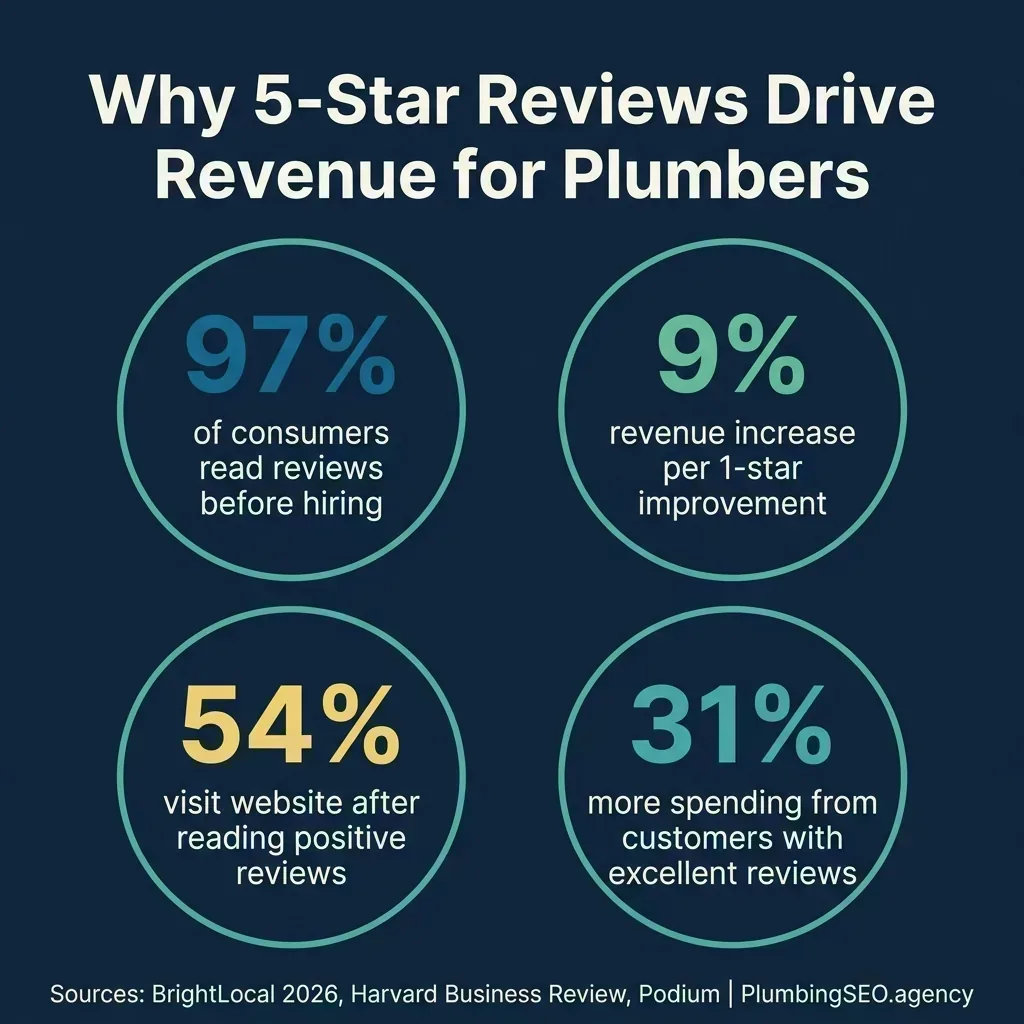
What those numbers mean for a plumbing company doing $500,000 a year in revenue: a single star improvement on your Google profile could translate to $45,000 in additional annual revenue. That's not marketing theory — it's the Harvard Business Review's finding applied to your P&L.
Here's the part most plumbers miss: reviews don't just attract new customers — they influence how much those customers are willing to pay. Podium's research shows customers spend 31% more with businesses that have excellent reviews. When a homeowner sees 87 five-star reviews mentioning "fair pricing" and "showed up on time," they stop shopping for the cheapest quote and start calling you.
That last stat surprises most plumbers. A perfect 5.0 rating with 12 reviews actually converts worse than a 4.7 with 85 reviews. Consumers are savvy — they know that a handful of perfect scores looks curated. A 4.7 with volume and a few honest 4-star reviews looks authentic. Aim for excellent, not artificially perfect.
The Review Psychology Gap: Why Your Happy Customers Stay Silent
You finish a job perfectly. The customer shakes your hand, says "fantastic work," and waves goodbye. You wait for the review. It never comes. Sound familiar?
This is the single biggest frustration plumbers have with reviews, and it comes up in every Reddit thread about the topic. As one plumber on r/Plumbing put it: "Ask nicely and repeatedly — if it's a customer who really enjoys using your service they won't mind taking 40 seconds to leave the review, most of them just simply forget."
The psychology is simple: satisfied customers have no emotional urgency to act. The problem is solved, the stress is gone, and they've moved on. Angry customers, on the other hand, are fueled by emotion — they'll find your Google listing at midnight and write three paragraphs about a $50 billing dispute.
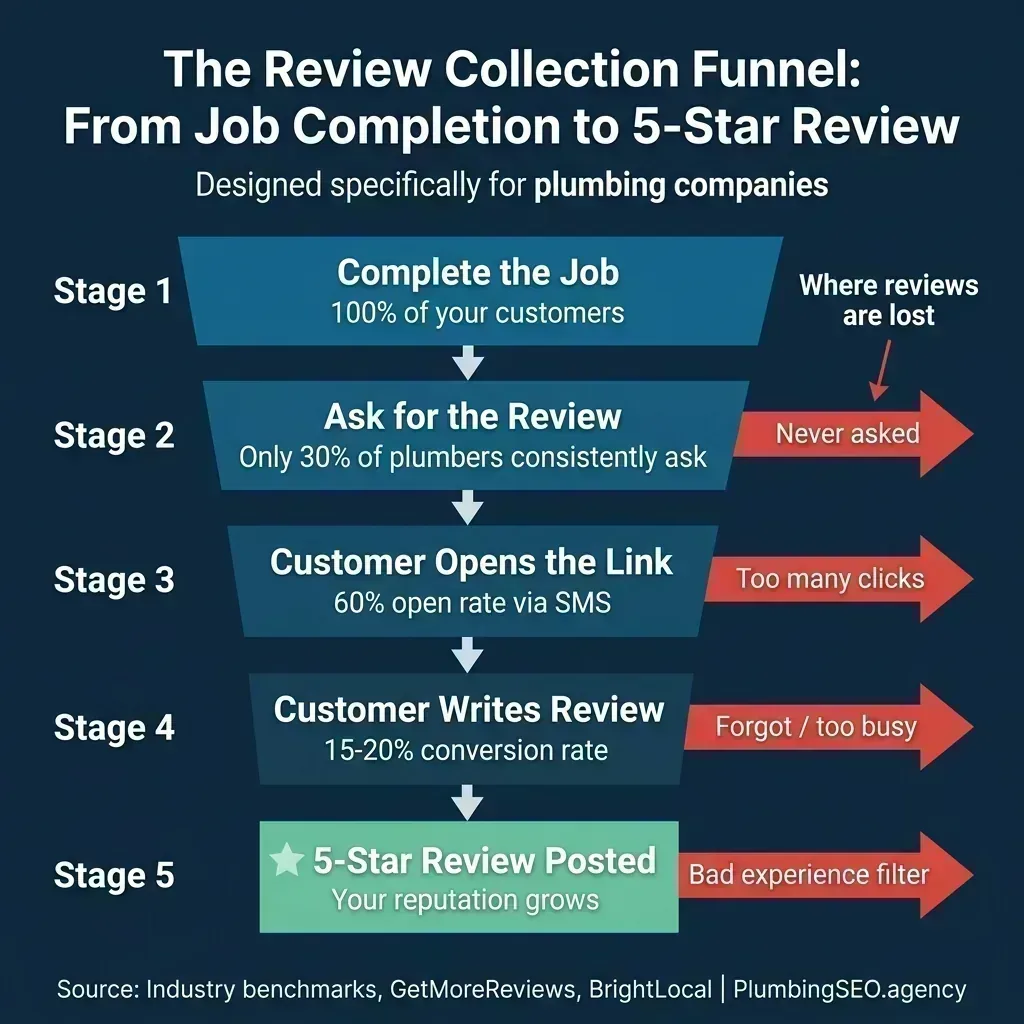
The gap between "happy customer" and "posted review" isn't a quality problem — it's a friction problem. Every barrier you remove between "great job" and "review posted" multiplies your collection rate. The biggest barriers, in order:
- Never asking — a Reddit thread on r/handyman found that most service businesses simply forget to ask after every job
- Too many clicks — telling someone "leave us a Google review" forces them to search, find your listing, click review, then write. Each step loses 40-50% of people
- Wrong timing — asking three days later via email catches people when they're busy and the gratitude has faded
- No template or script — your techs don't know what to say, so they say nothing
The solution isn't to ask harder. It's to build a system that removes every barrier, fires at the right moment, and runs without you having to think about it. That's what the rest of this guide covers.
The 7 Best Ways to Collect Reviews — Ranked by What Actually Works for Plumbers
Not all review request methods are equal. A plumber's workflow is radically different from a restaurant or retail store — you're in someone's home for 45 minutes, you fix a problem, and then you leave. The window to capture a review is narrow and specific to the trades.
Here's how the methods stack up based on actual conversion data from plumbing and home service companies:
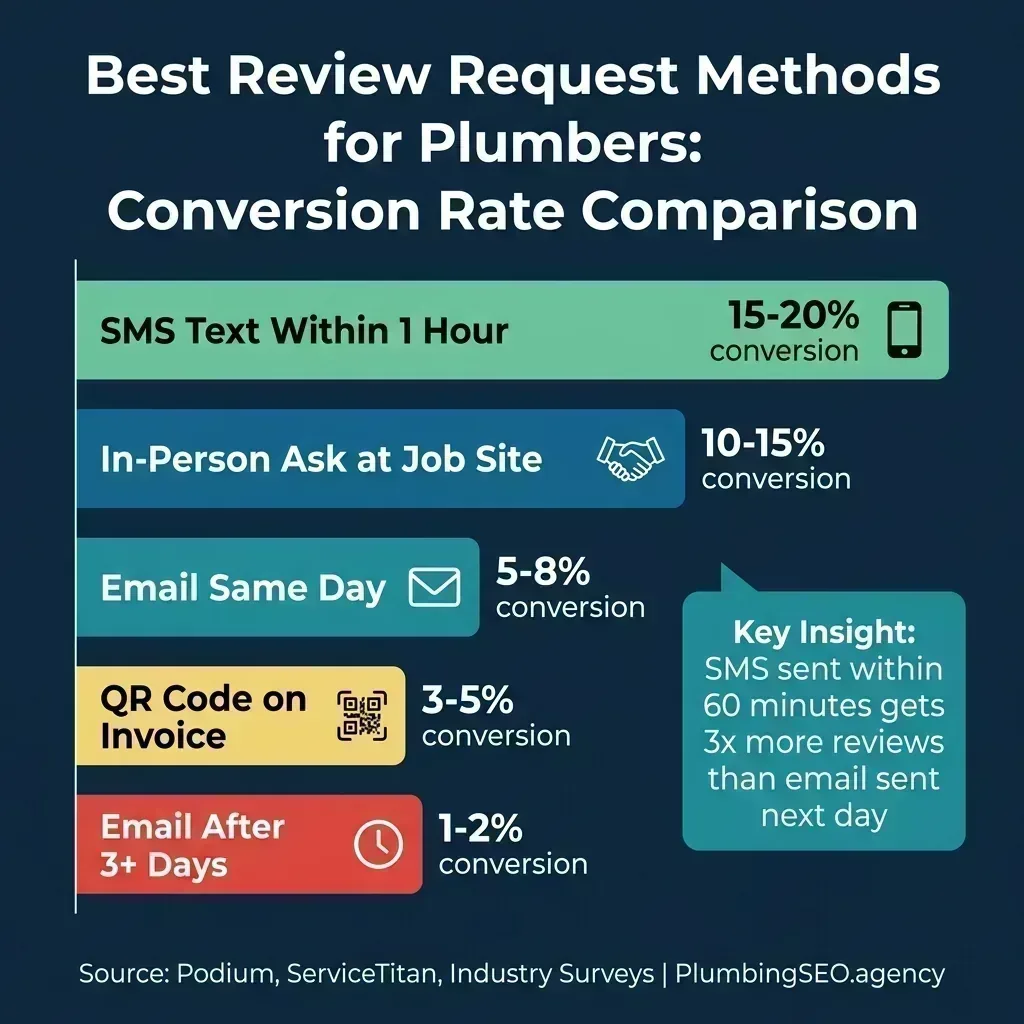
The gap between SMS and delayed email is staggering — a 10x difference. One business owner on r/smallbusiness shared: "When a customer books an appointment on my webpage, my booking system automatically sends reminders, follow-up thank you emails, and text messages with a Google link. In 18 months, I received over 160 5-star reviews."
| Method | Conversion Rate | Best For | Cost |
|---|---|---|---|
| SMS within 1 hour | 15-20% | All jobs — your #1 method | Free-$0.01/text |
| In-person ask at job site | 10-15% | High-ticket jobs, rapport situations | Free |
| Same-day email | 5-8% | Commercial clients, property managers | Free |
| QR code on invoice/van | 3-5% | Passive collection, zero effort | One-time print |
| Follow-up email (3+ days) | 1-2% | Second chance for missed requests | Free |
The smart approach isn't picking one method — it's layering them. Your tech asks in person at the job site, then an automated text goes out within the hour, and if there's no review by day 3, a gentle email follows up. Three touches, three chances to convert, zero extra effort after setup.
For deeper context on how reviews connect to your broader Google Maps SEO strategy, our Maps ranking guide breaks down exactly how review velocity impacts your Map Pack position.
Review Request Templates That Actually Convert
The exact words you use matter more than most plumbers realize. A generic "please leave us a review" converts at half the rate of a personalized, specific message. Here are the templates that work best, tested across hundreds of plumbing businesses:
The Post-Job SMS Template (15-20% conversion)
"Hey [Name], this is [Tech Name] from [Company]. Thanks for trusting us with your [specific service] today! If you have 60 seconds, a Google review really helps other homeowners find reliable plumbing help: [direct link]. Thanks!"
Why it works: It's from a named person (not "the company"), references the specific job, sets a time expectation (60 seconds), and gives a human reason (helping neighbors). The direct link removes every barrier between reading and reviewing.
The Emergency Job Template (higher conversion — emotional gratitude)
"Hi [Name], so glad we could help with your emergency today. We know plumbing problems are stressful — thanks for trusting us to fix it fast. If you have a minute, sharing your experience really helps: [direct link]. — [Tech Name]"
The Follow-Up Email (Day 3-5, for non-responders)
"Hi [Name], hope your [repair type] is still working perfectly! If you have 30 seconds, a quick Google review helps other homeowners in [city/neighborhood] find reliable plumbing help. [direct link] — Thanks, [Company Name]"
The In-Person Script (for technicians)
Train every tech to say this before they walk out the door:
"Hey, if you were happy with the work, a Google review really helps us out. I'll send you a text with the link — takes about 60 seconds. And if you wouldn't mind mentioning the [service type] and [neighborhood], it helps other people in the area find us."
That last line — suggesting they mention the service and location — is an advanced tactic from experienced local SEO practitioners. Reviews containing keywords like "water heater replacement" and neighborhood names carry extra relevance weight in Google's algorithm. You're not keyword-stuffing — you're giving the customer a helpful prompt that makes their review more specific and genuinely useful to other readers.
- Sending a generic "please review us" with no context
- Linking to your Google listing instead of the direct review link
- Waiting until Friday to batch-send review requests for the whole week
- Only asking after "perfect" jobs — imperfect-but-handled-well jobs get great reviews too
- Following up more than once — one reminder is fine, two feels pushy
- Sending the text while still on-site or within 60 minutes
- Using the Google review shortlink (search.google.com/local/writereview)
- Making it part of the job completion checklist — not optional
- Tracking conversion rate weekly (texts sent vs. reviews received)
- Celebrating review milestones with the team — keeps motivation up
Handling Negative Reviews Without Losing Your Mind (or Your Ranking)
Every plumber dreads the 1-star review. And every plumber will get one eventually — a miscommunication on pricing, a warranty dispute, a customer who was having a bad day. How you respond matters more than the review itself.
A critical insight from BrightLocal's 2026 Consumer Review Survey: 97% of consumers read business responses to reviews. That means your reply to a negative review is being read by dozens or hundreds of potential customers. It's not a private conversation — it's a public audition for future business.
- Respond within 24 hours — speed signals that you take feedback seriously
- Acknowledge the complaint specifically — "We understand the pricing felt unclear" beats "Sorry for any inconvenience"
- Apologize without excuses — even if you disagree with the characterization
- Take it offline — "Please call us at [number] so we can make this right"
- Never argue publicly — future customers are watching your temperament
- Argue with the reviewer in public comments
- Question whether they were actually your customer
- Copy-paste identical responses to every negative review
- Ignore the review and hope it goes away
- Ask friends to leave fake reviews to "bury" it
The pricing objection is the most common trigger for negative plumbing reviews. As the team at GetMoreReviews puts it: many negative reviews mention "too expensive" or "felt overcharged" — even when your pricing is fair. The fix is preventive: explain pricing before starting work, provide written estimates, and if a customer seems hesitant, acknowledge it directly. When customers understand the value upfront, they're far less likely to express frustration in a review later.
If you're weighing whether to handle review management yourself or bring in professional help, our guide on agency vs. in-house SEO for plumbers covers how review systems fit into the bigger picture.
The 30-Day Review Flywheel: From Zero System to 10+ Reviews Per Month
Everything in this guide boils down to one insight: reviews are a system, not an event. The plumbing companies that dominate local search don't have more likable technicians — they have a process that runs every day without anyone having to remember to do it.
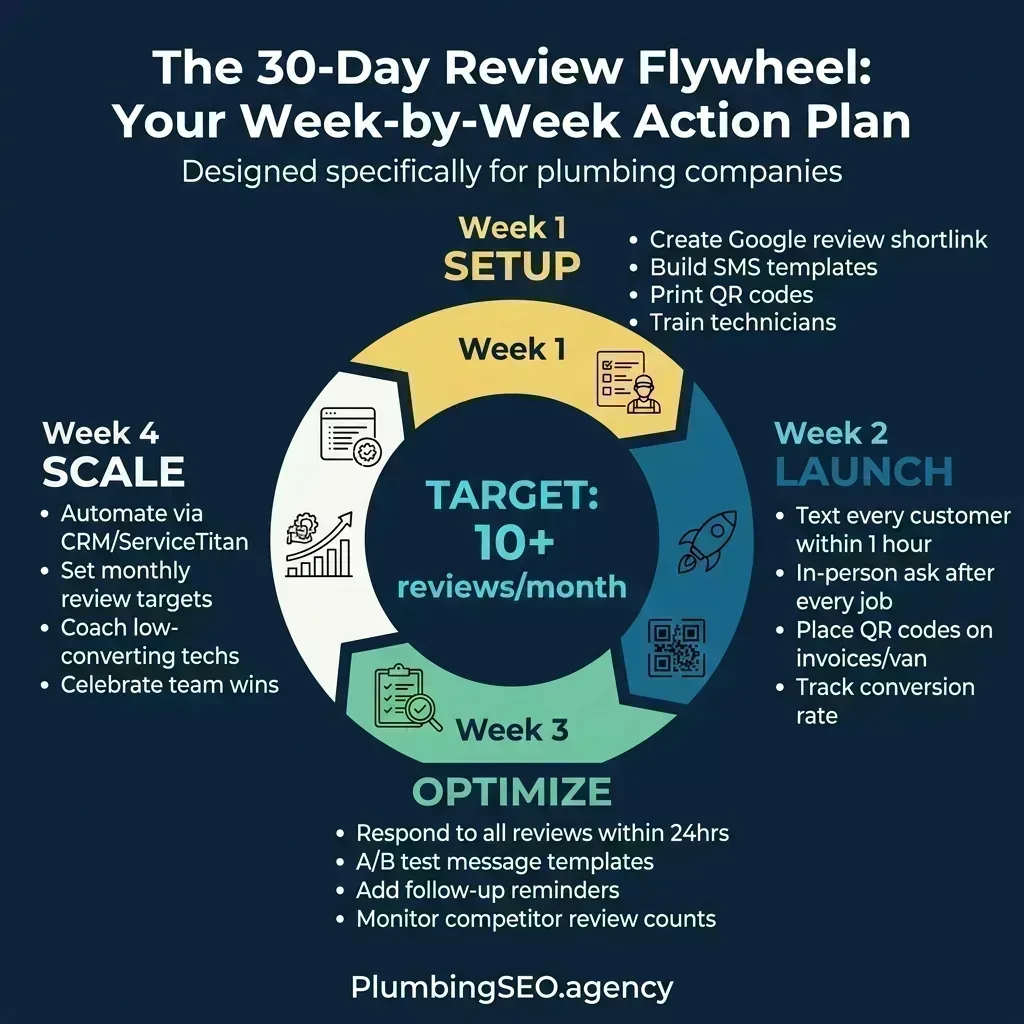
For larger operations doing 20+ jobs per week, the manual approach breaks down. That's where field service software becomes essential. Platforms like ServiceTitan, Jobber, and Housecall Pro all have built-in review request features that trigger automatically when a job is marked complete or an invoice is paid. This removes the "I forgot to send the text" failure point entirely.
The budget picture matters too: review management is a high-ROI marketing activities because it costs almost nothing. A text costs a fraction of a cent. Your tech's 30-second ask costs nothing. The QR code prints once. Compare that to Google Ads where every click costs $15-80 in competitive plumbing markets, and the leverage is obvious. For a full breakdown of where reviews fit in your marketing budget, see our guide on how much plumbing companies should spend on SEO.
Not Sure Where Your Review Strategy Has Gaps?
We'll audit your Google Business Profile, benchmark your review count and velocity against local competitors, and tell you exactly what it takes to start climbing the Map Pack.
Get My Free AuditFrequently Asked Questions
No — Google explicitly prohibits offering incentives (discounts, gifts, or payment) in exchange for reviews. This includes "review gating," where you only ask happy customers and filter out unhappy ones. You can ask all customers equally for honest feedback. A direct, sincere request via text, email, or in person is fully compliant. Some businesses run monthly drawings where any reviewer (positive or negative) is entered — this is a gray area, so proceed carefully.
Log into your Google Business Profile, click "Ask for reviews" (or "Get more reviews" in some versions), and Google can generate a short URL you can copy and share. This link takes customers directly to the review form — no searching required. Save this link in your phone, your CRM, and your email templates. You can also create a QR code from this link using any free QR generator.
Flag it through your Google Business Profile dashboard — click the three dots next to the review and select "Report Review." Document your case with screenshots. If the reviewer has no history and only one review (a red flag), note this in your report. Google removes roughly 50% of properly reported fake reviews within 30 days. In the meantime, respond professionally as if addressing a real concern, and accelerate your review collection to dilute its impact.
It varies by market. In small towns, 15-25 reviews may be enough. In mid-size cities, 40-60 is the entry point. In major metros, top plumbers typically have 75-120+. The best approach: search "plumber near me" in your city, check the review count of the #3 business in the Map Pack, and target that number plus 20%. For a deeper breakdown, read our complete guide to Google reviews and Map Pack rankings.
Respond to both — always. Businesses that respond to 80%+ of all reviews see a 10-20% improvement in local rankings. When replying to positive reviews, thank the customer by name, reference the specific service, and naturally mention your service area. Keep it under two sentences. This signals to Google that your business is active and engaged.
Within 60 minutes of completing the job — ideally while you're still on-site or just leaving. This is when customer gratitude peaks and the experience is freshest. SMS sent in this window converts at 15-20%, while emails sent 3+ days later drop to 1-2%. If you can't send a text immediately, same-day is still far better than next-day or end-of-week.
Find Out How Your Review Strategy Stacks Up
Our free SEO audit benchmarks your review count, velocity, and star rating against local competitors — then gives you a clear action plan to start collecting more 5-star reviews this month.
Get My Free SEO Audit