
- Google reviews account for 15% of your Local Pack ranking — they're not optional, they're infrastructure.
- You need 2-4 new reviews per month minimum to hold your Map Pack spot; 10+ per month to climb it.
- The highest-converting tactic is a text message with a direct review link sent within 60 minutes of job completion — not email, not a QR code on the invoice.
Reviews Aren't Just Social Proof — They're a Ranking Signal
Most plumbers think of Google reviews the same way they think of word-of-mouth: nice to have, hard to control, and best left to happy customers who take the initiative. That's the wrong mental model, and it's costing them Map Pack positions every month.
Google's local algorithm has three primary ranking factors: relevance, distance, and prominence. Reviews are the clearest signal of prominence you can directly influence. Distance is fixed. Relevance is tied to your business category and keywords. But prominence — the signal that says "this business is trusted and active" — is where reviews do the heavy lifting.
Here's how the math actually works in 2026:

The 270% statistic is the one that should really land: businesses with more than 5 reviews are nearly three times more likely to be chosen than those without. For a plumber competing in a local market where three businesses show up in the Map Pack and ten more appear just below, the difference between "gets clicked" and "gets ignored" is often the review count and star rating visible at a glance.
A Reddit thread in r/localseo that gained significant traction in early 2026 put it bluntly: "Focus on review velocity. If you aren't getting 2-3 new reviews every week, Google won't prioritize you for high-intent 'near me' queries." That's not a fringe opinion — it's consistent with every local SEO study published in the last two years.
- Reviews trickle in randomly — 1-2 per month
- Star rating drifts when a bad review isn't diluted
- Google sees an inactive business profile
- Competitors with velocity outrank you over time
- You're invisible for emergency "near me" queries
- 5-10+ reviews per month, predictably
- Star rating stays protected by consistent 5-stars
- Google sees an active, trusted business
- You climb past competitors who stopped building
- Top 3 Map Pack positions for your highest-value keywords
Review Velocity: The Metric Most Plumbers Ignore
Total review count gets all the attention. Velocity — how many new reviews you're earning per month — is the metric that actually moves your ranking in real time.
Think of it this way: a plumber with 200 reviews who stopped getting new ones 8 months ago is being overtaken by a competitor with 60 reviews who gets 8 new ones every month. Google's freshness signal interprets new reviews as proof the business is active, reliable, and worth serving to searchers right now.
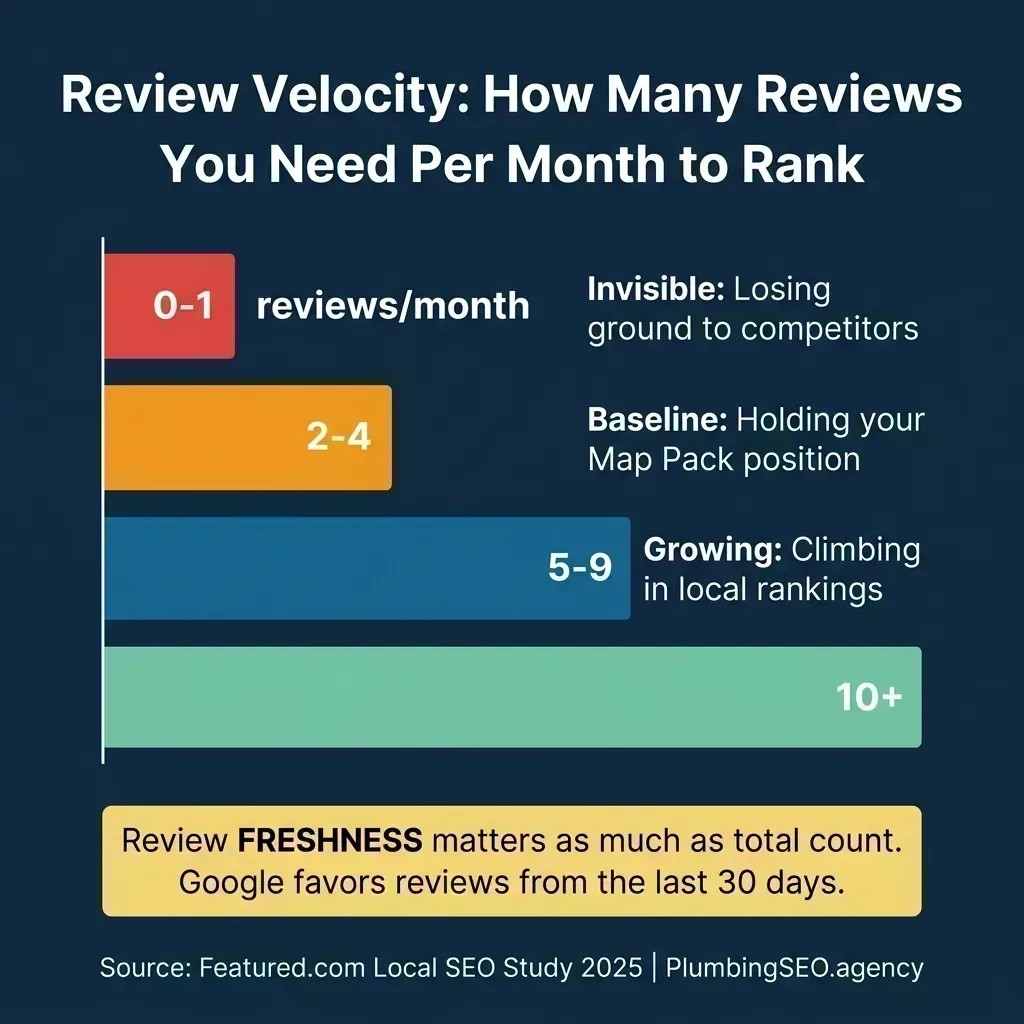
The 10+ reviews per month tier isn't just about rank — it creates what local SEO practitioners call a "review moat." Once you've built a lead of 150+ reviews at a 4.7+ star rating with fresh recent activity, competitors need to sustain that same velocity plus overcome your accumulated social proof. Most won't bother. They'll compete for second and third place instead.
For a two-truck plumbing company doing 4-6 jobs per day, 10 reviews per month means converting roughly 8% of your jobs into a review. That's a very achievable number with a simple system — and it puts you in the dominant tier for most mid-size markets.
| Review Velocity | Map Pack Impact | Typical Result |
|---|---|---|
| 0-1 per month | Declining | Losing positions to active competitors |
| 2-4 per month | Holding | Maintaining current Map Pack position |
| 5-9 per month | Growing | Climbing rankings month over month |
| 10+ per month | Dominant | 80%+ chance of staying in Top 3 |
How Many Reviews Do You Actually Need to Enter the Map Pack?
This is the question every plumber asks — and the honest answer is: it depends on your market. The error most plumbers make is either wildly underestimating the bar (thinking 10 reviews will cut it in a city of 500,000) or overestimating what it takes in a smaller market (spending years chasing 100 reviews in a town where 25 would have already put them first).
The correct approach is competitive intelligence: find out what the current Map Pack occupants have, then beat it by 20%.
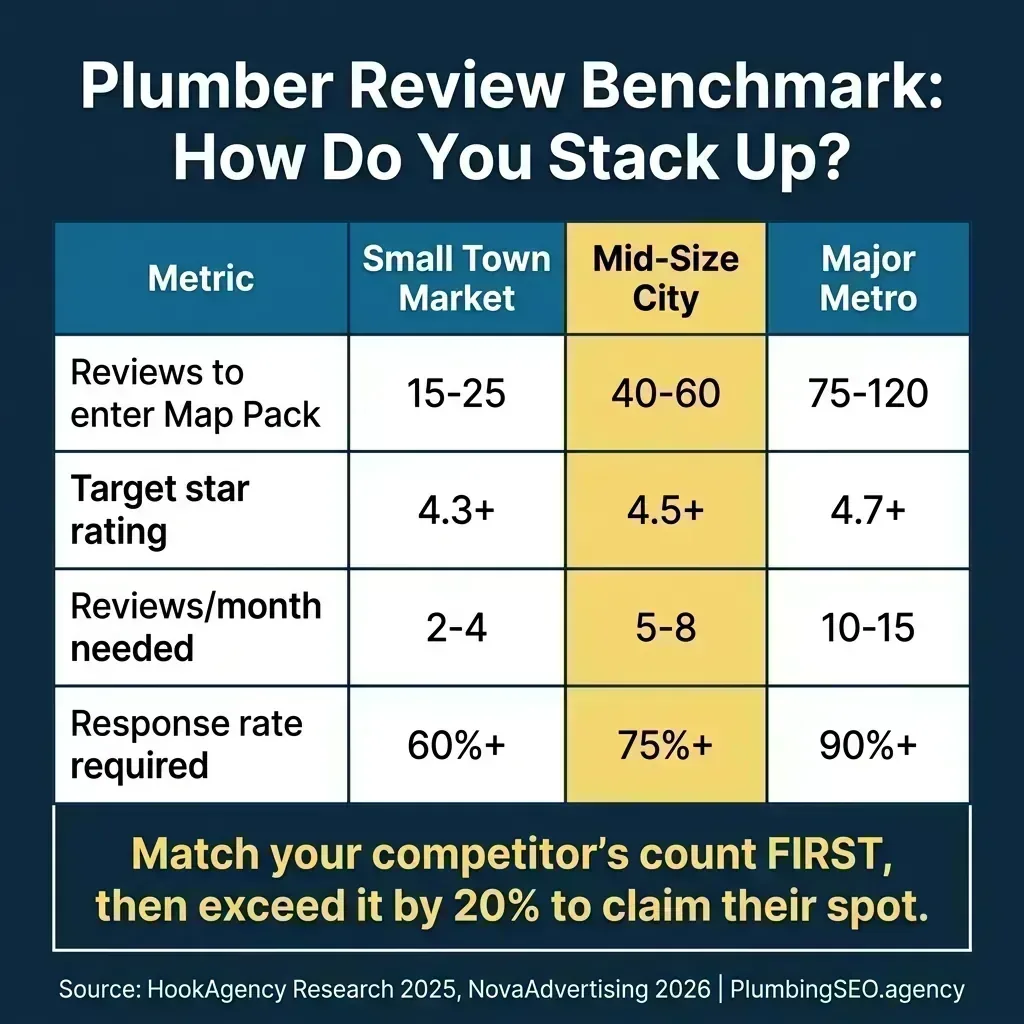
Here's the audit to run right now: Open Google, search "plumber near me" (or "[your city] plumber"), and look at the three businesses in the Map Pack. Check their review counts and star ratings. That's your baseline target. Add 20% to the count of the business in position #3 — that's your entry point. Add 20% to position #1 to understand what it takes to lead.
One pattern that comes up repeatedly in local SEO forums: plumbers in mid-size cities are often shocked to find that position #1 has only 47 reviews and a 4.6 rating. They've been sitting on 38 reviews at 4.8 stars — essentially Map Pack-ready — but hadn't built the velocity signal to push through. Fresh reviews every week tipped the balance within 60 days.
The 5-Method Review Collection System for Plumbers
There's no shortage of advice on getting reviews. The problem is that most of it is written for retail businesses, not service businesses. A plumber's relationship with a customer is fundamentally different: you're in their home during a stressful moment, the job ends abruptly when the problem is fixed, and the customer's relief quickly turns to other priorities. You have a very short window to capture that positive energy as a review.
These five methods are ranked by conversion rate for plumbing businesses specifically:
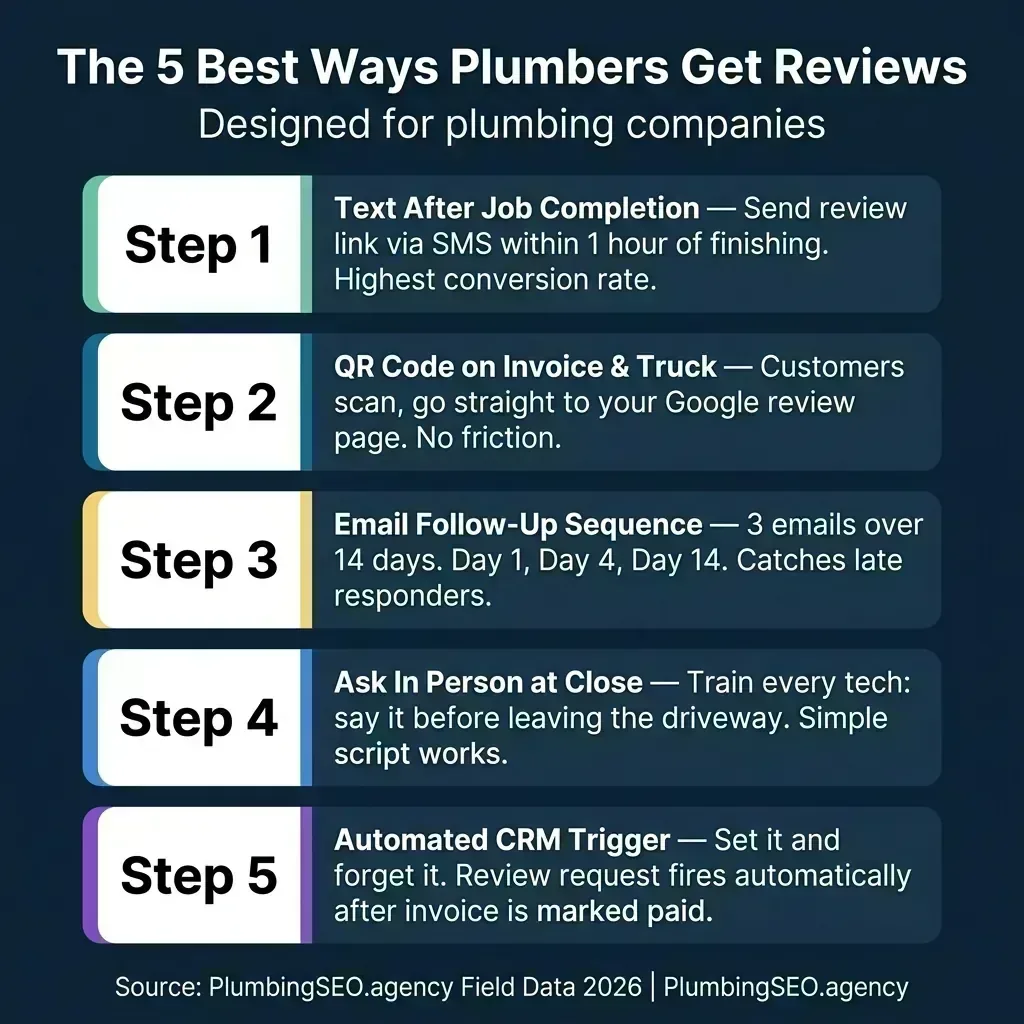
The ordering matters. Text messaging converts at 2-3x the rate of email for review requests in the trades. A customer who just watched you fix a burst pipe at 9pm is not going to open their laptop to leave a review — but they will tap a link on their phone while you're still loading your van. That's the window. That's where the review lives or dies.
The Text Script That Works
Keep it personal, short, and with a direct link. Something like:
"Hey [Name], it was great working with you today on the [service]. If you have 60 seconds, we'd really appreciate a Google review — it helps other homeowners find us. Here's the direct link: [link]. Thanks, [Tech Name] from [Company]"
What makes this script work: it's from a named person (the tech, not "the company"), it references the specific job, it sets a time expectation (60 seconds), and it gives a human reason for why it matters. The conversion rate on personalized texts like this runs 15-20% in the plumbing industry — meaning 1 in 5 customers who receive it will actually leave the review.
QR Code Placements That Actually Get Scanned
QR codes aren't as high-converting as texts, but they're passive — they work even when you forget to send the text. The highest-performing placements for plumbers are:
- On the invoice/receipt — printed prominently, not buried in the footer
- On a business card left at the job site ("How'd we do?")
- On the back of the service van — neighbors see it while you're parked
- On a small counter card for any office or showroom space
The key is making the call to action unmissable. "Scan to leave us a Google review" with the QR code large, not small. Test this: if you can't scan it from 18 inches away, reprint it larger.
Why Your Response Rate Is Also a Ranking Signal
Most plumbers, if they respond to reviews at all, reply to the negative ones and ignore the positive ones. This is backwards from a local SEO perspective.
Search Engine Land's research shows that businesses responding to 80%+ of their reviews see a 10-20% boost in local rankings. This isn't just about reputation management — Google interprets consistent response behavior as a signal of business activity and owner engagement, both factors in the prominence score.
- Thank them by name when possible
- Reference the specific service ("glad the water heater install went smoothly")
- Mention your service area naturally ("great working with you in [neighborhood]")
- Keep it under 2 sentences — don't over-explain
- Invite future business without being pushy
- Respond within 24 hours — always
- Acknowledge the specific complaint, don't deflect
- Apologize without making excuses
- Offer a resolution offline ("call us at [number]")
- Never argue — future readers are watching
A critical data point from GatherUp's 2025 consumer survey: 67% of dissatisfied customers stay loyal to a business that responds quickly to their negative review. For a plumber, this means a well-handled 1-star review can actually become a retention asset. Future customers reading the thread see the professionalism; the original reviewer sometimes edits their rating upward after resolution.
The Review Keyword Strategy
Here's an advanced tactic from r/localseo that most plumbers miss: when you ask a happy customer for a review, casually suggest they mention the service type and your city. Instead of "leave us a Google review," say: "If you wouldn't mind mentioning that it was a [emergency pipe repair] in [your neighborhood] — it helps neighbors find us."
Reviews that include service keywords ("water heater replacement," "slab leak repair") and location names ("downtown Phoenix," "Westside Chicago") carry additional relevance weight in Google's algorithm. You're not keyword-stuffing — you're giving the customer a helpful prompt that makes their review more specific and useful.
Protecting Your Star Rating: The Dilution Strategy
Every plumbing business will eventually get a bad review. A grumpy customer, a miscommunication, a job that didn't go as expected — it happens. The question isn't whether you'll get a 1-star review, it's whether you've built enough 5-star volume to absorb it without it tanking your average.
The math of dilution: if you have 20 reviews at 4.8 stars and get one 1-star review, your average drops to roughly 4.57. If you have 80 reviews at 4.8 and get the same 1-star, your average barely budges — 4.77. Volume is your armor.
This is why the Google Business Profile optimization and review velocity work together. Your GBP is the container; reviews are what fill it with credibility. A well-optimized profile with thin review coverage is like a great storefront on an empty street — people can find it, but they don't trust it yet.
What to Do When You Get a Fake or Malicious Review
Competitors, disgruntled ex-employees, or mistake-of-identity reviews are a real problem for plumbers. Google's process for flagging and removing reviews is notoriously slow, but there are steps:
- Flag it through your Google Business Profile dashboard — click the three dots next to the review, select "Report Review"
- Respond publicly as if addressing a real customer concern — this signals professionalism to readers even if the review is fake
- Document your case with screenshots, and if the reviewer has no history and only left one review (a red flag), note this in your report
- Accelerate your review velocity in the short term — diluting a malicious review is faster than waiting for Google to remove it
Google removes roughly 50% of properly reported fake reviews within 30 days. The other 50% require follow-up or escalation via Google's Business Profile support chat. In the meantime, the volume strategy is your most reliable defense.
Building Your 30-Day Review Flywheel
A review system isn't a campaign — it's a process. One that runs every day without you having to think about it. Here's the 30-day setup plan to go from ad-hoc reviews to a consistent flywheel:
- Get your Google review shortlink from your GBP dashboard ("Share review form")
- Create a text message template and save it in your phone
- Print QR codes for your invoices and van — free at QR code generators online
- Train every tech on the in-person script before they leave a job
- Send the text to every completed job customer within 60 minutes of leaving
- Set up a 3-email follow-up sequence (Day 1, Day 4, Day 14) in your CRM or Gmail
- Respond to every review within 24 hours — positive and negative
- Track weekly: how many texts sent vs. reviews received (target 15-20% conversion)
After 30 days, you'll have a baseline conversion rate for your market and team. Most plumbing companies running this system for the first time see 8-12 new reviews in their first month — often more than they collected in the previous 6 months combined. That's the compound effect of consistency replacing randomness.
For larger operations, consider integrating review automation through your field service software (ServiceTitan, Jobber, Housecall Pro). These platforms have native review request triggers that fire automatically when an invoice is marked paid — removing the "I forgot to send the text" failure point entirely. This aligns with what we cover in our piece on managing SEO operations at scale for plumbing companies.
The budget picture here is also important: review management is a high-ROI SEO activities because it costs almost nothing. A text message costs a fraction of a cent. Your technician's 30-second ask costs nothing. The QR code on your invoice is printed once. Contrast this with paid ads, where every click costs $15-80 in competitive plumbing markets, and the leverage of a review system becomes obvious. If you want to understand where reviews fit in your full plumbing SEO budget, we break down the full picture there.
Find Out What's Holding Your Reviews Back
We'll audit your Google Business Profile, check your review velocity vs. competitors, and tell you exactly what it would take to hit the Map Pack — no fluff, no sales pitch.
Get My Free AuditFrequently Asked Questions
It depends on your market. In small towns, 15-25 reviews may be enough. In mid-size cities, 40-60 is typically the entry point. In major metros, top-ranked plumbers often have 75-120+ reviews. The most reliable approach: search "plumber near me" in your city, check the review count of the business in Map Pack position #3, and target that number plus 20%. That's your minimum viable target.
Yes, you can absolutely ask customers to leave reviews — Google explicitly allows this. What Google prohibits is incentivizing reviews (offering discounts, gifts, or payment in exchange for a review) or review gating (only asking happy customers while filtering out unhappy ones). A direct, sincere request via text, email, or in person is fully compliant. Just ask all customers equally, not selectively.
Text message sent within 60 minutes of completing the job, containing a direct link to your Google review page. This single tactic typically converts at 15-20% in the plumbing industry, meaning 1 in 5 customers you text will leave a review. For a plumber doing 20 jobs per week, that's 4 new reviews per week — over 200 per year — from one habit change. The key factors: send it fast (within the hour), keep the message personal and brief, and include the direct link (don't make them search for you).
Yes. Businesses that respond to 80%+ of their reviews see a 10-20% improvement in local rankings according to Search Engine Land research. Google interprets owner responses as a signal of business activity and engagement — part of the "prominence" factor in local search. Beyond rankings, 97% of potential customers read business responses to reviews, making your reply tone and quality a visible trust signal for future customers.
Go to your Google Business Profile, find the review, click the three-dot menu next to it, and select "Report review." Provide as much detail as possible about why the review violates Google's policies (fake, spam, competitor review, etc.). Google removes about 50% of properly reported reviews within 30 days. For the rest, you can escalate through GBP support chat. In the meantime, accelerate your review collection to dilute the impact — fresh 5-star reviews from real customers are your most effective short-term defense.
At minimum, 2-4 new reviews per month to hold your current Map Pack position. To actively climb rankings, target 5-9 per month. At 10+ per month, research shows you have an 80%+ chance of maintaining a top-3 Map Pack position. Review freshness matters as much as total count — Google's algorithm favors reviews from the past 30 days, so a steady drip of new reviews consistently outperforms a burst of reviews followed by silence.
The benefits of Google reviews for plumbing companies go far beyond social proof. Reviews directly impact your local search rankings, accounting for 15-16% of Google's local algorithm. Companies with consistent review activity see 30% better local visibility and 20% higher rankings compared to competitors with fewer reviews. Beyond SEO, 87% of consumers read reviews before choosing a local business, and businesses with more than 5 reviews are 270% more likely to be chosen. For plumbers specifically, reviews build immediate trust during high-stress moments like emergencies, reduce the need for expensive paid advertising by generating organic leads, and create a competitive moat that is difficult for rivals to overcome quickly.
See Exactly Where Your Review Strategy Has Gaps
Our free SEO audit checks your review velocity, GBP completeness, and competitor benchmarks — then tells you the exact steps to close the gap and enter the Map Pack. That is the level of detail you should expect from a serious plumber SEO agency.
Get My Free SEO Audit