
- Check the provider on Google, Clutch, BBB, Trustpilot, and Reddit. No single review platform tells the whole story.
- Treat ratings as a shortlist signal. Real proof names the plumbing client, baseline, work performed, qualified calls, and booked jobs.
- Before signing, verify that you own the website, Google Business Profile, Search Console, analytics, call-tracking history, and ad accounts.
Start with the agency's Google Business Profile for review history and owner responses. Then check Clutch or G2 for project details, BBB for complaint handling, Trustpilot, Yelp, or Facebook for additional patterns, and Reddit or home-service owner groups for unverified context. Search the exact business name with reviews, complaints, and plumber. A strong rating earns a sales call, not a contract.
If you are looking up plumber SEO reviews, you are probably not browsing for fun. You may have had a slow week, watched another shop sit above you in Google Maps, or sat through a sales call where the agency promised the moon and showed a dashboard nobody in the room understood.
Here is the problem. Reviews can help you pick plumber SEO services focused on calls and booked jobs, but reviews can also fool you if you read them the wrong way. A five-star testimonial does not tell you whether the agency brought in drain calls, water heater jobs, sewer leads, or just sent pretty traffic charts.
Use the proof checklist below when an SEO provider shows public reviews, third-party ratings, case-study screenshots, or a happy-client quote. Your job is to connect the review to business proof you can verify before you sign.
The way I see it, plumber SEO reviews are useful only when they point to proof. You want to know what changed, when it changed, who owns the data, and whether the work turned into calls your dispatcher could actually book. The phone tells the truth. The report should help explain why.
Pair this checklist with the broader Plumber SEO Company: 2026 Hiring Guide, Costs & Red Flags. The hiring guide explains how to choose a provider. The checks here help you test reviews, testimonials, platform ratings, and case-study screenshots.
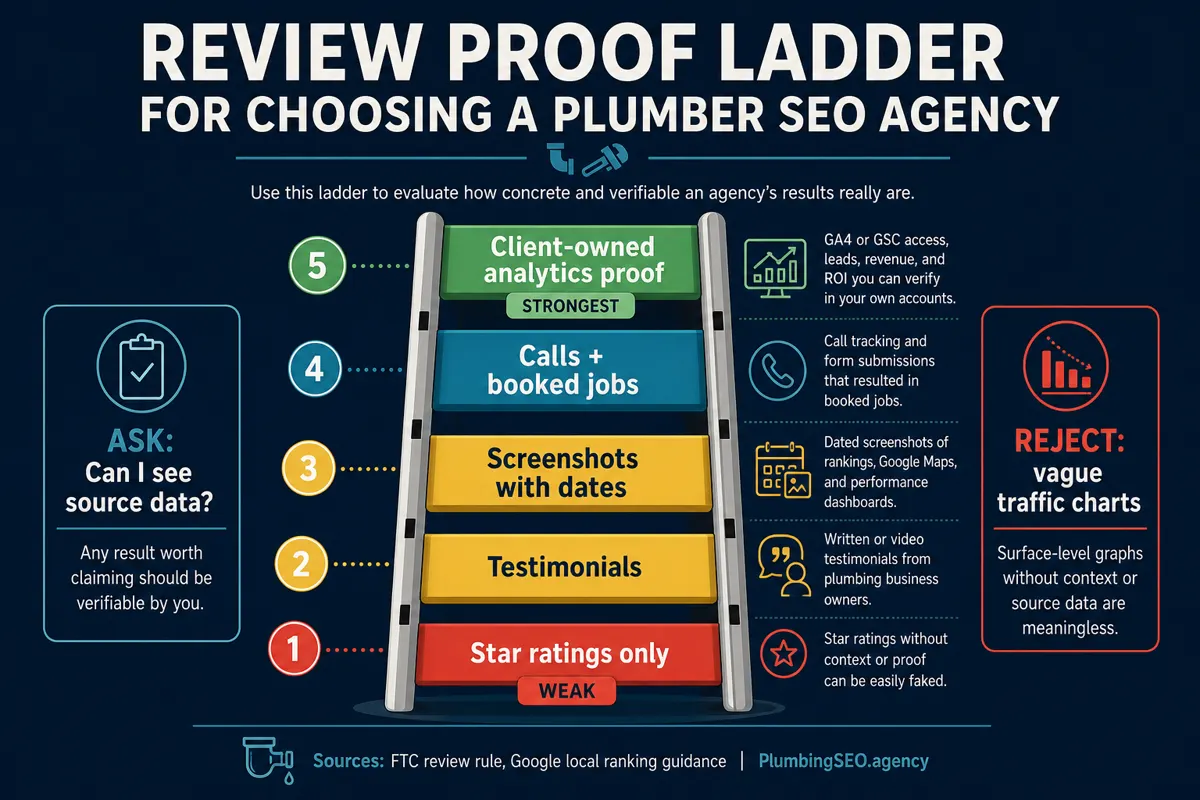
What a useful plumber SEO review actually proves
A useful review does not just say, "Great team" or "They got us ranked." That is nice, but it is not enough to risk monthly marketing money. A useful review tells you whether the agency understands plumbing search, local service calls, dispatch pressure, and the difference between a busy phone and a noisy inbox.
Look for reviews or case studies that answer four plain questions:
| Proof question | Why it matters for a plumber | Weak answer | Strong answer |
|---|---|---|---|
| What changed? | You need to know whether the work affected calls, jobs, and service-area visibility. | "Traffic went up." | "Qualified calls from drain cleaning pages rose after the service pages were rebuilt." |
| When did it change? | SEO takes time, but timelines should still be trackable. | "Results came fast." | "Baseline in month one, technical fixes in month two, call growth tracked by month four." |
| Who can verify it? | You should not have to take a sales deck on faith. | Anonymous screenshot. | Named client, owned analytics, call tracking, and before/after dates. |
| What kind of work drove it? | Plumbing SEO is not one magic trick. It is GBP, service pages, reviews, citations, technical cleanup, and links. | "We built authority." | "We fixed the Google Business Profile, rebuilt service pages, cleaned citations, and tracked calls." |
Google says local ranking depends on relevance, distance, and prominence, and that complete Business Profile information and review management can help local visibility. That does not mean reviews alone rank you. It means an agency should understand how your reviews, profile, service pages, and local proof work together. You can read Google's own local ranking guidance in its Business Profile help documentation.
Where to check plumber SEO provider reviews
Do not expect every provider to appear on every platform. Search the agency's exact legal or trading name, confirm the city and website match, and compare dates and details across more than one source. Similar business names and copied directory profiles can send you to the wrong company.
| Review source | What it can show | What to check |
|---|---|---|
| Google Business Profile | Review history, recent patterns, specific client comments, and how the agency answers criticism. | Sort by newest and lowest rating. Open reviewer profiles and look for details about SEO work, communication, and results. |
| Clutch and G2 | Project scope, company size, budget context, interview-style feedback, and service categories when a provider has a profile. | Read the full project details. Check whether the work involved local service businesses or plumbing, not an unrelated national campaign. |
| BBB | Complaint themes, response behavior, and whether the business attempts to resolve disputes. | Read the complaint and the company response. A resolved billing issue is different from repeated ownership or cancellation disputes. |
| Trustpilot, Yelp, and Facebook | Additional customer-experience patterns, especially communication, billing, and cancellation concerns. | Treat small samples carefully. Compare wording, dates, reviewer history, and the agency's response instead of relying on the average score. |
| Reddit and owner groups | Questions owners ask, contract surprises, and recurring provider names outside formal review sites. | Use posts as leads for due diligence, not verified facts. Anonymous stories and agency promotion can look alike. |
| Agency case studies and client references | Plumbing-specific starting points, work performed, timelines, and commercial outcomes. | Ask to see the source data in a live walkthrough and confirm whether the client, date range, calls, and booked jobs can be verified. |
Decision rule: shortlist the provider only if independent reviews show a stable, specific pattern and the sales team can back it up with a named plumbing example, dated before-and-after data, qualified-call and booked-job evidence, and written ownership terms. If the stars look good but those proof items stay vague, keep looking.
Third-party profiles can reduce risk, but they are still the beginning of the inspection, not the end. A public rating usually cannot tell you whether the client was a one-truck plumber or a multi-location plumbing company, whether emergency calls improved, whether the agency owned the tracking number, or whether the "lead growth" included spam and vendor calls.
Use reviews to decide whether the agency deserves a deeper conversation. Then move to evidence you can inspect: Search Console, Google Business Profile performance, call tracking, booked-job notes, page-level changes, and account ownership. If you take that conversation to an agency, ask them to apply the same proof standard to your own website.
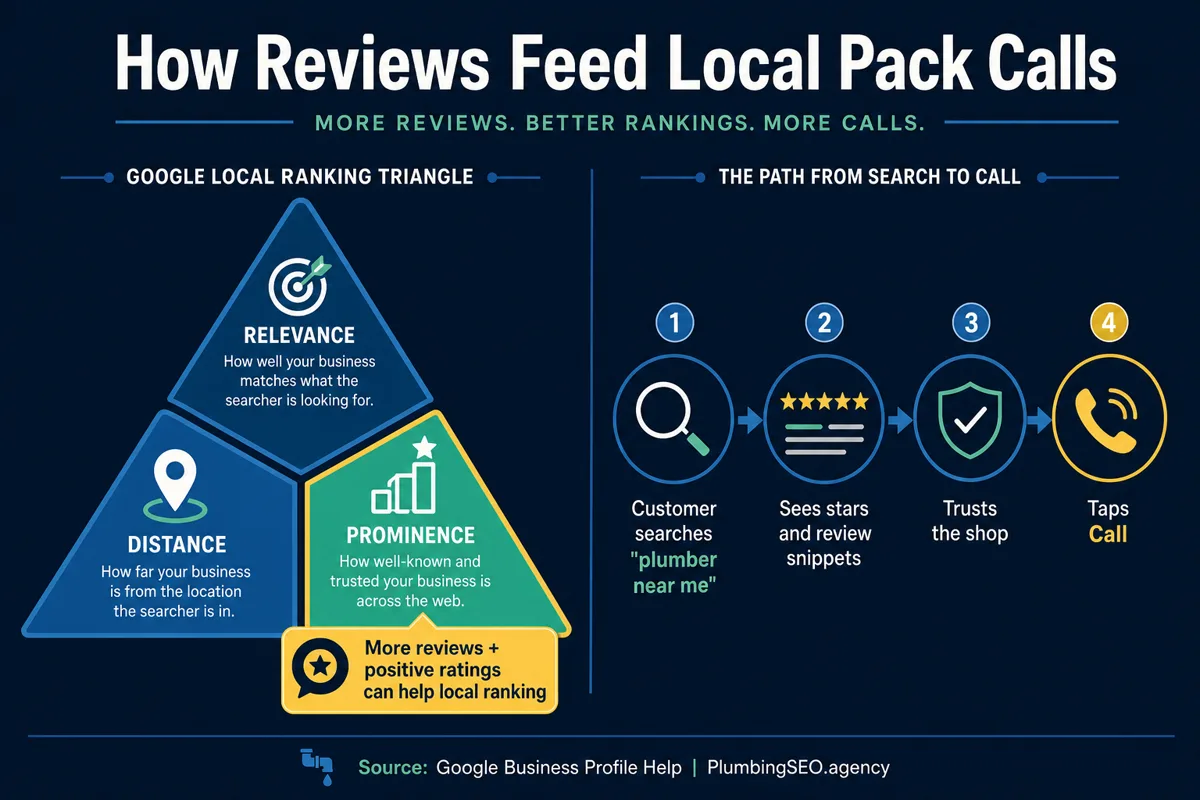
Red flags hiding inside agency reviews
Bad SEO agencies usually do not look bad at first. They show polished testimonials, big numbers, and a sales person who says all the right words. The trouble starts when you ask where the numbers came from.
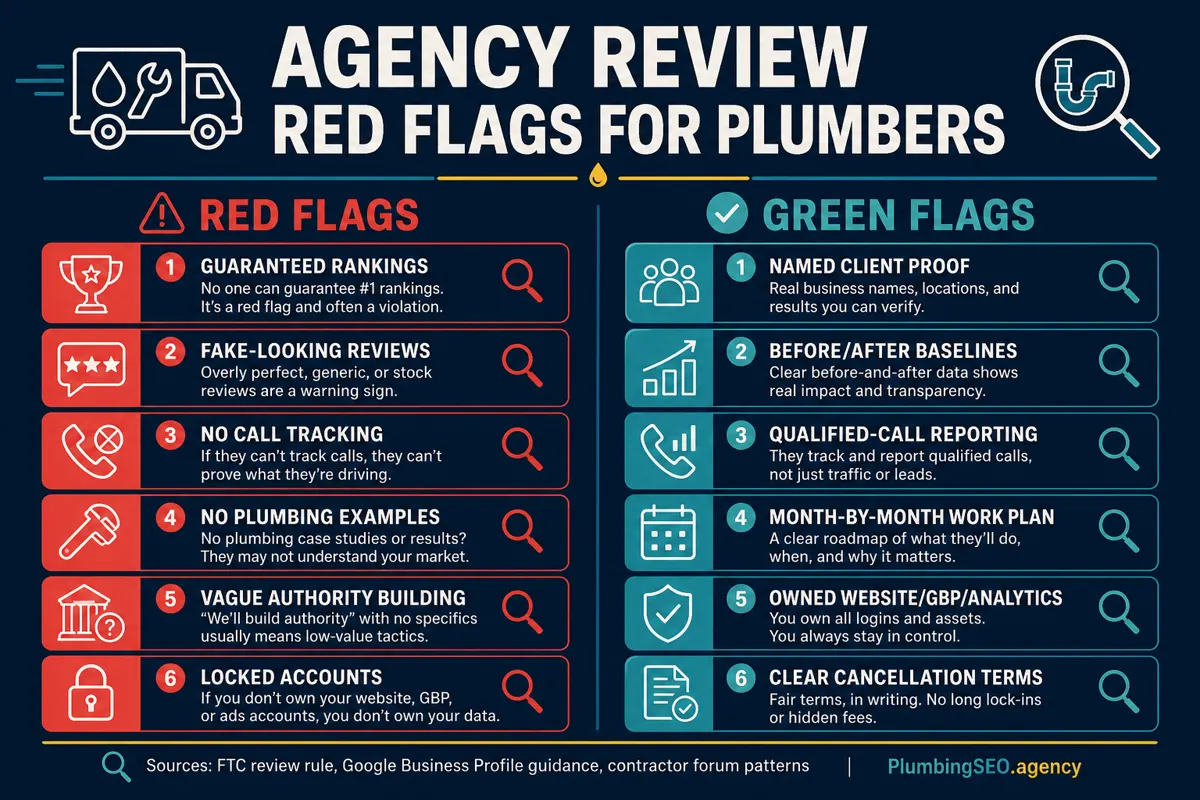
1. The review talks about rankings, not calls
Rankings matter, but a plumbing company does not deposit rankings at the bank. If a review only says "we hit page one" and never mentions qualified calls, form leads, booked jobs, or revenue context, keep digging. Maybe the ranking was for a low-value blog keyword. Maybe the phone never moved. Maybe the agency picked a phrase nobody in your town searches.
2. The agency guarantees a position
No honest agency controls Google. They can control the work, the tracking, the quality of your pages, and the consistency of the plan. They cannot honestly guarantee a number one organic ranking by a certain date. If a review or sales page leans on guarantees, treat it like a slow leak behind the wall. It may not show right away, but it can get expensive.
3. The testimonials look too perfect
The FTC's Consumer Reviews and Testimonials Rule went into effect in 2024 and addresses deceptive review practices, including fake reviews, paid sentiment, insider reviews without disclosure, review suppression, and company-controlled review websites posing as independent. That matters because review proof is now not just a trust issue. It can also be a compliance issue. See the FTC's summary of the final rule banning fake reviews and testimonials.
4. The case study hides the baseline
Before and after proof without the "before" is just a campfire story. Ask what the client had before the agency started: website speed, number of service pages, Google Business Profile completeness, review count, call volume, tracking setup, and local rankings. A good case study will not hide the starting line.
5. You do not own the accounts
If the agency owns your website, Google Business Profile access, call tracking number, analytics, Search Console, or ad account, the review may not protect you. You need to know what happens if you leave. The best reviews in the world do not help if switching agencies means losing your phone number, tracking history, or website control.
12 proof checks for plumber SEO reviews
You do not need to become an SEO analyst before the first call. You do need a repeatable way to separate useful proof from sales fog. Score each check as clear, partial, or missing while the agency talks through its reviews. A strong public rating can earn a sales call, but the evidence below should decide whether the provider earns your contract.
| Proof check | Ask for | What a credible answer looks like |
|---|---|---|
| 1. Plumbing client fit | Type of plumbing company, service area, and job mix. | The example sounds like your business, not a generic national SEO win. |
| 2. Dated baseline | Where calls, rankings, pages, reviews, and GBP health started. | The agency can show before dates and explain the starting problem. |
| 3. Work performed | Specific page, GBP, technical, link, citation, and review work. | You can connect the work to the movement they claim. |
| 4. Call quality | How calls were tracked, reviewed, filtered, and tied to a source. | Booked jobs or qualified call categories are separated from noise. |
| 5. Booked-job evidence | How qualified calls became estimates, appointments, or completed jobs. | The agency distinguishes a ringing phone from revenue-producing work. |
| 6. Timeline | Dates for the baseline, major changes, and measured outcome. | The sequence is plausible and does not imply overnight organic results. |
| 7. Search source | Separation of organic search, Google Maps, ads, referrals, and repeat customers. | The claimed SEO result is not padded with leads from unrelated channels. |
| 8. Service-line detail | Results by drain cleaning, water heaters, sewer work, repiping, or another target service. | The proof connects visibility to the jobs the campaign was built to win. |
| 9. Location context | Market size, service radius, competition, and whether the client has one or several locations. | The agency explains why the example is relevant to your market rather than presenting every win as universal. |
| 10. Reporting access | Read-only access or a live walkthrough of Search Console, analytics, GBP performance, and call tracking. | The evidence can be inspected beyond a cropped sales-deck screenshot. |
| 11. Account ownership | Who owns the site, content, profiles, tracking, and reports. | You keep the assets if the agency relationship ends. |
| 12. Client verification | A named example, attributable quote, or reference when confidentiality permits. | The agency explains what can be verified and labels anonymous or blended examples honestly. |
You do not need all 12 answers in a public review. You do need the agency to fill the gaps before you sign. Treat clear, dated, client-relevant evidence as a pass; treat missing context as an open question, not automatic proof of bad work. If the answers get vague, use the deeper question list in our questions to ask before hiring a plumbing SEO agency guide before you compare packages or sign a term agreement.
The 90-day proof test before you hire
Before you sign, ask the agency to explain the first 90 days in plain English. Not a mystery package. Not "ongoing optimization." A real work plan.
Green-light answer
Walk-away answer
If the proposal gets into budget, compare it against our plumbing SEO pricing guide so you know what kind of work should match the monthly spend. A cheap plan that cannot afford tracking, service-page work, review support, and reporting usually creates a prettier report without fixing the phone.
How to check a review without getting fooled
Do not argue with a testimonial. Test it. A good agency should welcome that because real proof makes the sales call easier.
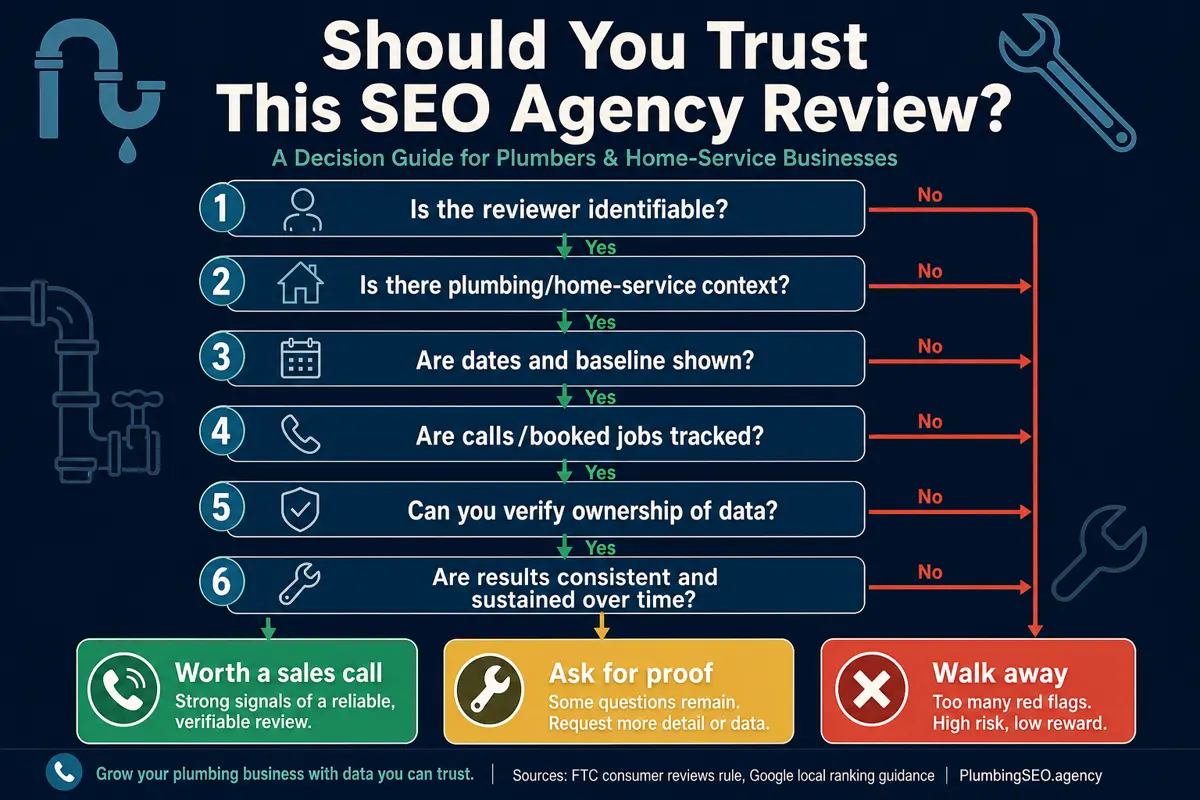
Ask for source screenshots with dates
Ask to see Search Console, Google Business Profile performance, analytics, call tracking, and ranking snapshots with date ranges. Screenshots can still be cherry-picked, but dated screenshots are better than a quote floating by itself.
Ask what counted as a lead
A missed call, spam call, vendor call, and booked water heater job are not the same thing. If an agency says it increased leads, ask how calls were reviewed. A plumbing owner needs qualified calls, not every ring that hits the line.
Ask for plumbing examples, not generic SEO wins
A dentist case study does not prove the agency understands emergency plumbing, service-area pages, drain cleaning jobs, or Google Maps competition. Generic SEO knowledge helps, but service plumbing is its own animal. If you want an agency built around that reality, start with a free plumbing SEO audit and make them show what they would fix first.
Ask how they handle reviews ethically
A strong agency helps you earn and respond to real customer reviews. They should not buy reviews, filter only happy customers, or pressure customers into scripted feedback. Your reputation has to last longer than one campaign. For the client-side reputation playbook, see reputation SEO for plumbers.
Ask what happens if you leave
You should own your website, content, logins, call tracking records, analytics, Search Console, and Google Business Profile access. If leaving means losing the work you paid for, that is not partnership. That is a hostage situation with a nicer invoice.
How to read case studies behind the reviews
A review is a statement. A case study is supposed to be the receipt. When the agency sends one, read it in the order a plumbing owner would inspect a job: diagnosis, work performed, result, and proof that the result belongs to the work.
Strong case studies usually show the starting condition, the constraint, the action, and the commercial result. For example, a drain cleaning campaign should explain whether the agency rebuilt the service page, improved internal links, fixed tracking, strengthened GBP categories, added location proof, or cleaned technical issues. A chart by itself does not tell you that.
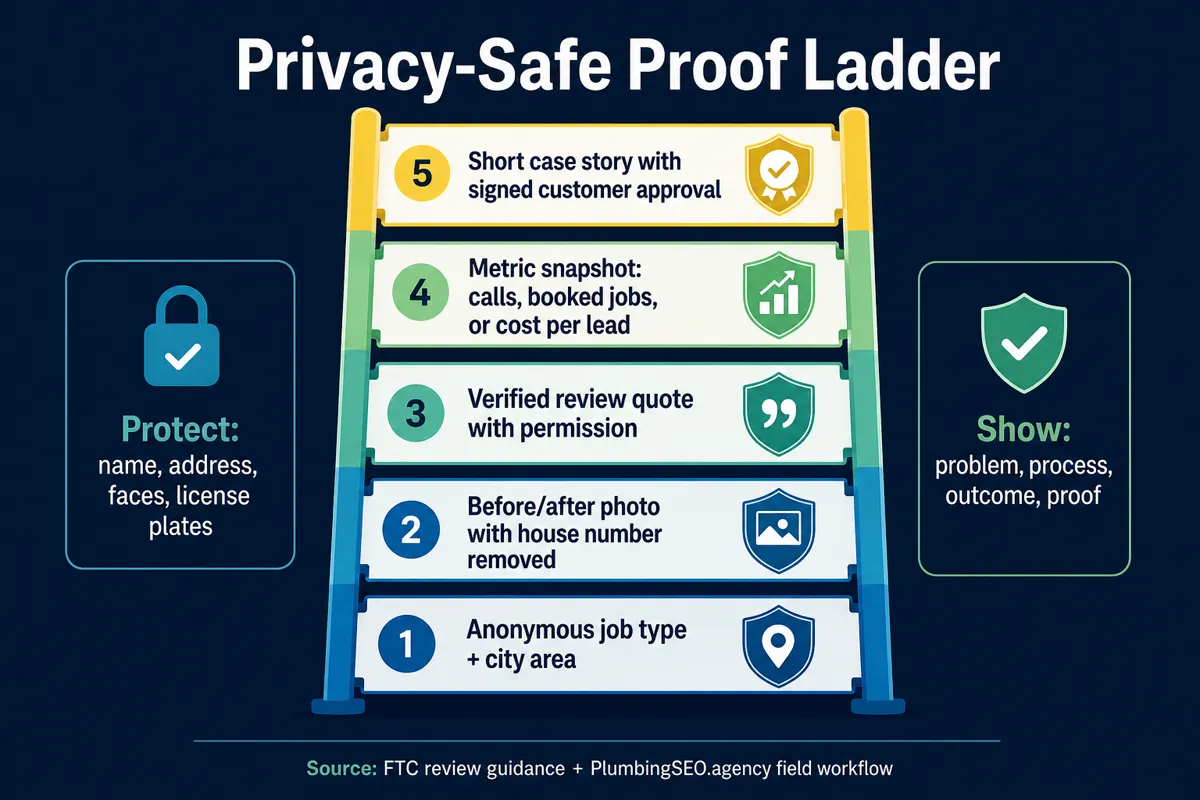
If you want to build this kind of proof for your own company, read our guide to plumbing case study pages. The same proof standard you use to judge an agency can become a trust asset on your own plumbing website.
How to route the next step after you verify the review
Once a review passes the smell test, the next step is not to ask for a generic package. Ask the agency to diagnose your actual search leaks. Which service pages are missing? Which city or neighborhood queries are weak? Which Google Business Profile signals are underbuilt? Which calls are coming from SEO, paid ads, referrals, or repeat customers?
That is the commercial route this page is meant to support. If you are evaluating PlumbingSEO.agency, start with our plumber SEO agency approach to calls and booked jobs, then use the free SEO audit to force the proof conversation around your site instead of somebody else's testimonial.
How this post differs from agency review roundups
There are plenty of pages that rank agencies and collect star ratings. This post is different on purpose. It is not trying to crown a winner from public review profiles. It is showing plumbing owners how to inspect the proof behind those reviews before the sales call turns into a contract.
If you want to read more about what agency proof should look like, see our related guide on plumber SEO agency reviews. That page focuses on reading agency proof signals. This one focuses on not getting fooled when the review looks good but the business evidence is thin.
Final rule: buy outcomes, not activity
A plumber does not need an agency that sounds smart. You need one that can show the work, explain the tradeoffs, track the calls, protect your accounts, and tie SEO back to jobs on the board. Reviews should help you find that agency. They should not replace your inspection.
Read the reviews. Then ask for the proof. If the proof is clean, keep talking. If the proof gets slippery, keep your money in the truck.
Frequently Asked Questions
Start with the provider's Google Business Profile, then check Clutch or G2, BBB, Trustpilot, Yelp, Facebook, and Reddit or owner groups when profiles exist. Compare details across sources, then ask for plumbing-specific case studies, qualified-call data, booked-job evidence, and written account-ownership terms.
They can be useful, but only when they connect to verifiable proof. Look for client context, dates, baseline data, call tracking, and proof that the work produced qualified plumbing leads.
Check whether the review names the business context and explains what changed. A useful review should point to the starting baseline, the work performed, and the call or booked-job result.
Third-party reviews can help you shortlist an agency, but they are not enough by themselves. Use them as a trust signal, then ask for owned Search Console, Google Business Profile, call tracking, and account-ownership proof.
The biggest red flag is a review that claims big results without showing what changed. Rankings, traffic, and vague growth claims should be backed by calls, booked jobs, owned analytics, and a clear work plan.
No. An agency can control the work it performs and how it tracks progress, but it cannot control Google. Guaranteed rankings are usually a sign to slow down and ask harder questions.
Ask for dated before-and-after evidence, Google Business Profile improvements, Search Console data, call tracking, service-page examples, and reporting that separates qualified plumbing calls from noise.
Compare the client type, starting baseline, work performed, timeline, qualified calls, booked jobs, market context, and account ownership. Use ratings to build a shortlist, then ask each agency to fill any proof gaps before you sign.
Use the first 90 days to judge execution quality, tracking, communication, and early movement. Some SEO results take longer, but you should not wait months to find out whether the agency has a real plan.
You should own your website, content, Google Business Profile access, analytics, Search Console, call tracking records, and ad accounts. Do not sign if cancellation means losing your own marketing assets.
Want a second opinion before you sign?
Send us the agency pitch, review claims, or SEO report. We will tell you what looks real, what looks vague, and what a plumbing owner should ask next.
Get a Free SEO Audit