
- If you searched plumber SEO reviews, treat every agency review as a first filter, not final proof. A useful review should connect the market served, the work completed, the timeline, and call or booked-job tracking.
- Compare three proof layers before booking a sales call: public reviews, case studies or reporting samples, and the agency's ability to explain your actual local search leaks in plain English.
- UGC mentions, directory lists, and “best agency” pages can help only when they are recent, specific, and backed by evidence. Use them to shape better questions, then route the final buying decision back to the plumbing SEO agency hub instead of another generic shortlist.
Start With the Problem: Reviews Can Sound Good and Still Hide the Leak
If you are comparing plumber SEO agency reviews, you are probably not looking for bedtime reading. You are trying to figure out who can help the phone ring without wasting another month of marketing budget.
That is the right instinct. Reviews matter. But an SEO agency review is not the same as a restaurant review. A plumber can have a five-star agency experience and still not know whether the campaign produced booked work, better service-area coverage, cleaner reporting, or just nicer-looking charts.
The way I see it, a review is only useful when it helps you answer one question: did this agency help a plumbing company get found, get trusted, get calls, and understand what changed?
Google's own hiring guidance says SEO can include site structure review, technical advice, content development, keyword research, market expertise, and more. It also warns that paying for ads does not affect organic rankings, and that no one can buy placement in Google's organic search results. That is a good starting line for evaluating any agency review or sales pitch. Read Google's advice here: Google Search Central guidance on hiring an SEO.
Quick Answer: Which Plumber SEO Reviews Deserve a Sales Call?
A plumber SEO review deserves a sales call when it gives you enough proof to ask sharper follow-up questions. The best plumber SEO agency reviews do not just say an agency was helpful. They show whether the agency understood emergency jobs, service-area priorities, Google Business Profile visibility, call tracking, and the difference between traffic and booked plumbing work.
For this page, “review” means more than a star rating. It includes Google reviews, agency testimonials, third-party lists, case studies, forum comments, and the proof packet an agency is willing to show before you sign. That wider view helps you avoid choosing the loudest testimonial page when you need the clearest path to calls.
Use this quick filter before you spend 45 minutes on a demo:
- Specific plumbing context: the review names drain cleaning, water heaters, sewer repair, repipes, emergency calls, service areas, or local-pack work.
- Real measurement: the proof mentions calls, forms, qualified leads, booked jobs, Google Search Console movement, or GBP actions instead of only “more traffic.”
- Recent enough to trust: the review, case study, or testimonial page has dates or context that show it still reflects today's local-search environment.
- Clear timeline: you can see whether the result took 30 days, 90 days, six months, or longer.
- Repeatable process: the agency can explain what changed on the website, in local SEO, and in tracking.
- Plain-language reporting: you would understand the monthly report without needing to decode agency jargon.
If a review checks three or more boxes, it may be worth a conversation. If it checks none, it is probably just social proof decoration.
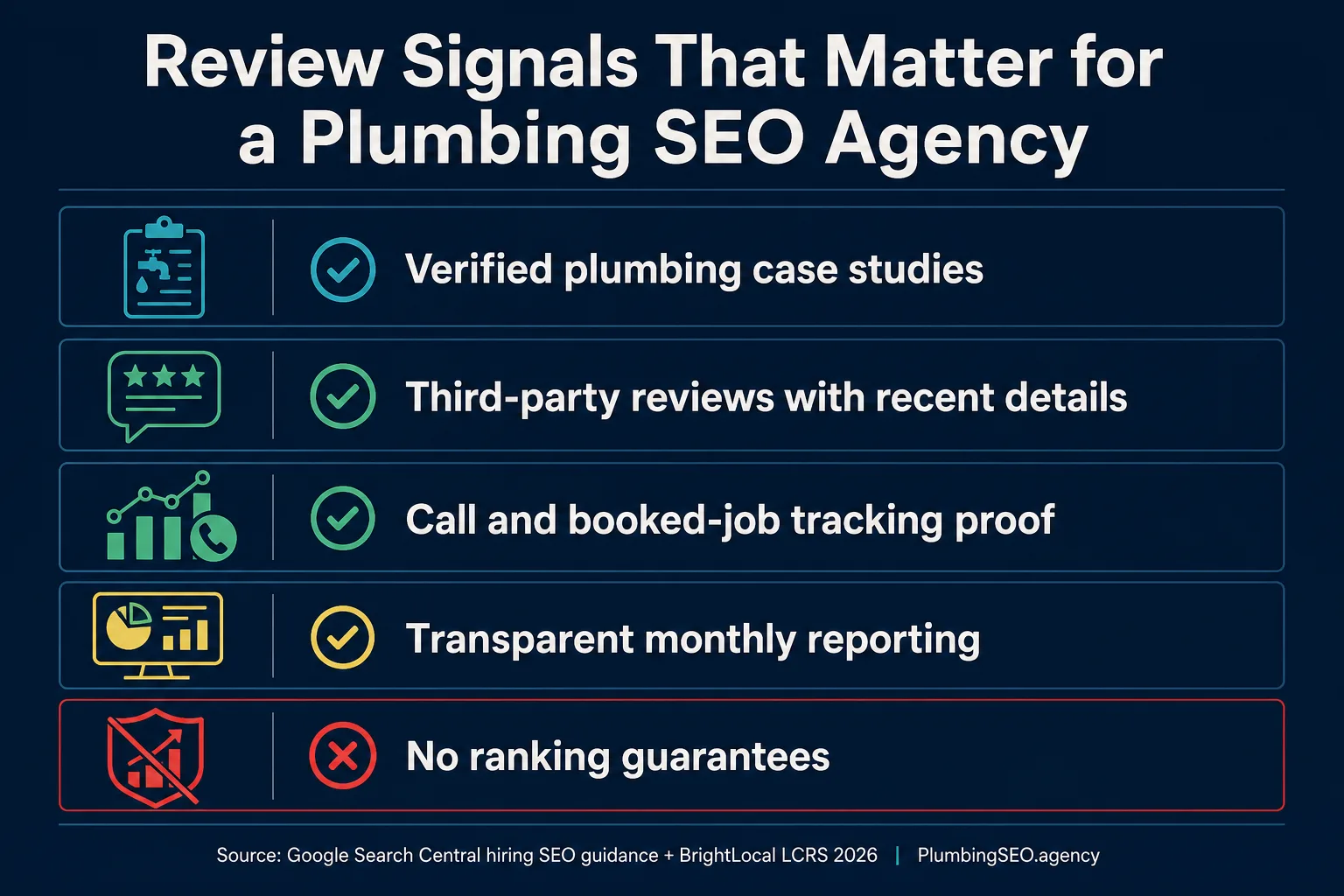
What a Strong Plumber SEO Agency Review Should Prove
A strong review gives you enough detail to understand the job. It does not need to expose private numbers, but it should show the type of plumbing company, the market, the work, and the result. If all you get is “great team” and “highly recommend,” that may be honest, but it does not help you decide who should touch your website.
Look for reviews and case studies that mention plumbing-specific work like Google Business Profile cleanup, service page improvements, technical fixes, review management, call tracking, or service-area content. If the review could apply to a dentist, roofer, lawyer, or dog groomer without changing a word, it is probably too thin for a plumbing owner making a serious decision.
| Review detail | Why it matters for a plumber | Question to ask |
|---|---|---|
| Named service area | Local SEO is tied to cities, routes, and proximity. | Which markets improved? |
| Work completed | You need to know whether they fixed pages, GBP, links, tracking, or all of it. | What did the agency actually do? |
| Baseline and timeline | A result without a starting point is just a story. | How long did it take? |
| Call or booked-job proof | Rankings are useful only when they help jobs get on the board. | How were leads tracked? |
| Reporting sample | You need to see if the agency reports work in plain English. | Can I see a sample monthly report? |
Separate Review Signals From Sales Theater
Some agency pages are built to impress you quickly. Big badges. Big promises. Big screenshots. That does not make them bad, but it means you need to slow down and check the plumbing behind the wall.
BrightLocal's 2026 Local Consumer Review Survey says review recency, star ratings, and responses are becoming more important to consumers. That applies to local businesses, but the lesson carries over when you are evaluating vendors too. A fresh, specific review usually beats a vague testimonial from years ago. See the source: BrightLocal Local Consumer Review Survey 2026.
For plumber SEO agencies, the useful review signals are not just “they were responsive.” Responsiveness is good. But the agency also needs to show they can work in a trade where calls, emergency demand, routes, local packs, and service pages all matter.
How to Weigh Google Reviews, Directories, and UGC Mentions
Review-intent searches often mix three very different sources: Google reviews, agency listicles, and user-generated comments from places like Reddit, Facebook groups, forums, or trade communities. Do not grade them the same way.
Google reviews are useful for service experience, responsiveness, communication, and whether clients felt heard. They are usually weaker on SEO proof because most clients do not write detailed measurement notes. Directory and “best agency” lists can help you find names, but many are pay-to-play or affiliate-driven, so treat the list as a starting point. UGC comments can reveal warnings, praise, or vendor names that do not show up on polished sales pages, but anonymous comments need evidence before they should affect a real budget decision.
| Source | What it is good for | What to verify next |
|---|---|---|
| Google reviews | Responsiveness, communication, account support, client satisfaction | Ask for the plumbing work, timeline, and tracking proof behind the praise. |
| Case studies | Campaign structure, starting point, work completed, business outcome | Ask whether the case matches your city size, job mix, and budget. |
| Directories/listicles | Finding agencies to compare | Check whether the list discloses ranking criteria or sponsorship. |
| Reddit/forums/groups | Unfiltered warnings, recurring names, owner-side objections | Look for dates, details, screenshots, and whether the commenter is credible. |
The goal is not to find one perfect review. The goal is to build a confidence stack: public sentiment, plumbing-specific proof, and a sales conversation that matches what your site actually needs.
Do a 7-Minute SERP Check Before You Believe the Shortlist
Before you trust any “top plumber SEO agencies” list, search the agency name plus words like reviews, complaints, case study, plumbing, and contract. You are not hunting for drama. You are checking whether the public story, the agency sales page, and owner-side comments all point in the same direction.
A useful review-intent check looks for patterns. One negative comment without evidence is not a verdict. Ten vague five-star reviews with no plumbing context are not proof either. The strongest signal is consistency across sources: specific plumbing examples, dated work, clear reporting, and answers that match what the agency says on the call.
- Search the brand: look for the agency name with “plumber SEO reviews,” “case study,” “contract,” and “reporting.”
- Check dates: favor recent proof over a testimonial page that has not changed in years.
- Compare claims: if a directory calls an agency “best” but the agency cannot explain lead tracking, treat the list as discovery only.
- Watch repetition: identical testimonials, generic screenshots, or unverified ranking claims should trigger deeper questions.
This same discipline applies to your own reputation signals. If your plumbing company needs a cleaner review engine, our reputation SEO guide for plumbers explains how customer reviews support local visibility without drifting into paid-review risk.
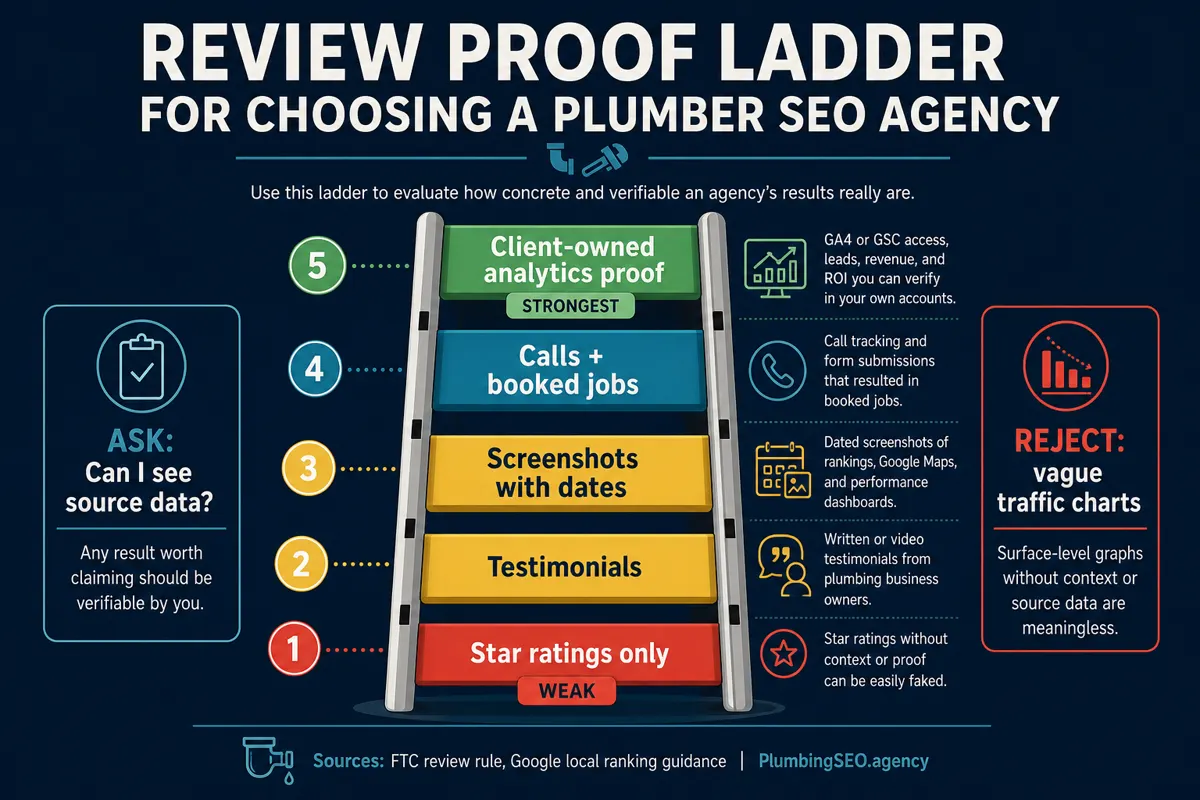
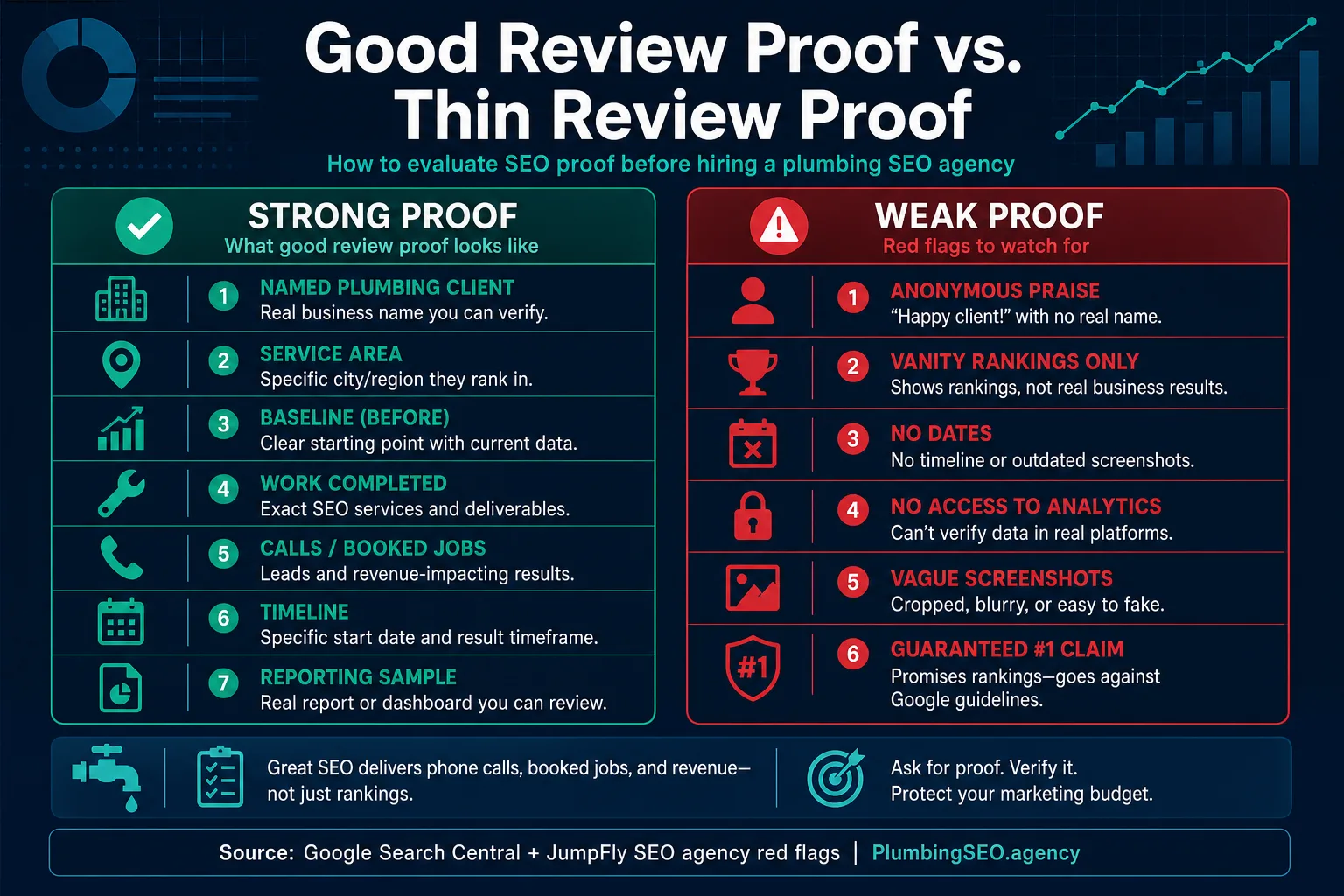
Red Flags Hiding Inside Plumber SEO Reviews
Here is what most agencies miss when they show proof. A plumbing owner is not buying a pretty report. You are buying the chance to get more of the right calls from the right service areas. If a review does not help you judge that, it is incomplete.
Watch for these red flags:
- Guaranteed rankings. Google warns against unrealistic promises. Nobody controls Google, no matter how confident the pitch sounds.
- Only vanity rankings. Ranking screenshots can be useful, but they do not pay payroll. Ask how those rankings affected calls, forms, and booked jobs.
- No dates. Old wins can be real, but SEO changes. You need recent examples or a clear explanation of what still applies.
- No plumbing context. A general small-business case study is not the same as ranking a plumber in a competitive local market.
- No access to reporting. If the agency cannot show a sample report before you sign, imagine how vague the updates may be after the invoice starts.
JumpFly's agency red-flag guide calls out performance promises, meaningless metrics, and canned audits. Those are the same traps plumbing companies run into when an agency sells “SEO” but cannot explain what will change on the website, in Search Console, or in call tracking. Source: JumpFly SEO agency red flags.
Use Reviews to Judge the Reporting, Not Just the Results
A good plumber SEO agency should make the work understandable. You should not need a decoder ring, a marketing degree, and three coffees to understand whether the campaign is moving in the right direction.
Ask what the monthly report includes. In my opinion, the basics should be plain: what was fixed, what was published, what moved in Google Search Console, what changed in Google Business Profile, which calls or forms were attributed, and what gets fixed next. If an agency only reports rankings, you may be missing the leak that matters.
This is where our own lead tracking guide for plumbers is useful. The cleaner your tracking is, the easier it is to tell whether SEO work is producing the kind of calls you actually want.
Ask for a Small Proof Packet Before You Compare Prices
Before you compare retainers, ask each agency for a small proof packet. You are not asking them to reveal another client's private data. You are asking whether their work can be inspected before you hand over access to your website, Google Business Profile, call tracking, and budget.
A fair proof packet can include:
- A redacted monthly report that shows work completed, movement, leads, and next actions.
- A plumbing or home-service case study with the market size, service mix, starting point, and timeline.
- A sample first-90-day roadmap that separates technical fixes, content, local SEO, tracking, and reporting.
- A contract summary that explains term length, cancellation, ownership of content, access, and what happens if you leave.
- A plain-English explanation of how the agency would support the homepage or main service pages instead of creating duplicate “agency” pages.
If the agency cannot provide any version of this, the reviews are doing too much of the selling and not enough of the proving.
Ask These Questions Before Trusting a Review
Do not make this complicated. Before you book a sales call, run the review through this owner-side filter.
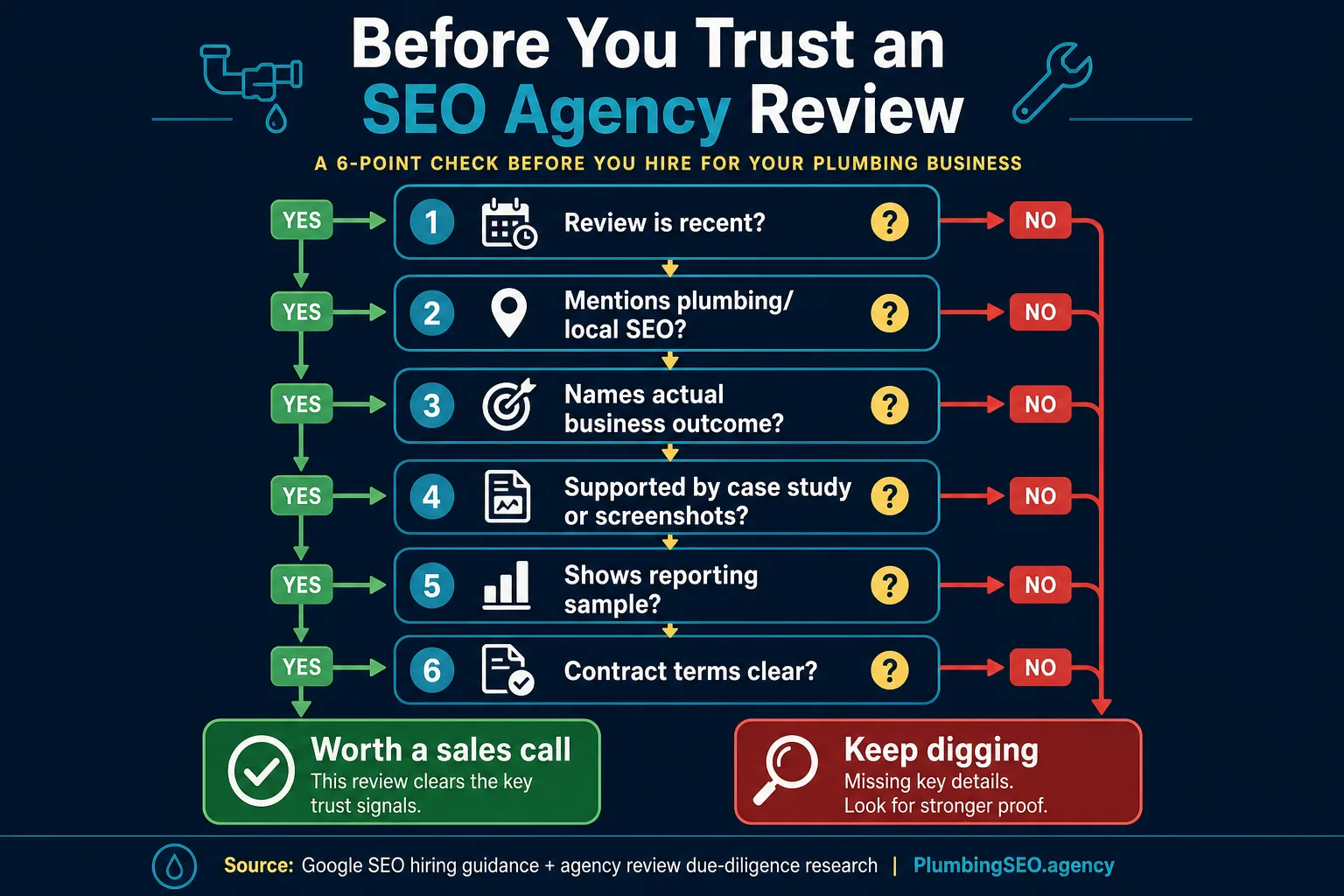
How This Differs From Google Review Tactics
This article is not about getting more customer reviews on your Google Business Profile. That is a different job. If you need that, read our guide on safe Google review requests for plumbers.
This guide is about evaluating reviews of an SEO agency before you hire them. The overlap is trust. The difference is the decision. One protects your local reputation with customers. The other protects your marketing budget from vague proof.
A Practical Review Checklist for Plumbing Owners
Use this before you sign a contract, especially if the agency claims to specialize in plumbing SEO.
- Find the plumbing proof. Look for plumber, HVAC, drain cleaning, water heater, sewer, or home-service examples.
- Check the outcome. Calls, booked jobs, service-area rankings, and GBP actions matter more than a generic traffic bump.
- Ask for a sample report. It should be readable and tied to work completed.
- Ask what they need from you. Good SEO needs access, approvals, photos, service details, and tracking cooperation.
- Check contract terms. Know the length, cancellation rule, asset ownership, and reporting cadence.
- Watch the guarantee language. If the promise sounds too clean, it probably skipped the hard parts.
If you are comparing agency help against doing it yourself, this pairs well with our plumbing SEO agency vs DIY guide. If you want to know what a proper engagement should include, read what professional plumbing SEO services include.
What to Bring From the Review Page to the Sales Call
Do not let the sales call restart the evaluation from zero. Bring the exact proof gaps you found while reading reviews. A good agency will welcome sharper questions because it lets them explain fit. A weak agency will try to move you back to vague promises.
| What you found | Question to ask on the call | Strong answer sounds like |
|---|---|---|
| Good reviews, no metrics | How do you connect SEO work to calls and booked jobs? | They explain call tracking, forms, Search Console, GBP actions, and reporting limits. |
| Case study in another trade | What changes for a plumber with emergency and service-area demand? | They separate local-pack work, service pages, city coverage, and phone-first conversion. |
| Directory award or “best” badge | What criteria put you on that list? | They disclose sponsorship, selection criteria, or tell you not to treat the badge as proof. |
| Strong testimonials, long contract | What do we own if we cancel? | They explain content ownership, access, tracking numbers, reports, and cancellation terms. |
Also inspect the agency's own site like you would inspect yours. Are trust signals visible? Are service pages clear? Are CTAs direct? Our plumbing website trust signals guide gives a simple owner-side lens for that check.
A 10-Minute Scorecard for Comparing Reviews
When several agencies look similar, score the proof instead of scoring the polish. Give each agency one point for each item below. A score of six or higher is worth a deeper conversation. A score below four means you should keep comparing or ask for stronger evidence before you book a call.
| Proof item | Point if yes | Why it matters |
|---|---|---|
| Plumbing or close home-service example | 1 | Shows the agency understands local trade demand. |
| Named work completed | 1 | Separates real SEO from vague account management. |
| Timeline included | 1 | Sets realistic expectations for movement and payback. |
| Call, form, or booked-job tracking discussed | 1 | Connects SEO to revenue, not just rankings. |
| Sample report available | 1 | Shows whether you will understand monthly progress. |
| Contract terms are clear | 1 | Protects ownership, cancellation, and access. |
| No ranking guarantee | 1 | Suggests the agency is honest about SEO risk. |
| Clear fit for your main market | 1 | Prevents buying a strategy built for another city or service mix. |
Do not overthink the math. The scorecard simply forces the conversation away from “who has the nicest testimonial page?” and toward “who can prove they know how to grow a plumbing company?”
Route the Final Decision Back to the Agency Hub
This page is a proof-check guide, not another near-duplicate agency-selection page. If you are ready to compare what an actual plumbing-only SEO engagement should look like, use the plumber SEO agency homepage as the main hub. It explains the positioning, the plumbing-only focus, and the kind of SEO work this site wants to be known for.
For buying details, pair that with the pricing page and the free SEO audit. Those links move a review-intent visitor from “can I trust the proof?” to “what would happen on my site?” without creating another competing agency guide.
What a Good Agency Should Be Able to Explain
Before you hire, ask the agency to explain the first 90 days in plain English. For a plumbing company, that should usually cover website structure, Google Business Profile, service pages, local visibility, technical basics, internal links, reporting, and tracking.
They should also explain how the work supports your main market goals. For PlumbingSEO.agency, the homepage remains the main hub for broad terms like plumber SEO agency and plumbing SEO services, so supporting posts like this one link up to the core plumbing SEO agency homepage instead of creating duplicate head-term pages.
The report may look good, but the phone tells the truth. Read reviews. Check proof. Ask better questions. Then hire the agency that can explain how their work helps the right customer find you before they call the other shop.
Frequently Asked Questions
Look for plumbing-specific proof: the market served, the work completed, the timeline, reporting details, and whether the campaign tracked calls, forms, or booked jobs. Vague praise is not enough for a serious hiring decision.
Use them as a clue, not a verdict. UGC comments can surface warnings or names to investigate, but they should be checked against dates, screenshots, detailed context, case studies, contracts, and a live sales conversation.
Yes. Google does not sell organic rankings, and no agency controls every ranking factor. A good agency can explain strategy, work, measurement, and risk. It should not promise a guaranteed number one ranking.
Ask for context. A stronger case study includes the business type, service area, starting point, work completed, dates, reporting sample, and the business outcome measured. If everything is anonymous and cropped, keep digging.
Whenever possible, yes. Rankings and traffic matter, but plumbing owners need to know whether SEO helped produce calls, forms, and jobs. If the agency cannot explain tracking, the review proof is incomplete.
It can help, but plumbing has local-pack, emergency-call, service-area, and Google Business Profile realities that general reviews may miss. Prefer proof from plumbers or closely related home-service businesses.
Ask for a redacted sample report, a plumbing or home-service case study, a first-90-day plan, contract terms, ownership rules, and how calls or booked jobs will be tracked. Price matters more when the proof is comparable.
Separate source types. Use Google reviews for client experience, directories for discovery, case studies for work proof, and forums or social comments for questions to verify. Trust rises when multiple sources point to the same plumbing-specific outcome.
Ask for a sample report, plumbing-specific examples, contract terms, ownership rules, tracking setup, first-90-day plan, and what they need from your team. The answer should be plain enough for an owner to act on.
Want a Cleaner Way to Judge SEO Proof?
Start with a free plumbing SEO audit. We will show what is leaking, what should be fixed first, which proof signals matter for your market, and how to measure whether the work is helping the phone ring.
Run My Free SEO Leak Check