
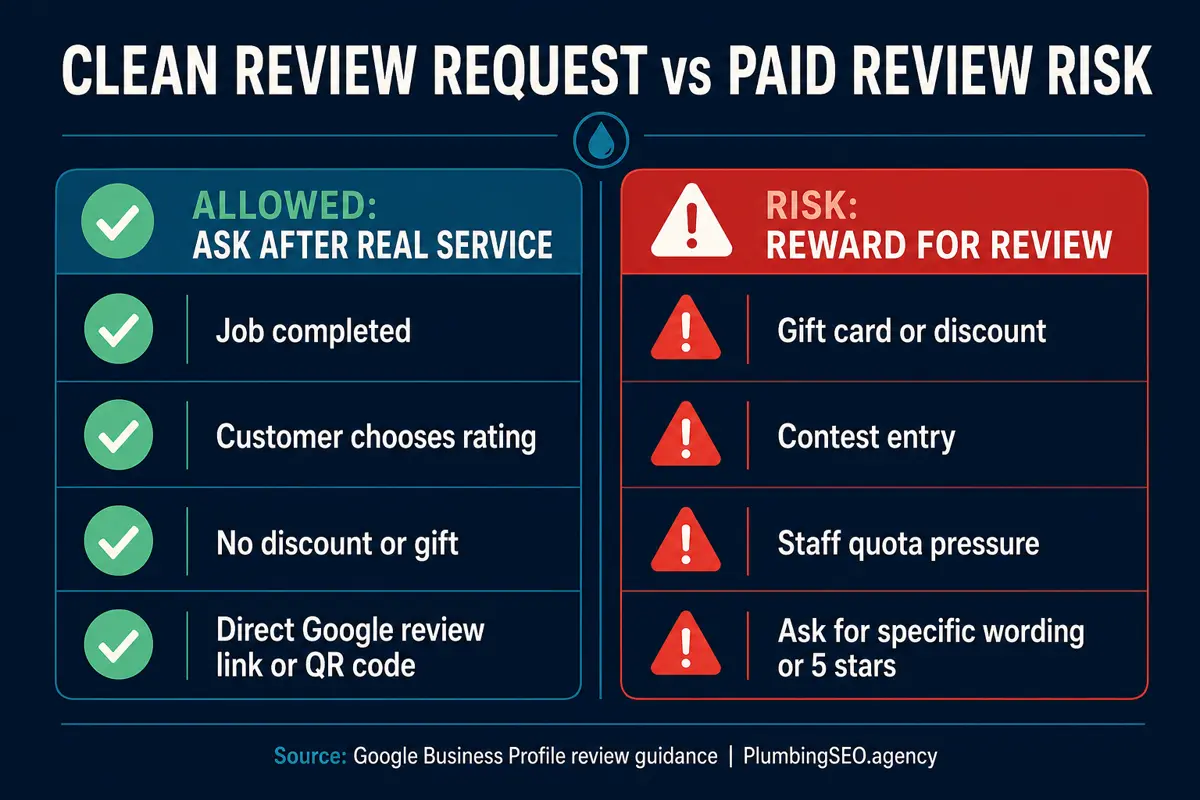
- Do not offer discounts, gift cards, contests, or technician bonuses in exchange for Google reviews. Google treats incentives as fake engagement.
- Ask after a real completed job, keep the wording neutral, and let the customer choose the rating and review details.
- Document your review-request process now, because Google Maps is collecting user signals about rewarded reviews.
Google Maps is putting a sharper spotlight on paid reviews. Recent reporting showed Maps users being asked a direct question after visiting a business: does this business offer rewards in exchange for reviews? For plumbing companies, that should get your attention.
Reviews help homeowners decide who gets the call when a toilet is backing up or a water heater quits. They also support local visibility. But if those reviews are tied to a discount, gift card, contest, free add-on, or pressure from a tech standing in the driveway, the short-term bump can turn into a long-term mess.
In my opinion, the fix is not to stop asking for reviews. The fix is to build a clean review process before you ask. Good service should create the review. The request should only make it easy for the customer to say what really happened.
What changed with Google Maps paid review prompts?
The latest industry coverage from PPC Land described Google Maps showing users an in-app prompt asking whether a business offered rewards in exchange for reviews. The important part is not the exact screen. The important part is the direction Google is moving.
Google already says review incentives are prohibited. The difference is that Maps is now asking people directly about the review experience. That means your office script, technician instructions, invoice insert, QR card, and follow-up text all need to match the policy. Google may not see your break-room whiteboard, but the customer might tell Google what it says.
What Google allows and what it does not
Google's own guidance says businesses can ask customers for reviews and make the process easy with a link or QR code. It also says offering incentives, including free or discounted goods or services, in exchange for reviews is fake and misleading content. The Google Business Profile review guidance is plain enough: ask, respond, and value honest feedback. Do not buy the answer.
That boundary matters for plumbers because review requests often happen at the end of a job, when the customer is standing there, the invoice is open, and the tech wants to leave on a good note. That is exactly when a sloppy line can create risk.
The plumber-safe review request rule
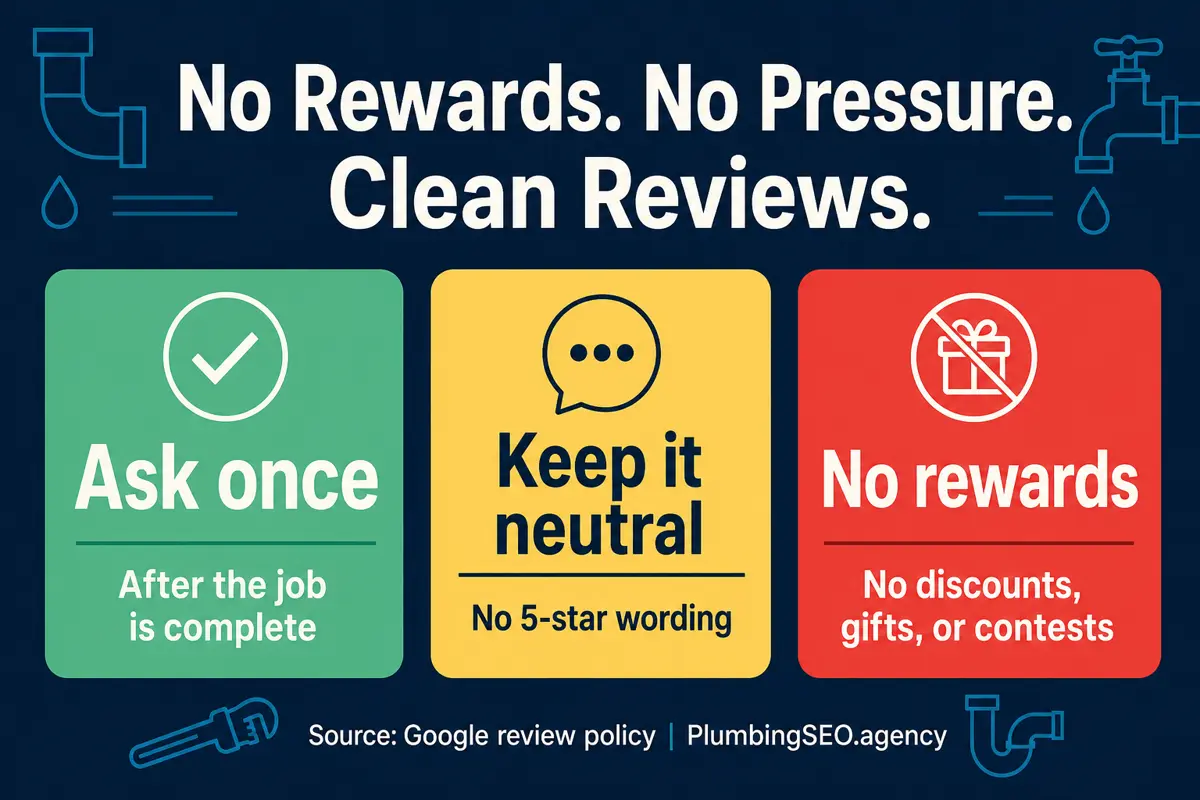
Use this rule with every CSR, dispatcher, tech, and manager: ask once, ask neutrally, and never attach a reward. If the customer had a real experience with your company, they can leave a real review. If they did not, do not ask them. If they are upset, do not hide the review link and route them somewhere else just to protect the star rating.
Use this field script after a completed job
Here is a simple script a plumbing tech can use without sounding like a robot:
"I'm glad we got that taken care of. If you have a minute later, would you mind leaving an honest Google review about your experience? It helps local homeowners know who they can call. I'll send the link by text so it is easy to find."
Notice what is missing. There is no "please mention my name." No "five stars would really help." No "show me the review and I can take something off the bill." It is just a clean ask after a real job.
What to remove from your review process today
| Risky tactic | Why it creates trouble | Safer replacement |
|---|---|---|
| "Leave a review for $10 off" | It ties the review to a financial incentive. | Send a neutral review link after the job. |
| Monthly tech quotas | They can pressure staff to push customers too hard. | Track request consistency, not forced outcomes. |
| Only asking happy customers | Selective solicitation can look like review gating. | Ask all real customers in a consistent workflow. |
| "Mention Mike by name" | It influences review content instead of letting customers speak naturally. | Let customers describe the job in their own words. |
If you already have one of these tactics running, do not panic. Shut it off, update the scripts, and document the cleaner process. Like a slow leak under a sink, review risk gets worse when everyone pretends it is probably fine.
Run this audit before your next review push
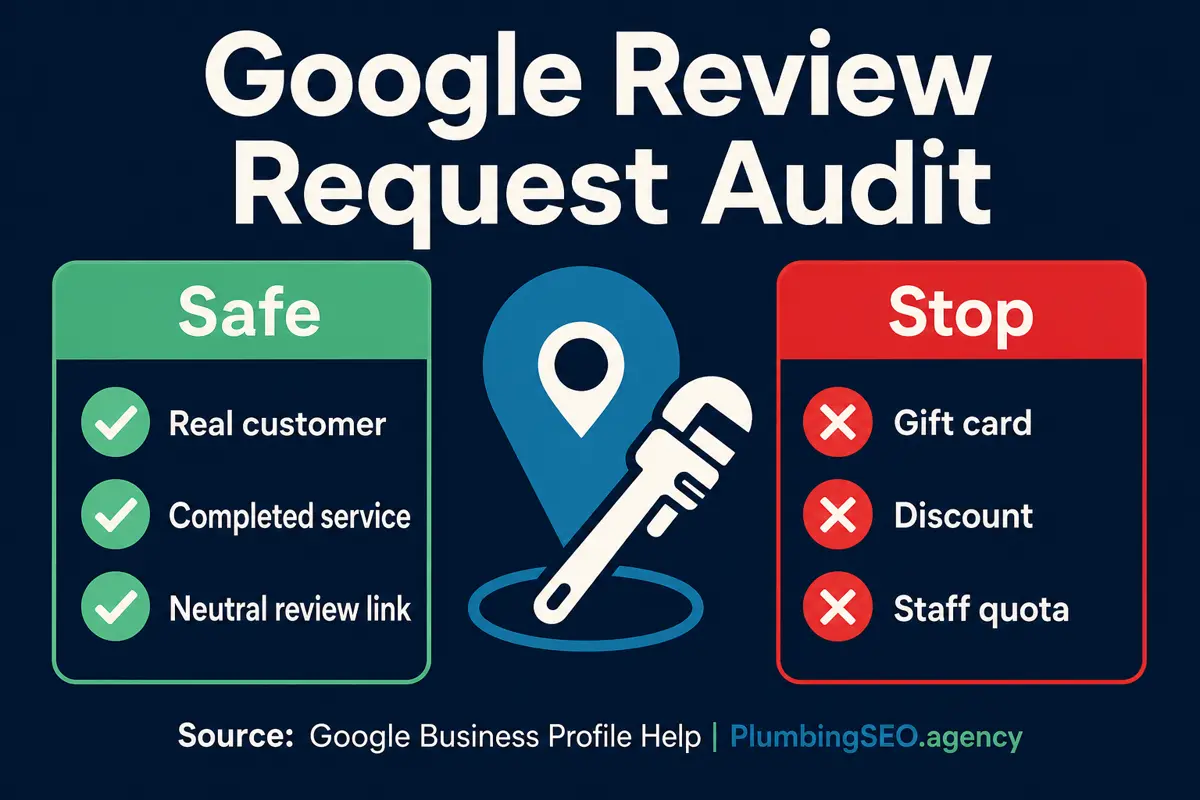
Before you print QR cards, launch an SMS automation, or tell every tech to start asking harder, run a quick audit. The goal is to make sure every request can stand on its own if a customer, competitor, or platform reviewer questions it.
The clean review system for a plumbing company
- Finish the job first. Do not ask during pricing, dispatch, or before the customer has seen the work.
- Confirm the customer has what they need. Ask if there are any questions before you ask for feedback.
- Send one neutral link. Text or email the Google review link. Do not write the review for them.
- Log the request. Track job ID, customer, request date, channel, and staff member.
- Respond to every review. Thank positive reviewers and handle negative ones calmly. If you need templates, use our guide on responding to negative Google reviews.
- Review the pattern monthly. Look for repeated service issues, not just star counts.
This also supports your broader local SEO. If your Map Pack visibility is weak, reviews are only one piece. Your categories, service areas, citations, service pages, photos, and calls all matter too. Start with our Google Maps SEO guide for plumbers if the whole profile needs work.
Where paid ads and SEO fit after you clean up reviews
A compliant review process will not replace a full marketing plan. It protects trust. For emergency calls and slow weeks, you may still need Google Ads, Local Services Ads, and stronger service pages while SEO builds. The difference is that clean reviews make every channel work better because the customer sees real proof before they call.
If you are comparing channels, our SEO vs PPC guide for plumbing companies explains how organic visibility and paid ads should support each other instead of fighting for budget.
Bottom line
Google Maps paid review prompts are a warning shot. Plumbing companies should keep asking for reviews, but only after real service, with neutral wording, no incentives, and a process the whole team understands. That is how you build trust without putting your profile at risk.
FAQ: Google paid review prompts for plumbers
Yes. Plumbing companies can ask real customers for honest Google reviews and make the process easy with a link or QR code. The request should be neutral and should not offer anything in exchange.
No. Google says incentives such as free or discounted goods or services in exchange for reviews are prohibited. That includes discounts, gift cards, contests, free add-ons, or other rewards.
No. Ask for an honest review, not a five-star review. The customer should choose the rating and wording based on the real job experience.
They can ask once after the job is complete, but they should not pressure the customer, stand over them while they write it, or tie the request to a reward. A neutral follow-up text is usually cleaner.
Track the job, request date, channel, staff member, and whether the customer received a neutral link. Do not track tech performance by forced review quotas or promised five-star outcomes.
Stop the incentive immediately, update staff scripts, remove promotional language, and document the new compliant process. If reviews disappear, focus on earning new honest reviews from real completed jobs.
Want cleaner Google reviews without risking your profile?
We can audit your plumbing company's review request workflow, Google Business Profile, and local SEO signals so you can earn trust the right way.
Get a Free Plumbing SEO Audit