
- Google Maps SEO for plumbers is now a full local-search system: GBP accuracy, review velocity, category relevance, service-area proof, website authority, and call tracking all have to agree.
- This page is support content, not a duplicate money page. The canonical buyer path remains our local SEO service for plumbers, with the homepage supporting broad plumbing SEO terms.
- Use the checklist below to diagnose why competitors own the Local Pack, then route implementation through GBP cleanup, citations, review systems, service pages, service-area SEO, internal links, and attribution.
When a homeowner wakes up to a burst pipe or a flooded basement, they do not spend 20 minutes researching companies. They grab their phone, search "emergency plumber near me," and tap the first reliable-looking option they see in the Google Maps Local 3-Pack.
If your plumbing company is not showing up there, you are losing high-value, immediate-need jobs to competitors every single day. This refreshed playbook shows what Google looks for, what your team can fix, and where a plumber-focused Google Maps SEO service can take over the heavier execution without creating a competing page.
The 2026 Local/Maps SERP Gap This Page Is Built to Close
For searches like local SEO for plumbers, Google Maps SEO plumbers, and plumber near me SEO, the current SERP is crowded with generic local SEO agencies, directory-style guides, and competitors that talk about Maps without showing a plumbing-specific operating system. Plumbing companies need a clearer path: what belongs in the Google Business Profile, what belongs on the website, what earns trust off-site, and what proves the work is producing booked calls.
This article deliberately supports, rather than competes with, the canonical buyer pages. If a visitor wants implementation, send them to the local SEO for plumbers service page. If they are comparing broader plumbing SEO help, route them to the plumbing SEO services page or the PlumbingSEO.agency homepage. Keeping this intent map clean avoids cannibalization while still giving Google a deep support article for Maps-specific questions.
Maps-to-Service Handoff: When the Local SEO Page Should Take Over
Use this blog when the reader is learning why the Maps Pack matters or auditing basic Google Business Profile signals. Send the next click to the local SEO service route when the work becomes operational: profile cleanup, citation repair, review systems, service-area proof, page/schema alignment, and call attribution. That handoff keeps the blog educational while the local SEO for plumbers service owns buyer and implementation intent.
| Reader signal | Keep them in the guide when... | Route to service when... |
|---|---|---|
| They ask "what affects Maps rankings?" | They need definitions for proximity, relevance, prominence, reviews, citations, and GBP categories. | They need someone to audit the profile, fix inconsistent NAP, and coordinate those signals monthly. |
| They compare competitors in the 3-Pack | They are collecting review counts, categories, photos, spam signals, and website proof. | The competitor gap requires citation cleanup, service-area content, review workflows, or local links. |
| They want more booked calls, not more impressions | They are learning how Maps clicks, organic visits, and phone calls relate. | They need call tracking, lead-source reporting, and page improvements tied to real plumbing jobs. |
The practical rule: this page explains the system; the service page explains the implementation. That is why the strongest contextual link from this article points to Google Maps SEO implementation for plumbers, not to a new duplicate blog or a changed slug.
When Google Maps Impressions Rise but Calls Do Not
A common local SEO failure pattern is not total invisibility. It is partial visibility that never turns into booked jobs. A plumber may start appearing for google maps for plumbers, drain cleaning, water heater, or emergency searches, but the listing still earns no calls because the searcher chooses a competitor with stronger trust signals.
That gap usually shows up in one of three places. First, the Google Business Profile is technically live but does not look like the strongest plumbing option in the map pack. Second, the website page connected to the profile does not confirm the same services, service areas, reviews, and phone CTA. Third, tracking is too muddy to separate Maps leads from ads, branded searches, and referrals.
| Visibility leak | What homeowners see | Fix first |
|---|---|---|
| Profile appears but earns no tap | Competitors have more recent reviews, better photos, clearer hours, or a stronger service match. | Update categories, services, review requests, owner responses, and real job photos before chasing new content. |
| Profile and website disagree | The GBP says one service area or category while the linked page says something broader, thinner, or outdated. | Align GBP services with the local SEO implementation page, service-area proof, NAP, LocalBusiness schema, and internal links. |
| Calls happen but attribution is unclear | The team sees phone activity but cannot tell whether Maps, organic search, ads, or referrals produced the job. | Install a safe local SEO call attribution loop before judging whether Maps work is profitable. |
| Spam or lead-gen listings crowd the pack | Legitimate companies get pushed below fake-address listings, keyword-stuffed names, or national lead sellers. | Document violations carefully and use the Google Maps spam guide for plumbers instead of risky shortcuts. |
The fix is not to create a second local SEO page or stuff the blog with buyer copy. Keep this article educational, then pass implementation intent to the right service page, the Maps process section, and the free SEO audit when the reader wants a diagnosis.
Why Google Maps Matters More for Plumbers
Plumbing is an inherently local, urgent service. Unlike a retail store or a software company, your customers are geographically bound. Google knows this. When someone searches for a plumber, Google prioritizes proximity, prominence, and relevance.
"Ranking #1 in the organic results is great, but the Google Maps 3-Pack appears above those organic links on mobile devices. That is where the calls happen."
Here is a number that should get your attention: according to Backlinko's analysis of local search behavior, 42% of all local searchers click on a result inside the Maps Pack. The #1 organic result? It drops to about 23.7% click-through rate when a local pack is present on the page, per First Page Sage's 2026 CTR data. The Maps Pack is eating the organic results for breakfast on local searches.
And for plumbing, it gets even more stark. One analysis of 34,116 U.S. plumbing businesses found that most have solved "being found" on Maps, but many still fail what researchers called the "first-click test." Being visible is step one. Being the one they actually tap is step two.
Quick Diagnosis: Why a Plumber Loses the Local Pack
Before rewriting pages or buying more ads, check the five leaks that usually explain why competitors show up in Maps while you do not. The fastest wins often come from fixing mismatched signals, not from publishing another generic blog post.
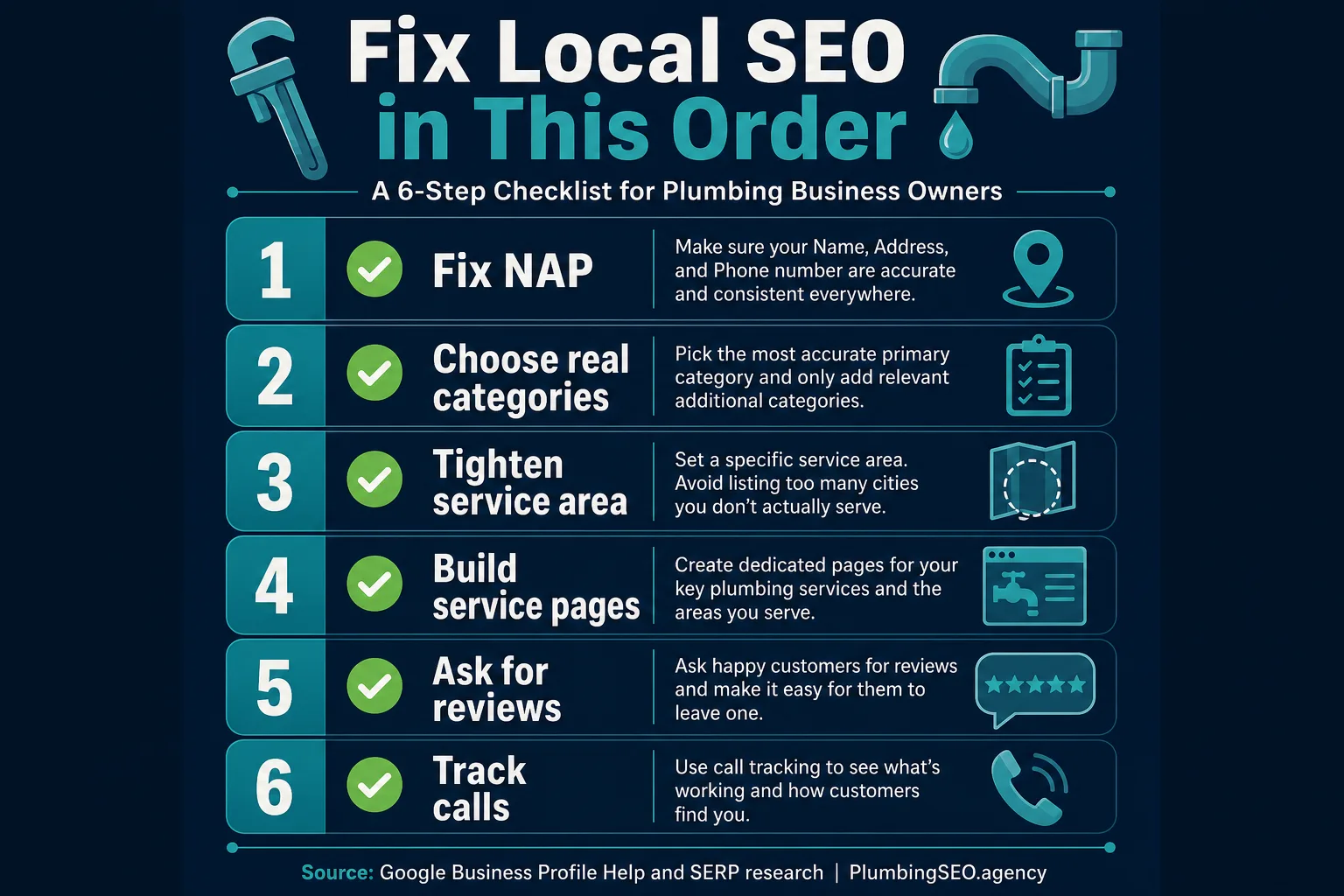
A practical fix order for plumbers: correct the profile first, then build trust signals and measurement around it.
- GBP mismatch: The listing category, services, hours, phone number, or service area does not match the website.
- Review weakness: The company has fewer recent, service-specific reviews than the top three competitors in the searcher's city.
- Citation drag: Directory listings disagree on the business name, address, phone, tracking number, or service area.
- Thin website support: The site has no service pages, city proof, LocalBusiness schema, or internal links reinforcing the GBP services.
- No attribution loop: Calls from Maps, organic search, ads, and branded traffic are mixed together, so nobody knows which work created revenue.
Maps Pack vs Organic Results: Where Do the Clicks Actually Go?
Before you invest a dollar in local SEO, you need to understand where your potential customers are clicking. The Maps Pack and organic results attract different types of searchers, and both matter.
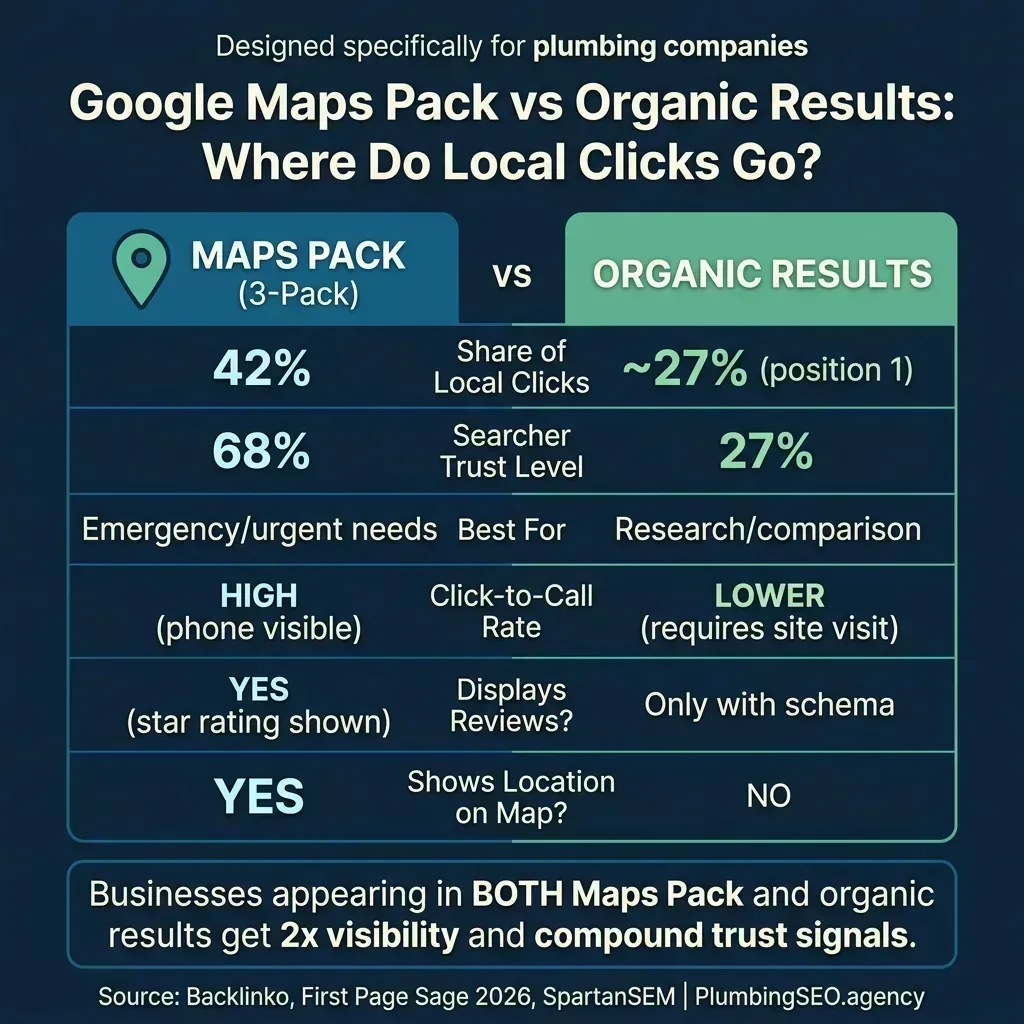
Maps Pack captures nearly twice as many local clicks as the top organic result. Source: Backlinko, First Page Sage 2026
| Factor | Maps Pack (3-Pack) | Organic Results |
|---|---|---|
| Share of local clicks | ~42% | ~27% (position 1) |
| Searcher trust level | 68% | 27% |
| Best for | Emergency / urgent needs | Research / comparison |
| Click-to-call rate | High (phone visible) | Lower (requires site visit) |
| Displays reviews? | Yes (star rating shown) | Only with schema markup |
| Shows on map? | Yes | No |
| Long-term compounding? | Moderate | High (content lasts years) |
The takeaway is straightforward: for a plumber, the Maps Pack is where urgent, high-intent calls come from. Someone with a burst pipe at 2 AM is not scrolling to organic position #4. They are tapping the top Maps result with the most reviews. But organic results catch the homeowners who are planning ahead, comparing companies, or looking for specific services. You need both, but the Maps Pack is your front door.
Businesses that show up in both the Maps Pack and organic results on the same page get what amounts to double visibility. The customer sees your name twice. That compounds trust before you even pick up the phone.
That double visibility is why this refresh ties Maps work back to the rest of the site instead of treating GBP as a separate checklist. The Google Business Profile earns the tap, but the website has to confirm the city, service, proof, and next step. When those signals split, competitors with a cleaner local SEO system usually win the pack even if their brand is weaker.
Internal Link Map That Protects the Local SEO Service Route
One reason plumbing sites underperform is that every article links to the wrong next step. A Google Maps how-to should not scatter authority across ten similar pages or behave like a second service page. It should route each intent to the page that can convert, explain the next action, or support the broader plumbing SEO architecture.
| Searcher intent | Best internal destination | Why it matters |
|---|---|---|
| "I need Google Maps rankings handled" | Local SEO for plumbers | The service page owns implementation, GBP cleanup, citations, review systems, service-area proof, and call tracking. |
| "I need a plumbing-only SEO partner" | Plumbing SEO services | Broad buyer intent belongs on the main service page, not inside this support article. |
| "I want the whole agency overview" | Homepage | The homepage remains the canonical target for head plumbing SEO terms and brand trust. |
| "I want to diagnose the leak first" | Free SEO audit | Audit intent should become a measured lead, not another informational click. |
GBP-to-Website Signal Map for Plumbing Companies
The fastest way to close a local/Maps SERP gap is to map each Google Business Profile field to the website signal that should support it. This keeps the profile, service pages, local content, schema, and internal links from drifting apart.
| GBP signal | Website support signal | Where this page should link |
|---|---|---|
| Primary category: Plumber | Homepage and main service page clearly position the company as a plumbing-only SEO specialist. | Plumbing SEO services |
| Service areas and hidden-address SAB setup | Service-area content explains where calls come from without doorway pages or unrealistic city claims. | Service-area SEO for plumbers |
| Reviews, Q&A, and owner responses | Reputation content shows how review velocity and response quality support both rankings and conversions. | Reputation SEO for plumbers |
| Spam competitors and lead-gen listings | Spam documentation protects legitimate rankings without creating risky duplicate listings. | Google Maps spam for plumbers |
| LocalBusiness / PlumbingService schema | Structured data reinforces NAP, service areas, sameAs profiles, and page intent. | Plumbing schema examples |
This is the core difference between a generic Maps checklist and a plumbing-specific local SEO system. The profile should not carry the whole ranking burden by itself; every key GBP field needs a matching website proof point and a clean internal link path.
The 3 Ranking Factors That Control Your Maps Position
Google's own documentation says local results are based on three factors: relevance, distance, and prominence. That is straight from Google's support page. In plumber language, here is what each one means and what you can actually do about it.
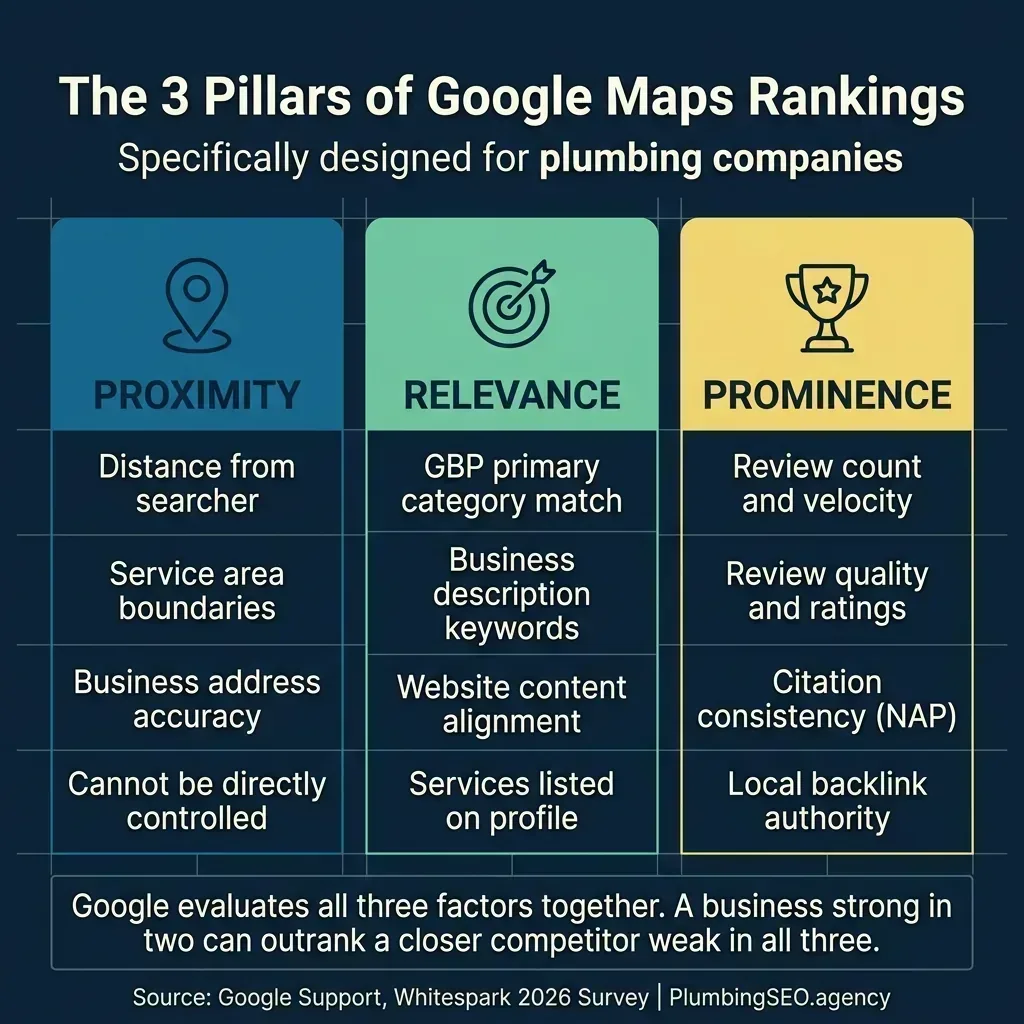
The three factors Google uses to decide who shows up in the Maps Pack. Source: Google Support, Whitespark 2026
Proximity: How Close You Are to the Searcher
Proximity is the one factor you cannot fake or optimize your way around. When a homeowner in north Dallas searches "plumber near me," Google weighs how close your listed business address is to that person's phone. A shop in south Fort Worth is at a disadvantage no matter how many reviews it has.
Here is the practical truth: proximity matters most for "near me" and emergency searches. For branded or specific service searches like "water heater installation Dallas," relevance and prominence carry more weight. As one local SEO practitioner on r/localseo put it: "Most plumbers lose local rankings because their GBP and site don't echo the exact search phrasing that drives map packs."
What you can do about proximity:
- Make sure your address is accurate. If you moved shops two years ago, confirm your GBP reflects the current location. Google will verify it.
- Define realistic service areas. Do not claim you serve a 100-mile radius. Google knows that is not how a 3-truck plumbing company operates. Stick to the cities and zip codes you actually drive to regularly.
- Build localized proof. City pages, service-area mentions on your site, and location-specific reviews all tell Google where you actually do business.
Relevance: How Well Your Profile Matches the Search
Relevance is about whether Google thinks your business is a good match for what the person searched. This is where your GBP categories, business description, services, and website content all come into play.
If your primary category is set to "Contractor" instead of "Plumber," you are telling Google the wrong thing about your business. Google's algorithm matches the searcher's intent against your profile data. The more precise the match, the higher you rank. A complete profile with accurate categories, a detailed GBP description that uses real service keywords, and aligned website content creates a relevance signal that is hard for competitors to beat.
The Whitespark 2026 Local Search Ranking Factors survey found that on-page signals account for 36% of local search ranking influence, with link signals at 26% and behavioral signals at 9%. Your website and your GBP need to tell the same story.
Prominence: How Well-Known and Trusted You Are
Prominence is the factor most in your control, and it is the long game. Google evaluates how well-known your business is based on reviews, ratings, citation mentions, backlinks, and overall online authority.
Think of it this way: if a plumber has 340 reviews at 4.8 stars, consistent NAP data across 50+ directories, and backlinks from the local chamber of commerce, that is a strong prominence signal. A competitor with 12 reviews and no citations is fighting an uphill battle.
Prominence is also where your website quality matters. Google's documentation notes that link signals and behavioral signals (how people interact with your listing and site) feed into prominence. A slow, thin website with no content drags down your Maps ranking too, not just your organic position.
"In local SEO, Map Pack rankings usually depend on reviews, proximity, and local authority. Getting consistent Google reviews, adding job photos, and maintaining consistent citations are the low-hanging fruit."
Want to know how your profile stacks up against competitors on all three ranking factors?
See Our Local SEO Service for PlumbersStep 1: Claim and Fully Optimize Your Google Business Profile
Your Google Business Profile (GBP) is the engine behind your Maps ranking. If it is incomplete, you are effectively invisible.
- Primary Category: This must be set to "Plumber". Not "Contractor", not "Handyman".
- Secondary Categories: Add relevant secondary categories if applicable, like "Drainage service" or "Water heating installation service".
- NAP Consistency: Your Name, Address, and Phone number must exactly match what is on your website. No abbreviations on one and full words on the other.
- Service Areas: If you are a Service Area Business (SAB) without a storefront, define your service areas by zip code or city. Do not stretch this too far; Google favors realistic service zones.
Not sure if your Google Business Profile is optimized correctly?
Get a Free GBP AuditChoosing the Right GBP Categories for Your Plumbing Company
Your GBP primary category is one of the strongest relevance signals Google uses for Maps rankings. Get it wrong, and you are invisible for the searches that matter most. Get it right, and you are telling Google exactly what you do, every time someone searches.
Based on data from Google's own category system and recommendations from local SEO practitioners who work with plumbers daily, here is what to choose:
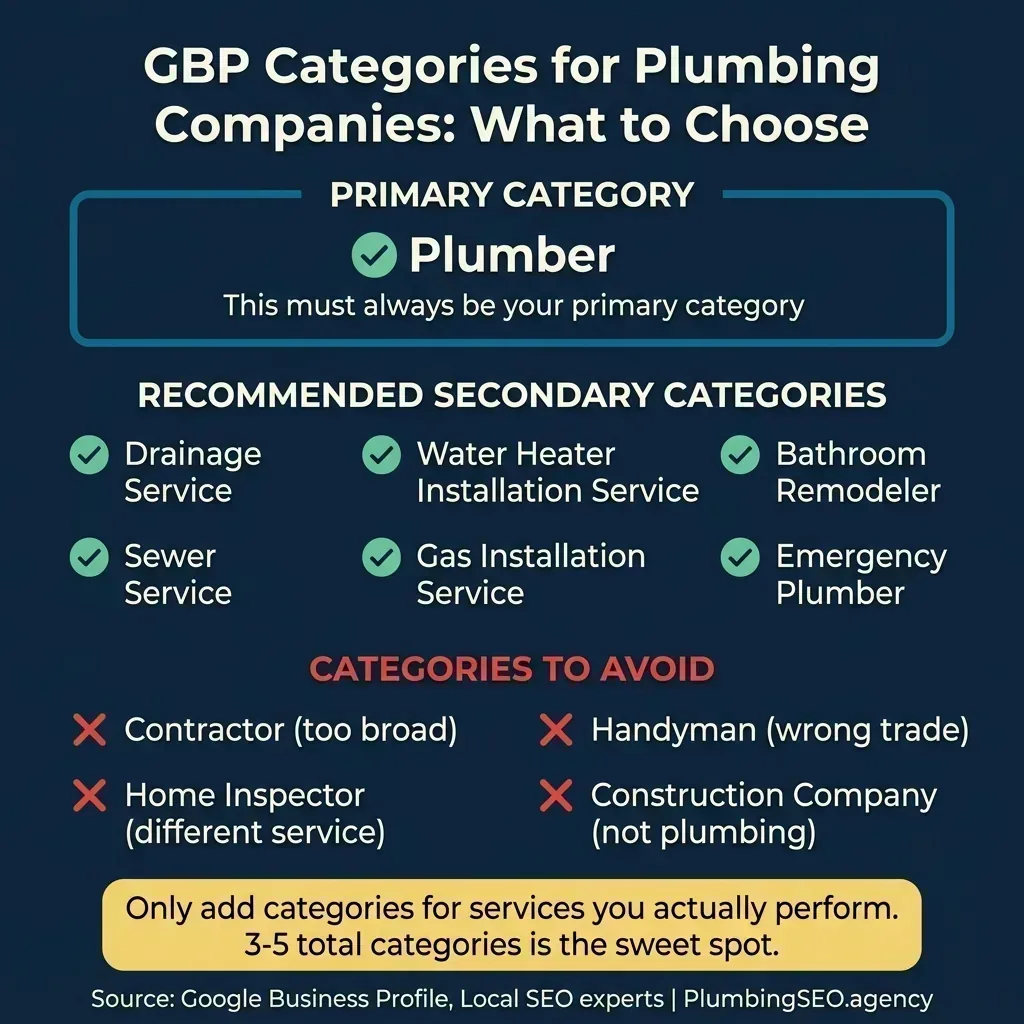
The right GBP category setup for plumbing companies. Only add categories for services you actually perform.
Primary Category: Always "Plumber"
Your primary category must be "Plumber." This is non-negotiable. Not "Contractor," not "Handyman," not "Home Inspector." Google's matching algorithm gives the primary category the most weight. If you do plumbing work and your primary category is set to anything other than "Plumber," fix it today. That single change can move you into the Maps Pack for searches you have been missing.
Secondary Categories: Be Specific, Not Greedy
Google lets you add secondary categories to describe additional services. The sweet spot is 3 to 5 total categories. Here are the ones that make sense for most plumbing companies:
- Drainage Service - If you handle drain cleaning, clogs, and sewer lines
- Water Heater Installation Service - If you install or repair water heaters
- Sewer Service - If you do sewer line repair or replacement
- Bathroom Remodeler - If you handle bathroom remodeling or renovation work
- Gas Installation Service - If you work with gas lines (and hold the required license)
- Emergency Plumber - If you offer 24/7 or after-hours emergency service
The rule is simple: only add a category if you actually provide that service. Adding "Bathroom Remodeler" when you only do rough-in plumbing confuses Google and dilutes your relevance for your core services. As one Google Business Profile specialist on Reddit noted, "wrong categories confuse Google and customers."
For more on optimizing the text portion of your profile, see our guide on writing a GBP description that actually helps you rank. If categories are the biggest uncertainty, use the dedicated GBP categories for plumbers guide before changing anything in the live profile.
Step 2: Build Local Citations That Reinforce Trust
Google uses other directories across the web to verify your business information. These are called citations. If Yelp, Angi, the Better Business Bureau, and local chambers of commerce all list the exact same NAP (Name, Address, Phone) data, Google trusts your business more.
Citation consistency feeds directly into your prominence signal. According to the Whitespark 2026 survey, citation signals remain a confirmed ranking factor for the Maps Pack. One common mistake plumbers make is having slightly different business names or phone numbers across directories. "Joe's Plumbing" on your GBP but "Joe's Plumbing LLC" on Yelp can weaken your signal.
Start with the directories that matter most: Google Business Profile, Yelp, Angi, HomeAdvisor, BBB, Thumbtack, and your state plumbing board listing. Our top 50 citation directories for plumbers walks through the full priority list. If you are working with an agency, citation building should be part of what you are paying for. Read our full pricing guide to understand what fair SEO packages include.
Step 3: A Relentless Focus on Reviews
Reviews are one of the strongest ranking factors for the Local 3-Pack. It is not just about having a 5-star rating. It is about three things: count (how many you have), velocity (how often new ones come in), and content (what the reviews actually say).
A review that says, "Joe came out to fix our broken water heater in Dallas" is infinitely more valuable than one that just says, "Great service!" because it includes service keywords and location data that Google can index. You do not ask customers to stuff keywords in their reviews. But you can time your request right after a successful job, when the details are fresh. The result is naturally specific reviews.
Review velocity matters too. A business that gets 3 reviews per week signals to Google that it is active and trusted. A business that got 20 reviews three years ago and nothing since sends the opposite signal. For a practical system you can start using this week, read our guide on how to get more 5-star reviews for your plumbing business.
And do not forget to respond to every review, good or bad. Google has confirmed that owner responses are a ranking signal. A thoughtful response to a negative review can actually help your Maps position, not just your reputation. We break this down in our guide to responding to negative reviews.
Step 4: Use Real Photos, Not Stock Images
Your GBP listing with stock photos of a model holding a wrench looks exactly like every other plumbing listing with stock photos of a model holding a wrench. Google and customers can tell the difference.
Real photos of your team, your trucks, your completed work, and your shop do two things: they increase engagement (Google tracks how people interact with your listing) and they build trust with the homeowner who is about to let a stranger into their house. Listings with photos receive 42% more requests for driving directions and 35% more click-throughs to websites, according to Google's own data.
We put together a complete breakdown of the 7 useful photos plumbing companies should add to their GBP. If you do nothing else this week, replace your stock photos with real job photos and name them descriptively before upload.
Step 5: Post to Your GBP Every Week
Google Business Profile posts are a simple, free way to signal to Google that your business is active. Most plumbers never post at all. That is an opportunity.
A weekly post does not have to be complicated. Share a before-and-after job photo, a seasonal tip, a special offer, or a quick update about your availability. Google shows these posts to people viewing your listing, and the activity signals freshness to the algorithm.
We built a 10-minute GBP post template with examples you can copy and adapt. It takes less time than filling out a service invoice.
Step 6: Connect Your Website to Your Maps Listing
Your website and your GBP need to talk to each other. Your website should feature local schema markup (specifically LocalBusiness or PlumbingService schema) that clearly states your address, coordinates, and service areas. Additionally, embedding your Google Map on your contact page helps reinforce this connection.
Your website content should align with your GBP services and categories. If your GBP lists "drain cleaning" as a service but your website has no drain cleaning page, that is a relevance gap. Every service on your GBP should have a dedicated page on your website that targets those keywords. This is how we build service pages that rank for plumbing companies, and why the Maps portion of our plumbing SEO process is tied to content, schema, links, and tracking.
Make sure your NAP (Name, Address, Phone) on your website matches your GBP exactly. This includes using the same formatting, the same phone number, and the same address down to the suite or unit number. These are exactly the kind of technical SEO issues we fix for plumbing companies.
If you want this work handled as one connected system, use our local SEO for plumbers service page as the next step. This blog teaches the ranking factors; the service page explains how we execute GBP cleanup, review systems, service-area proof, citation repairs, local landing pages, and call attribution for plumbing companies. If you need a deeper tactical layer after this checklist, move into the advanced local SEO for plumbers guide, then connect service-area proof through the service-area SEO for plumbers resource.
How to Audit Your Maps Footprint in 30 Minutes
A useful Google Maps SEO audit does not start with a 60-page PDF. It starts with a searcher, a city, a service, and a phone. Use this 30-minute version before you decide whether the problem is GBP data, reviews, website support, or tracking.
- Search from the service area. Use the city and service combinations that actually make money: emergency plumber, drain cleaning, sewer repair, water heater repair, and plumber near me.
- Capture the top three competitors. Note primary category, review count, rating, recency of reviews, services shown, photos, hours, and whether the website reinforces the same city/service pairing.
- Compare your GBP fields. Check the primary category, secondary categories, services, appointment URL, website URL, phone number, service areas, opening date, and business description.
- Check website support. Confirm that the linked website page has a visible phone CTA, NAP consistency, LocalBusiness or PlumbingService schema, service pages, city proof, and internal links to the right money pages.
- Check the measurement loop. Use local SEO call attribution so Maps calls are separated from ads, branded organic traffic, and referral leads.
If two or more of those checks fail, the answer is not simply "post more." Fix the foundation first, then use weekly GBP posts and review requests to keep the profile active.
90-Day Google Maps SEO Fix Order
Plumbers lose momentum when every local SEO task is treated as equally urgent. Use this 90-day order to fix the signals Google can verify first, then build the trust and measurement layers that make the gains stick.
| Timeframe | Priority work | Success signal |
|---|---|---|
| Days 1-14 | Correct GBP categories, services, hours, appointment URL, NAP, service areas, and website destination. Remove stock photos and add real team/truck/job photos. | The listing matches the website and no longer sends mixed relevance signals. |
| Days 15-45 | Repair citations, add missing service pages, connect LocalBusiness schema, and build internal links from support content to the local SEO service page and service-area resources. | Google sees the same city, phone, category, and service set across the profile, directories, and site. |
| Days 46-75 | Run a review request cadence, publish GBP posts weekly, answer Google Q&A, and document any spam competitors before reporting them. | Review recency, engagement, and trust signals improve without violating GBP guidelines. |
| Days 76-90 | Audit call tracking, compare Maps calls to organic and paid leads, and tighten the pages that assist booked jobs instead of just impressions. | Maps visibility can be tied to real calls, booked jobs, and the pages that helped the lead convert. |
For most plumbing companies, this order beats publishing another broad blog post. If the site is slow, fix the website speed leaks before pushing more Maps traffic to it. If the call source is unclear, install the local SEO call attribution layer before judging whether the campaign worked.
What the Local SEO Service Route Should Handle
Once the audit shows multiple leaks, the work should move from a blog checklist into an accountable local SEO workflow. A plumber-focused local SEO service should not just "optimize the GBP" and disappear. It should connect profile relevance, website support, reputation, citations, and call tracking so Maps visibility turns into booked plumbing jobs.
| Service layer | What gets handled | Why it supports Maps |
|---|---|---|
| GBP cleanup | Categories, services, hours, service areas, appointment URL, photos, posts, Q&A, and review responses. | Gives Google cleaner relevance signals and gives homeowners more reasons to call. |
| Website alignment | Service pages, service-area proof, LocalBusiness or PlumbingService schema, NAP consistency, and internal links. | Confirms that the website backs up the exact services and cities shown in the profile. |
| Authority and trust | Citation repairs, local links, reputation systems, spam documentation, and competitor gap monitoring. | Builds prominence without risky shortcuts or fake-location tactics. |
| Measurement | Maps call attribution, lead-source reporting, form tracking, and booked-job feedback loops. | Separates ranking vanity from the calls and jobs that actually pay for the campaign. |
That is the role of the local SEO service route: take the checklist below and turn it into a monthly operating system. This article stays the educational support page; the service page stays the commercial route for plumbers who want Google Maps SEO handled.
When to Do It Yourself vs Hire a Plumbing Local SEO Team
You can handle the basics yourself if the profile is simple, your service area is small, and someone on the team can consistently request reviews, upload job photos, post weekly, and keep citations clean. The most important DIY wins are category correction, business information consistency, real photos, review responses, and matching website content to real services.
Hiring help starts to make sense when you serve multiple cities, rely on emergency calls, have stale or inconsistent citations, cannot prove which calls came from Maps, or need pages and schema that line up with every GBP service. At that point, local SEO is not just a checklist; it is an operating system for visibility, trust, and lead attribution.
A good plumbing local SEO team should be able to show exactly which internal links they chose, why each service page supports a GBP service, how review requests are handled without incentives, how citations are corrected, and where call tracking numbers are safe to use. If an agency cannot explain that relationship, they may be chasing rankings without protecting your actual lead flow.
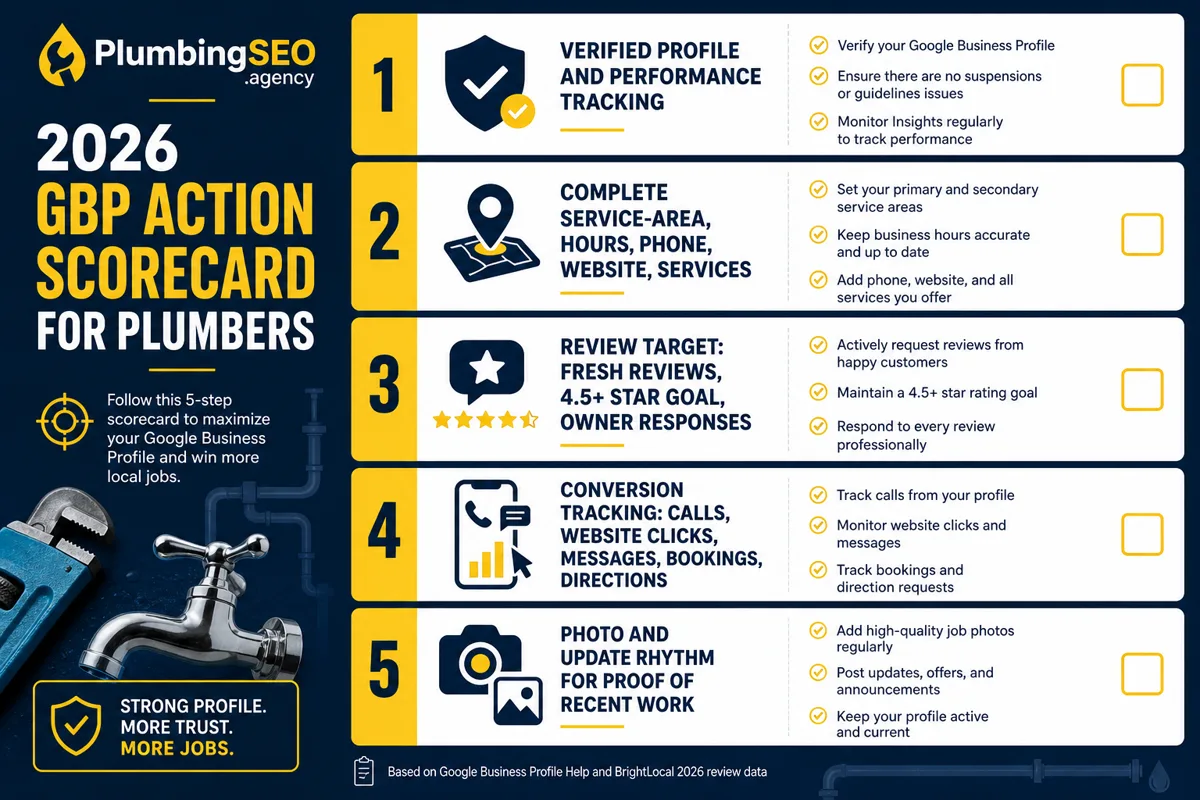
Use this page as the DIY checklist. Use the local SEO service when the fixes need coordination, tracking, and monthly execution.
Need the whole Maps system cleaned up and measured?
Review the Local SEO ServiceThe Bottom Line
Google Maps SEO is not a one-time trick. It requires a sustained effort of managing your profile, generating reviews, and ensuring your website sends the right local signals. But the payoff is massive: more visibility, more trust, and most importantly, more ringing phones. If you are weighing whether to invest in SEO or paid ads, our SEO vs PPC comparison breaks down the real numbers. And if you are thinking about hiring help, compare this checklist with our Google Maps SEO service for plumbing companies so the blog supports the service page instead of competing with it. For the broader plumbing SEO strategy, continue through the main plumbing SEO service page.
Frequently Asked Questions
Start with a complete Google Business Profile, the right primary and secondary categories, consistent NAP citations, steady review generation, service-area content on your website, and local links. Google Maps rankings usually improve when profile relevance, proximity signals, and trust signals all point in the same direction.
Maps impressions without calls usually mean the listing is visible for some searches but is not trusted enough or relevant enough to win the tap. Check whether the primary category is "Plumber," reviews are recent, photos are real, the linked page confirms the same services and service area, and call tracking separates Maps leads from organic and paid calls.
Most plumbing companies should expect the first measurable movement within 30-90 days, especially after profile cleanup and citation fixes. Bigger gains usually compound over 3-6 months as reviews, service pages, and local authority build together.
Yes. Review count, review velocity, rating quality, owner responses, and service keywords inside natural customer reviews all support Maps visibility. Reviews also lift conversion because homeowners compare plumbers quickly before calling.
Yes, but the service area must be set up correctly and the rest of the local signals need to be strong. If customers do not visit your location, hide the address on your Google Business Profile, keep your business data consistent, and build localized proof across your website and citations.
Your primary category must be "Plumber." For secondary categories, add only the services you actually perform, such as Drainage Service, Water Heater Installation Service, Sewer Service, or Bathroom Remodeler. The sweet spot is 3 to 5 total categories. Avoid generic categories like "Contractor" or "Handyman" because they dilute your relevance for plumbing-specific searches.
Use real photos of your team, trucks, completed work (before and after), your shop or office, and your service area. Listings with photos get 42% more requests for driving directions and 35% more website clicks, according to Google. Never use stock photos. They look generic and undercut trust with homeowners.
At least once per week. GBP posts signal to Google that your business is active and engaged. Share job photos, seasonal tips, special offers, or service area updates. Posts expire after 7 days, so consistent weekly posting maintains visibility. Most plumbers never post at all, so this is an easy way to stand out.
The Maps Pack (3-Pack) shows 3 local businesses with a map, reviews, and click-to-call buttons at the top of the search results page. It captures about 42% of local clicks and is driven by your Google Business Profile signals. Organic results appear below and are driven by your website content and backlinks. For plumbers, the Maps Pack drives more emergency calls, while organic captures homeowners who are researching and comparing.
Google Maps SEO is the Maps and Google Business Profile side of local SEO for plumbers. Local SEO also includes service pages, city proof, citations, reviews, links, technical SEO, and call tracking. In competitive markets, the profile and website need to reinforce the same cities and services.
This blog should answer educational Google Maps questions and pass authority to the buyer page. The local SEO service page should rank and convert for implementation intent because it explains deliverables, process, and next steps.
Use this guide for the DIY foundations. A local SEO service for plumbers makes sense when GBP cleanup, citation repairs, service-area pages, review systems, local links, and call tracking need to work together every month. The goal is not to create another competing page; it is to make your Maps signals and service pages support each other.
A local SEO service should handle GBP cleanup, review workflows, citation repairs, service-area proof, local links, schema alignment, spam documentation, and call attribution. For PlumbingSEO.agency, that implementation intent belongs on the local SEO service for plumbers page, while this blog remains the educational Maps guide.
Most plumbers should link the Google Business Profile to the strongest conversion page: usually the homepage or a dedicated local SEO/service page with clear NAP, phone CTA, reviews, services, and service-area proof. Do not link GBP to a thin blog post or a generic contact page if a stronger service page can confirm the same category and location signals.
Stop Losing Calls to the Maps Pack
As a specialized plumbing SEO agency, we help plumbing companies climb into the Google Maps 3-Pack and stay there. Start with the implementation details on our local SEO for plumbers service page, or request a free audit and we will show you exactly where your local visibility is leaking.
Run My Free SEO Leak Check