
- Advanced local SEO starts after the basics: connect GBP, service pages, reviews, citations, schema, and call tracking so Google sees one clear plumbing entity.
- For competitive markets, service-area architecture and review velocity usually matter more than publishing random city pages or stuffing GBP fields.
- Run a monthly Map Pack diagnostic by service and neighborhood, then ship one focused fix instead of guessing from one office search.
Basic local SEO advice for plumbers is everywhere: claim the Google Business Profile, add categories, get reviews, and make sure the phone number is correct. That is still necessary. But in a competitive market, the companies sitting in the Map Pack usually already did the basics.
Advanced local SEO for plumbers is the next layer: building a service-area architecture Google can understand, creating review signals that prove real jobs in real neighborhoods, tuning GBP without spam, reinforcing the entity with citations and local links, and diagnosing the Map Pack every month like a dispatcher reviewing missed calls.
This guide is built for a plumbing owner or marketing manager who already has a live website and GBP, but is stuck around positions 4-10 in Maps or watching better-organized competitors take the high-intent calls.
What Makes Local SEO “Advanced” for a Plumbing Company?
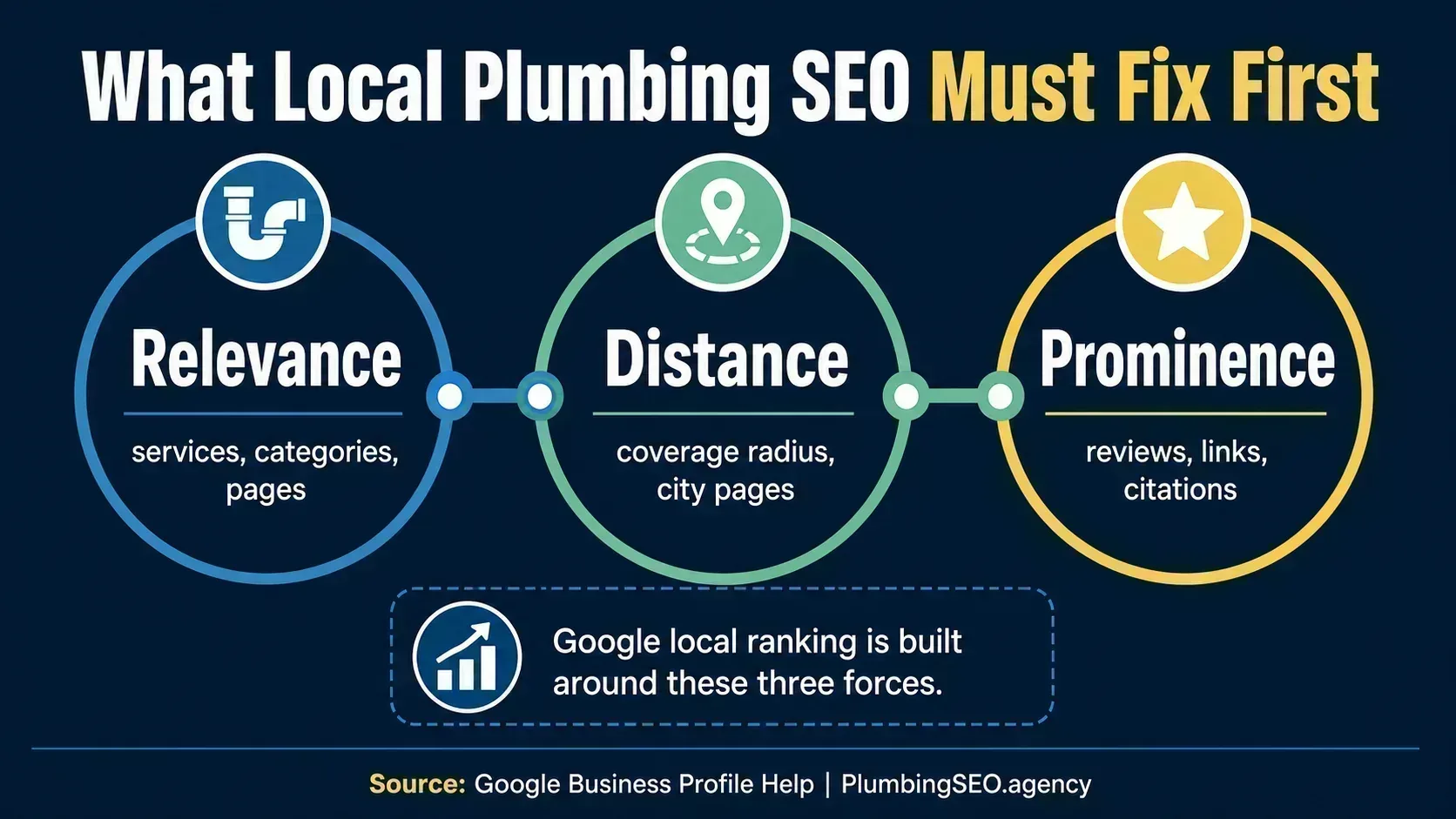
Advanced does not mean risky tricks. It means connecting the signals that Google and customers already use to decide who deserves the call. Google says local results are influenced by relevance, distance, and prominence. A plumber cannot move closer to every searcher, but you can make relevance and prominence much clearer.
The competitor article that triggered this brief covers broad advanced local SEO themes. The opportunity for PlumbingSEO is to make the advice more operational: exactly what a plumber should build, review, and measure when the basics are done but rankings are still not moving.
| Basic Local SEO | Advanced Plumber SEO | Why It Matters |
|---|---|---|
| One services page | Service clusters linked to city and problem pages | Google can match drain, sewer, water heater, emergency, and city intent separately. |
| Ask for reviews | Track review velocity, service language, city mentions, and response speed | Prominence becomes fresher and more specific than star rating alone. |
| Fill out GBP services | Align GBP services, categories, photos, Q&A, and landing pages | The profile and website tell one consistent story. |
| Build citations once | Prioritize authoritative local citations, niche mentions, and cleanup after changes | Local entity trust stays stable as the company grows. |
Who This Advanced Guide Is For
This is not the first-week checklist. Start here if your plumbing company already has most of these foundations in place:
- A verified Google Business Profile with the correct primary category.
- A real plumbing website with service pages, not only a homepage.
- Some Google reviews and a process for asking customers after completed jobs.
- Basic NAP consistency across major directories.
- Call tracking or lead tracking that tells you which channels create booked jobs.
If those are missing, read our step-by-step SEO guide for plumbers first. If the basics are in place and the Map Pack still feels stuck, the sections below are where leverage usually hides.
1. Build Service-Area Architecture Instead of Random City Pages
A lot of plumbing sites try to win local search by publishing dozens of thin city pages. That might create pages, but it rarely creates trust. Advanced service-area SEO starts by mapping how homeowners actually search: service + problem + city + urgency.
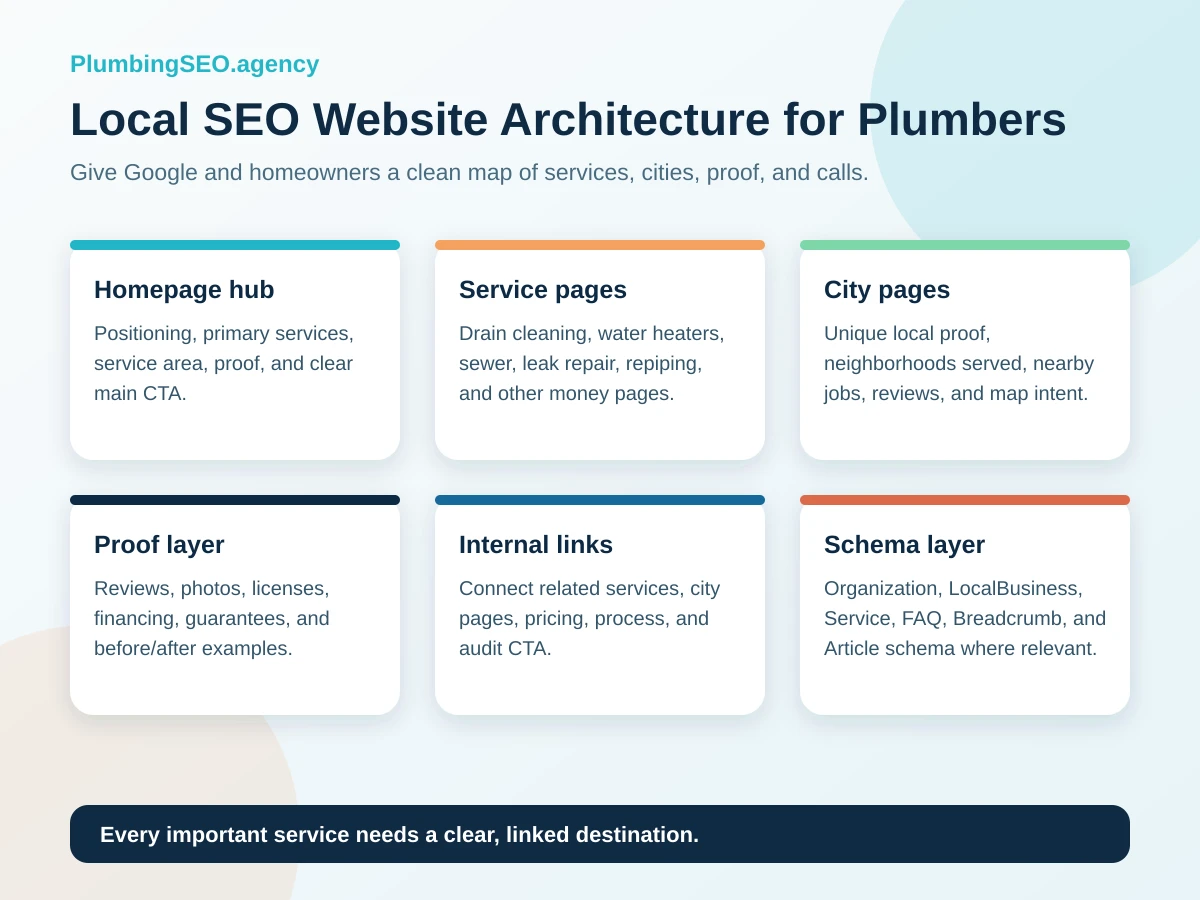
For example, a strong architecture does not only have “Plumber in Dallas.” It has a drain cleaning service page, a sewer line repair page, a water heater page, an emergency plumbing page, and supporting city/area pages that link to the right services. The pages reinforce each other instead of competing with each other.
The Plumber Service-Area Cluster Model
Use this structure before adding more location pages:
- Core service pages: drain cleaning, water heater repair, sewer line replacement, leak detection, emergency plumbing, repiping, fixture installation.
- Primary market pages: only the cities or neighborhoods where the company actually wants more jobs.
- Support articles: cost guides, symptom guides, maintenance guides, and comparison articles that internally link to the money pages.
- Proof blocks: reviews, job photos, neighborhoods served, licenses, and response-time expectations.
Each service page should link to relevant location pages. Each location page should link to the services that are actually offered there. This gives Google a clearer path than a flat list of generic city pages in the footer.
Not sure whether your city pages are helping or diluting your site?
Get a Free Local SEO Structure Audit2. Use Reviews as a Ranking and Conversion System
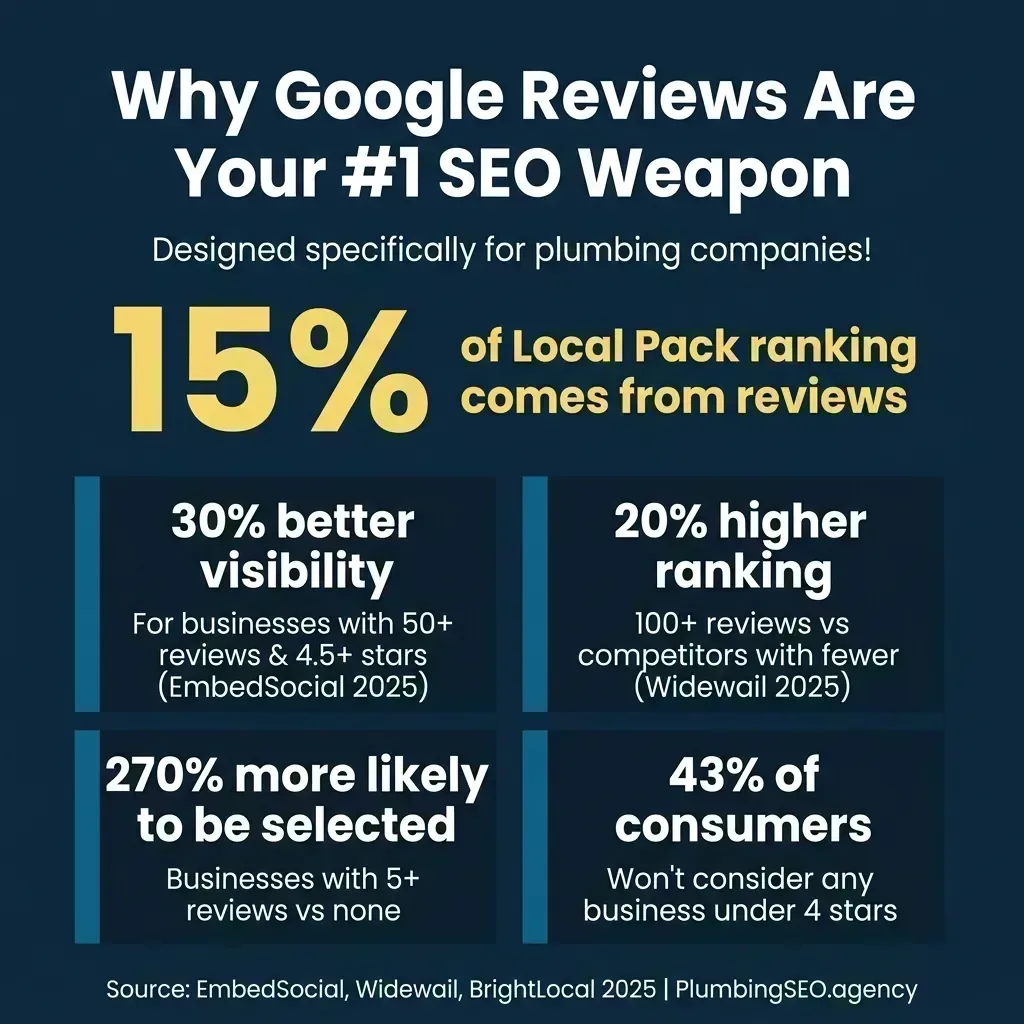
Reviews are often treated like reputation work. For local SEO, they are also content, freshness, proof, and conversion support. A review that says “fixed our tankless water heater in Plano the same day” gives Google and the next customer more useful context than “great service.”
That does not mean scripting customers or asking for keyword-stuffed reviews. Make the request timely and neutral: ask every eligible customer soon after the job, provide the direct link, and let the customer describe the real experience in their own words without supplying the service, city, keywords, or rating.
Review Signals to Track Monthly
- Velocity: how many new Google reviews came in this month?
- Recency: does the profile have recent reviews, or did momentum stop months ago?
- Service language: do reviews naturally mention drain cleaning, sewer repair, water heaters, leaks, or emergency calls?
- Location context: do customers mention neighborhoods or cities where you want rankings?
- Response rate: are owner responses thoughtful, fast, and specific?
For a deeper process, pair this with our guide on getting more 5-star reviews for your plumbing business and our negative review response templates.
3. Tune GBP Categories, Services, Products, Photos, and Q&A Without Spam
The primary category should often be “Plumber.” Advanced GBP work happens after that: secondary categories, services, products, photos, posts, and Q&A should match what the company actually offers and what the website can support.
The mistake is treating GBP like a keyword stuffing field. The goal is alignment. If the profile lists sewer line repair, the website should have a sewer line page. If the profile promotes tankless water heater installation, the site should explain the service, service area, proof, and CTA.
| GBP Element | Advanced Optimization | What to Avoid |
|---|---|---|
| Categories | Use only categories that match real services and licensing. | Adding unrelated contractor categories to chase broader keywords. |
| Services | Mirror high-value service pages and use clear customer language. | Dozens of duplicate or near-identical service labels. |
| Photos | Add real trucks, team, equipment, before/after work, and job-site proof. | Stock photos that make the company look generic. |
| Q&A | Answer real buying questions about emergency service, pricing, service areas, and licensing. | Fake-looking questions that read like ads. |
Google's local ranking documentation emphasizes complete and accurate business information. For plumbers, “complete” means more than hours and address. It means every important service signal points to the same entity: GBP, website, reviews, citations, and local mentions.
4. Strengthen Local Entity Signals With Citations, Links, Photos, and Mentions
Citations still matter most when they confirm reality. If your business name, address, phone, service area, and categories are inconsistent, Google has to reconcile conflicting data. That friction is avoidable.
Start with the obvious sources: Google, Bing Places, Apple Business Connect, Yelp, BBB, Angi, HomeAdvisor, Thumbtack, Facebook, local chamber pages, state license boards, and any plumbing association profiles. Then move beyond directories into local proof.
- Sponsor a Little League team and earn a local sponsor mention.
- Publish a water-heater safety checklist with a local real estate partner.
- Get listed on city/vendor pages where appropriate.
- Document real community jobs with permission and non-sensitive photos.
- Ask vendors and partners for accurate company mentions when you already have a relationship.
For a prioritized citation list, use our top 50 NAP citation directories for plumbers. The advanced layer is not blasting hundreds of weak directories; it is making the strongest mentions consistent and believable.
5. Add Schema and Technical Signals That Support Local Intent
Schema does not magically rank a plumber by itself. But it helps search engines understand the page, the organization, the service, the FAQ, breadcrumbs, and local business context. Google's structured data docs are clear that markup should reflect visible content, not hidden claims.
For advanced plumber local SEO, prioritize:
- LocalBusiness / PlumbingContractor context on core business pages where appropriate.
- Service schema for major service pages when the visible page supports it.
- FAQPage schema only when the FAQ is visible on the page.
- Breadcrumb schema so Google understands hierarchy.
- Article schema for educational guides like this one.
Technical cleanup still matters too: crawlability, indexation, canonical tags, page speed, mobile usability, internal links, image alt text, and broken links. Our technical SEO checklist for plumbing websites walks through the full audit path.
6. Run a Monthly Competitive Map-Pack Diagnostic
The Map Pack changes by query, device, location, proximity, and competitor behavior. A plumber who only checks one “plumber near me” search from the office is flying blind. Advanced local SEO uses a recurring diagnostic.
- Pick 10-20 priority keywords: emergency plumber, drain cleaning, water heater repair, sewer line repair, plumber near me, plus city/service combinations.
- Check from the service area: use rank tracking, grid tools, or manual spot checks from representative neighborhoods.
- Compare top competitors: categories, review count, review recency, photos, GBP services, website pages, backlinks, and citations.
- Find one bottleneck: missing service page, weak reviews, wrong category, thin city page, slow page, citation mismatch, or low local authority.
- Ship one improvement: publish a service page, add proof, clean citations, request reviews, improve internal links, or update GBP photos.
This is how local SEO becomes an operating system instead of a one-time setup. The owner can see what changed, what competitors did, and which fix will likely move the next ranking or conversion metric.
The 30-Day Advanced Local SEO Playbook
If you want a practical starting sprint, use this order:
| Week | Focus | Output |
|---|---|---|
| Week 1 | Map-pack baseline and competitor diagnostic | Keyword grid, top competitors, bottleneck list |
| Week 2 | Service-area architecture cleanup | Internal link map and page priority list |
| Week 3 | Review and GBP signal alignment | Review request process, GBP service/photo/Q&A updates |
| Week 4 | Citations, schema, and technical cleanup | Fixed NAP issues, schema checks, crawl fixes |
The key is sequence. Do not add ten city pages before your service pages are clear. Do not obsess over backlinks while your reviews are stale. Do not tune GBP services that point to thin or missing pages. Fix the leak closest to revenue first.
FAQs About Advanced Local SEO for Plumbers
Advanced local SEO for plumbers is the work beyond basic GBP setup: service-area architecture, review velocity, GBP service alignment, local citations, schema, local links, and recurring Map Pack diagnostics. The goal is to make the plumbing company more relevant and prominent for service-plus-location searches.
Plumbers improve Map Pack rankings by aligning Google Business Profile categories and services with strong website pages, earning steady real reviews, keeping NAP citations consistent, adding local proof such as photos and mentions, and monitoring competitors by service area. Distance still matters, but relevance and prominence are the levers you can improve.
Yes, but quality and consistency matter more than volume. Focus on major platforms, plumbing/home-service directories, licensing boards, BBB or chamber profiles, and local partner mentions. Citations are most useful when they confirm the same business name, phone, address or service area, categories, and website.
Review GBP monthly for categories, services, hours, Q&A, photos, and profile accuracy. Add fresh job photos and posts regularly when they are real and useful. The profile should reflect current services, service areas, and seasonal priorities without keyword stuffing or fake activity.
Want to Know Why Competitors Outrank You in Maps?
We will review your Google Business Profile, service-area architecture, reviews, citations, technical SEO, and tracking so you can see the highest-impact local SEO fixes first.
Run My Free Local SEO Leak Check