
- Start with your Google Business Profile. It is the single fastest way to show up in Maps and start getting calls from local searches.
- SEO is a 5-step process: GBP setup, on-page optimization, content strategy, link building, and tracking. Skip a step and you leave money on the table.
- Expect 3-6 months for real results. Companies that stick with it for 12+ months see 300-800% ROI, with leads costing $25-45 each instead of $183 from ads.
Why Your Plumbing Company Needs SEO in 2026
Here is the problem most plumbing company owners run into. The phone used to ring because of referrals, a truck magnet, maybe a Yellowbook ad. That worked for a long time. But in 2026, 93% of consumers search online before they call a local service provider. If your company does not show up when someone types "plumber near me" or "emergency plumber [your city]," you are invisible to the majority of people who need your services right now.
And here is the part that should keep you up at night: 76% of people searching for a plumber do not have a specific company in mind. They are picking from whoever shows up first. That means the plumber who ranks at the top of Google gets the call, not the one with the best work or the most experience.
One plumber on Reddit put it plainly: "For years it ran fine on referrals, but now everyone just searches on Google and calls whoever shows up first." That is the reality for most shops right now.
SEO is how you fix that. It is the process of making your plumbing company show up in Google search results and Google Maps when someone in your service area needs a plumber. Not paid ads that stop the second you stop paying. Organic visibility that compounds over time, like equity in a truck, not a rental.
The good news is that plumber SEO is not rocket science. It is a step-by-step process, and every step makes the next one easier. Think of it like roughing in a new build. You start with the main lines, then branch out, then connect everything, then test. Skip a step and you are going back to tear out drywall.
Here is the full roadmap, from first step to measuring results:
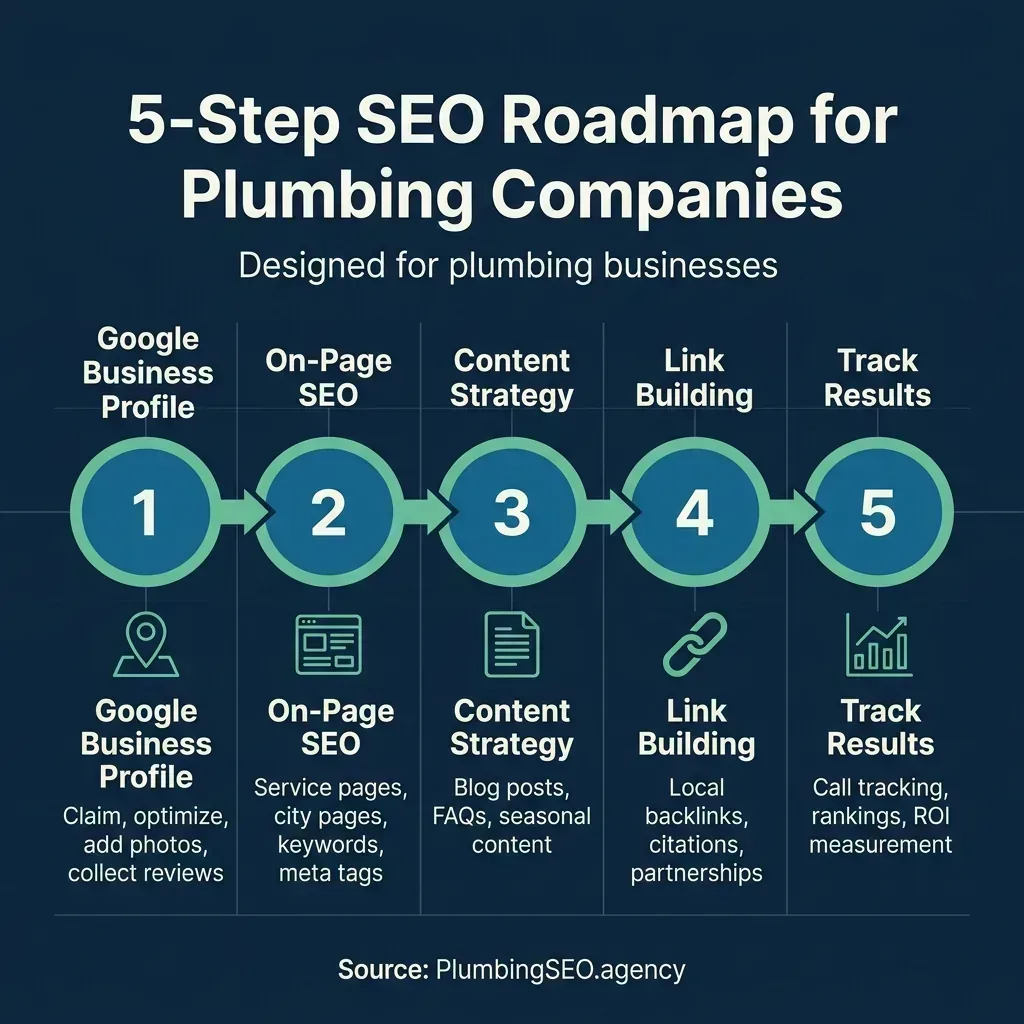
The 5-step SEO roadmap Many plumbing companies should consider follow. Source: PlumbingSEO.agency
Let us walk through each step.
Step 1: Claim and Optimize Your Google Business Profile
If you only do one thing from this entire guide, do this. Your Google Business Profile (GBP) is the engine behind your Google Maps ranking. When someone searches "plumber near me," the three businesses that show up in the Map Pack are there because of their GBP, not their website.
Think of your GBP as your digital storefront. It is often the first thing a potential customer sees, even before your website. And unlike your website, your GBP shows up directly in search results with your phone number, reviews, hours, and photos. For a deeper dive into Maps ranking specifically, see our complete Google Maps SEO guide for plumbers.
The GBP Optimization Checklist
Here is what a fully optimized profile looks like:
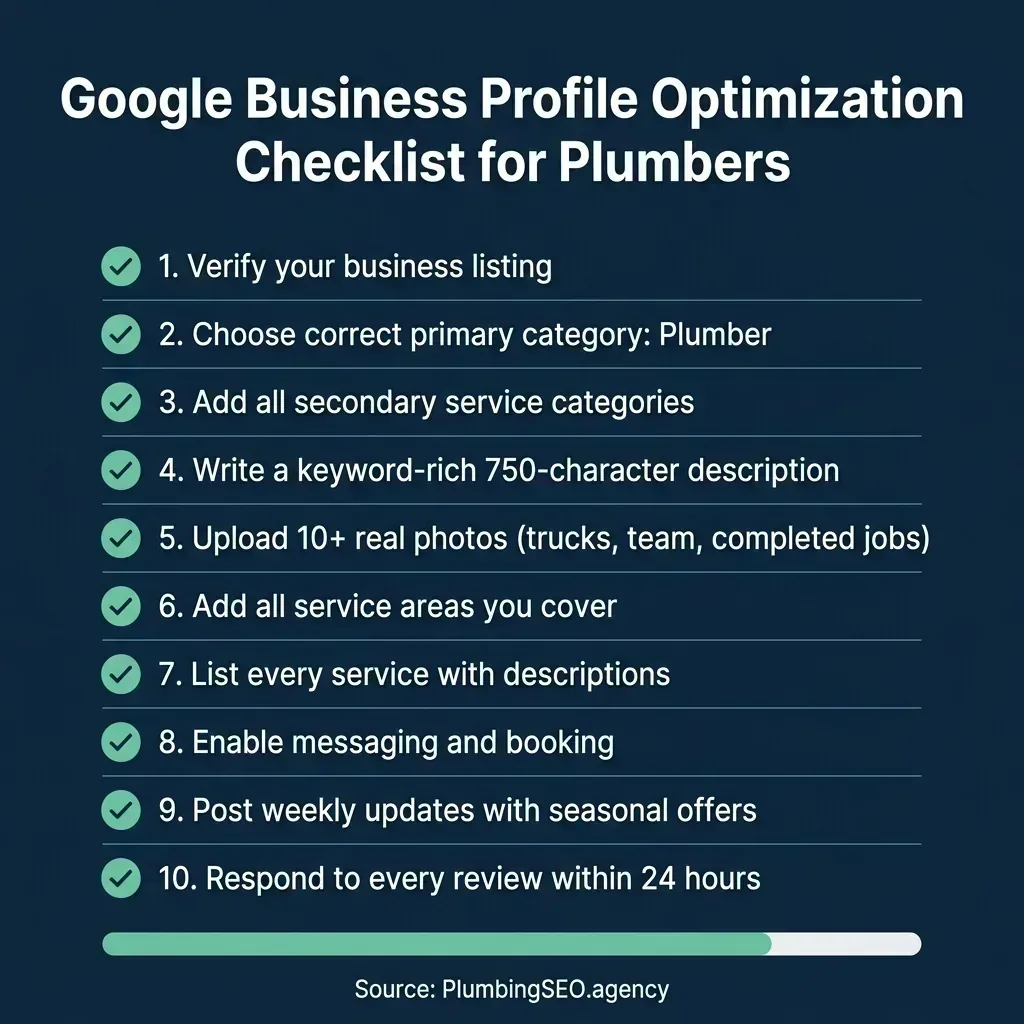
Complete GBP optimization checklist for plumbing companies. Source: PlumbingSEO.agency
A few things most plumbers get wrong on their GBP:
- Primary category matters more than you think. "Plumber" should be your primary category, not "Plumbing Service" or "Contractor." Google treats these differently for ranking purposes.
- Photos need to be real. Your trucks, your team, your completed jobs. Stock photos kill trust instantly. Businesses with 10+ real photos get 35% more website clicks from their profile. If you need a guide on which photos to use, we have a full breakdown of the 7 essential GBP photos.
- Your description gets 750 characters. Use them. Include your primary services, service areas, and what makes your company different. If you want a framework for writing one that actually helps your ranking, read our guide on writing a GBP description that ranks.
- Weekly posts influence rankings. According to 2026 data, GBP posts now influence 12% of local pack rankings, up from 5% in 2024. That is not a small number. Post weekly with service keywords and seasonal offers.
Reviews: The Ranking Factor You Control
Reviews are not just about trust, although that matters too. They are a direct ranking factor for Maps. The minimum acceptable rating in 2026 is 4.2 stars. Below that, customers scroll right past you.
Businesses that respond to reviews within 24 hours see 18% higher conversion rates from their profile views. That means responding to every review, positive or negative, within one business day. Not next week. Not when you get around to it.
The key is building a system, not relying on memory. Text each customer a review link after the job. Make it part of your process, the same way you do a final walk-through before you leave a job site. For a complete review system, check out our guide on getting more 5-star reviews for your plumbing business.
Step 2: Build SEO-Ready Service and City Pages
Your website is the foundation that supports everything else. A Google Business Profile without a solid website is like a truck without an engine. It looks good parked in the lot, but it is not going anywhere.
For plumbers, on-page SEO comes down to two things: service pages and city pages. Get these right and you have a machine that ranks for dozens of keywords automatically.
Service Pages: One Page Per Service
Every service you offer needs its own dedicated page. Not a single "Services" page that lists everything with a sentence each. Separate pages for drain cleaning, water heater repair, sewer line replacement, leak detection, bathroom remodeling, and every other service you want to rank for.
Each service page should include:
- A keyword-focused title and H1. Example: "Drain Cleaning Services in [City] | [Company Name]"
- Detailed descriptions of the service, what is included, common problems it solves, and your process
- Local keywords woven naturally throughout, like "drain cleaning in [city]" or "emergency plumber [neighborhood]"
- Trust signals: certifications, insurance info, years of experience, and real customer testimonials
- A clear call to action with your phone number and a contact form above the fold
- Schema markup for LocalBusiness and Service types
If you want the exact framework we use to build service pages that actually rank and convert, read our guide on how we build service pages that rank.
City Pages: Expand Your Reach
If you serve multiple cities or neighborhoods, you need a page for each one. But here is the catch: these cannot be copy-paste jobs with just the city name swapped out. Google is smarter than that and will flag them as thin content.
Good city pages include:
- Specific mentions of neighborhoods, landmarks, and local details
- Unique content about common plumbing issues in that area (older homes, specific pipe materials, water quality)
- Testimonials from customers in that city
- Driving time or distance from your base
For the full playbook on when city pages work and when they backfire, check out our complete city page guide.
Keyword Strategy: The Right Words on the Right Pages
Keywords are the bridge between what your customers type into Google and what shows up on your website. Getting this right is not about stuffing your pages with phrases. It is about understanding what people actually search for when they need a plumber.
Here is how plumbing keywords break down by intent:
| Keyword Type | Example | Intent | Best Page For It |
|---|---|---|---|
| Emergency | "emergency plumber near me" | Ready to call NOW | Homepage / Service page |
| Service-specific | "water heater repair [city]" | Needs a specific fix | Service page |
| Location-based | "plumber in [neighborhood]" | Wants someone nearby | City / area page |
| Problem-based | "why is my water heater leaking" | Researching, not ready yet | Blog post |
| Cost/comparison | "how much does drain cleaning cost" | Comparing options | Blog post / FAQ |
A common mistake is trying to rank one page for everything. Your homepage should not target "drain cleaning" and "water heater repair" and "plumber in Dallas" all at once. Each page targets a specific keyword cluster. For a complete walkthrough of this approach, our plumbing website keyword strategy guide lays it all out.
Technical SEO: The Stuff Under the Hood
Technical SEO is the plumbing of your website. Nobody sees it, but if it is broken, nothing else works right. The big items:
- Mobile-friendly design. More than half of all plumber searches happen on a phone. If your site is hard to use on mobile, you are losing calls.
- Page speed. If your site takes more than 3 seconds to load, 40% of visitors will leave before it even finishes. Run your site through Google PageSpeed Insights and fix whatever is red.
- Click-to-call buttons. Every page needs a tappable phone number. Make it easy to call you.
- SSL certificate (HTTPS). If your URL starts with "http" instead of "https," Google penalizes you and browsers show a "Not Secure" warning. That scares customers away.
- Schema markup. Structured data tells Google exactly what your business does, where you are, and what services you offer. It can get you rich snippets in search results.
For the full 15-point checklist, see our technical SEO checklist for plumbing websites.
Step 3: Develop a Content Strategy That Gets Found
Content is what keeps your website fresh, ranks you for new keywords, and positions you as the go-to plumber in your area. But "content strategy" does not mean pumping out random blog posts about plumbing tips nobody reads.
Here is the approach that actually works for plumbing companies:
Answer the Questions Your Customers Are Already Asking
Every time a customer calls you, they are telling you what to write about. "How much does it cost to replace a water heater?" "Why is my water pressure low?" "Is it an emergency if my toilet is running?" These are all blog posts waiting to happen.
Google's "People Also Ask" section is a goldmine. Search for your main services and look at what questions come up. Write a detailed answer for each one. That is content strategy in its simplest form.
Types of Content That Work for Plumbers
- How-to guides for common problems ("How to unclog a drain without calling a plumber")
- Cost guides for services ("How much does a sewer line replacement cost in [city]?")
- Seasonal content ("How to winterize your pipes before the first freeze")
- FAQ pages for each major service
- Comparison content ("Tankless vs. tank water heaters: which is right for your home?")
- Local content ("Common plumbing problems in homes built before 1970 in [city]")
The key insight most competitors miss: your content should not just inform, it should qualify. A homeowner who reads your article about "signs you need a sewer line replacement" and then calls you is already 80% sold on the job. They just need to confirm the price and the schedule.
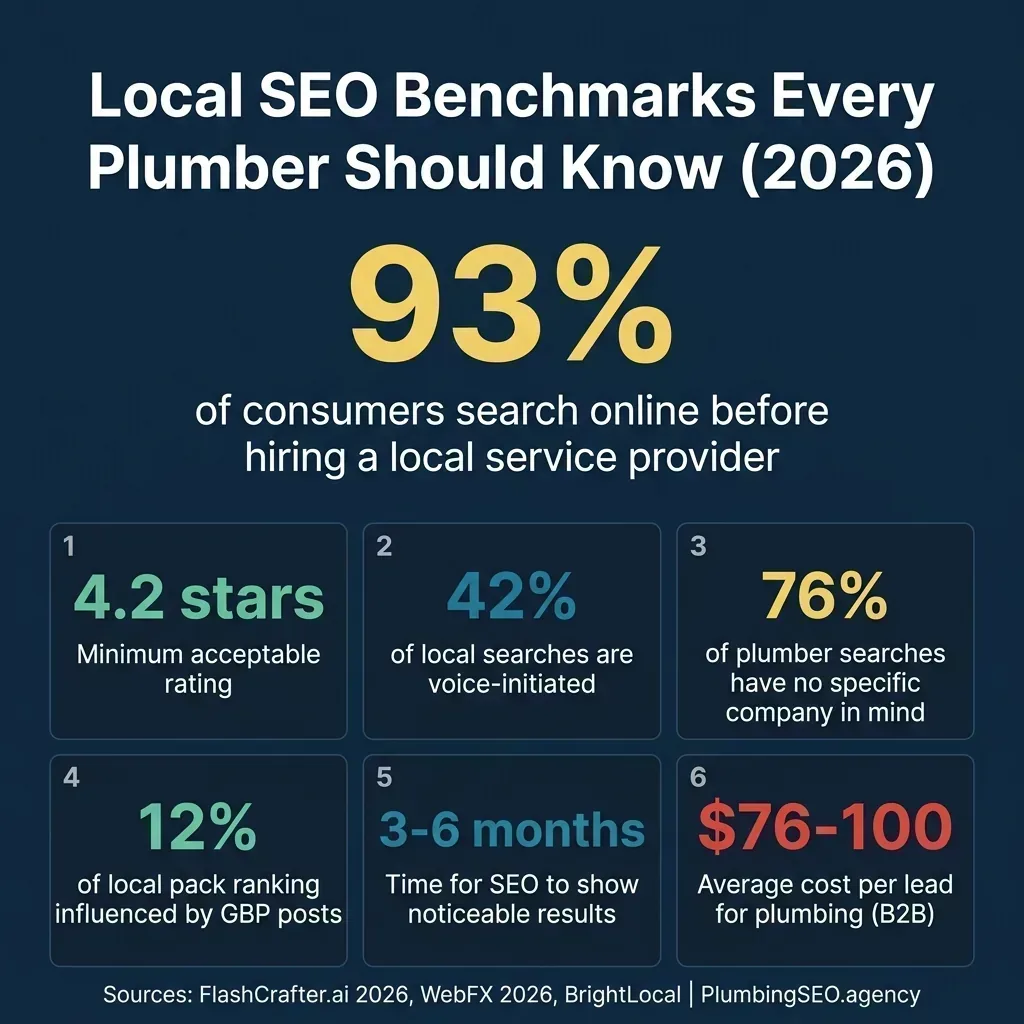
Key local SEO benchmarks that shape plumber content strategy in 2026. Sources: FlashCrafter.ai, WebFX, BrightLocal
Not sure which keywords to target first? Start with a free audit of your current rankings.
Get a Free SEO AuditStep 4: Build Local Authority With Backlinks
Backlinks are links from other websites that point to yours. Think of them as votes of confidence. When a local chamber of commerce or a real estate blog links to your website, Google sees that as a signal that your business is legitimate and trusted.
For plumbers, the good news is that you do not need thousands of backlinks from big national sites. A handful of quality local links can outperform a hundred random directory listings. As one SEO professional on Reddit put it: "Even 5-10 legit backlinks can outperform 100 random citations."
Where Plumbers Can Get Quality Backlinks
- Local chamber of commerce. Most cities have one. Join and get listed. These are high-authority local links.
- Supplier websites. Your supply house may have a "featured contractors" or testimonial page. Ask to be included.
- Local business partnerships. Real estate agents, general contractors, home inspectors, and property managers all have websites. Offer reciprocal referrals and content swaps.
- Sponsorships. Little league teams, local charity events, neighborhood associations. Sponsor something and get a link on their site.
- Guest posts on local blogs. A real estate agent might appreciate a guest post about "5 plumbing red flags when buying an older home." You get a link, they get useful content.
- Industry directories. Angi, HomeAdvisor, BBB, Yelp, and the top 50 plumber directories. These are citation links that build trust.
For the full strategy, including which directories actually move the needle, see our guide on how plumbers get local backlinks without begging.
Citations: The Foundation Layer
Citations are mentions of your business name, address, and phone number (NAP) on other websites. Before you chase backlinks, make sure your citations are clean. Inconsistent NAP information across directories confuses Google and hurts your rankings.
Start with the top 20 directories, then expand. Consistency matters more than quantity. If your business is listed as "Joe's Plumbing" on Google, "Joe's Plumbing LLC" on Yelp, and "Joseph's Plumbing Services" on the BBB, that is three different businesses in Google's eyes.
Step 5: Track What Matters (Calls, Jobs, Revenue)
Here is where most plumbing companies drop the ball. They invest in SEO but never measure whether it is actually working. Or worse, they measure the wrong things, like rankings and "impressions" that look good on a report but do not pay the bills.
The metrics that actually matter for a plumbing company:
| Metric | Why It Matters | How to Track It |
|---|---|---|
| Phone calls from organic search | This is the end goal. Calls that turn into booked jobs. | Call tracking software (CallRail, WhatConverts) |
| Cost per lead | How much each lead is costing you through SEO | Monthly SEO spend / total organic leads |
| GBP actions | Calls, direction requests, website clicks from your profile | Google Business Profile Insights |
| Organic traffic by page | Which pages bring in actual visitors | Google Search Console + Google Analytics |
| Keyword rankings | Are you moving up for your target terms? | Rank tracking tools (BrightLocal, Whitespark) |
| Booked jobs from SEO | The ultimate metric. Revenue, not vanity numbers. | CRM + call tracking attribution |
One common frustration from plumber forums: "I run a service plumbing company and have spent $1,500 a month for the past year on SEO. I am starting to think I am wasting my money." Nine times out of ten, the problem is not that SEO does not work. The problem is that nobody set up proper tracking, so there is no way to know what is working and what is not.
Call tracking is one of the most important tool you can add. It assigns unique phone numbers to different sources (Google organic, Maps, ads, website) so you know exactly where every lead comes from. For a complete setup walkthrough, read our call tracking guide for plumbing companies.
The Realistic 12-Month SEO Timeline for Plumbers
If anyone tells you SEO delivers results in two weeks, walk away. If they say it takes two years before you see anything, that is also wrong. Here is what a realistic timeline looks like for a plumbing company starting SEO from scratch or near-scratch:
| Timeframe | What Happens | What You Should See |
|---|---|---|
| Months 1-2 | GBP optimization, technical fixes, service page creation, citation cleanup | GBP visibility improves, some early Maps movement. Few organic leads yet. |
| Months 3-4 | Content production begins, link building starts, reviews accumulate | First organic rankings appear. Phone starts ringing from Maps. 5-15 organic leads/month. |
| Months 5-8 | Authority builds, content indexes, rankings strengthen across multiple keywords | Consistent growth. 15-40 organic leads/month. Cost per lead dropping. |
| Months 9-12 | Compounding kicks in. You rank for dozens of service + city keyword combinations. | 40-60+ organic leads/month. SEO ROI typically hits 300-800%. Leads continue even if you pause briefly. |
The key word is compounding. Unlike paid ads where you are renting visibility, SEO builds equity. The content you create in month 3 is still ranking and generating calls in month 36. Case studies from plumbing companies show 260-500% increases in organic traffic within 12 months of consistent investment.
"Bad SEO is like a slow drain. You can ignore it for a while, but eventually it backs up somewhere ugly."
Should You DIY or Hire an Agency?
This is the question every plumbing company owner asks at some point. The honest answer is: it depends on your market, your time, and your budget.
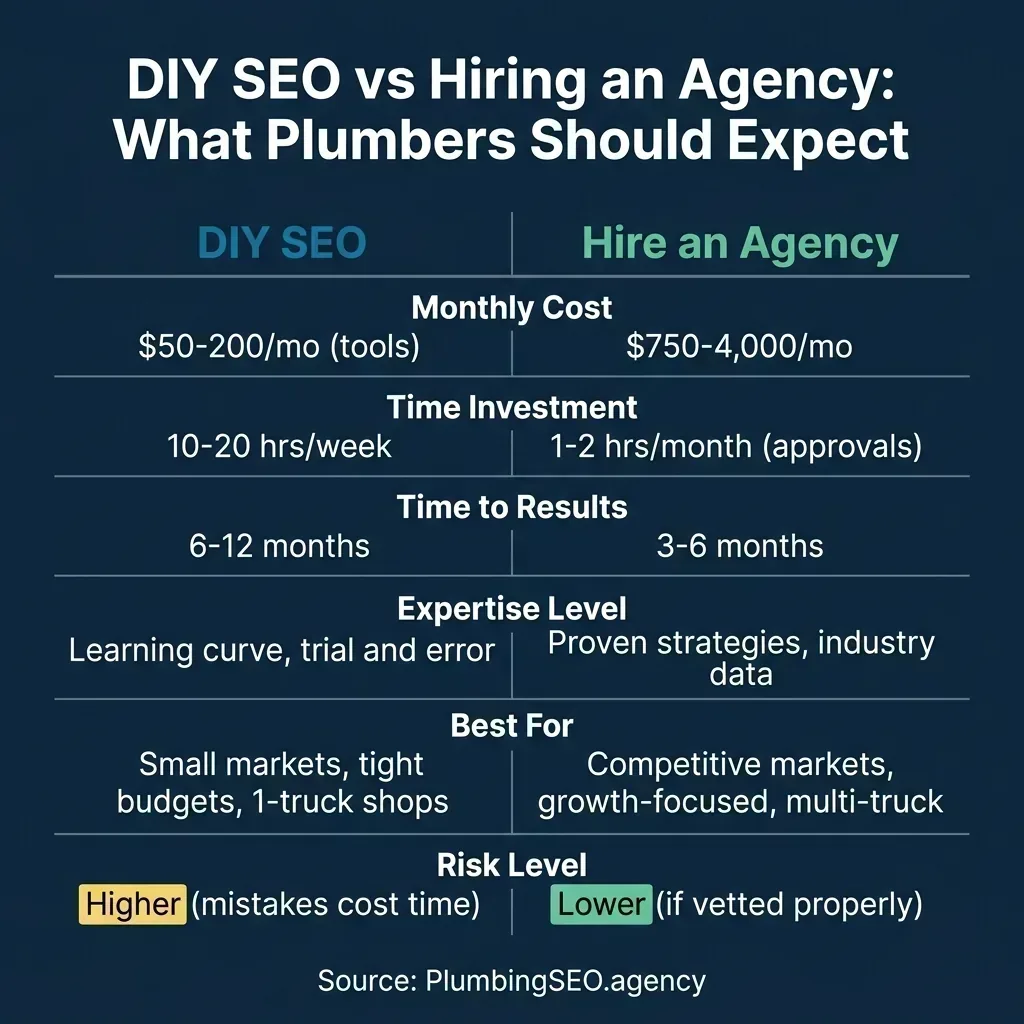
DIY SEO vs hiring an agency: what plumbing company owners should expect. Source: PlumbingSEO.agency
Here is the way I see it. If you are a one-truck shop in a small market with more time than money, you can handle the basics yourself. Claim your GBP, get reviews flowing, write some content about your services. That will move the needle.
But if you are in a competitive metro area, running multiple trucks, and your time is worth more spent on jobs than on learning SEO, the math usually favors hiring someone who knows what they are doing. As one plumber on Reddit said: "I am sure you have seen firsthand exactly what happens when someone, with no clue, tries to DIY a plumbing project. Which is precisely what you are doing with SEO."
The key is vetting whoever you hire. Ask for case studies with plumbing clients. Ask what they will actually do each month. Ask how they report results. If they guarantee #1 rankings or cannot explain their process in plain English, keep looking. For the right questions to ask, see our guide on what to ask before hiring an SEO agency.
Frequently Asked Questions
Plumber SEO typically costs $750-$4,000 per month depending on your market size and competition. Small markets with less competition start around $750-$1,500/month. Competitive metro areas need $2,000-$4,000/month for comprehensive services. DIY costs run $50-200/month for tools like Ahrefs or BrightLocal. The key is measuring cost per lead, not just the monthly fee. Well-executed SEO should deliver leads at $25-45 each once rankings are established.
Google Business Profile improvements can show Maps visibility gains in 2-4 weeks. Organic website rankings typically take 3-6 months for noticeable improvement in moderately competitive markets. By 9-12 months of consistent work, most plumbing companies see 300-800% ROI. The results compound over time, meaning each month builds on the last. Companies that commit for 12+ months see the strongest returns.
Yes, especially the fundamentals. Claiming and optimizing your Google Business Profile, getting reviews, ensuring your NAP info is consistent, and creating basic service pages are all DIY-friendly. However, technical SEO, advanced link building, and competitive keyword strategy require more expertise. Many plumbing companies start DIY, then hire an agency once they see early results and want to accelerate. The biggest risk of DIY is making mistakes that cost you time, like targeting the wrong keywords or creating thin content that Google ignores.
For Google Maps (the Local 3-Pack), your Google Business Profile optimization, review quantity/quality, and proximity to the searcher are the top three factors. For organic website rankings, it is a combination of relevant on-page content, quality backlinks, and technical site health. In practice, most plumbing companies get the biggest early wins by fully optimizing their GBP and building a consistent review system.
For long-term ROI, SEO wins. SEO leads cost $25-45 each once established, compared to $183 average for Google Ads leads. But Google Ads delivers immediate results while SEO takes 3-6 months. A strong strategy is to use both: run ads for immediate cash flow while building SEO for long-term growth. As organic rankings strengthen, gradually shift budget from ads to SEO.
Focus on local service keywords: "plumber in [city]," "emergency plumber [city]," "water heater repair [city]," and "drain cleaning [city]." Also target "near me" keywords by optimizing your Google Business Profile. For blog content, target problem-based keywords like "why is my water heater leaking" and cost-related queries like "how much does a sewer line replacement cost." Each keyword type belongs on a specific page type: service keywords on service pages, location keywords on city pages, and question keywords on blog posts.
Track phone calls from organic search using call tracking software, monitor Google Business Profile actions (calls, direction requests, website clicks), and check organic traffic growth in Google Search Console. The ultimate metric is booked jobs from organic sources. If you cannot attribute phone calls to specific channels, install call tracking before anything else. Rankings and traffic are leading indicators, but phone calls and booked jobs are the numbers that pay the bills.
Ready to Get Your Phone Ringing?
SEO is a process, not a project. But every plumbing company that commits to it sees the same result: more calls, more booked jobs, and a cost per lead that keeps dropping. As a focused plumbing SEO agency, we help plumbing companies build the kind of online visibility that fills schedules and keeps trucks moving. Find out exactly where your leads are leaking.
Run My Free SEO Leak Check