
- Cost benchmark: BuzzStream's 2026 study found averages of $295 bought directly and $461 through vendors, but price does not prove quality.
- Buy quality, not quotas: review relevance, real readership, recent indexation, publishing standards, outbound links, and sponsorship terms before approving a site.
- Prioritize real-world fit: local press, chambers, trade groups, suppliers, and home-service publications can be more useful than a generic high-DR guest-post list.
A plumbing guest post usually costs a few hundred dollars per placement, but the invoice does not tell you whether the link is useful. In a 2026 marketplace study, BuzzStream found an average direct-from-site price of $295 and an average vendor price of $461. The same study also found that weak sites dominated the available inventory. That is why a plumber should buy editorial quality and audience fit, not a promised domain score or a fixed monthly link count.
This guide is for plumbing company owners comparing outreach services, agencies, and guest-post packages. It explains what the fee can include, how many placements may be reasonable, how to review a publisher, and when a local or plumbing-trade link is a better use of the budget.
One distinction matters from the start: a legitimate article written for another publication can build awareness and referral traffic. A paid link arranged mainly to manipulate rankings creates a different risk. The placement, disclosure, link attribute, anchor text, and publishing pattern all matter.
What counts as a plumbing guest post?
A plumbing guest post is an article published on a website your plumbing company does not own. It may be written by the plumber, an SEO provider, a publicist, or the publisher. A useful article has a clear audience and an editorial reason to exist: winter pipe advice for a regional property publication, water heater guidance for a home-improvement site, or a commercial maintenance checklist for a facilities audience.
The phrase is also used for paid link placements sold from large publisher lists. Those offers often sound similar—choose a domain authority tier, approve an article, receive a live URL—but their business value can vary wildly. One placement may reach homeowners or property managers. Another may sit on a site that publishes hundreds of unrelated paid articles and attracts no plausible plumbing customer.
Use this simple test: would the article still make sense if the link did not influence search rankings? If it teaches a real audience, supports your expertise, and can send a relevant visitor, the placement has an independent reason to exist. If the only explanation is “the site has DR 50,” keep your wallet closed.
How much does a guest post cost in 2026?
The most defensible current benchmark we found comes from BuzzStream's 2026 guest-post marketplace study. Its cleaned analysis included 257,267 sites for which price, estimated traffic, and Domain Rating data were available.
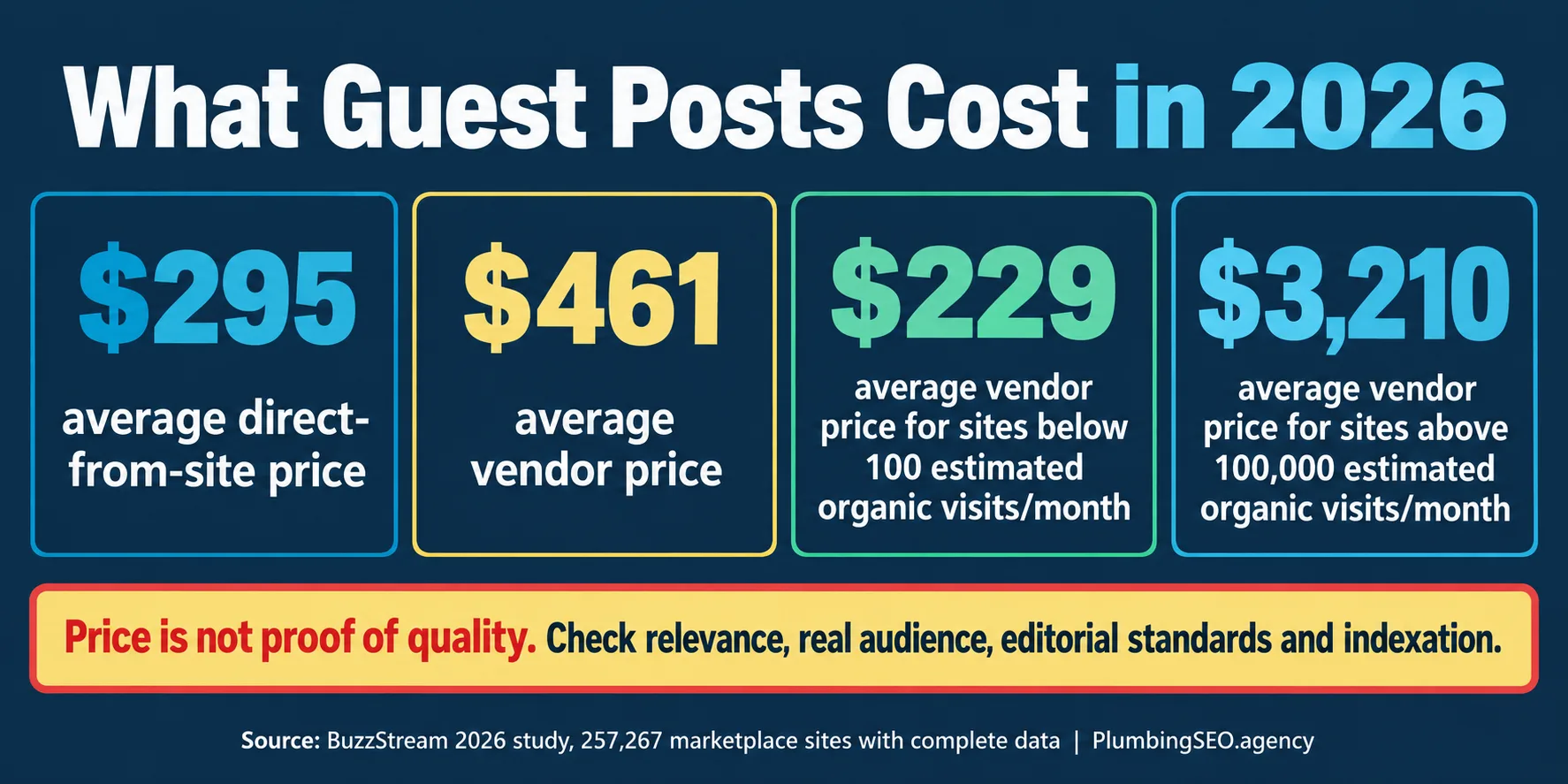
| Pricing benchmark | Average price | What it means for a plumber |
|---|---|---|
| Buying directly from a site | $295 | Lower average cost, but your team handles prospecting, negotiation, briefs, writing, and quality control. |
| Buying through a vendor | $461 | The markup may cover outreach and content, but it does not guarantee a better publication. |
| Vendor sites below 100 estimated visits per month | $229 | Cheap inventory may have little discoverable audience; inspect it manually before approving. |
| Vendor sites above 100,000 estimated visits per month | $3,210 | Real visibility can be expensive, yet traffic still must match your market and customer. |
Those are market observations, not a promise that a $461 link will rank a plumbing page. BuzzStream classified 96.2% of the inventory in its study as low quality and found that 39.6% of the sites had no estimated organic traffic. Only 1.37% landed in its two strongest quality tiers. The practical lesson is not “pay more.” It is “verify more.”
What should the placement fee include?
Ask for a line-item answer. A managed fee may include prospect research, outreach, negotiation, topic selection, article writing, editing, image sourcing, publisher payment, link monitoring, and a replacement policy. Some vendors quote only the publication fee, then charge separately for content or outreach. Others bundle everything and hide the publisher until after payment.
- Prospecting: finding publications relevant to plumbing, homes, property, construction, facilities, or the service area.
- Editorial work: creating an original article for that publication's audience rather than spinning a generic plumbing post.
- Publisher cost: any disclosure, sponsorship, or placement fee charged by the site.
- Quality assurance: confirming the page is live, indexable, accurate, linked as agreed, and not surrounded by obvious spam.
- Monitoring: checking that the article and link remain live and reporting changes without disguising them as new placements.
If you are comparing a standalone link campaign with a broader program, review what a complete plumbing SEO service does before assigning the whole budget to placements. Guest posts cannot repair a weak service page, broken tracking, an incomplete Google Business Profile, or a site that fails to turn visitors into calls.
Guest-post package models compared
Most offers fall into four models. None is automatically best. The right choice depends on who controls publisher selection, whether you can reject sites, and whether the work connects to pages that can generate booked jobs.
| Model | How it works | Main advantage | Main risk |
|---|---|---|---|
| Direct outreach | You or your agency contacts publications individually. | More control over relationship, topic, and audience. | Slow research and outreach; direct fees still may apply. |
| Publisher marketplace | You select from a catalog by price and metrics. | Fast comparison and predictable ordering. | The catalog can reward easy-to-sell inventory rather than editorial fit. |
| Fixed monthly package | A provider promises a set number or metric tier each month. | Simple budgeting and delivery cadence. | The quota can pressure the provider to buy weak sites when good opportunities are unavailable. |
| Custom campaign | Placements are chosen around pages, markets, competitors, and outreach opportunities. | Better connection between the link, target page, and business goal. | Requires transparent strategy and may produce an uneven monthly count. |
A fixed package is not automatically bad, but the number should be a planning ceiling, not an order to publish at any cost. Our comparison of plumbing SEO packages vs custom SEO plans explains the same principle across the rest of an SEO program: consistent work matters, but the work should follow the market rather than a rigid deliverables menu.
How many guest posts should a plumber buy per month?
There is no universal correct number. Any answer that ignores your market, current link profile, target pages, budget, and available publishers is a sales quota dressed up as strategy.
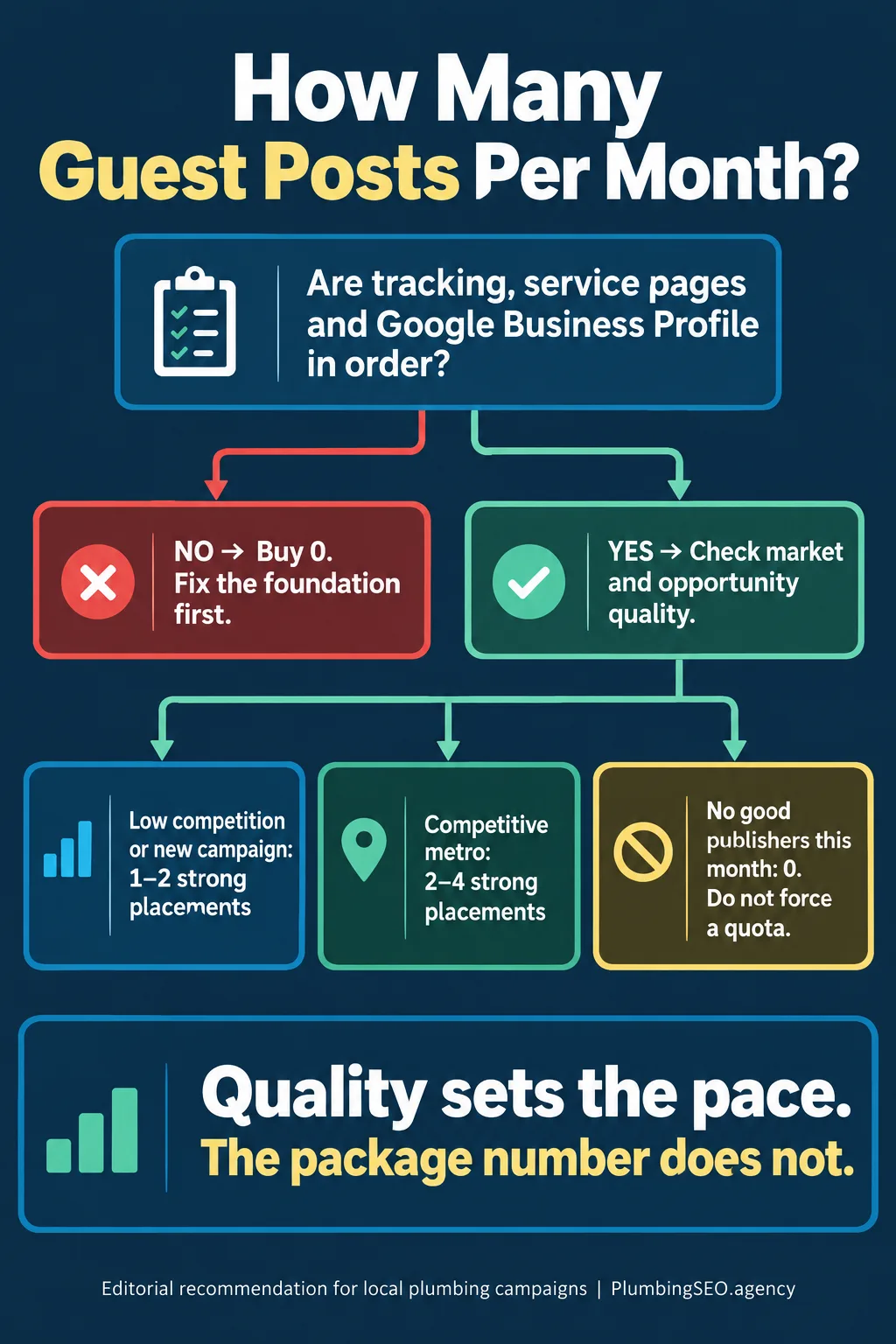
As an editorial planning range—not a ranking formula—a focused new campaign may pursue one or two strong placements in a month. A competitive metro campaign with good target pages and credible opportunities may pursue two to four. A month with no suitable publishers should produce zero. It is better to carry the budget forward than force a plumber onto a weak site to make a dashboard turn green.
Before buying even one placement, confirm that call tracking works, core service pages are useful, local proof is visible, the Google Business Profile is in order, and the destination page matches the intended query. If those foundations are missing, follow the step-by-step plumber SEO guide first. Links amplify what is already there; they do not turn a poor customer path into a good one.
The seven-gate plumbing guest-post quality checklist
Third-party metrics can help you screen a long list, but they are not proof of quality. DA and DR are estimates built by tool companies, not Google scores. Estimated traffic can also miss seasonal changes, regional visibility, and traffic concentrated on one irrelevant page. Use the numbers to decide what to inspect, then inspect the site yourself.
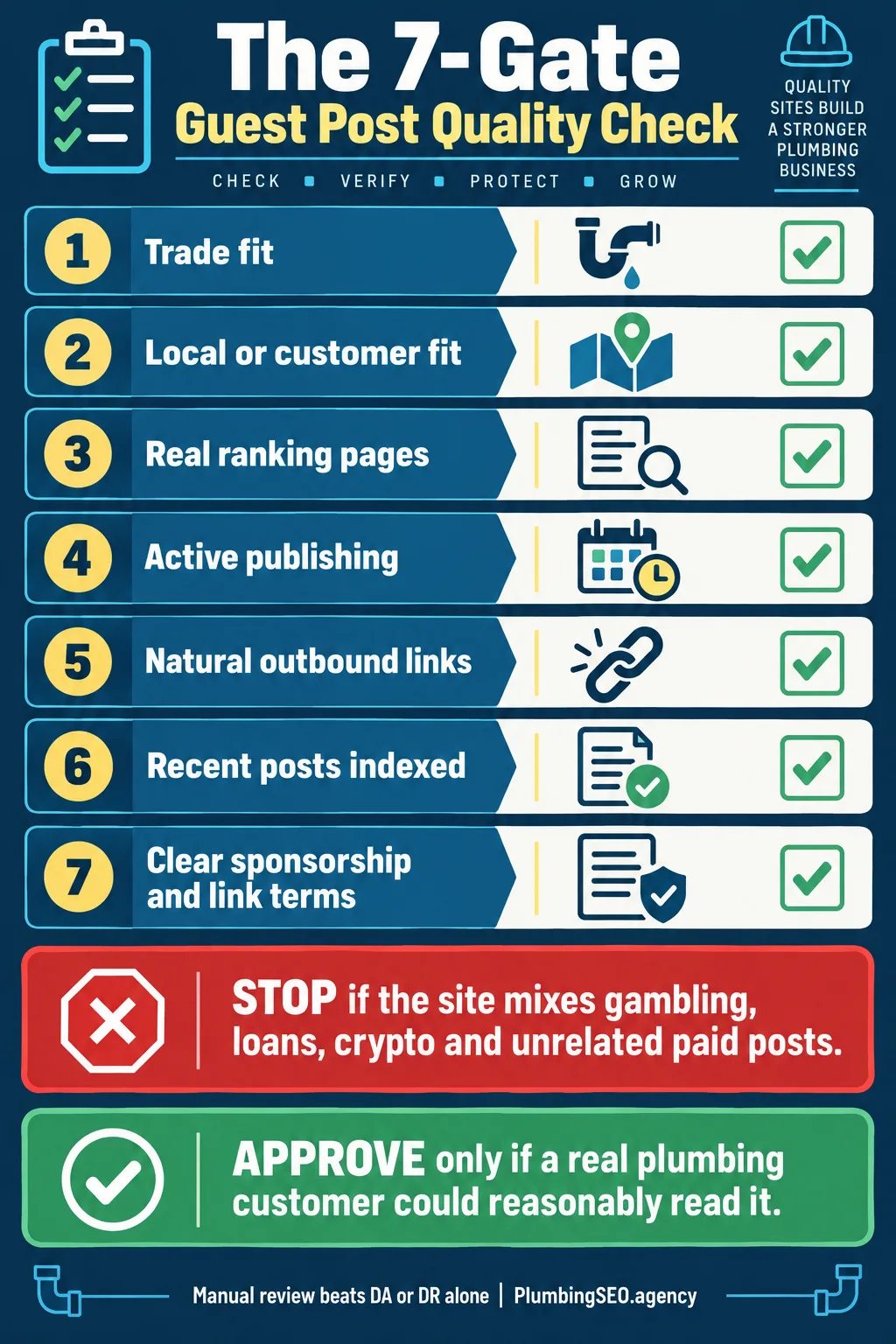
1. Trade fit
Start with the publication's normal subject matter. Plumbing, home improvement, property management, facilities, construction, real estate, building maintenance, insurance, and local homeownership can all make sense. A general business publication may also work if the article is genuinely about operating a plumbing company. A site that jumps from casino bonuses to payday loans to water heaters is not broad; it is inventory.
2. Local or customer fit
Ask who might actually read the article. A regional newspaper, local business journal, HOA resource, landlord publication, or city home magazine can have stronger customer fit than a global blog with a larger headline metric. For a plumbing company, relevance can come from the trade, the location, or the customer problem. The best placements often have two of those three.
3. Real ranking pages
Do not accept a vendor screenshot of total traffic. Review which pages rank and where that visibility comes from. A U.S. plumbing company gets little value from a site whose traffic comes almost entirely from unrelated entertainment queries in another country. Look for multiple useful pages attracting search visibility across the site's core topic, not one statistical outlier.
4. Active publishing and accountable authors
Check the recent archive. Are there thoughtful articles published at a believable pace? Do author pages identify real editors, specialists, or organizations? Are dates, corrections, contact information, and editorial standards visible? A publication does not need a newsroom, but it should look managed by people who care what readers see.
5. Natural outbound links
Open several recent articles and inspect the links. Healthy editorial pages cite useful sources where the reader needs them. Link farms repeatedly push commercial exact-match anchors to unrelated companies. Also watch for every article linking to one buyer, links inserted into awkward sentences, and a pattern of posts that exist only to host two or three paid URLs.
6. Recent posts indexed
Search for several exact article titles and inspect whether the pages are discoverable. Lack of indexation does not prove a penalty—new or low-priority pages can take time—but repeated non-indexation across recent posts is a reason to stop and investigate. Your vendor should never guarantee indexation; it should explain what happens if a page remains unavailable or is removed.
7. Clear sponsorship and link terms
Know whether the placement is editorial, contributed, advertised, or sponsored. Ask which link attribute will be used, whether the publisher can edit or remove the article, whether the URL is indexable, how long the placement is expected to remain live, and what the replacement policy covers. A provider that hides those terms until after payment is shifting all the risk to you.
Red flags that should stop the purchase
Reject the placement when the overall publishing pattern looks designed to sell ranking links. No single signal is perfect, but several together can make the decision easy.
- The site publishes gambling, loans, crypto, adult, essay-writing, and unrelated local-service posts side by side.
- The vendor sells only by DA or DR and will not show real pages, topics, traffic distribution, or recent examples.
- Most articles use keyword-rich commercial anchors that no editor would choose naturally.
- The article is promised across a large network, or nearly identical copy appears on multiple sites.
- The publisher accepts every topic and has no visible audience, editorial identity, author accountability, or contact information.
- Recent posts are not indexed, vanish quickly, or are later moved to a different URL without notice.
- The sales pitch promises guaranteed rankings, permanent links, or a specific increase from one placement.
Practitioners in community discussions often suggest checking recent indexation, branded demand, traffic distribution, topical consistency, and outbound-link behavior instead of relying on authority scores alone. Treat those as useful field checks, not official Google criteria. The final decision still requires human review.
Google's rules for sponsored and large-scale article links
Google's guidance is more precise than the common claim that “all guest posting is bad.” In its reminder about large-scale article campaigns, Google says it does not discourage articles that inform users, educate another site's audience, or build awareness. Problems arise when the main intent is to manufacture links at scale.
Google lists warning signs such as stuffing keyword-rich links into articles, publishing the same or similar content across many sites, using writers who are not knowledgeable about the topic, and running campaigns primarily for links. Publishers are also expected to vet contributors and question links that appear designed to manipulate search.
Google's outbound-link qualification documentation gives publishers three relevant values:
| Link value | When Google says to use it | Plain-English meaning |
|---|---|---|
rel="sponsored" | Links that are advertisements or paid placements. | Money, products, or services were exchanged for the placement. |
rel="ugc" | Links inside user-generated content such as comments or forum posts. | The link came from a user contribution, not the publisher's editorial team. |
rel="nofollow" | Cases where other values do not apply and the publisher does not want Google to associate the site with or crawl the linked page. | The publisher is declining normal endorsement or crawl association. |
Values can be combined when appropriate. For example, a publisher may use rel="nofollow sponsored" on a paid link. The important owner-level point is simple: do not pay a publisher to hide the commercial relationship and pass ranking credit. Paying for legitimate advertising or sponsorship can be reasonable, but the link should be handled according to the nature of the placement.
Anchor text and destination-page rules
A link should help the reader understand what comes next. Branded anchors, the company name, a plain URL, or a natural description of the resource are usually easier to defend than repeatedly forcing “best emergency plumber Dallas” into unrelated articles.
Match the destination to the editorial context:
- A local business profile can naturally link to the homepage or about page.
- A water-heater maintenance article can link to a genuinely useful water-heater guide or service page.
- A property manager checklist can link to a commercial plumbing or emergency-planning resource.
- A broad article about plumbing marketing can link to a relevant research page rather than forcing a local service anchor.
Do not rotate exact-match anchors through a spreadsheet as if they were fittings on a truck. A natural link profile reflects how editors and customers talk: brand names, URLs, article titles, and varied descriptions. The destination page should also be strong enough to deserve the referral—accurate service details, local proof, clear calls to action, and no mismatch between the article's promise and the landing page.
Generic guest posts versus local and trade links
A broad home-improvement publication can be useful, but it should not crowd out links that prove your place in the local market or plumbing trade. A chamber profile, manufacturer installer listing, supplier case study, local news quote, trade association page, or community sponsorship may have a smaller authority score while offering a clearer connection to real customers and partners.
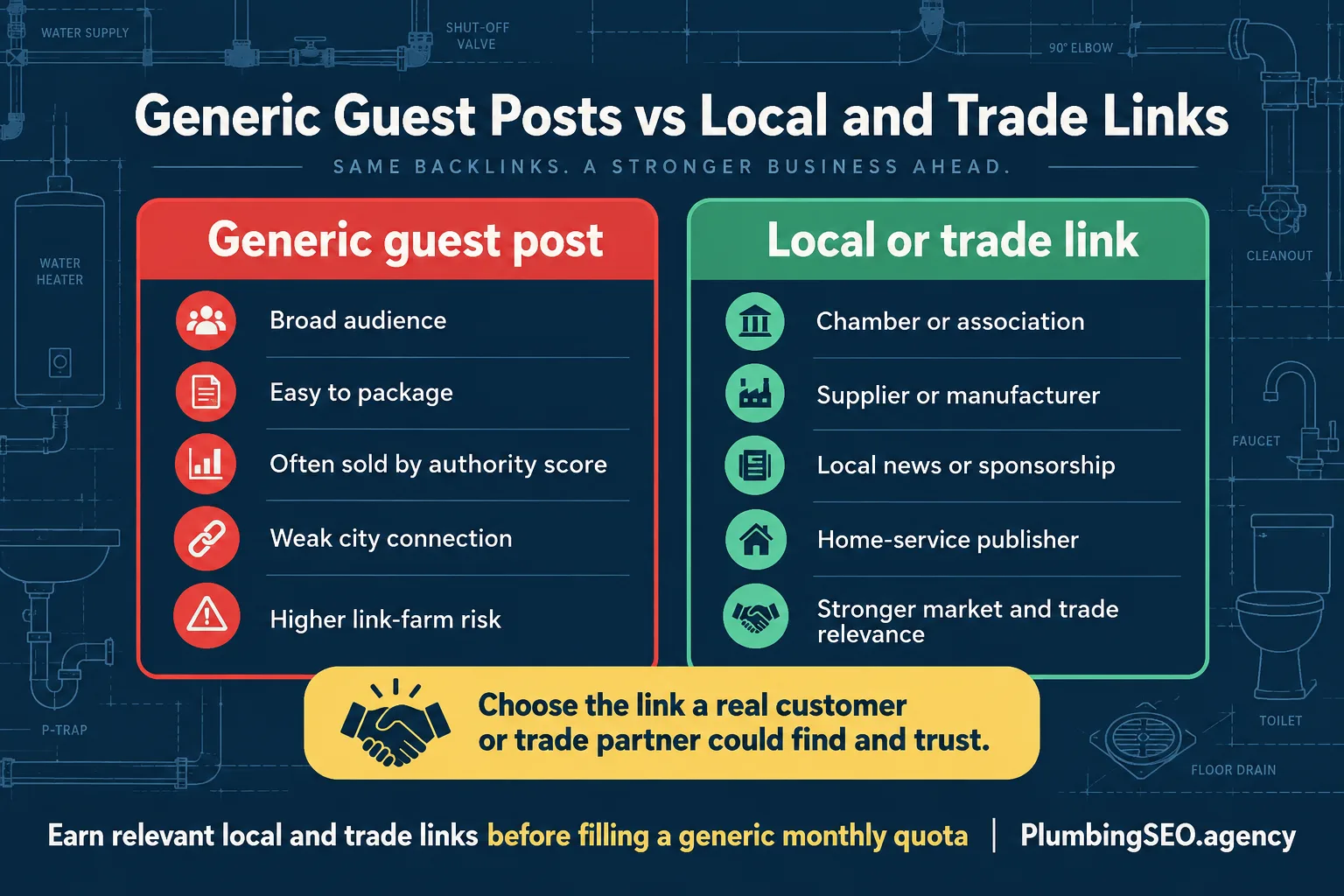
| Opportunity | Best use | Question to ask |
|---|---|---|
| Home-service or property publication | Teach homeowners, landlords, realtors, or managers about a relevant problem. | Does the publication reach people who influence a plumbing job? |
| Local news or city publication | Seasonal warnings, code changes, water issues, community expertise, and brand awareness. | Is there a real local angle rather than a generic article with the city inserted? |
| Supplier or manufacturer | Installer profiles, product education, case studies, and dealer directories. | Does the link reflect a genuine product or business relationship? |
| Chamber or trade association | Membership visibility, trust, referrals, and local or professional relevance. | Would the membership still be useful without the backlink? |
| Generic high-authority site | Broader expertise and brand exposure when the topic and audience still fit. | Can the provider show real readers, relevant ranking pages, and editorial standards? |
If your campaign lacks those relationship-based opportunities, use our local backlink strategy for plumbing companies. That guide covers suppliers, associations, cross-trade partners, sponsorships, local press, unlinked mentions, and useful city resources. This page has a narrower job: helping you evaluate paid or managed guest-post inventory without confusing quantity with quality.
Fifteen questions to ask a guest-post provider
Do not start by asking for the cheapest DR tier. Send the provider these questions and compare the clarity of the answers.
- Can I review and reject every publisher before writing or payment?
- How do you define relevance for a plumbing company and its service area?
- Will you show estimated traffic by country and the pages producing that traffic?
- How do you check recent article indexation and publishing activity?
- Do you inspect outbound-link patterns and unrelated paid topics?
- Who chooses the article topic, and is the content written for the publisher's readers?
- Who writes and fact-checks plumbing claims?
- Is the placement editorial, contributed, advertised, or sponsored?
- Which
relattribute will the publisher use on a paid link? - Can the publisher change the anchor, destination, URL, or article after publication?
- What happens if the page is removed, redirected, deindexed, or the link changes?
- Does the fee include content, edits, publisher charges, monitoring, and replacements?
- Will the same or similar article appear anywhere else?
- How will the placement be connected to a target page and business goal?
- Will reporting include referral traffic, assisted leads, target-page movement, indexation, and retention instead of only DR and link count?
A trustworthy provider may say no to some requests. That can be a good sign. Real publications retain editorial control, and no honest agency can guarantee a page will stay live forever or cause a specific ranking. What matters is whether the limits, fees, risks, and remedies are stated before you approve the work.
How to measure a placement after it goes live
Guest posts should be measured as part of a campaign, not judged only by whether a link exists. Record the baseline before publication and review both the placement and its destination.
- Publication quality: article accuracy, page indexation, surrounding content, link attribute, anchor, destination, and whether the page remains live.
- Audience response: referral visits, engaged sessions, branded searches, email or form actions, and calls attributable to the source when tracking allows.
- Target-page movement: impressions, clicks, query mix, and visibility for the linked page over a reasonable period.
- Business outcome: qualified calls, estimates, booked jobs, revenue, and assisted conversions—not raw sessions alone.
- Portfolio health: relevance and diversity across local, trade, editorial, branded, and naturally earned sources.
Do not credit one link for every positive change that follows. Rankings move because of content, technical changes, competitors, reviews, Google Business Profile activity, seasonality, and other links. Use before-and-after data as evidence, not as a magic-link story.
A practical 30-day buying plan
If you are ready to test guest posting, keep the first month controlled.
| Week | Action | Deliverable |
|---|---|---|
| 1 | Audit foundations, current links, target pages, conversion tracking, and competitors. | One clear page and business goal for the campaign. |
| 2 | Build a mixed prospect list: local, trade, supplier, home-service, property, and selected general publications. | A shortlist with audience, topic, traffic distribution, recent posts, and risk notes. |
| 3 | Approve the strongest opportunity and create an original article for that publisher's readers. | A useful, fact-checked piece with a natural destination and agreed disclosure. |
| 4 | Verify publication details and set monitoring. | Live URL, link attribute, indexation check, baseline metrics, cost record, and review date. |
If no prospect clears the quality gates, end the month with the research and budget intact. Use the time to strengthen the destination page or earn a local link through a real relationship. Zero weak placements is a successful quality-control result.
The recommendation for plumbing company owners
Guest posting can support a plumbing SEO campaign when the article belongs on the publication, serves its readers, uses honest commercial terms, and points naturally to a page worth visiting. It becomes a poor buy when the provider substitutes a metric for an audience, a quota for a strategy, or a hidden paid link for editorial trust.
Start with the plumbing company's foundation. Then prioritize local and trade opportunities. Add selective guest articles where the publication, topic, and reader fit are real. Review every publisher manually, accept zero in a weak month, and measure calls and jobs alongside visibility.
For budgeting beyond link placements, our plumbing SEO pricing explains the broader work required to turn search visibility into booked calls. A complete campaign connects technical health, service pages, Google Maps, local trust, measurement, and careful authority building instead of treating guest posts as a standalone shortcut.
Guest Posting FAQs for Plumbers
Not sure whether your backlink package is helping or leaking money?
We will review the publishers, destination pages, local opportunities, and tracking behind the campaign, then show you the practical next move.
Run My Free SEO Leak CheckNo mystery link lists. No forced quotas. Just a plumbing-focused quality review.