
- A fixed package works when your plumbing company needs the basics tightened up in one main market. Custom scope fits when the leak is bigger than one checklist.
- Do not compare SEO plans by blog count or backlink count alone. Compare diagnosis, service-area coverage, technical work, tracking, and reporting tied to calls.
- For package-intent buyers, the safest next step is a scope check: what is missing now, what must be fixed first, and what budget can actually keep the trucks moving.
If your plumbing company is shopping for SEO, you will see two kinds of offers fast. One agency sells a neat monthly package. Another wants to build a custom SEO plan after looking at your website, service area, competitors, and call goals.
Both can be right. Both can also waste money if they are sold wrong.
A fixed plumbing SEO package is like a standard service call. It has a known price, a known checklist, and a clear limit. A custom SEO plan is more like repiping an old building. You do not price it honestly until you know where the lines run, what is corroded, and which walls you are opening.
The mistake is buying the label instead of the scope. A $600 package can be a smart start for a small shop with a thin Google Business Profile and weak service pages. A $3,500 custom plan can be fair in a brutal metro if it includes strategy, implementation, tracking, and conversion work. But a $3,500 checklist with prettier words is still a checklist.
This guide explains how to choose between fixed plumbing SEO packages and custom SEO plans without getting buried in agency language.
The real difference is not price. It is diagnosis.
Most plumbing owners ask the first obvious question: "How much does it cost?" Fair question. You have trucks, payroll, insurance, parts, fuel, and a phone that needs to ring before next Friday.
But the better question is this: "What problem is this plan actually built to fix?"
A package usually starts with pre-set deliverables. Maybe Google Business Profile optimization, citations, a few service-page edits, one or two blog posts, and a monthly report. That can help if your basics are missing.
A custom plan should start with diagnosis. Which services are most profitable? Which city pages are weak? Is the website slow? Are calls coming from the wrong towns? Does the Google Business Profile have the wrong categories, weak photos, thin reviews, or inconsistent business data? Are rankings present but calls still low?
Google says local results are influenced by relevance, distance, and prominence in its local ranking guidance. That means a plumbing plan cannot live on the website alone. It has to cover the map listing, reviews, service-area signals, website pages, and trust signals customers see before they call.
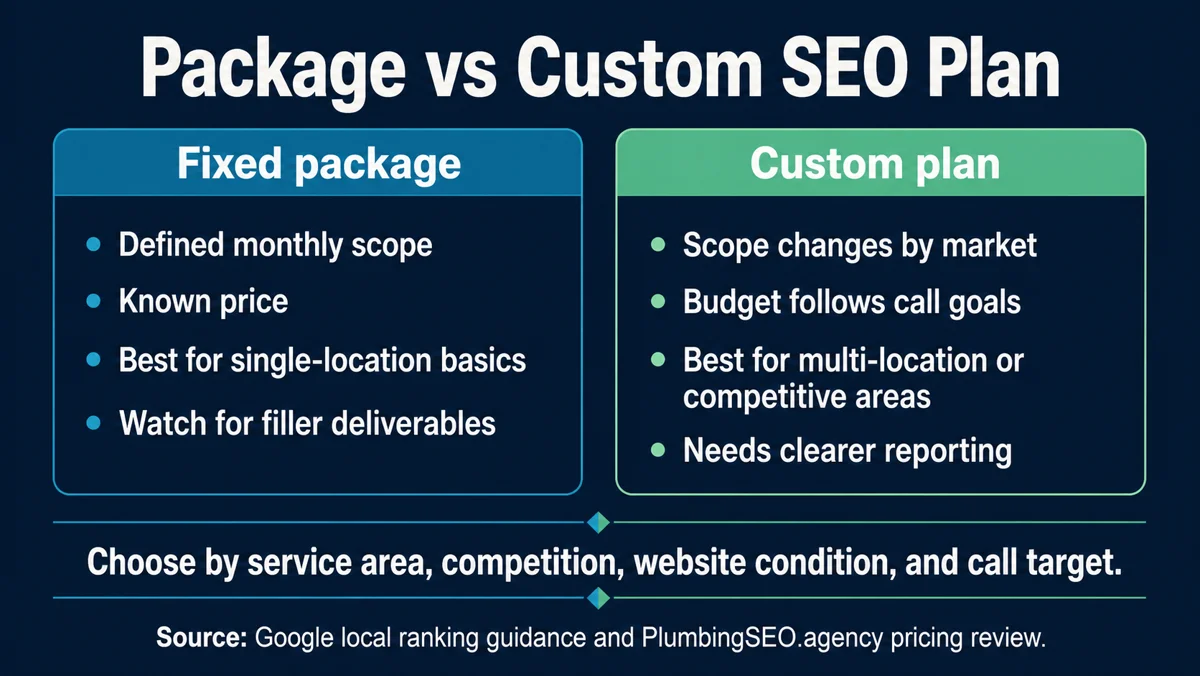
Here is the practical rule: use a package when the problem is simple and visible. Use custom scope when the problem needs investigation before the fix is obvious.
When a fixed plumbing SEO package makes sense
A package is not automatically bad. A lot of plumbers need a clean starting point, not a giant strategy deck. If the shop has one main location, a small service area, and a website that has never been properly tuned, a fixed package can get the basics covered without turning the buying process into a courtroom hearing.
A package can be a fit when these are true:
- Your Google Business Profile is incomplete, inconsistent, or barely touched.
- Your core services are not clearly explained on separate pages.
- Your business name, address, phone number, and service information do not match across important listings.
- You do not have call tracking or form tracking, so nobody can tell what SEO is bringing in.
- Your market is moderate, not packed with heavily funded plumbing companies.
- You need predictable spend while you prove the channel.
That is where our guide to affordable plumber SEO packages is useful. It focuses on starter budgets and what to skip when money is tight.
The catch is that packages should still be tied to business outcomes. If the proposal says "four blogs and twenty links" but does not explain how that helps the right homeowner find you in the right service area, keep asking questions. Rankings are nice. Booked calls pay bills.
When a custom SEO plan is the better buy
Custom scope is worth considering when the plumbing business has more moving parts. Multiple trucks. Multiple service areas. Drain cleaning, water heaters, leak detection, sewer repair, slab leaks, commercial work, or emergency calls all fighting for attention. One checklist rarely covers that well.
A custom plan makes sense when:
- You compete in a dense metro where every serious plumber is investing in SEO, ads, reviews, and local pages.
- You need different page strategies for different services and cities.
- Your website has technical problems that block indexing, crawling, speed, or conversions.
- You already have rankings, but the calls are weak, low quality, or not tracked.
- You are trying to reduce dependence on paid leads or ads without letting the calendar go quiet.
- You need reporting that separates impressions, calls, booked jobs, and service-area performance.
For a lot of plumbing companies, the honest answer is not package or custom forever. It is package first, then custom once the easy leaks are sealed and the next bottleneck is clearer.
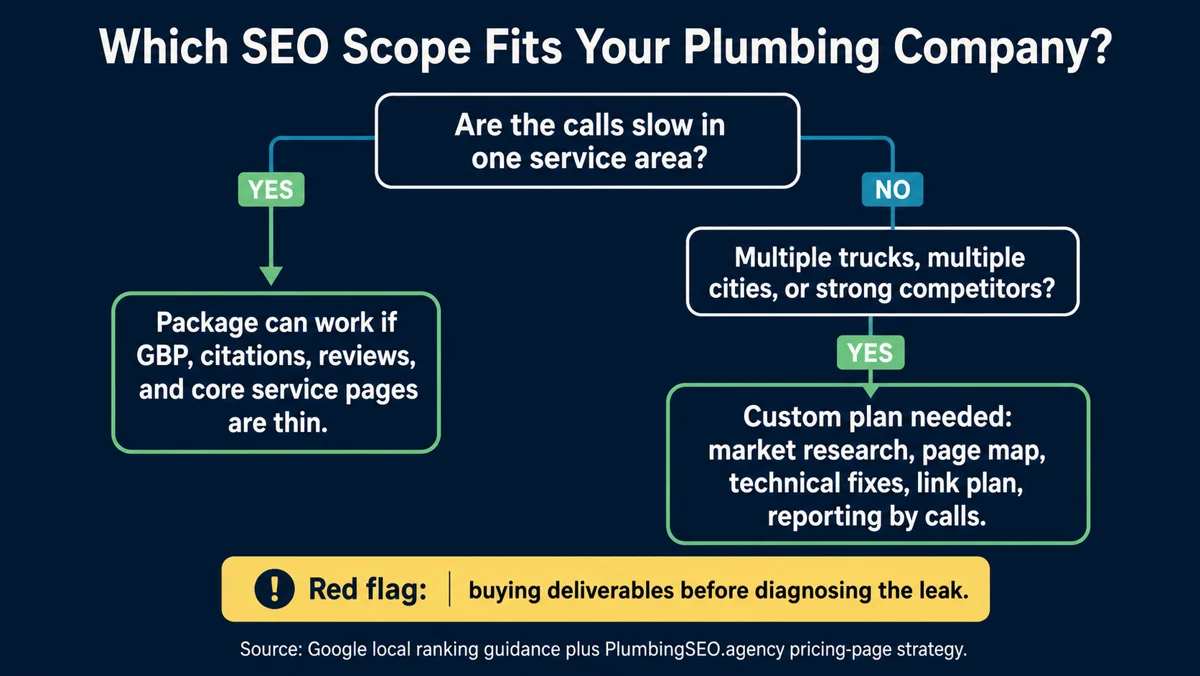
Compare scope before you compare monthly price
Two agencies can quote the same monthly fee and sell completely different work. One may be doing real diagnosis, technical fixes, page planning, and call tracking. The other may be shipping content because content is easy to count in a report.
Use this table before you sign:
| What to compare | Package offer | Custom plan | Owner question |
|---|---|---|---|
| Starting point | Pre-set monthly checklist | Audit and market diagnosis | What did you find before recommending this? |
| Service pages | Core pages only | Mapped by service, city, and profit priority | Which pages will help calls, not just traffic? |
| Google Business Profile | Basic setup or cleanup | Category, services, reviews, photos, posts, and local signals | How will Maps work connect to the website? |
| Technical fixes | Limited basics | Crawl, speed, schema, indexation, and conversion cleanup | Which technical issue is costing us calls? |
| Reporting | Rankings and tasks completed | Calls, forms, service-area movement, and next priorities | Will I know what is making the phone ring? |
The agency should be able to explain the first fix, the next fix, and what they will monitor. If they cannot, you are buying hope with a dashboard attached.
What every plumbing SEO proposal should include
No matter which route you choose, some pieces should show up before money changes hands. Google's SEO Starter Guide is clear that useful content, crawlable pages, descriptive titles, and helpful links matter. For plumbers, those basics have to be joined with local trust signals and call tracking.
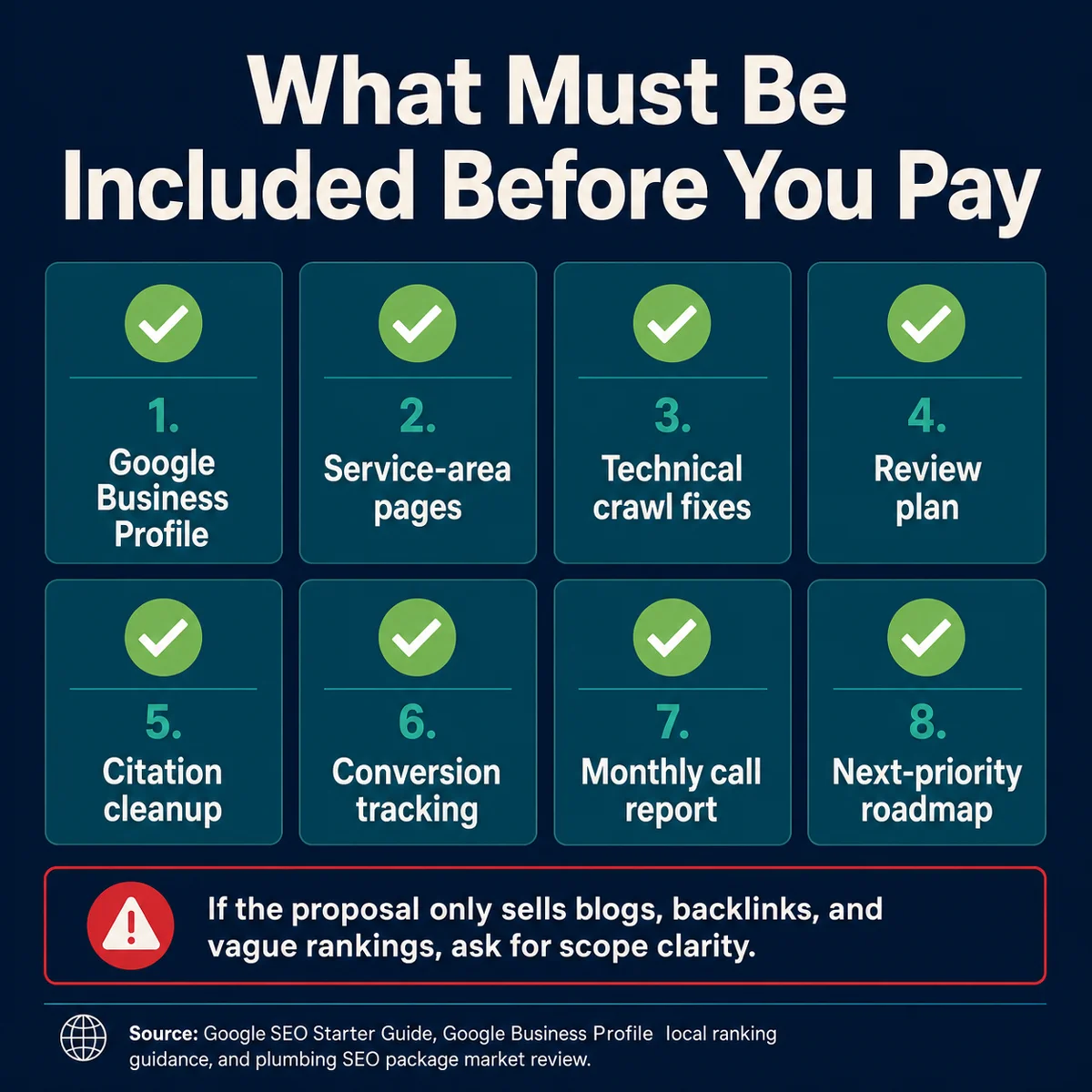
At minimum, ask for these pieces in plain English:
- Market diagnosis: who you are trying to beat, where, and for which services.
- Page plan: which service pages, city pages, or existing pages need work first.
- Google Business Profile work: categories, services, photos, reviews, and local signals.
- Technical cleanup: crawl issues, page speed, schema, mobile usability, and indexing blockers.
- Tracking: calls, forms, and lead quality, not only ranking screenshots.
- Monthly decisions: what changed, what worked, what did not, and what gets fixed next.
If you want the broader cost view, read the full plumbing SEO pricing guide. This article is about fit. That one is about what the market usually charges and how to read the numbers.
Quick scope-fit estimator
Use this as a gut check. It will not replace a real audit, but it will tell you whether a package conversation is enough or whether you should ask for custom scope.
Move the sliders. The recommendation updates by service-area complexity, competition, website condition, and call pressure.
If your result lands in the middle, that is normal. Many plumbing companies should buy a simple first month, then let the plan get more specific once the first round of issues is visible.
Red flags that make any package risky
You do not need to become an SEO expert to avoid a bad deal. Watch for these warning signs:
- The plan leads with guaranteed rankings instead of practical work.
- The report counts tasks but does not show calls, forms, or lead quality.
- Every client gets the same blog count, same backlink count, and same page count.
- The agency will not explain how Google Business Profile work connects to service-page work.
- They talk about traffic but not dispatch, service areas, job value, or booked calls.
- They cannot tell you what should be fixed first and what can wait.
One plumbing owner discussion that ranked for this topic centered on a $3,500 monthly local SEO quote and a simple question: how do you even know if it is worth it? That is the right question. Worth is not measured by how thick the proposal is. It is measured by whether the work closes the leak between search visibility and real jobs.
How to choose without overthinking it
Here is the simplest decision path I would use if I owned the shop and had to protect cash flow:
- Start with the leak. Are you missing visibility, calls, trust, conversions, or tracking?
- Match scope to the leak. Simple missing basics can fit a package. Multi-market problems need custom planning.
- Demand plain reporting. You should see what changed and how it connects to calls.
- Do not buy filler. A deliverable only matters if it helps customers find you, trust you, or contact you.
- Review after the first cycle. If the basics are fixed, the next plan should get sharper, not repeat the same checklist forever.
If you are comparing quotes right now, start with our free plumbing SEO audit. It gives you a cleaner way to judge whether you need a starter package, a deeper custom plan, or just a few specific fixes before spending more.
The phone tells the truth. Pick the plan that finds where calls are leaking, fixes the right things first, and keeps the crew busy for the right kind of work.
Frequently Asked Questions
They can be worth it when the scope matches a simple problem, such as an incomplete Google Business Profile, weak core pages, missing tracking, or basic citation cleanup. They are risky when the same checklist is sold to every plumbing company regardless of market, competition, or service mix.
Choose custom scope when you have multiple locations, several service areas, strong competitors, technical website problems, poor call tracking, or different high-value services that need their own page strategy.
A useful package should include Google Business Profile work, core service-page improvements, technical basics, local listing consistency, review strategy, call or form tracking, and plain monthly reporting. Blog posts and backlinks alone are not enough.
Not always, but it usually takes more planning time. A custom plan can save money when it avoids filler work and focuses budget on the pages, technical fixes, and local signals most likely to produce calls.
Compare diagnosis, deliverables, implementation responsibility, reporting, tracking, and the reason each item matters. If one quote explains exactly what will be fixed first and how success will be measured by calls, it is usually stronger than a cheaper list of generic tasks.
Many new shops need both. Ads can bring faster visibility while SEO builds the website, Maps presence, reviews, and service-area pages that create longer-term lead flow. The right split depends on cash flow, market pressure, and how fast you need calls.
Not sure which SEO scope fits your shop?
Run a free plumbing SEO audit before you sign a package or custom plan. We will show you the visible leaks first, then you can decide what is worth paying for.
Run My Free SEO Leak Check