
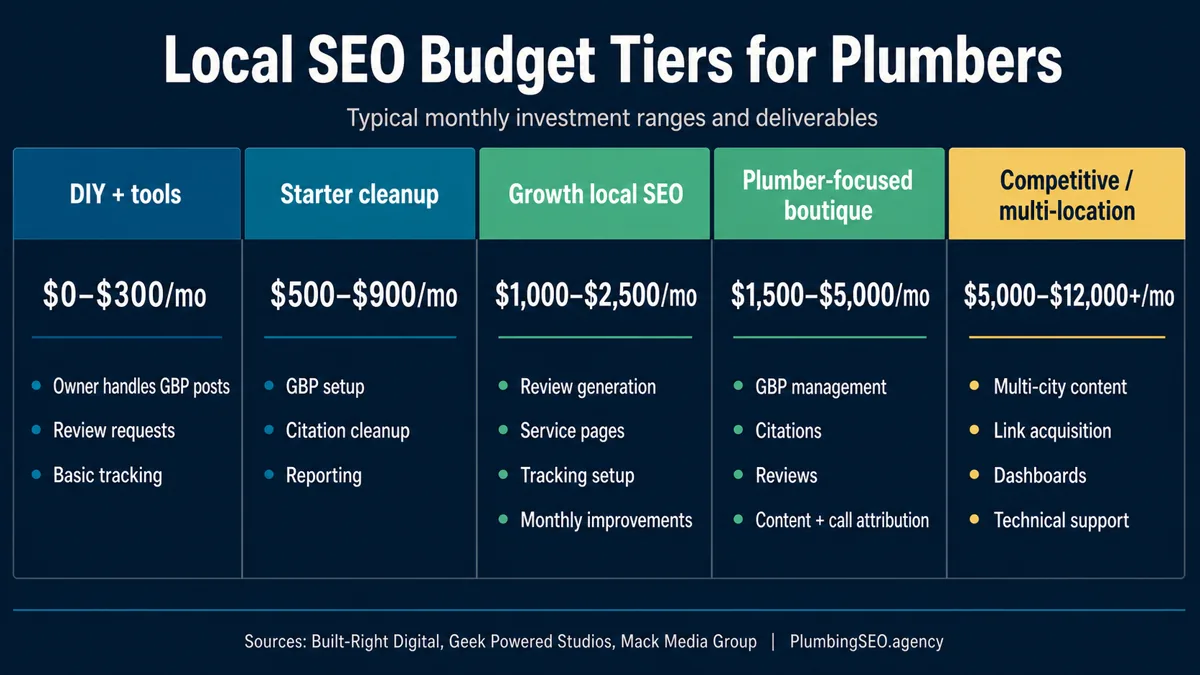
- Most single-location plumbers should expect roughly $1,000 to $2,500 per month for steady local SEO. Competitive markets often land closer to $1,500 to $5,000 per month.
- The price changes when your Google Business Profile is weak, reviews are thin, citations are messy, or your service-area pages do not explain what you do and where you work.
- Judge the spend by booked jobs and gross profit. Rankings matter, but the phone tells the truth.
Local SEO cost for plumbers usually comes down to one blunt question: how much work will it take to get your company found in Google Maps before the other shop gets the call?
If your phone is already ringing and you only need cleanup, the number can be modest. If your competitors have hundreds of reviews, strong service pages, clean citations, and years of Map Pack history, the budget has to cover more than a quick profile edit. That is where cheap local SEO turns into a slow leak.
For most independent plumbing companies, a serious local SEO budget in 2026 falls between $1,000 and $2,500 per month. A plumber-focused boutique plan often sits around $1,500 to $5,000 per month. Smaller cleanup or starter plans can run lower. Multi-location, major-metro, or franchise-level work can run much higher.
What local SEO for plumbers actually includes
A fair local SEO quote should not be a mystery box. You are paying for the work that helps Google understand where you work, what plumbing jobs you handle, and why customers should trust you enough to call.
At minimum, local SEO for plumbers should include:
- Google Business Profile work: categories, services, photos, posts, Q&A, hours, tracking, and ongoing profile maintenance.
- Review strategy: a steady review ask, response guidance, and attention to review velocity. A pile of old reviews is not the same as fresh trust.
- Citation cleanup: consistent name, address, phone, website, and service-area data across the directories customers and search engines see.
- Service and location content: pages that explain emergency plumbing, water heaters, drains, sewer, leak repair, and the areas you actually serve.
- Technical basics: mobile usability, speed, schema, indexability, internal links, and clean crawl paths.
- Call tracking and reporting: proof that visibility is turning into calls, not just prettier charts.
Google says local ranking is shaped by relevance, distance, and prominence. For a plumbing company, that means the job is part profile cleanup, part trust building, part website work, and part tracking. One setting will not carry the whole truck.
If you need the service side handled for you, the next step is usually a dedicated local SEO for plumbers plan, not a generic small business SEO package.
What changes the price?
Two plumbers can get two very different quotes and both can be reasonable. The difference should be the work, not the agency's ability to say "Map Pack" with a straight face.
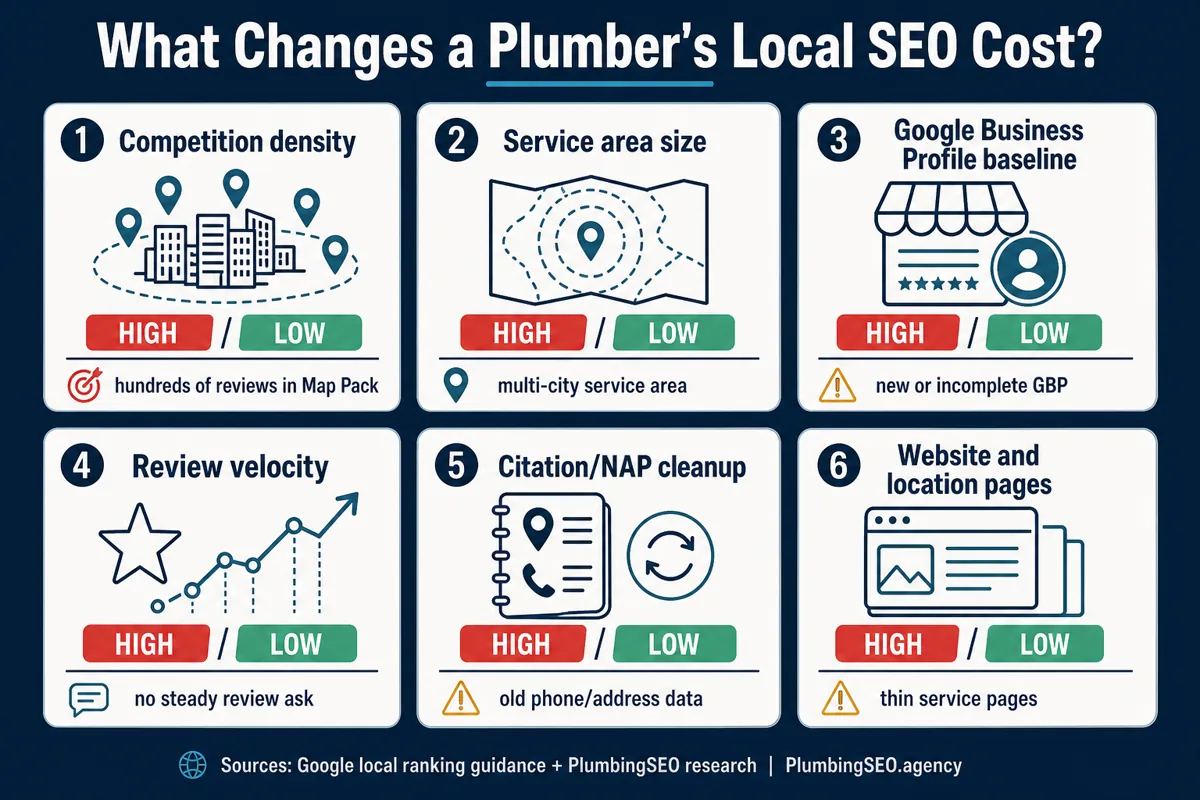
1. Your market is the biggest cost driver
A plumber in a small town does not need the same plan as a ten-truck company fighting in Dallas, Phoenix, Atlanta, or Chicago. In a busy metro, the top Map Pack competitors may have years of reviews, strong location pages, local links, and active profiles. Catching them takes steady work.
2. Your Google Business Profile baseline matters
A claimed, complete, photo-rich profile with good reviews costs less to improve than a profile with old hours, missing services, no tracking, and duplicate listings floating around. Google Business Profiles are free to create and manage, but the work around them is not free if you want it done every week.
3. Reviews can change the whole job
Plumbing is trust-heavy. A customer with water on the floor is not reading your life story. They are checking reviews, distance, hours, and whether you look like a real local company. If your review process is weak, local SEO has to include a practical review system, not just keywords.
4. Your website may be holding the profile back
Maps and website SEO are connected. If your profile says you handle sewer repair but your site barely explains sewer repair in your city, Google gets less confirmation. That usually means the budget has to include service pages, service-area pages, internal links, and technical fixes.
5. Tracking changes what you can prove
Without call tracking, form tracking, and some kind of lead quality review, you are guessing. A plumber should know which calls came from Maps, which came from organic pages, and which ones turned into jobs worth chasing. Guessing is fine for finding a missing 10mm socket. It is not fine for a monthly marketing bill.
| Situation | Likely budget range | What should be included |
|---|---|---|
| Owner can do some work and needs tools | $0 to $300/mo | Rank tracking, citation tools, manual GBP updates, owner-led review asks |
| Basic cleanup in a low-pressure market | $500 to $900/mo | GBP setup, citation cleanup, basic reporting, light recommendations |
| Most single-location plumbers | $1,000 to $2,500/mo | Ongoing GBP work, reviews, citations, service pages, tracking, monthly fixes |
| Competitive plumber-focused growth | $1,500 to $5,000/mo | Deeper content, call attribution, competitor checks, local links, stronger reporting |
| Major metro or multi-location company | $5,000 to $12,000+/mo | Multi-city content, technical support, dashboards, links, location-level planning |
These ranges line up with current pricing examples from plumbing and local SEO providers. Built-Right Digital places common plumbing SEO retainers around $1,000 to $7,500 per month. Mack Media Group lists broader local SEO ranges around $500 to $5,000+ per month. Those are not guarantees. They are useful guardrails for judging whether a quote is thin, fair, or built for a bigger fight than you are actually in.
How to judge the cost by booked jobs
The right question is not, "Can I afford local SEO?" The better question is, "How many extra booked jobs would make this worth it?" Use gross profit, not total revenue. Revenue can make any plan look good on paper. Gross profit is what helps payroll, fuel, insurance, and the next truck.
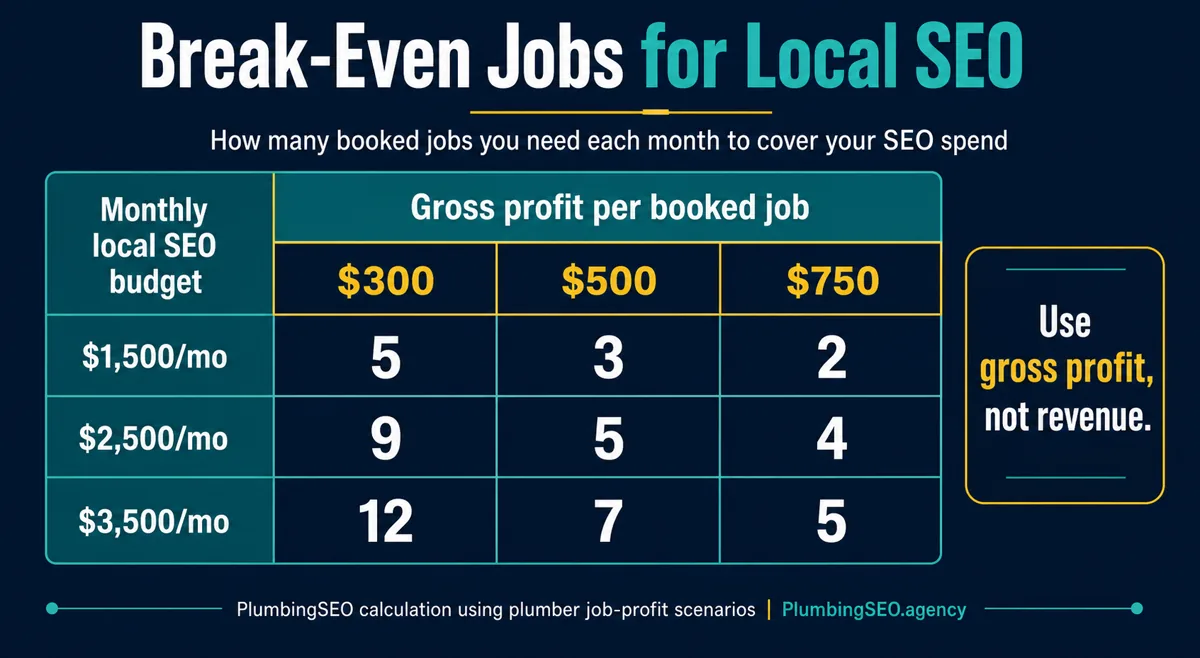
Quick plumber local SEO break-even calculator
Adjust the monthly budget and average gross profit per booked job. This gives you the extra booked jobs needed to cover the spend.
If one water heater, sewer job, or commercial repair can cover a big piece of the monthly spend, local SEO may make sense. If your average profit is low and you need a dozen extra jobs just to break even, start smaller, fix tracking first, and make the budget prove itself.
For wider marketing math, compare this with plumber cost per lead. A cheaper lead is not always better if it wastes dispatch time or never turns into a paid job.
What should happen in the first 90 days?
A local SEO plan should have early proof points even when rankings take time. You may not own the Map Pack in month one, but you should see cleanup, tracking, profile activity, content improvements, and a clearer view of where calls are coming from.
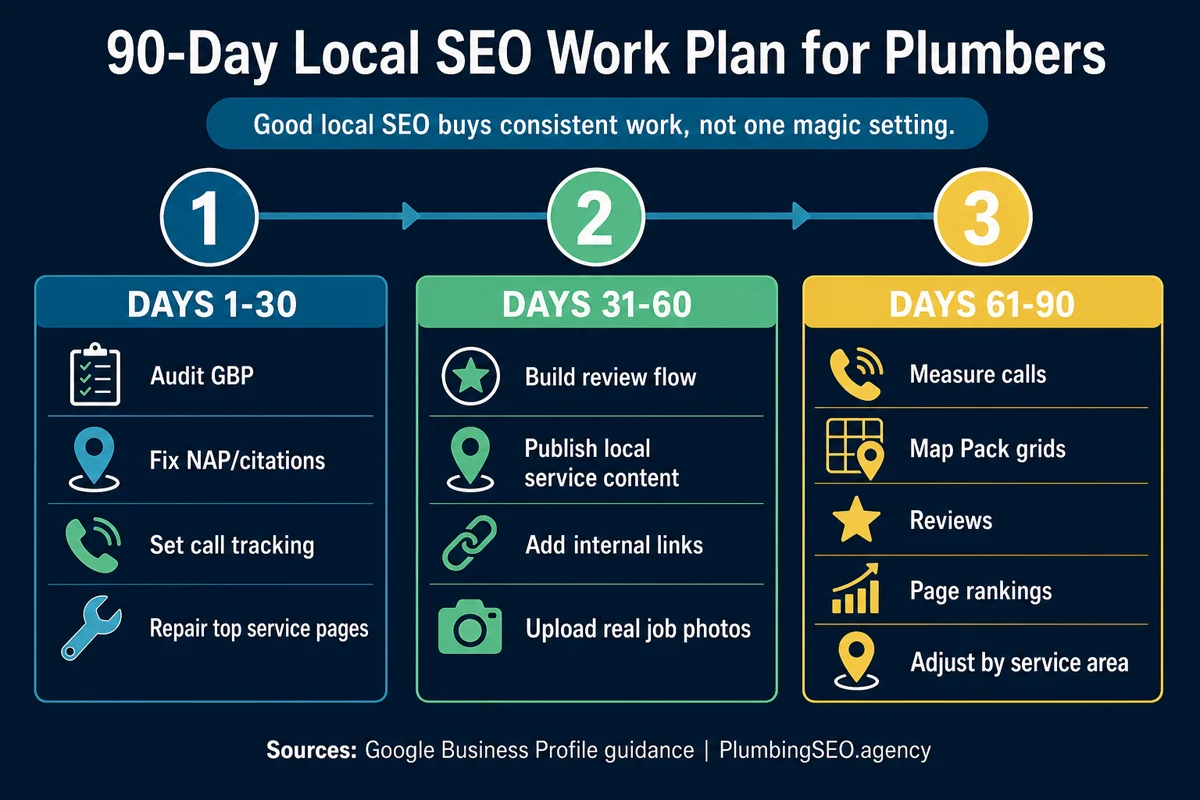
Days 1 to 30: find the leaks
The first month should clean up the basics. That means auditing your Google Business Profile, checking categories and services, finding citation problems, setting up call tracking, reviewing the top service pages, and checking whether Google can crawl the site cleanly.
Days 31 to 60: build the trust signals
The second month should focus on review flow, better service content, photos from real jobs, internal links, and the local pages that match how customers search. This is where Google Maps SEO for plumbers becomes more than a profile checklist.
Days 61 to 90: measure and adjust
By the third month, you should be watching calls, form fills, Map Pack grid movement, review velocity, and which services are improving. If the agency only sends keyword charts and cannot talk about calls or booked work, the report is not close enough to the business.
When a cheaper local SEO plan is enough
A smaller plan can make sense if you are in a low-competition town, already have a clean website, have decent reviews, and only need profile cleanup plus basic tracking. You may also start with a free plumbing SEO audit so you know whether the biggest problem is the profile, the site, citations, or conversion.
DIY can work if you have time every week. You can claim the profile, add photos, answer questions, request reviews, write service pages, and check calls. The hard part is doing it consistently while also running calls, managing techs, ordering parts, and putting out fires that are not metaphorical.
When a higher budget is justified
A higher budget starts to make sense when you are competing against larger shops, expanding into nearby cities, losing high-value emergency calls, or carrying enough trucks that one quiet week hurts. In that situation, you are not buying a few edits. You are buying a system that keeps your visibility, reviews, pages, and tracking moving together.
Before paying at that level, ask for specifics:
- Which services and cities will be worked on first?
- How will Google Business Profile changes be tracked?
- What review process will be installed?
- Which citations need cleanup?
- What pages will be written or improved?
- How will calls be separated from junk leads?
- What does a good first 90 days look like?
If the answer is vague, keep your wallet in your pocket. A plumber would not accept "we will improve water movement" as a drain repair plan. Do not accept the SEO version of that either.
Local SEO vs PPC cost for plumbers
PPC can bring calls faster, but it stops when the spend stops. Local SEO is slower, but the work can compound if your profile, reviews, pages, and reputation keep improving. In a healthy plumbing marketing plan, the two do not have to fight. PPC can cover urgent demand while local SEO lowers dependence on paid clicks over time.
If you are comparing channels, read the dedicated local SEO pricing for plumbers breakdown and the plumbing SEO pricing page. Keep the local SEO conversation focused on Maps, GBP, reviews, citations, and service-area demand. That keeps it separate from broad marketing spend or PPC management.
My practical recommendation
For a single-location plumber, I would usually start with an audit, tracking, GBP cleanup, review flow, and the highest-value service pages. If the basics are broken, fix them before buying a huge monthly plan. If the basics are clean and you are fighting real competitors, budget enough to do the work every month.
The number matters, but the scope matters more. A $600 plan that only sends a report can be expensive. A $2,000 plan that fixes the right leaks and brings in profitable calls can be cheap. The phone tells the truth.
Local SEO Cost for Plumbers FAQ
Most single-location plumbers should expect about $1,000 to $2,500 per month for steady local SEO. Plumber-focused boutique work often runs $1,500 to $5,000 per month, while major metro or multi-location campaigns can cost more.
The main cost drivers are market competition, service-area size, Google Business Profile condition, review velocity, citation cleanup, website quality, service pages, and tracking needs.
Local SEO is usually slower than PPC, but it can compound over time. PPC can bring calls faster, but the calls stop when the spend stops. Many plumbers use PPC for immediate demand and local SEO to build longer-term Maps visibility.
Yes, if the owner or office team can consistently manage the Google Business Profile, ask for reviews, update photos, fix citations, improve service pages, and track calls. The tradeoff is time and consistency.
A solid quote should explain GBP work, review strategy, citation cleanup, service and location content, technical fixes, internal links, reporting, and call tracking. If it only says rankings or visibility, ask for more detail.
Cleanup can show early movement, but meaningful Maps and organic gains often take 60 to 90 days in lighter markets and three to six months in competitive markets. The first month should still produce visible work and better tracking.
Not sure what local SEO should cost for your plumbing company?
Start with a free audit. We will check your Google Business Profile, service pages, citations, reviews, and call tracking so you can see what needs fixing before you spend.
Run My Free SEO Leak Check