
- Cheap SEO is not the same as affordable SEO. Cheap usually skips tracking, ownership, local proof, and the service pages that turn searches into calls.
- A real affordable plumber SEO package should protect the basics first: Google Business Profile, reviews, technical cleanup, service pages, internal links, and call tracking.
- If the package cannot show what was fixed, what calls came in, and what the next priority is, your low monthly fee is probably hiding a bigger leak.
If you searched for plumber SEO packages, you probably do not need another vague agency promise. You need to know what should be inside the package, what a small monthly budget can realistically cover, and which missing pieces will keep the phone from ringing even if the price looks attractive.
The SERP problem is that many package searches get answered by general “best SEO company” articles. Those can help you compare vendors, but package intent is different. A plumber comparing SEO packages wants scope, tradeoffs, deliverables, ownership, tracking, and a clean path to pricing. This article is built to answer that support intent and then route serious buyers to our plumbing SEO pricing and packages page when they are ready to compare plan fit.
Cheap SEO is not automatically bad. A tight starter package can be useful when it fixes the leaks closest to calls. Cheap becomes dangerous when the low fee works because the package leaves out Google Business Profile work, service-page improvements, call tracking, review proof, and the reporting that shows whether the work is actually producing leads.
- Best affordable package: a focused plan that fixes tracking, Google Business Profile, priority pages, reviews, technical basics, internal links, and monthly next actions.
- Best use of a small budget: start with a foundation sprint or starter monthly package before buying content volume, backlinks, or multi-location expansion.
- Best red flag: a package that promises rankings but cannot explain ownership, deliverables, call measurement, and exactly what gets fixed in the first 30 days.
The package answer: buy the work closest to calls first
A plumber does not need an SEO package because “SEO” sounds nice. The package has to make your company easier to find, easier to trust, and easier to contact. That means the first dollars should go to the parts of the search journey that leak real calls.
For most plumbing companies, the first layer is simple: own the site and accounts, track calls and forms, clean up Google Business Profile, fix obvious technical problems, improve the pages for the services customers search, and create a review process that supports local trust. If a package skips those basics, the rest of the work is usually decoration.
That is why affordable does not mean “lowest price.” Affordable means the package is scoped around the highest-return sequence for your market. A one-truck company in a smaller city may not need the same volume as a multi-location plumbing company in a crowded metro. But both need a package that connects deliverables to calls, not just rankings.
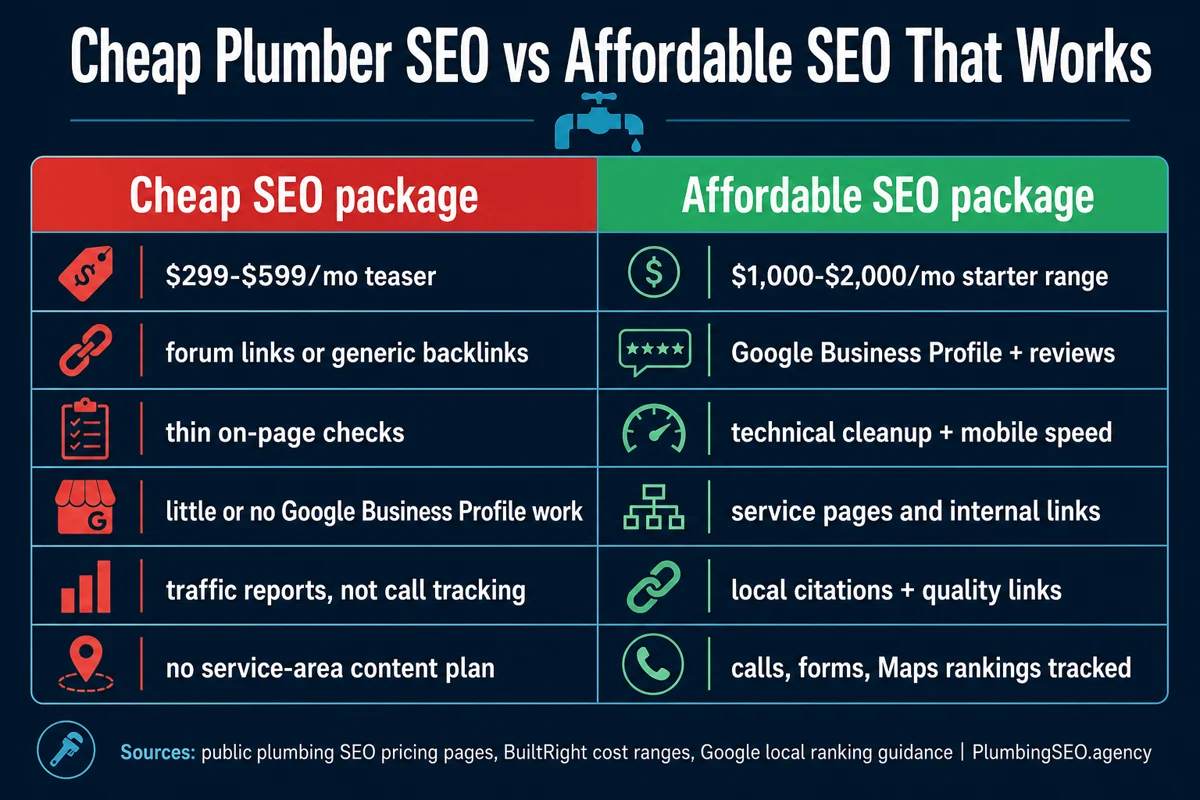
Cheap SEO is priced low because something is missing
Public plumbing SEO pricing pages show everything from very low monthly packages in the few-hundred-dollar range to retainers in the thousands. One published plumbing SEO cost guide from BuiltRight Digital describes basic plans around $1,000 to $2,000 per month, mid-tier plans around $2,000 to $4,000, and advanced work above that for competitive or multi-location markets.
That does not mean every plumber has to start at the top. It does mean a $299 package and a real local SEO plan are usually not selling the same thing. One may be selling activity. The other should be building the system that helps your company show up in the right service areas and turn that visibility into calls.
The missing piece can be time, expertise, measurement, or ownership. Some cheap packages are just automated reports and directory submissions. Some use rented pages or tracking that you lose when you cancel. Some create thin city pages without fixing the main service pages customers actually need. The invoice is lower because the work is narrower than the problem.
What an affordable plumber SEO package must include
The way I see it, an affordable package should not mean “barely anything.” It should mean the work is focused, sequenced, and honest about what can be done at that budget. The monthly checklist should include enough of the foundation to make each later task compound.
Ownership and access
- Your website, domain, analytics, call tracking, and Google Business Profile should not be held hostage.
- You should know what was changed each month and what assets you own.
- You should be able to leave without losing your site, tracking history, or content foundation.
Local ranking basics
- Complete Google Business Profile information, categories, services, photos, and service-area signals.
- Review request process and response guidance tied to real plumbing jobs.
- Service and location signals that match how customers search in your market.
Call-focused reporting
- Calls, forms, and booked-job signals matter more than pretty traffic graphs.
- Map visibility and priority keywords should be tied to real service areas.
- The report should tell you what was fixed and what gets fixed next.
Google's own local ranking guidance says local results are mainly based on relevance, distance, and prominence. For a plumbing company, that points to practical package work: complete business information, accurate service coverage, reviews, links, local mentions, and pages that clearly match the service being searched.
Package tiers that make sense for plumbers
Every market is different, but package comparison gets easier when you separate foundation work from growth work. A small package should not pretend to do everything. It should make the strongest possible first moves and explain what waits until the next tier.
| Package tier | Best fit | What should be included | What should not be promised |
|---|---|---|---|
| Foundation sprint | Site has tracking, GBP, technical, or ownership leaks | Audit, analytics, call tracking, GBP cleanup, title/meta fixes, priority technical cleanup, first internal-link fixes | Instant map-pack dominance or large content volume |
| Starter monthly package | Small or local single-location plumbing company | Ongoing GBP support, review process, priority service-page improvements, citations, internal links, monthly work log | Ranking every service in every city at once |
| Growth package | Competitive services or a larger service area | Deeper service content, conversion improvements, local authority building, content support, call-quality reporting | Cheap backlinks as the whole strategy |
| Multi-location package | Several branches or separate markets | Location architecture, unique local proof, branch-level GBP work, tracking segmentation, service-area prioritization | Copy-pasted city pages with no proof |
If you want to compare our actual plan structure, start with the pricing and packages hub. This support article explains what to look for; the pricing page shows the plan options and fit.
What cheap plumber SEO usually misses
Cheap SEO misses the plumbing part. It treats your company like any other local business, then hands you the same package a dentist, roofer, or storage company might get. Service businesses do not work that way. Plumbing has emergency intent, high-ticket repairs, seasonal swings, city boundaries, dispatch realities, and customers who want proof before they call.
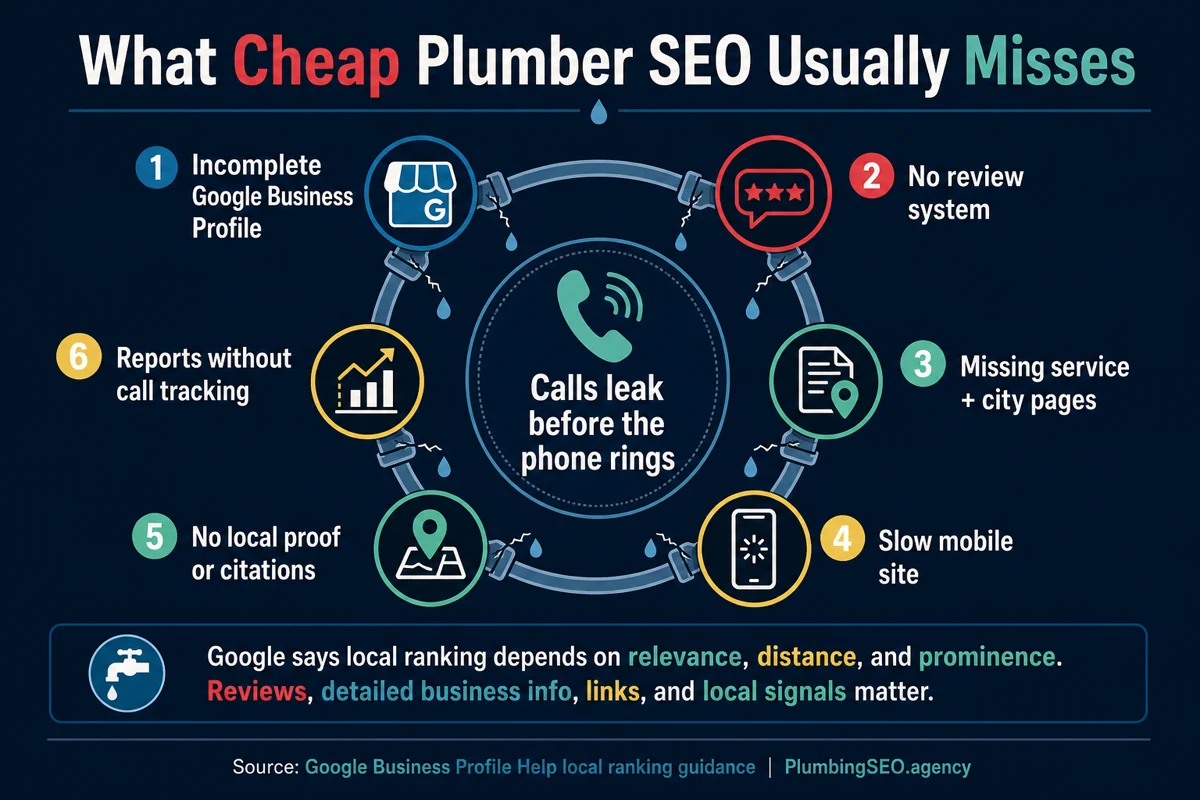
1. They skip Google Business Profile work
Your Google Business Profile is not just a listing. It is often the first thing a customer sees when they search for an emergency plumber, drain cleaning, water heater repair, or a plumber near them. If the profile is thin, inconsistent, or ignored, your website can be decent and still lose calls.
2. They do not build a review system
Plumbers know this already: people trust other customers. A package that never helps you ask for reviews, respond to reviews, and use review proof on service pages is leaving trust on the floor. That is not a small miss. That is a call going to the shop with stronger proof.
3. They use one generic service page
A plumbing company does not sell one service. It sells drain cleaning, leak repair, water heater work, sewer line repair, hydro jetting, backflow testing, emergency plumbing, and more. Cheap SEO often stuffs everything onto one page and calls it done. Google and customers both need clearer routes than that.
4. They report traffic, not calls
A traffic chart can look nice while the phone tells the truth. If the package cannot separate sales calls from spam, track form submissions, and show which pages or locations are producing leads, you are driving without gauges. Nobody runs a truck that way for long.
Affordable does not mean under-scoped
There is a difference between a focused starter package and an under-scoped package. A focused package says, “Here are the first three leaks we will fix because your budget is tight.” An under-scoped package says, “Everything is included,” then quietly does the same shallow tasks every month.
A focused package should name tradeoffs. Maybe you do not get four new service pages every month. Maybe local link outreach waits until technical cleanup and tracking are stable. Maybe the first month is mostly foundation. Those tradeoffs are fine when they are visible. They are dangerous when they are hidden behind a broad package name.
| Package item | Cheap version | Affordable version |
|---|---|---|
| Google Business Profile | Claimed once, then ignored | Completed, tuned, reviewed, and updated around priority services |
| Service pages | Generic page with a keyword list | Priority services get useful pages, stronger proof, and internal links |
| Local proof | Random directory submissions | Consistent citations, reviews, local links, and service-area signals |
| Reporting | Rankings and traffic only | Calls, forms, Maps movement, completed work, and next priorities |
If you want to see how these pieces should fit together, compare any package against our plumbing SEO process. The exact monthly workload can change by budget, but the fundamentals should not disappear.
Red flags before you buy a cheap package
Here are the signs I would slow down for before signing anything. Not every low-cost offer is a scam. Some are starter plans with tight scope. The red flag is when the scope sounds cheap, vague, and strangely magical.
- Guaranteed first-page rankings. No agency controls Google, and local results depend on factors like relevance, distance, and prominence.
- No mention of call tracking. If they cannot measure calls, they cannot prove plumbing lead impact.
- You do not own the website or content. Renting your own foundation is not a strategy.
- Backlinks are the whole offer. Links can help, but plumbing local SEO also needs profile work, pages, reviews, and technical cleanup.
- They ignore your service area. A plumber in one dense metro needs a different plan than a company covering rural towns.
- The report has no next action. A report should lead to decisions, not sit in your inbox like a receipt for confusion.
- They cannot explain the first month. If month one is vague, the package is probably activity-first instead of diagnosis-first.
How to budget without overbuying
A good affordable plan starts with the highest-leak items first. That may be tracking, Google Business Profile cleanup, a service page, mobile speed, or fixing a mess left by the last vendor. The first month should not be random. It should feel like a plumber diagnosing before cutting pipe.
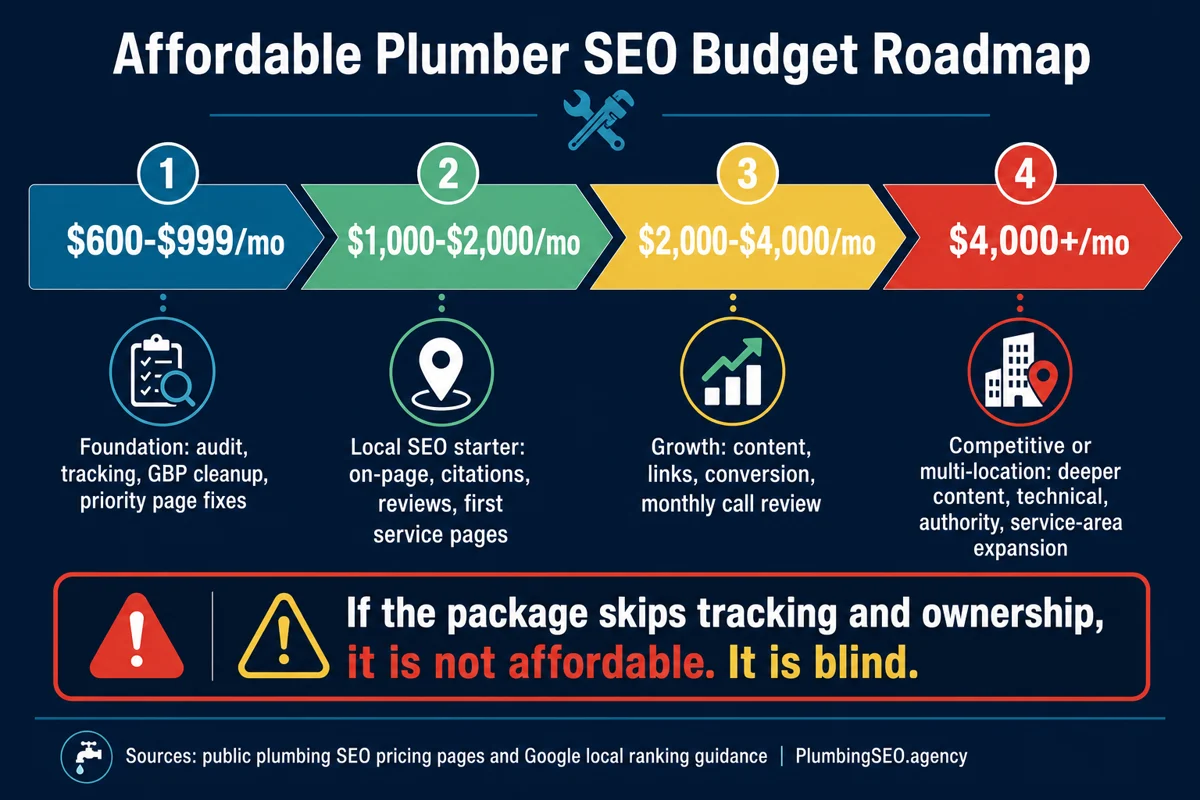
If your budget is under $1,000 per month
Keep the scope tight. Ask for an audit, tracking setup, Google Business Profile cleanup, priority title and page fixes, and a short list of next steps. You may need to handle reviews, photos, and some content input yourself. That is okay if everyone is honest about it.
If your budget is $1,000 to $2,000 per month
This is where a real local starter plan can begin. You should expect on-page fixes, citation cleanup, review process help, internal links, service-page improvements, and basic monthly reporting. If you are comparing options, our plumbing SEO pricing packages show how we frame starter work around actual call-generating pieces.
If your market is competitive
Competitive cities usually need more than a light tune-up. You may need deeper service pages, better local authority, content that supports high-value services, and conversion work so visitors actually call. If you are trying to beat established companies in the map pack, budget for a longer climb.
What should happen in the first 90 days
A package should not make you wait three months to understand whether anything is happening. SEO results take time, but the work log should be visible right away. The first 90 days should show diagnosis, cleanup, early page improvements, and a roadmap based on what the data says next.
- Days 1-30: confirm access, set up tracking, review Google Business Profile, audit priority pages, fix obvious technical issues, and choose the first service-page opportunities.
- Days 31-60: improve priority service pages, add internal links, clean up citations, start or tighten the review process, and compare early call/search signals.
- Days 61-90: expand the highest-performing service or location route, strengthen conversion proof, refine calls/forms reporting, and decide whether to stay lean or increase scope.
If an agency cannot explain what gets done in each phase, you are not comparing packages. You are comparing price tags.
Reporting should prove package value, not hide behind rankings
Rankings matter, but plumbers buy SEO because they want more qualified calls and booked jobs. A package report should help you see whether the work is moving toward that outcome. It should connect visibility to actions: calls, forms, Google Business Profile clicks, service-page movement, and what was fixed.
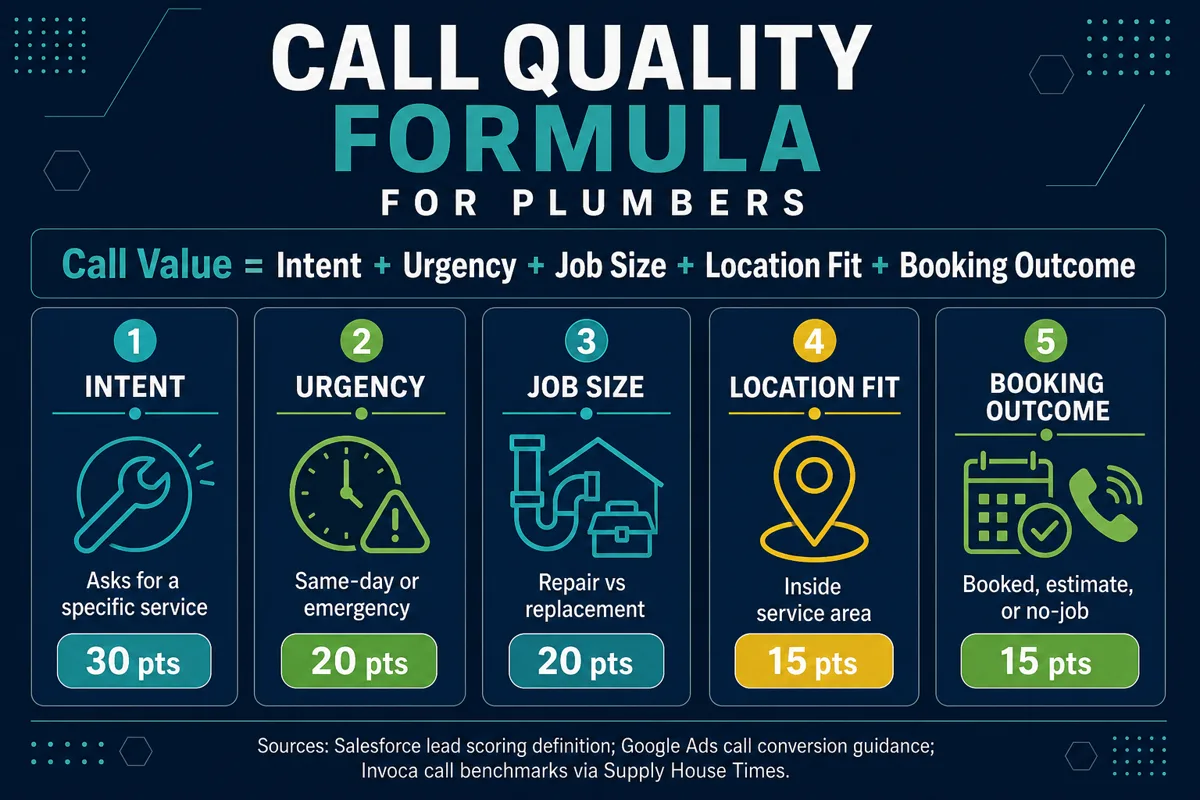
Ask to see the monthly work log, not just the dashboard. A real report should say which title tags changed, which service page was improved, which internal links were added, whether GBP categories or services changed, what review process was supported, and what the next highest-leak item is.
How this package guide fits with pricing and buyer comparison pages
This page is the package-support guide. Its job is to help a plumbing owner understand package scope and avoid cheap SEO traps. If you are ready to see the actual plan menu, go to plumbing SEO pricing, costs, and package options. If you are still deciding what type of vendor to hire, the best SEO for plumbers buyer guide can help you compare agency fit without turning this page into another agency-selection article.
That separation matters. Package searches should land on package guidance and then route to pricing. Agency-selection searches should land on buyer comparison content and then route to the homepage or pricing when the owner is ready. Keeping those jobs separate reduces cannibalization and makes the path clearer for users.
Questions to ask before you choose a package
Before you buy, ask these questions in plain English. If the answer sounds slippery, that tells you something.
- What exactly will you fix in the first 30 days?
- Who owns the website, content, tracking numbers, analytics, and Google Business Profile access?
- How will you measure calls, forms, and booked-job quality?
- Which service pages are the first priority and why?
- What package tier should we not buy yet?
- What happens if we pause after three months?
- Can I see the monthly work log, not just the ranking report?
- How does this package support my highest-value services?
Those questions separate cheap from affordable fast. Cheap gets uncomfortable because it was selling a box. Affordable can answer because it is selling a focused plan.
The practical answer
Affordable plumber SEO is worth considering when it protects ownership, fixes local visibility basics, improves priority service pages, and tracks the calls that matter. Cheap SEO is risky when it hides the work, skips the plumbing-specific pieces, and gives you a report that looks busy but does not help dispatch.
If the budget is tight, start smaller. Just do not start blind. Make sure the first dollars go toward the leaks closest to the phone: profile completeness, reviews, service pages, technical cleanup, local proof, and tracking. Then use the next month to build on what the data shows instead of buying a bigger package just because a salesperson said it sounds safer.
That is not flashy. Neither is tightening a fitting properly. But it keeps bigger problems from showing up later.
Affordable Plumber SEO Package FAQs
A reasonable affordable package should include tracking, Google Business Profile cleanup, priority on-page fixes, review guidance, service-page improvements, internal links, and clear monthly reporting. The exact price depends on your market, competition, site condition, and how much content or technical cleanup is needed.
SEO packages for plumbers should include ownership checks, analytics and call tracking, Google Business Profile work, review support, service-page improvements, technical cleanup, local citations or authority building, internal links, and reporting that connects the work to calls and forms.
Cheap SEO is risky when it skips ownership, call tracking, service pages, reviews, and local SEO basics. A small focused package can be fine, but a vague low-cost package often hides missing work that affects calls.
Yes. A plumber can start on a small budget if the scope is honest. Start with tracking, profile cleanup, obvious technical fixes, and the pages most likely to bring calls. Avoid packages that promise fast rankings without showing the work.
Compare package scope, first-30-day deliverables, account ownership, call tracking, reporting, service-page work, Google Business Profile support, review process help, and cancellation terms. The best affordable option is usually the one that names tradeoffs clearly.
Backlinks can help, but they should not be the whole package. Plumbing SEO also needs local proof, technical health, Google Business Profile work, reviews, useful service pages, and conversion tracking. Be careful with packages that sell links without explaining quality and relevance.
Look beyond traffic. Check qualified calls, forms, Google Business Profile actions, map visibility, priority service-page movement, completed work logs, and next-priority recommendations. A good report should explain what happened and what gets fixed next.
Move up when the foundation is stable, tracking is clean, priority pages are improving, and the next bottleneck is content depth, local authority, conversion proof, or multi-location expansion. Do not upgrade just because a starter package has a lower-sounding status name.
Want to match the right package to your market?
Get a plumber-first SEO leak check. We will show what is missing, which package scope makes sense, what should be fixed first, and whether a focused starter plan is enough for your market.
Run My Free SEO Leak Check