
- Start with the calls and booked jobs you want, then assign every search, Maps, page, and tracking deliverable to that outcome.
- Accept work only when there is owner-visible proof: access, a changed URL or listing, a before-and-after check, and a named next action.
- Use this page as an implementation and acceptance plan. For broad plumbing SEO agency or service intent, the main plumbing SEO offer remains the right destination.
A plumbing company does not need another list of SEO buzzwords. It needs a work order: what gets done first, who owns each step, what proof closes the step, and how the work should help produce better calls and more booked jobs.
This guide is intentionally narrow. It is a 90-day plumbing SEO implementation plan for an owner who already understands the basic scope and now wants to verify execution. If you are still comparing proposals, use the separate buyer checklist for SEO services for plumbers. If you want to see the broad commercial offer, service options, or agency fit, go to the plumbing SEO services homepage.
The distinction matters. A buyer checklist helps you decide what a package should contain. This page helps you run the work after the decision: sequence deliverables, confirm ownership, inspect evidence, and keep the team focused on calls instead of activity for activity's sake.
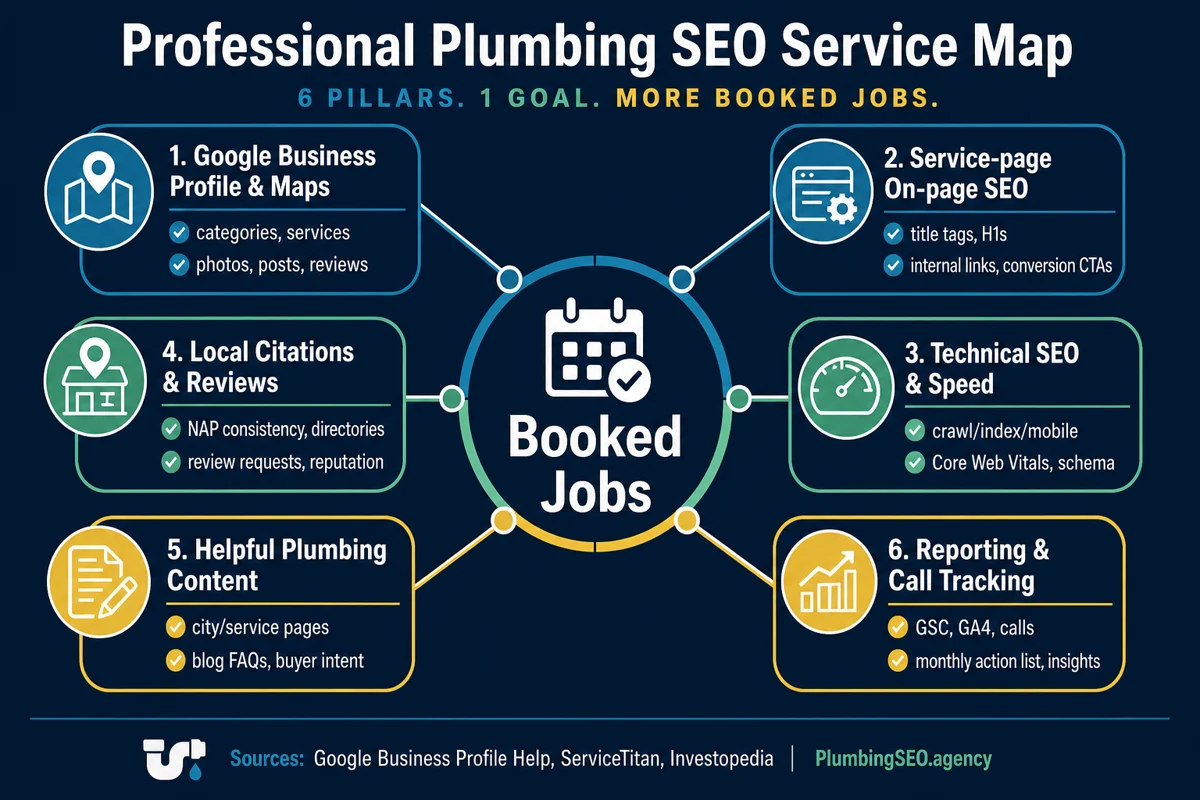
What this implementation plan is—and is not
This plan is for turning an approved scope into completed, testable work. It is not a claim that every plumbing company needs the same number of pages, citations, posts, or links. A one-truck shop in a smaller market and a multi-location company in a competitive metro will have different workloads.
The sequence should stay recognizable even when the scope changes: define business outcomes, secure owner-controlled access, verify tracking, repair the highest-impact visibility leaks, improve the pages and profile customers use, then measure what happened. Skipping that order usually creates busy reports and weak accountability.
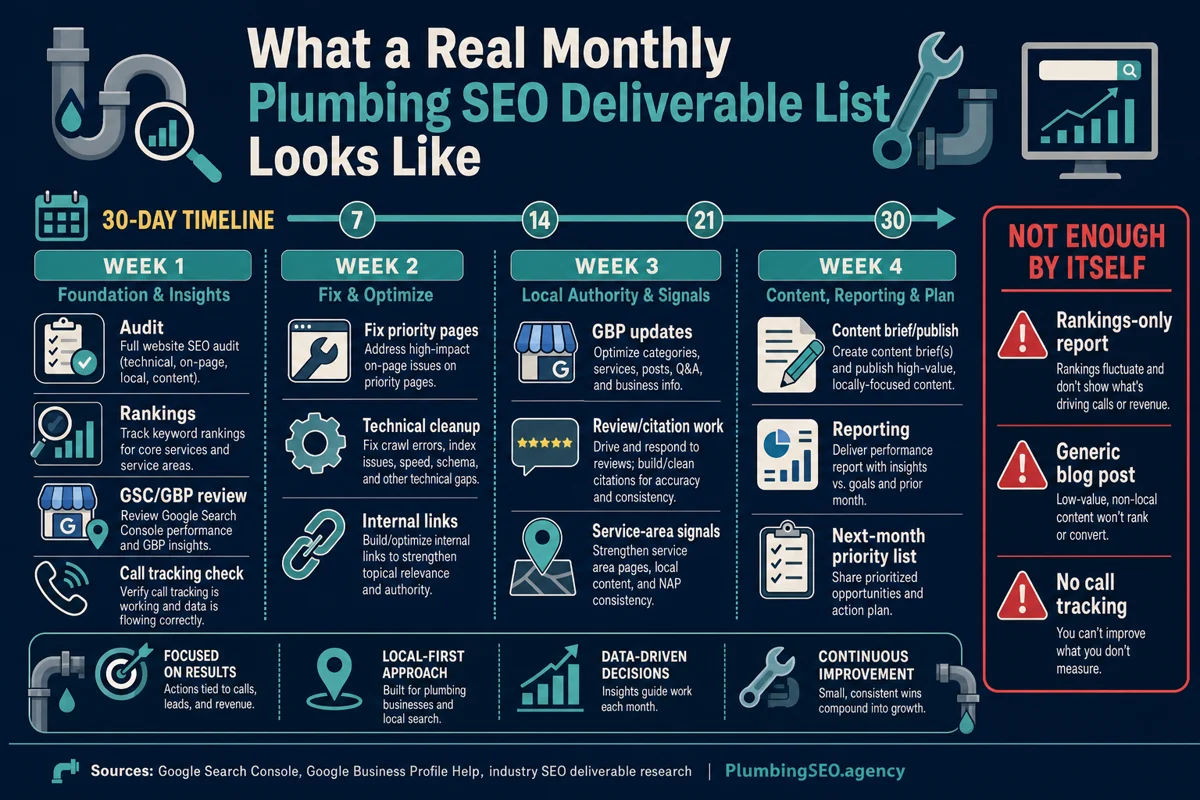
| Implementation window | Primary deliverables | Owner-visible acceptance proof |
|---|---|---|
| Days 0-10 | Access, ownership, tracking baseline, call-quality definitions, crawl and profile review | Access register, baseline report, tested calls/forms, issue list with priorities |
| Days 11-30 | Critical technical fixes, Google Business Profile cleanup, priority service-page improvements | Changed URLs, listing screenshots, test results, crawl comparison, annotated change log |
| Days 31-60 | Reviews, local trust, supporting content, internal links, second page batch | Published assets, resolvable links, review workflow, indexed-page checks |
| Days 61-90 | Authority work, conversion cleanup, call-quality review, next-quarter priorities | Outcome summary, source data access, wins/losses, accepted next work order |
Define calls and booked jobs before any SEO work starts
Begin with the dispatch board, not the keyword list. Decide which calls the company wants more of: emergency plumbing, drain cleaning, sewer repair, water heater replacement, repiping, leak detection, commercial work, or another profitable service. Add the service areas that matter and any jobs the company does not want.
That short business brief keeps the implementation honest. A ranking gain for a low-value query may be useful, but it should not distract from a drop in qualified calls. Search and Maps are mechanisms. The operational result is a customer who finds the company, trusts it, calls, and books a job the team can serve profitably.
- Call target: name the service, service area, urgency, and minimum quality standard.
- Conversion target: decide whether success is a phone call, booked appointment, estimate request, or qualified commercial inquiry.
- Capacity check: confirm the team can answer and fulfill the work being promoted.
- Exclusions: document out-of-area calls, recruiting calls, vendors, spam, and services the shop does not perform.
Day 0: secure access and keep the owner in control
No implementation should depend on an agency-owned login that disappears when a contract ends. The plumbing company should retain ownership of its domain, website repository or CMS, Google Business Profile, Search Console, analytics, call-tracking account, form inboxes, and primary business listings. The provider receives the access level needed to do the work.
Create a simple access register with the asset, owner, administrator, recovery contact, and date verified. Do not place passwords in the work log. The acceptance test is not “the agency says it has access.” The test is that the owner can sign in, sees the provider as an authorized user, and knows how access will be removed later.
Days 1-10: establish a tracking baseline the office can trust
Before changing pages, test the measurement path. Confirm that phone calls, forms, booking actions, Google Business Profile actions, and organic landing pages can be reviewed without breaking local business information. Record a baseline for the priority services and service areas, but do not confuse a baseline with a promise.
Call tracking is useful only when someone checks call quality. A monthly total that combines booked water heater jobs, wrong numbers, spam, and out-of-area calls is not a business metric. Review a practical sample with the owner or dispatcher and label the calls consistently. The goal is to learn which pages and searches bring work worth answering.
Acceptance proof should include a test call, a test form, source attribution where available, the number that remains published as the company's primary local number, and a short definition of a qualified lead. For a deeper look at the sequence, see the call-tracking stage of the plumbing SEO process.
Days 1-15: repair Google Business Profile and Maps fundamentals
For local plumbing demand, the Google Business Profile can be the shortest route to the phone. Verify ownership, primary and secondary categories, business name, phone, hours, service areas, services, appointment link, website link, photos, and review response process. Resolve suspensions, duplicate profiles, or access disputes before layering on routine posts.
Each change needs a reason. Adding every nearby city to a service-area field does not prove relevance there. Uploading stock photos does not prove local work. The stronger implementation uses accurate business details, recent job photos the company owns, service descriptions customers understand, and a review request process the office can follow without incentives or pressure.
Google's verification options can vary by business, and review can take time. Use Google's current Business Profile verification guidance rather than promising an instant approval date.
Days 10-30: improve priority service pages in a fixed order
Choose the first page batch from the calls the company wants, the current search opportunity, and the quality of the existing page. Do not rewrite twenty pages just to show volume. Start with the pages that can change the call mix: emergency plumbing, drain cleaning, sewer repair, water heaters, leak detection, repiping, or the shop's strongest commercial services.
For each page, define one primary job intent, the service area context, proof the company can substantiate, and a clear next step. Then improve the title, description, H1, section structure, FAQs, images, descriptive alt text, internal links, schema where appropriate, and call-to-action path. Check the mobile page and click the phone button before calling the work complete.
The acceptance record should name the URL and show what changed. “On-page optimization completed” is too vague. A useful record says the water-heater page received a clearer replacement intent, local proof, three supporting links, tested FAQ markup, compressed job photos, and a working call button.
Days 15-30: close technical leaks that block discovery or calls
Technical work should be prioritized by impact. A non-indexable service page, broken canonical, dead internal link, failed form, blocked crawl path, or unusable mobile call button comes before a minor score improvement on a low-value post. The implementation list should separate critical blockers, important repairs, and cleanup that can wait.
Common checks include indexability, canonicals, robots rules, sitemap inclusion, redirect chains, broken links, duplicate titles, missing metadata, schema validity, image weight, mobile layout, Core Web Vitals, and JavaScript-dependent content. Google's practical guidance is to make pages accessible to users and crawlers and use clear structure and descriptive links. The acceptance test is a recrawl plus manual checks on changed URLs—not a screenshot of an audit score.
Days 31-60: build reviews and local trust without shortcuts
Reviews, consistent business information, licenses where relevant, real project photos, service-area proof, and local mentions help a homeowner decide whether to call. The provider can design the workflow, templates, and tracking, but the plumbing team has to request reviews from real customers and supply truthful proof.
A workable review process identifies when the request is sent, who sends it, how the customer reaches the correct profile, who responds, and how feedback is handled. It should never buy reviews, gate unhappy customers, or fabricate location proof. Acceptance proof is a repeatable office process and a visible response history, not a sudden pile of suspicious five-star ratings.
Days 31-60: publish support content with clear routing
Supporting content should answer a narrow question and help the correct commercial page. Pricing guides can support pricing intent. A timeline article can explain why results take time. A service-specific troubleshooting guide can help a relevant plumbing service page. Every piece needs a defined reader question and destination.
Broad plumbing SEO company, agency, and service intent belongs on the homepage. This implementation article supports that route by explaining how work is sequenced and accepted. It should not pretend to be another offer page. Likewise, the proposal-comparison checklist answers what to buy, while this page answers how to verify delivery.
Internal links should use language that helps a reader predict the destination. After adding them, resolve each local path and click-test important links. The count alone is not the goal. The goal is a clean route from the question, to the useful answer, to the commercial page that can help.
Days 61-90: strengthen authority and conversion paths
Authority work should favor relevance and credibility over raw link counts. Useful local partnerships, trade associations, supplier relationships, community involvement, original resources, and genuinely cited expertise are more defensible than bulk directory blasts or purchased link packages. The provider should show the source, destination page, context, and status of each placement.
At the same time, review what happens after a visitor lands. Is the phone number obvious on mobile? Does the page say which service and area are covered? Is there proof near the call to action? Does the form ask only what dispatch needs? A page can gain visibility and still leak calls. Conversion review closes that gap.
Use acceptance proof for every monthly deliverable
A deliverable is not complete because it appears in a package. It is complete when the agreed work exists, passes the agreed check, and can be inspected by the owner. This is the difference between “content,” “links,” or “technical SEO” as labels and an implementation the company can manage.
| Deliverable | Evidence to request | Acceptance question |
|---|---|---|
| Tracking setup | Test calls/forms, source view, access confirmation, lead-quality labels | Can the owner verify which inquiries were qualified? |
| Profile work | Changed fields, approved photos, owner access, before-and-after record | Is the listing accurate, controlled by the business, and useful to a caller? |
| Page refresh | URL, change summary, mobile check, schema test, link check | Does the page match one job intent and make the next action clear? |
| Technical repair | Issue before, page changed, retest result, recrawl evidence | Was the blocker removed without creating a new one? |
| Internal links | Source URL, destination URL, anchor context, successful route check | Does the link help the reader and reinforce the intended page route? |
| Monthly report | Work log, outcome context, calls/forms review, risks, next priorities | Can the owner explain what shipped and why the next step matters? |
Assign ownership so work does not stall
Many campaigns slow down because nobody owns the inputs. The provider waits for photos. The office waits for a draft. The developer waits for approval. The owner assumes the work is moving. A lightweight responsibility table prevents that standstill.
| Work item | Plumbing company owns | SEO provider owns |
|---|---|---|
| Business facts and priorities | Services, areas, hours, licensing, capacity, job values, exclusions | Translate facts into page and profile priorities |
| Access and approvals | Asset ownership, user invitations, factual approval | Request minimum access and document dependencies |
| Content and proof | Accurate claims, photos, job examples, customer permission | Research, structure, write, optimize, and quality-check |
| Measurement | Dispatcher feedback and booked-job outcomes | Tracking implementation, analysis, and recommendations |
Match price to the implementation load
Price should follow the condition of the site, market competition, number of locations, number of priority services, tracking complexity, and production load. A smaller shop may need a focused first quarter with baseline tracking, profile cleanup, technical repairs, and a few priority pages. A multi-location company may need deeper page architecture, content production, local proof, and reporting.
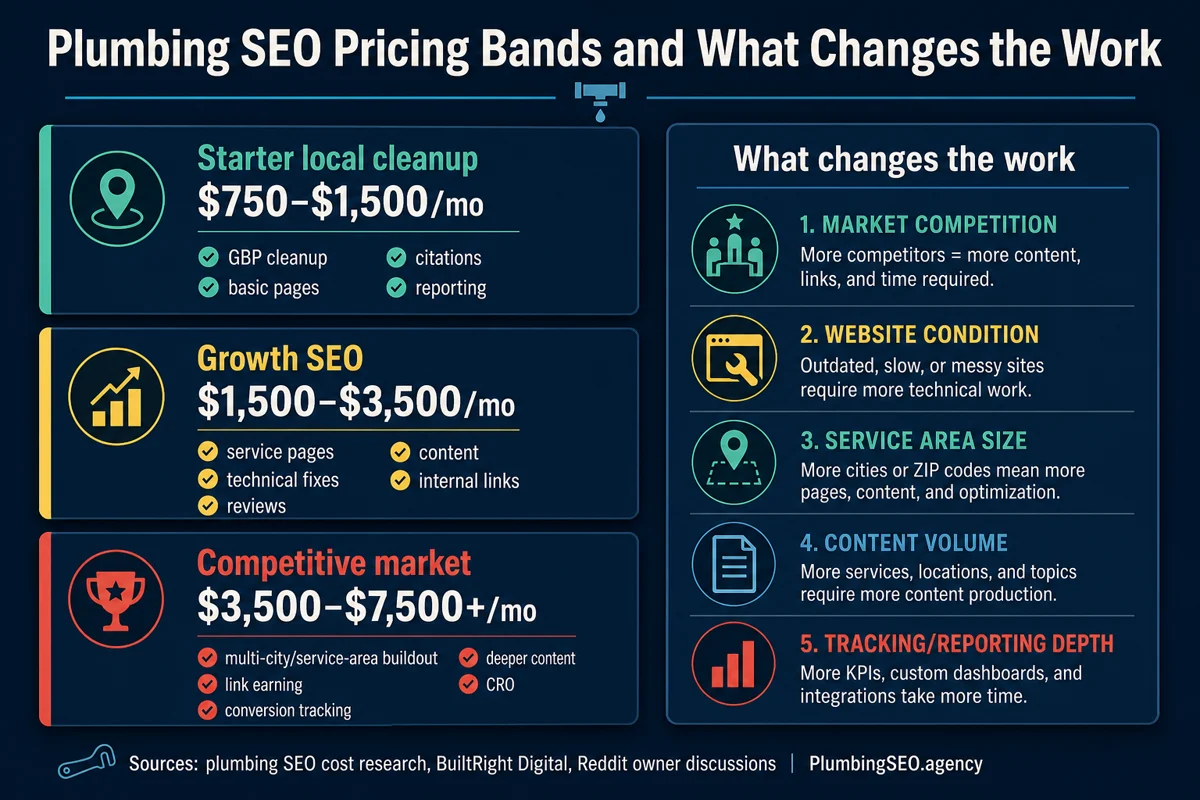
When scope changes, document the change. If a migration, suspension, tracking rebuild, or new location appears, say what moves out, what moves in, and why. That protects both sides from a package that grows quietly while accountability shrinks. For budget context, use the plumbing SEO pricing guide.
Watch for implementation red flags
- No owner access. The company cannot inspect or recover its own accounts.
- No changed URLs or assets. Reports list activity but do not identify what shipped.
- No baseline. Results are discussed without a starting point or source data.
- No call-quality review. Every phone event is counted as a lead.
- Broad pages fight each other. Multiple posts and service pages chase the same general intent without a routing plan.
- Guaranteed rankings. The provider promises a fixed position it cannot control.
- Volume without priority. Many low-impact tasks hide the fact that critical page, profile, or tracking problems remain open.
- No acceptance test. “Done” means sent, not verified.
Run a 20-minute monthly implementation review
The monthly review should be short enough to happen and specific enough to matter. Open the source data, completed-work log, and next work order. Review calls first, then the mechanisms that influenced them.
- Which qualified calls or booked-job opportunities changed, and what do we know about their sources?
- Which URLs, listings, links, tracking rules, or technical items changed?
- What passed its acceptance test, and what is still blocked?
- Did any page begin attracting intent that belongs somewhere else?
- What is the single highest-impact constraint for the next month?
- What input or approval does the plumbing company owe, and by when?
If the team cannot answer those questions, pause before adding more deliverables. A clear backlog of accepted work is more useful than a large package with no visible route to calls.
What should happen after day 90?
At day 90, do not judge the program by one ranking screenshot. Review the baseline, work shipped, technical health, visibility by priority service, Maps activity, qualified calls, booked-job feedback, and unresolved risks. Some search outcomes take longer than one quarter, but completed work and measurement quality should already be visible.
Keep what is working, repair what is weak, and stop tasks that cannot be connected to a useful customer route. The next quarter should be a shorter, sharper work order built from evidence—not a reset to the same generic package.
If you need an independent baseline before assigning the first work order, start with the free plumbing SEO audit. If you are evaluating who should implement the work, the main plumbing SEO agency page explains the commercial offer.
Plumbing SEO Implementation FAQ
The first 30 days should verify owner-controlled access, define qualified calls, test tracking, establish a baseline, audit the site and Google Business Profile, fix critical blockers, and improve the first priority pages. The owner should receive a changed-work log and acceptance proof.
A buyer checklist helps compare package scope before signing or renewing. This implementation plan starts after scope is chosen and explains sequencing, ownership, acceptance tests, evidence, and monthly review.
Ask for changed URLs or listing fields, completed technical fixes, before-and-after checks, tested calls and forms, internal-link routes, source-data access, call-quality context, unresolved risks, and the next priority work order.
No. This page should answer the narrower implementation and acceptance question. Broad plumbing SEO company, agency, and service intent should route to the homepage, while this article supports that offer with a practical 90-day work plan.
There is no universal number. Choose the smallest batch that covers the highest-value call opportunities and can be researched, edited, checked on mobile, linked, tested, and documented well. Quality and routing clarity matter more than page volume.
It needs reliable call measurement, which may include carefully configured call tracking. The setup should preserve accurate local business information, be tested, and include call-quality review so spam and wrong numbers are not reported as booked-job opportunities.
Review whether the right work shipped, pages are indexable, routing is clear, tracking works, calls are qualified correctly, and the market needs more authority or time. Do not hide a weak result, but do not treat one snapshot as the whole outcome either.
Need a baseline before the 90-day work order starts?
Run a free SEO leak check. We will review the site, Maps signals, priority pages, tracking path, and the biggest call leaks so the first implementation month starts with a clear order.
Run My Free SEO Leak Check