
- A real plumber SEO package should include tracking, technical cleanup, Google Business Profile work, service pages, reviews, content, internal links, and reporting you can inspect.
- If the agency only sends a vague ranking report, ask what changed on the site, what changed in Maps, what calls were tracked, and what gets fixed next.
- For most shops, the first 90 days should establish the baseline, fix leaks, build priority pages, and prove whether search is helping the phone ring.
If you are paying for SEO services for plumbers, you should not have to guess what is happening behind the curtain. A good package is not a mystery box. It should show what was fixed, what was built, what Google can understand better now, and whether more of the right customers are finding you before they call the shop down the road.
The way I see it, plumber SEO should be judged like a service call. Did someone diagnose the problem, fix the leak, clean up after the work, and show you what was done? Or did they wave at the pipes, print a report, and leave?
This guide is different from a general plumbing SEO services overview. Here we are treating the package like a buyer checklist. If you are comparing proposals, renewing a contract, or wondering what your current agency does every month, these are the pieces that should be included.
Why plumber SEO services need a plumbing-specific checklist
Plumber SEO services are not just local SEO with a trade name pasted on top. Plumbing companies need calls by job type, service area, urgency, and trust level. A homeowner searching for an emergency plumber behaves differently from a facility manager comparing backflow testing providers or a landlord researching water heater replacement. The SEO package should reflect those differences.
That is why the checklist below is built around booked-work outcomes instead of vanity deliverables. A good scope should make it easier for the right person to find the company, understand the service, trust the proof, and call or request an estimate. Ranking reports matter, but they are not the whole job. The stronger test is whether the package improves the path from Search and Maps to qualified calls.
This page is a supporting buyer guide, not a replacement for the main offer. If you want to compare the actual plumbing SEO services offered by PlumbingSEO.agency, start with the homepage plumbing SEO offer and use this checklist to judge whether any proposal has the right pieces.
What should SEO services for plumbers include?
At minimum, SEO services for plumbers should include seven work areas: call and form tracking, technical SEO, Google Business Profile optimization, service-page improvement, local trust building, useful content, and internal links. The exact monthly workload depends on your market, number of locations, and current site condition, but those buckets should not be missing.
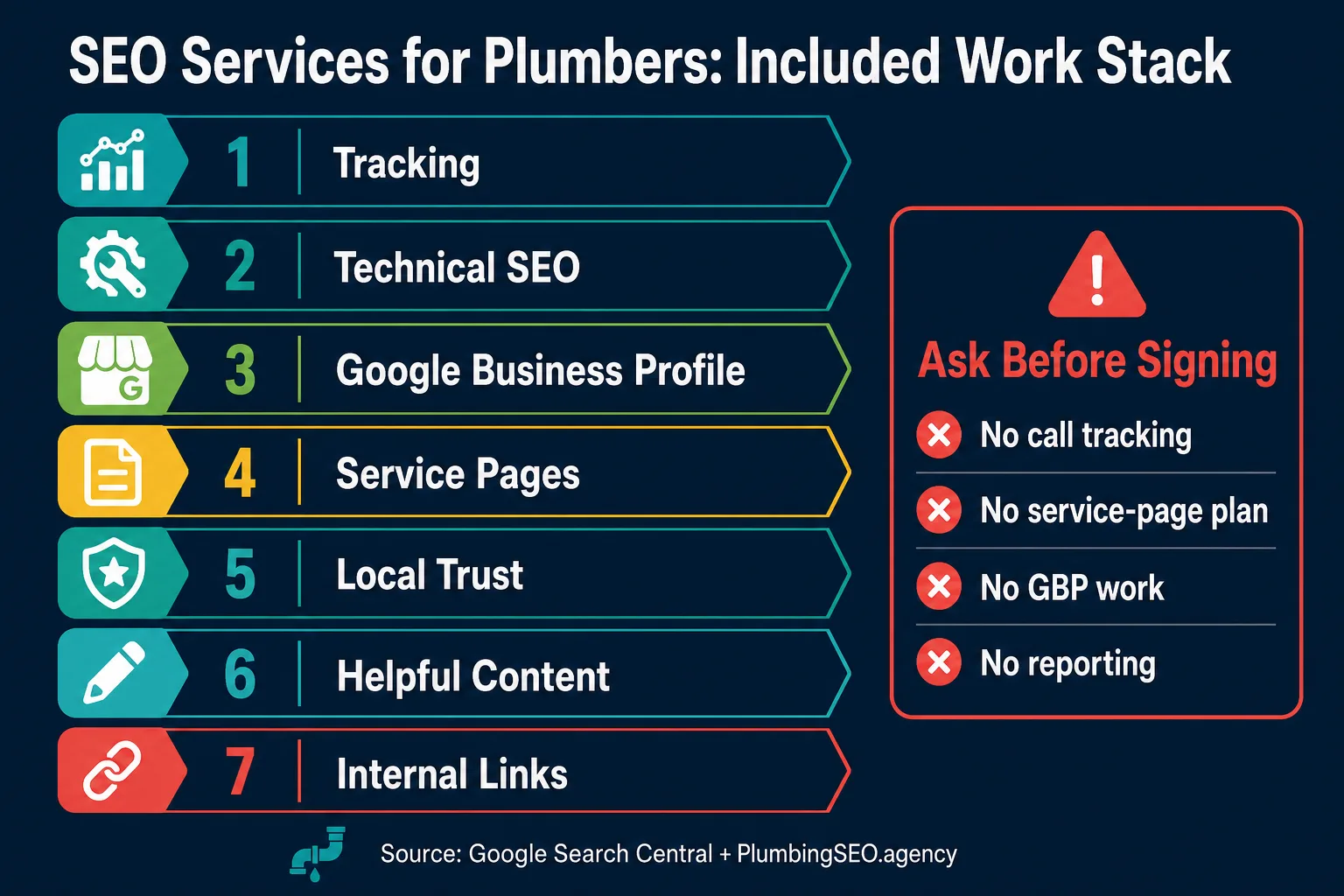
That stack matters because plumbing searches are not one simple keyword. Customers search by emergency, city, neighborhood, fixture, symptom, brand, job type, and trust signal. One person searches for a water heater replacement quote. Another searches for a clogged sewer line at 11 p.m. Another searches your company name after seeing a truck in the neighborhood.
Google's own SEO starter guide says SEO is about helping search engines understand your content and helping users decide whether to visit through search. It also says there are no secrets that automatically rank a site first. That is the plain truth. Good SEO is steady work that makes your pages easier to find, understand, trust, and act on. Source: Google Search Central.
Use this buyer checklist before you renew, switch, or sign
Before you compare prices, ask each provider to show the work in plain language. A stronger plumber SEO proposal should answer four questions without dodging: What will be fixed first? Which pages or listings will get attention? How will calls and forms be measured? What proof will the owner see every month?
| Checklist question | Strong answer | Weak answer |
|---|---|---|
| What demand are we targeting? | Priority services, service areas, Maps searches, and emergency/high-ticket calls | Generic "more traffic" with no call or job-type tie-in |
| What gets shipped? | Specific page updates, technical fixes, GBP work, internal links, and content briefs | A monthly PDF with no changed URLs or completed work log |
| How do we judge progress? | Calls, forms, qualified leads, Search Console movement, Maps actions, and next priorities | Keyword screenshots with no business interpretation |
If you already have a package, use the checklist as a renewal test. If you are starting from scratch, pair it with the plumbing SEO process so you can see how the work should sequence from diagnosis to shipped improvements.
Match the package language to the calls you actually want
Proposal wording matters because it reveals what the provider thinks the job is. A generic "SEO services" package may focus on traffic and rankings. A stronger plumbing SEO services package should talk about calls, service-area visibility, Maps actions, high-value jobs, dispatcher feedback, and which pages turn searches into booked work.
Use the same test when you see phrases like plumber SEO services, SEO services for plumbers, or local SEO for plumbing companies. The wording can vary, but the route should be clear: fix the website leaks, strengthen the right service pages, make the Google Business Profile more trustworthy, build useful supporting content, and show the owner what changed. If the route from services to calls is missing, the package is probably too thin.
Start with tracking, or the report is just noise
Before anyone rewrites pages or chases keywords, the package should set a baseline. That means Google Search Console, analytics, call tracking where appropriate, form tracking, rank or visibility tracking, and a simple way to tell which calls came from organic search, Maps, paid ads, referrals, or brand searches.
Without tracking, everyone argues from feelings. The agency says traffic is up. The owner says the board still looks light. The dispatcher says calls are worse. Nobody knows which statement is true because the meter was never installed. You would not pressure-test a line by squinting at it. Do not pressure-test marketing that way either.
Included
- Search Console and analytics access
- Tracked calls and forms
- Baseline rankings for priority services
- Monthly notes on what changed
Red flag
- No access to source data
- Only screenshots in a PDF
- No call quality review
- No connection to booked jobs
Google Business Profile work should be active, not forgotten
For a local plumbing company, Maps visibility is often the shortest path between a customer and a phone call. Your package should include Google Business Profile work, not just a one-time setup from two years ago. That includes categories, services, service areas, business info, photos, posts when useful, Q&A monitoring, review response guidance, and a plan to improve local trust signals.
This is also where plumbing-only knowledge matters. A general agency may optimize for broad terms and miss the work that fills trucks: emergency plumbing, drain cleaning, sewer repair, leak detection, water heaters, repipes, slab leaks, sump pumps, gas lines, and the towns you actually serve.
If your Maps listing gets calls but nobody reviews the calls, the package is still thin. The goal is not to make a graph prettier. The goal is to get more good-fit service calls from the right service area.
Service pages are where plumber SEO turns into booked work
A strong SEO service should improve the pages that match real plumbing jobs. The homepage can support the main plumbing SEO services theme, but each plumbing company still needs clear pages for the services customers search before calling.
Good service-page work includes title tags, meta descriptions, H1s, helpful copy, service-area context, FAQ content, schema where appropriate, internal links, and stronger calls to action. More important, the page should answer the customer question fast: Do you fix my problem, do you serve my area, can I trust you, and how do I call?
| Included service | What the owner should see | Why it matters for calls |
|---|---|---|
| Service-page map | A list of priority services and which URL targets each one | Prevents three weak pages from fighting over one job type |
| On-page optimization | Improved titles, headings, copy, media, schema, and CTAs | Helps Google and customers understand the page faster |
| Local proof | Service areas, reviews, photos, credentials, and job examples | Builds confidence before the customer dials |
| Internal links | Contextual links from related pages and posts | Moves authority toward the pages that book work |
If a proposal promises "content optimization" but cannot name which service pages need work first, slow down. Ask for the service map. Ask which page should rank for drain cleaning, which page should rank for water heater repair, and which page supports emergency plumbing. If the answer is "all of them," that is not a strategy. That is a junk drawer.
Technical SEO should clear the path for customers and crawlers
Technical SEO for a plumber is not about showing off with jargon. It is about removing friction. Search engines need to crawl the site. Customers need pages that load, buttons that work, images that make sense, forms that submit, and clean URLs that do not confuse people.
Google says its crawler should be able to see the page the same way a user does, including CSS and JavaScript. It also recommends descriptive URLs, logical organization, useful content, good link text, and descriptive image alt text. That gives you a simple technical checklist to request: crawl errors, indexability, canonicals, sitemap, robots rules, speed, mobile layout, broken links, schema, image alt text, and conversion elements.
If you want an independent starting point, run the free plumbing SEO audit and compare the findings against what your current package claims to handle.
Content should answer real plumbing searches
Helpful content is not filler. It should support the services and questions that lead to real calls. A water heater guide can support water heater replacement. A sewer backup article can support emergency and drain pages. A pricing guide can help owners and homeowners understand when it is worth calling instead of waiting.
For plumbers, content should be tied back to jobs, service areas, and trust. If the agency publishes generic posts that could belong to any contractor in any city, the work is probably being done for the calendar, not for the phone.
A useful content plan should also protect the right page for the right search. Broad buyer terms such as plumbing SEO services should strengthen the main offer, while support articles answer narrower questions like pricing, timelines, proposal checks, and service-page structure. That keeps the site helpful without making five pages compete for the same phrase.
Quick proposal test
Ask the agency to show the next three pages they plan to improve, why those pages matter, and which service calls those pages should support. A real answer should fit on one page.
Compare Plumbing SEO PricingThe first 90 days should have a visible plan
SEO can move slowly, but the work should not be invisible. Google says some changes can show in a few hours while others may take several months, and that you should usually wait a few weeks to assess impact. That does not mean waiting three months to learn whether anything happened.
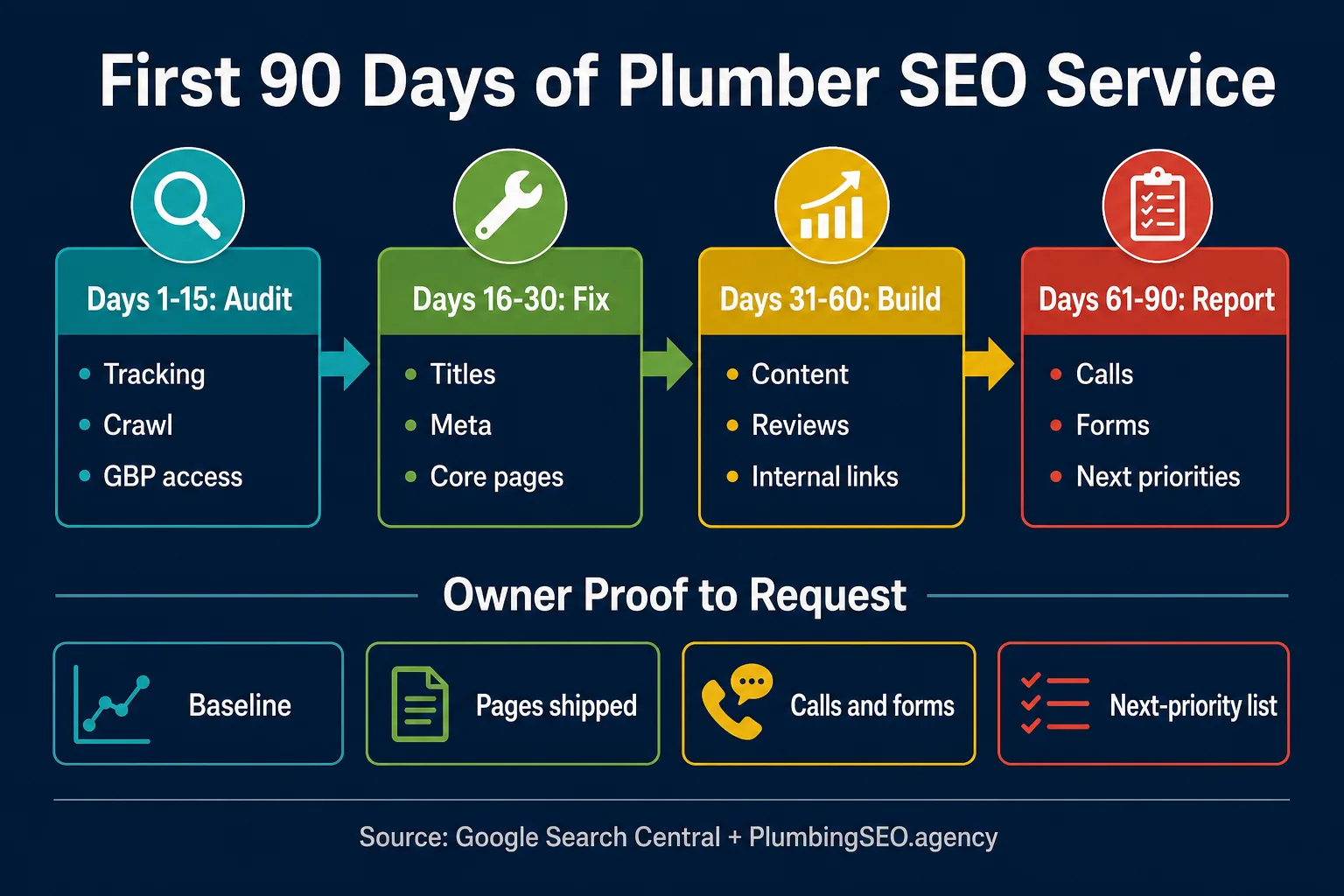
In the first month, you should see access gathered, tracking installed or verified, a crawl completed, priority pages chosen, and urgent technical issues handled. In the second month, you should see pages improved, Google Business Profile work, internal links, review process improvements, and content work. By the third month, you should see a clearer report on calls, forms, ranking movement, pages shipped, and next priorities.
That is why the best package is not just "SEO monthly." It is a sequence. Diagnose first. Fix the easy leaks. Improve money pages. Build supporting content. Strengthen trust. Report in a way the owner can understand before the next slow week shows up.
Reporting should show changed work, not just changed numbers
A good SEO report should tell you three things: what changed, why it matters, and what happens next. Rankings can move for many reasons. Traffic can rise from branded searches. Impressions can climb while calls stay flat. You need the work log and the business interpretation, not just a screenshot with green arrows.
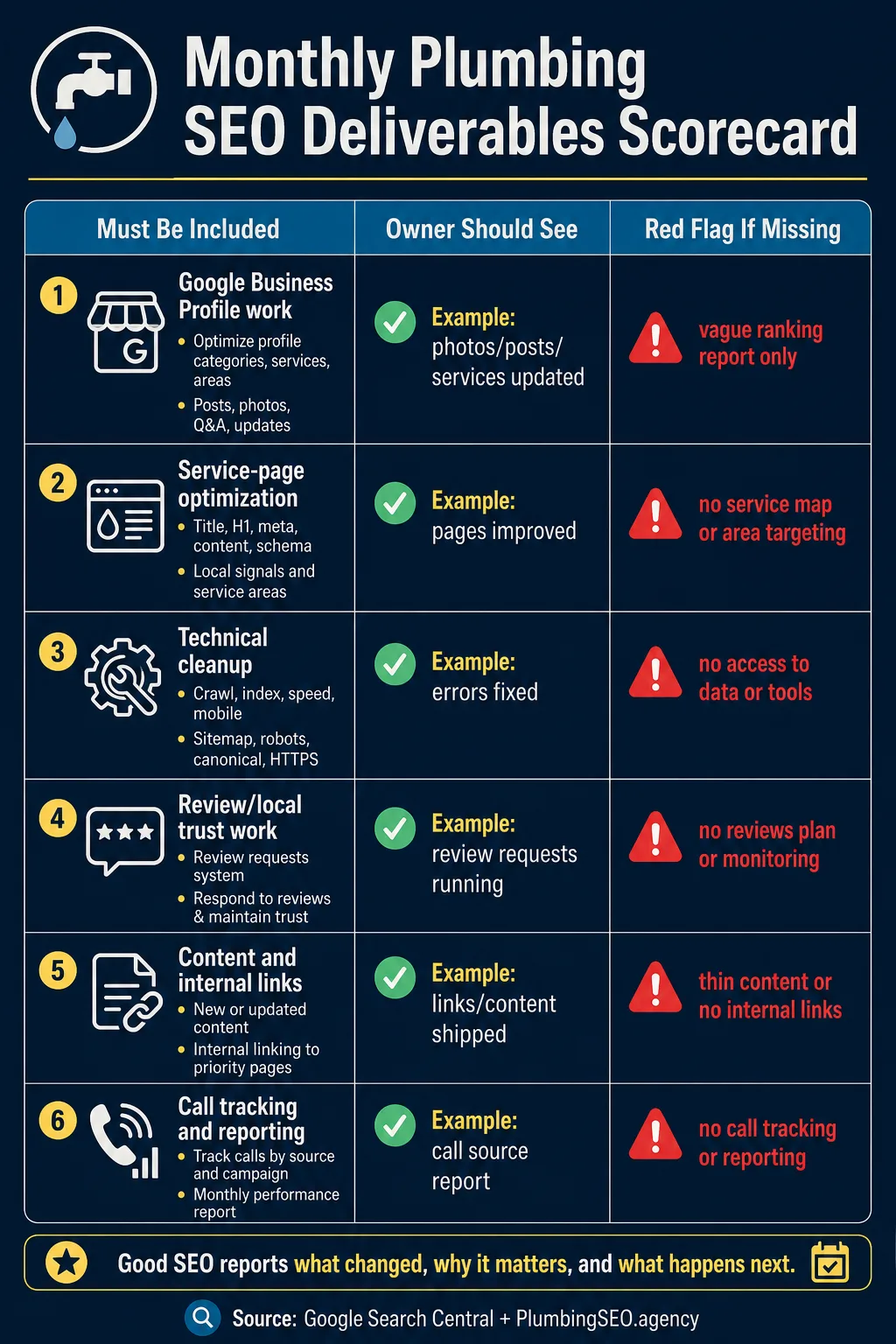
Here is a practical owner rule: if you cannot explain the SEO report to your office manager in two minutes, the report may be serving the agency more than the plumbing company. You should be able to say, "We fixed these pages, improved this listing, built these links, got these calls, and this is next." That is enough. Nobody needs a 42-page PDF unless it is holding up a wobbly desk.
What should not be included in a plumber SEO package?
Some items sound impressive but do not help much. Be careful with packages built around meta keyword tags, automated blog posts, bought backlinks, directory blasts with no quality control, fake review tactics, or reports that hide source data. Google specifically warns against keyword stuffing and notes that meta keywords are not something Google Search uses. If the proposal leans on outdated tricks, keep your wallet in your pocket.
Also be careful with guaranteed rankings. A useful agency can commit to work, process, transparency, and measurement. It cannot honestly guarantee a fixed Google ranking. Search results are shared ground, not a private parking spot.
How to choose the right scope
A small plumbing shop in a less competitive market may need a lean local package: tracking, Google Business Profile, citations, a handful of service pages, review process help, and a simple monthly report. A multi-truck company in a competitive metro may need deeper work: technical cleanup, location pages, service clusters, content strategy, digital PR, conversion testing, and stronger reporting.
The right scope depends on the gap between where you are and where the calls are. If your site is broken, fix technical leaks first. If your Maps listing is weak, work the profile and reviews. If competitors have stronger service pages, improve those. If you are trying to judge spend, compare the package against our plumbing SEO pricing guide, the local SEO cost breakdown, and the actual deliverables you receive.
Final renewal test: can you see the route from work to calls?
The final question is simple: does this service help the right customer find you, trust you, and call you before they call another plumber? If the answer is yes, keep it in the package. If the answer is no, ask why you are paying for it.
Ask the provider to walk through one example from start to finish: the keyword or customer problem, the page or Maps asset improved, the trust signal added, the internal link or technical fix shipped, and the call or form evidence watched afterward. If they can explain that route clearly, you probably have a real SEO service. If they cannot, you may have a bundle of tasks without a strategy.
FAQs About SEO Services for Plumbers
They should include tracking, technical SEO, Google Business Profile work, service-page optimization, local trust building, useful content, internal links, and plain reporting that shows what changed and why it matters.
Yes. A plumber SEO package should map work to emergency calls, high-ticket services, service areas, Google Maps visibility, reviews, and trust signals that affect booked jobs. General local SEO may miss those plumbing-specific priorities.
Ask for a monthly work log, page changes, Google Business Profile updates, fixed issues, call and form tracking, and next priorities. A real report should connect work to visibility, calls, and booked-job opportunities.
Yes. For local plumbing companies, Maps visibility can drive high-intent calls. The package should include categories, services, service areas, photos, review response guidance, Q&A monitoring, and local trust improvements.
The homepage should usually be the main offer page for broad plumbing SEO services terms. A blog like this should support that page by answering buyer questions, explaining deliverables, and linking naturally to the main offer.
Some technical and on-page changes can be noticed quickly, but meaningful search movement often takes weeks or months. Judge early work by completed fixes, tracking quality, priority pages improved, and whether the plan is moving toward better calls.
Yes, when the posts support real services, answer real customer questions, and link to priority pages. Blog posts written only to fill a calendar are weak. Content should help customers trust the company and help search engines understand service expertise.
Compare each proposal by the route from work to calls. A strong proposal names the tracking setup, priority service pages, Maps work, internal links, review/trust improvements, content plan, and owner-visible reporting proof.
Red flags include vague ranking reports, no call tracking, no access to source data, no service-page plan, no Google Business Profile work, bought-link promises, guaranteed rankings, and no clear explanation of next priorities.
Want to know what your current SEO package is missing?
Run a free plumbing SEO audit and we will show the leaks in tracking, service pages, Maps visibility, technical SEO, and internal links.
Run My Free SEO Leak Check