
- A realistic plumbing SEO timeline uses the first 90 days to build tracking, service pages, Google Business Profile trust, reviews, citations, and internal links before judging scale.
- By day 90, you should see more indexed pages, more non-branded impressions, clearer GBP actions, steady review activity, and pages close to page-one wins.
- Warning signs include number-one-in-30-days guarantees, no call tracking, citations-only work, no service pages, no review process, and reports that ignore booked calls.
If a plumbing SEO company promises a flood of organic calls in two weeks, the problem is not ambition. The problem is physics. Google has to crawl the site, understand which services and cities you actually deserve to rank for, compare your business to entrenched local competitors, and watch whether customers keep choosing you.
That is why a serious plumbing SEO timeline usually needs about 90 days before you can judge whether the campaign is on track. Day 90 is not a magic finish line. It is the first honest checkpoint where the foundation, early ranking movement, Google Business Profile work, reviews, and call tracking should all be visible in the same report.
The short version: plumbing SEO takes 90 days because local rankings depend on both website relevance and local trust. Local SEO coverage of Google's ranking guidance commonly summarizes map visibility around relevance, distance, and prominence, as explained by Search Engine Journal. Google Search Central also explains that pages must be discovered, crawled, indexed, and served before they can earn search visibility. For a plumber, that process is slowed by competitive service keywords, map pack trust signals, review velocity, and whether your site has real pages for the jobs you want.
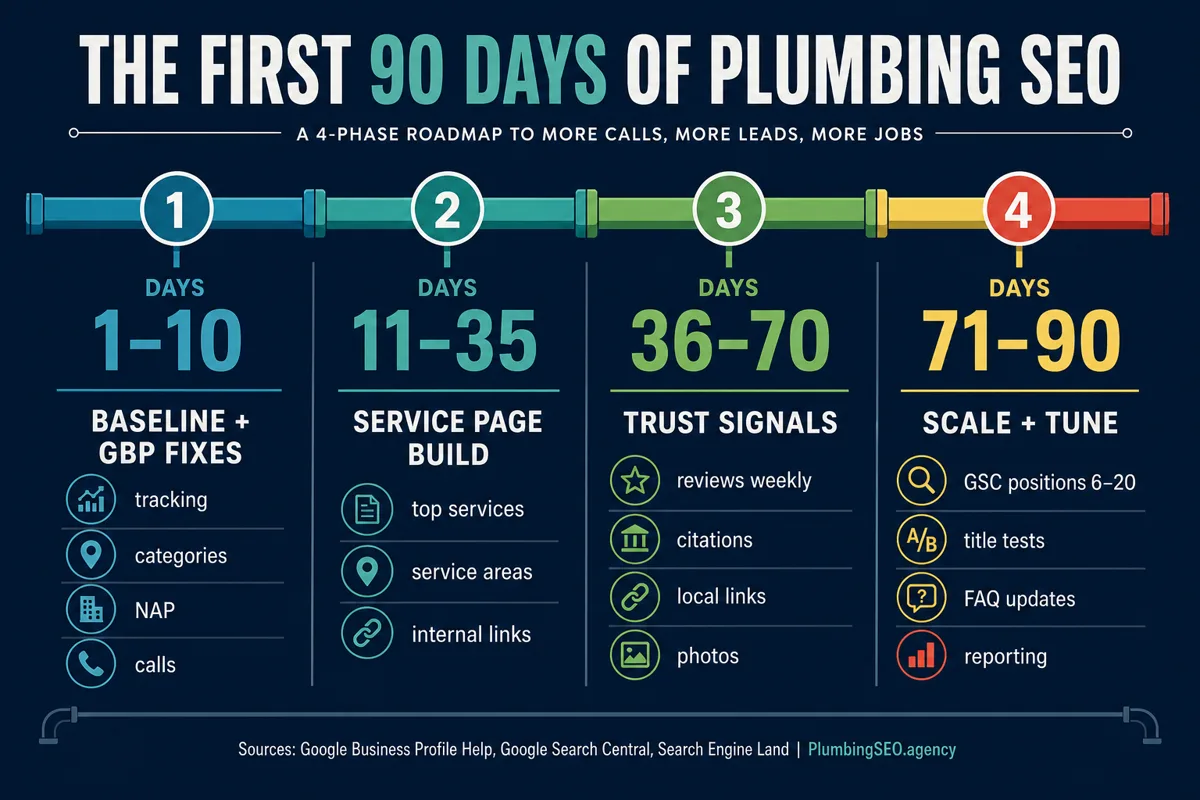
The plumbing SEO timeline in one table
Use this timeline to separate normal early-stage SEO from a campaign that is drifting. The exact pace depends on competition, domain age, your current Google Business Profile, the number of real reviews, and whether your service pages already exist.
| Period | What should happen | What you should see | What would worry me |
|---|---|---|---|
| Days 1-10 | Tracking, baseline audit, GBP cleanup, index checks, call/form attribution, service priority list. | Current rankings, GSC baseline, GBP action baseline, technical issues, and a prioritized work plan. | No access request, no call tracking, no baseline, or a report that only talks about rankings. |
| Days 11-35 | Core plumbing service pages, service-area coverage, title/H1/meta cleanup, internal links, schema checks. | New or improved pages for emergency plumbing, water heaters, drain cleaning, sewer, repiping, and priority cities. | Only directory submissions while the website still has thin or missing money pages. |
| Days 36-70 | Review cadence, citations/NAP cleanup, GBP posts/photos/services, local link targets, content support. | More indexed pages, more non-branded impressions, cleaner GBP actions, and early movement into positions 6-20. | A one-time review blast, generic blog posts with no service links, or links from irrelevant sites. |
| Days 71-90 | Tune pages near page one, expand FAQs, improve click-through titles, strengthen internal links, report call quality. | Clear next moves from Search Console, map grid changes in priority areas, and qualified-call reporting. | No specific page-level wins, no call data, and no explanation of what will be scaled next. |
Why plumbing SEO is slower than flipping on ads
Google Ads can put a plumber above the organic results today because you are paying for placement. SEO has to earn placement. That difference matters when a homeowner searches for an emergency plumber, sewer backup help, or water heater replacement near them.
A plumbing SEO campaign has to prove four things at the same time:
- Service relevance: your site has specific pages for the services customers search, not one generic services page.
- Local relevance: your Google Business Profile, address or service area, content, and citations consistently support the markets you serve.
- Prominence: your reviews, local mentions, backlinks, and brand signals are strong enough to compete with the plumbers already visible.
- Customer usefulness: people who click can call, request help, and find the answer without bouncing back to Google.
That is also why our plumbing SEO process starts with tracking and page architecture before expansion. If the foundation is wrong, more content just gives Google more messy signals.
Days 1-10: baseline, tracking, and Google Business Profile fixes
The first ten days should feel boring in the best possible way. Before anyone claims a ranking win, the campaign needs a clean baseline. That means Search Console, analytics, call tracking, form tracking, Google Business Profile access, current map visibility, current organic rankings, and a site crawl.
This is where a plumbing company often finds hidden leaks:
- Emergency calls are going to the main office line but not being attributed to SEO.
- The Google Business Profile has the wrong primary category or incomplete service list.
- Old tracking numbers created NAP inconsistencies across citations.
- High-value pages are not indexed, blocked, duplicated, or missing from internal navigation.
- City pages exist, but they are thin copies with swapped city names.
By the end of this phase, you should know the current reality. How many non-branded impressions does the site get? Which service pages already rank? Which towns are already close? Which calls are from organic search versus ads? Without that baseline, day 90 reporting becomes storytelling instead of measurement.
Days 11-35: build the pages that can actually rank
Most plumbing websites underperform because the money pages are too thin. A homepage cannot carry every search. Google needs a clear destination for searches like emergency plumber, drain cleaning, sewer line repair, tankless water heater installation, water heater repair, repiping, leak detection, and backflow testing.
In this phase, the campaign should build or improve the pages that match your highest-profit services and your best service areas. Each page needs a distinct title tag, H1, useful copy, FAQs, internal links, local proof, and a clear call button. The goal is not to publish the most pages. The goal is to publish the fewest pages needed to make your service coverage obvious.
Internal links matter here. A water heater page should link to the relevant location pages, related service pages, financing or estimate CTAs if they exist, and supporting guides. A timeline article like this should link to planning assets such as the plumbing SEO ROI calculator and buying guidance like plumber SEO pricing models. That helps readers and helps Google understand the site architecture.
Days 36-70: trust signals start compounding
Once the core pages are in place, the campaign has to make the business look active, trusted, and locally relevant. This is where many plumbers expect rankings to jump, but the healthier expectation is gradual movement.
Google Business Profile work should include service cleanup, fresh photos, accurate hours, post activity where appropriate, product/service details, and review response discipline. Google says prominence can be based on information Google has about a business from across the web, including links, articles, and directories. That is why local trust work is not optional.
For plumbing companies, the most useful trust signals usually include:
- Consistent reviews: a steady review process after completed jobs, not a one-week burst followed by silence.
- Clean citations: consistent name, address, phone, website, and service categories on major platforms.
- Local links: chambers, sponsorships, vendor pages, local associations, community pages, and partner mentions.
- Job proof: real photos, project notes, city/service examples, and staff or truck imagery.
- Content support: articles that help close real customer questions and link back to the service page that should win.
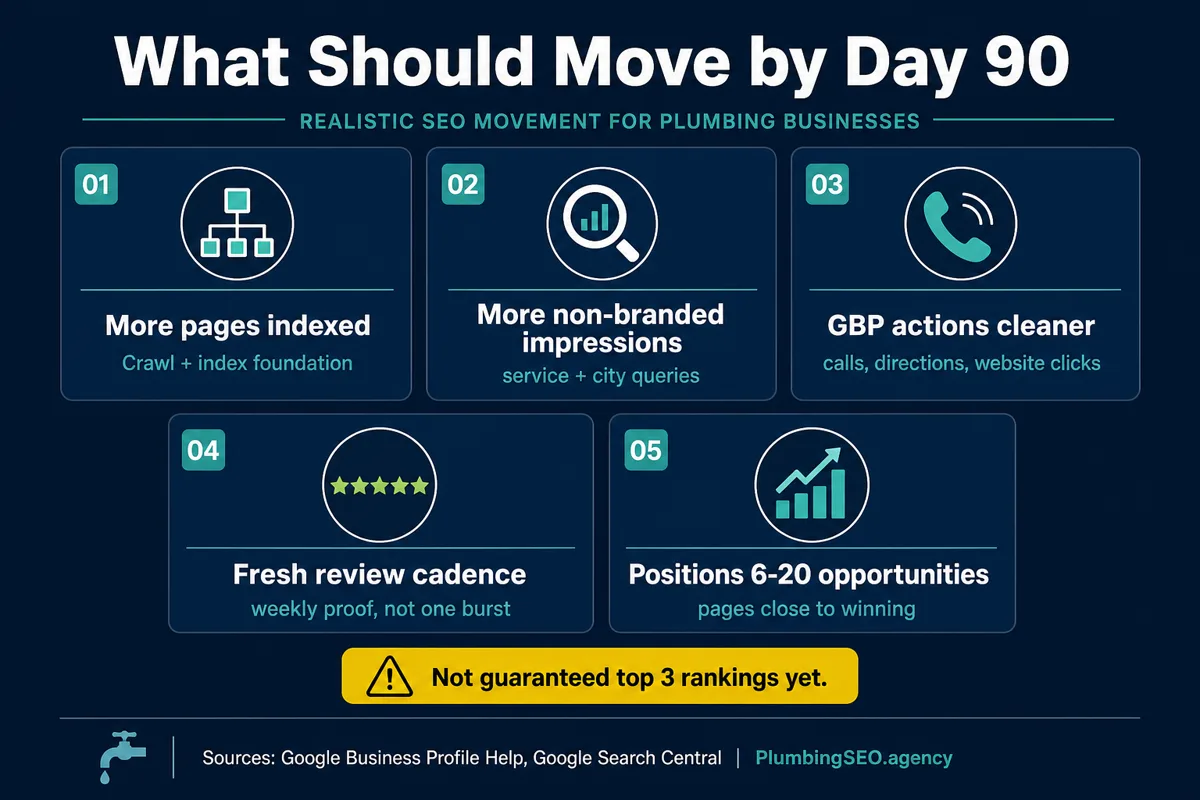
Days 71-90: tune what is close to winning
The last third of the first 90 days should not be random content production. It should be tuning. Search Console will usually reveal pages earning impressions but not enough clicks, pages ranking in positions 6-20, and service queries where Google is testing the site.
This is where good SEO gets practical. If a water heater page is sitting in position 12 for a profitable city keyword, the answer may be a stronger title, better FAQ section, more internal links, a supporting article, or a local proof block. If a page gets impressions but no calls, the answer may be a clearer above-the-fold offer, a click-to-call button, or a stronger emergency CTA.
This is also where the SEO plan should coordinate with paid search. If a keyword is profitable in ads, it may deserve an SEO page. If SEO is starting to rank for a lower-cost informational query, ads may stay focused on emergency and high-intent terms. See the breakdown in SEO vs Google Ads for plumbers if you are deciding where the next dollar should go.
What should be true by day 90?
A strong 90-day report should answer five questions in plain English:
- Are the right pages indexed? Core service and location pages should be crawlable, indexed, and internally linked.
- Are non-branded impressions growing? The site should be seen for more service and city queries, not only the company name.
- Are Google Business Profile actions clearer? Calls, directions, website clicks, and photo activity should be tracked against the baseline.
- Are reviews flowing? The campaign should show a repeatable review process, not a one-time push.
- What is close to winning next? The report should list pages and keywords within striking distance and the exact actions planned.
Notice what is not on that list: guaranteed top-three map rankings in every city by day 90. That can happen in easier markets, especially when a business already has trust and the site only needed cleanup. But in competitive plumbing markets, day 90 is often the point where the campaign proves traction and earns the right to scale.
When should calls start improving?
Calls can improve before day 90 when the business already has authority, the Google Business Profile is close to ranking, or the site had obvious conversion leaks. Fixing tracking, phone visibility, click-to-call buttons, title tags, and GBP categories can produce earlier movement.
But if the website has no real service pages, the domain is new, reviews are thin, competitors are established, and the business serves a crowded metro, the first 90 days are foundation plus early traction. That is normal. The question is whether the leading indicators are moving in the right direction.
Warning signs your 90-day SEO plan is weak
The fastest way to waste three months is to buy a plan that does busy work instead of plumbing SEO. Watch for these red flags before day 30, not after month six.
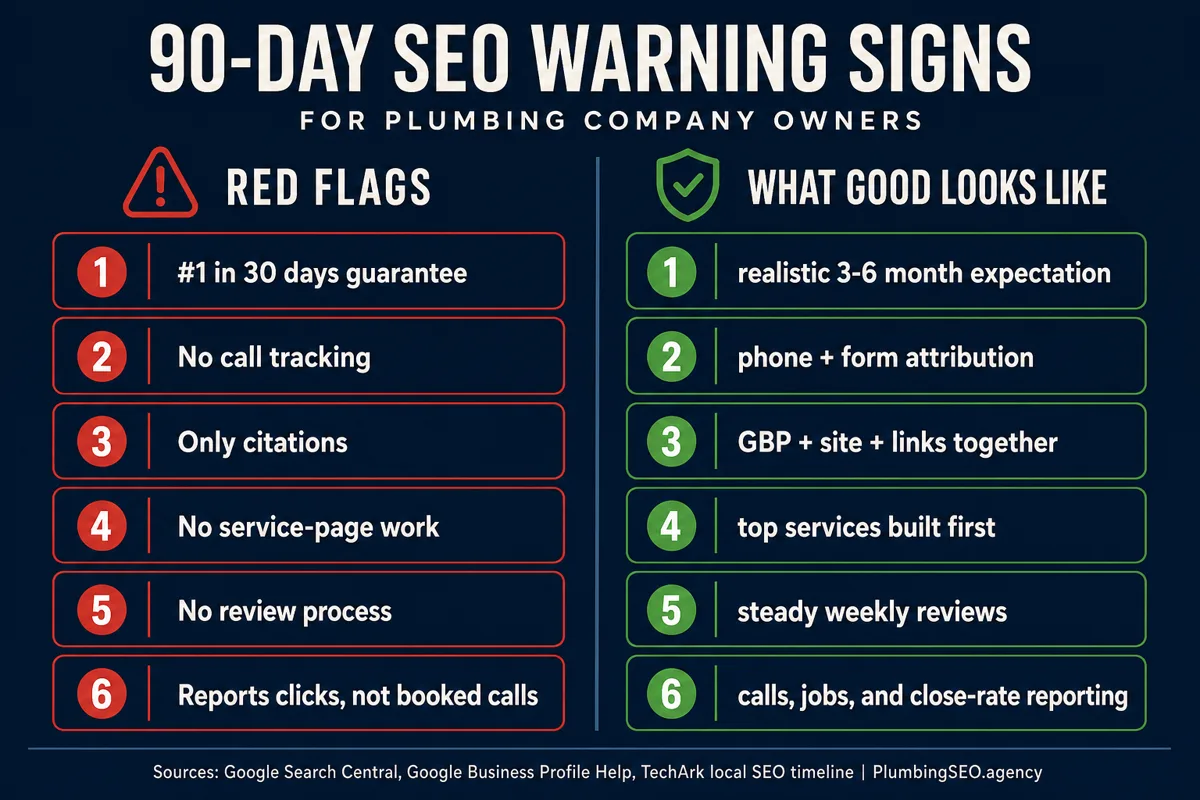
What weak campaigns say
- "We guarantee number one in 30 days."
- "You just need 200 citations."
- "We do SEO, but we do not need phone tracking."
- "Blogs are enough. Service pages can wait."
- "Reviews are your job, not part of SEO."
What good campaigns show
- A baseline, campaign plan, and day-90 checkpoint.
- Service pages, GBP, reviews, links, and technical fixes together.
- Phone and form attribution tied to organic search.
- Priority pages for the services that produce profit.
- Next actions based on Search Console, GBP, and call quality.
How to judge a plumbing SEO company after 90 days
Do not judge the first 90 days only by the prettiest ranking screenshot. Judge it like an owner. Did the campaign create assets that can keep compounding? Did the work target profitable services? Did the reports connect visibility to calls? Did the next 90-day plan get sharper because of real data?
Ask for these items in the day-90 review:
- Before and after non-branded Search Console impressions and clicks.
- A list of pages created, rewritten, indexed, and internally linked.
- Google Business Profile action trends and map grid movement for priority areas.
- Review count, review velocity, and review response status.
- Qualified organic calls, booked jobs if tracked, and missed-call notes.
- Pages ranking in positions 6-20 and the exact plan to push them forward.
The best plumbing SEO campaigns get more specific over time. Month one is discovery and foundation. Month two is asset creation and trust cleanup. Month three is evidence and tuning. Months four through six should then scale what the first 90 days proved.
Sources used for this timeline
- Search Engine Journal: Relevance, distance, and prominence as local ranking factors
- Google Search Central: How Search works
- Google Search Central: SEO Starter Guide
- Google Search Central: Creating helpful, reliable, people-first content
The bottom line
Plumbing SEO takes 90 days because the first stage is not just ranking. It is building a measurable local search machine: tracking, service pages, GBP trust, reviews, citations, internal links, and conversion paths. Some calls may improve earlier. The real test is whether day 90 gives you proof that the campaign can scale.
If you want a plumber-specific read on what your next 90 days should look like, start with the free plumbing SEO audit. We will show where your current rankings leak calls and which service pages, GBP fixes, or trust signals should come first.
FAQs About the Plumbing SEO Timeline
Yes, especially when a plumbing company already has a trusted domain, strong reviews, and pages that only need cleanup. Fast wins often come from fixing tracking, title tags, internal links, Google Business Profile categories, and conversion leaks. But a full SEO campaign still needs enough time for Google to crawl, test, and trust the changes.
Not automatically. Day 90 should show leading indicators: more indexed pages, more non-branded impressions, better GBP activity, review cadence, and pages moving into positions 6-20. If none of those are happening and there is no call tracking, the plan needs to be challenged.
The first month should establish tracking, baseline rankings, Search Console data, GBP access, citation issues, service-page priorities, and technical index health. Without those basics, later reports cannot prove whether SEO created more qualified calls.
No. Citations help Google verify business information, but they do not replace service pages, reviews, Google Business Profile optimization, local links, technical SEO, or conversion work. Citations are a foundation signal, not a complete plumbing SEO strategy.
Ask for page-level deliverables, before-and-after Search Console data, GBP action trends, review progress, call attribution, and the list of pages close to winning next. Real work leaves assets and data behind. Weak work leaves vague reports and ranking screenshots.
Want a 90-day SEO plan for your plumbing company?
Get a plumber-specific audit that shows your current rankings, missing service pages, Google Business Profile gaps, and the fastest path to more qualified calls.
Run My Free SEO Leak Check