
- SEO pays back when the profit from booked organic jobs is greater than the monthly SEO spend. Calls alone are not enough.
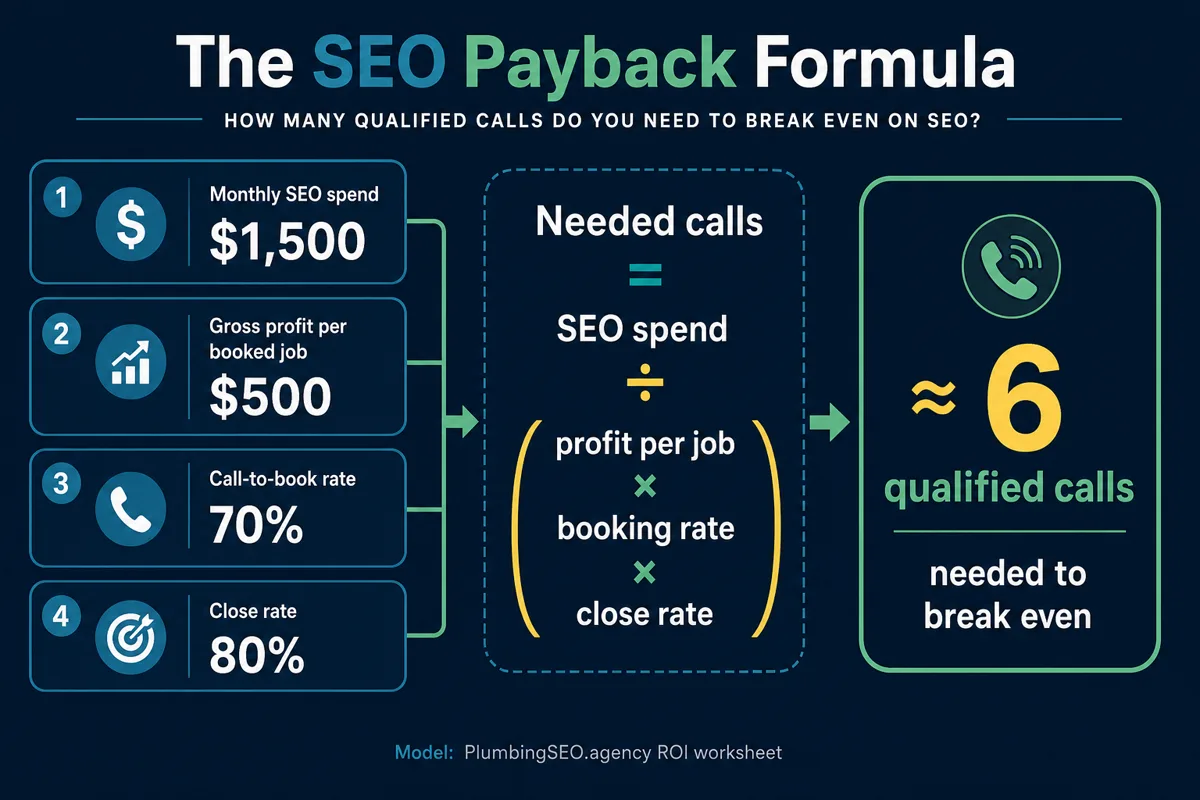
- For a $1,500 monthly plan, $500 gross profit per booked job, 70% booking rate, and 80% close rate, you need about 6 qualified calls to break even.
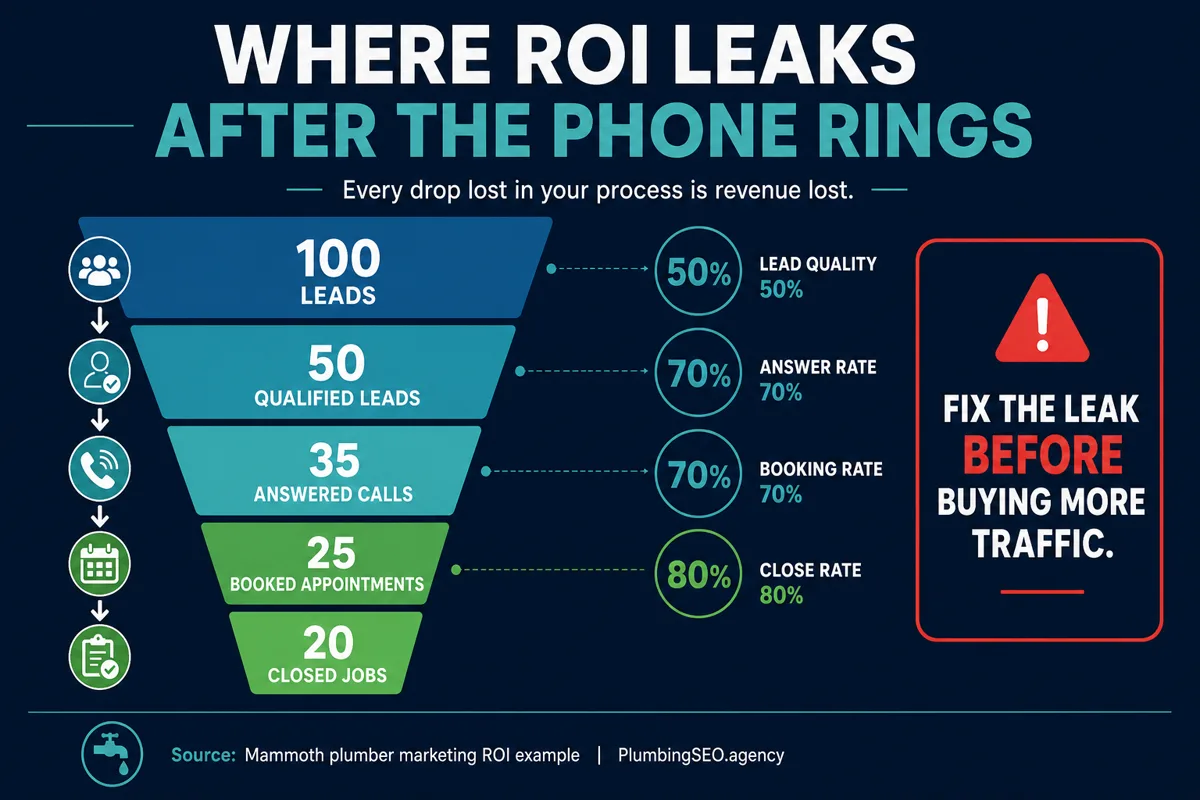
- The biggest ROI leak is usually not Google. It is missed calls, weak booking, low close rate, wrong service area calls, or jobs priced too low.
If the phone is quiet, SEO sounds expensive. If the phone is already ringing with the wrong calls, SEO sounds confusing. Either way, the question underneath is simple: how many calls does this need to bring in before it pays for itself?
This guide gives you a plumber-specific way to run that math. Not traffic. Not impressions. Not a report with green arrows. Calls, booked jobs, gross profit, and payback.
The short version: divide your monthly SEO spend by what one qualified organic call is worth after booking rate, close rate, and gross profit. That gives you the number of qualified calls SEO needs to create before you are back to even.
The quick plumbing SEO ROI formula
Use this formula when you are comparing an SEO plan, checking a current agency, or deciding whether your own content work is worth the time.
| Input | What it means | Example |
|---|---|---|
| Monthly SEO spend | What you pay each month for strategy, fixes, content, local SEO, and reporting. | $1,500 |
| Gross profit per booked job | Average job revenue minus labor, material, parts, and direct job cost. | $500 |
| Call-to-book rate | How many qualified calls turn into scheduled jobs. | 70% |
| Close rate | How many booked jobs become paying jobs. | 80% |
In that example, one qualified SEO call is worth about $280 in gross profit before overhead. A $1,500 plan needs roughly 6 qualified calls to pay back. If your average job is higher, the call count drops. If your booking rate is weak, the call count climbs.
Plumbing SEO ROI calculator
Adjust the numbers to match your shop. Use gross profit, not top-line revenue, if you want honest payback math.
What counts as a qualified SEO call?
A qualified SEO call is not every phone ring. It is a real customer in your service area, asking for work you want, from a search path you can reasonably credit to organic visibility, local pack visibility, or your website.
That matters because a plumbing company can look busy and still lose money. Wrong-area calls, tire-kickers, warranty-only calls, jobs you do not perform, and missed calls all make the report look better than the bank account.
Good tracking separates at least four buckets: total calls, qualified calls, booked jobs, and closed jobs. If your current report stops at traffic or call count, the payback math has a leak in it.
Use gross profit, not revenue, for honest payback
A $1,200 water heater job is not $1,200 of money you can use to pay the SEO bill. Parts, labor, warranty risk, fuel, payment fees, and callbacks all take a bite before the owner sees profit.
That is why I like using gross profit per booked job for ROI planning. It is stricter than revenue, but it keeps you from lying to yourself. The phone tells the truth, and the books back it up.
Revenue math feels good
$1,500 SEO spend divided by an $800 average ticket says you only need 2 jobs. That sounds easy, but it ignores job cost.
Profit math keeps you safe
$1,500 divided by $500 gross profit says you need 3 closed jobs, before you even account for calls that do not book.
If you do not know your exact gross profit per job, start with a conservative estimate and update it later. A rough honest number beats a perfect fake one every time.
The leaks that change your SEO break-even point
Research from plumber-focused marketing examples shows why call handling matters. One published plumber ROI model used a $5,000 marketing spend, $50 cost per lead, 50% qualified lead rate, 70% answer rate, 70% booking rate, 80% close rate, and an $800 average ticket to show how fast leads shrink before revenue appears. The useful lesson is not the exact numbers. It is the leak pattern.
That plumber ROI breakdown is worth reading because it connects marketing to answer rate, booking rate, close rate, and average ticket. Those are the same inputs your SEO calculator needs.
- Lead quality: SEO should bring service-area calls for work you want, not random traffic from across the country.
- Answer rate: If you miss after-hours calls, SEO gets blamed for an operations problem.
- Booking rate: A weak CSR script can turn a good organic call into a lost job.
- Close rate: If estimates are not followed up, more calls will not fix the leak.
- Average ticket: Low-value work needs more call volume to cover the same SEO cost.
This is also why an SEO plan should not live in a separate little box. It should connect to call tracking, your Google Business Profile, service pages, reviews, and the way your office books work. If you want the full scope behind that, read our guide to what plumbing SEO services should include.
Three break-even scenarios
The number of calls needed changes with your market, your package, and your job mix. A small shop with lower prices may need nearly the same call count as a bigger shop spending more, because each booked job carries less profit.
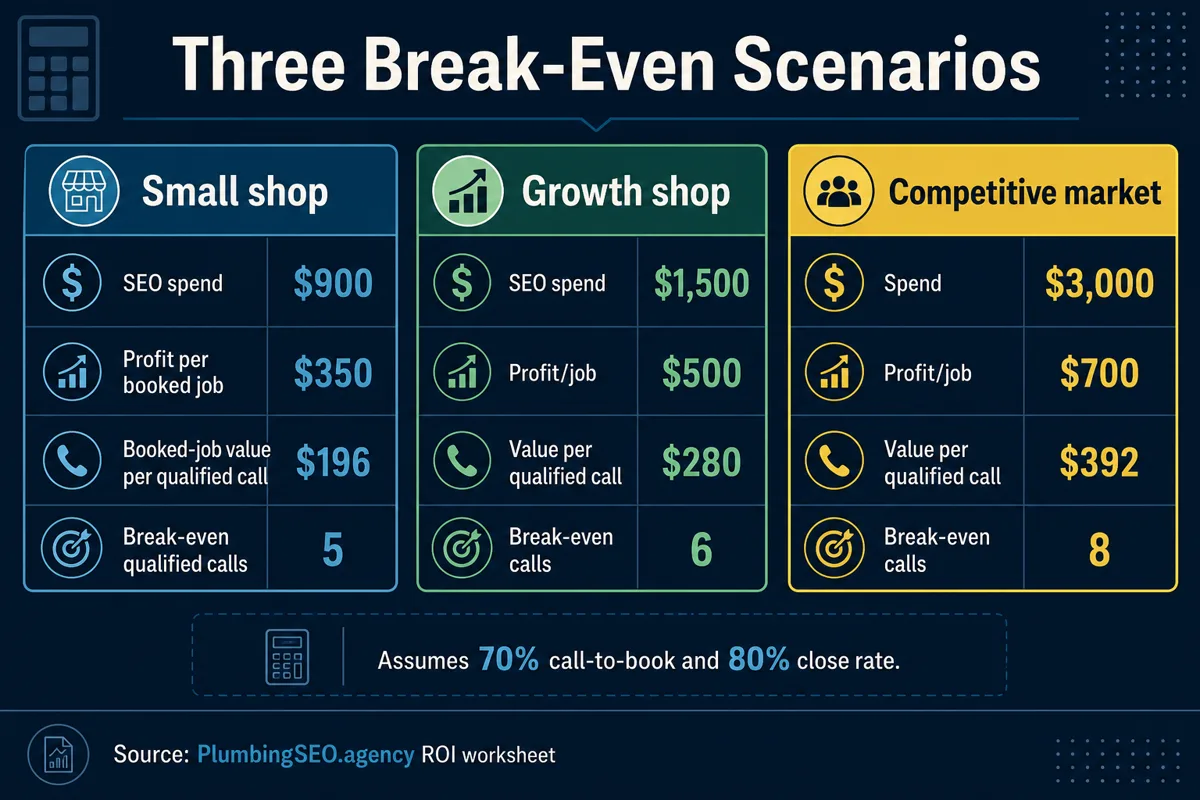
Use these as planning examples, not promises. A competitive city can take longer to rank. A company with strong reviews and clean service pages can convert faster. A shop with no call tracking is guessing, and guessing is a bad way to run payroll.
When should SEO pay back?
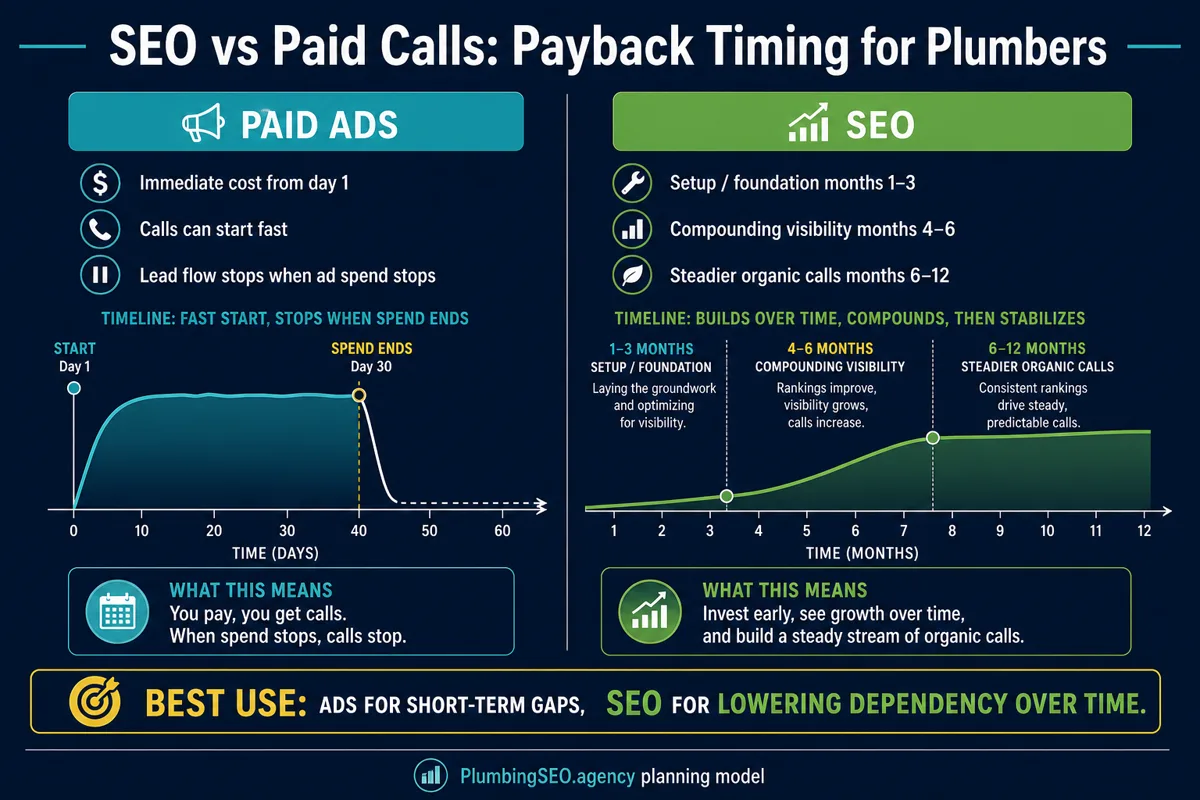
SEO rarely pays back like a faucet repair invoice. You do not pay on Monday and get the money back by Friday. Local SEO usually starts with technical cleanup, Google Business Profile work, service page improvement, internal links, content, and authority signals. The early work sets the pipe. The calls come as visibility compounds.
A plumbing SEO cost guide from Built-Right Digital notes that basic local SEO packages often start around $1,000 to $2,000 per month, with broader campaigns moving higher for competitive markets, multi-location work, content, and links. It also frames early movement around 3 to 6 months and stronger lead flow around 6 to 12 months for harder terms. That lines up with what most owners should expect: track early indicators, but judge payback over a real enough window.
You can compare that with our own plumbing SEO pricing and the deeper plumbing SEO pricing guide if you want to run the calculator against actual plan costs.
What to measure before you judge SEO ROI
Before you decide SEO is winning or losing, make sure the tracking is not sloppy. At minimum, measure these every month:
| Metric | Why it matters | Owner question |
|---|---|---|
| Organic calls | Shows whether search visibility is creating phone activity. | Are more real customers finding us? |
| Qualified-call rate | Separates useful plumbing calls from noise. | Are these calls in our service area and job mix? |
| Booked-job rate | Reveals whether the office is turning calls into jobs. | Are we booking what SEO sends? |
| Closed-job rate | Connects SEO to revenue, not just booked estimates. | Did the job actually happen? |
| Gross profit | Keeps ROI grounded in money left after job costs. | Did this help cover payroll and overhead? |
For the search side, keep an eye on Google Business Profile actions, service-page rankings, non-branded organic calls, and form fills. Google explains the basics of measuring website traffic and search performance in Search Console performance reporting. Pair that with call tracking for plumbers or CRM data so you can connect search to jobs on the board.
How to use this calculator before hiring an SEO company
Do not ask an SEO company only, “How many keywords will you rank?” Ask them what has to happen for the plan to pay back.
- Start with your numbers. Put your monthly spend, average gross profit, booking rate, and close rate into the calculator.
- Ask what counts as a qualified call. Emergency repair, water heater, drain cleaning, repipe, and commercial calls should not all be treated the same.
- Ask where the first calls should come from. Maps, service pages, reviews, and city/service content do different jobs.
- Ask what gets fixed first. If your site is slow, service pages are thin, or tracking is missing, that may come before new blog posts.
- Ask how progress is reported. You want calls, booked jobs, and revenue context, not only rankings.
If the answer is all jargon, be careful. A good plan should make sense to the person paying the bills. You can also read our guide to affordable plumber SEO packages before comparing quotes.
My practical rule for plumbing SEO payback
In my opinion, a plumbing owner should judge SEO in two layers.
First, make sure the SEO foundation work is actually happening: technical fixes, service-page improvements, local SEO, tracking, reviews, internal links, and useful content. That is the work that earns future calls.
Second, watch the call math. If qualified organic calls are growing, booking is clean, and closed jobs are moving up, the plan has a path to payback. If traffic is up but the right calls are not, something is leaking.
SEO should not feel like a mystery box. It should feel like a tool on the truck. You know what it is for, you know when to use it, and you know when it is not pulling its weight.
Plumbing SEO ROI calculator FAQs
Want help checking whether SEO can pay back for your plumbing company?
Send us your service area, average ticket, and current call tracking setup. We will show where calls are leaking and what a realistic SEO plan should need to return.
Get a Free SEO Leak CheckNo pressure. No mystery report. Just the math and the fixes that matter.