
- Most plumbing companies should judge SEO pricing by booked jobs and gross profit, not by rank reports or a cheap monthly invoice.
- Retainers fit ongoing local SEO. Projects fit cleanup and launches. Performance pricing only makes sense when the tracked outcome cannot be gamed.
- If the price does not include call tracking, service-area work, Google Business Profile care, and clear ownership, the cheaper option can get expensive fast.
If you are comparing plumber SEO pricing, the hard part is not finding a number. You can find $500 a month, $5,000 a month, one-time audits, pay-per-ranking deals, and enough package names to make your dispatch board look simple.
The real question is this: which pricing model gives your plumbing company the best chance of turning search visibility into booked work?
That matters because SEO is not a tool you buy off the shelf. It is work done over time. A low retainer can be too thin to move the needle. A big project can be useful but leave you with nobody maintaining the system. A performance plan can sound safe until you realize the agency gets paid for keywords that do not make the phone ring.
This guide breaks down the three common plumber SEO pricing models: monthly retainers, one-time projects, and performance-based pricing. The goal is simple. Know what you are buying before the invoice starts showing up every month.
What plumbers usually pay for SEO
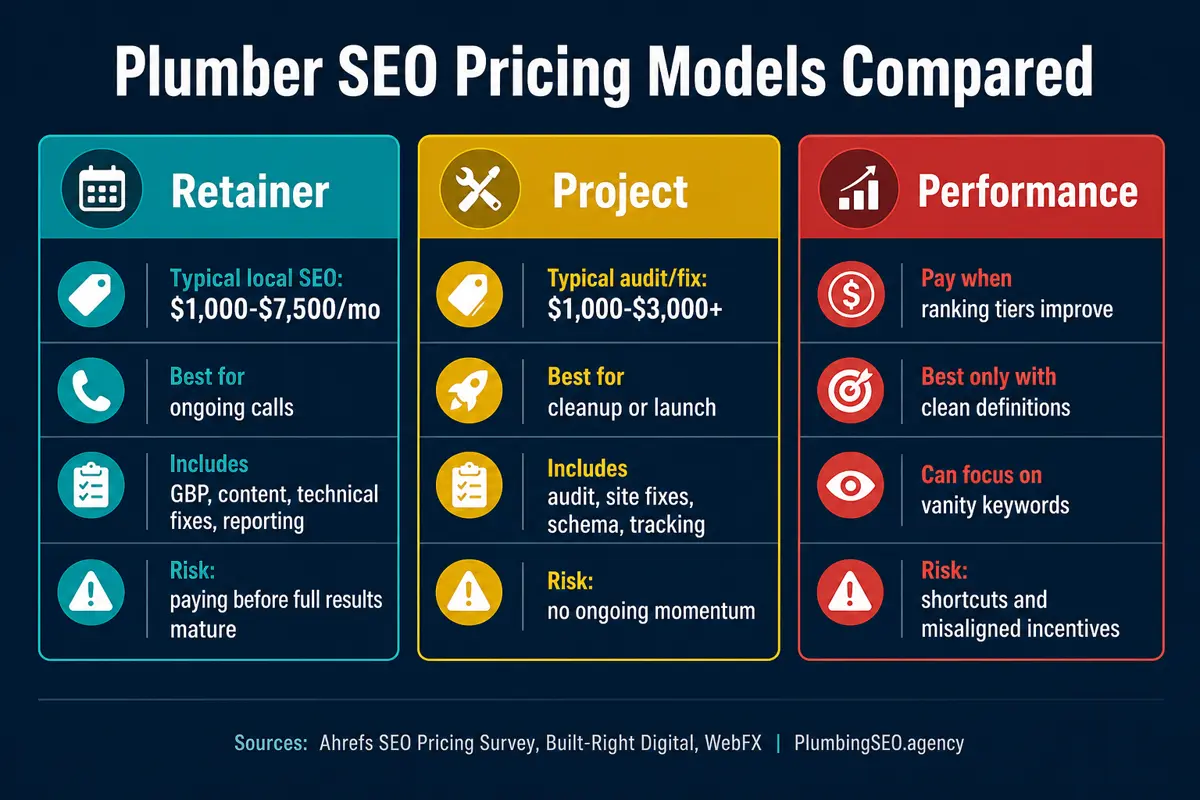
Public pricing research shows a wide range. Ahrefs surveyed 439 SEO providers and found local SEO averaging $1,557 per month, while SEO agencies averaged $3,209 per month. Plumbing-specific pricing pages commonly show a wider range because a one-truck shop in a small town is not the same job as a multi-location drain and sewer company.
Recent plumbing SEO cost pages commonly put monthly plumber SEO somewhere around $1,000 to $7,500+ per month, with one-time audits or technical projects often starting around $1,000 to $3,000+. Those are not magic numbers. They are market signals. Your actual fit depends on service area, competition, website condition, reviews, content gaps, tracking, and whether the agency is doing real work or just sending reports.
| Pricing model | Typical use | Where it helps | Big risk |
|---|---|---|---|
| Monthly retainer | Ongoing local SEO | Maps, service pages, content, technical fixes, links, reporting | Paying for activity that does not connect to booked jobs |
| One-time project | Audit, cleanup, launch, migration, tracking setup | Fixes a defined problem with a clear finish line | No one keeps improving the system after the project ends |
| Performance pricing | Pay tied to rankings, leads, or agreed milestones | Can reduce upfront risk if terms are clean | Incentives can drift toward easy keywords or shortcuts |
Monthly retainer pricing: best for ongoing local SEO
A monthly retainer is the most common SEO pricing model for a reason. Local SEO does not stay fixed. Competitors publish new pages, reviews change, Google Business Profile signals move, pages break, citations drift, and your service mix changes with the season. Somebody has to keep tightening the bolts.
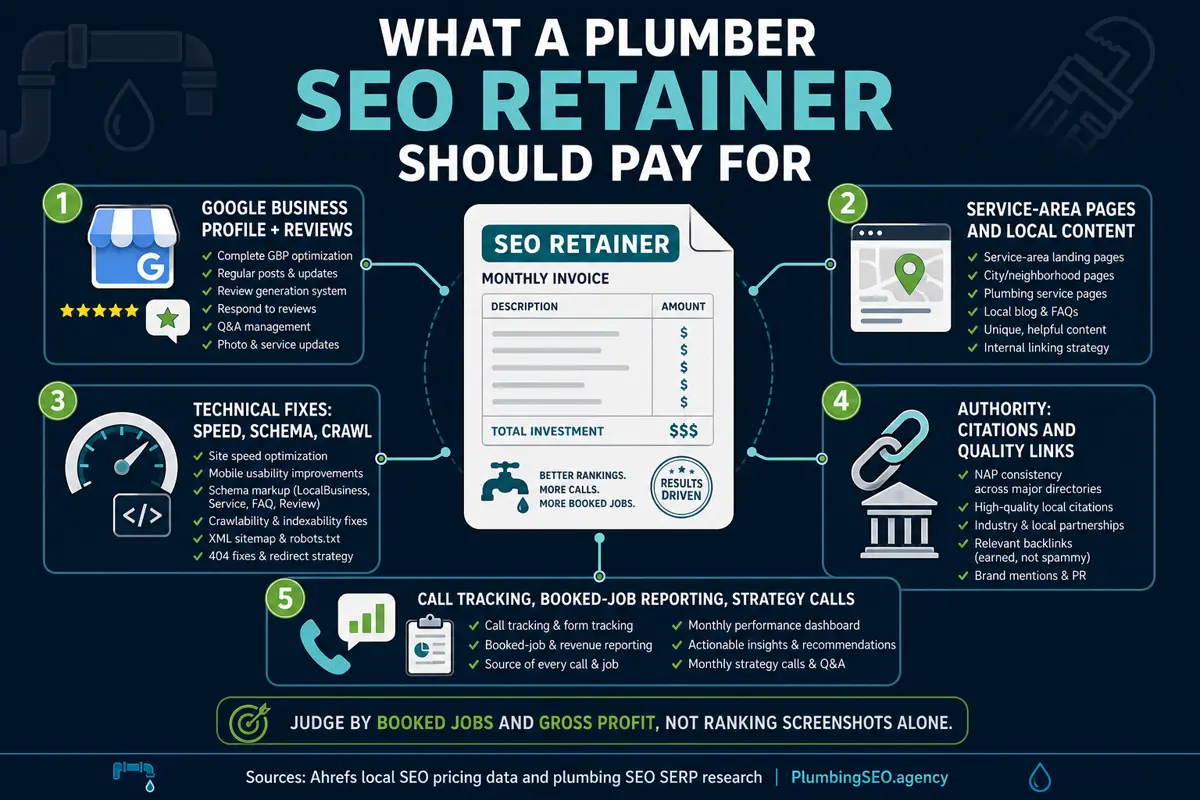
For a plumbing company, a good retainer usually covers the recurring work that keeps the phone from going quiet:
Local visibility
Google Business Profile updates, review strategy, service categories, citation cleanup, and Maps tracking.
Service-area growth
Pages and content for the jobs and towns you actually want, not random blog posts written because a calendar needed filling.
Technical upkeep
Speed, crawlability, schema, internal links, redirects, and conversion issues that can quietly leak calls.
Business reporting
Call tracking, booked-job notes, ranking context, and plain-English next steps. The phone tells the truth.
The way I see it, a retainer is right when SEO is part of how you fill the board every month. If you need more emergency calls, more sewer work, better calls from nearby towns, and less dependence on paid ads, you need ongoing execution. Not a PDF and a handshake.
What a fair SEO retainer should include
A fair retainer is not just a price. It is a scope. Before you compare proposals, ask what work repeats every month and what work only happens once. That is where cheap SEO gets slippery.
For most independent plumbing companies, the strongest retainer is built around plumbing-specific pages, Maps visibility, reviews, conversion tracking, and technical cleanup. If your agency talks for 20 minutes about rankings but cannot explain which calls came from which pages, keep one hand on your wallet.
| Retainer item | Why it matters to a plumber | Question to ask before signing |
|---|---|---|
| Google Business Profile work | Maps searches drive high-intent local calls. | What changes will you make to categories, services, photos, posts, reviews, and Q&A? |
| Service and city pages | Customers search by problem and location, not by your company name. | Which services and towns are being built or improved first? |
| Technical SEO | Slow pages, broken links, missing schema, and crawl issues can waste good content. | What technical issues are included versus billed as extra projects? |
| Authority building | Local citations, relevant links, and mentions help Google trust the business. | Are links earned and local, or are they bought from junk sites? |
| Call and form tracking | Rankings do not pay payroll. Booked jobs do. | Will the report separate calls, qualified calls, booked jobs, and spam? |
If you want the clean version of our own package structure, see the plumbing SEO pricing page. This article explains the buying model. The pricing page shows how the work is packaged.
One-time SEO project pricing: best for a defined fix
A project price can be the right call when you have a specific problem with a finish line. Think website launch, migration cleanup, technical audit, schema repair, local landing page buildout, call-tracking setup, or a content refresh for an important service page.
Projects are useful because they force clarity. You should know the deliverables, the files or pages touched, the timeline, and what counts as done. That is cleaner than paying a monthly fee when the real job is a one-time repair.
But a project has a ceiling. Once it is done, the market keeps moving. Your competitor can add new drain pages next month. Your reviews can slow down. A city page can stop converting. Google can rewrite a title. SEO is a living system. A project can fix the clogged line, but it does not keep somebody checking the cleanout.
Good project fit
- Technical audit and priority fixes
- New website SEO setup before launch
- Tracking, form, and call attribution setup
- Service page refresh for a high-value category
Bad project fit
- Promising ongoing rank growth without ongoing work
- Publishing pages once and never improving them
- Ignoring reviews, Maps, and local authority after launch
- No plan for measuring calls after the project ends
Performance-based SEO pricing: tempting, but read the fine print
Performance pricing sounds safe. You pay only when the agency gets results. Nobody likes paying for promises, especially if you have been burned by marketing before.
The problem is the definition of performance. Some plans bill when ranking tiers improve. RankPay explains a ranking-tier model where fees change as selected keywords move into different positions. That is clear enough as a billing mechanism, but a plumbing owner still has to ask whether those keywords bring real jobs.
WebFX warns that pay-for-performance SEO can push agencies toward easy keywords, short-term tactics, or a narrow list of rankings that do not match business goals. That is the part owners need to watch. Ranking for a soft keyword in a tiny suburb may trigger an invoice while your best sewer repair terms still belong to another shop.
Performance pricing is not always wrong. It just needs strong guardrails:
- Define performance by qualified calls, booked jobs, or agreed business milestones when possible.
- Exclude vanity keywords that do not match profitable services.
- Require access to call recordings, forms, and source reporting.
- Make sure you own the website, pages, tracking numbers, accounts, and content.
- Avoid any plan that guarantees first place rankings or refuses to explain the work.
In my opinion, pure ranking-based pricing is usually a poor fit for plumbers. A hybrid can work better: a fair base retainer for the real labor, plus incentives tied to qualified calls or revenue signals both sides agree on.
Judge price by booked-job math, not package names
The cheapest SEO plan is not always cheap. The expensive plan is not automatically smart either. The math has to land in the truck schedule.
Start with a simple break-even question: how many extra booked jobs would this SEO spend need to produce each month to make sense?
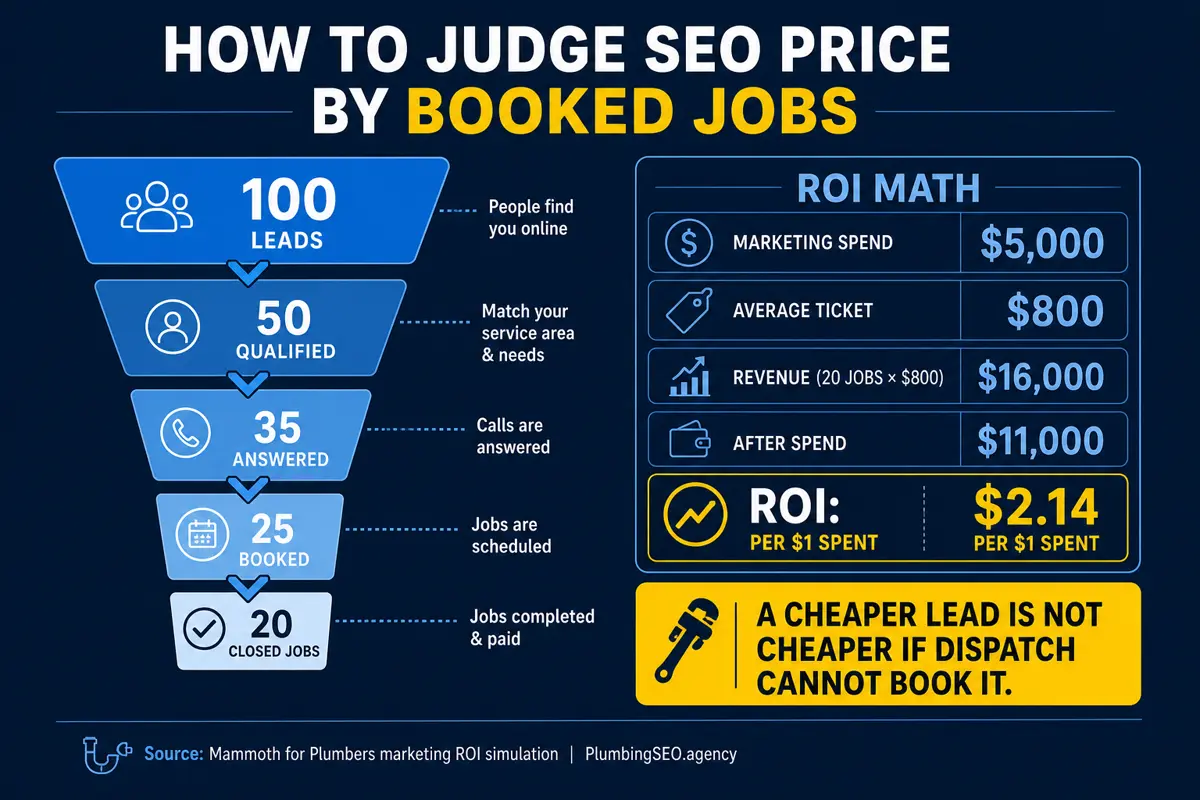
Use rough numbers. This is not accounting advice. It is a sanity check before you sign a contract.
If your numbers say you need 18 extra closed jobs just to break even, that does not mean SEO is bad. It means the package, service area, offer, conversion rate, or tracking model may be wrong. Fix the math before you blame the channel.
Which model should your plumbing company choose?
Here is the practical version.
| Your situation | Best pricing model | Why |
|---|---|---|
| You already have a site, but calls are flat and competitors own Maps. | Monthly retainer | You need ongoing GBP, content, reviews, links, and technical work. |
| You are launching a new site or cleaning up a messy old one. | Project first, then retainer | The foundation needs repair before monthly SEO has enough traction. |
| You only need tracking, schema, redirects, or a one-page refresh. | One-time project | A clear problem deserves a clear scope and finish line. |
| You are skeptical because you paid for SEO before and saw nothing. | Short retainer with strict reporting | Use a 90-day plan with call tracking, deliverables, and cancellation terms. |
| An agency wants to bill only when rankings move. | Proceed carefully | Make sure the keywords and outcomes match profitable plumbing jobs. |
If you are trying to keep the budget tight, read the affordable plumber SEO packages guide. If you want to compare channel economics, the plumber cost per lead benchmarks will help. If you want deeper payback math, use the plumbing SEO ROI calculator.
Red flags in plumber SEO pricing
Bad pricing usually hides in the details. Look for these before you sign:
- Guaranteed number one rankings. No one controls Google that tightly.
- No call tracking. If they cannot show calls, they are asking you to trust screenshots.
- No ownership. You should own the website, content, accounts, domains, tracking numbers, and data.
- Thin deliverables. "Optimization" is not a scope. Ask what pages, what fixes, what links, and what reporting.
- Long contracts with no early proof. A 90-day starting window is reasonable. A locked 12-month mystery box is not.
- One-size-fits-all packages. Drain cleaning in Dallas and water heater repair in a small town are different fights.
The right pricing model should make both sides accountable. You pay for real work. The agency explains what changed, what is next, and whether the phone is moving in the right direction. No smoke. No magic. No report that needs a translator.
Final take: buy the model that matches the job
Use a retainer when SEO is a growth channel you want maintained every month. Use a project when the problem has a clean finish line. Be careful with performance pricing unless the outcome is tied to calls, jobs, and profitable services.
For most plumbing companies, the best answer is boring but effective: a defined setup project if the foundation is weak, then a monthly retainer focused on local visibility, service pages, tracking, and booked-job reporting.
That is the kind of SEO pricing that can help you keep the trucks moving. And around here, that beats a pretty ranking chart every day of the week.
Plumber SEO Pricing FAQ
Many plumbing companies see local SEO retainers between about $1,000 and $7,500+ per month, depending on market competition, website condition, service area size, and scope. Smaller local campaigns can be less. Multi-location or aggressive growth campaigns can be more.
A retainer is better for ongoing local visibility, content, reviews, links, and technical upkeep. A one-time project is better for a defined fix, such as an audit, migration, schema repair, tracking setup, or service page refresh.
It can work only when the performance metric is hard to game and tied to real business outcomes. Ranking-only performance plans can reward easy keywords instead of calls, booked jobs, and profitable plumbing services.
Good plumber SEO pricing should include Google Business Profile work, service and location pages, technical SEO, internal links, local authority building, call tracking, conversion review, and plain reporting that connects work to calls and booked jobs.
Cheap SEO can make sense only if the scope is honest and limited. Be careful with packages that promise fast rankings, hide deliverables, skip tracking, use low-quality links, or lock you into a long contract before showing useful proof.
Want pricing tied to calls, not mystery reports?
Start with a free plumbing SEO audit. We will show what is leaking calls, what should be fixed first, and which pricing model makes sense for your service area.
Run My Free SEO Leak Check