
- If the phone is quiet this week, put controlled spend into Google Ads or Local Services Ads while SEO is being built.
- If ads already bring calls but profit feels thin, the next dollar usually belongs in SEO, better pages, reviews, and tracking.
- Do not judge either channel by clicks. Judge by booked jobs, close rate, average ticket, and how much dependence you want on paid traffic.
If you own a plumbing company, the question is usually not "Should I do SEO or Google Ads?" The real question is, "Where should the next dollar go so the schedule gets filled without bleeding profit?"
Google Ads can make the phone ring fast. SEO can build the kind of local visibility that keeps working when the ad budget slows down. Local Services Ads sit in the middle because they can show above normal search ads and charge for leads instead of clicks. That is useful, but only if the shop answers fast and books the right calls.
Here is my practical opinion: most plumbers should not pick one forever. They should pick the next dollar based on the problem in front of them. Quiet board this week? Ads may be the tool. Cost per booked job creeping up? SEO probably needs more attention. New service area? You may need both, because nobody gets bonus points for an empty truck with a beautiful long-term plan.
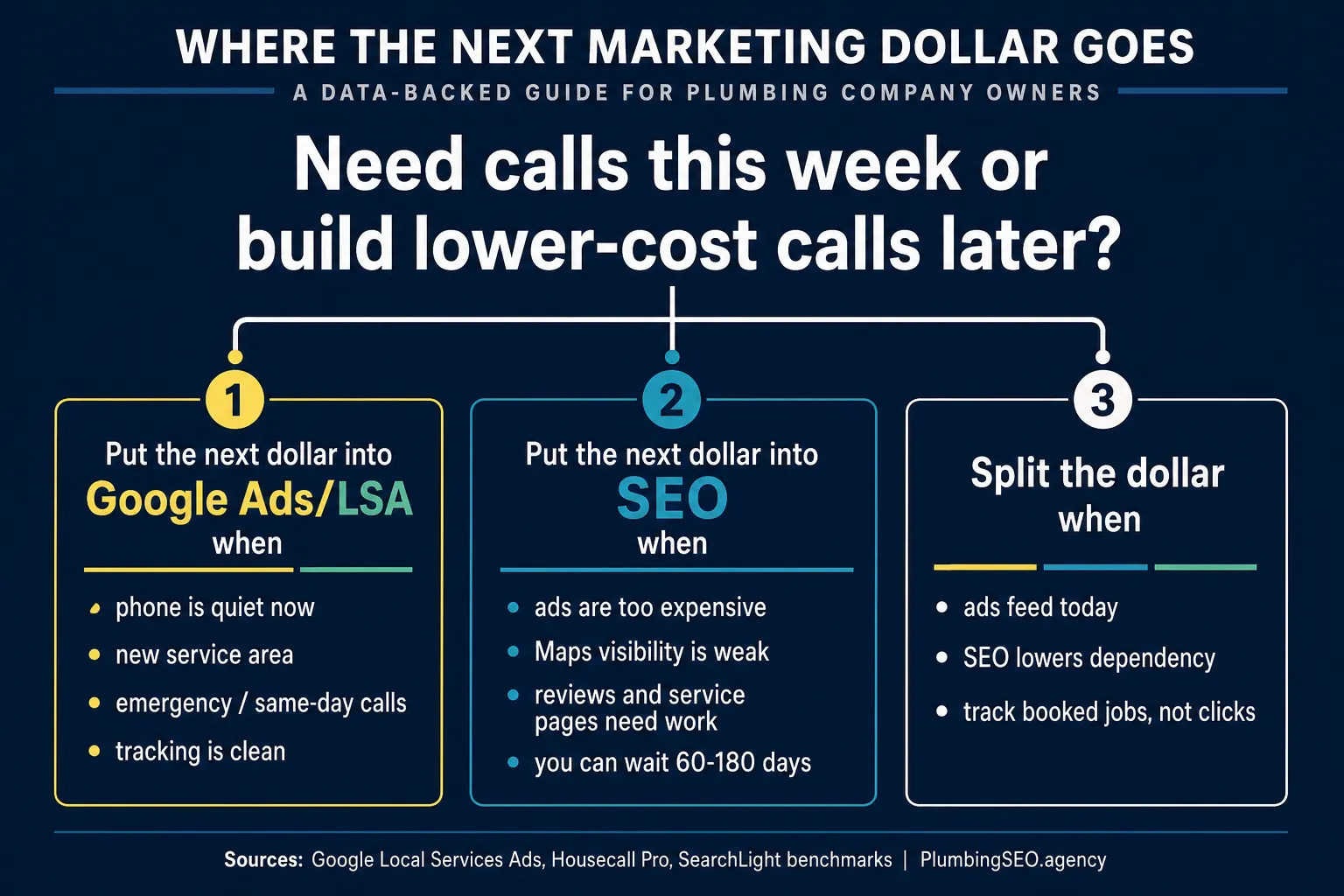
The quick rule: ads buy speed, SEO builds leverage
Google Ads and Local Services Ads are speed tools. They can put you in front of urgent searches before your organic rankings are strong. Google's own Local Services Ads guidance says these ads help local customers find you when they need service and that advertisers pay when potential customers get in touch.
SEO is different. It improves the assets you own: Google Business Profile strength, service pages, city coverage, internal links, reviews, and the trust signals that help a customer choose you before calling the next shop. If your site and profile keep earning calls over time, every good page is like another cleanout cable in the truck. You may not use it every hour, but when the line backs up, you are glad it is there.
Best when the schedule needs help now
- New company, new service area, or slow season.
- Emergency, drain, sewer, water heater, or same-day work.
- Tracking is clean enough to see which calls become jobs.
- You can answer fast, dispute bad LSA leads, and pause waste.
Best when paid lead cost feels heavy
- Maps visibility is weak for profitable service lines.
- Your landing pages are thin or do not match real services.
- Reviews, photos, service areas, and internal links need work.
- You want less dependence on bidding for every call.
What the current lead math says
Paid search is not cheap in home services. SearchLight's 2026 benchmark for HVAC and plumbing Google Ads reported an average cost per lead of $104 across $14.9 million in Google Ads spend. Their Local Services Ads benchmark reported $57 average CPL for plumbing LSAs in February 2026.
Those numbers do not mean your market will match the average. Some emergency plumbing campaigns run hotter. Some small towns are cheaper. Some accounts waste money on broad terms and bad landing pages. The lesson is simpler: if you do not track booked jobs, a campaign can look busy while profit leaks out the side.
The money test: cost per booked job, not cost per click
A $40 click can be cheap if it turns into a $2,400 sewer job. A $12 click can be expensive if it turns into tire kickers, wrong-area calls, or work your crew does not want. Same with SEO. A ranking report is not cash. A booked call from the right service area is where the math starts to matter.
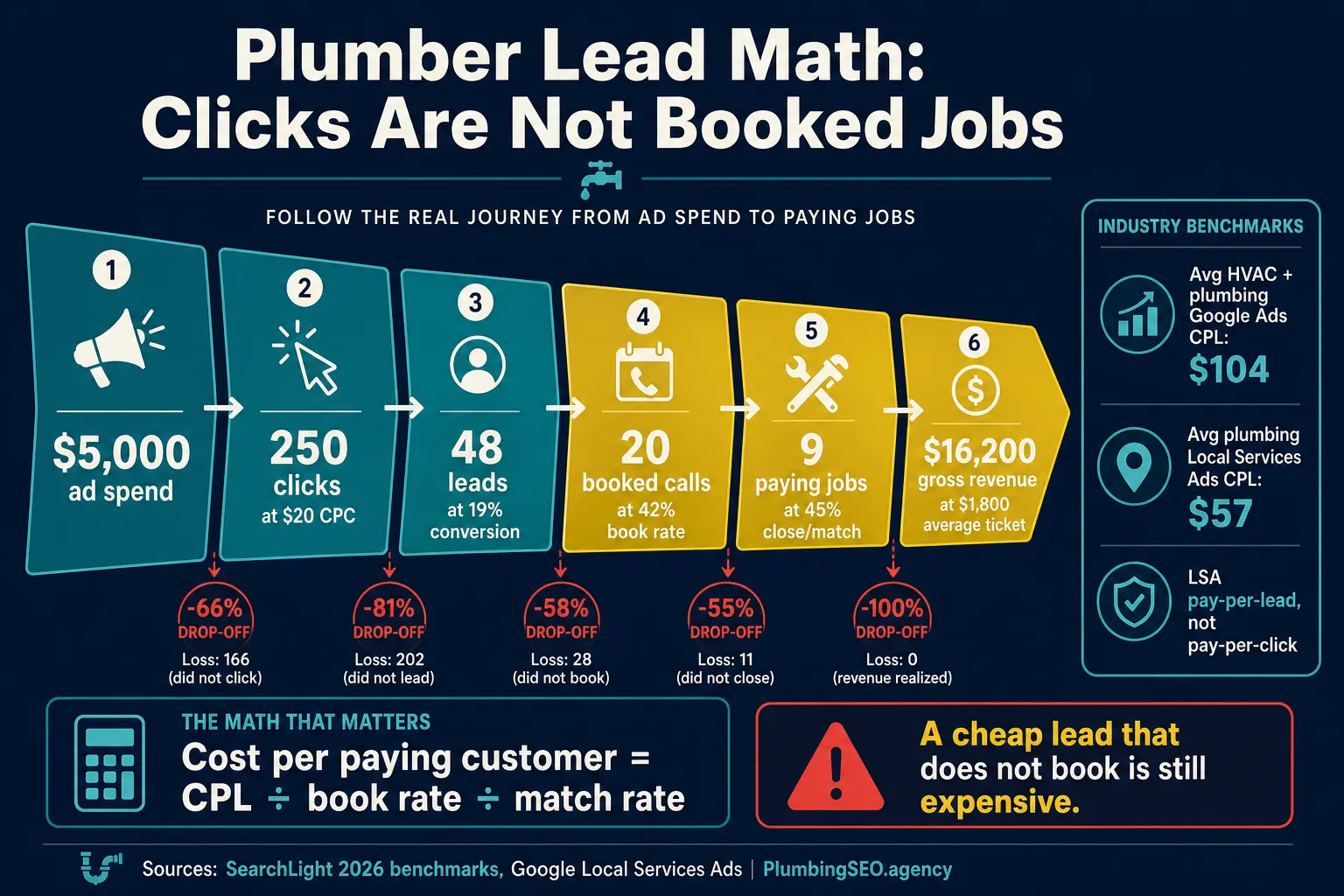
Before you move budget from one channel to the other, build a simple scorecard. You do not need a giant dashboard. You need the owner numbers: how much came in, how many real calls happened, how many booked, what the tickets were worth, and which channel created work your crew actually wants.
| Question | Google Ads / LSA answer | SEO answer | Where the next dollar goes |
|---|---|---|---|
| Do we need calls within days? | Usually yes, if tracking and targeting are tight. | Not usually. SEO needs time to compound. | Ads first, SEO running behind it. |
| Are we paying for too many bad calls? | Fix keywords, negatives, LSA disputes, and landing pages. | Build clearer service pages and local proof. | Fix conversion leaks before adding budget. |
| Are Maps and organic competitors beating us? | Can cover the gap, but you keep paying. | Profile, reviews, pages, links, and content carry the load. | SEO gets the next serious investment. |
| Do we know profit by channel? | Only if calls, forms, jobs, and tickets are tracked. | Same. Organic calls need source tracking too. | Tracking first. No guessing with payroll money. |
When I would put the next dollar into Google Ads
I would put the next dollar into ads when the business needs call flow before SEO can reasonably catch up. That means a new shop, a new territory, a seasonal slowdown, or a high-margin service where one booked job can pay for the test.
For plumbers, paid search usually works best when the offer is specific: emergency plumber, water heater replacement, sewer line repair, drain cleaning, slab leak detection, or another service that already has urgent buyer intent. Housecall Pro's plumber PPC guidance makes the same practical point: PPC is strongest for immediate, high-intent searches, especially when call tracking and fast follow-up are in place.
If that is your situation, do not spread the budget across every service and every city. Keep it tight. Use call-only or high-intent search campaigns where appropriate. Keep Local Services Ads clean. Send traffic to service-specific pages. Review calls. Add negative keywords. If the campaign cannot show booked jobs, do not reward it with more budget.
If you want help with that paid side, the support page for Google Ads and LSA management for plumbers explains how a plumbing-only campaign should be built around calls, service areas, and booked jobs rather than vanity clicks.
When I would put the next dollar into SEO
I would put the next dollar into SEO when ads are proving demand exists, but the company is paying too much to rent every lead. That usually shows up as rising CPCs, expensive LSAs, weak Maps placement, thin service pages, or a profile that loses trust before the customer calls.
SEO is also the better next dollar when the shop has steady work but wants better quality calls. Maybe you do not need every clogged toilet at 10 p.m. Maybe you want more tankless installs, sewer work, repipes, or commercial accounts. Ads can target those, but SEO lets you build pages and local proof around those services so customers keep finding you without a bid on every search.
Start with the basics before writing twenty blog posts. Fix the Google Business Profile. Tighten service pages. Add proof and photos. Build internal links from useful articles. Review the cost per lead benchmarks by channel so the conversation stays tied to booked jobs, not rankings for their own sake.
A practical 90-day split for the next dollar
If I were sitting across the desk from a plumbing owner with a real budget decision, I would not tell them to shut ads off and wait for SEO. I would also not tell them to keep pouring money into a campaign that cannot prove profit. I would run a controlled 90-day split.
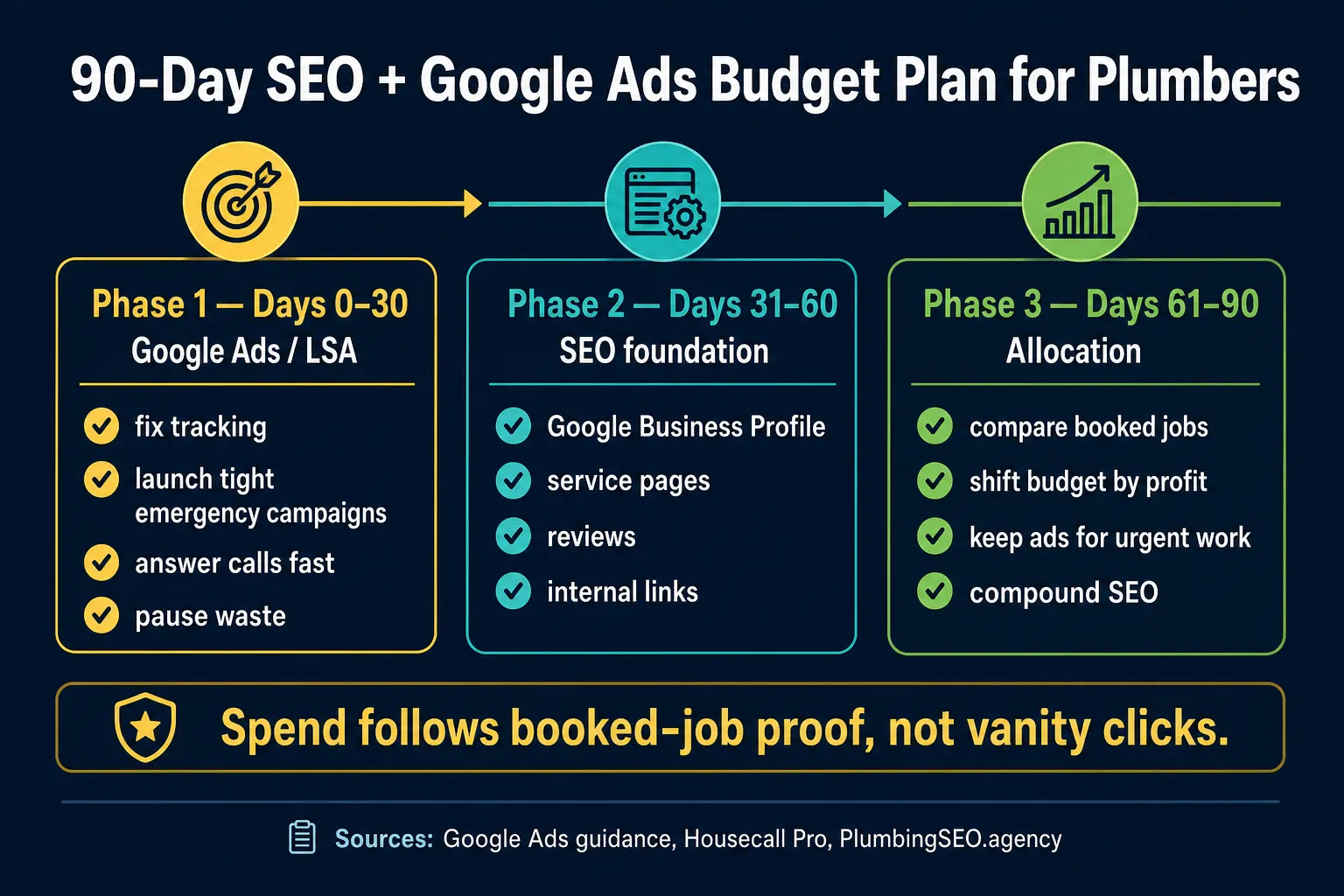
Budget splits by situation
These are not universal rules. They are starting points for owner judgment. Your market, close rate, crew capacity, and average ticket matter. A one-truck shop and a multi-location company should not spend the same way.
| Situation | Likely split for the next 90 days | Why |
|---|---|---|
| New plumbing company or new service area | 70% ads / 30% SEO foundation | You need calls now, but the profile and pages must start catching up. |
| Steady shop with rising paid lead cost | 60% SEO / 40% ads | Ads already proved demand. Now build owned visibility and reduce dependency. |
| Emergency-heavy company | 50% LSA and search / 50% SEO | Urgent calls need coverage, but Maps trust and reviews decide who gets picked. |
| Company at capacity | 80% SEO and conversion / 20% ads | Use ads carefully for the most profitable work. Spend SEO effort on quality and service mix. |
What I would not do
I would not stop all ads just because SEO sounds cheaper. If the trucks need work this week, patience does not pay payroll. I would not keep raising ads because a report shows more clicks. Clicks do not clear invoices. I would not buy SEO that cannot explain which pages, services, and calls it is supposed to improve.
I would also avoid building a new blog post or service page for every tiny keyword before the core pages are strong. The better move is usually a clean plumbing SEO foundation, then supporting articles that answer real buyer questions and link customers toward the right next step.
If you need a tighter budget model, run the numbers in the plumbing SEO ROI calculator. Then compare that against your ad account's cost per booked job. The right answer is the one that keeps the trucks moving at a profit.
FAQ: SEO vs Google Ads for Plumbers
If you need calls right away, start with controlled Google Ads or Local Services Ads while the SEO foundation is built. If you already have steady work but paid leads are getting expensive, SEO should usually get the next larger investment.
Google Ads can be worth it when campaigns target high-intent services, calls are tracked, landing pages are strong, and the shop answers fast. They become expensive when broad keywords, weak tracking, or poor follow-up turn clicks into unbooked calls.
SEO can produce lower-cost calls over time because you are building owned visibility instead of paying for every click or lead. It is not free, and it usually takes longer. Compare both channels by cost per booked job, not by click cost alone.
Start with enough budget to get a useful sample of calls from one or two high-intent services. In competitive markets, a tiny budget may not prove anything. Track cost per lead, booked-call rate, close rate, and average ticket before increasing spend.
For many plumbing companies, yes. Ads can protect immediate call flow while SEO improves Maps visibility, service pages, reviews, and trust. The split should change as booked-job data proves which channel is producing profitable work.
Track calls, forms, source, service requested, booked appointment, completed job, average ticket, and gross profit. Without those numbers, moving budget between SEO and Google Ads is guesswork dressed up as strategy.
Not sure where the next dollar should go?
We can review your plumbing SEO, Google Ads, LSA setup, call tracking, and service-page leaks so the next budget move is based on booked-job proof.
Run My Free SEO Leak Check