
Google Ads for Plumbers: PPC & LSA Management Built Around Booked Jobs
We manage Google Search Ads and Local Services Ads as one plumber paid-search system: campaigns grouped by service demand, matching landing pages, call-quality review, and reporting that follows leads through to booked work.
What Plumber PPC and LSA Management Includes
This is ongoing paid-search management for local plumbing companies and plumbers. We connect account structure, service-area controls, landing pages, phone handling, and booking feedback so decisions are based on the work your shop wants—not clicks in isolation.
Google Search Ads by service and urgency
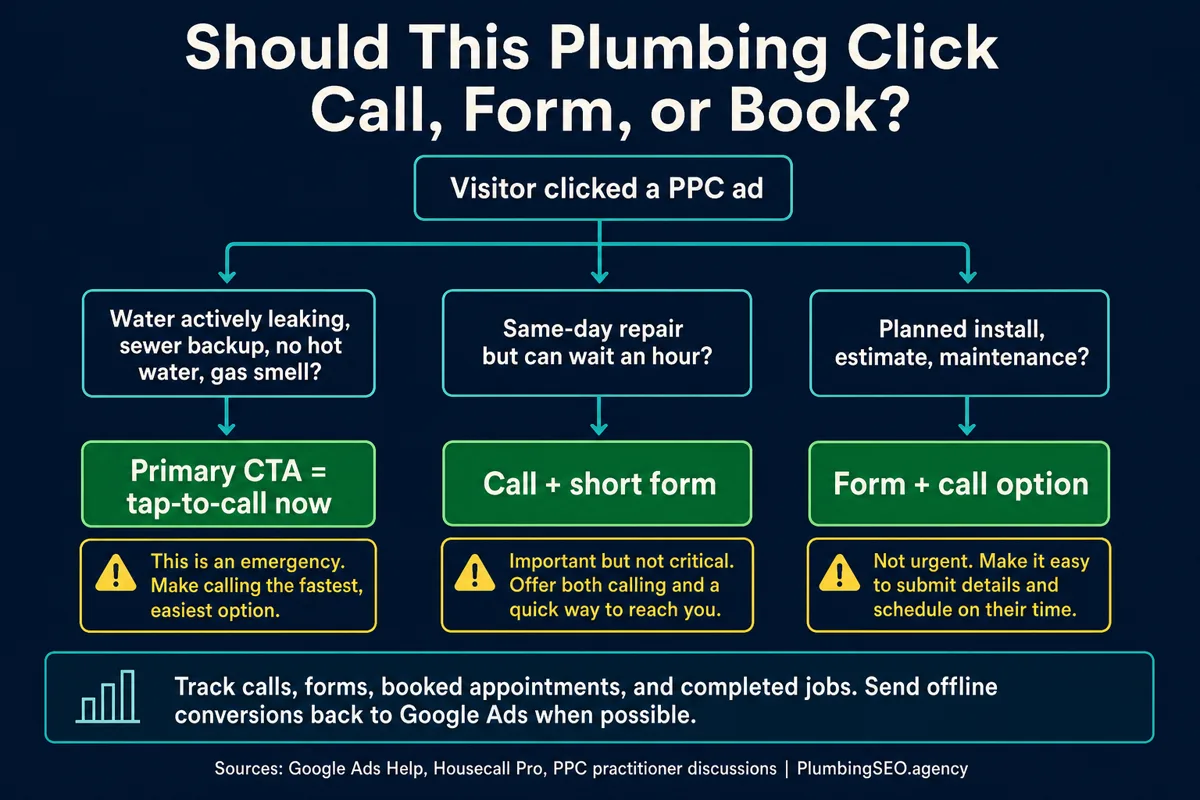
Emergency calls, scheduled repairs, and larger replacements use separate campaign logic. Keywords, locations, schedules, ads, and budgets can then reflect service value and crew availability instead of competing inside one catch-all campaign.
Local Services Ads profile management
We review service categories, service areas, operating hours, budget settings, lead feedback, and review handoffs. For setup context, read our Google LSA for plumbers guide.
Landing-page and conversion-path alignment
Ads should send a drain-cleaning buyer to drain-cleaning information—not a generic homepage. We map each campaign to an appropriate page and check calls, forms, and mobile actions. See our plumber PPC landing-page guide.
Search-term, call-quality, and booking review
We separate irrelevant searches, unanswered calls, non-service inquiries, qualified leads, and booked jobs where the available tracking supports it. Budget recommendations use that evidence plus your capacity, margins, and target services.
Why Plumbing Ad Spend Gets Disconnected From Booked Work
A dashboard can show clicks and calls while the shop still cannot tell which services, territories, or lead sources produced worthwhile jobs. The management problem is usually a broken chain between search intent, the landing page, the phone response, and the final booking outcome.
We manage the complete path we can measure, then state the tracking limits clearly.
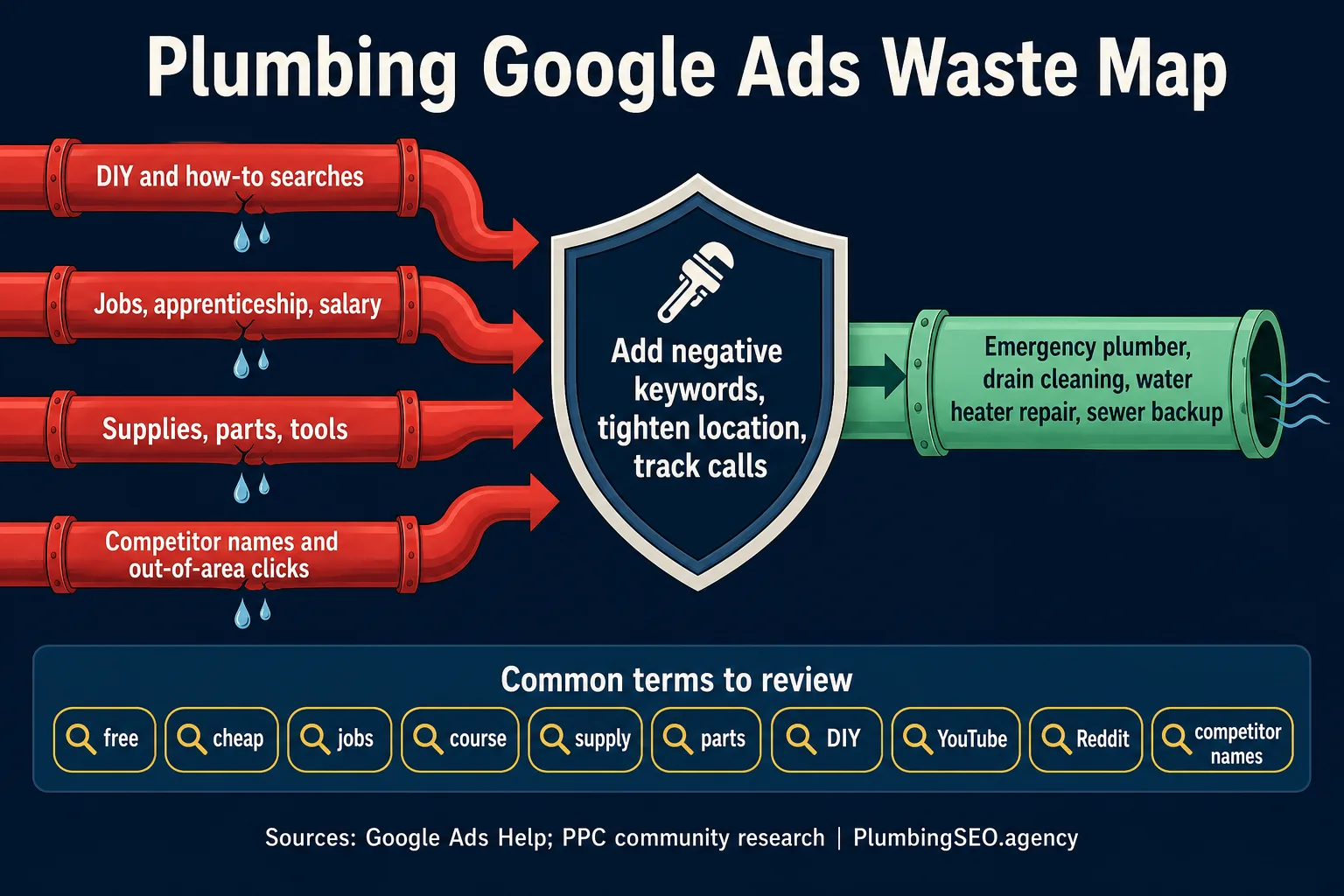
The 5 Places Your Ad Budget Leaks
Think of your Google Ads budget as water pressure through a pipe. Each break between search intent, targeting, the landing page, the phone response, and the final outcome can make performance harder to interpret. We inspect those connections before recommending more spend.
Wrong Search Terms
Broad or loosely matched searches can include job seekers, training queries, DIY research, and services the company does not offer. We review the actual search-term report and maintain account-specific negative keywords instead of relying on a generic list.
Wrong Geography
Location settings can include people who show interest in an area rather than only people physically present there. We select the available Google Ads location options that fit the service area, review matched locations, and exclude places the company cannot serve.
Mixed Campaign Structure
Emergency and scheduled-service searches can require different hours, messages, budgets, and landing pages. We separate them when demand and account economics support distinct decisions instead of forcing every service into one structure.
Generic Landing Pages
A service-specific ad should lead to information about that service, the covered area, trust signals, and a clear call or form action. We align campaign groups with relevant pages and remove conversion friction without inventing urgency or pricing.
Incomplete Call Feedback
Keyword-level call tracking helps connect demand to the campaign, but duration alone does not prove lead quality. Where consent, systems, and data access allow it, we classify calls by relevance, answer status, booking status, and final outcome.
The initial campaign review is part of the management setup.
We inspect search terms, location settings, campaign structure, landing paths, and call feedback before recommending budget changes.
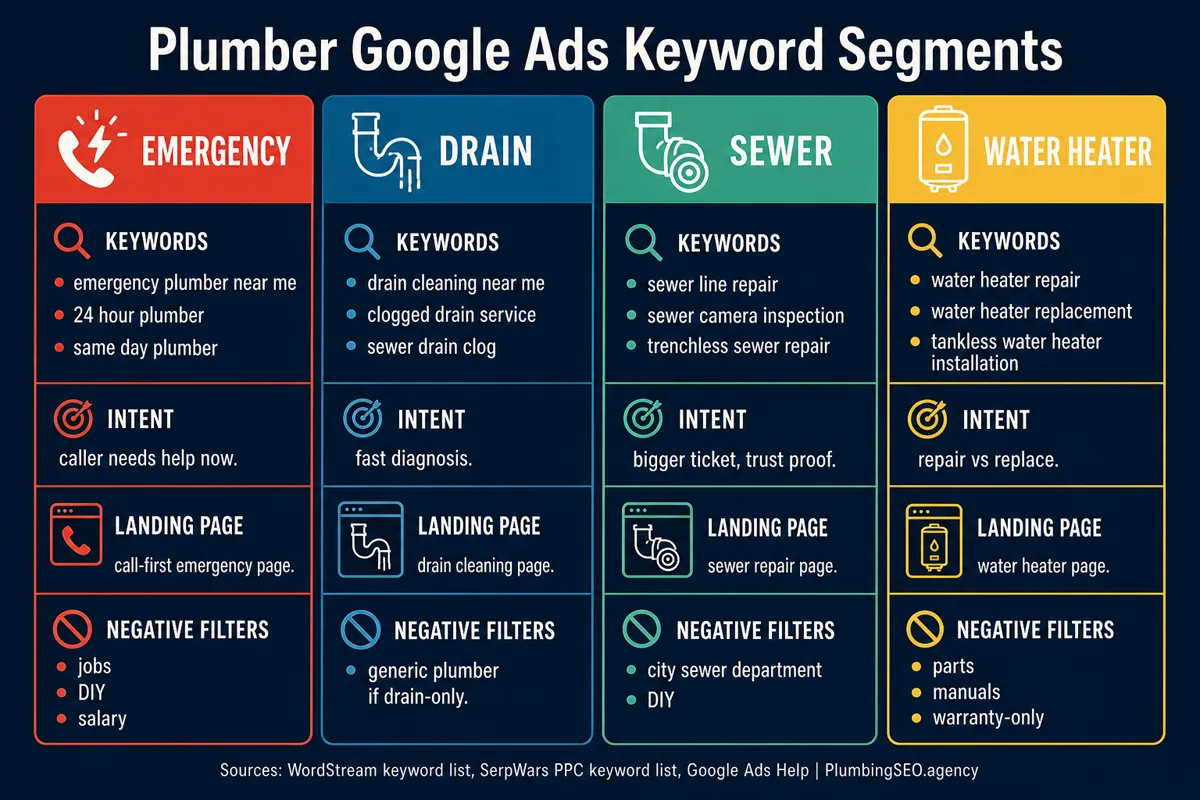
Campaign Architecture Built Around Plumbing Service Demand
A catch-all campaign hides meaningful differences between urgent repairs, scheduled work, and larger projects. We segment only where search volume, budget, territory, and service priorities support a useful decision.
Emergency & Urgent Calls
Burst pipes, no hot water, backed-up sewer. These homeowners call the first number they see.
- Scheduling that matches real on-call coverage
- Mobile call actions with accurate availability
- Location and service-area controls
- Budget rules based on capacity and qualified demand
Scheduled Service Calls
Dripping faucets, running toilets, and slow drains can involve more research and flexible scheduling than emergency work.
- Business-hours bidding with dayparting
- Landing pages with reviews + pricing cues
- Form fills for non-urgent bookings
- Budget separated from urgent-service demand
High-Value Projects
Water heater replacements, repipes, sewer line work, and other larger projects need service-specific qualification and landing-page detail.
- Specific service + location keywords
- Dedicated landing pages with financing CTAs
- Value-based bidding on revenue, not volume
- Outcome review based on qualified and booked work
Google Ads vs. LSAs vs. SEO: Roles and Trade-Offs
These channels use different eligibility rules, controls, cost models, and measurement paths. The right mix depends on market access, account readiness, service priorities, budget, website quality, and call-handling capacity.
| Factor | Google Search Ads | Local Service Ads (LSAs) | Organic SEO |
|---|---|---|---|
| Activation | Can run after account, billing, ads, targeting, and conversion checks are ready | Requires eligibility, profile setup, and Google verification where available | Requires crawlable pages, useful content, and time for search systems to reassess them |
| Cost model | Advertiser pays for eligible clicks | Advertiser generally pays for eligible leads under Google's current program rules | Traffic is not billed per click, but strategy, content, technical work, and maintenance still cost money |
| Control | Direct controls for keywords, bids, schedules, locations, ads, and pages | More of the matching and placement system is controlled by Google | Site owners control pages; search engines control crawling, indexing, and ranking |
| Volume limits | Constrained by demand, competition, budget, eligibility, and account quality | Constrained by program availability, profile eligibility, demand, and Google's matching | Constrained by search demand, indexability, relevance, competition, and site authority |
| Useful role | Service-specific paid-search demand with detailed campaign and landing-page control | Additional local lead coverage for eligible plumbing categories | Durable discovery across service, location, and informational searches |
| Main risk | Spend can accrue before call and booking feedback exposes weak traffic | Lead quality and dispute options can vary by market and current program rules | Results are not guaranteed and can change with competition, site changes, and search systems |
| Planning question | Can the shop answer, qualify, and report paid calls? | Is the business eligible and is the profile configured accurately? | Does the site deserve to rank for the intended service and location? |
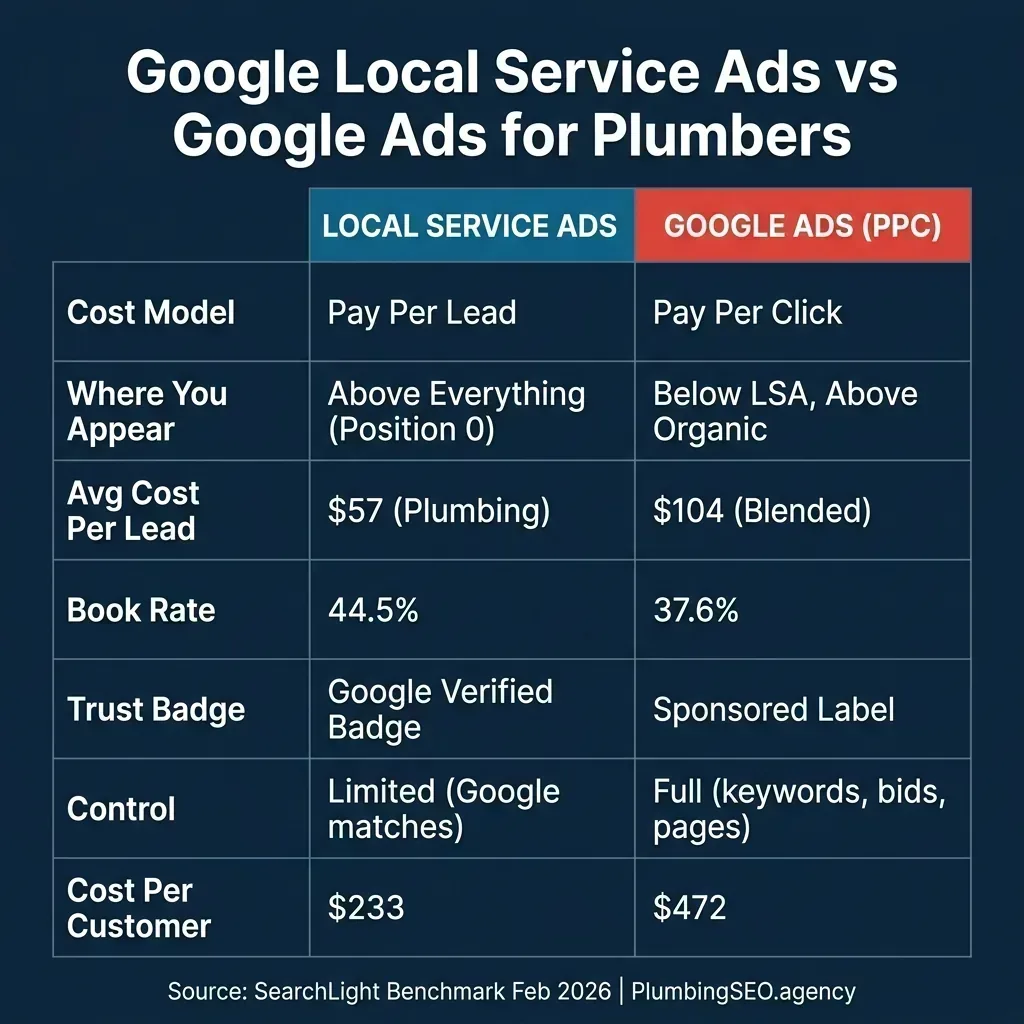
Plumber LSA Belongs on the Same Paid-Search System as PPC
A plumbing company should not have to hire one vendor for Search Ads and another for Local Services Ads. This page is the management route for commercial paid-search help. Our educational LSA and PPC guides explain the mechanics; this service combines both channels with landing pages, call tracking, and booked-job reporting.
1. One intake for paid-search calls
We map Search Ads, Local Services Ads, call extensions, and landing-page calls into one source-of-truth report. The question is not whether a lead came from PPC or LSA; the question is whether it became a booked plumbing job.
2. LSA profile tuning before bid increases
For plumber LSA campaigns, we tighten service categories, zip codes, hours, response expectations, and review prompts before raising budgets. Higher bids cannot fix a profile that attracts wrong-service or out-of-area calls.
3. PPC captures what LSA categories miss
LSAs are strong for broad local service intent, but Google Ads can target emergency drain cleaning, tankless water heater replacement, sewer line repair, commercial plumbing, and other high-ticket searches with dedicated landing pages.
4. Weekly budget routing by booked job value
We compare Search Ads and LSAs using cost per qualified inquiry, answer rate, booked-job feedback, dispute outcomes, and capacity. Budget changes follow the strongest available account evidence; neither channel is assumed to absorb volume profitably.
5. Blog support links point here
Educational posts explain bidding mechanics, while this page is where you request management. Read the support guides on LSA bidding strategy for plumbers, LSA vs SEO for plumbers, and Google Ads keywords by plumbing service, then return here when you want the campaigns managed.
| Paid-search query type | Best destination | Why |
|---|---|---|
| plumber lsa / plumbing contractor lsa | This Google Ads + LSA service page | Commercial buyer wants management, not another explainer article. |
| best LSA bidding strategy | Support blog + service-page CTA | Educational intent first, then route to paid-search management. |
| plumber PPC / Google Ads for plumbers | This service page | Direct service intent with budget, landing page, and tracking questions. |
| LSA vs SEO | Comparison blog + links to service pages | Decision-stage reader may need paid ads, local SEO, or both. |
How Management Decisions Mature Over Time
Calendar dates alone do not create better performance. The account can move from baseline work to broader optimization only when the tracking, search-term, call-quality, and booking evidence is reliable enough to support the next decision.
| Phase | Primary work | Decision evidence | What can delay progress |
|---|---|---|---|
| Baseline | Verify access, conversion actions, locations, schedules, service mapping, ads, pages, phone routes, and existing search terms. | Documented account state and known measurement gaps | Missing access, broken call routing, unclear service areas, or insufficient booking feedback |
| Traffic quality | Review search terms, negative keywords, geography, schedules, LSA categories, lead disputes, and landing-page alignment. | Enough recurring patterns to justify exclusions, segmentation, or message changes | Low volume, major seasonal shifts, or inconsistent lead classification |
| Outcome alignment | Connect qualified calls and booked jobs to campaign decisions; test bidding or budget changes only where the data supports them. | Repeatable qualified-lead and booking signals by service or territory | Offline outcomes missing, imported conversions misconfigured, or capacity changing faster than the account |
| Ongoing allocation | Revisit service priorities, territories, creative, pages, LSA settings, and budget as demand and operating capacity change. | Current business constraints plus a clear change log of previous tests | Treating an old winning pattern as permanent or expanding beyond the shop's ability to answer and fulfill work |
The Profitability Threshold
Use this worksheet with your own average ticket, margin, booked-job rate, and verified ad costs. It is a planning model, not a forecast or guarantee.
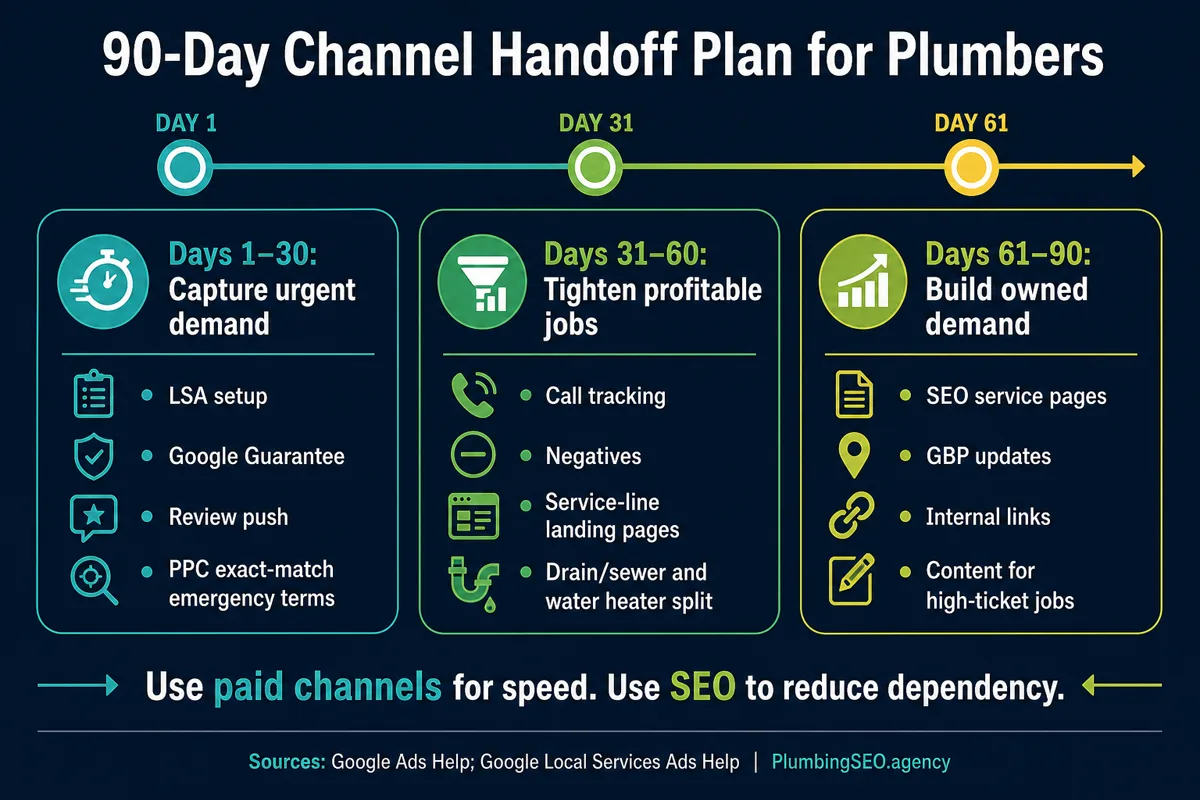
Your First 90 Days of Plumber PPC and LSA Management
The sequence depends on account history, tracking access, budget, seasonality, and how quickly your team can return call and booking outcomes. The plan below is a management framework—not a promise that every account will reach the same result on the same date.
Days 1–30: Baseline and repair
Confirm account access, conversion actions, call routing, billing, service areas, operating hours, campaign settings, search terms, existing landing pages, and LSA profile details. We document what can and cannot be measured before changing bids or budgets.
Days 31–60: Segment and align
Separate priority services and locations where the available volume supports it, expand negative keywords, align ads with service-specific pages, and establish a practical way for dispatch or office staff to return qualified-call and booking feedback.
Days 61–90: Learn and allocate
Compare Search Ads and LSA using the strongest outcome data available. We identify repeat waste patterns, missed-call issues, service-capacity constraints, and landing-page gaps before recommending where to maintain, reduce, or expand spend.
Ongoing: Operate the feedback loop
Search terms, lead quality, booking outcomes, service priorities, and capacity change over time. Ongoing management reviews those inputs regularly and records why material budget or targeting changes were made.
What We Need From Your Plumbing Company
We need accurate service areas and hours, priority and excluded services, a realistic spend range, access to the relevant Google properties, and a named contact who can return call-quality and booking feedback. If office staff cannot reliably answer or classify leads, we address that measurement gap before treating platform changes as the whole solution.
How We Set Expectations
No fixed CPL, lead volume, booking rate, or revenue outcome is guaranteed. Actual demand and economics vary by market, season, competition, service mix, budget, landing experience, call handling, and measurement quality. Read the supporting guides to negative keywords for plumber campaigns and SEO versus Google Ads for plumbers.
Model Your Own Plumbing Ads Scenario
Enter your own assumptions to see the arithmetic. The output is an illustrative scenario, not a traffic, lead, booking, revenue, or return forecast.
Your Business Numbers
Illustrative Scenario Output
All starting values are editable placeholders, not industry benchmarks. Actual results vary. Management fee shown: $500/month at up to $3,000 ad spend, then 15% of spend above that threshold.
8 Questions to Ask a Plumbing Google Ads Agency
A weak answer does not prove an account is failing, but it identifies where ownership, measurement, scope, or decision-making needs to be clarified.
Red Flags
What We Do Instead
Seasonal Plans Should Follow Account Evidence
Weather and local demand can change the service mix, but fixed national assumptions can waste budget. We use these periods as planning prompts, then verify changes in the company's own search terms, qualified calls, bookings, and capacity.
Frozen-pipe, no-hot-water, and water-heater demand may change in cold markets. We check weather, staffing, after-hours coverage, search terms, and actual eligible calls before changing emergency budgets.
Sewer, outdoor faucet, and remodeling queries may emerge differently by market. We compare current demand with service capacity before testing seasonal messages or shifting budget toward planned projects.
Outdoor plumbing, irrigation-adjacent work, and vacation-property demand can vary widely. We avoid automatic bid reductions or remarketing increases and use local results to decide what changes.
Winterization and cold-weather preparation can become relevant in some service areas. We inspect local demand and crew plans before testing preparation-focused ads or adjusting budgets.
Our Plumbing PPC Operating Standards
Use the table to compare our stated scope with any proposal you receive. Ask each provider to put ownership, pricing, tracking, reporting, landing-page, and cancellation terms in writing.
| Capability | PlumbingSEO.agency standard | What to verify in any proposal |
|---|---|---|
| Industry Focus | Plumbing accounts and plumbing search demand | Who will manage the account and what comparable service knowledge do they use? |
| Pricing | $500/month at up to $3,000 ad spend; 15% of spend above that threshold | What is included, excluded, billed separately, or tied to ad spend? |
| Account Ownership | Client-owned account and billing with client admin access | Who owns the account, data, audiences, conversion actions, and creative after cancellation? |
| Negative Keywords | Account-specific list informed by actual search terms | How often are search terms reviewed and can the client inspect exclusions? |
| Campaign Structure | Services separated when demand, budget, and business priorities justify it | Why is each campaign, location, schedule, and budget boundary configured that way? |
| Call Tracking | Best-fit source tracking with consent and recording requirements documented | Which calls can be attributed, reviewed, and connected to outcomes? |
| Reporting | Spend, traffic, qualified inquiries, booked-job feedback, available revenue, and change log | Which outcomes are first-party facts, modeled values, or unavailable? |
| Landing Pages | Service-specific alignment where a relevant page exists or is approved | Who owns the page, copy, tracking, forms, and future edits? |
| Contract | Month-to-month service | What are the cancellation notice, final billing, access, and handoff terms? |
| Seasonality | Changes based on local account evidence and operating capacity | Which data supports a seasonal adjustment rather than a calendar assumption? |
How We Judge Whether a Plumbing Campaign Is Improving
We do not publish borrowed case-study numbers as if they predict your account. Instead, we establish a baseline from your own systems and show how each management decision connects to observable search, call, booking, and revenue data.
Review: Search terms, match types, negative keywords, service areas, schedules, device patterns, and campaign segmentation.
Decision: Exclude irrelevant demand, separate materially different services, and protect budget for the locations and hours the company can actually serve.
Review: Answer status, call relevance, lead disputes, form quality, response time, service fit, and whether dispatch records a consistent disposition.
Decision: Fix routing or response problems before assuming bids are the only cause, then use qualified inquiries—not raw contacts—to compare channels.
Review: Booked jobs, cancellations, completed work, available invoice data, gross-margin constraints, crew capacity, and service priorities.
Decision: Maintain, reduce, or expand spend using the strongest outcome data available while documenting gaps that prevent reliable attribution.
What Useful Plumbing Search Ads Communicate
Ad copy should match the search, covered service, location, business availability, and landing page. Every license, review, response-time, price, and availability statement must be true for the specific advertiser.
Google Ads for Plumbers - FAQ
How Google Ads Fits With SEO, Web Design, and GBP
Paid search, organic search, landing pages, and the Google Business Profile are separate surfaces. They should share accurate business information and measurement definitions without treating one channel's visibility as proof that another will perform.
SEO + Google Ads
SEO and Google Ads can reach different search-result placements on different timelines. Query data may inform page and campaign decisions, but neither channel guarantees visibility or makes the other automatically cheaper.
See Our SEO Plans →Web Design + Ads
A relevant, usable landing page can remove avoidable friction between the ad and the next action. We align the page with the verified service, area, offer terms, availability, and tracking setup.
Plumbing Web Design →GBP + Ads
An accurate Google Business Profile supports local business discovery and consistent public information. It is managed separately from Search Ad quality scoring, and we do not present GBP work as a guaranteed paid-search lift.
GBP Management →Want a Clearer View of Your Plumbing Paid-Search Setup?
Request a review of an existing account or discuss the requirements for a new one. We will document access, targeting, tracking, landing pages, call handling, budget limits, and measurement gaps before recommending a launch or restructure.
- $500/month at up to $3,000 ad spend
- No contracts
- You own your account
- Month-to-month