
- LSA is built for speed: It gets your phone number to the absolute top of Google within days under the Google Guaranteed badge, charging you only for actual new leads.
- SEO is built for long-term equity: Ranking in the Google Maps Local 3-Pack delivers free, high-trust phone calls month after month, driving down your customer acquisition costs over time.
- The hybrid playbook wins: Profitable shops do not choose one over the other, they run LSAs to keep trucks moving today while investing in SEO to build a business that does not depend on daily ad spend.
The Battle for the Top of Google: LSA vs. SEO
When a homeowner walks downstairs at 2:00 AM and finds their basement ankle-deep in sewage, they do not sit down to read blogs or compare digital marketing strategies. They pull out their phone, type "emergency plumber near me," and call the first licensed company they see. How Google displays that search page dictates exactly who gets the call.
At the absolute summit of the search page are Google Local Services Ads, or LSAs. They display the green "Google Guaranteed" badge, your average star rating, and a direct click-to-call button. Directly below LSAs are traditional Google Paid Search Ads, or PPC, which charge you every time someone clicks, whether they call your shop or not.
Underneath the paid ads sits the Google Maps Local 3-Pack, followed by standard organic search results. Getting into this section is the goal of search engine optimization, or SEO. If you rank here, you show up when customers are looking for local help, and your clicks do not cost a single cent.
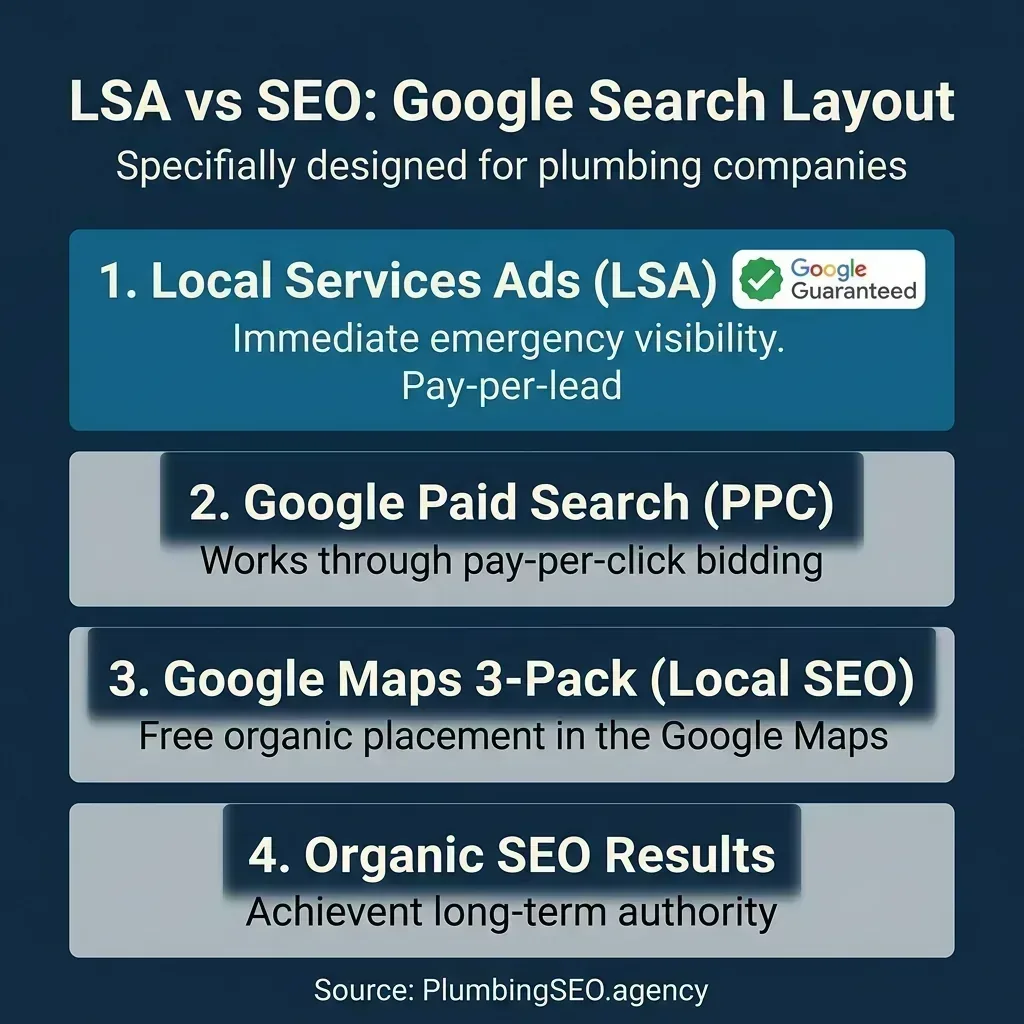
Google Search layout showing LSA at the very top, followed by Paid Search, the Google Maps 3-Pack, and organic SEO results.
For a plumbing shop owner, this layout creates two distinct paths to the customer's phone. LSAs place you right in front of the customer when the urgency is highest, but it is strictly pay-to-play. The minute you pause your ad budget, your phone stops ringing. Local SEO takes longer to build, but once your business ranks in the Local 3-Pack, you own that digital territory, securing a steady stream of calls without paying Google for every lead.
The Math Breakdown: Cost Per Lead & ROI
Running a plumbing business means managing overhead, tracking dispatch efficiency, and making sure your crew has enough billable hours to justify carrying payroll. You cannot afford to spend money on marketing metrics like impressions or views. You need to know how much it costs to put a technician in a truck and send them to a job site.
With Google Local Services Ads, you pay per lead. A lead is defined as a call or message that lasts longer than a few seconds from a customer in your service area. Depending on your location and how saturated your local market is, plumbing leads on LSA average between $35 and $65 per call. If you set a budget of $1,200 a week, you only pay when someone contacts you. Industry reports show the average booking rate for LSA leads is around 43.9%, meaning nearly half of the calls you pay for convert into scheduled service calls.
With Local SEO, you pay a flat monthly retainer to an agency or specialist to optimize your Google Business Profile, build local citations, and write service area pages that rank. This service typically costs between $300 and $2,500 per month. There is no pay-per-call fee. Whether your website brings in five calls or one hundred calls, your marketing cost remains exactly the same.
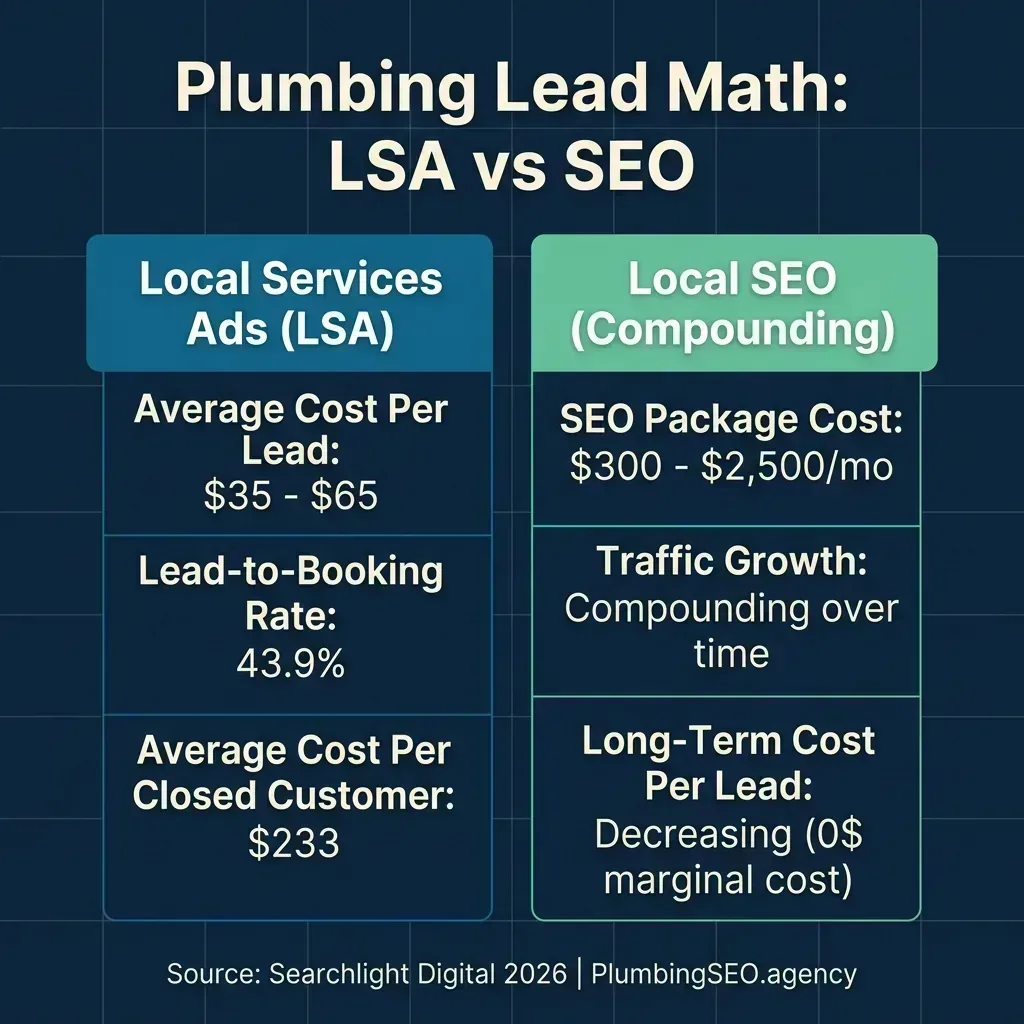
Comparison of direct LSA costs vs. compounding organic SEO returns for plumbers.
The difference in cash flow is clear. LSAs provide a direct, transactional relationship with Google. If you need more calls to fill your schedule next week, you raise your budget and pay the fixed fee. Local SEO is an investment in your company's digital infrastructure. Your initial cost per lead will be high because you are paying for optimization work before the rankings kick in. However, as your organic visibility grows, your lead volume increases while your monthly costs stay flat, bringing down your average customer acquisition cost month over month.
The Hidden LSA Algorithm: How to Actually Get Calls
Many plumbing owners set up their LSA profile, link their billing card, and wait for the phone to ring. A week later, they have received zero leads. When they call Google's support line, the representative usually tells them to bid higher or make their weekly budget unlimited. This is a common trap that wastes your ad spend.
Google wants to protect the reputation of its Google Guaranteed program. If they send a lead to a plumber who lets it go to voicemail or takes three hours to reply, the homeowner gets frustrated and blames Google. To prevent this, Google uses a hidden ranking system for LSAs that prioritizes customer experience over bid amounts.
Your response rate and answer speed are the most critical factors in LSA rankings. If your office answers every call live within three rings, Google rewards you with more impressions. If you miss calls or reply slowly, your profile gets pushed down. Additionally, the algorithm pulls reviews directly from your Google Business Profile. Having 80 reviews with a 4.9 rating and an immediate answer rate will help you beat a competitor with 800 reviews who lets calls go to voicemail.
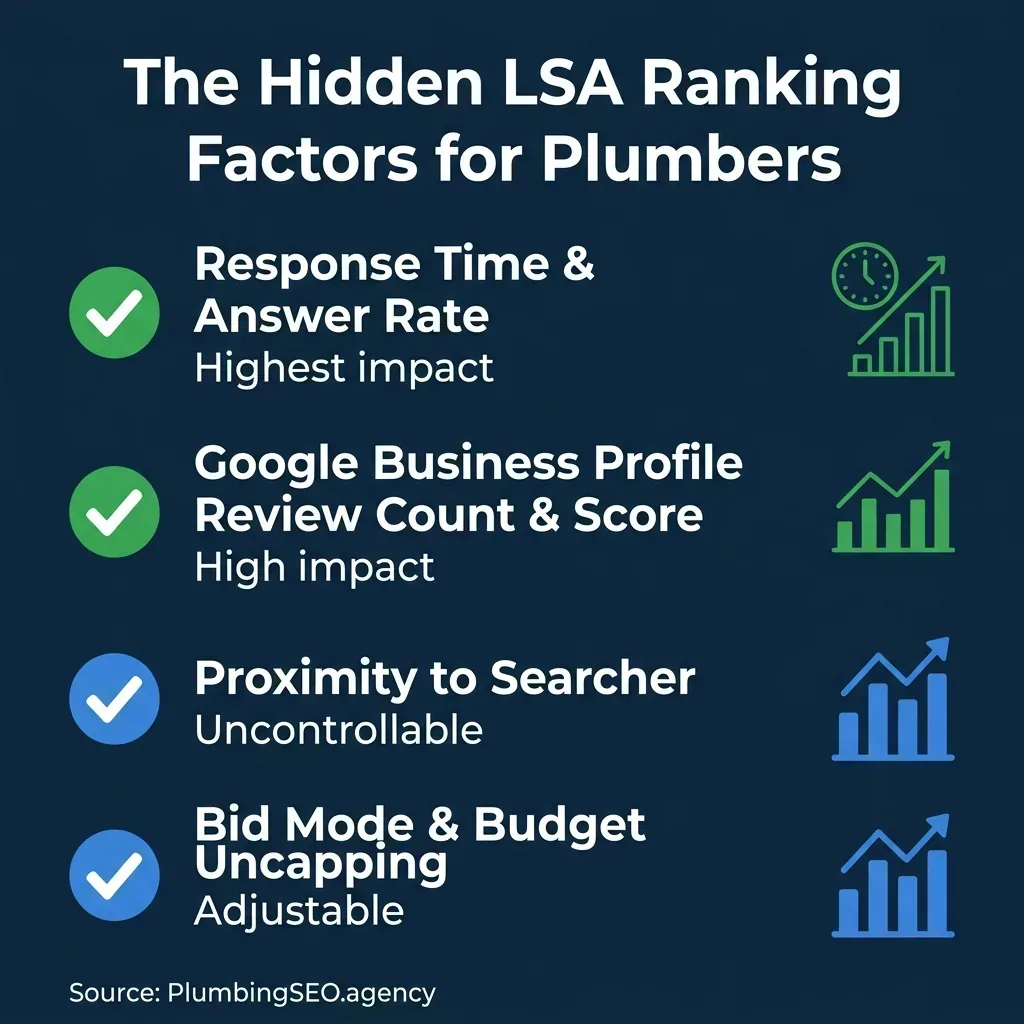
The critical ranking factors that determine placement in Google's Local Services Ads.
Targeting is another area where plumbers lose visibility. If you target an entire county, you compete against every major franchise in the region. Local contractors have found that targeting specific cities or postal codes instead of counties improves ad delivery. Google prioritizes proximity, so refining your service area ensures you show up where your trucks are already working, preventing you from paying for long drives to out-of-area calls.
The Compounding Value of Local Pack SEO
While LSAs are excellent for filling immediate gaps in your schedule, they do not build long-term value for your plumbing company. Every lead you get from LSA is a transaction. You pay Google, they route the call, and the transaction is complete. If you stop paying, the calls disappear.
This is where Local SEO differs. Your Google Business Profile is the most valuable digital asset your business owns, contributing to nearly 80% of your local search pack visibility. When you optimize your profile and build local authority, you rank in the Google Maps Local 3-Pack. The calls generated from this section are completely organic, meaning your marginal cost per lead is zero.
Furthermore, Local SEO allows you to capture high-intent, specialized search queries that LSA categories miss. Google Local Services Ads are structured around broad job types, like "drain cleaning" or "water heater installation." However, homeowners and property managers often search for specific, high-ticket solutions, such as "commercial backflow preventer testing," "trenchless sewer line replacement cost," or "tankless water heater repair."
By implementing a targeted keyword strategy and building dedicated service area pages, you can capture these premium jobs without paying a lead fee. If you want to rank for these lucrative queries, read our Google Maps SEO guide for plumbers to learn how to claim your space in the Local 3-Pack. If you are trying to figure out how to allocate your marketing budget, we have documented the investment tiers in our SEO campaign cost breakdown.
The Hybrid Playbook: Running LSA and SEO Together
The most profitable plumbing companies do not treat LSA and SEO as competitors. They treat them as partners in a unified local lead generation engine. If you only run LSAs, you are entirely dependent on Google's advertising auction. If you only do SEO, you may experience a slow start when launching in a new service area.
By running both channels simultaneously, you create a powerful synergy that increases your overall conversion rates. There are three key reasons why a hybrid strategy outperforms a single-channel approach:
- Review Sharing: Because your LSA rankings are heavily influenced by your Google Business Profile rating, your organic review generation efforts directly support your paid ads. Setting up a system to collect feedback, as outlined in our guide on getting 5-star reviews, will improve performance across both platforms.
- The Double-Dip Effect: When a homeowner searches for plumbing help and sees your company name listed in the Google Guaranteed section at the top, and then sees your shop again in the Maps 3-Pack, it creates immediate trust. They are far more likely to call a brand they see multiple times.
- Budget Flexibility: When your organic rankings are strong and your dispatch board is full during busy summer months, you can scale back your LSA spending. When shoulder seasons hit and call volumes drop, you can ramp up your LSA budget to keep your team busy.
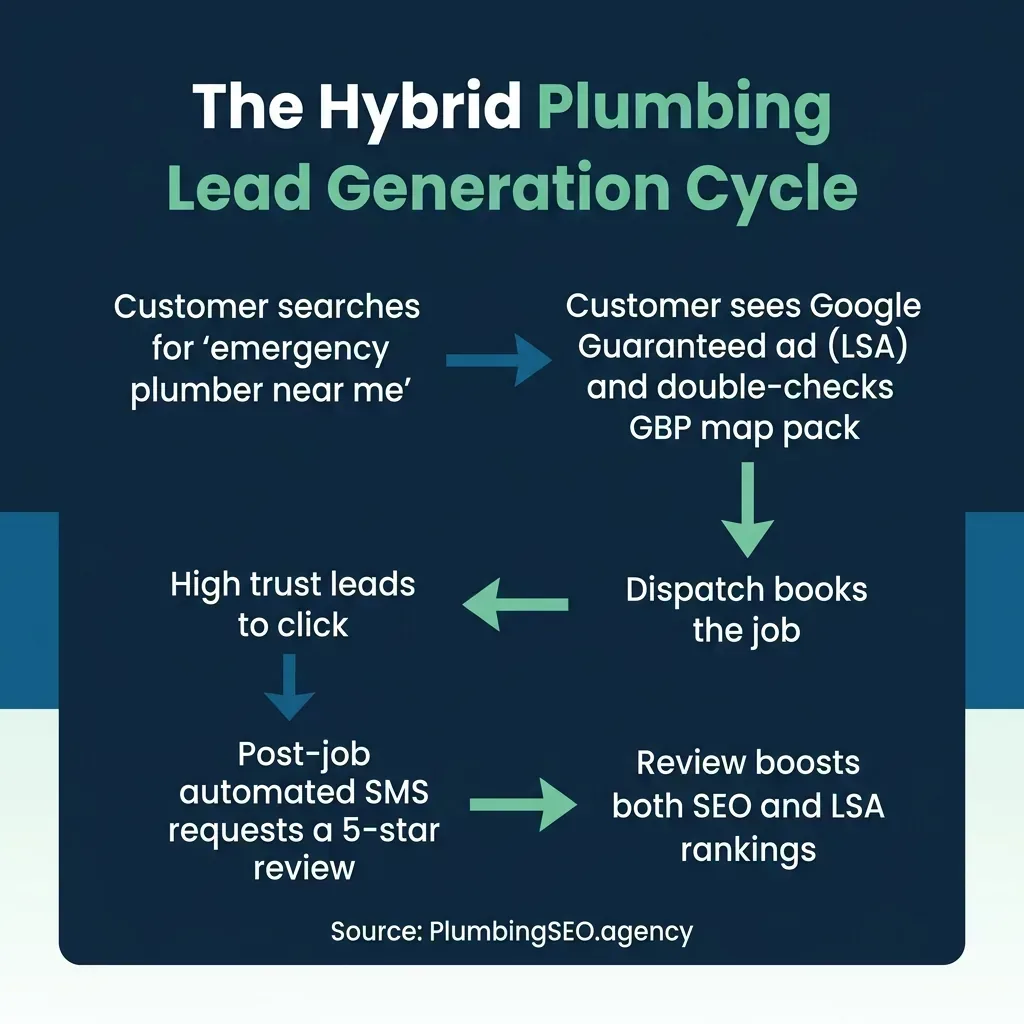
The customer search loop showing how organic search presence and LSA work together to secure booked plumbing jobs.
If you are ready to launch your first ad campaign, our Google Local Services Ads setup guide provides step-by-step instructions. For done-for-you campaign management, route commercial paid-search intent to our Google Ads and LSA management for plumbers page. For a deeper analysis of paid search versus organic marketing, you can read our SEO vs PPC comparison guide.
Frequently Asked Questions
Plumbing leads on LSA average between $35 and $65 per call. The cost varies based on location and competition. Unlike traditional Google Ads, you only pay when a customer calls or messages you directly through the ad.
Industry benchmarks indicate the average booking rate for plumbing leads on LSA is 43.9%. This means that roughly 4 to 5 out of every ten calls will result in a scheduled job on your dispatch board.
Google ranks LSA ads based on responsiveness (how quickly and consistently your office answers calls), your Google Business Profile review score, your proximity to the searcher, and your bidding settings. Answer rate is the most critical factor.
Targeting specific cities or zip codes is generally more effective than targeting an entire county. It narrows your reach to high-value areas, decreases travel times, and signals stronger local relevance to Google's proximity algorithm.
Yes. LSA pulls reviews directly from your Google Business Profile, which is optimized through Local SEO. A strong organic review profile and a trusted website boost your LSA conversion rate and trust score.
While LSAs can start generating calls within days, Local SEO is a long-term investment. Most plumbing companies see measurable movement in Map Pack rankings within 30 to 90 days, with compounding returns over 6 to 12 months.
Stop Wasting Money on Junk Calls
As a specialized plumbing SEO agency, we help you align your Local Services Ads and Local SEO strategy to maximize calls, reduce lead costs, and keep your trucks moving. Let us analyze your local search territory.
Run My Free SEO Leak Check