
- Google Local Service Ads put your plumbing company above everything else on the search results page, and you only pay when a real customer contacts you, not when someone clicks.
- Plumbing LSA leads cost an average of $57 each (Feb 2026 data), book at 44.5%, and produce a 6.85x return on ad spend, making them one of the most cost-effective lead channels available.
- The companies winning on LSA all share the same traits: 50+ Google reviews, 95%+ call answer rate, under-5-minute response time, and a complete, verified profile.
What Are Google Local Service Ads (and Why Should You Care)?
If your phone goes quiet for a few days, you feel it. Payroll is still due. The trucks still need fuel. And meanwhile, some competitor down the road seems to get every call in your zip code.
There is a good chance that competitor is running Google Local Service Ads. These are the listings that show up at the very top of Google, above regular ads, above the map pack, above everything. When a homeowner searches "plumber near me" or "emergency plumber," LSAs are the first thing they see.
Here is why that matters for a plumbing company owner: unlike regular Google Ads where you pay every time someone clicks (whether they call you or not), LSAs use a pay-per-lead model. You only get charged when a customer actually calls you or sends a message through the ad. No click fees. No paying for people who just browsed and left.
Each LSA listing shows your business name, star rating, number of reviews, years in business, hours, and a Google Verified badge. That badge is Google's way of telling the customer, "We checked this company out. They are licensed, insured, and passed a background check." For a homeowner with water coming through their ceiling at 10pm, that badge matters.
How the Pay-Per-Lead Model Actually Works
The mechanics are simpler than regular Google Ads, which is one reason so many plumbing owners prefer them.
You set a weekly budget. Not a daily one. Google spreads your spend across the week and pauses your ads once you hit the cap. You are not going to wake up to a $500 surprise on a Tuesday because someone forgot to check a box.
Google sets the lead price. Unlike Google Ads where you bid on keywords, LSA lead pricing is determined by Google based on your trade, your market, and how many other plumbers are competing in your area. You control how much you are willing to spend per week, but Google controls the per-lead cost.
You pay for contacts, not clicks. A "lead" in LSA means someone called your tracked number or sent you a message through the platform. If a homeowner sees your ad, checks your reviews, looks at your photos, and then leaves without calling, you pay nothing.
Bad leads get credited. Google used to let you manually dispute leads. As of mid-2025, they switched to an automated credit system. Google's AI reviews incoming leads and issues credits automatically for spam calls, wrong numbers, and wrong-area contacts, usually within 72 hours. Industry data shows contractors get roughly 6-7% of their LSA spend back in credits. You should still provide feedback on every lead in the dashboard. It trains the system to send you better leads over time.
What Plumbing LSA Leads Actually Cost (Real Numbers)
Most articles on this topic throw around vague ranges. Here is what the actual data says.
The SearchLight Home Services LSA Benchmark tracked $6.72 million in LSA spend across 888 home services contractors in February 2026. For plumbing specifically, they tracked 230 accounts and $2.03 million in spend. Here is what they found:
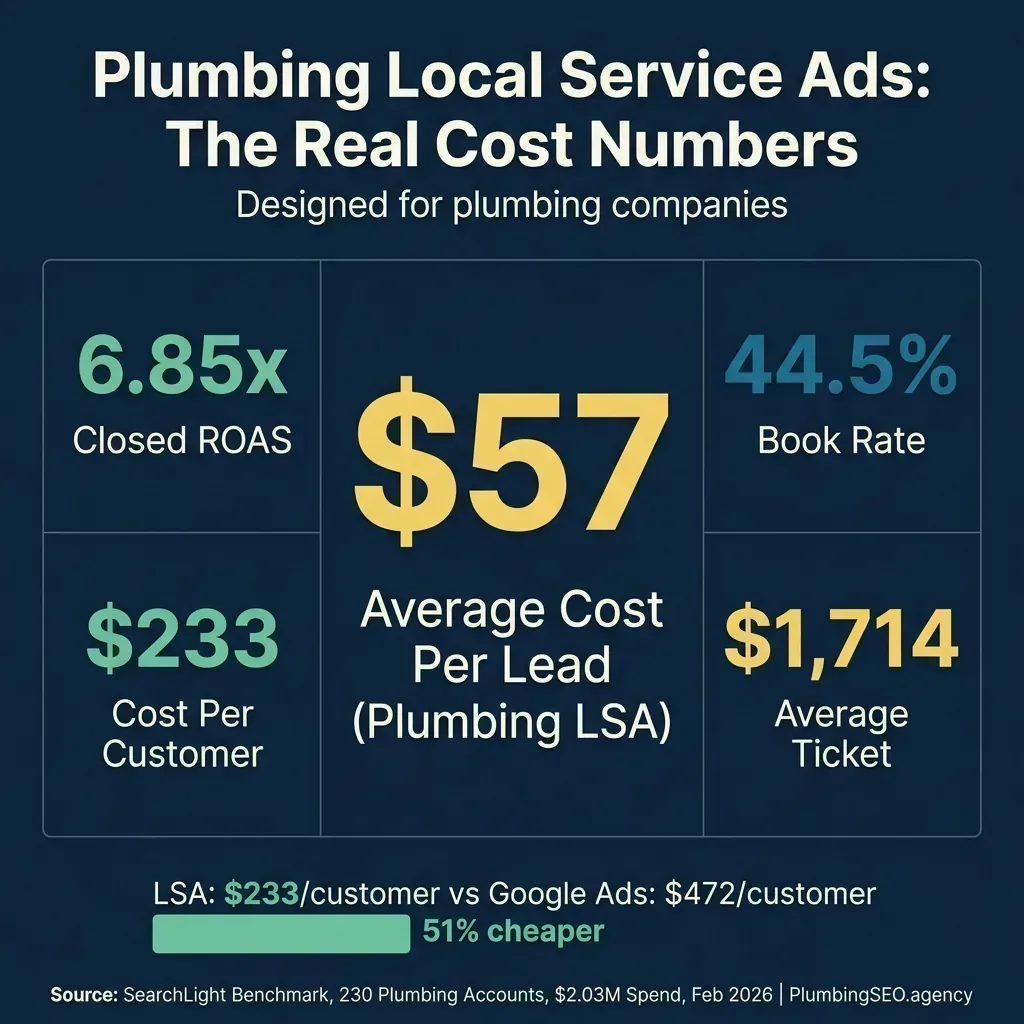
Those numbers tell a clear story. At $57 per lead with a 44.5% book rate, you are paying roughly $128 per booked job. If your average plumbing ticket is $1,714, the math works strongly in your favor. For every dollar you put into LSA, you are getting back almost $7 in closed revenue.
That said, the national average can hide real differences between markets. A plumber in a smaller city might see $30-40 leads. A plumber in Phoenix, Dallas, or Miami might be paying $80-100+. The fundamentals are the same, but competition and population density push prices up in metro areas.
One thing worth knowing from the plumbing owners on Reddit: the top 3-4 established companies in a market tend to capture 80-90% of all LSA leads. Everyone else fights over the remaining scraps. That is not a reason to avoid LSA. It is a reason to take your profile seriously and do the things that get you into that top tier. We will cover exactly what those things are later in this post.
LSA vs Google Ads: Which One Is Better for Plumbers?
This is the question every plumbing owner asks eventually. The short answer: they are not competing tools. They cover different parts of the search page and serve different moments in the buying process. But if you had to pick one to start with, LSA wins for most plumbing companies.
Here is how the two stack up side by side:
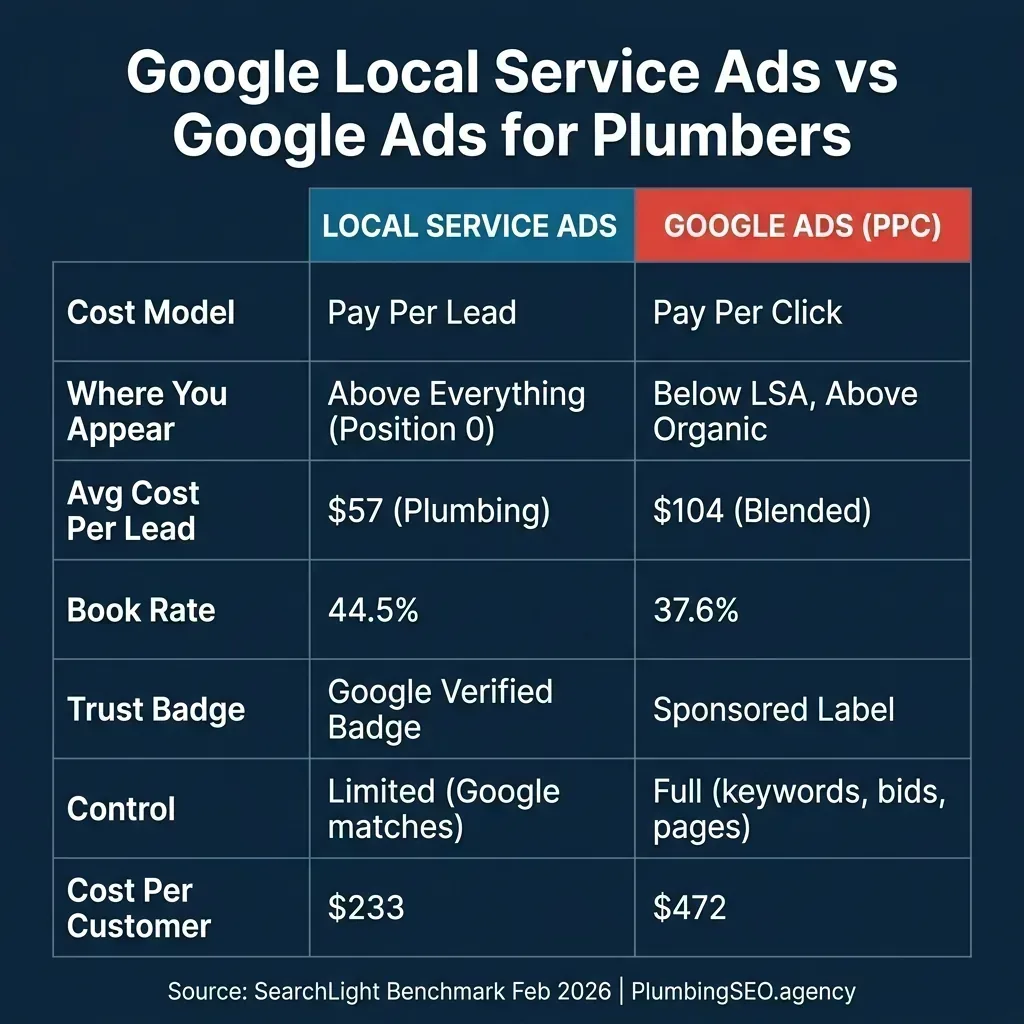
The numbers are hard to argue with. LSA produces paying customers at $233 each versus $472 for Google Ads. That is 51% cheaper. The trade-off is control. With Google Ads, you pick the keywords, write the ad copy, design the landing page, and manage bids down to the penny. With LSA, Google handles the matching. You set your budget, keep your profile strong, and answer the phone.
For a plumbing company that runs a lot of emergency and repair work, that trade-off usually makes sense. Someone searching "burst pipe plumber near me" does not need a custom landing page. They need someone who answers quickly and has good reviews. LSA is built for exactly that kind of call.
Where Google Ads pulls ahead is planned work. If you want to push water heater installations, bathroom remodels, or repiping projects, Google Ads lets you target those specific searches with dedicated pages and messaging. LSA treats all plumbing leads the same.
According to a 2025 Semrush study, contractors who ran both LSA and SEO together generated 42% more total leads than those using either channel alone. The channels reinforce each other. Strong organic rankings build brand familiarity, which makes your LSA profile more trusted when a homeowner sees it.
In my experience, the best plumbing marketing setup in 2026 looks like this: LSA for capturing urgent, high-intent calls. Google Ads for targeting specific services and planned purchases. Organic SEO for long-term pipeline that keeps delivering even when ad budgets get tight.
How to Get Approved for Google Local Service Ads (Step by Step)
Before your ads go live, Google needs to verify your plumbing business. This process typically takes 2-4 weeks from the day you submit everything. Here is what you need and what to expect.
Step 1: Gather Your Documentation
You will need three things ready before you start the application:
- Business license for your service area (state or local, depending on your market)
- Certificate of Insurance (COI) with your exact business name matching
- Google Business Profile in good standing with at least 3 Google reviews
The most common delay in approval is a name mismatch. If your insurance says "Smith Plumbing LLC" and your license says "John Smith Plumbing," Google will flag it. Make sure every document uses the same business name before you submit.
Step 2: Complete the LSA Signup
Head to Google's Local Services Ads portal and walk through the setup wizard. You will need to:
- Select your service categories (drain cleaning, water heater, emergency plumbing, etc.)
- Set your service areas (pro tip from practitioners: use city-level targeting instead of county-level. More on this below)
- Upload 5-10 quality photos of your team, trucks, and work
- Write a business description mentioning your experience, specialties, and availability
Step 3: Pass the Background Check
Google requires background checks for all owners and field technicians listed on the account. This is handled by a third-party provider and typically takes 1-2 weeks on its own. Submit background check information early in the process.
Step 4: Set Your Budget
LSA budgets work weekly. Here are starting ranges by plumbing service type based on 2026 market data:
| Service Type | Typical Lead Cost | Starter Weekly Budget |
|---|---|---|
| Emergency Plumbing | $40 - $80 | $400 - $700 |
| Drain Cleaning | $35 - $65 | $350 - $600 |
| Water Heater | $45 - $90 | $450 - $800 |
| General Plumbing | $30 - $60 | $300 - $550 |
Start conservative and let Google collect 30 days of data before adjusting. The algorithm learns over time which types of leads convert for your business, and it needs initial data to calibrate.
A Targeting Tip That Most Plumbers Miss
One of the best pieces of advice from a practitioner on Reddit who ran plumbing LSA campaigns: switch your service area from county-level targeting to city-level targeting. When the service area was set to Fulton County, they got zero leads. When they replaced it with the actual city names (Atlanta, Marietta, Roswell), leads started coming in the next day.
The reasoning is straightforward. More people search using city names than county names. Google matches your service area to the words in the search query. If you are targeting "Fulton County" but the customer searches "plumber in Atlanta," you might not show up.
What Actually Determines Your LSA Ranking
Getting approved is step one. Getting your ads to actually show above the competition is where the real work happens.
Google does not publish an exact formula, but between their own support documentation, industry research, and what practitioners report working, the ranking factors break down like this:
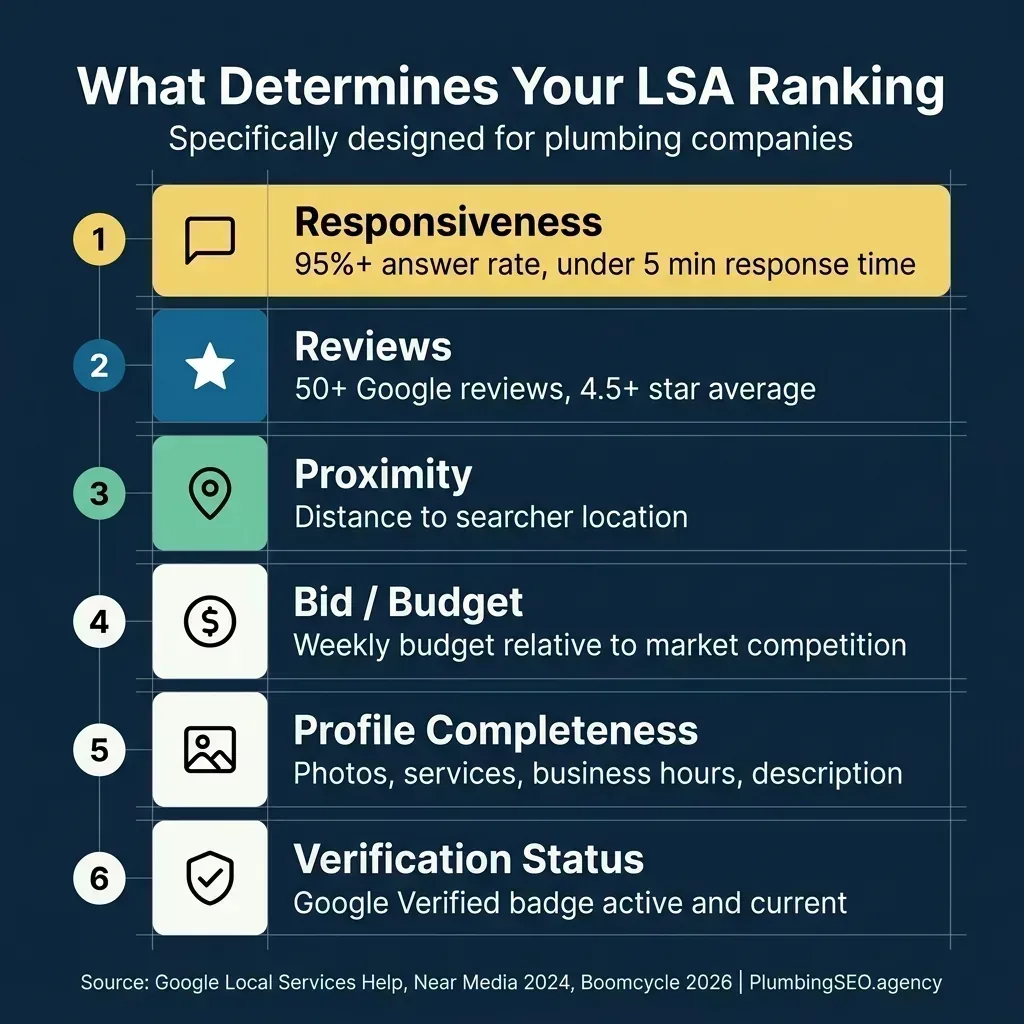
Responsiveness is number one, and it is not close. Google tracks your answer rate and response time. Businesses with answer rates above 95% rank significantly higher than those who let calls go to voicemail, even when every other factor is identical. "In local service businesses, 35 to 50% of sales go to the first responder," says Mike Blumenthal, co-founder of Near Media. "Customers in an emergency do not wait. They call the next person on the list within two to three minutes if they do not reach you."
If you cannot answer your phone 24/7, get a live answering service or set up an AI-powered call answering system that picks up immediately. Some plumbing companies use automated text-backs for missed calls: "Sorry I missed you. I am on a job. What can I help with?" That keeps you in the game until you can call back.
Reviews are the second biggest factor. Aim for 50+ Google reviews with a 4.5+ star average. Your Google Business Profile reviews feed directly into your LSA star rating, so building a systematic review request process pays off in two places at once. The top-performing plumber LSAs typically have 4.8+ stars and 100+ reviews.
Proximity matters. Google factors in how close your business is to the searcher. You cannot change your location, but you can make sure your service area settings accurately reflect where you actually work.
Budget affects volume, not quality position. This is one of the few advertising products where a well-reviewed independent contractor who answers every call can outrank a franchise with more ad spend but slower response times. Budget matters for how many leads you receive, but it does not determine your position the way it does in regular Google Ads.
7 Ways to Get More Leads From Your Plumbing LSA Profile
Getting approved and understanding the ranking factors is one thing. Turning your LSA profile into a consistent lead machine takes ongoing effort. Here is what actually moves the needle, based on what the top-performing plumbing companies do differently.
1. Answer Every Call (or Make Sure Someone Does)
We covered this in the ranking factors, but it is worth repeating because it is the single most impactful thing you can do. Companies with under 15-minute response times book 70%+ of their leads. Those who frequently miss calls book under 50%. If you are on a job site crawling under a house, you cannot answer the phone. That is fine. Route your LSA calls to a backup number, use an answering service, or set up an automated text-back. Just make sure someone picks up.
2. Stack Reviews Relentlessly
Your competitors are asking for reviews after every job. If you are not, you are falling behind every single week. The goal is not to be "good enough." The goal is to be the company with the most reviews and the highest rating in your market. Set up an automated review request system that sends a text or email right after each job is complete. Make it easy. One tap. One link. Done.
3. Choose Your Service Categories Strategically
Do not check every box in the signup wizard. Focus on the services you actually want leads for, especially the high-margin ones. If water heater replacements pay 5x more than a basic drain clean, weight your categories toward the work that fills the trucks with the right kind of jobs.
4. Upload Real Photos (Not Stock)
Homeowners scroll through your profile photos before they call. Real photos of your crew, your wrapped trucks, and your actual work build trust. Stock photos scream "we are not legitimate." The right photos on your profile can be the difference between a call and a scroll-past.
5. Set Accurate Business Hours
If you list 24/7 availability, you need to actually answer at 2am. Missed calls during your listed business hours hurt your ranking. If you do not offer after-hours emergency service, do not pretend you do. Set realistic hours and make sure someone picks up during every minute of those hours.
6. Provide Feedback on Every Lead
The old manual dispute system is gone. Google now handles lead credits automatically. But you should still rate every lead in the LSA dashboard using the feedback survey. Mark whether the lead was good, what service they needed, and whether you booked the job. This data trains Google's matching algorithm to send you better leads over time. Skipping it is leaving quality improvement on the table.
7. Keep Your Documents Current
Expired insurance or a lapsed license will suspend your ad serving immediately. No warning. No grace period. Set calendar reminders 60 days and 30 days before every expiration date. Upload renewed documents the day you get them.
Want to know if your plumbing website is set up to convert the leads LSA sends you?
Run My Free SEO Leak CheckCommon LSA Mistakes That Quietly Kill Your Results
Even experienced plumbing companies make these errors. They are not dramatic. That is what makes them dangerous. They do not break your campaign overnight. They slowly convince you that LSA does not work.
Not Spending Enough to Get Visibility
One plumbing owner on Reddit set a $1,200 monthly budget with a $65 max bid and got zero leads. The issue was not LSA itself. The market was saturated, and the budget was too low to compete. Google recommends a budget range for your market. If you are at the bottom of that range in a competitive city, you are basically invisible. Test by uncapping your budget temporarily and watching what happens. You can always dial it back once you understand what the market actually costs.
Failing to Mark Leads as "Booked"
When a lead turns into a booked job, mark it in the dashboard. Google uses this conversion data to optimize which leads get sent to you. If you never mark leads as booked, Google cannot learn what a good lead looks like for your business. It takes 30 seconds per lead. Do it.
Inconsistent NAP Information
If your business name, address, or phone number does not match between your LSA profile and your Google Business Profile, it can trigger a suspension. Check both profiles quarterly and make sure everything matches exactly.
Using Maximize Leads When You Should Be Testing Manual
Google recommends Maximize Leads as the default bidding strategy, and for most plumbers it works fine. But if you are in a smaller market or want more control over your cost per lead, switching to manual bidding with a target CPL lets you find your sweet spot. Start with Google's recommended range, then adjust up or down in $5 increments based on lead volume.
The Google Verified Badge: What Changed and What It Means
If you have been running LSA for a while, you probably remember the green "Google Guaranteed" badge. As of October 2025, that badge is gone.
Google replaced it with a single "Google Verified" badge. The old Google Guaranteed, Google Screened, and License Verified badges were all folded into one. At the same time, Google killed the Money Back Guarantee program, the customer-facing refund policy that backed Google Guaranteed listings with up to $2,000 in coverage.
What this means for your plumbing company:
- No action required on your end. The badge change happened automatically on Google's side.
- Update your marketing materials. If your website, sales scripts, or social media mention "Google Guaranteed," switch to "Google Verified." Google does not want businesses using the old branding.
- Trust signals matter more than ever. Without the money-back guarantee behind it, the new badge carries slightly less weight with consumers. That means your reviews, response time, and overall reputation carry even more weight in earning customer trust.
There is a potential silver lining. Google mentioned the new Google Verified badge "may dynamically appear on other surfaces where it adds consumer value." That could mean it eventually shows up on your Google Business Profile, not just in LSA results. More visibility for verified businesses is a good thing.
How to Calculate Your Plumbing LSA ROI
Before you put money into anything, you should be able to run the math yourself. Here is a straightforward way to figure out whether LSA makes sense for your shop.
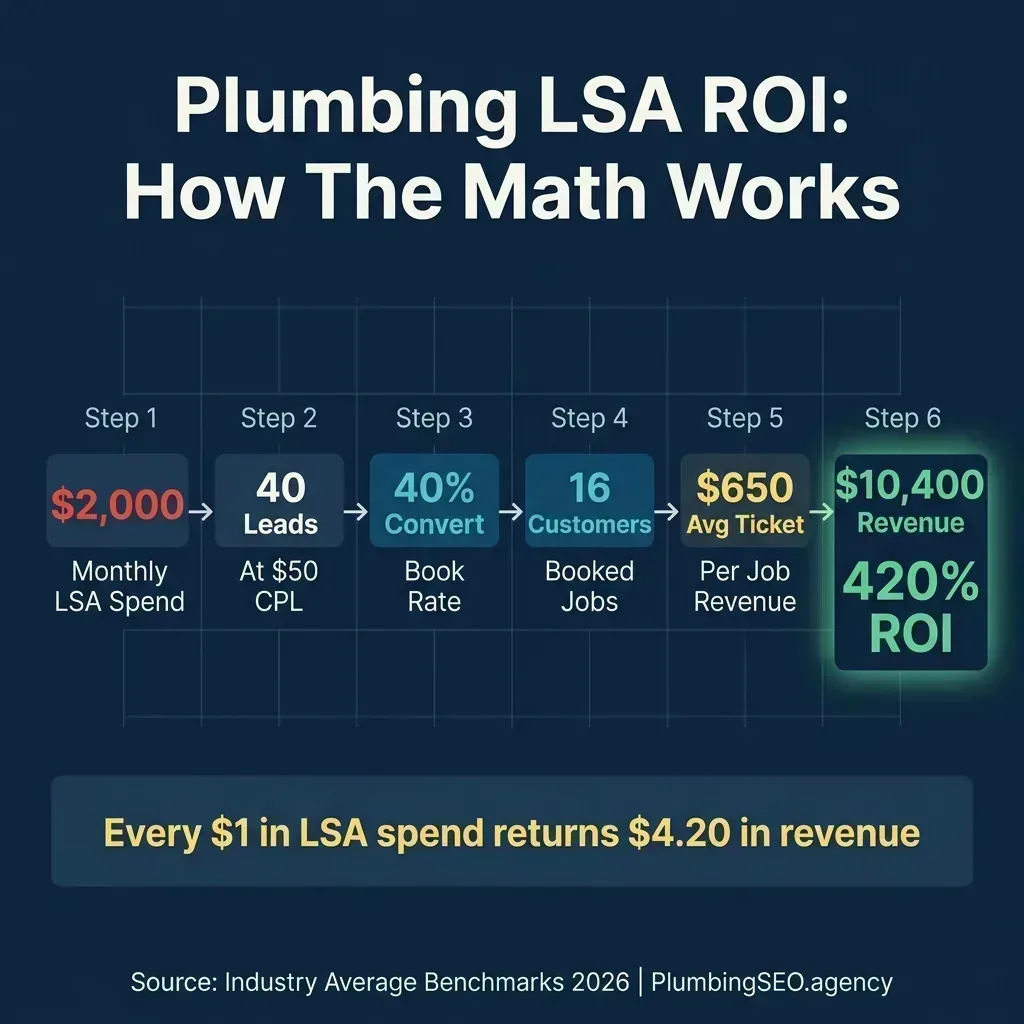
The beauty of this math is that improving any single variable multiplies the whole thing. Get your book rate from 40% to 50%? That is 4 more jobs per month from the same spend. Raise your average ticket by upselling water heater flushes or whole-house inspections? The ROI climbs even further. If you want to track these numbers precisely, setting up proper call tracking is essential so you know exactly which calls came from LSA and which ones turned into booked revenue.
For most plumbing companies operating at roughly 25% profit margins, the breakeven math works like this: if your average ticket is $1,800 and your margin is 25%, each job generates $450 in profit. With a 44% book rate and typical match rate, roughly 19% of LSA leads become paying customers. That means you can afford a cost per lead of up to $85 before first-job acquisition becomes unprofitable. The current national average is $57. That margin of safety is substantial.
Frequently Asked Questions
The average cost per lead for plumbing LSA is $57 as of February 2026, based on SearchLight's benchmark of 230 plumbing accounts and $2.03 million in spend. Actual costs vary by market. Smaller cities typically see $30-45 per lead, mid-sized markets average $50-70, and major metro areas can run $80-120+. Emergency plumbing leads tend to cost more than general plumbing leads due to higher urgency and competition.
The verification process typically takes 2-4 weeks after you submit all required documents, including business license, insurance certificate, and background check information. The most common delay is a name mismatch between documents. Make sure your business name is identical across your license, insurance COI, and Google Business Profile before you apply.
LSA uses a pay-per-lead model where you only pay when a customer contacts you. Google Ads charges per click regardless of whether the visitor calls. LSA appears at the very top of search results with a Google Verified badge, while Google Ads appear below with a "Sponsored" label. LSA leads for plumbers average $57 per lead with a 44.5% book rate, compared to $104 per lead (blended) for Google Ads with a 37.6% book rate. LSA offers less control but lower costs. Google Ads offer more targeting options but require more management.
As of mid-2025, Google switched from manual disputes to an automated credit system. Google's AI now reviews leads automatically and issues credits for spam calls, wrong numbers, and out-of-area contacts, usually within 72 hours. You can no longer manually submit disputes for most categories. However, you should still provide feedback on every lead using the dashboard's lead quality survey. This helps train Google's algorithm to improve future lead quality and can trigger additional automated credits.
The top ranking factors are responsiveness (answer 95%+ of calls and respond within 5 minutes), reviews (aim for 50+ Google reviews with a 4.5+ star average), proximity to the searcher, competitive budget, and profile completeness. The most impactful improvement most plumbing companies can make is simply answering the phone more consistently. Use an answering service or automated text-back system to cover times when you are on a job site.
Google retired the green "Google Guaranteed" badge in October 2025 and replaced it with a new "Google Verified" badge. The Money Back Guarantee program was also discontinued at the same time. All existing LSA advertisers were automatically transitioned to the new badge. No action is required on your end, but you should update any marketing materials that reference "Google Guaranteed" to say "Google Verified" instead.
Yes. LSA ranking is heavily influenced by review count, review rating, and responsiveness, not just budget. A well-reviewed independent plumber who answers every call can outrank a franchise with a bigger ad budget but slower response times. Budget affects how many leads you receive, but it does not determine your ranking position the way it does in standard Google Ads. Focus on reviews, response speed, and profile completeness first.
Not sure if your plumbing website is ready to handle the leads LSA will send? Find out in 60 seconds.
Run My Free SEO Leak Check