
- LSA is not regular PPC. Plumbers pay for qualified contacts, but Google still ranks profiles by bid, reviews, responsiveness, service fit, and profile quality.
- Start with clean setup: licenses, insurance, background checks, real truck/team photos, tight job types, honest service areas, and hours your office can actually cover.
- Use LSA for fast calls, then hand the winners to SEO. The search terms, booked jobs, reviews, and service-area patterns should shape your Google Ads and organic plan.
If your phones are quiet and payroll is coming, Google Local Services Ads can look like the fastest way to get back on the board. And for plumbers, they can be. They sit above regular search ads, show trust signals, and charge when a customer contacts you instead of every time someone clicks around during lunch.
But LSA is not a magic faucet. If the setup is loose, the office misses calls, or the job types are too broad, the money can run out before the schedule fills. The right way to use LSA for plumbers is simple: get verified, make Google comfortable showing you, answer fast, measure booked jobs, then use what you learn to strengthen SEO and regular Google Ads.
This guide covers the whole handoff. Setup first. Bidding second. Then the part most shops miss, how LSA data should feed your Google Ads and LSA management, service pages, reviews, and local SEO.
What Google LSA actually is for plumbers
Local Services Ads are Google's pay-per-lead ads for local service businesses. Google explains the basic promise plainly: businesses can show in local search and pay for results instead of clicks. For plumbing companies, that usually means calls, messages, or booking requests from people searching for service in your area.
That makes LSA different from regular Google Search Ads. A normal ad can charge when someone clicks. LSA usually charges when the lead comes through the Local Services profile. That sounds cleaner, and often it is, but it also shifts the weak point. You are no longer just buying traffic. You are buying conversations, and your office has to turn those conversations into jobs.
LSA is good for speed
It can put a verified plumbing shop near the top of the page for urgent local searches. That helps when you need call volume now.
LSA is weak without follow-up
Missed calls, stale leads, broad job types, and slow callbacks can drag results down. Google notices when customers do not get served.
The setup order I would follow before spending hard
Do not start by arguing over the weekly budget. Start by making sure the account can pass screening, show the right work, and send leads to someone who can answer. A smaller clean setup beats a big messy one. Same as a water heater install. If the connections are wrong, adding pressure does not help.
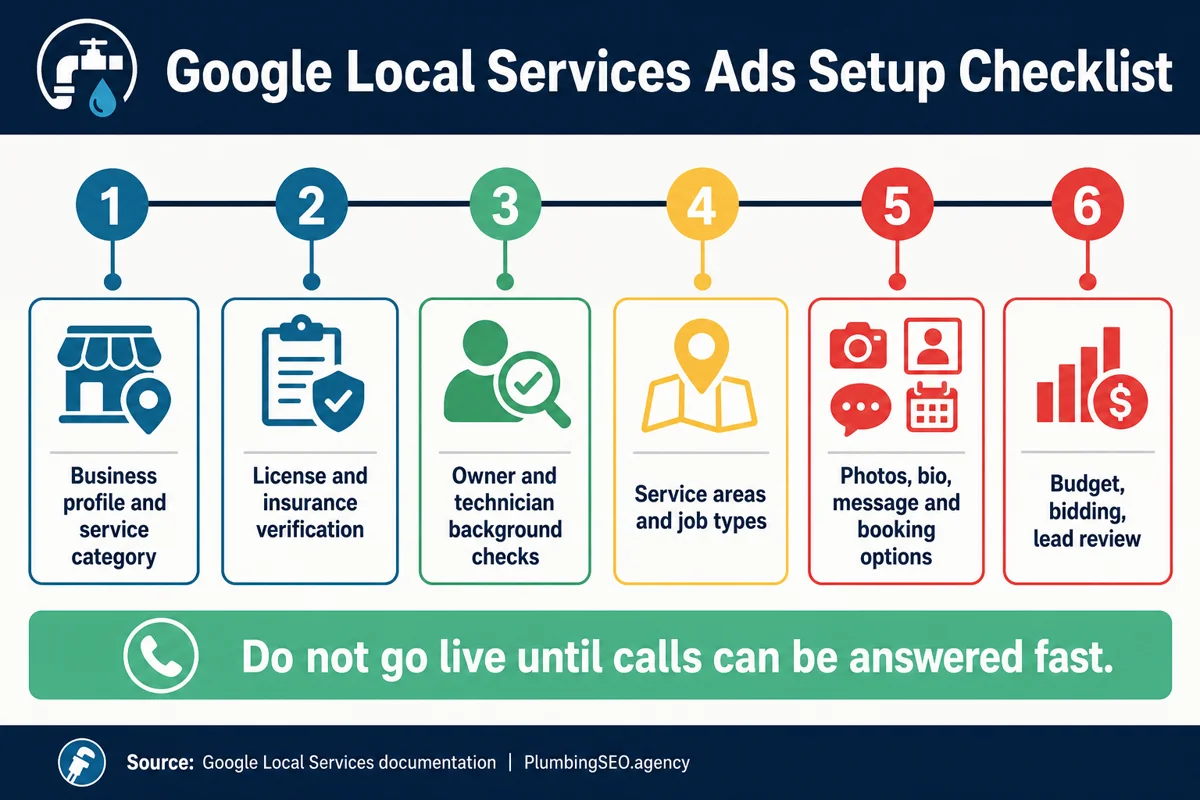
1. Match the business profile and service category
Use the real business name, service category, phone number, website, and service area. If the LSA profile, Google Business Profile, and website tell three different stories, the customer feels it. Google may also struggle to match you with the right search.
2. Finish license, insurance, and background checks
Plumbing is a trust-heavy category. Depending on the market, Google may require license, insurance, business, owner, and worker screening before ads can run. Do not treat this as paperwork only. The badge helps a nervous homeowner choose who gets into the house.
3. Tighten job types before broadening them
Pick the plumbing services you actually want. Emergency repair, water heater replacement, sewer and drain, leak detection, repipes, and commercial work can behave very differently. If you do not want small handyman-style calls, do not invite them because the checkbox was sitting there.
How Google ranks LSA profiles
Google says Local Services listings are ordered through an auction that considers the bid and overall profile quality. Its own ad rankings help page names several practical factors: bid, responsiveness, the customer's search context, relevance, services, business bio, message or booking options, rating, review count, response time, photos, and verification checks.
That is why two plumbers can set similar budgets and get different results. The stronger profile, faster office, better review base, and cleaner service match often wins more chances. The bid opens the door. Trust and operations decide whether Google keeps pushing people through it.
| Ranking lever | What it means for a plumber | Owner-side fix |
|---|---|---|
| Bid and budget | Your maximum lead price and weekly spend ceiling. | Start with Maximize Leads, then adjust after booked-job data exists. |
| Responsiveness | Missed calls and slow replies can hurt lead flow. | Route calls to a real person during active LSA hours. |
| Profile quality | Reviews, rating, photos, verification, and bio all shape trust. | Add real crew/truck photos and keep review requests running. |
| Service relevance | Google matches the searcher's job to your selected services. | Trim job types that waste dispatch time or create bad-fit calls. |
Bidding: start simple, then let booked jobs tell the truth
For most plumbing shops, I would start with Maximize Leads unless there is a strong reason not to. Google itself says providers with equivalent quality and budgets using Maximize Leads typically get more leads than those that do not. That does not mean you let the account run wild. It means you avoid choking the account before it has enough data.
The first month should answer owner questions, not vanity questions. Did the phone ring? Did someone answer? Was the caller in your service area? Was the job type profitable? Did it book? Did the job close? If you cannot answer those, you do not have a bidding problem yet. You have a tracking problem.
Good LSA lead
A homeowner calls for a water heater replacement inside your service area. Dispatch answers, books the visit, tags it in the lead portal, and the invoice connects back to the source.
Bad LSA leak
A renter asks for a tiny fixture issue outside your service area. Nobody tags it, nobody disputes it, and the report still says you bought a lead. That is how numbers lie.
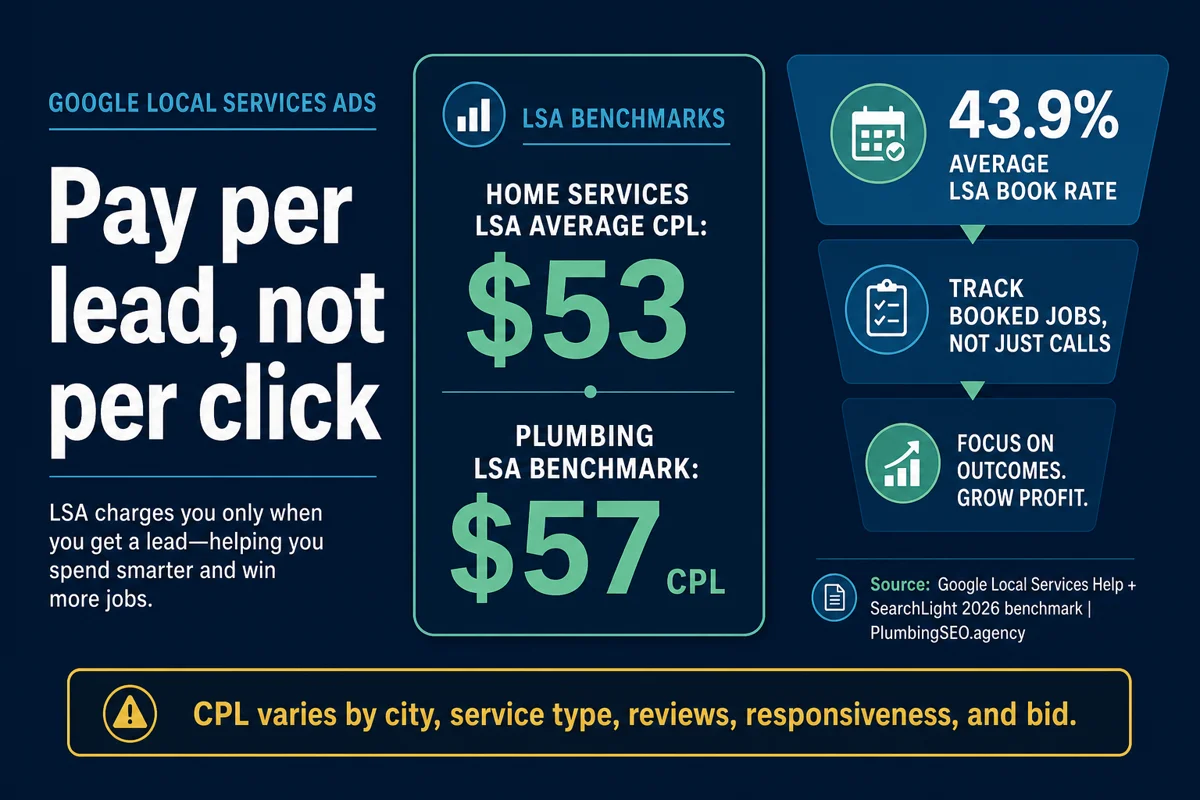
Benchmark data can help set expectations. SearchLight's 2026 home services LSA benchmark reported $6.72M in spend across 888 contractors and 126,650 leads, with a $53 average home services LSA cost per lead and a 43.9% average book rate. It also reported plumbing around a $57 CPL in that dataset. Those are not promises for your city, but they are useful guardrails when you compare LSA against regular search ads and organic SEO.
WordStream also notes that LSA leads are not automatically booked jobs. That is the right mindset. A cheap lead that never books is expensive. A higher-cost emergency lead that fills a truck today may be worth it.
The dispatch rules that protect the budget
LSA works best when the office treats lead handling like part of the ad campaign. The ad did its job when the phone rang. The company does its job when the call is answered, qualified, booked, tagged, followed up, and measured.
- Run ads only when someone can answer. If you cannot handle 24/7 calls, do not pretend you can. After-hours calls need an answering service, message workflow, or booking option.
- Review leads every day. Listen to calls, mark booked jobs, archive old leads, and dispute invalid ones when Google allows it.
- Separate calls from revenue. Track cost per lead, booked rate, cost per booked job, close rate, average ticket, and gross profit.
- Keep job types tight. If sewer leads are profitable but small repair calls clog dispatch, adjust the account instead of blaming the whole channel.
Where SEO should take over from LSA
LSA can buy speed. SEO builds the base that makes every lead source stronger. When someone sees your Google badge and then checks your company name, website, reviews, service pages, and photos, SEO is either helping close the job or quietly sending them to another shop.
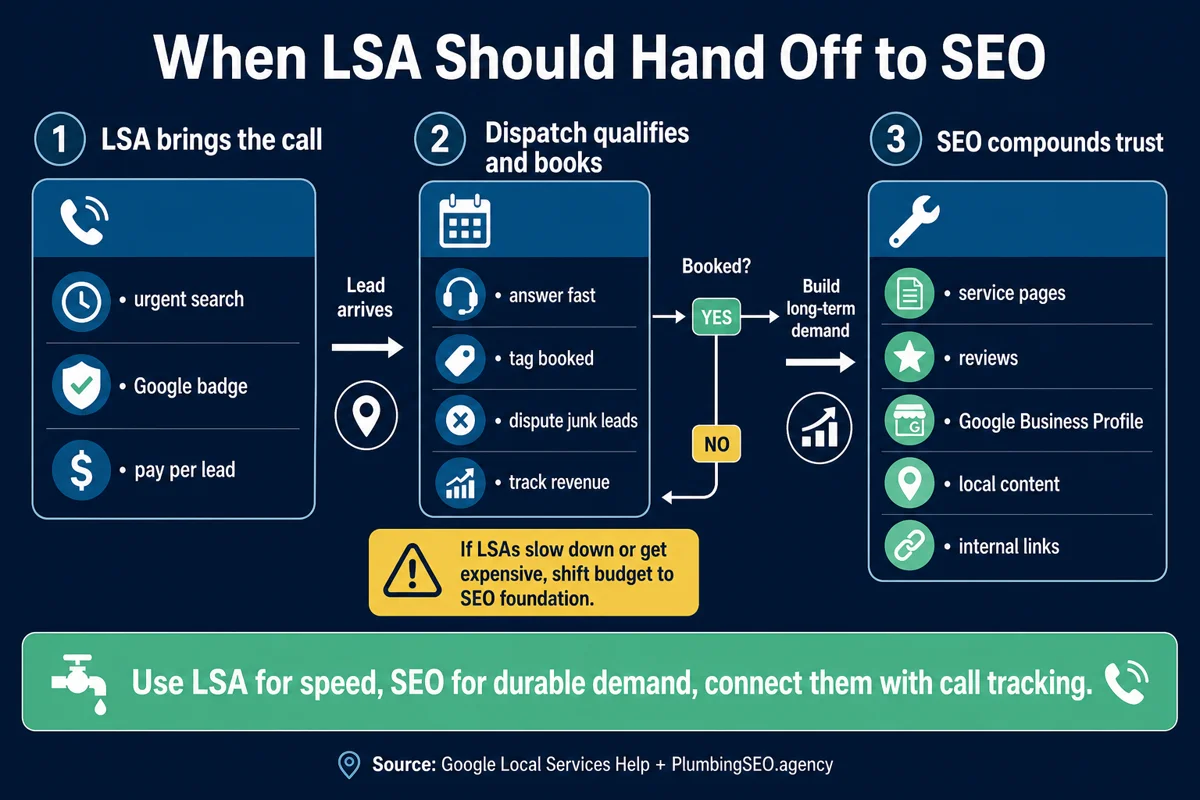
The handoff starts with patterns. If water heater LSA leads book well, build a stronger water heater service page, add job photos, collect reviews mentioning water heaters, and link to that page from helpful articles. If sewer leads are costly but profitable, create content that answers sewer-line questions before the customer panics and calls whoever is first.
This is also where LSA protects SEO from guessing. Instead of writing content because a keyword tool looks busy, you can write from the calls your company already paid for. The phone tells you which services matter, what neighborhoods are active, what objections come up, and what language real customers use.
My practical LSA to SEO handoff checklist
| LSA signal | SEO action | Why it matters |
|---|---|---|
| High booked rate for a job type | Improve or create the matching service page. | Turns paid demand into a long-term organic asset. |
| Common caller questions | Add FAQ copy and supporting blog sections. | Answers objections before the phone call. |
| Strong neighborhoods or suburbs | Strengthen local proof, reviews, and area mentions. | Helps Google and customers connect your shop to the area. |
| Bad-fit repeated leads | Clarify service copy and adjust internal links. | Reduces wasted calls and weak expectations. |
How this fits with regular Google Ads
Do not make LSA fight regular search ads like two techs arguing over the same wrench. They can do different jobs. LSA is strong for verified, urgent, local service demand. Search Ads can be stronger when you need tighter keyword control, landing-page testing, commercial work, brand defense, or services where LSA volume is inconsistent.
If LSA is bringing good calls but not enough volume, regular Google Ads can fill gaps. If regular Google Ads is expensive, LSA can lower the blended cost of booked jobs. If both are producing, SEO should be capturing the repeated questions and profitable service themes so you are not renting every call forever.
The best setup is not "LSA or SEO." It is a clean paid search system feeding a stronger organic system. That keeps the trucks moving today and gives the company more control next season.
Want someone to connect LSA, Google Ads, and SEO?
We manage plumber paid search with the SEO handoff built in, so your ad spend teaches the website what should rank next.
See Google Ads and LSA managementGoogle LSA for Plumbers FAQ
Google LSA, or Local Services Ads, is a pay-per-lead ad format that can show plumbing companies above regular search ads for local service searches. Plumbers usually pay when a customer contacts them through the ad, not when someone only clicks around.
Start with a weekly budget you can answer and track. The useful number is not spend by itself. Watch cost per lead, booked rate, cost per booked job, close rate, and average ticket. Increase budget only when the calls are being handled and measured.
Most shops should start with Maximize Leads so the account can gather enough lead data. After you know which calls book, which job types are profitable, and what your true cost per booked job is, you can test tighter bid controls.
No. LSA can bring faster calls, but SEO builds the service pages, reviews, Google Business Profile strength, and local content that customers check before they choose a plumber. The best results come when LSA data feeds the SEO plan.
Common problems include missed calls, slow replies, weak reviews, incomplete profiles, broad job types, poor photos, loose service areas, and no lead review process. A big budget will not fix an account that sends the wrong calls to an office that cannot answer.
Track cost per lead, booked rate, cost per booked job, closed revenue, average ticket, gross profit, bad-fit lead reasons, missed calls, and which service types produce the best customers. Then use that information to improve SEO and regular Google Ads.
Need cleaner plumber lead tracking?
Get a practical paid search and SEO plan built around calls, booked jobs, service pages, and the work your shop actually wants.
Get a Free SEO Leak Check