
- Plumbing PPC costs $2,000 to $7,500 per month total, that covers both your ad spend and whoever is managing the campaigns.
- Cost per click runs $8 to $120 depending on keyword type. Emergency terms are the expensive ones, service keywords like water heater repair are more manageable.
- A properly managed campaign should deliver leads at $40 to $100 each. If you are paying more than that consistently, something is wrong with the setup.
You have been told PPC is the fast way to get the phone ringing. And it can be. But every article you read gives you different numbers. One says $500 a month. Another says $10,000. A buddy at a trade show told you he spent $3,000 last month and got nothing.
So what does PPC actually cost for a plumbing company?
The real answer depends on three things: where you are, what services you are targeting, and who is running the campaigns. A plumber in Phoenix competing for emergency keywords is playing a completely different game than a drain cleaning company in a small town in Ohio.
This guide gives you actual numbers based on what plumbing companies are paying right now. Not agency estimates. Not "it depends" followed by a contact form. Real data you can use to decide if PPC makes sense for your business and how much to budget if it does.
The Real Cost Breakdown: Ad Spend vs Management Fees
Most articles blur ad spend and management fees into one number. That makes it impossible to know what you are actually paying for. They are two completely different costs, and understanding the split is the first step to not getting taken for a ride.
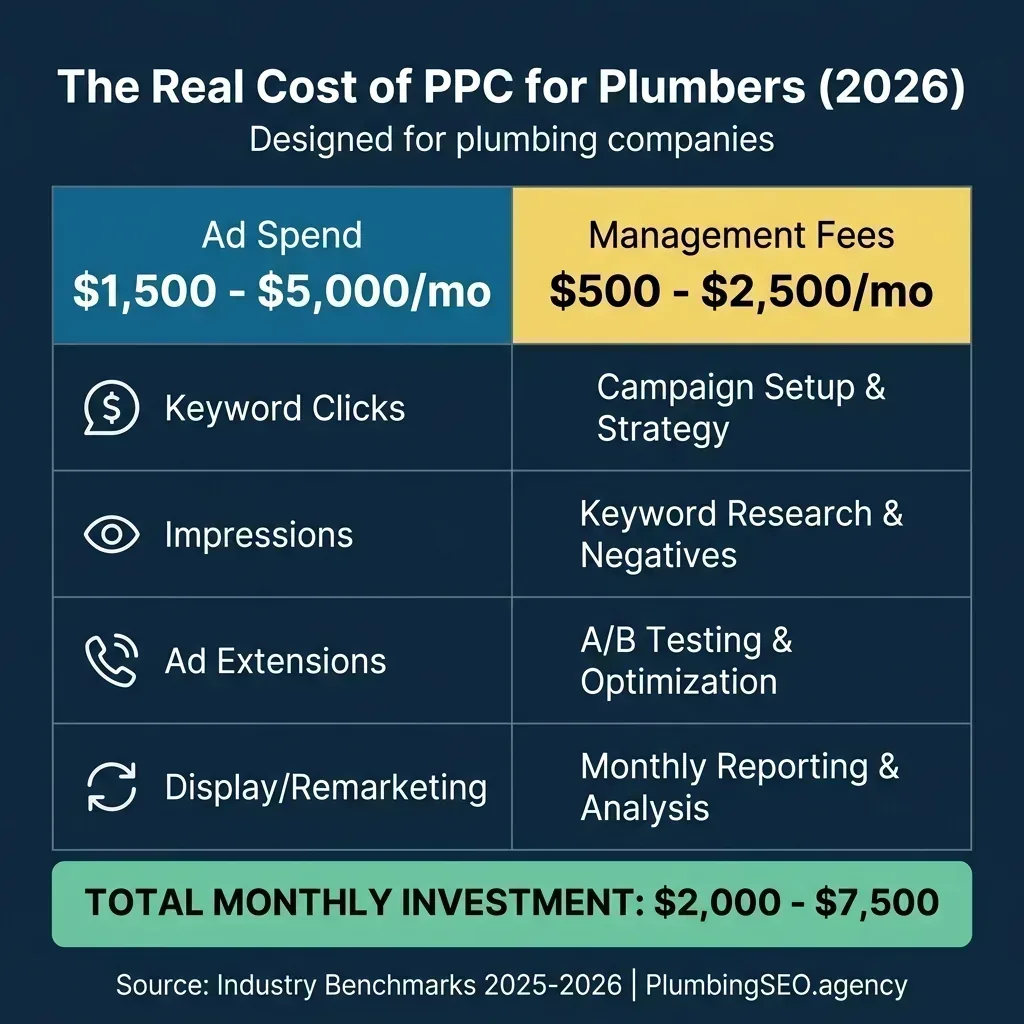
Two separate costs, one monthly bill. Know what you're paying for before you sign anything.
Your ad spend ($1,500 to $5,000/mo) goes directly to Google. This is the money that pays for clicks. Your management fee ($500 to $2,500/mo) goes to whoever is running and optimizing the campaigns. Together, most local plumbing companies are looking at a total investment of $2,000 to $7,500 per month.
Do not just look at the management fee. Look at what is included. A $500/mo agency that does not set up call tracking is more expensive in the long run than a $2,000/mo agency that shows you exactly which keywords are booking jobs. The management fee should cover keyword research, negative keyword maintenance, A/B testing, landing page optimization, and monthly reporting at minimum. If any of those are missing, you are paying for someone to babysit a campaign that is not getting better.
If you want to understand what goes into a PPC campaign, check out our data-driven PPC FAQ for plumbers.
What a Click Actually Costs in Plumbing
Plumbing is one of the most expensive PPC industries. Here is why: when someone searches "emergency plumber near me" at 11 PM with water coming through their ceiling, they are ready to hire the first company that picks up. That click is worth hundreds in revenue, so every plumber in town is bidding on it.
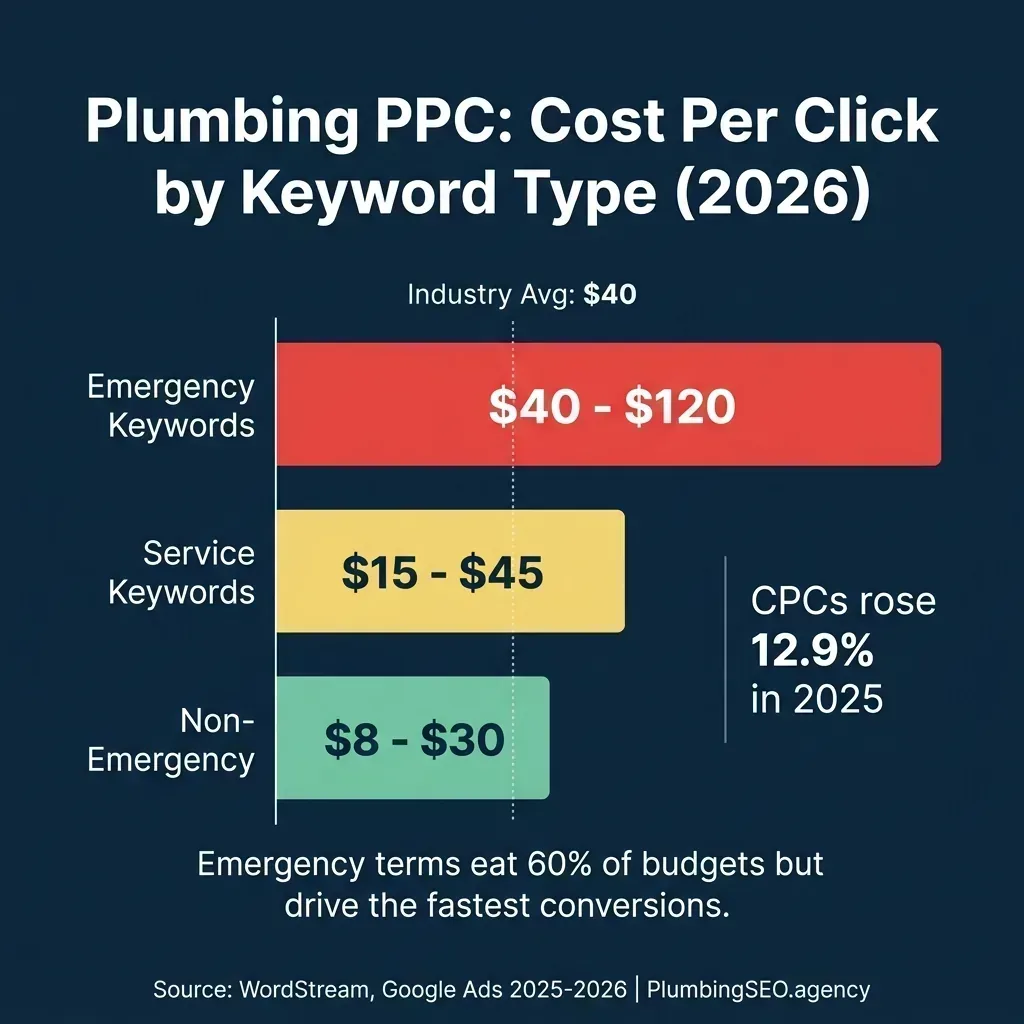
Emergency terms eat most of your budget but also drive the fastest conversions.
Emergency keywords run $40 to $120 per click. Service keywords like water heater repair or slab leak repair sit in the $15 to $45 range. Non-emergency terms like drain cleaning and toilet repair are more manageable at $8 to $30 per click.
CPCs rose 12.9% year over year in 2025 according to WordStream data, and plumbing is not getting cheaper. But here is what matters: a $90 click that turns into a $3,000 water heater install is a fantastic investment. A $15 click that goes to a homepage with no phone number is a complete waste. The click cost is not what makes or breaks PPC. It is what happens after the click.
One contractor on Reddit's r/PPC shared that they spent $2,000 in their first month on Google Ads and got 4 calls, two of which were for services they do not even offer. The problem? Broad match keywords, no negatives, and geo-targeting set to "people interested in" their area instead of "people IN" their area. That one setting alone was eating 40% of their budget. (If that sounds familiar, keep reading. We cover exactly how to fix it below.)
Cost Per Lead: The Number That Actually Matters
Forget CPC for a minute. The number that determines whether PPC is working for your plumbing company is your cost per lead.
Here is the simple math. Take your cost per click and divide it by your conversion rate. If your CPC is $40 and your landing page converts at 25%, you are paying $160 per lead. If that same $40 click lands on a page that only converts at 10%, you are paying $400 per lead. Same click cost, completely different outcomes. That is why your landing page and call-to-action matter just as much as your bid strategy.
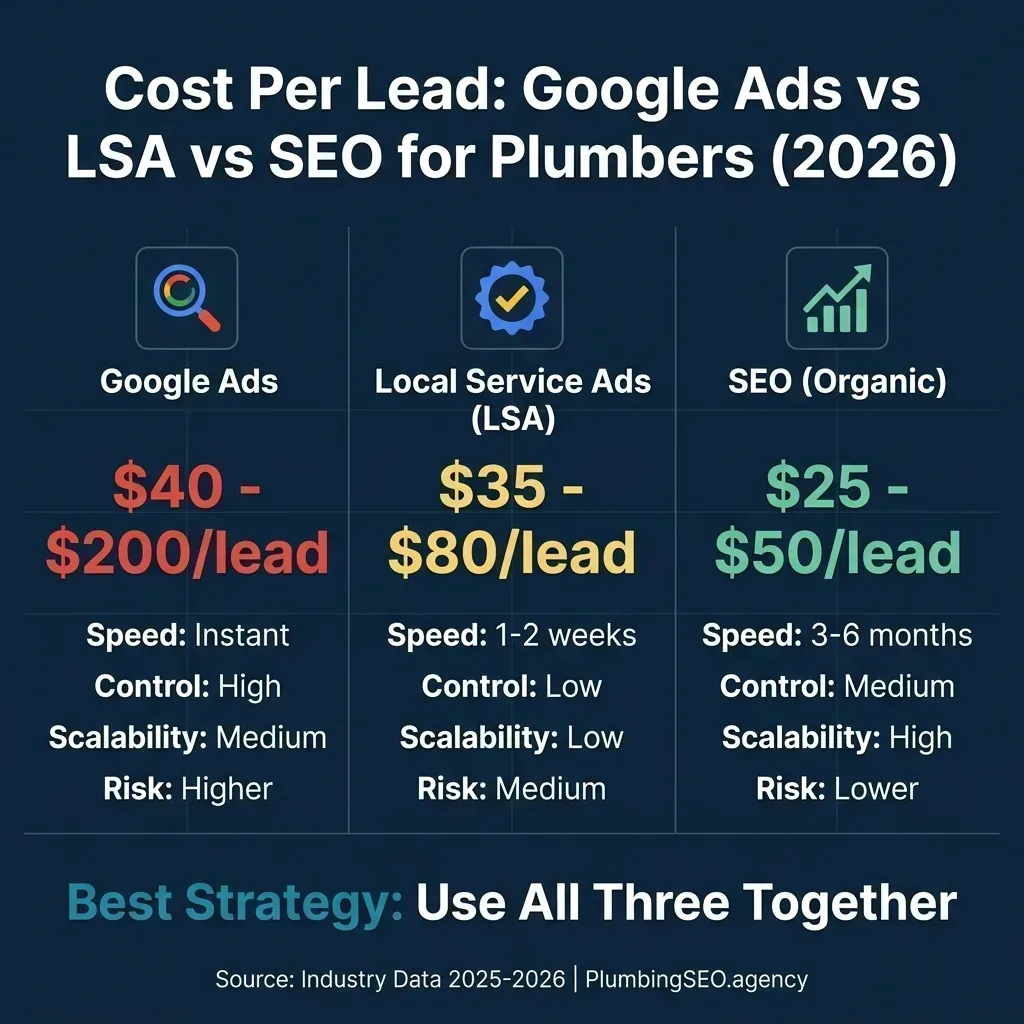
Google Ads can be the most expensive or the cheapest channel depending entirely on how well campaigns are managed.
The range across channels tells a clear story. Google Ads runs $40 to $200 per lead, and that wide range exists because setup quality varies enormously. Local Service Ads (LSA) come in at $35 to $80 per lead. And SEO (organic) delivers leads at $25 to $50 each after about 6 months of investment.
The best plumbing companies use all three channels together. PPC fills the gap while SEO builds. LSA catches the Google Guaranteed traffic. And once SEO kicks in around month 4 to 6, your cost per lead drops across the board because you are not leaning on paid clicks for 100% of your leads. We broke down the full comparison in our SEO vs PPC analysis for plumbers.
One Reddit user in r/PPC reported getting quality plumbing leads at around $100 per lead with a 7 to 8x ROAS on Google Ads alone. That means for every $1 spent, they were bringing in roughly $7 to $8 in revenue. That is the math you need PPC to hit. If you are spending $3,000 a month and cannot point to $15,000 to $20,000 in booked revenue from those ads, something needs fixing.
How PPC Management Pricing Actually Works
When you start shopping for someone to run your Google Ads, you will hear four different pricing models. Each has tradeoffs, and none of them is automatically the best choice. It depends on your budget, your growth stage, and how much you trust the person running the campaigns.
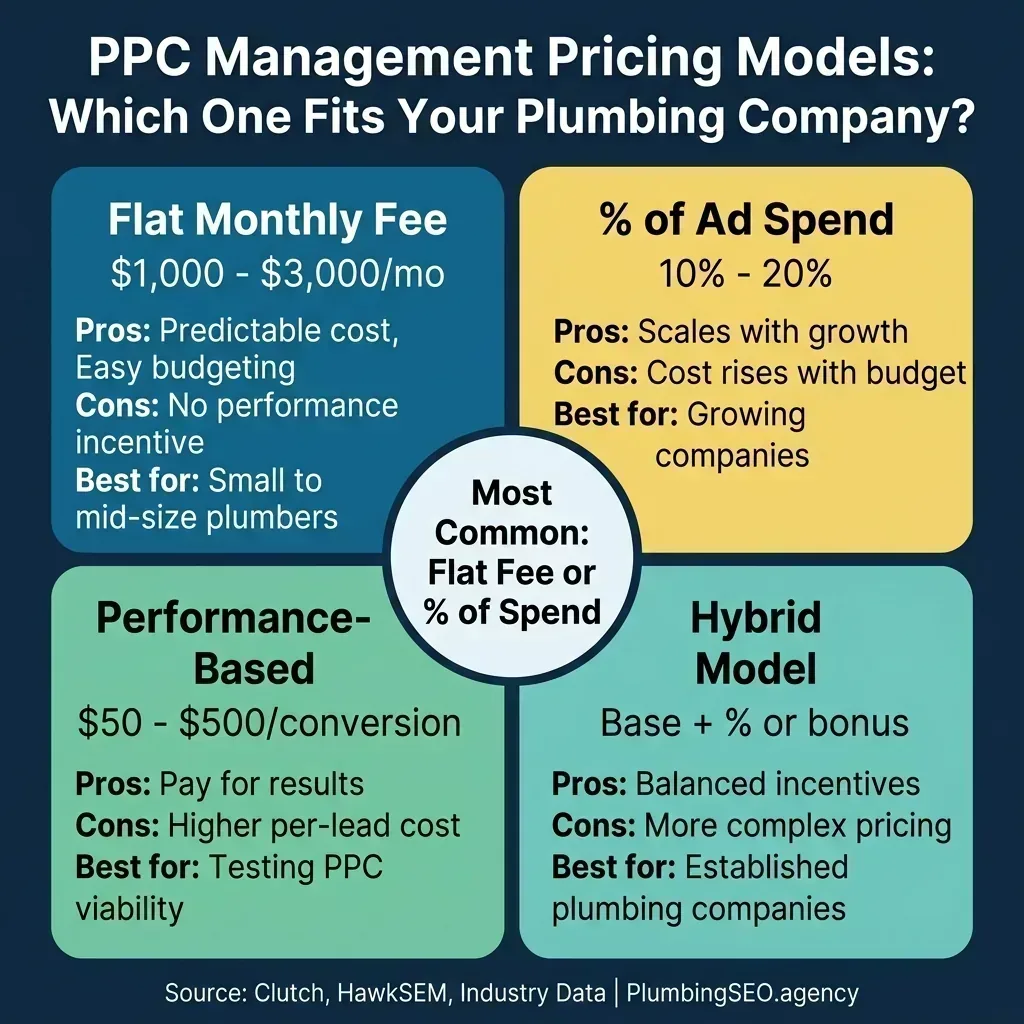
Most plumbing companies do best with a flat fee or percentage model. Performance-based sounds great until you see the per-lead price.
Flat monthly fee ($1,000 to $3,000/mo) is the most common model for local plumbing companies. It is predictable, easy to budget, and you know exactly what you are paying every month. No surprises.
Percentage of ad spend (10 to 20%) scales with your growth. If you are spending $2,000 in ads, the fee is $200 to $400. If you scale to $10,000, it jumps to $1,000 to $2,000. Good for growing companies, but the cost rises whether results improve or not.
Performance-based ($50 to $500 per conversion) sounds like the dream. You only pay for results. But the per-lead cost tends to be higher to offset the agency's risk, and you need very clear definitions of what counts as a "lead" so you are not paying for spam calls and form fills from people looking for a job.
Hybrid (base fee + percentage or bonus) gives balanced incentives. The agency has a base income to cover their costs, and a bonus tied to performance keeps them motivated to improve results. This works well when both sides are transparent about the numbers.
What should raise a red flag? Long-term contracts when month-to-month is standard in this industry. Agencies that will not share your Google Ads account access (you should own your account, period). No call tracking setup. And vague reporting that shows impressions and clicks instead of actual leads and booked calls. If they cannot tell you which keywords generated phone calls last month, they are guessing just like you are.
Before you sign anything, read our questions to ask before hiring an agency.
The Budget Sweet Spot for Plumbing Companies
Not Many plumbing companies benefit from to spend $7,000 a month on PPC. The right budget depends on how many trucks you are running, how many service areas you cover, and how aggressive your competition is. Here is where most companies land.
Starter: $1,500 to $2,500/mo total. Good for a single service area with 5 to 10 keywords. You will not dominate emergency terms at this level, but you can win on service-specific keywords like "water heater repair [city]" or "drain cleaning [city]." This is enough to test whether PPC works for your market and start collecting data.
Growth: $3,000 to $5,000/mo total. Covers 2 to 3 service areas with 15 to 30 keywords. This is where most 3 to 5 truck operations land. You have enough data to optimize, enough reach to fill the schedule, and enough budget to compete on a few higher-value terms. This is the sweet spot for companies that want to keep the trucks moving without betting the business on ads.
Aggressive: $5,000 to $10,000+/mo total. Multi-area, full service line coverage. This is for companies running 6+ trucks that need consistent lead volume across multiple cities. At this level, you should be running Google Ads, LSA, and investing in SEO simultaneously. If you are spending this much on PPC alone, you are leaving money on the table by not building organic rankings in parallel.
One thing every tier has in common: expect a 3-month optimization period. Month 1 to 3 is a testing phase. Your cost per lead will be higher during this window. That is normal. The algorithm needs data. Keywords need refinement. Negative keywords need building. Judge PPC performance over quarters, not weeks. If someone promises you results in week one, they are either lying or they do not understand how Google Ads actually works.
For a deeper dive into how to allocate your marketing dollars, check our guide on how much plumbing companies should spend on SEO.
5 Ways Plumbers Waste PPC Budget (And How to Fix Each One)
Most of the plumbing companies we talk to are not failing at PPC because the channel does not work. They are failing because of preventable setup mistakes that drain budget faster than a busted water main. Here are the five biggest ones.
-
Broad match keywords without negative keywords.
Google's broad match is designed to spend your money. Without a strong negative keyword list (you need 2,000+ over time), you will show up for "plumber salary," "how to become a plumber," and "plumbing snake for sale." None of those are customers. Fix: Start with exact and phrase match only. Build negatives weekly from your search terms report. This is not a set-it-and-forget-it job.
-
"Interested in" geo-targeting instead of "people IN" your area.
This one Google Ads default setting can waste 40% of your budget on people who are not in your service area. A plumber in Dallas should not be paying for clicks from someone in Chicago who was "interested in" Dallas. Fix: Change location targeting to "Presence: People in or regularly in your targeted locations." It takes 30 seconds and can save you thousands.
-
Sending all traffic to your homepage.
Your homepage has 6 different services on it. Someone searching "water heater repair" lands there and has no idea if you actually do that specific job. They leave. You just paid $35 for nothing. Fix: Build dedicated landing pages for each service with a clear phone number, service description, pricing context, and trust signals like reviews and licenses. One page per service, one clear action per page.
-
Running Performance Max without understanding it.
Reddit's r/PPC is full of plumbing companies that tried Performance Max and got flooded with fake calls and bot traffic. PMax can work, but it requires significant conversion data and is better suited for e-commerce than local services. Fix: Stick to standard Search campaigns for plumbing. If you try PMax, run it alongside Search and watch closely for fake lead indicators. Do not let it be your only campaign type.
-
Not tracking calls and attributing leads.
If you cannot tell which keyword generated which phone call, you are flying blind. You are spending $3,000 a month and have no idea which $1,500 is working and which $1,500 is waste. That is like sending two trucks out every day and never checking which one actually booked jobs. Fix: Set up call tracking (CallRail or similar) and import conversions back into Google Ads so the algorithm can optimize for what actually books jobs.
We walk through the full setup in our call tracking guide for plumbing companies.
Frequently Asked Questions About PPC Costs for Plumbers
PPC management fees range from $1,500 to $10,000 per month as a flat fee, or 10 to 20% of your ad spend according to HawkSEM data. Most plumbing companies pay between $1,000 and $2,500 per month for management. The fee should cover keyword research, bid management, negative keyword maintenance, A/B testing, and monthly reporting.
Most plumbing companies spend $1,500 to $5,000 per month in ad spend, plus management fees on top. Start on the lower end if you are testing PPC for the first time. Scale your budget based on ROI once you have 2 to 3 months of data showing which keywords are booking actual jobs.
Yes, when managed properly. The median plumbing ROAS is 5.54x, meaning you get roughly $5.54 back for every $1 you spend. But poorly managed campaigns burn money fast. The difference between profitable PPC and wasted budget often comes down to campaign setup, keyword targeting, and landing page quality.
Plumbing CPCs range from $8 to $120 depending on keyword type. Emergency keywords like "emergency plumber near me" are the most expensive at $40 to $120 per click. Service keywords run $15 to $45, and non-emergency terms like drain cleaning are $8 to $30 per click.
A well-managed plumbing PPC campaign should deliver leads at $40 to $100 each. If you are consistently paying over $150 per lead, there are likely optimization issues with your keywords, landing pages, or targeting settings that need attention. Top-performing campaigns can get below $50 per lead.
Traffic starts the same day you launch, but expect 2 to 4 weeks for enough initial data to make optimization decisions. Full optimization typically takes 1 to 3 months as you build negative keyword lists, test ad copy, and refine targeting. Judge PPC results over quarters, not days.
DIY PPC management can work if you have 5 or more hours per week to dedicate to it and you are willing to learn the platform. Most plumbing owners hire out because their time is better spent running the business and managing crews. A good manager will also avoid costly mistakes that eat budget during the learning curve.
Google Ads charges per click ($8 to $120) and gives you full control over keywords, ad copy, and targeting. Local Service Ads charge per lead ($35 to $80) and Google controls which leads you receive. LSA leads tend to be cheaper but you have less control over volume. Most successful plumbing companies run both channels together.
Stop Guessing What PPC Should Cost
Get a free PPC audit that shows you exactly where your ad budget is going, which keywords are booking jobs, and what a realistic cost per lead looks like in your market.
Get My Free PPC Audit