
- The average plumbing PPC cost per click is $30 to $120 depending on keyword type, with a national average around $40 per click and $183 per lead (Q1 2026 data from 524 contractors).
- The median plumbing Google Ads ROAS is 5.54x, meaning every $1 spent returns $5.54 in closed revenue. But only if you track past the lead and into the booked job.
- Most plumbing PPC mistakes come from broad match keywords, missing negative keywords, and no call tracking. Fix those three things before increasing your budget.
If you are running Google Ads for your plumbing company, or thinking about starting, you probably have questions. How much does it cost? Is it worth it? What budget do I need? Should I hire someone to manage it?
We pulled real benchmark data from 524 plumbing contractors and $15.9 million in Google Ads spend to answer every PPC question plumbing owners actually ask. No guessing, no agency sales pitch. Just numbers and straight talk.
What Is PPC for Plumbers?
PPC (pay-per-click) is online advertising where you pay each time someone clicks your ad. For plumbers, this usually means Google Ads that show up at the top of search results when a homeowner types something like "plumber near me" or "emergency drain repair."
You only pay when someone actually clicks. If they see your ad and scroll past it, that impression costs you nothing. The main PPC platforms for plumbing companies are Google Search Ads, Google Local Service Ads (LSAs), and Meta (Facebook/Instagram) Ads.
The reason PPC works for plumbers is simple: people searching for plumbing help usually have an urgent problem. A burst pipe, a backed-up sewer, a water heater that quit. They are not browsing. They are ready to call whoever shows up first.
How Much Does PPC Cost for Plumbers?
Plumbing PPC costs range from $8 to $120+ per click depending on the keyword, your location, and how competitive your market is. The national average cost per click for plumbing keywords is approximately $40.
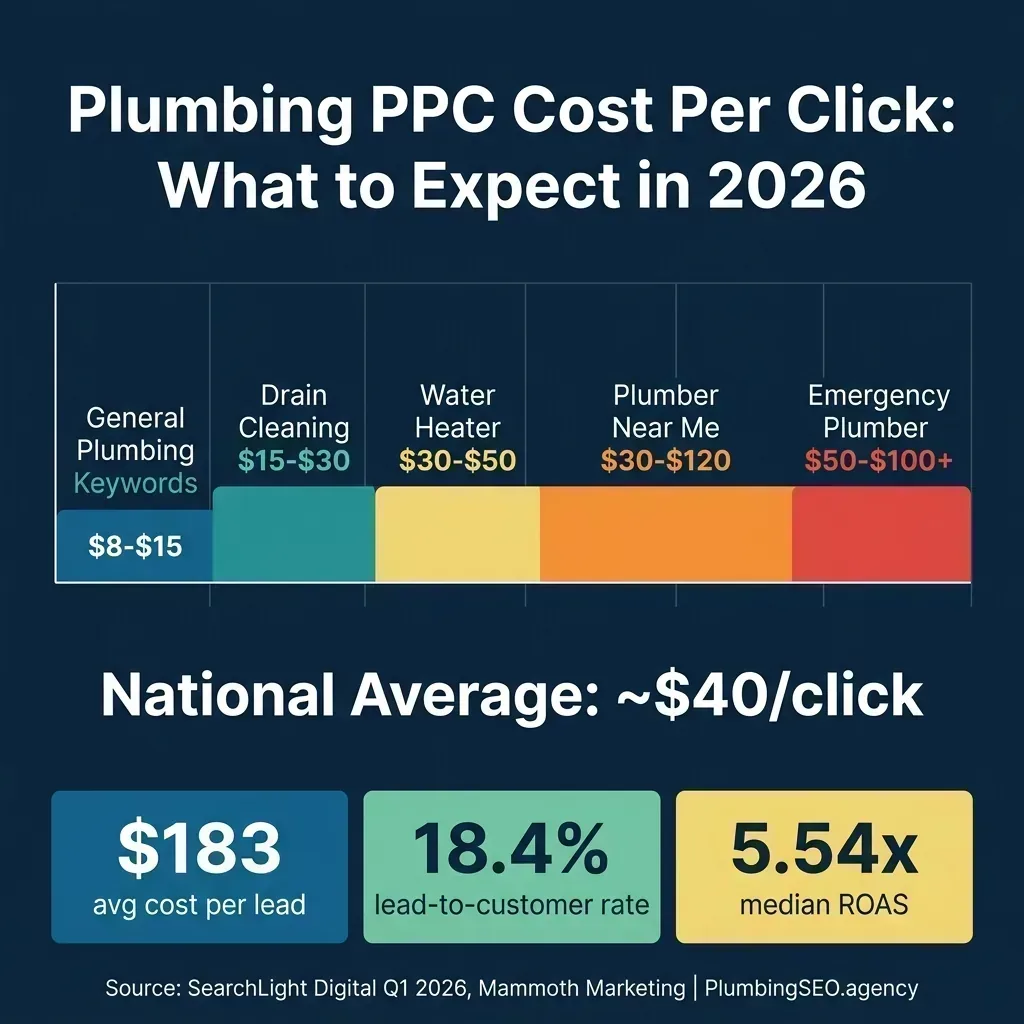
Source: SearchLight Digital Q1 2026, Mammoth Marketing
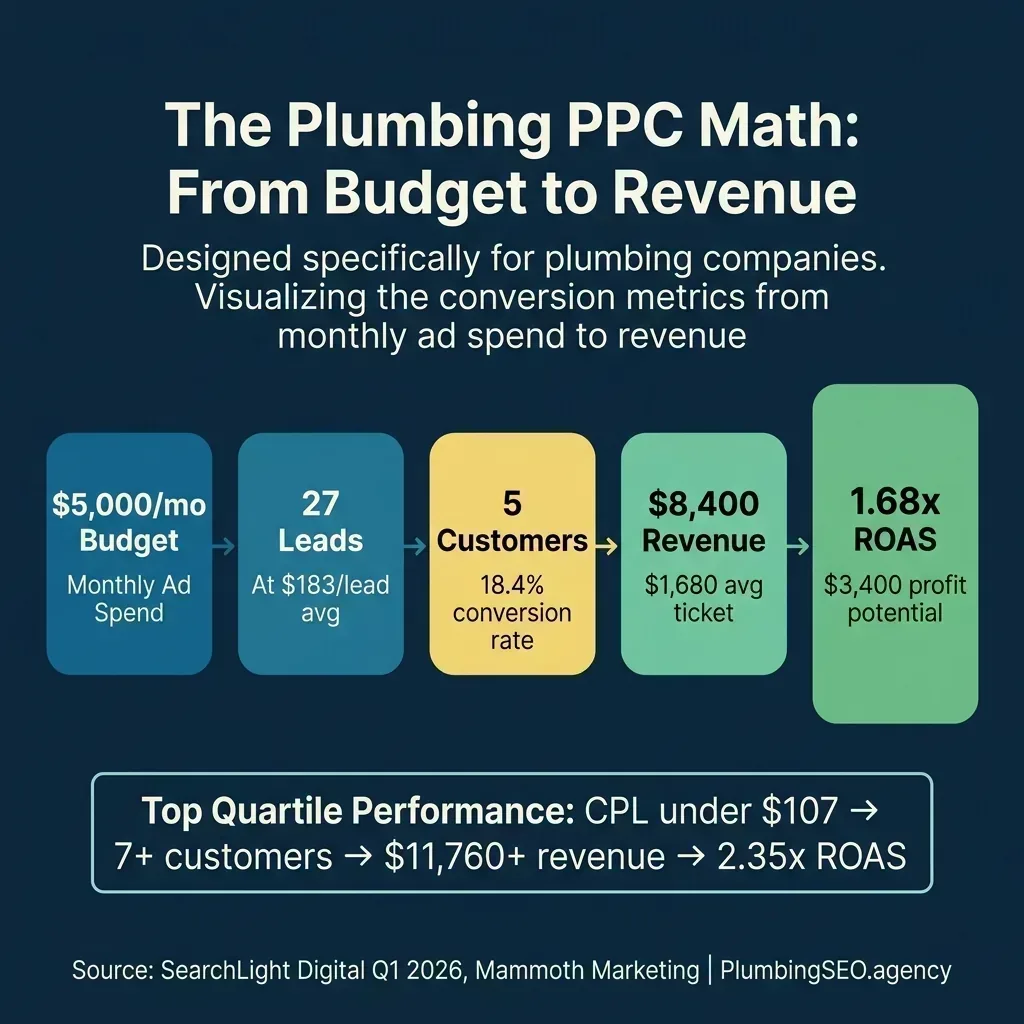
Those numbers can feel steep, but context matters. A single plumbing job averages $1,680 in revenue. If your ad spend brings in even one customer for every $333 spent (the current median), you are still ahead. The real question is not "how much does a click cost" but "how much does a paying customer cost." For a full breakdown of ad spend, management fees, and budget tiers, read our complete PPC cost guide for plumbers.
What Is the Average Cost Per Lead for Plumbing Google Ads?
The average non-branded cost per lead for plumbing Google Ads is $183 as of Q1 2026, based on $14.6 million in observed spend across 524 plumbing contractors. Performance Max campaigns average $82 per lead, though lead quality from PMax is a common complaint among plumbers on Reddit.
That $183 is a median figure. The top 25% of plumbing advertisers pay under $107 per lead. The bottom 25% pay over $253. That gap usually comes down to campaign structure, keyword targeting, and landing page quality, not just budget size.
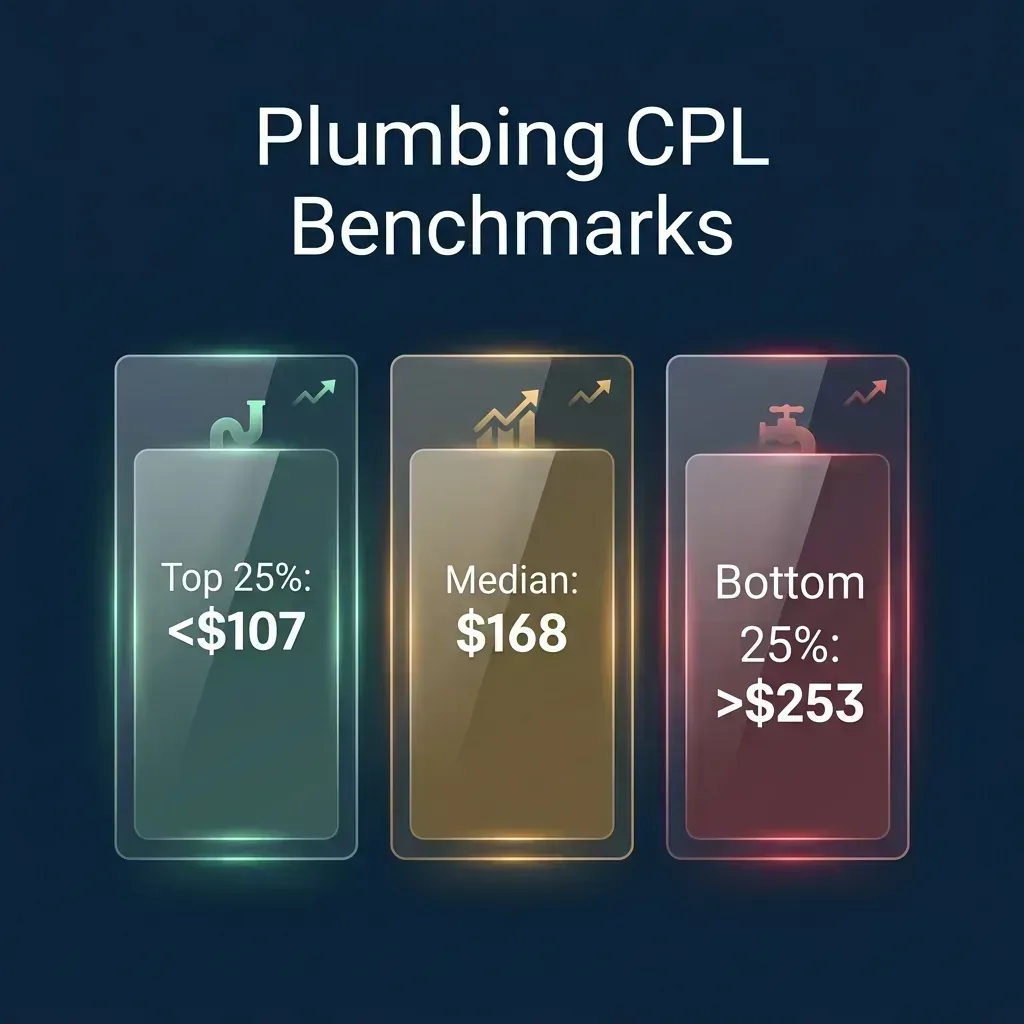
Source: Q1 2026 Plumbing PPC Benchmarks
Does Cost Per Lead Vary by Plumbing Service?
Yes, plumbing cost per lead varies significantly by service type. General plumbing campaigns average $161 per lead, drain and sewer campaigns average $166, and water heater campaigns are the most expensive at $256 per lead.
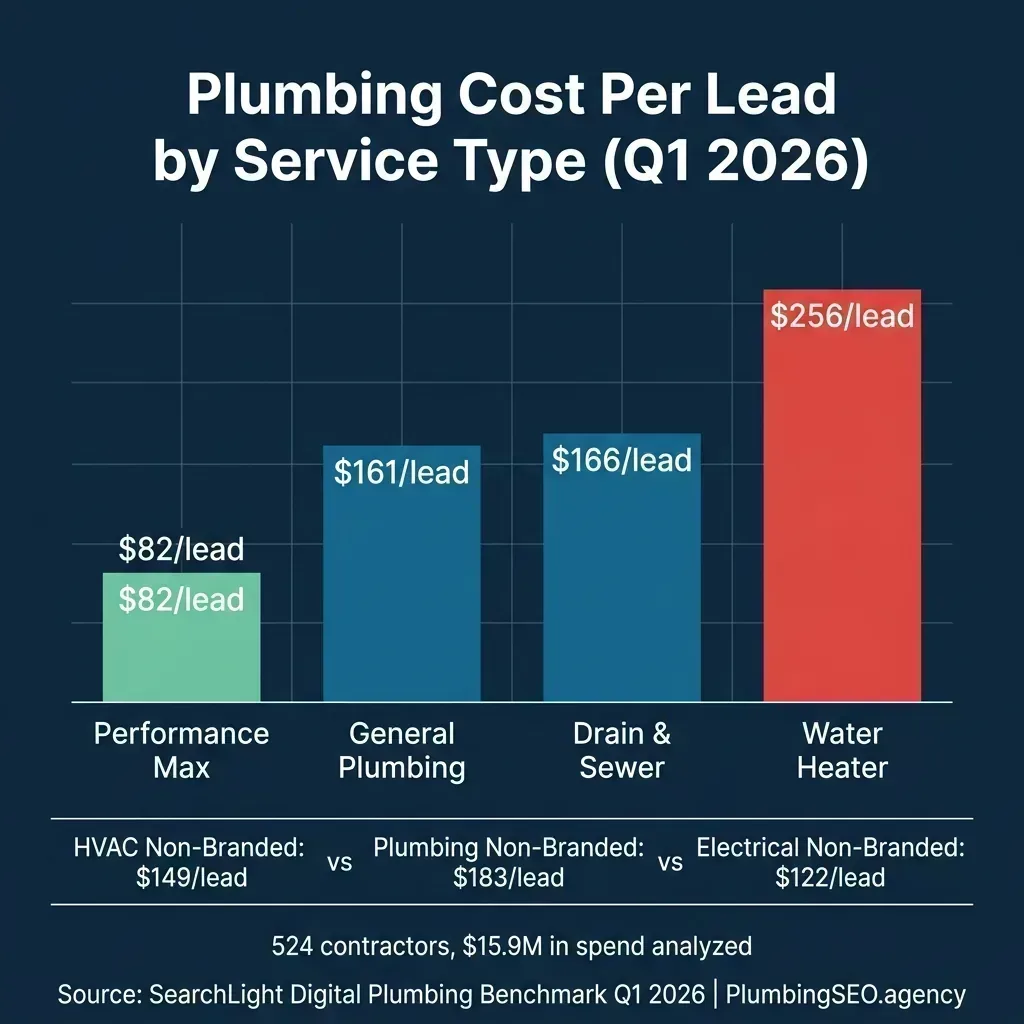
Source: SearchLight Digital Plumbing Benchmark Q1 2026
Water heater campaigns cost more because the keywords are more competitive and the jobs are higher ticket. A water heater replacement can run $2,000 to $5,000, so advertisers are willing to bid more aggressively. If you are running a tight budget, general plumbing and drain campaigns give you more leads per dollar.
What Is a Good Cost Per Lead for Plumbers?
A good cost per lead for plumbers depends on your average ticket and profit margin, but anything under $107 puts you in the top 25% of plumbing advertisers. The median is $168, and anything above $253 signals room for improvement.
Here is the math that actually matters. If your average plumbing job brings in $1,680 and your net margin is around 22%, each job generates roughly $370 in profit. If 18% of your leads become paying customers (that is the median), your cost per lead needs to stay under about $67 to be profitable on the first job alone.
The Q1 2026 data shows most plumbers are above that $67 threshold. That does not mean PPC is unprofitable. It means you need to factor in customer lifetime value. A customer who calls you for a drain cleaning today might call again for a water heater replacement next year, and refer their neighbor in between.
How Much Does It Cost to Acquire a Paying Plumbing Customer Through Google Ads?
The median cost to acquire a paying plumbing customer through Google Ads is $333, based on Q1 2026 data from SearchLight Digital. The top 25% of advertisers acquire customers for under $196, while the bottom 25% pay over $576 per customer.
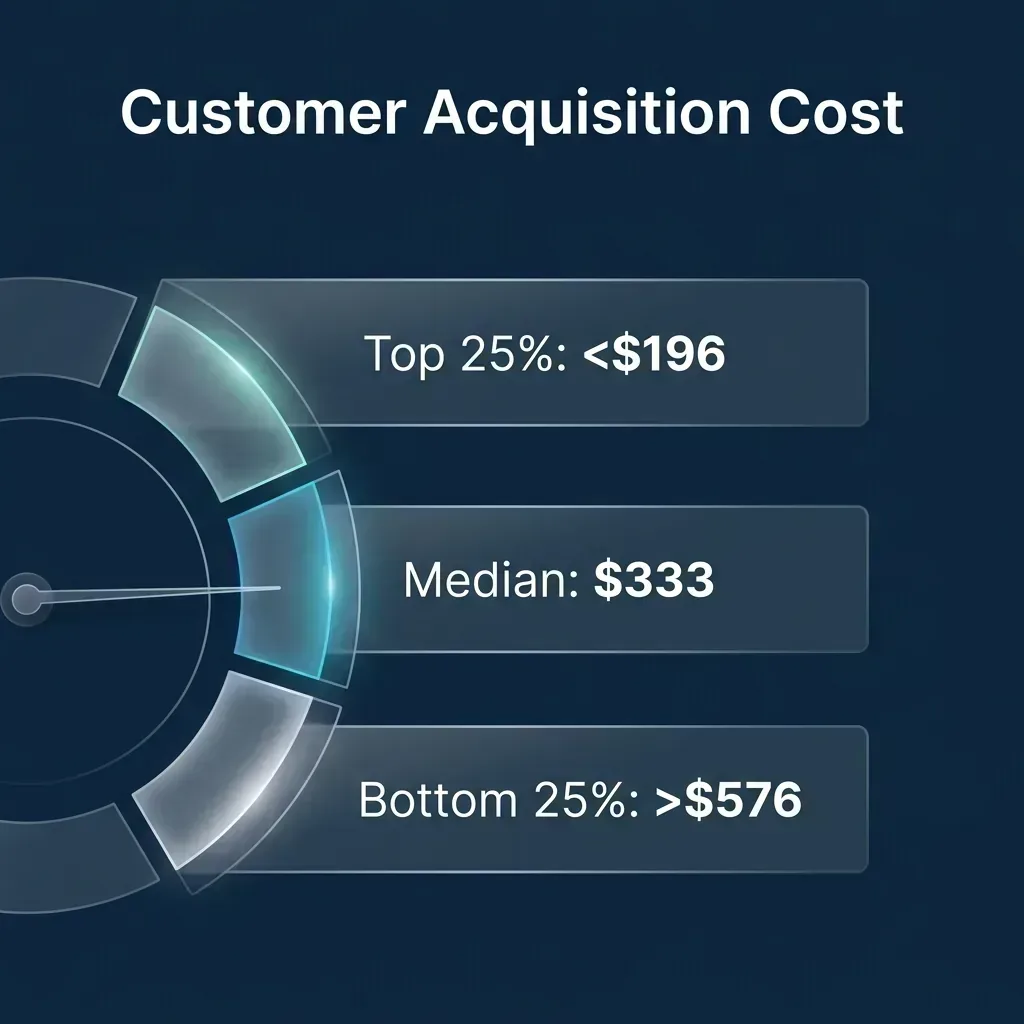
Source: Q1 2026 Plumbing PPC Benchmarks
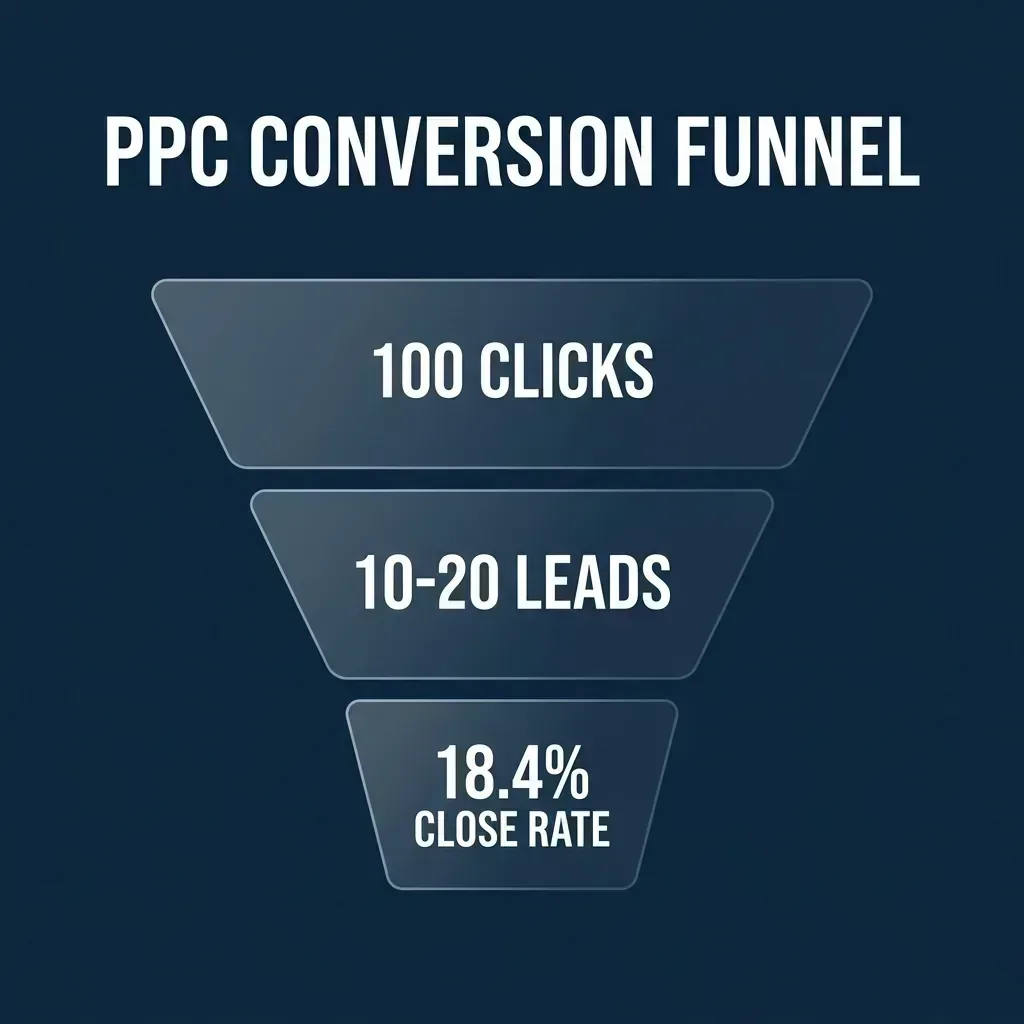
This metric matters more than cost per lead because not every lead turns into a job. The median plumbing advertiser converts 18.4% of leads to paying customers. So out of 10 leads, roughly 2 become booked jobs. If you can push that conversion rate higher through better call handling and faster follow-up, your acquisition cost drops without spending an extra dollar on ads.
What Is a Good Monthly PPC Budget for a Plumbing Company?
A practical starting PPC budget for a plumbing company is $1,000 to $2,000 per month for a single service area. The typical plumbing contractor in benchmark data spends $14,206 per month on Google Ads total, with about $5,055 going to plumbing-specific non-branded campaigns.
Source: SearchLight Digital Q1 2026, Mammoth Marketing
If you are just getting started, $30 per day per city is a reasonable floor. That comes to about $900 per month per service area. At $40 per click, that is 22 to 23 clicks per month. At a 15% conversion rate, you are looking at 3 to 4 leads. Not huge volume, but enough to test whether your campaigns and landing pages are working before you scale.
What Is a Good ROAS for Plumbing Google Ads?
A good ROAS (return on ad spend) for plumbing Google Ads is 4:1 or higher, meaning you earn $4 for every $1 spent on ads. The median plumbing ROAS is 5.54x according to Q1 2026 benchmark data, meaning every dollar generates $5.54 in closed revenue.
Google's own estimate is more aggressive, suggesting businesses earn $8 for every $1 spent. That number varies wildly by industry and campaign quality. For plumbers, the 5.54x median is a more realistic target. If you are below 4:1, look at your landing pages, keyword match types, and whether you are properly tracking conversions back to revenue.
How Long Does It Take for PPC to Work for Plumbers?
PPC campaigns can start driving traffic immediately, but meaningful, optimized results take 2 to 4 weeks of data collection and 1 to 3 months of refinement. Your ads can go live within hours, but the platform needs time to learn which searches, times, and audiences convert best for your plumbing business.
In the first two weeks, you are mostly buying data. Which keywords get clicks, which ads get ignored, which landing pages convert, which calls turn into jobs. That learning period is not wasted spend. It is the foundation for everything that comes after. Plumbers who pull the plug after one week of "no results" never give the algorithm enough data to optimize.
What Are the Best PPC Keywords for Plumbers?
The best PPC keywords for plumbers are high-intent, service-specific phrases like "emergency plumber near me," "drain cleaning [city]," and "water heater repair [city]." These keywords target homeowners with immediate problems who are ready to call, not browsers doing general research.
Keyword costs vary dramatically by intent:
- General plumbing keywords ($8 to $15/click): "plumbing services," "licensed plumber." Lower intent, lower cost.
- Service-specific keywords ($15 to $50/click): "drain cleaning," "water heater installation," "sewer line repair." Moderate intent.
- "Near me" keywords ($30 to $120/click): "plumber near me," "emergency plumber near me." Highest intent, highest cost, highest conversion.
In my experience, the sweet spot for most plumbing companies is a mix of service-specific keywords with city modifiers. "Drain cleaning Dallas" converts better than just "drain cleaning" because it already qualifies the searcher by location.
Should Plumbers Use Google Ads or Local Service Ads?
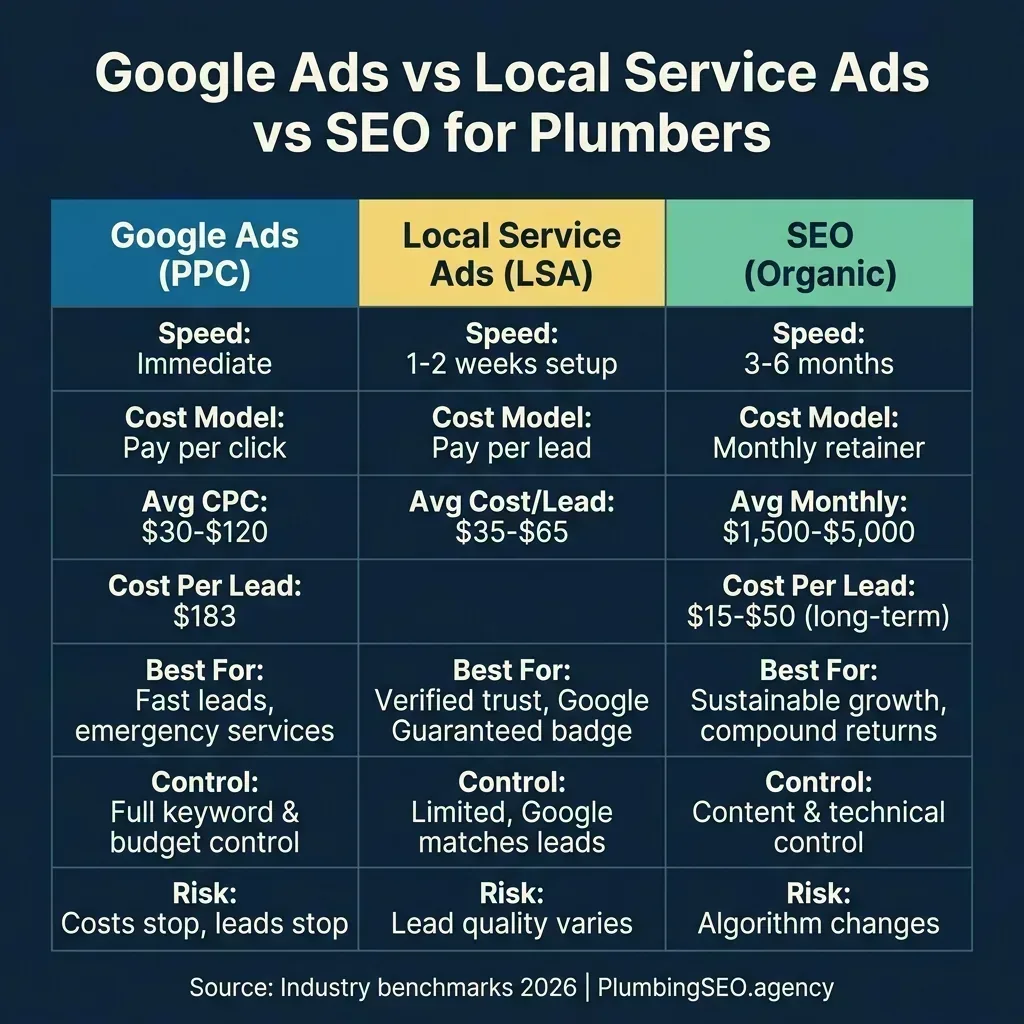
Plumbers should ideally use both Google Ads and Local Service Ads (LSAs), as they serve different roles. LSAs cost $35 to $65 per lead with a Google Guaranteed badge, while standard Google Ads average $183 per lead but offer more targeting control.
Source: Industry benchmarks 2026
LSAs are simpler. Google matches you with leads based on your service area and categories. You pay per lead instead of per click, and the Google Guaranteed badge builds instant trust. The downside is less control. You cannot pick specific keywords, and lead quality can be inconsistent.
Google Search Ads give you full control over keywords, ad copy, bidding, and landing pages. That control means more optimization opportunities, but also more room for expensive mistakes if campaigns are not managed properly. For most plumbing companies, LSAs handle the steady baseline of leads while Google Ads let you target specific high-value services or competitive keywords.
Is PPC Better Than SEO for Plumbers?
PPC delivers immediate leads while SEO builds long-term visibility that compounds over time. Neither is universally "better." Most successful plumbing companies use both, with PPC for fast results and SEO for sustainable, lower-cost lead generation.
Here is the practical difference: PPC is like renting a billboard. It works the day you pay for it, but the moment you stop paying, the leads stop. SEO is more like buying the building. It takes months to build, but once your Google Maps listing and organic pages rank, you get leads without paying per click.
The data supports using both. PPC drives immediate traffic while SEO builds your organic presence. Over 12 months, the SEO cost per lead typically drops to $15 to $50 while PPC stays around $183. But you need PPC to keep the phone ringing while SEO ramps up.
What Is Quality Score and Why Does It Matter for Plumbers?
Quality Score is Google's 1-to-10 rating of your ad's relevance, expected click-through rate, and landing page experience. A higher Quality Score directly lowers your cost per click and improves your ad position, meaning you can outrank competitors while paying less.
For plumbers, Quality Score comes down to three things. First, your ad copy needs to match the search intent. If someone searches "emergency drain repair," your ad should say "emergency drain repair," not just "plumbing services." Second, your landing page needs to match the ad. A general homepage will not perform as well as a dedicated drain repair page with a clear call-to-action. Third, your click-through rate needs to be competitive. If people see your ad and do not click it, Google assumes it is not relevant and raises your costs.
What Are the Biggest PPC Mistakes Plumbers Make?
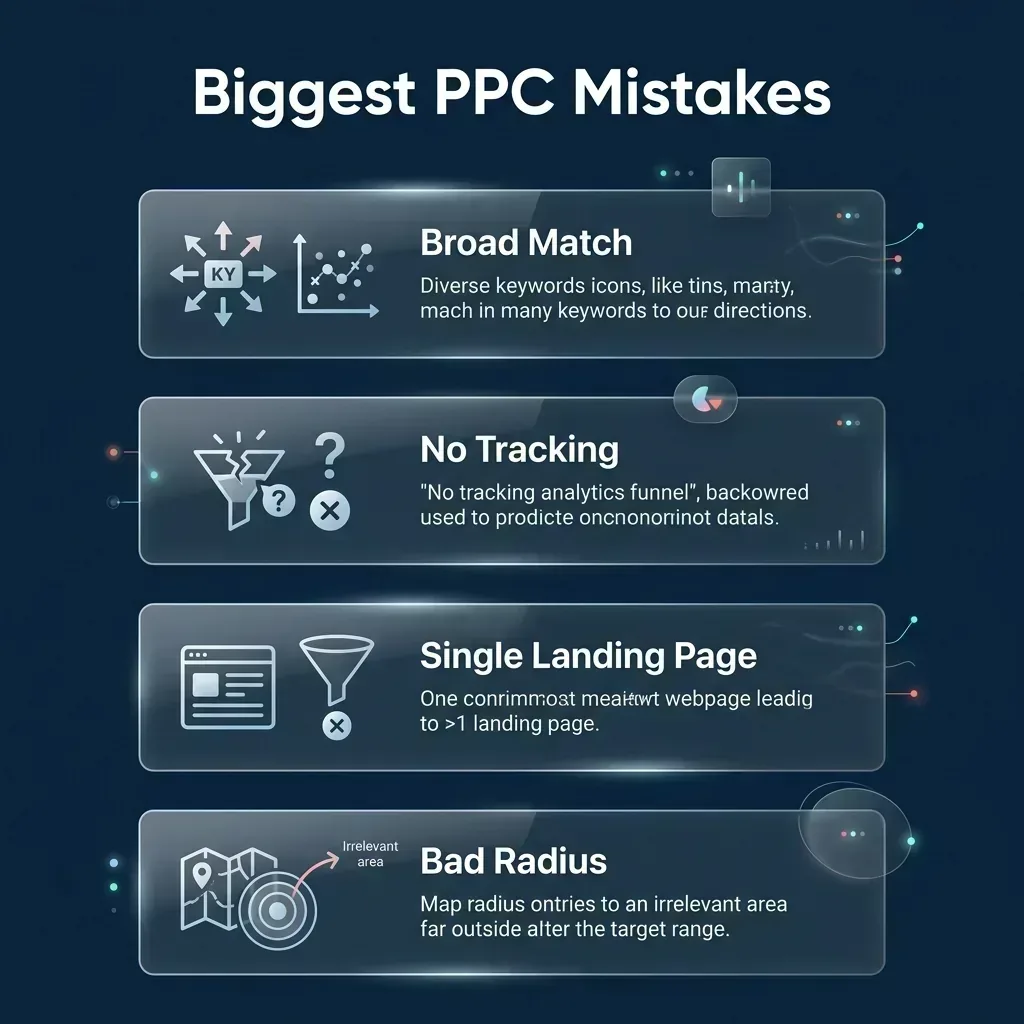
The most common PPC mistakes plumbers make are using broad match keywords without negative keyword lists, sending all traffic to a single landing page, and not tracking which ads actually produce booked jobs.
Source: 2026 PPC Account Audit Data
Here are the specific mistakes we see most often:
- Broad match keywords without negatives: A keyword like "plumbing" will match searches for "plumbing supply store," "plumbing school near me," and "plumbing salary." You pay for every one of those clicks. Use phrase or exact match, and build a negative keyword list from day one.
- No call tracking: If you are not tracking which ad and keyword produced each phone call, you are flying blind. You have no way to know which campaigns are making you money and which are draining your budget.
- One landing page for everything: Sending drain cleaning clicks and water heater clicks to the same homepage kills conversion rates. Each service needs its own landing page with targeted messaging.
- Skipping location targeting: If your ads show up outside your service area, you are paying for clicks from people you cannot serve. Tighten your radius.
- Not reviewing search term reports: Google matches your keywords to searches you might not expect. Review these weekly and add irrelevant terms as negatives. The plumbers who check their search terms regularly pay significantly less per lead.
Should Plumbers Hire a PPC Agency or Do It Themselves?
Plumbers with monthly ad budgets under $2,000 can often manage Google Ads themselves using platforms like Google Ads Express. Once budgets exceed $2,000 to $3,000 per month, a professional agency typically delivers better results through daily optimization and strategic testing.
The DIY path works if you have time to learn the platform, check your campaigns weekly, and are comfortable with the learning curve. The risk is wasted spend during that learning curve. A typical PPC agency charges 15% to 25% of ad spend or a flat fee of $300 to $600 per month for small local clients. That fee needs to be justified by better campaign performance, not just convenience.
Here is the honest test: if you are spending $2,000 per month on ads and an agency charges $500 per month to manage them, they need to improve your results by at least 25% just to break even on their fee. Ask for specific performance commitments before signing.
What Is Performance Max and Should Plumbers Use It?
Performance Max (PMax) is Google's automated campaign type that runs ads across Search, Display, YouTube, Gmail, and Maps simultaneously. For plumbers, PMax campaigns average $82 per lead, which is significantly cheaper than standard search campaigns at $183 per lead, but lead quality is frequently lower.
The PMax trade-off is real. One plumbing advertiser on Reddit reported getting "50+ dirt cheap leads and all were garbage." The platform optimizes for lead volume, not lead quality. If your PMax campaign is generating form fills from tire-kickers instead of phone calls from homeowners with burst pipes, the lower CPL is meaningless.
If you use PMax, run it alongside standard search campaigns, not instead of them. Use PMax for broader awareness and remarketing. Keep your high-intent emergency and service keywords in dedicated search campaigns where you have full control.
How Do I Track If My PPC Campaign Is Actually Working?
Track PPC performance by monitoring four metrics: cost per lead (CPL), cost per paying customer (CAC), return on ad spend (ROAS), and booking rate. Cost per lead alone is not enough because it tells you what you paid to make the phone ring, not what happened after.
Set up call tracking from day one. Every phone call from an ad should be recorded and attributed to a specific keyword and campaign. Use form submission tracking for web leads. Then connect those leads to your CRM or job management software to track which leads became booked jobs and how much revenue each job generated.
The plumbing companies that actually know whether PPC is profitable are the ones tracking beyond the click. Two contractors can both have a $175 cost per lead and be in completely different financial positions. The one converting 25% of leads at a $2,500 average ticket is thriving. The one converting 12% at $1,200 tickets is barely breaking even.
What Conversion Rate Should Plumbers Expect from PPC?
Plumbers should expect a 10% to 20% conversion rate on well-optimized PPC landing pages, meaning 10 to 20 out of every 100 clicks turn into leads (calls or form submissions). The median lead-to-paying-customer conversion rate is 18.4% across the plumbing industry.
Source: Q1 2026 Plumbing PPC Benchmarks
If your conversion rate is below 10%, look at your landing page first. Common conversion killers for plumbers include slow page load speed, no click-to-call button above the fold, no reviews or trust signals visible, and sending all traffic to the homepage instead of service-specific pages. A 2% conversion rate, as one plumber reported on Reddit, is a clear sign the landing page needs work, not the ads.
How Does Plumbing PPC Compare to HVAC PPC Costs?
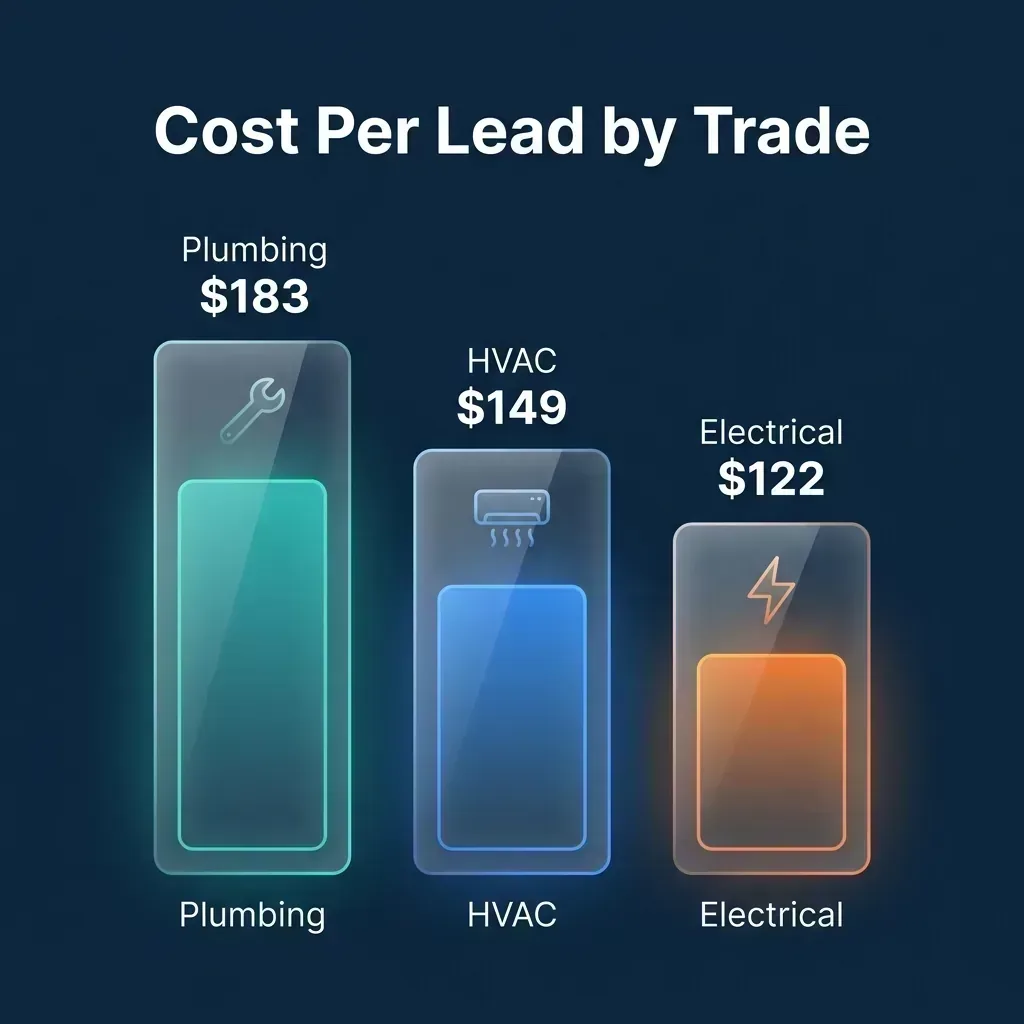
Plumbing non-branded cost per lead ($183) runs about 23% higher than HVAC non-branded cost per lead ($149), based on Q1 2026 data. However, plumbing typically has higher urgency and same-day conversion rates, which can offset the higher lead cost.
Source: Q1 2026 Trade Benchmarks
Electrical PPC is the cheapest of the three trades at $122 per lead. The differences come down to keyword competition and the nature of each service. Plumbing emergencies are more common and more urgent than most HVAC calls, which drives up bidding competition. But plumbing also has stronger same-day close rates, meaning fewer leads are lost to "I will think about it."
What Are Negative Keywords and Why Do Plumbers Need Them?
Negative keywords are search terms you tell Google NOT to show your ads for. They prevent your plumbing ads from appearing when someone searches for irrelevant things like "plumbing jobs," "plumbing school," "plumbing supply store," or "DIY plumbing."
Without negative keywords, you will waste a significant portion of your budget on clicks that will never turn into jobs. Here are the most common negative keywords every plumber should add immediately:
- Job seekers: jobs, career, salary, hiring, apprentice, apprenticeship, resume, indeed
- DIY searchers: DIY, how to, tutorial, video, YouTube, home depot, lowes
- Suppliers/parts: supply, store, wholesale, parts, fittings, pipe, pvc
- Education: school, course, certification, license, training, degree, trade school
- Unrelated: free, cheap, coupon, discount (unless you run promotions)
Review your search term report weekly for the first month, then bi-weekly. You will find new irrelevant search terms that slip through. Adding them as negatives is one of the fastest ways to lower your cost per lead without changing anything else.
Do Plumbers Need Separate Landing Pages for PPC?
Yes, plumbers should create dedicated landing pages for their highest-spend PPC campaigns instead of sending all traffic to their homepage. A service-specific landing page typically converts 2 to 3 times better than a general homepage because the message matches the search intent.
If someone clicks an ad for "emergency drain cleaning," they should land on a page about emergency drain cleaning with a clear phone number, service description, trust signals (reviews, licensing info), and a strong call to action. Landing on a homepage that talks about 15 different services forces the visitor to hunt for what they need, and most will leave instead.
At minimum, create dedicated landing pages for your top 3 to 5 highest-spend keyword groups. Your existing service pages can work as landing pages if they are well-optimized, but they often need modifications for PPC. Remove navigation menus that let visitors wander away, add a sticky call button, and make the phone number impossible to miss.
What Is Remarketing and Should Plumbers Use It?
Remarketing shows ads to people who have already visited your website but did not call or submit a form. For plumbers, remarketing costs $0.50 to $4 per click, significantly less than cold search ads, and can recover leads that were not ready to commit on the first visit.
Not every homeowner with a plumbing issue calls the first company they find. Some compare prices, read reviews, or put it off until the drip becomes a flood. Remarketing keeps your name in front of those people as they browse other websites, watch YouTube, or check their Gmail. When they are finally ready to call, your company is the one they remember.
Remarketing works best when paired with a clear offer or urgency. "Still dealing with that drain problem? Call for same-day service" performs better than generic brand ads. Set up remarketing audiences for your main service pages and keep the ads running with a small daily budget.
Should Plumbers Run PPC and SEO at the Same Time?
Yes, running PPC and SEO simultaneously is the most effective approach for plumbing companies. PPC provides immediate leads while SEO compounds over time, and data from PPC campaigns directly improves your SEO strategy by revealing which keywords and messages convert best.
Here is how the two work together. PPC search term reports show you exactly what homeowners type when they need a plumber. That data informs your keyword strategy for organic content. Your SEO pages test which headlines and messaging convert, which improves your ad copy. And when you rank organically AND have an ad at the top, you dominate the search results page.
The smart play is to start with PPC for immediate leads, invest in SEO simultaneously for long-term growth, and gradually shift budget from PPC to SEO as your organic rankings improve. Over time, SEO brings your blended cost per lead down while PPC keeps the phone ringing during the months it takes to rank. If you want help building that kind of strategy, our complete marketing guide breaks down every channel side by side.
What Are the Key Benefits of Pay-Per-Click Advertising for Plumbers?
Pay-per-click advertising offers several distinct benefits that make it particularly effective for plumbing companies. Unlike SEO which takes months to build momentum, PPC delivers measurable results from day one. Here are the key benefits of PPC advertising for plumbers:
- Immediate visibility. Your ads appear at the top of search results the same day you launch. For a new plumbing company or one entering a new service area, this is invaluable.
- Precise targeting. You control exactly which keywords trigger your ads, which geographic areas see them, and what times of day they run. A plumber in Dallas can target "emergency drain repair" only within a 15-mile radius during peak hours.
- Measurable ROI. Every click, call, and conversion is tracked. You know exactly what you spent and what you earned. The median plumbing ROAS of 5.54x means most plumbers are profitable with PPC when managed properly.
- Budget control. You set daily and monthly spending limits. If you need to pause for a slow week or scale up during peak season, you adjust in minutes.
- Competitive advantage. In markets where organic rankings are dominated by established competitors, PPC lets you appear above them immediately while your SEO strategy builds.
- Data for SEO. PPC search term reports reveal exactly what homeowners type when they need a plumber. This data directly improves your organic keyword strategy and content planning.
- Seasonal flexibility. Ramp up ads for water heater campaigns in winter and sewer line campaigns in spring. Adjust messaging and budget to match seasonal demand patterns.
- Testing ground. Test different headlines, offers, and calls-to-action quickly. What converts best in ads often converts best on your website and marketing materials too.
The most important benefit for plumbing owners is the combination of immediacy and measurability. Unlike a billboard or a mailer, you know within days whether PPC is generating calls worth more than you are spending. That feedback loop lets you optimize fast and stop wasting money on what does not work.
Quick Answers: Plumbing PPC at a Glance
How much does a click cost for plumbing Google Ads?
Plumbing Google Ads cost between $8 and $120+ per click depending on keyword type. General plumbing keywords run $8 to $15, service-specific keywords run $15 to $50, and emergency or "near me" keywords can exceed $100 per click. The national average is approximately $40 per click.
What is the average plumbing cost per lead in 2026?
The average non-branded cost per lead for plumbing Google Ads is $183 as of Q1 2026, based on data from 524 contractors and $14.6 million in spend. Performance Max campaigns average $82 per lead. The top 25% of advertisers pay under $107 per lead.
What is a good ROAS for plumbing Google Ads?
A good ROAS (return on ad spend) for plumbing Google Ads is 4:1 or higher. The median plumbing ROAS is 5.54x, meaning every dollar spent generates $5.54 in closed revenue. The median cost per paying customer is $333 with an average ticket of $1,680.
How much should a plumber spend on Google Ads per month?
A practical starting budget is $1,000 to $2,000 per month for a single service area. The typical plumbing contractor spends $14,206 per month total on Google Ads, with about $5,055 allocated to plumbing-specific non-branded campaigns. Start at $30 per day per city and scale based on results.
Is PPC or SEO better for plumbers?
Neither is universally better. PPC delivers immediate leads but stops when you stop paying. SEO takes 3 to 6 months to build but produces leads at $15 to $50 each long-term. Most successful plumbing companies run both simultaneously, using PPC for immediate results while SEO compounds over time.
What is the difference between Google Ads and Local Service Ads for plumbers?
Google Ads charge per click ($30 to $120) and give you full keyword and bidding control. Local Service Ads (LSAs) charge per lead ($35 to $65) and include a Google Guaranteed badge. LSAs are simpler but offer less targeting control. Most plumbers benefit from running both.
Not Sure If Your PPC Is Working?
We audit plumbing PPC campaigns and SEO strategies side by side. If you are spending money on Google Ads and are not sure whether it is paying off, start with a free audit. We will show you exactly where your leads are coming from and where money is being wasted.
Get Your Free Plumbing Marketing Audit