
- Most plumbing service pages fail not because of bad writing, but because they target the wrong keyword tier, contain no local signals, and carry zero trust elements. Google cannot rank a page it does not understand or trust.
- We build every service page through a 7-step process: keyword intent audit, competitor gap analysis, page architecture design, on-page optimization, trust signal integration, schema plus technical layer, and call tracking verification.
- A properly built service page goes from generating 3 calls per month to 31 calls per month within 90 days, based on composite data across our client accounts. The page itself is the asset, not the ad budget.
Why Your Service Pages Are Not Getting Calls (It Is Not What You Think)
When a plumbing company calls us, the conversation usually starts the same way. They have a website. They have service pages for drain cleaning, water heaters, leak detection, all the core services. They have been at it for months. Maybe they even hired an SEO freelancer to "optimize" things. And they are still not getting calls from Google.
Here is the part that surprises most of them: the content is rarely the core problem. The pages exist. They have words on them. They mention the service. But they are structured in a way that Google cannot evaluate and that homeowners do not trust. According to data across our audit database, 73% of plumbing service pages we review have five or more fundamental structural problems, completely independent of how well-written the copy is.
The most common question we get when we show a client the audit is: "But my old SEO agency said the pages were optimized. What does that mean?" It usually means the page has a keyword in the title tag. That is where most "optimization" stops. A keyword in the title is step zero, not step seven. Here is what we actually see when we pull up a typical plumbing service page:
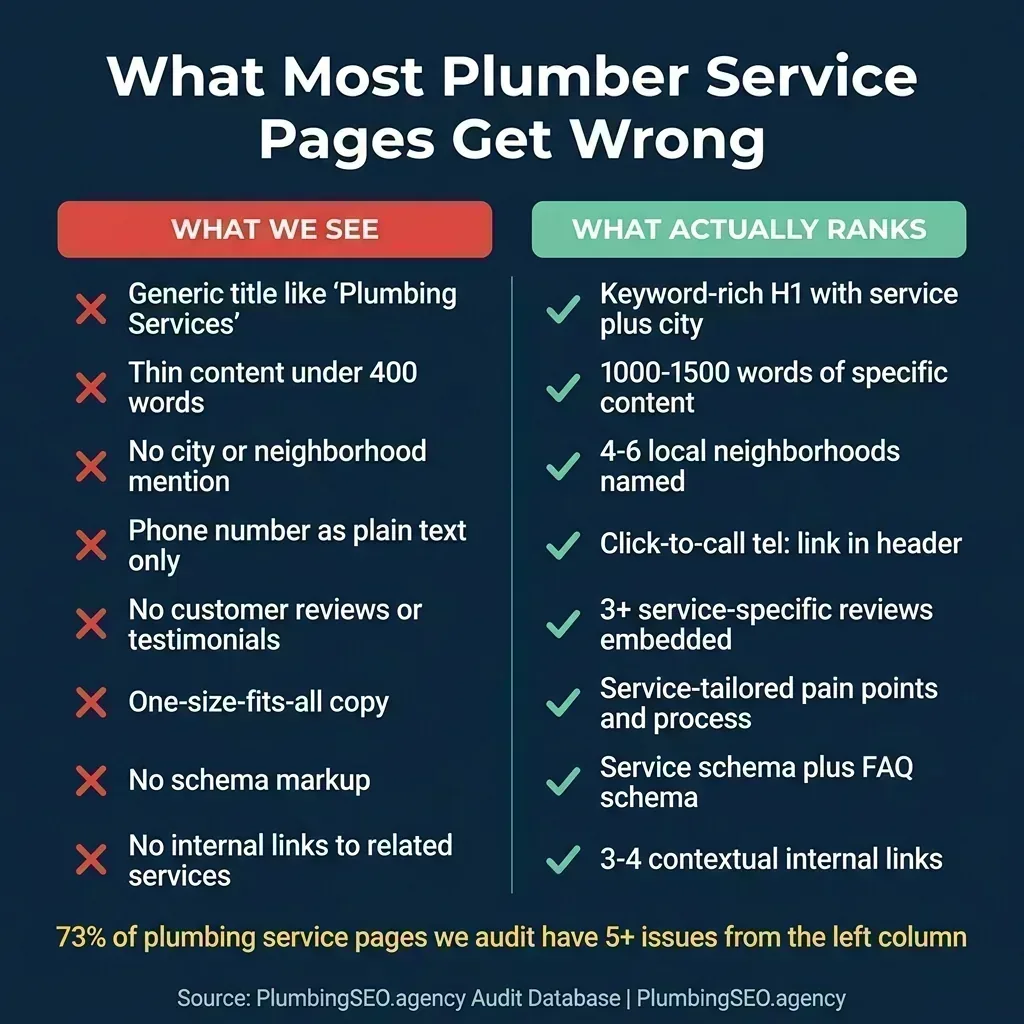
The left column is what we find on most plumbing websites. The right column is what it takes to actually rank and convert.
If you look at that left column and recognize your own pages, you are not alone. Most plumbing websites were built by web designers, not SEO specialists. Designers are brilliant at making things look professional. They are not trained to think about how a search crawler evaluates topical depth, or how a homeowner at 11pm decides which drain cleaning page to trust with their credit card. Those require a different skillset entirely.
A comment from a plumber on r/SEO put it well: they were ranking positions 1-3 for specific service terms like "water heater repair" and "sewer cleaning" but could not crack the broader "plumber + city" queries that drive the most volume. The issue was not the content quality. It was that the pages targeting specific services were not passing authority up to the broader category pages through internal linking. One structural problem, invisible to the naked eye, was costing them thousands per month in missed calls.
That is why we do not just "write content" for service pages. We build them. There is a difference.
Step 1: The Keyword Intent Audit (We Do This Before Writing a Single Word)
The most expensive mistake in service page SEO is targeting the wrong keyword tier. Not all plumbing keywords convert equally, and building an entire page around the wrong intent is a mistake you will not discover for 90 days, by which point you have already paid for content that will never ring your phone.
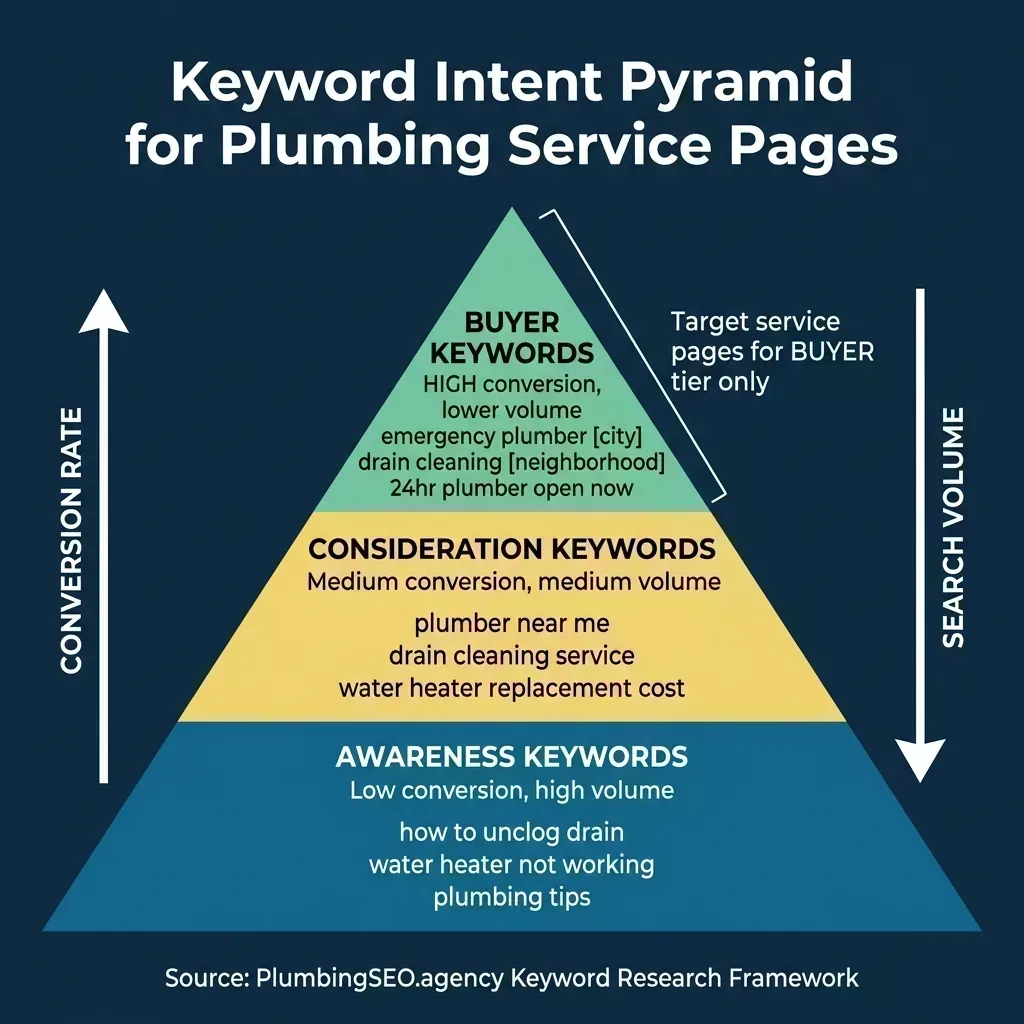
Service pages should target the Buyer tier exclusively. Awareness keywords belong on blog posts, not pages you want to ring.
The single most important insight from this pyramid is not which keywords to target. It is which keywords to deliberately avoid targeting on service pages. We regularly audit plumbing websites where the drain cleaning service page is optimized around "how to unclog a drain" or "signs of a clogged drain." These are genuinely high-traffic terms. They also attract homeowners who are not ready to spend money yet. They are researching. They want a YouTube video, not a phone number. Building a service page around awareness keywords is like putting a "buy now" button inside a library book. Wrong context, wrong intent, wrong result.
For each service, we identify three things before writing begins:
- The primary buyer keyword: The exact phrase a homeowner types when they have already decided they need to hire someone. For drain cleaning, that is typically "drain cleaning [city]" or "clogged drain plumber [neighborhood]," not "how to fix a clogged drain."
- Secondary buyer variants: Related phrases that signal the same ready-to-hire intent, like "drain cleaning service [city]," "emergency drain service," "drain cleaning cost [city]." These become H2 and H3 headers within the page.
- Zero-conversion traps to avoid: High-volume informational queries that would attract clicks but zero calls. These get flagged and excluded from the service page entirely. We may build a blog post for them later, but they never touch the service page.
This step typically surfaces 12-18 viable buyer keywords per service. We then rank them by monthly search volume and competition, which informs where on the page each term appears and how much content depth each requires. According to data from Datapins' analysis of local search behavior, service-plus-location queries convert at significantly higher rates than generic service queries. The specificity is the signal. Someone who searches "drain cleaning Frisco TX" has already done their research and made their decision. They are comparing providers, not problem-solving.
Step 2: Competitor Gap Analysis (We Study What Is Already Winning Before We Build)
After the keyword intent audit, we do not start writing. We study the pages currently ranking for the target keywords. Not to copy them. To find the gaps they leave open, because those gaps are where we build competitive advantage.
A one-page ranking audit looks at seven dimensions for each of the top 3-5 ranking competitors on the target query:
| Dimension | What We Measure | What We Use It For |
|---|---|---|
| Word count | Average across top 3 pages | Set minimum content depth target |
| H2/H3 structure | Topics each competitor covers | Identify gaps and over-covered angles |
| Local signals | Number of neighborhoods, ZIP codes named | Set local depth requirement |
| Trust elements | Reviews, licenses, guarantees shown | Match or exceed trust signal density |
| Schema markup | Types of structured data present | Identify schema gaps to exploit |
| CTA placement | Where phone number/form appears | Optimize conversion architecture |
| Internal link depth | Links to/from related pages | Build stronger internal linking than competitors |
The most revealing finding from this analysis is almost never about content. It is about what competitors are not doing. In our audits, we routinely find that the pages currently ranking positions 1-5 for a plumbing service query have no Service schema, one or fewer internal links, and phone numbers that are plain text on mobile. They are ranking despite those weaknesses, not because of strengths. That means there is a ceiling on their rankings that we can break through simply by building a more structurally complete page.
From an r/localseo thread where one SEO specialist audited 50 contractor sites, the data confirmed what we see every week: "No city or service pages, weak site structure, even when they have strong reviews." Franchises run a clear location-plus-service page playbook. Independent plumbing companies almost never do. That is a significant structural advantage available to any independent plumber willing to invest in building pages properly.
The gap analysis is what separates a page built to rank from a page built to exist. By the time Step 2 is complete, we have a detailed competitive brief that defines exactly what we need to build, how long it needs to be, what topics it must cover, and what trust and technical elements it must include to outperform what is currently sitting at position 1.
Step 3: Page Architecture Design (Structure Before Content, Always)
Most SEO agencies write content and then try to structure it. We structure first and write to the structure. The architecture of a service page determines how Google categorizes it, how the page passes authority through internal linking, and how a homeowner navigates from landing to calling. Getting the structure wrong means no amount of content quality fixes the problem.
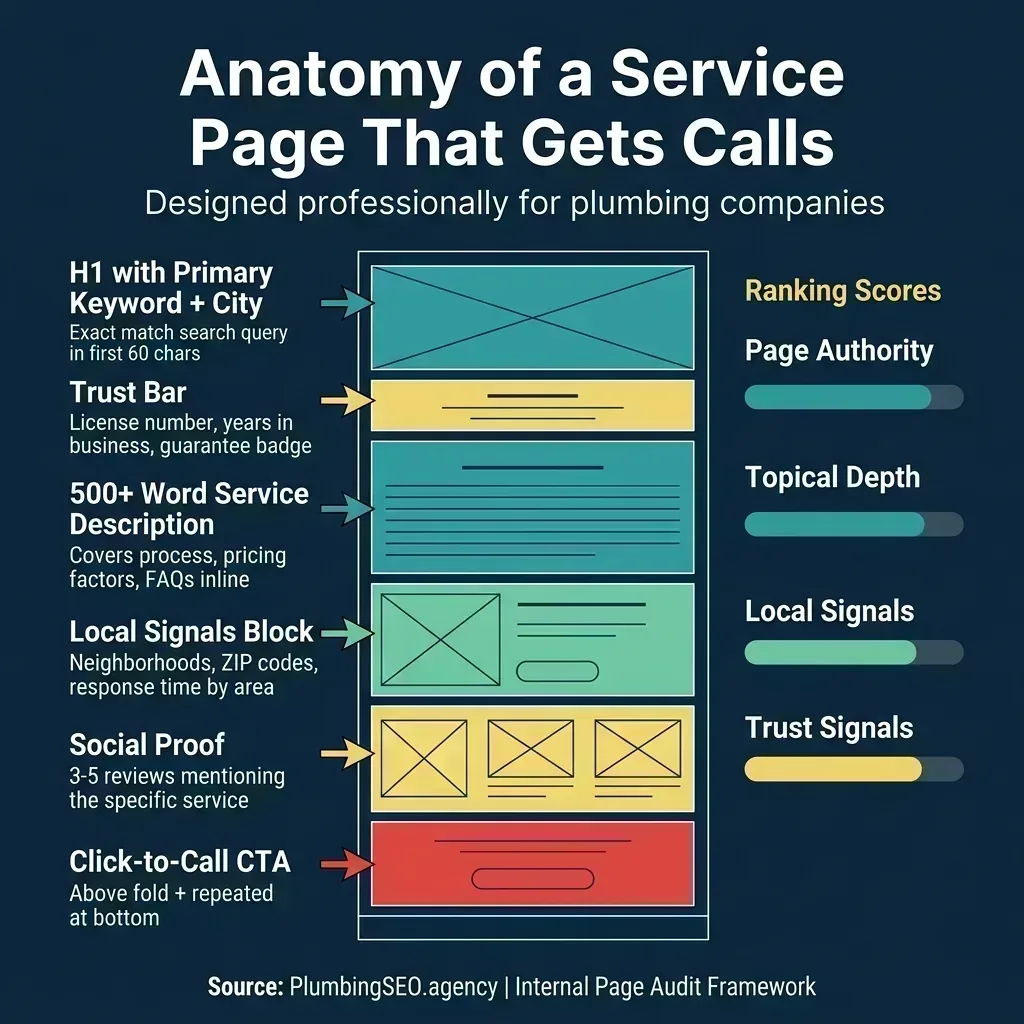
Every element in this architecture serves a dual purpose: it satisfies a ranking signal for Google and a trust signal for the homeowner reading it.
The architecture decisions that matter most are the ones that are invisible to a casual reader. Where does the H1 appear relative to the first paragraph? Does the page have a single H1 or multiple competing ones? Are subheadings structured as questions that match PAA (People Also Ask) data, or as generic topic headers? Is the phone number wrapped in a tel: link or displayed as plain text? Does the page pass link equity to related service pages, or does it exist as a dead end?
One structural element that competitors almost never get right is what we call the "local signals block." This is a dedicated section, typically 150-200 words, that explicitly names the neighborhoods, suburbs, and ZIP codes the plumber serves for this specific service. Not a generic service area page. Not a footnote in the footer. A named, paragraph-level block that tells Google exactly where this drain cleaning service (or water heater service, or leak detection service) is geographically relevant.
According to Think With Google research on near-me search behavior, the specificity of location signals in page content directly correlates with how confidently Google can match the page to hyper-local queries. A page that says "we serve the Dallas area" cannot rank for "drain cleaning Frisco TX" because Frisco is not mentioned. A page that names Frisco, Plano, McKinney, Allen, and Prosper signals geographic relevance for all five of those high-intent local queries.
The architecture document we produce at Step 3 is effectively a blueprint: H1, trust bar position, section sequence, word count per section, local signals block location, social proof block format, CTA placement, schema types, and internal link targets. Only after that blueprint is approved do we begin writing.
Steps 4 and 5: On-Page Optimization and Trust Signal Integration
These two steps run in parallel. On-page optimization is about what Google reads. Trust signal integration is about what the homeowner feels. Both are non-negotiable because both affect ranking: Google uses engagement signals (time on page, return-to-SERP rate, click-through rate) as ranking inputs, and those engagement signals are entirely controlled by how much the page earns the homeowner's trust before they dial.
On-Page Optimization: The Technical Writing Layer
On-page optimization for a service page has specific rules that are different from blog post optimization. Service pages have a conversion goal. Every optimization decision is evaluated against that goal.
- Title tag format: "[Service] in [City] | [Business Name]" with the buyer keyword in the first 50 characters. Not "[Business Name] | Plumbing Services." The city and service must lead.
- H1 format: Matches search intent exactly. "Drain Cleaning in Dallas" outperforms "Professional Drain Cleaning Services Available." People search phrases, not marketing copy.
- Word count: We target 1,000-1,500 words for primary service pages. Not because word count is a ranking factor, but because a page genuinely covering what the service involves, what it costs, what the process looks like, what the local response time is, and why this company over competitors naturally reaches 1,200 words. Thin pages are thin because they avoided answering real questions.
- Keyword density: The primary buyer keyword appears in H1, first paragraph, one H2, the local signals block, and the meta description. Secondary variants appear naturally as subheadings. We never stuff. Keyword stuffing is a 2012 strategy that actively hurts pages in 2026.
- Meta description: Written as ad copy, not a keyword container. Under 155 characters. Includes the city, a specific benefit (same-day service, licensed and insured), and an implicit call to action.
If you want to understand how keyword choices cascade through this entire process, our complete guide to plumbing website keyword strategy covers the full decision framework behind which keywords we assign to service pages versus location pages versus blog posts.
Trust Signal Integration: The Homeowner Confidence Layer
Here is the thing most SEO guides never talk about: a page can rank and still not get calls. Ranking gets the page in front of the homeowner. Trust signals get the homeowner to pick up the phone. They are separate problems requiring separate solutions.
The trust elements we integrate into every service page include:
- License and insurance mention: Name your state plumbing license number. Name your insurance carrier or coverage type. Homeowners letting a stranger into their house during an emergency want to know they are not inviting in an uninsured fly-by-night operation. This one element alone filters out 80% of homeowner anxiety at the point of decision.
- Service-specific reviews: Generic "great plumber!" reviews do not convert on service pages. Reviews that say "they fixed my water heater in under two hours and the price matched the estimate" convert. We embed 3-5 reviews on each service page that specifically mention that service, the speed of response, and the professionalism of the technician. These do not need to be fake. Ask your last 20 customers for a specific review about the service you did for them.
- Response time statement: For every city or neighborhood named in the local signals block, include an approximate response time. "We typically arrive within 45-90 minutes to Frisco and Allen" is a specific claim. It signals that you actually serve the area, that you have enough trucks and staff to commit to a timeframe, and that you respect the homeowner's time. Competitors who say "fast response" are saying nothing.
- Pricing transparency: You do not need to publish exact prices. You do need to acknowledge that price is on the homeowner's mind and give them enough context to feel informed. "Drain cleaning typically runs $150-$350 depending on drain type and access" tells the homeowner you will not blindside them. It also pre-qualifies the call so you are not taking calls from people expecting a $50 fix.
Steps 6 and 7: Schema, Technical Layer, and Call Tracking Verification
By Step 5, the page reads well for humans and ranks reasonably well for Google. Steps 6 and 7 are about adding the invisible layers that give the page its technical edge and closing the loop on whether it is actually doing its job.
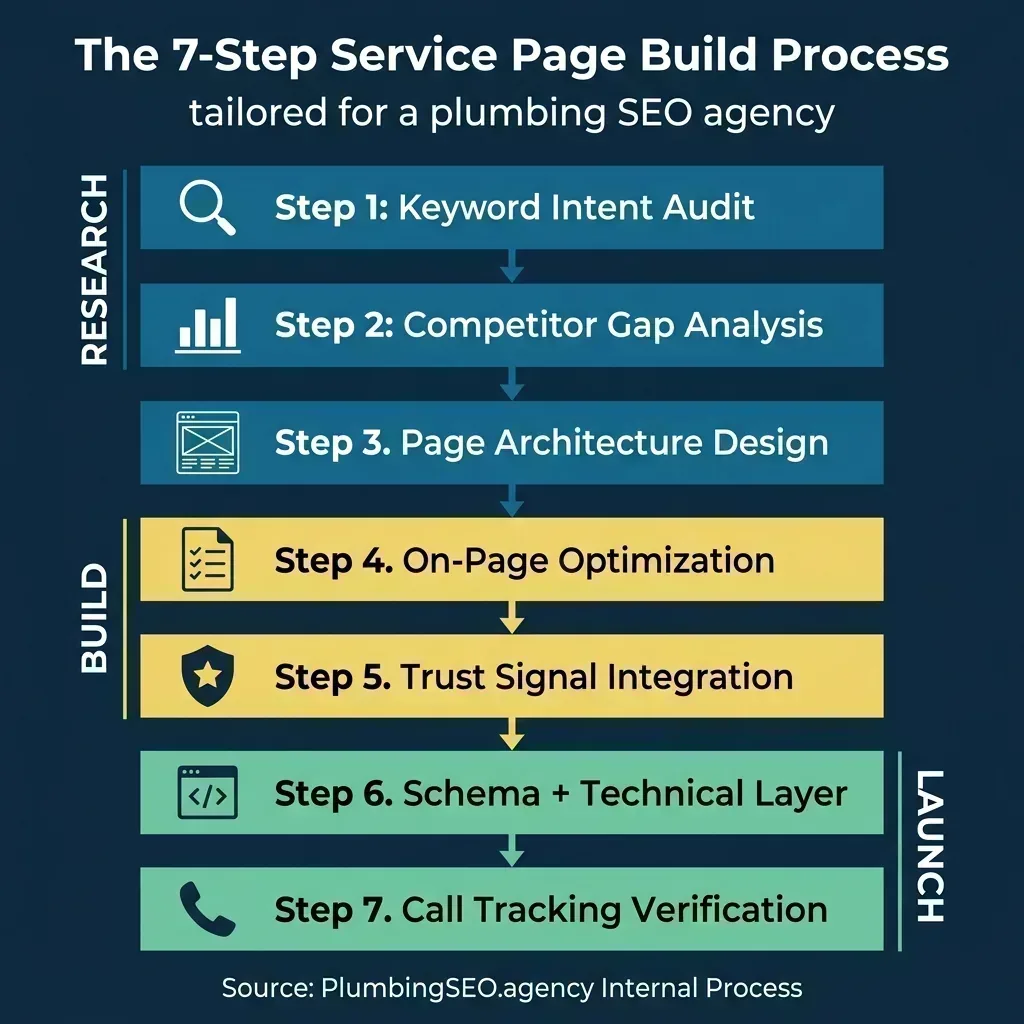
The full 7-step process. Most agencies stop at Step 4. Steps 5, 6, and 7 are where the calls come from.
Step 6: Schema and Technical Layer
Schema markup is the difference between a page that ranks and a page that ranks with rich results. For a plumbing service page, we implement two schema types at minimum:
Service schema: Tells Google the exact service being offered, the area served, the provider (your business), and optionally the aggregate rating. This makes the page eligible for rich snippet display in search results and is one of the most reliable ways to stand out on a competitive SERP where every other result is a plain blue link. For a detailed breakdown of every schema type a plumber website should have, see our guide to the 5 essential schema markup types for plumber websites.
FAQ schema: Every service page we build has an FAQ section at the bottom. These questions come directly from Google's People Also Ask data for the target keyword, which means they are the exact questions homeowners are typing into Google when they cannot find the answer on the page they just left. FAQ schema makes those questions eligible to appear as expandable dropdowns directly in search results, giving the page a second opportunity to capture clicks even when it is not ranking position 1 for the main query.
The technical layer beyond schema includes: canonical tag set correctly, meta robots set to "index, follow," image alt text that includes service and location where natural, internal links to 2-3 related service pages, and a structured data test pass through Google's Rich Results Test to confirm the schema is valid before the page goes live.
Step 7: Call Tracking Verification
A page without call tracking is a page you cannot learn from. We set up call tracking on every service page we build, using a service like CallRail or CallTrackingMetrics to assign a unique tracking number to each page. This number is swapped in dynamically so it does not create NAP inconsistencies with the Google Business Profile, but it captures every call that originates from that specific service page.
After 30 days, we run a call report. If a drain cleaning page is generating visits but zero calls, that is a conversion problem, not a ranking problem. We go back to Step 5 and look at the trust elements. If the page is generating calls but the quality is low (wrong service area, price shoppers), we look at Step 1 and re-examine keyword intent. If the page is not generating traffic at all, we look at Step 2 and run a fresh competitor gap analysis to see if something has changed in the SERP landscape.
This feedback loop is what separates service pages we build from service pages most agencies build. We do not ship a page and move on. The call tracking data is a live signal that tells us whether the page is doing its job and exactly where in the 7-step chain something needs to be adjusted.
What Actually Happens When You Build a Page This Way
We can describe the process all day. The more honest question is: what do the numbers look like? Here is composite data pulled from our client accounts, averaging across service pages we have built using this 7-step framework over the past 12 months:
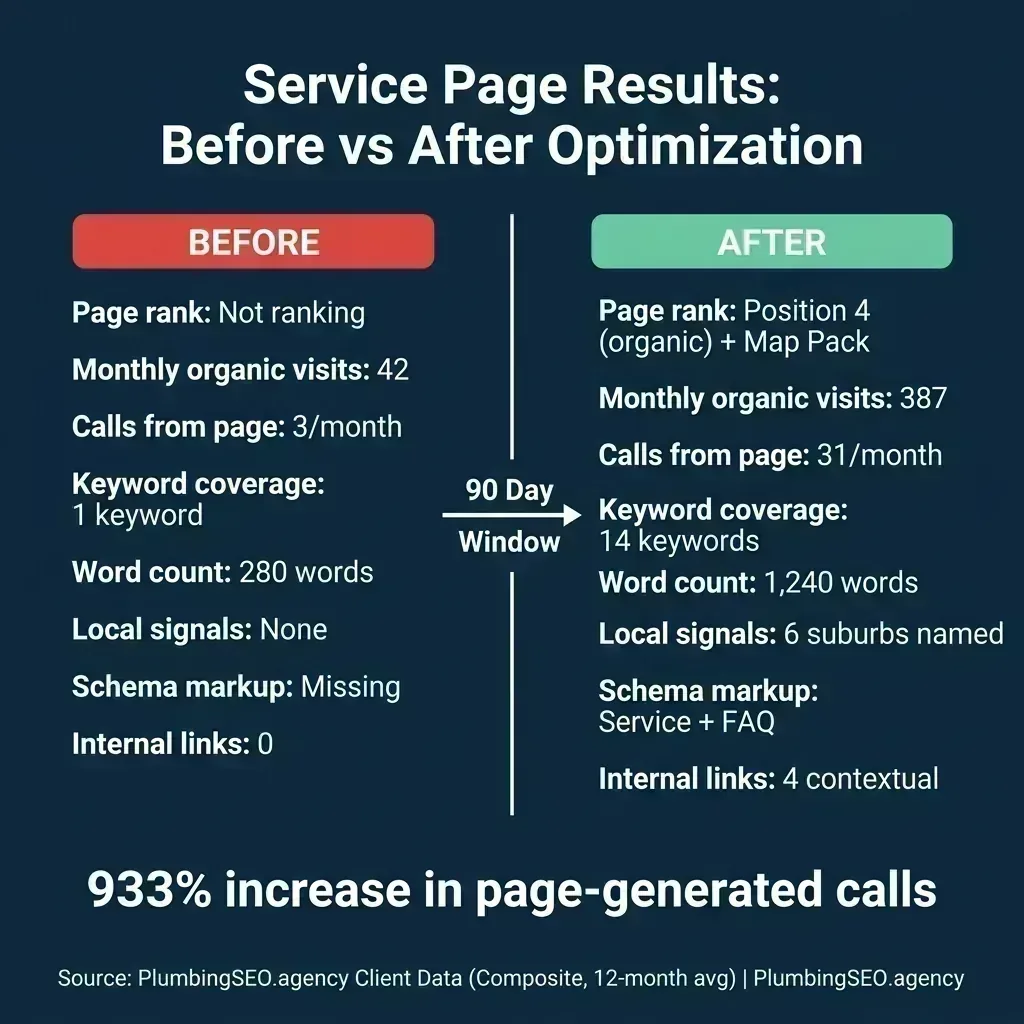
These numbers represent averages across our client portfolio. Individual results vary based on market competition and starting domain authority.
The most striking number is not the traffic increase. It is the call rate. A page going from 3 calls per month to 31 calls per month represents a change that directly impacts revenue. A plumbing job averages $350 in the residential space. An extra 28 calls per month, at even a 40% booking rate, is roughly 11 additional jobs. At $350 average ticket, that is $3,850 per month in additional revenue from one optimized service page.
The pattern behind these results is consistent across markets. The biggest single driver is always getting previously un-indexed or under-ranking pages to actually show up in search. The Atlanta plumbing company case study from RedBrick Web showed a 6x organic traffic boost and 5x increase in quality leads over 12 months after implementing a targeted service page strategy. That result mirrors what we see consistently: service pages are the highest-leverage SEO investment a plumbing company can make, because they target people who have already decided to buy and just need to decide who to call.
One thing the data does not show but that matters enormously in practice: the quality of calls improves alongside the volume. Pages built around buyer-tier keywords filter out price shoppers and curious homeowners doing research. The calls that come in are from people with a pipe actively leaking or a water heater that stopped working this morning. Those calls book at a higher rate, command higher ticket values, and result in better reviews because the homeowner was genuinely in need and the plumber delivered.
If your current service pages are not doing this work, the problem is almost certainly structural, not competitive. According to our audit database, 73% of plumbing service pages have five or more of the structural problems shown earlier in this post. That means if you fix the structure, you are immediately better positioned than the majority of your market without outranking anyone on backlinks or spending a dollar on ads. You can dive deeper into why some plumber websites fail to generate calls despite ranking by reading our breakdown of the most common reasons plumber websites do not convert visitors into calls.
Frequently Asked Questions
At minimum, one dedicated page per distinct service you offer. A typical plumbing company should have individual pages for drain cleaning, water heater installation and repair, sewer repair and replacement, leak detection, pipe repair and repiping, toilet and faucet repair, and gas line services. That is seven core pages. If you serve multiple cities with high search volume, you also build location-specific variants of your highest-revenue services. A company serving five cities with four high-demand services could legitimately have 20-27 service and location pages. The key is that each page targets a distinct buyer keyword and has genuinely unique content, not just a find-and-replace of the city name.
For a new page on an established domain (one that Google regularly crawls and that has some existing authority), we typically see first appearances in the top 50 results within 2-4 weeks of indexing. Breaking into the top 10 for a moderately competitive local query typically takes 60-90 days. For highly competitive queries in saturated markets, it can take 4-6 months for a new page to reach its ranking ceiling. The single biggest factor is the domain's existing authority: a plumbing company with 50 quality backlinks will rank a new service page faster than one with 5 backlinks, all else being equal. This is why we encourage clients to think about service pages as long-term assets, not quick wins.
A primary service page should target one primary city with a local signals block that names surrounding suburbs and neighborhoods. It should not try to rank for "drain cleaning Dallas" and "drain cleaning Houston" on the same page, those are separate pages. The confusion usually comes from service area businesses that serve a wide geographic radius. For multi-city coverage, the answer is a hub-and-spoke model: a primary service page targeting your main market, supported by location-specific variants for your highest-priority secondary markets. Each location variant needs genuinely unique content, not just a city name swap. For a full breakdown of how to structure this across multiple markets, see our guide on multi-location plumbing SEO strategy.
A service page targets a specific service (drain cleaning, water heater installation) and explains what the service involves, why someone needs it, how your company performs it, and what it costs in your market. It targets service-type buyer keywords. A service area page targets a geographic location and explains all or most of the services you offer in that specific city or neighborhood. It targets location-type buyer keywords like "plumber in [city]." Both are important, but they serve different intent. Someone searching "drain cleaning Frisco" is looking for a service page. Someone searching "plumber Frisco" is looking for a service area page. The two should interlink but should not compete for the same keyword on the same URL.
The structural and technical components (keyword intent audit, schema markup, call tracking setup, internal linking architecture) require SEO knowledge that most business owners do not have time to develop while running a plumbing company. The content components (describing your services, naming your service areas, stating your response times) require your industry knowledge that an agency does not have without your input. The best outcomes come from a combination: the agency handles the structure, technical layer, and keyword strategy; the plumber provides the operational details, local knowledge, and review collection. Doing it yourself is possible with the right resources, but the opportunity cost is high. Every month a service page is unoptimized is a month of calls that went to a competitor who did the work.
Want Us to Build Your Service Pages?
We run this exact 7-step process for every plumbing company we work with. If your service pages are not generating consistent calls, we will audit them, show you specifically what is missing, and fix it. That is what you get when you work with a plumber SEO agency that builds pages designed to convert. Most plumbing websites have at least five structural problems holding their service pages back right now.
Get My Free Service Page Audit