
- Plumbing websites convert at 12-16% when built correctly, the highest in home services. If yours converts below 3%, you are leaving thousands in revenue on the table every month.
- The #1 reason plumber websites fail to generate calls is not a traffic problem. It is a trust and conversion problem: missing click-to-call buttons, slow load times, and zero social proof.
- Seven specific, fixable issues account for most lost calls. This guide walks through each one with real data and actionable fixes you can implement this week.
The Plumber Website Conversion Gap: Traffic Without Calls
Here is a scenario that plays out hundreds of times a day across the plumbing industry: a homeowner searches "plumber near me," clicks on your website, looks around for 8 seconds, and leaves. They call your competitor instead. You never know it happened.
According to WebFX's 2026 Home Services Marketing Benchmarks, some plumbing businesses convert 12-16% of leads into paying customers. Use that as a diagnostic benchmark, not a universal requirement. A solo plumber in a small town, a new company with low review volume, and a 30-truck emergency-heavy company can all have different realistic targets.
Yet the median website conversion rate across all industries sits at just 2.35%. Top performers reach 11.45%. That gap between 2.35% and 12%+ represents thousands of dollars in lost revenue every single month for plumbing companies sitting on the wrong side of it.
The frustration is real. One plumber on r/Plumbing put it bluntly: "If the site is slow, vague about services, or looks outdated, people just bounce and call the next plumber in the search results. Trust and convenience make a big difference." Another noted that "one in twenty website visitors will actually call. The others are just comparing your website to your competition."
That last point is critical. Your website is not just competing for rankings. It is competing for trust. And trust is built (or destroyed) in the first 5 seconds a visitor lands on your page.
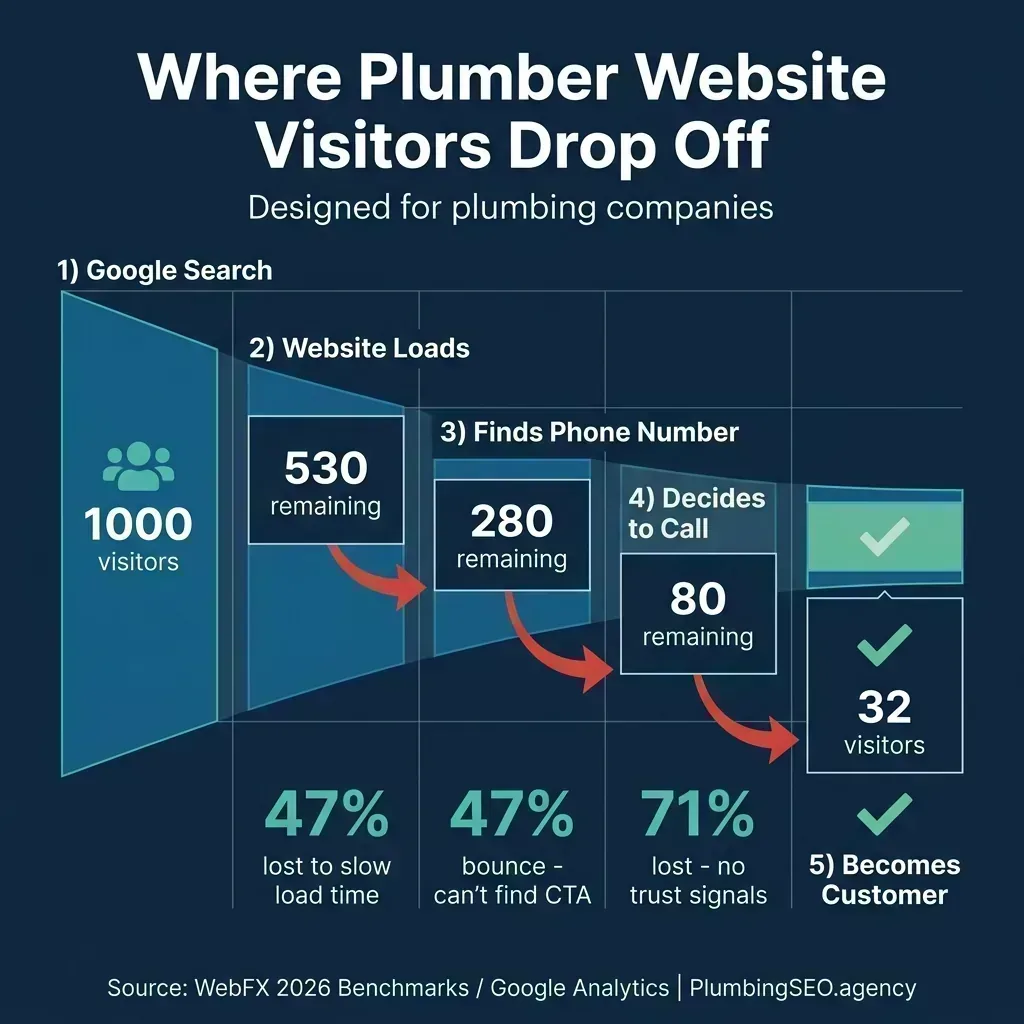
The good news? Most drop-off points in that funnel are fixable. The seven issues covered in this guide account for many lost calls, and several can be addressed quickly. The right priority order depends on your market, lead source, crew capacity, and whether the site is for a small local operator or a larger multi-city company.
The 7 Conversion Killers Costing You Calls
After analyzing competitor plumbing websites, scraping Reddit threads where plumbers discuss what actually works, and reviewing 2026 conversion data from BaaDigi's contractor benchmarks, a clear pattern emerges. The same seven issues appear repeatedly on plumbing websites that get traffic but few calls.
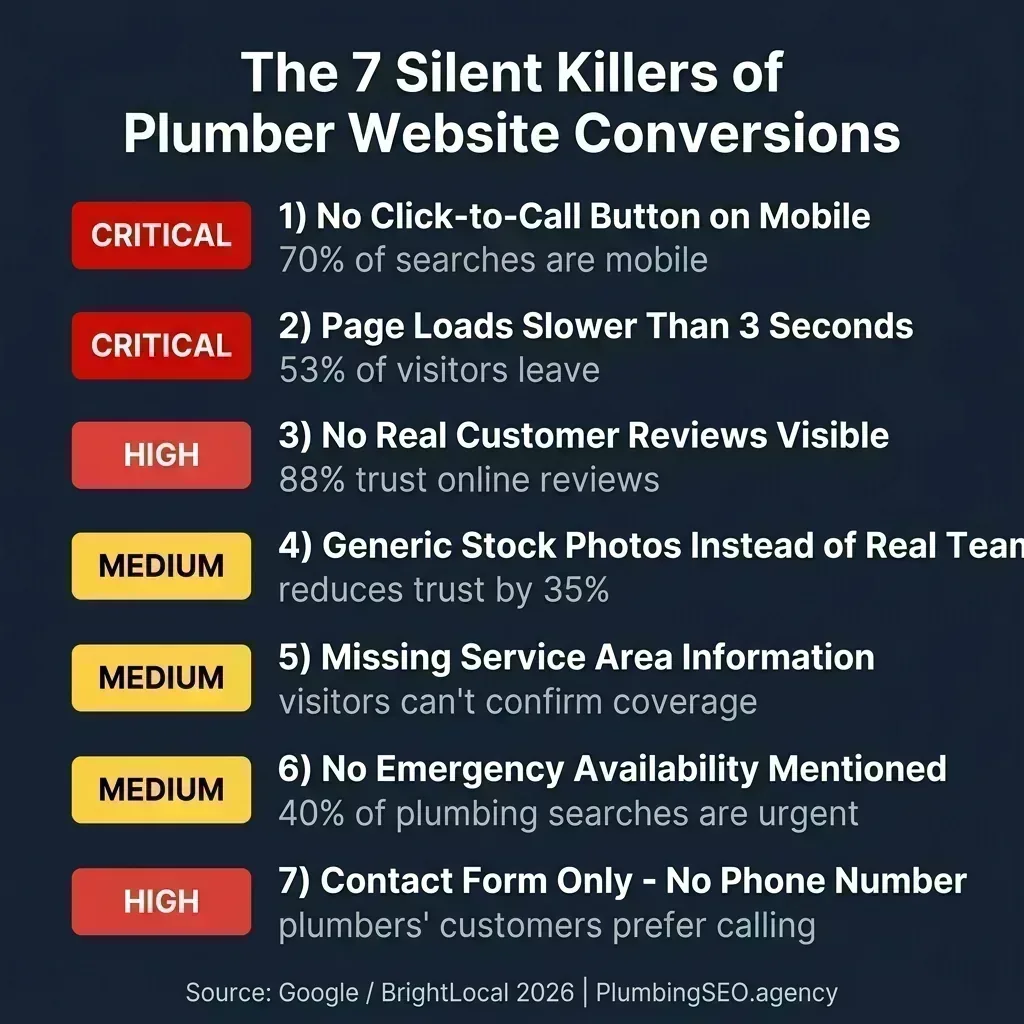
What makes this list particularly damaging for plumbing companies is that these issues compound. A site that loads slowly AND lacks reviews AND has no click-to-call button does not lose 3x the visitors. It loses nearly all of them. Each barrier multiplies the friction of the others. If your site needs a structural fix instead of another patch, our plumbing web design service is built around calls, trust, and local intent.
Let us walk through each killer and its specific fix.
Killer #1: No Click-to-Call Button on Mobile
Over 70% of local plumbing searches happen on mobile devices. When a homeowner with a burst pipe searches "emergency plumber near me" at 11 PM, they are holding their phone. They want to tap a button and hear a voice. If your phone number is buried in a hamburger menu or only appears as plain text in the footer, you just lost that call.
The fix is simple but overlooked on a surprising number of plumber websites: place a sticky, tappable phone button in your mobile header that stays visible as visitors scroll. Make the tap target at least 44x44 pixels. Use an href="tel:..." link so one tap initiates the call. No forms, no extra steps.
As one experienced local SEO practitioner shared on Reddit: "A website's job is to generate enquiries, not just exist. Visitors need to know what to do immediately." If your primary call-to-action requires scrolling, you have already failed the mobile test.
Most service pages should also end with a clear call button. Do not assume visitors will scroll back to the top. Place a call-to-action wherever a reader might make a decision, which is typically after reading about a specific service, seeing your reviews, or checking your service area.
Killer #2: Your Website Takes More Than 3 Seconds to Load
Page speed is not just a ranking factor. It is a direct revenue lever. According to Portent's conversion research, every additional second of load time reduces conversions by approximately 7%. A plumbing company tracked this firsthand in a Facebook group: after cutting their mobile load time from 6 seconds to 2.1 seconds, their bounce rate dropped 28% and call button clicks increased measurably.
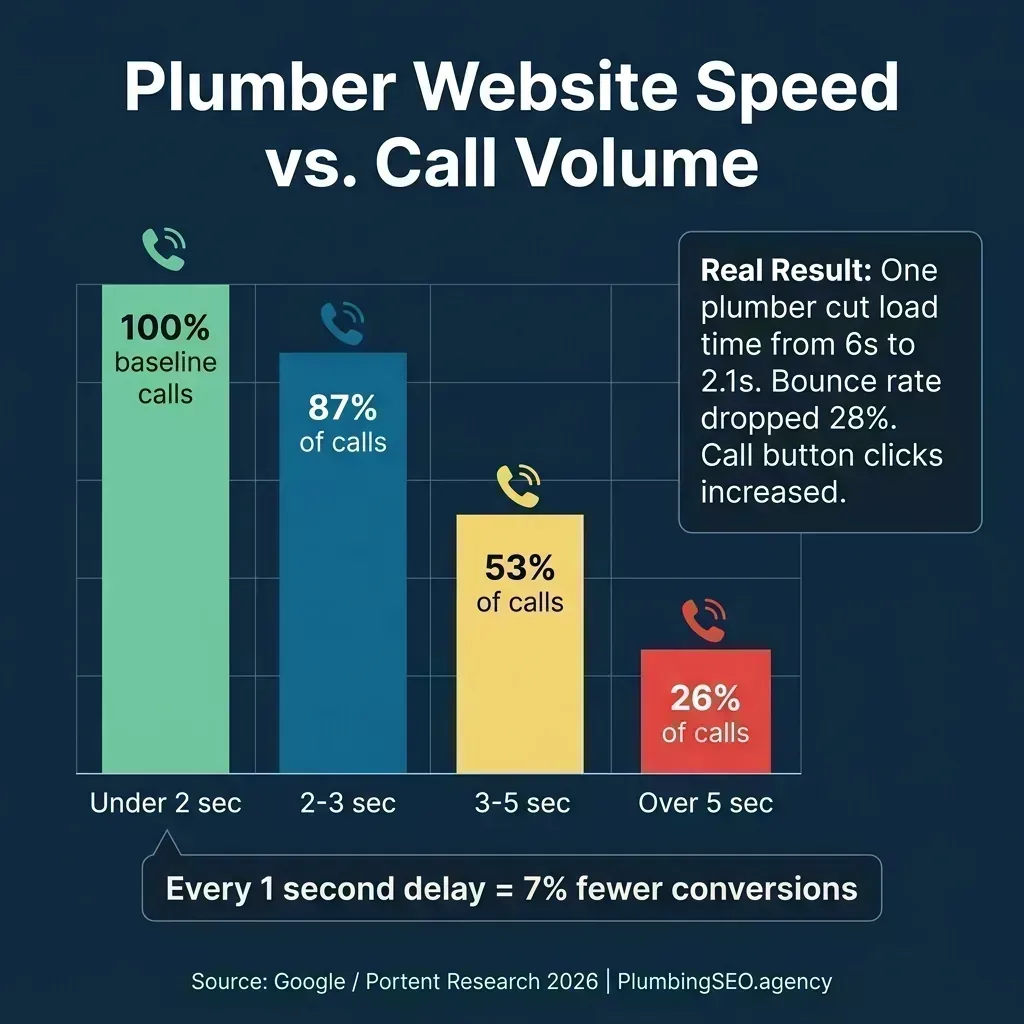
For plumbing companies, the speed problem usually comes down to a few culprits: oversized before-and-after job photos that were uploaded straight from a phone camera, heavy WordPress themes with dozens of unused plugins, and cheap shared hosting that bottlenecks during peak traffic hours. The fix does not require a full rebuild. Start with these high-impact changes:
- Compress images using WebP format. A 4MB phone photo can shrink to 80KB with no visible quality loss.
- Remove unused plugins if you are on WordPress. Each plugin adds scripts that slow your page.
- Test your speed at Google PageSpeed Insights. Aim for a score above 80 on mobile.
- Upgrade hosting if you are on a shared plan under $20/month. Fast hosting is the cheapest performance investment you can make.
Remember: when someone searches for an emergency plumber, they are checking the first 2-3 results that load. If yours takes 5 seconds while your competitor loads in 1.5, that customer is already dialing someone else. As one digital marketing professional noted, "18 seconds. That is how long it takes for one plumber's website to show customers anything useful on mobile." That is not an exaggeration. It is a case study in lost revenue.
Killer #3: No Real Customer Reviews Visible on Your Site
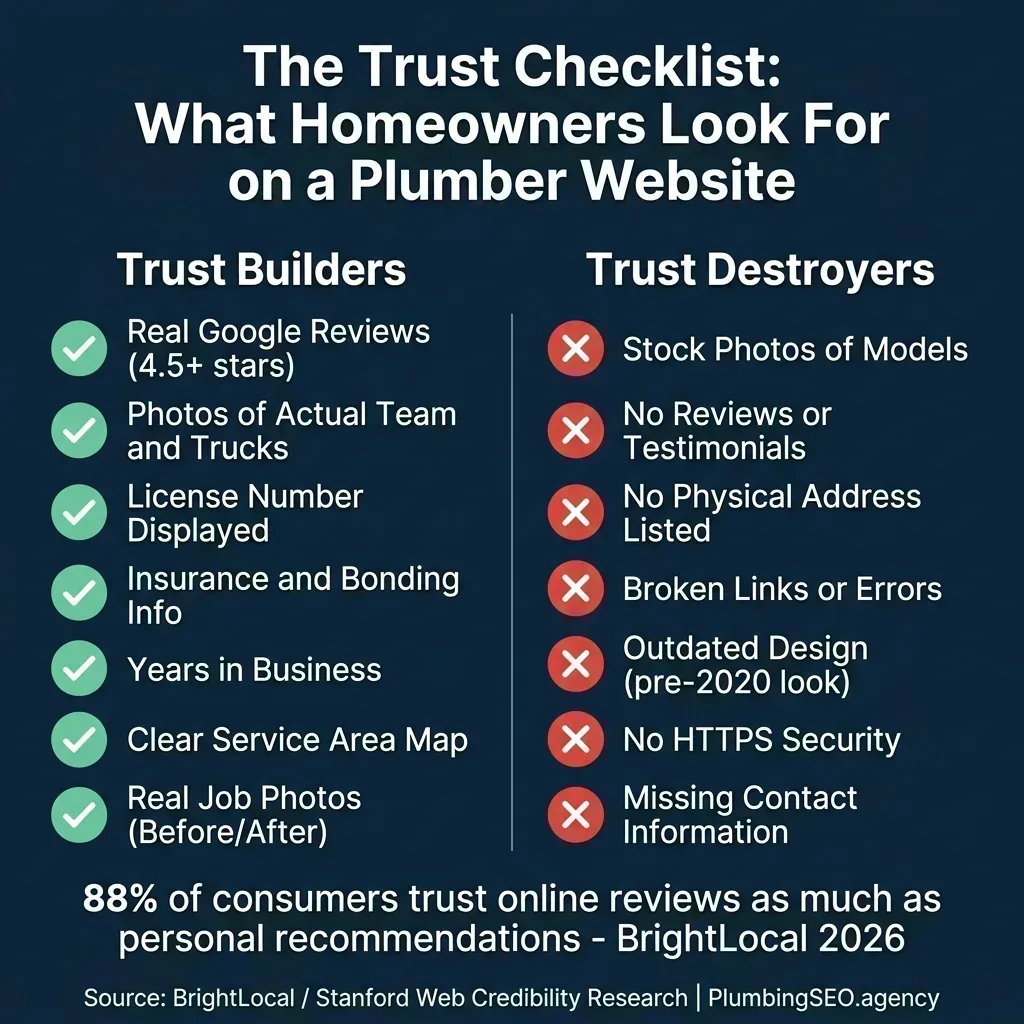
Homeowners are not comparing plumbers based on who has the fanciest website. They are trying to figure out which company they can trust inside their home. And in 2026, online reviews are the primary trust signal. According to BrightLocal's annual consumer survey, 88% of consumers trust online reviews as much as personal recommendations from friends and family.
Yet many plumber websites either have zero reviews displayed, or show a single generic testimonial from "John D." with no date, no photo, and no link to verify it. That does not build trust. It raises suspicion.
The fix requires two steps. First, build a consistent review collection system. Our guide to getting more 5-star reviews covers the exact SMS templates and timing that convert at 15-20%. Second, display those reviews prominently on your website, particularly on your homepage and every service page. Embed your Google Reviews directly using a widget, or at minimum, display screenshots with star ratings and dates.
The goal is not just to show that you are good at plumbing. The goal is to show that other people, real people, have trusted you and were satisfied. That is what turns a browser into a caller.
Killer #4: Generic Stock Photos Instead of Your Real Team
A homeowner who is about to let a stranger into their house wants to see who is actually coming. When your "About" page shows the same smiling model in a hard hat that appears on 50 other contractor websites, your credibility takes an immediate hit. According to the Elevated Audience conversion study, faceless businesses trigger skepticism, and showing real people behind the service transforms anonymous visitors into confident leads.
This does not require a professional photoshoot. Take a few clear photos of your team standing next to your branded truck. Get a shot of a technician working on a real job (with the customer's permission). Post a 30-second video of your team in the morning before heading out. Authenticity converts better than polish every time.
A popular Reddit thread about home service websites emphasized this exact point: "Imagine visiting a plumbing contractor's website and they do not mention what they do and there are no testimonials for proof that they can do a good job." If visitors cannot tell you are a real and credible company within five seconds of landing, they will leave and click the next result.
Killer #5: Missing Service Area Information
This one sounds obvious, but it eliminates more potential calls than most plumbers realize. A visitor lands on your site, likes what they see, but cannot confirm that you actually serve their area. They are not going to call and ask. They are going to search for the next plumber whose website clearly lists their zip code or neighborhood.
Your service area should be displayed on your homepage and on a dedicated service area page. List specific cities, neighborhoods, and zip codes. If you serve 12 cities in your metro, you should have content targeting each one. As one highly upvoted post on r/localseo explained: "If you serve 12 cities in your metro then you need 12 location pages. Each one unique to that area. Not a template with the city name swapped out because Google can tell the difference and so can your potential customers."
This approach does double duty: it reassures visitors that you cover their area AND it creates location-specific landing pages that rank for "plumber in [city name]" searches. Our multi-location plumbing SEO guide covers the exact hub-and-spoke architecture that makes this work at scale.
Killer #6: No Emergency Availability Mentioned
Approximately 40% of plumbing searches are urgent. Burst pipes, backed-up sewers, water heater failures. These are not people browsing for a contractor next Tuesday. They need help now. And emergency plumber keywords cost $15-25+ per click according to WebFX's 2026 benchmarks, which means you are paying premium prices for these visitors.
If your website does not prominently mention emergency availability, 24/7 service, or rapid response times, you are wasting those high-value clicks. The highest-converting plumber websites lead with urgency: "Emergency Plumbing. At Your Door in 60 Minutes or Less." Compare that with "We provide comprehensive plumbing solutions using state-of-the-art equipment." The first gets calls. The second gets ignored.
As the Elevated Audience study found: "Every second a customer spends translating your generic service descriptions into their specific emergency is a second too long." If you offer emergency service, say it in your header, in your hero section, and on every service page.
Killer #7: Contact Form Only, No Phone Number
Plumbing is a phone-call business. When a homeowner has water flooding their basement, they are not going to fill out a contact form and wait for an email response. They need to talk to a real person, immediately.
This does not mean you should eliminate forms entirely. Forms work well for non-urgent inquiries, quote requests, and lead capture during off-hours. But your phone number must be the primary, most visible contact method. Make it clickable on mobile. Display it in your header on desktop. Do not hide it behind a "Contact Us" page.
One Reddit commenter captured the issue perfectly: "If you make it impossible to find a price range, I'm not going to bother calling." The principle extends to contact information. If calling requires effort, people will not make it.
Your Site Structure Is Costing You Rankings AND Calls
Beyond the seven conversion killers, there is a structural issue that compounds all of them: your site hierarchy. Most plumbing websites are built as digital brochures. A homepage, an "Our Services" page with bullet points, a contact page, and maybe a blog. That structure fails both visitors and search engines.
A well-structured plumbing website follows a clear hierarchy that serves two purposes: it helps Google understand what you do and where you do it, and it gives visitors a fast path from search to phone call.
| What Most Plumbers Have | What Actually Converts |
|---|---|
| One "Services" page listing everything | Separate page for each core service (drain cleaning, water heater repair, etc.) |
| No location pages | Dedicated page for each city/area served with unique local content |
| Generic 150-word service descriptions | In-depth service pages with pricing expectations, FAQs, job photos, and reviews |
| Blog posts about "5 tips to maintain your drains" | Blog content answering buyer questions: "How much does a sewer line replacement cost?" |
| Internal links only in the menu | Contextual links connecting service pages, location pages, and blog posts |
Each service page should answer three questions: What do you do? Why should someone trust you to do it? What should the visitor do next? Include real job photos, service-specific reviews, and a clear call-to-action. As the PlumberSEO.net analysis noted: "If your service page is 150 words and a stock photo, it is not going to rank for anything."
Internal linking matters more than most plumbers think. Your service pages should link to related services. Your location pages should link to the service pages relevant to that area. This helps Google understand the relationship between your content and distributes authority across your site. As the Reddit post put it: "fixing your internal linking is usually more powerful than building backlinks."
For a deeper walkthrough of how to set up this structure across multiple service areas, read our multi-location SEO guide.
Want to Know Exactly Which of These 7 Killers Are on Your Site?
We will audit your plumber website for conversion killers, check your mobile speed score, and show you exactly where visitors are dropping off before they call.
Get My Free Website AuditFrequently Asked Questions
The most common reasons are poor mobile experience (no click-to-call button), slow page load speed (over 3 seconds), missing trust signals (no reviews or real photos), and weak calls-to-action. Most plumber websites fail at conversion, not traffic. You may be getting visitors who leave before calling because the site does not build enough trust or make it easy enough to take action.
WebFX's 2026 benchmarks cite 12-16% as a strong plumbing lead-to-customer conversion range, but that is not a universal target. Emergency-heavy companies, small-town solo plumbers, new brands, and larger multi-location shops can all see different numbers. If your site converts below 3%, use that as a signal to review site structure, lead quality, trust signals, and follow-up speed.
Your website should load in under 3 seconds on mobile. Ideally, aim for under 2 seconds. Research shows that every additional second of load time reduces conversions by approximately 7%. Sites that take over 5 seconds to load lose up to 74% of potential visitors. Test your speed at Google PageSpeed Insights and aim for a mobile score above 80.
Usually, each major revenue-driving service deserves its own dedicated page once there is enough demand and proof to support it. If you offer drain cleaning, water heater repair, sewer line replacement, and emergency plumbing, each may need a separate page with unique content, real job photos, service-specific reviews, pricing expectations, and a clear call-to-action. A very small operator can start with the highest-value services first instead of building thin pages for every minor offering.
Both, but the phone number should be the primary and most visible contact method. Plumbing is a phone-call business, especially for emergencies. Your phone number should be clickable on mobile, visible in your header, and present on every page. Contact forms are useful for non-urgent inquiries and off-hours lead capture, but should never replace a prominently displayed phone number.
Start with the highest-impact fixes: add a sticky click-to-call button on mobile, improve your page load speed to under 3 seconds, display real Google Reviews on every page, replace stock photos with real team and job photos, and make sure your emergency availability is prominently mentioned. These five changes alone can improve call volume without spending more on advertising or SEO.
Is Your Plumber Website Leaving Money on the Table?
Our free SEO audit checks your website for all 7 conversion killers, tests your mobile speed score, reviews your trust signals, and shows you exactly how to turn more visitors into phone calls.
Get My Free Conversion Audit