
- Marketing ROI is not clicks, impressions, or rankings. For a plumbing company, the number that matters is gross profit from booked jobs compared against what you spent to get them.
- Cost per lead is only half a number. Track cost per booked job, qualified lead rate, answer rate, booking rate, close rate, average ticket, and gross margin by job type.
- The fastest ROI fix is often operational. If paid calls hit voicemail, quotes do not get followed up, or low-margin jobs fill the board, the marketing report may look fine while cash leaks out.
The Phone Can Ring and the Math Can Still Be Bad
A busy phone feels good. It feels like the money is working. The ads are running, the Google Business Profile is getting views, the SEO report has some green arrows, and dispatch has jobs on the board.
But here is the problem. A plumbing company can get more leads and still make less money if the wrong numbers are being watched.
Clicks do not pay payroll. Impressions do not put a water heater on the schedule. Rankings are useful only when they turn into the right calls, from the right service area, for jobs your crew can do profitably.
The way I see it, plumber marketing ROI should answer one question first: did this channel help us book profitable work? Everything else is supporting evidence.
That sounds simple, but most marketing reports dodge it. They show traffic, clicks, average position, cost per click, and lead volume. Those are not useless numbers. They are just unfinished numbers. They tell you activity happened. They do not tell you whether the activity made the company stronger.
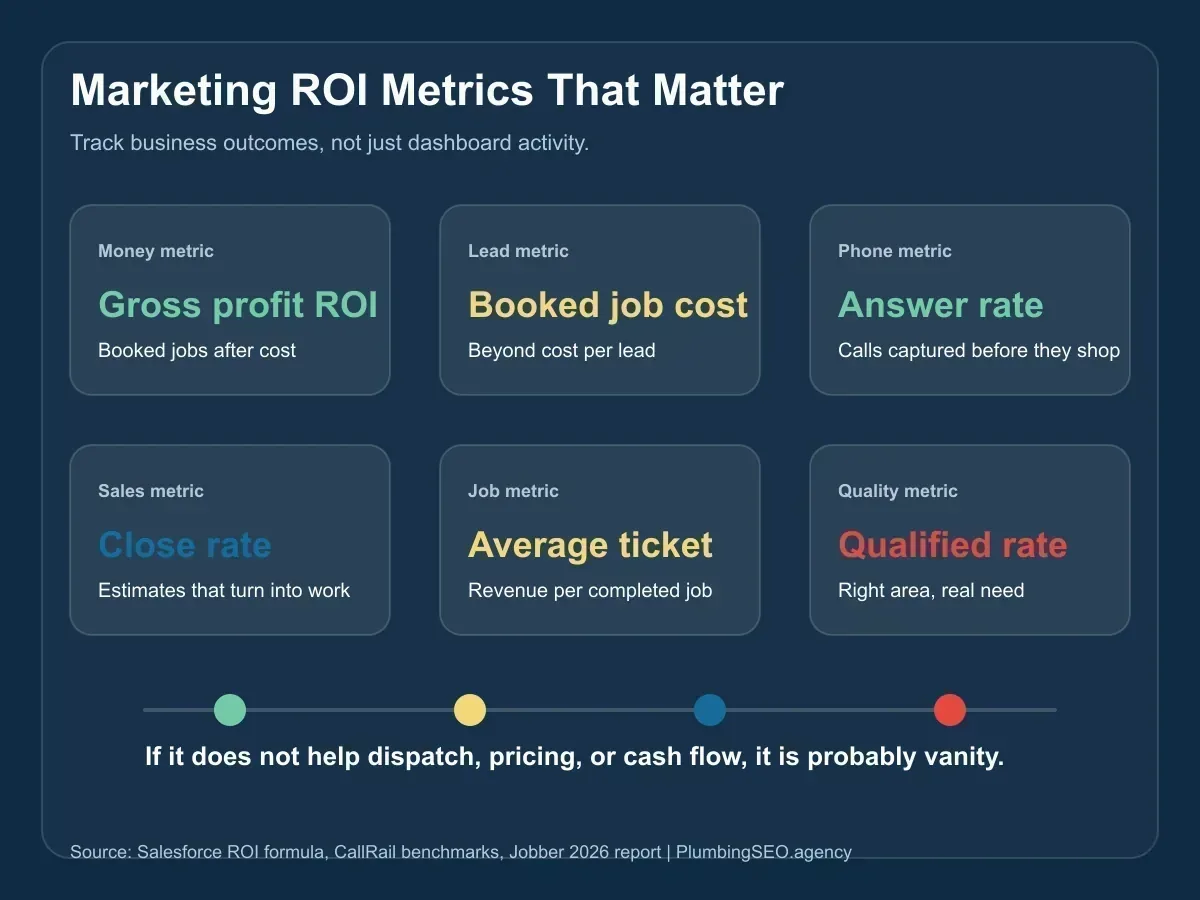
The numbers worth watching are the ones that help you make a decision about spend, dispatch, pricing, or follow-up.
If your report cannot connect marketing spend to calls, booked jobs, and profit, it is not really an ROI report. It is a receipt with decorations.
The Real ROI Formula for Plumbing Companies
The standard marketing ROI formula is useful, but plumbers need to run it through gross profit, not just revenue. Salesforce defines marketing ROI as marketing value minus marketing cost, divided by marketing cost. That is the right starting point.
For plumbing, I would tighten it like this:
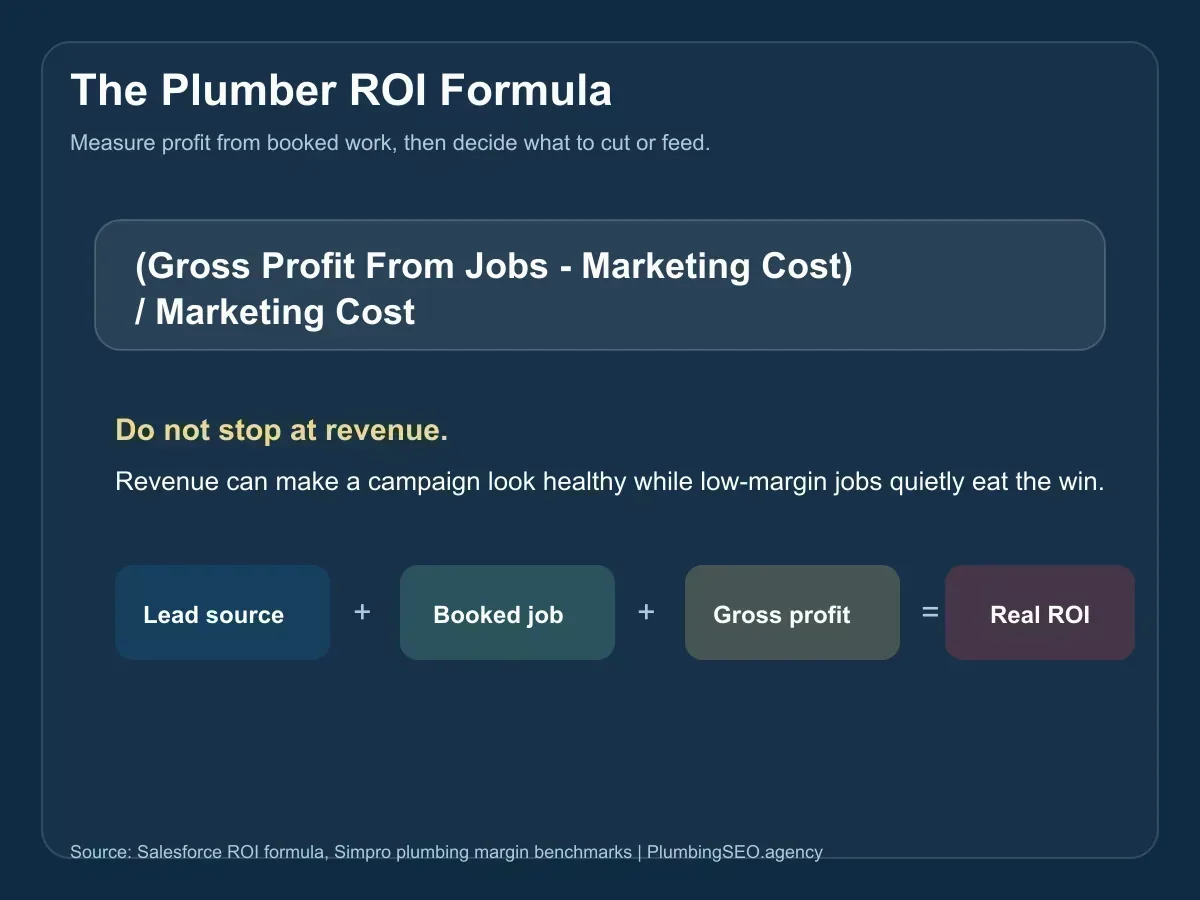
Revenue is not enough. A campaign that fills the calendar with low-margin work can still be a bad campaign.
Here is why gross profit matters. A $4,000 sewer job and four $1,000 jobs both show $4,000 in revenue. But they may not leave the same money behind after labor, materials, drive time, permits, callbacks, and overhead.
Simpro's plumbing margin guide says healthy service and repair work often targets 50-60%+ gross margin, while new construction can sit much lower. That difference matters when you decide where to spend your next marketing dollar.
A simple version looks like this:
| Metric | What to Track | Why It Matters |
|---|---|---|
| Marketing cost | Ad spend, agency fees, software, tracking tools, creative, landing pages | You need the full cost, not just the Google Ads bill. |
| Booked revenue | Revenue from jobs tied to the source | This filters out form fills, bad calls, and tire kickers. |
| Gross profit | Revenue minus direct labor and materials | This shows whether the work actually helped the business. |
| ROI | (Gross profit - marketing cost) / marketing cost | This tells you whether to cut, fix, or feed the channel. |
Do not make this harder than it has to be. Start with a spreadsheet if you need to. One row per lead source. One column for spend. One for calls. One for booked jobs. One for revenue. One for gross profit. Fancy dashboards can come later. The first win is knowing where the money went.
Cost Per Lead Is Not the Finish Line
Cost per lead gets talked about because it is easy to measure. Spend $3,000, get 30 leads, pay $100 per lead. Clean math. Nice report. Everyone nods.
Then the owner looks at the schedule and realizes half the leads were outside the service area, three wanted commercial work you do not take, five were price shoppers, and four called after hours and booked with somebody else.
That is where calls leak away.
One plumber-specific ROI example from Mammoth for Plumbers models a $5,000 marketing spend with lead quality, answer rate, booking rate, close rate, and average ticket all included. The useful part is not the exact dollar amount. It is the chain of numbers. Every step can shrink the pile before a truck ever rolls.
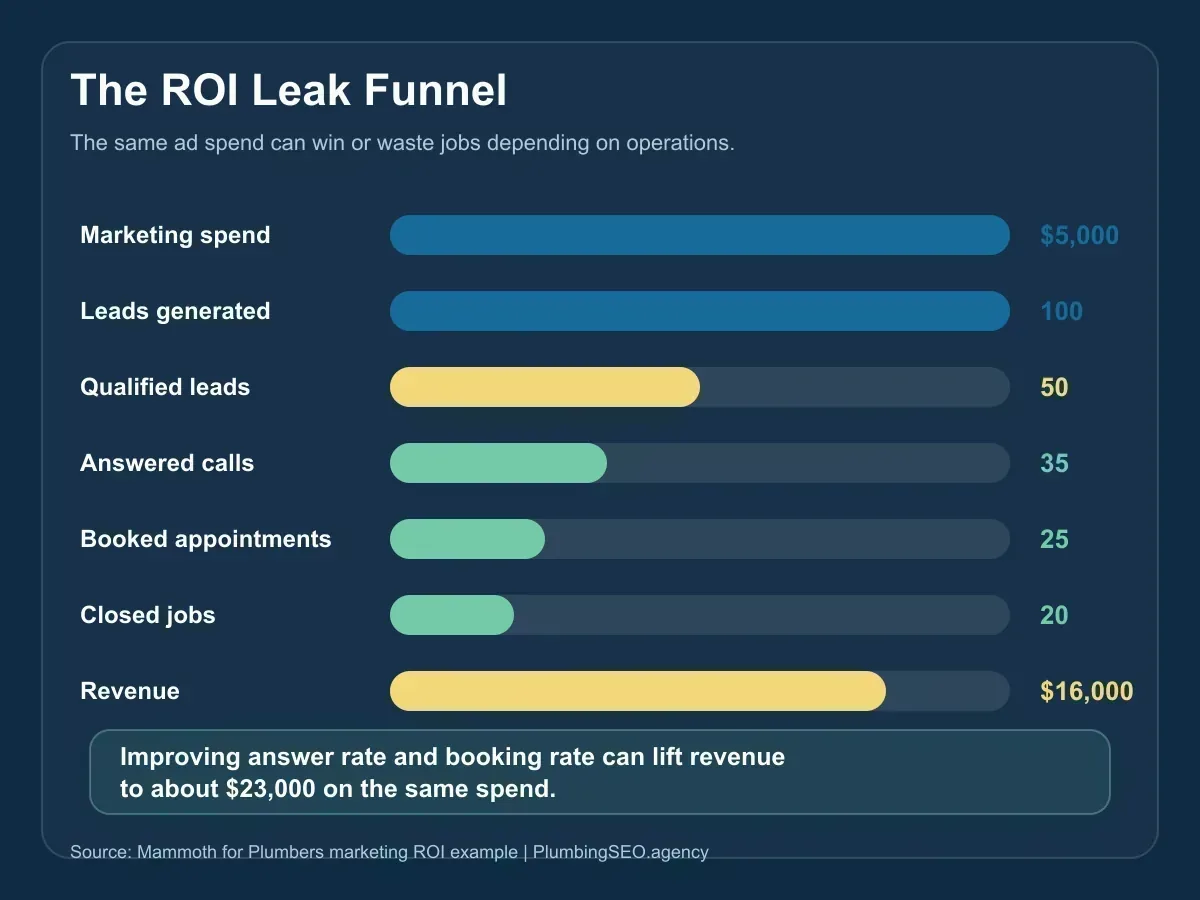
This is why a low cost per lead can still lose money. Leads have to survive the whole path from search to sale.
For a plumbing owner, the better number is cost per booked job. If you want to go one layer deeper, track cost per profitable booked job. That is the number that tells you whether the source deserves more budget.
If Google Ads brings in expensive calls but those calls turn into emergency jobs with strong margins, that source may be worth feeding. If a cheap lead source fills your day with free estimates that never close, that is not growth. That is a scenic route to frustration.
The Seven Numbers I Would Watch Every Month
You do not need fifty KPIs. You need a small board of numbers that tells the truth. If I owned the shop, these are the numbers I would review every month before touching the marketing budget.
1. Qualified Lead Rate
A lead is not automatically good because someone called. Track whether the caller is in your service area, needs a service you sell, has a real problem, and is worth dispatching or estimating.
This is where a lot of agencies miss the mark. They celebrate lead volume. The owner gets stuck paying for the wrong work. If 100 leads produce only 40 qualified opportunities, the real cost is not your cost per lead. It is your cost per qualified lead.
2. Answer Rate
Plumbing is phone-heavy. CallRail's 2026 home services statistics say phone calls remain the top way homeowners contact home service businesses, and response speed strongly affects who gets hired.
Reddit threads from small business and PPC communities tell the same story in rougher language. Contractors pay for calls, miss them during the day, then blame the campaign. That is like buying pipe and leaving it in the parking lot. Technically you bought materials. You still did not fix anything.
For Local Services Ads, Google also says fast response matters. Its Local Services Ads guidance notes that quick message response times can drive more engagement, and that lead likelihood is part of the auction.
3. Booking Rate
Answering is step one. Booking is step two. Track how many answered calls become scheduled jobs or estimates.
If booking rate is weak, the issue may be CSR training, unclear pricing, no financing options, no service area script, weak follow-up, or no online booking path. The marketing channel gets blamed, but the handoff is where the call dies.
4. Close Rate
Close rate tells you whether booked estimates become paid work. Jobber's 2026 Home Service Trends Report found that more than 45% of plumbing businesses said they close 70%+ of jobs, and top performers often have stronger quote systems and faster follow-up.
One warning. A close rate near 100% is not always a victory. It can mean your pricing is too low. Full schedule, thin margins, tired crew. That is a trap with nice handwriting.
5. Average Ticket
Average ticket tells you how much revenue each completed job brings in. It also helps you judge which marketing channels attract better work.
If one channel sends $175 drain calls and another sends $2,400 water heater work, they should not be judged by cost per lead alone. They are not doing the same job for the business.
6. Gross Margin by Job Type
Do not blend everything together and call it good. Separate service calls, emergency work, installs, remodels, commercial, and new construction if you do those.
When you know gross margin by job type, marketing gets sharper. You stop trying to get "more leads" and start trying to get more of the work that keeps the company healthy.
7. Cost Per Booked Job
This is the owner number. It accounts for spend, lead quality, phone handling, booking, and close rate. It is not perfect, but it is much closer to the truth than cost per click or impressions.
Benchmarks Help, But Your Own Numbers Decide
Benchmarks are useful when you need a gut check. They tell you whether your market is unusually expensive, whether a channel is way outside normal range, or whether your website and phone handling are lagging behind the field.
LocaliQ's 2025 home services search ad benchmarks put plumbing search ads at a 4.97% click-through rate, $10.49 cost per click, 7.63% conversion rate, and about $129 cost per lead. That gives you a reference point. It does not decide whether your campaign is good.
Invoca's 2025 call benchmark summary found a 46% conversion rate for home services calls. CallRail reports that call tracking customers saw lower cost per lead and better call lead-to-close rates. Those are useful clues, especially if you are still guessing where calls come from.
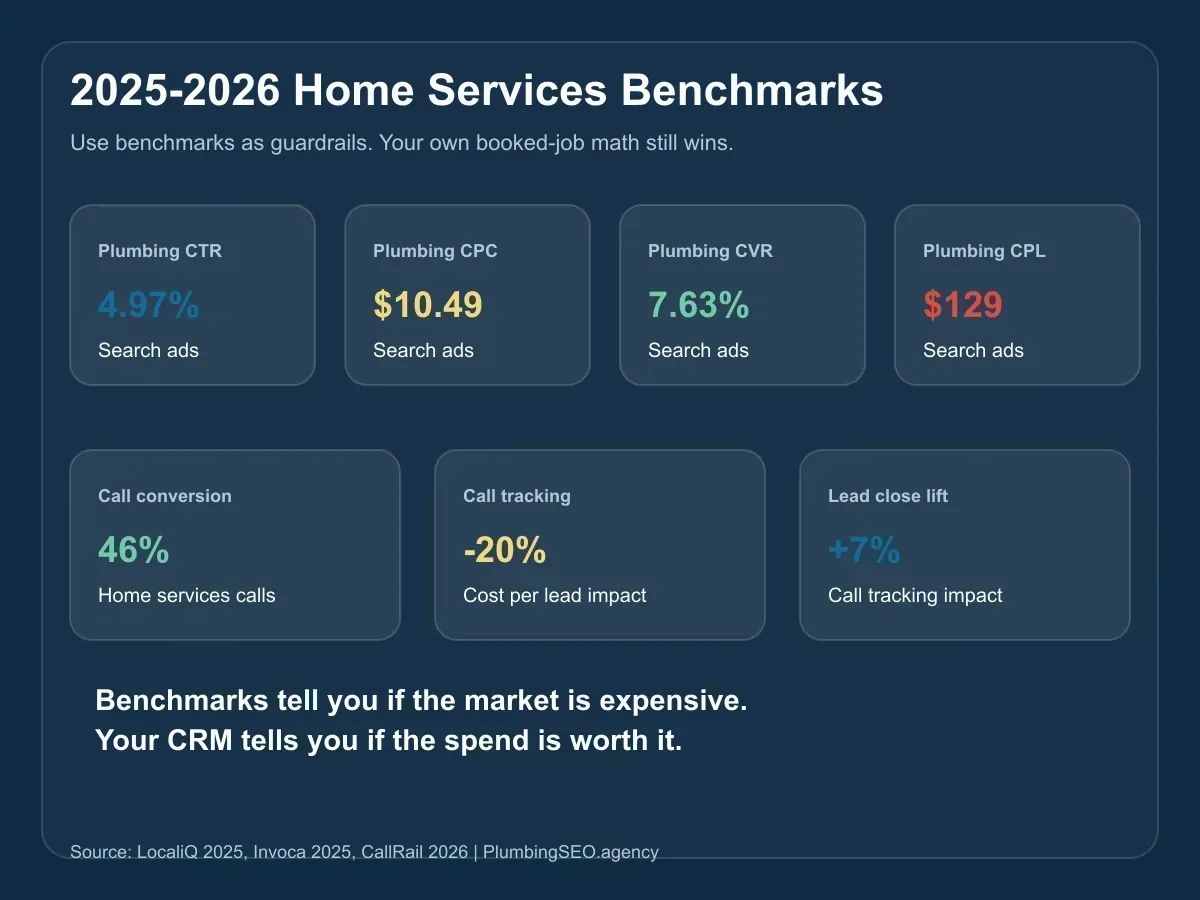
Use outside benchmarks to spot possible problems. Use your own booked-job data to make budget decisions.
Here is the practical rule. Benchmarks tell you if you are in the ballpark. Your CRM, call tracking, invoices, and job costing tell you whether you should keep spending.
If your plumbing company is already tracking calls, start matching every lead source to the final job. If you are not tracking calls yet, read our call tracking guide for plumbers or check out our call tracking platform comparison before you judge any channel too harshly.
A Simple ROI Calculator for Plumbers
Use this quick calculator as a rough planning tool. It will not replace your books, but it will show how fast answer rate, booking rate, close rate, average ticket, and gross margin change the picture.
Plumbing Marketing ROI Calculator
Adjust the numbers to see estimated booked jobs, gross profit, and marketing ROI.
What to Cut, What to Fix, and What to Feed
Once you have the numbers, the decision gets easier. Not easy. Easier. Marketing is still a little like chasing a leak behind a finished wall. But at least now you know which wall to open.
Cut It
Cut a source when it sends low-quality leads, poor-fit jobs, bad service areas, or work that does not leave margin after real job costs.
Fix It
Fix a source when the demand is good but the handoff is broken. Missed calls, weak landing pages, slow follow-up, and bad tracking belong here.
Feed It
Feed a source when it produces qualified calls, booked work, healthy margins, and customers you would happily serve again.
This is also where SEO and PPC need different patience levels. Paid ads can show lead quality fast. SEO takes longer, but a good organic page can keep producing after the original work is paid for. Our SEO vs PPC comparison for plumbers breaks down that tradeoff in more detail.
Do not starve a channel just because the first-month ROI looks messy. But do not keep feeding it because the report has pretty charts either. Give each channel a job. Give it a measurement window. Then judge it by booked work and profit.
The Monthly ROI Review I Would Run
Once a month, sit down with whoever handles marketing, dispatch, sales, and bookkeeping. If that is all you, pour coffee first. Then pull these numbers.
| Review Item | Question to Ask | Action |
|---|---|---|
| Lead source report | Which sources produced qualified calls? | Move budget away from low-fit sources. |
| Call log | How many paid calls were missed? | Fix answering, routing, after-hours coverage, or callback speed. |
| Booking report | Which calls turned into scheduled work? | Train CSRs and tighten scripts where bookings fall off. |
| Sales report | Which estimates closed, and at what ticket? | Improve follow-up, pricing confidence, and quote structure. |
| Job costing | Which jobs actually left gross profit? | Shift marketing toward higher-margin services. |
If the report cannot answer those questions, your first project is not scaling. It is plumbing the numbers together. Call tracking, CRM source fields, clean invoicing, and job costing are boring until they save you $3,000 a month. Then they are suddenly beautiful.
If you already get SEO reports but do not know what to do with them, our plain-English Google Search Console report guide shows which search numbers are worth checking and which ones need more context.
The Numbers That Actually Matter
Here is the practical position. A plumbing company should not measure marketing ROI like a media company. You are not selling attention. You are selling service, trust, availability, and skilled labor in a specific service area.
So measure the path that matters:
- Did the right person find you?
- Did they call, book, or request service?
- Did your team respond fast enough?
- Did the lead turn into a real job?
- Did the job leave enough gross profit to justify the spend?
That is the whole game. Get found, get trusted, get called, get booked, do good work, keep enough margin to take care of the crew and invest back into the company.
Marketing ROI is not a magic number. It is a leak check. Run it monthly, fix what is dripping, and put more pressure behind what is working.
Frequently Asked Questions
A good ROI depends on your market, margins, service mix, and growth stage. A 5:1 revenue return may sound strong, but plumbers should judge ROI by gross profit from booked jobs, not revenue alone. If a channel brings profitable work you can service well, it may deserve more budget even if the cost per lead looks higher than another source.
Track marketing spend, qualified lead rate, answer rate, booking rate, close rate, average ticket, gross margin by job type, cost per booked job, and gross profit ROI. Clicks, impressions, rankings, and traffic can help diagnose a channel, but they should not be the final scorecard.
No. Cost per lead is useful, but it is incomplete. A cheap lead that never books is expensive. A costly lead that turns into a high-margin emergency job may be worth it. Use cost per lead as an early warning number, then judge the source by cost per booked job and gross profit.
Use call tracking numbers, dynamic number insertion on the website, source fields in your CRM, tagged form submissions, and job records that connect the lead source to invoice revenue and job cost. The setup does not need to be fancy at first. It just needs to connect spend to calls, calls to booked jobs, and booked jobs to profit.
The final business numbers should be similar, but the timing is different. Google Ads can be judged faster because spend and calls appear quickly. SEO usually needs a longer window because content, Google Maps visibility, and organic rankings compound over time. For both, the final test is booked profitable work.
Review lead quality, answer rate, booking rate, and cost per booked job monthly. Review SEO trends over a longer window, usually 90 days or more, because organic work takes time to show. Review missed calls and follow-up speed weekly if you are spending heavily on ads or Local Services Ads.
Want to Know Which Marketing Dollars Are Actually Booking Jobs?
Our free SEO leak check looks at visibility, calls, tracking gaps, service pages, and the numbers that help you decide what to cut, fix, or feed. It is the same ROI-first approach every client gets from our plumber SEO agency.
Run My Free SEO Leak Check