
- Google Local Services Ads (LSA) operate on a pay-per-lead model, meaning you only pay when a customer calls or messages you directly.
- Maximize Leads (automated bidding) is the fastest way to scale lead volume, but it can quickly exhaust your budget on lower-quality leads.
- Manual Bidding (setting a max bid per lead) gives strict cost control but will limit your volume in competitive metropolitan markets.
- Our recommended strategy is a hybrid approach: start with Maximize Leads to establish a quality history, then transition to Target Cost Per Lead (tCPL) to stabilize customer acquisition costs.
For years, plumbing contractors relied on standard Google Ads PPC campaigns to keep their phones ringing. You bid on keywords, paid for every click, and hoped your landing page was good enough to convert those visitors into service calls. But in recent years, Google Local Services Ads (also known as the Google Guaranteed program) have completely shifted the local marketing landscape.
Unlike standard PPC, where a single click for a high-intent keyword like "clogged drain repair Dallas" can easily cost $40 or more without guarantee of a call, LSA charges you only when a homeowner actually calls or messages your business. This pay-per-lead structure makes LSAs highly attractive, but it also creates an intense auction environment where your bidding strategy directly dictates your visibility.
Understanding the Three LSA Bidding Options for Plumbers
Google offers three distinct bidding strategies within the Local Services Ads dashboard, each designed for different business objectives and budget levels. Choosing the correct setting determines how frequently your business appears at the very top of Google search results.
1. Maximize Leads (Automated Bidding)
Maximize Leads is Google's default and recommended setting. Under this model, you set a weekly budget, and Google's machine-learning algorithm automatically adjusts your bid per lead to secure the maximum number of leads possible. The algorithm optimizes for volume, bidding higher during peak call periods and lowering bids when demand drops.
While this method guarantees the highest volume of inbound calls, it operates as a black box. You have no control over what you pay for a single lead, and in highly competitive plumbing markets, Google will gladly spend your entire weekly budget at a higher cost-per-lead than you might pay under manual control.
2. Target Cost Per Lead (tCPL)
Target Cost Per Lead acts as a middle ground between automation and control. You give Google a target dollar amount you would like to pay on average for a lead, and the automated bidding system dynamically shifts individual bids to keep your overall average lead cost aligned with your target.
This strategy is highly effective once you have historical account data and know exactly what a lead is worth to your plumbing business, allowing you to scale without runaway customer acquisition costs.
3. Max Per Lead (Manual Bidding)
Manual Bidding provides absolute cost control. You tell Google the maximum amount you are willing to pay for a single lead. Google will never charge you more than this cap, even if a highly competitive lead opportunity arises that requires a slightly higher bid.
The downside is immediate: if your competitors are bidding automated or setting higher manual caps, your ad will be pushed down or hidden entirely, resulting in a severe drop in lead volume. According to trade discussions on r/PPC, contractors using manual bidding often experience a "feast or famine" pattern where they only receive leads during off-peak hours when competitor budgets are exhausted.
How Plumbing LSA Bidding Strategies Stack Up
Every bidding strategy forces you to make a trade-off. You are balancing the volume of incoming calls against the time you spend managing the account and the price you pay for each customer. Finding the right mix depends entirely on how many trucks you need to keep busy and how much cash flow you have available to invest in marketing.
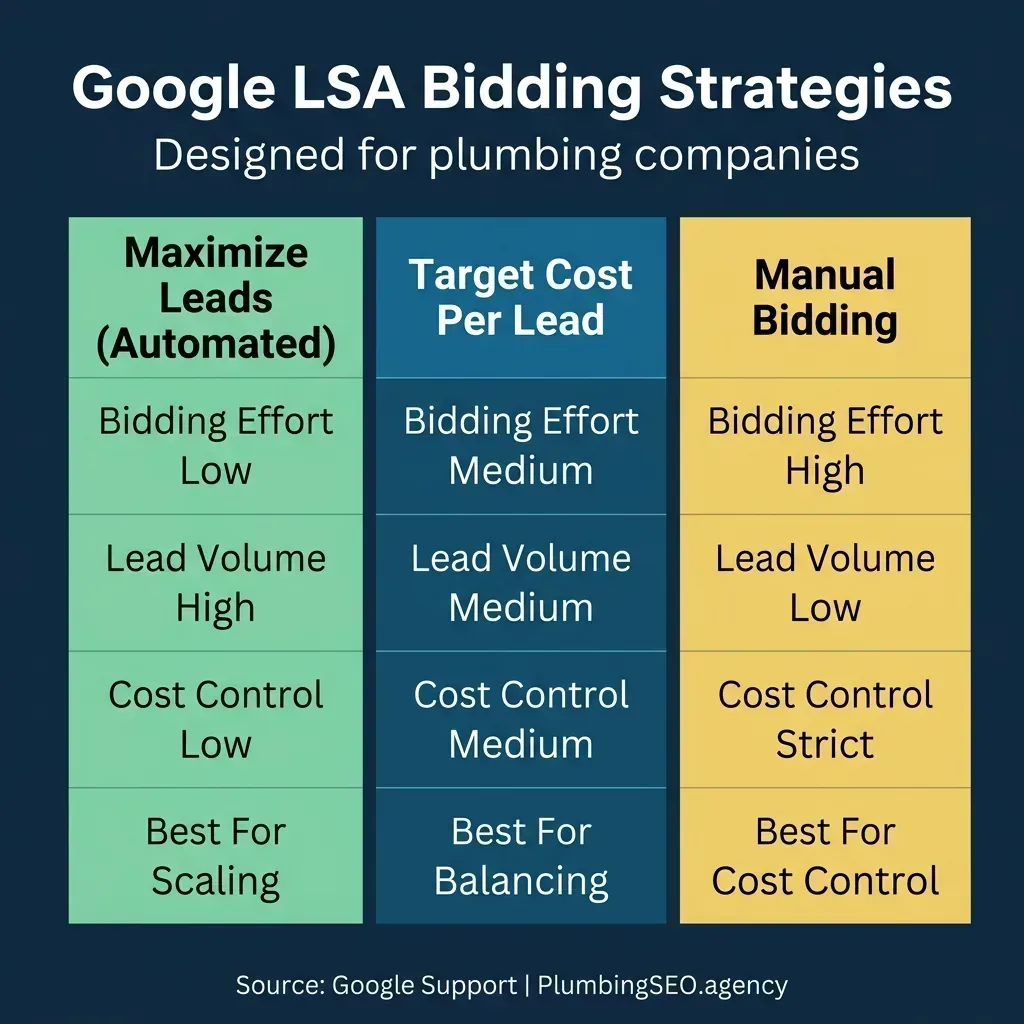
Bidding matrix comparing Maximize Leads, Target Cost Per Lead, and Manual Bidding options. Source: Google Support, PlumbingSEO.agency
| Bidding Option | Control Level | Volume Potential | Lead Quality | Ideal For |
|---|---|---|---|---|
| Maximize Leads | Low (Automated) | Maximum | Variable | Shops looking to scale quickly and fill dispatch boards |
| Target Cost Per Lead | Medium (Semi-Auto) | Moderate to High | Stable | Established companies with reliable lead-to-job metrics |
| Max Per Lead | Strict (Manual) | Low to Moderate | Higher Average | Owner-operators and shops with tight marketing budgets |
The numbers show a clear reality: automated bidding is designed to spend your budget to keep your phone ringing, whereas manual bidding is designed to protect your wallet at the expense of opportunities. If you are running a multi-truck shop, a manual strategy will rarely generate enough calls to sustain your overhead. However, if you are a single-truck owner-operator, starting with an automated strategy without a daily cap is a quick way to burn through your savings before the algorithm even finishes its learning phase.
Plumbing LSA Cost Benchmarks: What Leads Actually Cost
Google Local Services Ads prices are not uniform. A lead for a routine faucet leak repair is priced far lower than a lead for an emergency sewer line excavation. Google dynamically adjusts its base lead pricing based on the average job value, the customer's location density, and the number of competing plumbing companies active in that zip code.
To help you calculate your budget, the table below shows typical plumber LSA lead cost benchmarks and booking rates across various plumbing service categories:
| Service Category | Typical LSA Lead Cost | Average Booking Rate | Typical Job Value | Target Bid Mode |
|---|---|---|---|---|
| Emergency Drain Cleaning | $45 to $75 | 55% | $350 | Maximize Leads |
| Water Heater Replacement | $70 to $110 | 45% | $1,800 | Target CPL |
| Sewer Line Repiping | $120 to $180 | 35% | $6,500 | Target CPL |
| General Fixture Repair | $30 to $50 | 65% | $250 | Manual Bidding |
| Commercial Plumbing | $110 to $160 | 40% | $1,200 | Target CPL |
As the data shows, emergency services like drain cleaning and water heater replacements command higher search volume and lead costs. Bidding aggressively on water heaters or sewer repiping is highly profitable because a single booked job easily covers the cost of multiple leads. Conversely, general fixture repairs have lower average ticket sizes, meaning high manual bids or unchecked automated bidding can quickly erode your profit margins on these service types.
The Hidden LSA Quality Score: Why Bids Alone Don't Win
A common misconception among plumbing contractors is that setting a higher bid will automatically guarantee the top spot. Google does not run Local Services Ads as a pure financial auction. Behind the scenes, Google uses a hidden quality ranking algorithm to determine which three plumbers get featured at the top of the search results.
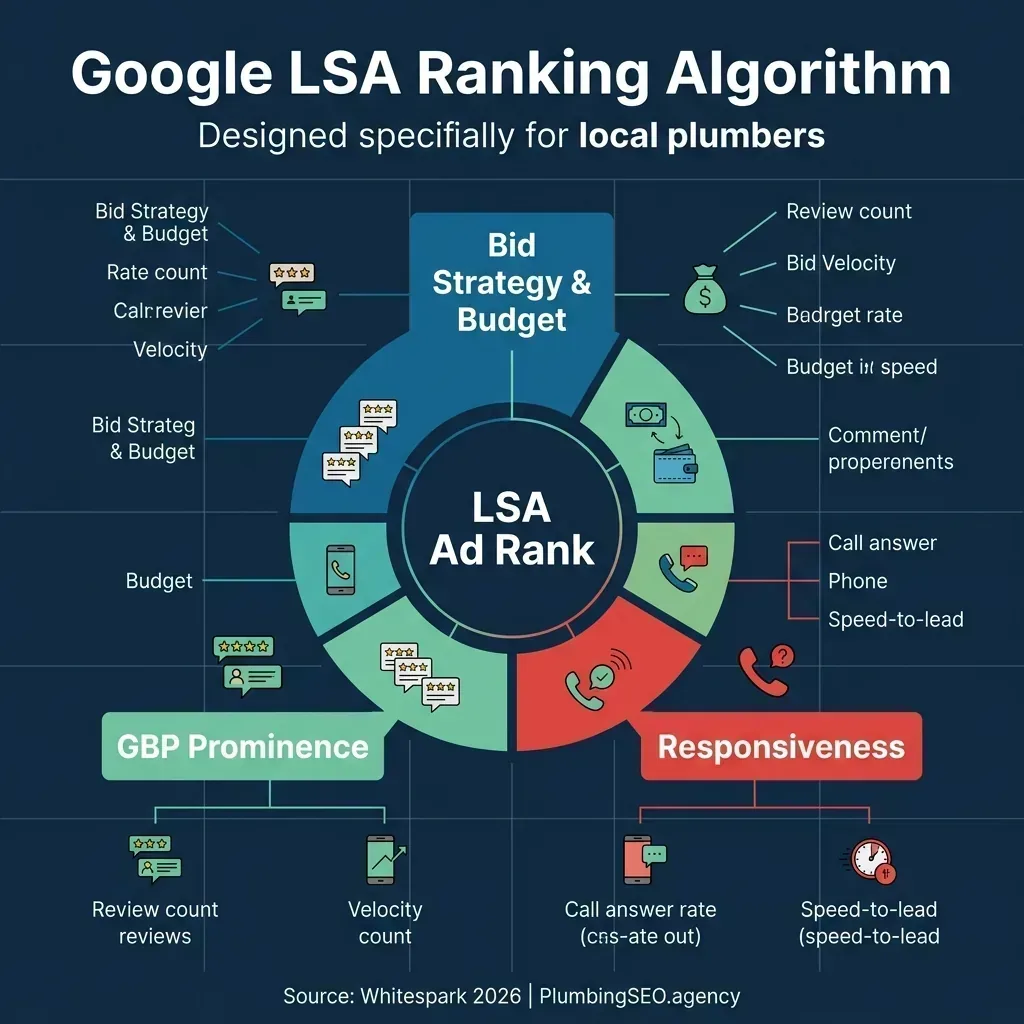
The three core pillars of the Google LSA ranking algorithm. Source: Whitespark 2026, PlumbingSEO.agency
While your bid strategy tells Google how much you are willing to pay, your operational performance dictates whether Google actually wants to send you the customer. Google guarantees these services, meaning if a contractor does a poor job, Google may refund the homeowner up to $2,000. Because Google has real money on the line, the algorithm heavily favors businesses that reduce their liability and provide excellent service.
Two major operational factors carry more weight than your actual bid:
- Call Answer Rate and Speed: If you miss LSA calls, Google stops displaying your ad. The algorithm tracks your connection rates. If your staff lets calls go to voicemail, your ranking will plummet within forty-eight hours. Utilizing the tech stack that prevents lost leads is essential to protect your ad ranking.
- Review Velocity and Ratings: Google pulls reviews directly from your Google Business Profile. The algorithm looks at your overall star rating, but it cares even more about how frequently you get new reviews. A steady flow of fresh reviews signals that your business is active and reliable. Implementing the 5-star system for plumber Google reviews will do more for your LSA visibility than raising your manual bid by $20.
"We saw a local client raise their max bid to $75 per lead, yet they still ranked below a competitor bidding $45. Why? The competitor answered 98% of their calls live, while our client was sending 25% of their leads to a automated voicemail system."
The 14-Day LSA Learning Phase Survival Guide
When you launch a new Local Services Ads campaign, or make a major change to your bidding strategy (such as shifting from Maximize Leads to Target CPL), Google's machine learning algorithm enters a calibration phase. This is known as the learning phase, and it typically lasts fourteen days.
During this critical window, Google is testing your business's responsiveness, lead quality, and customer feedback. The algorithm is trying to determine where your ads should rank and how much it should bid on your behalf. Disrupting this phase will reset Google's algorithm, extending the period of volatile lead volumes and higher lead costs.
To help your campaign stabilize quickly, follow these rules during the initial fourteen-day learning phase:
- Do Not Adjust Your Weekly Budget: Avoid modifying your budget. Changing your budget by more than 10% will force the algorithm to recalibrate its bidding model.
- Keep Service Areas Locked: Do not add or remove zip codes. Keep your service area consistent so Google can accurately benchmark demand in your primary markets.
- Leave Bidding Mode Alone: If you start on Maximize Leads, let it run for the full two weeks. Switching between manual and automated modes during this time will erase the algorithm's gathered performance history.
- Keep Service Categories Stable: Do not toggle specific services (like water heater installation or drain repair) on and off. Select your core services before launching and leave them active.
Daily Operational Checklist During Calibration
To ensure Google rewards your profile with high visibility after the learning phase, your shop must maintain strict operational discipline:
- Answer Every LSA Call Live: A single missed call during the learning phase can depress your visibility for days. Ensure your office staff or an after-hours call center answers every LSA lead within three rings.
- Mark Leads as Booked Immediately: Log into your LSA dashboard daily and update the status of each lead. This signals to Google that you are actively booking jobs and that their leads are converting.
- Archive Spam and Solicitations: If you receive a solicitor or a robocall, do not just hang up. Mark it as spam in the LSA dashboard to help train the automated filter.
By protecting the learning phase from administrative changes and executing excellent call operations, you give Google the positive signals it needs to lower your average cost per lead over the long term.
How to Calculate Your Profitable LSA Bid Cap
The Unit Economics of a Plumber's Lead
Setting an ad bid without doing the math is a quick way to lose money. To find your maximum profitable bid, you must analyze your shop's core unit economics: average ticket size, gross margin, booking rate (leads converted to scheduled appointments), and technician close rate (quoted jobs turned into paid work).
You can calculate your Maximum Profitable Cost Per Lead (CPL) using this formula:
Max Profitable CPL = Average Ticket × Gross Margin (%) × Booking Rate (%) × Tech Close Rate (%)
For example, if your average plumbing ticket is $1,600, your gross margin is 35%, your booking rate is 45%, and your technicians close 75% of scheduled jobs, the math breaks down as follows:
Max Profitable CPL = $1,600 × 0.35 × 0.45 × 0.75 = $189
This means you can bid up to $189 per LSA lead before the first transaction becomes unprofitable. Since typical plumbing LSA leads average $55 to $85, you have a solid margin of safety. If you set your manual bid cap to $80, you are comfortably within your profitable zone while remaining highly competitive in the auction.
Drag the sliders to match your plumbing shop's metrics and calculate your profitable cost per lead.
Budget Throttling: The Danger of Low LSA Weekly Budgets
The "Monday Morning Drain" Effect
When you select the Maximize Leads bidding strategy, the LSA algorithm attempts to win as many leads as possible. However, if your weekly budget is set too low (e.g., $300 per week) relative to your local market's average lead cost (e.g., $60 per lead), Google's automated system will throttle your ads.
In many cases, the algorithm will spend your entire weekly budget within the first 24 to 48 hours of the week. If you receive five calls by Tuesday afternoon, your ads are paused for the remaining five days of the week. This budget throttling means you miss out on high-value emergency calls on Friday night and Saturday morning when homeowners are home and searching. To prevent throttling, ensure your weekly budget is at least ten times the average cost of a single lead.
Stepped Target CPL Bidding: Climbing the LSA Auction Safely
Avoiding the Click Choke
Switching from Maximize Leads to Target Cost Per Lead (tCPL) bidding can help stabilize your acquisition costs, but setting your target too low will instantly kill your volume. If the average LSA lead cost in your city is $70, and you set your tCPL to $35, Google's algorithm will stop showing your ad because it cannot find leads at that price.
Instead, use a stepped target CPL strategy:
- Start by setting your tCPL equal to or slightly above the average lead cost suggested by Google (e.g., $80).
- Let the ads run for 14 days to establish a steady volume history.
- Reduce your tCPL by $5 increments each week (e.g., from $80 to $75, then $70).
- Stop reducing your bid the moment you notice a drop in weekly impressions or calls. This is your market's real bid floor.
The Plumbing Playbook: Matching Bidding to Your Shop's Scale
There is no single best bidding strategy for every plumbing business. Your setup should align with your business size, dispatch capacity, and growth goals.
Protect your cash flow. Set your manual bid slightly above Google's average suggestion to secure visibility, but keep a strict weekly cap so you do not get billed for ten leads on a single Tuesday.
Keep your dispatch board full. Let Google auto-bid to capture high-value emergency calls. Combine this with automated tracking to monitor booking rates per lead source.
If you are unsure where your marketing dollars are best spent, you can read our comparison of LSA vs SEO for plumbers to see how paid lead generation compares to organic SEO over a twelve-month period. If you want PlumbingSEO.agency to manage the paid side, start with our Google Ads and LSA management for plumbers service page.
Advanced Plumbing LSA Bidding: Bidding High + The Dispute Funnel
If you want to dominate a competitive market, there is an advanced strategy utilized by top-tier HVAC and plumbing agencies: **bidding aggressively high while running a strict weekly dispute process**.
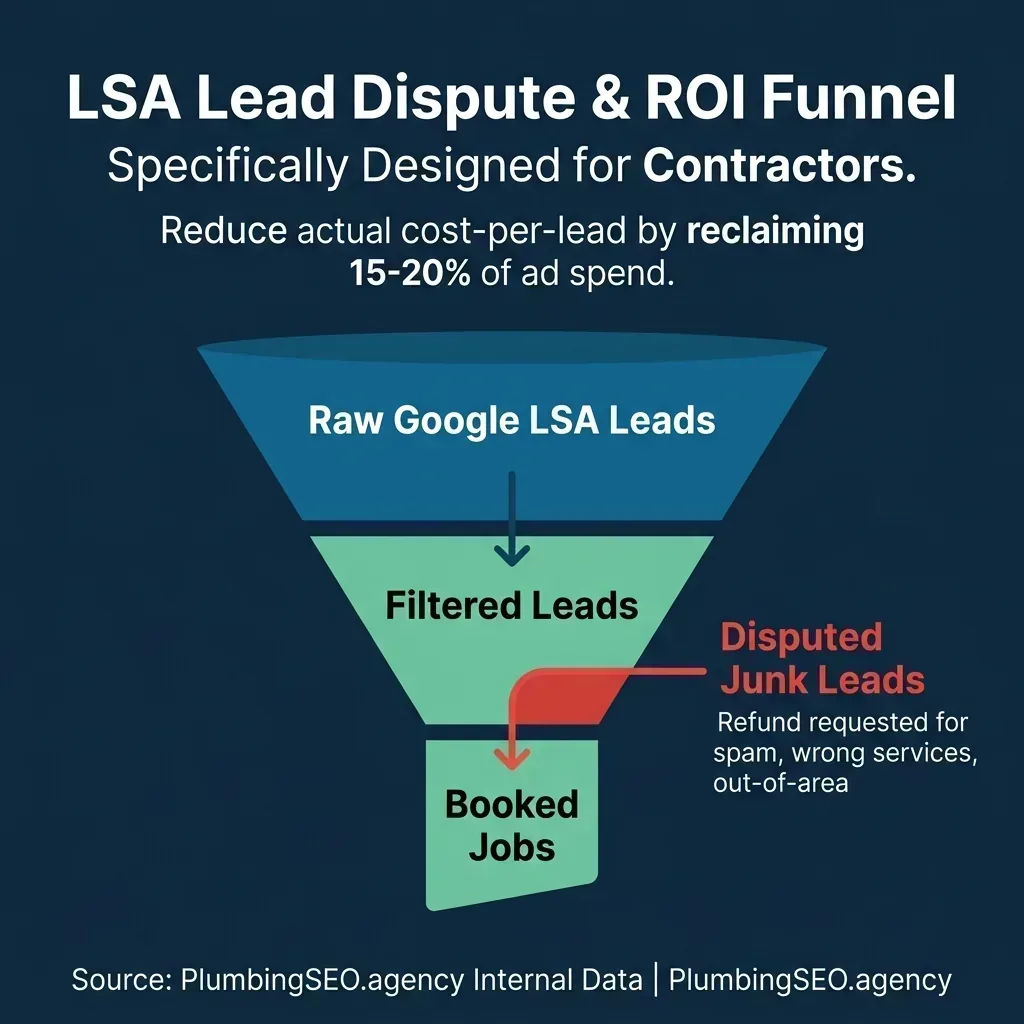
The LSA lead lifecycle: maximizing ROI by disputing invalid calls. Source: PlumbingSEO.agency Internal Data
By choosing Maximize Leads or setting a high Manual Bid, you signal to Google that you are willing to pay top dollar for customers. Google will reward this by pushing your ad to the top of the pile, sending you a high volume of raw calls. However, some of these calls will inevitably be junk: out-of-area homeowners, spam callers, telemarketers, or people looking for services you do not provide.
This is where the dispute funnel comes in. Google allows you to dispute invalid leads directly inside the Local Services dashboard. If you verify that a call was spam, a solicitor, or outside your service area, Google will credit the lead cost back to your account. By combining aggressive bidding to win volume with a disciplined weekly review of your call recordings, you can capture high-value emergency calls while keeping your actual cost-per-lead low. To make this work, you must understand how to track where every plumbing lead comes from so you have the recordings and data to back up your disputes.
Running this strategy successfully requires tracking your marketing performance closely. You need to know your average ticket size and booking rates to evaluate whether the increased ad spend translates to profit. If you are ready to audit your numbers, our guide on how to measure marketing ROI for plumbers outlines the exact formula to track your cost per booked job.
The Automated Credit Era: Bidding in the New LSA Dispute System
The Death of the Manual Dispute
In late 2025, Google retired the manual lead dispute system for most contractor categories, replacing it with an automated credit determination engine. Plumbers can no longer submit manual disputes for "job type not serviced" or "customer just shopping." Google's AI now automatically credits your account for spam, wrong numbers, and out-of-area calls by analyzing call duration and transcription data.
Why Profile Tuning Outweighs Bidding Control
Under this automated system, your bidding ROI depends heavily on how tightly you configure your LSA profile. If you run a high bid but leave general service categories checked (like "leak detection" when you only want "repipe" jobs), you will be charged for lower-value calls that Google's automated system will not refund. Protecting your margins in 2026 requires strict service category filtering and using the "Rate this Lead" feedback tool daily to train Google's algorithm on what leads to avoid.
Operational Checklist: Dominating the LSA Auction Safely
To execute the advanced bidding strategy (bidding high to win maximum visibility while maintaining a highly profitable cost per booked job), your plumbing shop needs a systematic process. You cannot just increase your bids and hope for the best.
Use this operational checklist to audit your LSA campaigns weekly and protect your profit margins:
Google LSA Bidding and Operations Cheat Sheet
To help you keep these strategies and rules handy in your shop, we have compiled the entire playbook into a single visual cheat sheet. Save this image to your phone, pin it in your dispatch office, or share it with your marketing team:
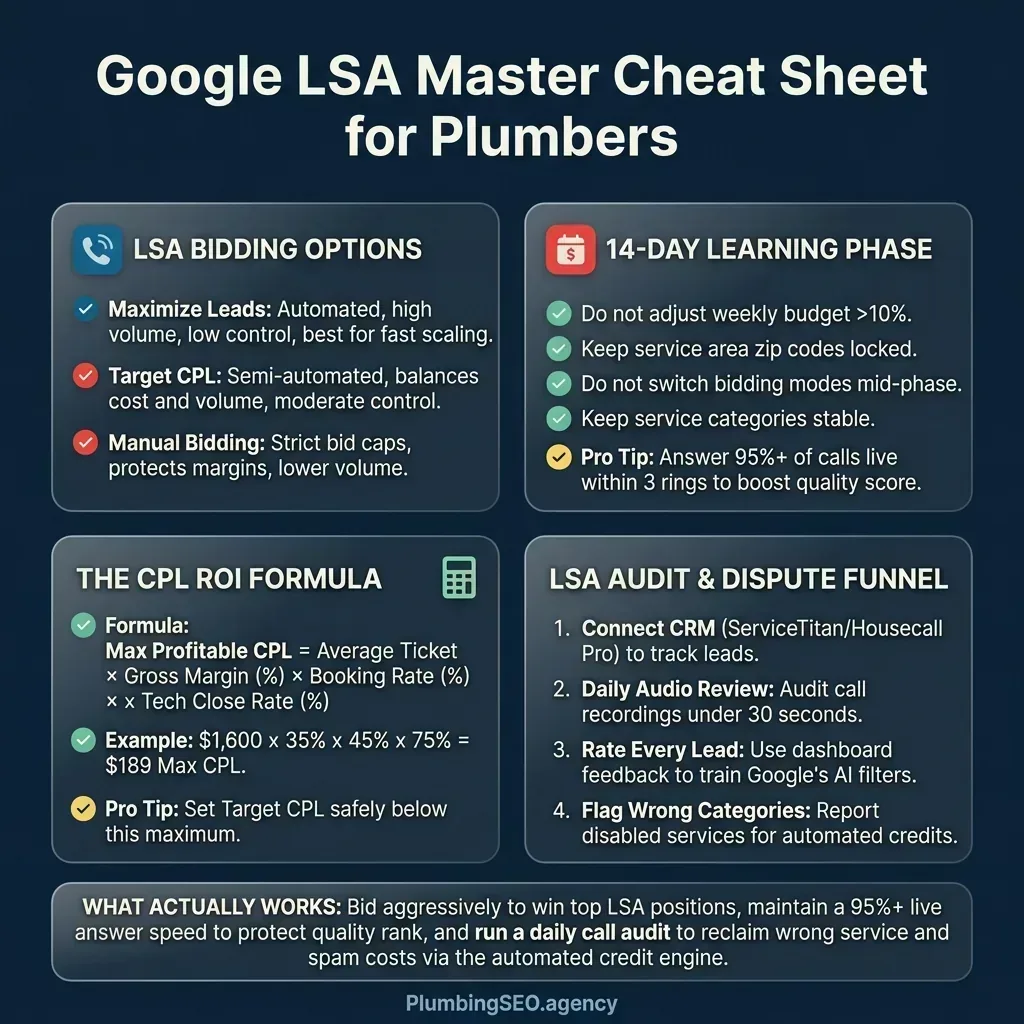
Google LSA Master Cheat Sheet: bidding modes, learning phase guidelines, CPL profitability math, and the weekly operational audit checklist. Source: PlumbingSEO.agency
Frequently Asked Questions About Plumbing LSA Bidding
To increase your lead volume, expand your target service area by zip code, select all plumbing service types you are licensed to perform, actively request reviews from customers, set your bidding mode to Maximize Leads, and ensure your team answers every incoming call live.
Maximize Leads is fully automated, allowing Google to bid whatever is necessary to win leads within your budget. Target Cost Per Lead (tCPL) lets you set a target average price per lead, and Google adjusts bids to keep your overall average lead cost close to that amount.
Yes. Because you only pay when a customer calls or messages you directly, it is highly cost-effective compared to traditional PPC search ads where you pay for clicks that might not convert. However, you must actively dispute and request refunds for spam and out-of-area calls to protect your margins.
It typically takes about two weeks for Google's machine learning bidding model to adjust and learn about your specific plumbing business, local service areas, customer call volume patterns, and competitor bidding levels in your market.
Missing calls severely damages your business responsiveness score, which is a major factor in the ranking algorithm. If Google notices a pattern of unanswered calls or long response times, it will depress your visibility and push your ad below competitors who answer live.
Stop Wasting Money on Junk LSA Leads
As a specialized plumbing SEO agency, we help plumbing companies optimize their Google Local Services Ads, manage campaigns, and build organic SEO that brings in high-value calls without the ad spend. Let us find where your marketing is leaking.
Run My Free SEO Leak Check