
- Home service businesses miss 27% of inbound calls on average, and 85% of those callers never call back. The problem is not marketing. It is the gap between the ad click and the booked job.
- A connected communication stack (website + call tracking + webchat + CRM + after-hours automation) costs $200-400/month combined and recovers leads that would otherwise go to the shop down the road.
- This guide walks through the 5 layers of a plumber's lead-capture tech stack, what each layer does, which tools fit, and how they connect so nothing falls through the cracks.
Your Marketing Is Working. Your Communication Is Not.
Here is a pattern we see at plumbing companies all the time. The owner is doing everything right on the marketing side. The website ranks. The Google Business Profile is optimized. Ads are running. Reviews look good. But somewhere between the customer finding the company and actually talking to someone, leads are leaking out.
A homeowner searches "plumber near me" at 9pm on a Tuesday. They click your website, see the phone number, and call. Nobody picks up. They do not leave a voicemail because 80% of callers sent to voicemail will not leave a message. They call the next plumber on Google. That lead is gone. You paid for the click. You paid for the SEO. You never even knew they called.
According to call-tracking data from the home services industry, businesses miss an average of 27% of inbound calls. For small and mid-sized operations, that number can climb to 62%. Industry research shows the average plumbing company loses between $50,000 and $120,000 annually from missed calls alone.
On r/Construction, a plumber asked how other tradespeople handle high call volume. The top response was blunt: "You can't do it all. If your week's not booked and you are missing calls while working, you need a phone service." Another user added: "If I get an AI answer, I assume that company's overhead drives prices higher than I want to pay, so I call someone else." The real answer is not one tool. It is a connected system where each piece handles a different part of the lead flow.
Here is how the numbers break down:
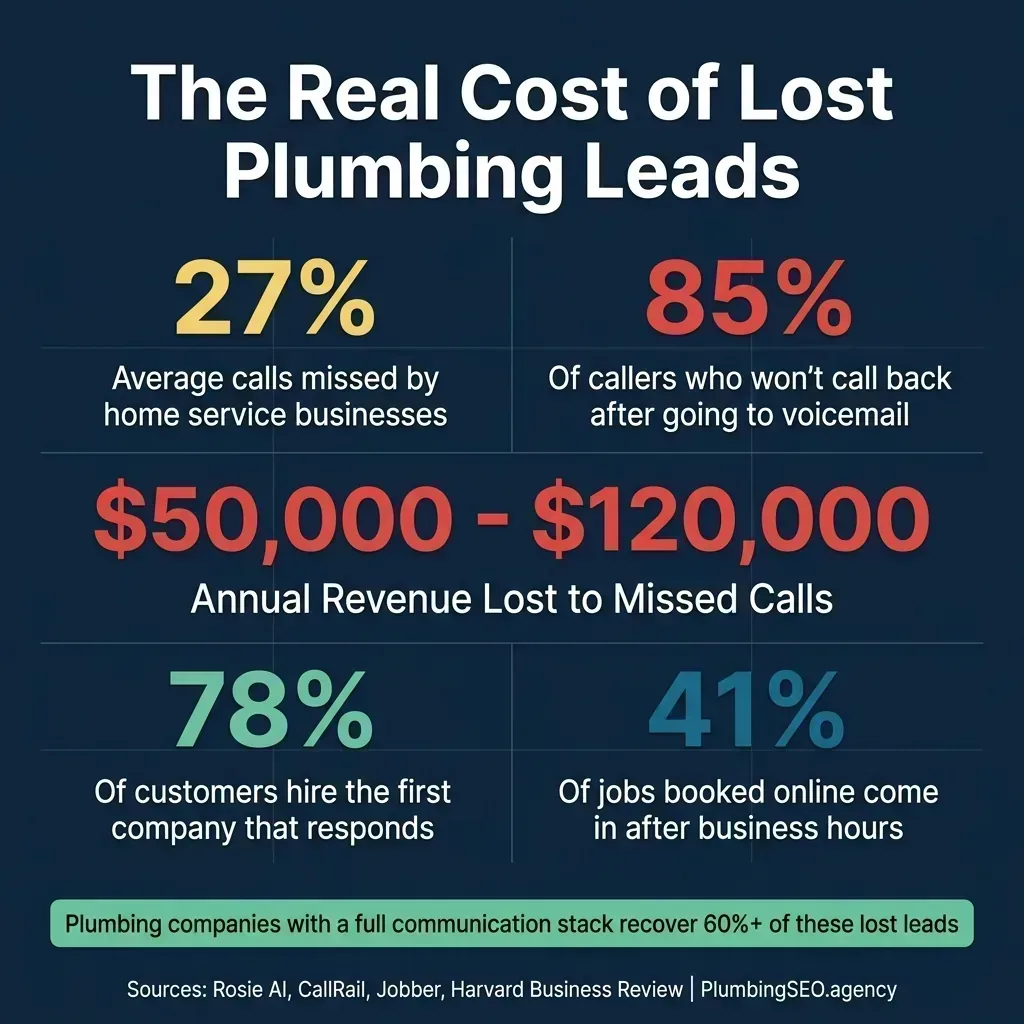
The compound cost of disconnected communication. Each stat represents a different leak point in your lead pipeline.
The fix is not answering every call yourself. It is not hiring a full-time receptionist (though that works at scale). It is building a communication tech stack where each layer catches what the previous one missed. Think of it like a drain system. You do not rely on one fitting. You use joints, traps, vents, and cleanouts, each serving a purpose, so nothing backs up.
The 5-Layer Lead-Capture Tech Stack
Every plumbing company that consistently turns website visitors into booked jobs has some version of this stack. Some call it a "communication ecosystem." Some call it their "lead flow." Most just call it "the way we handle calls." Whatever the name, the structure has five layers:
- Your website (the hub where traffic lands)
- Call tracking (so you know where every lead comes from)
- Webchat and text-back (for visitors who will not pick up the phone)
- CRM integration (where leads become booked jobs)
- After-hours automation (so 41% of leads do not disappear overnight)
Here is how they connect:
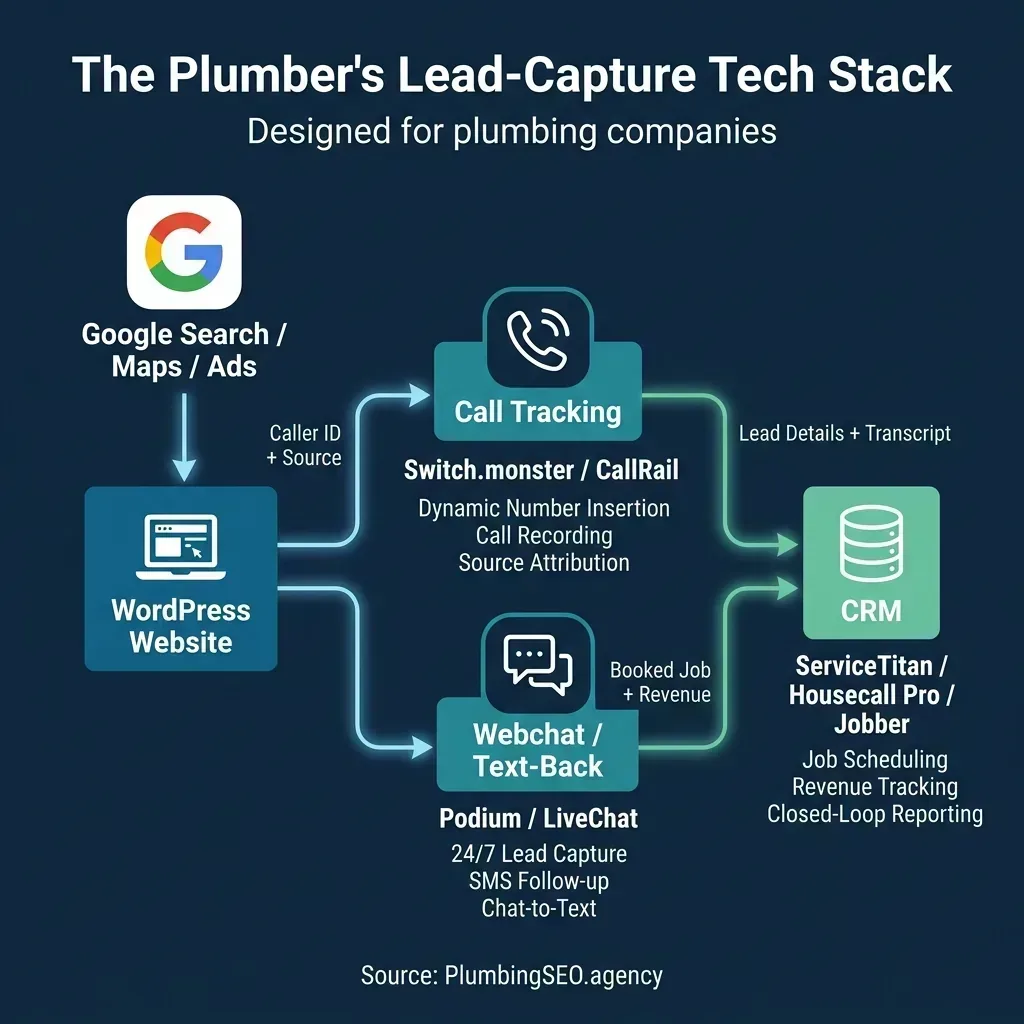
The complete lead-capture pipeline. Traffic enters through Google, hits your website, and splits into call and chat channels, both feeding into your CRM for scheduling and revenue tracking.
Most plumbing companies have layer one (a website) and some version of layer four (a CRM or at least a spreadsheet). The three layers in between are where leads leak. Let us walk through each one.
Layer 1: Your Website Is the Hub, Not Just a Brochure
Your website is the center of everything. Every Google search, every Maps listing, every ad click, every QR code on your truck eventually sends someone to your site. If the site does not make it dead simple to contact you in three different ways, you are losing leads before any other tool can help.
At minimum, your website needs:
- A click-to-call button that stays visible on mobile. On most plumbing sites, 70%+ of traffic is mobile. If someone has to scroll back up to find your phone number, some will not bother. A sticky call button at the bottom of the screen on mobile is standard for a reason. It works.
- A contact form that asks the right questions. Name, phone, service needed, and zip code. That is it. Do not ask for their address, how they heard about you, or what day works best. You can gather that on the phone. The form's job is to capture the lead. Period.
- A webchat widget. More on this in Layer 3, but the chat bubble needs to be on every page. Not just the homepage.
- Page speed that does not frustrate customers. If your site takes more than 3 seconds to load on mobile, you are losing visitors before they even see your phone number. A fast site is not a luxury. It is one of the reasons your website may not be getting calls.
The website is not where leads are captured. It is where leads decide whether to reach out. Every other layer in this stack depends on the site doing its job as the hub.
Layer 2: Call Tracking Shows You Where Every Lead Comes From
If you are spending money on marketing but cannot tell which channel generated each phone call, you are flying blind. Call tracking fixes that by assigning unique phone numbers to each marketing source. When a customer calls one of those numbers, the system logs which source drove the call. The customer never knows the difference. The call still rings your office.
We wrote a complete guide to call tracking for plumbers that covers setup step by step. Here is the short version of why it matters for your communication stack.
Dynamic Number Insertion (DNI) is the core technology. When someone visits your website from a Google Ad, they see one phone number. When someone visits from organic search, they see a different number. When someone calls the number on your truck wrap, that is a third number. All three ring your office, but you know exactly which source brought each call.
Switch.monster is a newer entry worth knowing about. It launched a free call tracking platform built around the customer's own Twilio account, which means you own your phone numbers outright instead of renting them from the platform. That matters because switching call tracking providers usually means losing your numbers. With Switch.monster, you keep your numbers regardless. It includes dynamic number insertion, call recordings, AI-powered call reviews, transcripts, and lead routing. If you want a detailed look at how it holds up against industry giants, check out our comprehensive Switch.monster call tracking comparison.
CallRail remains the industry standard at $45/month starting. If you want something proven and well-integrated with ServiceTitan, it is the safe choice. But for plumbing companies just getting started with tracking, Switch.monster's free tier removes the cost barrier entirely.
According to CallRail's 2026 marketing statistics report, home services businesses that use call tracking reduce cost per lead by 10% and decrease time spent qualifying leads by 50%. Those are real numbers from real contractors. Call tracking also drove a 7% increase in call lead-to-close rates because the data shows where the sales process breaks down.
The bottom line: if you do not know whether a call came from Google, your truck, or a yard sign, every marketing decision you make is a guess. Call tracking makes it a fact.
Layer 3: Webchat and Text-Back Capture the Leads Who Will Not Call
Not every homeowner wants to pick up the phone. Some are researching at midnight. Some are at work and cannot talk. Some just prefer texting. According to industry data from plumbing website specialists, only 5-10% of website visitors convert to leads on a typical plumbing site. That means 90%+ of the people who found you, needed your service, and were in your area left without contacting you. Live chat is proven to increase that visitor-to-lead rate by 30-40%.
The way it works is simple. A small chat bubble sits in the corner of your website. When someone clicks it, they can type a question or request a callback. The key is what happens after that initial message. The best tools in this space, like Podium, convert that webchat into a text message conversation. So even after the visitor leaves your website, you are still texting with them. That is a massive difference compared to traditional live chat, which dies the moment the visitor closes the browser tab.
On r/smallbusiness, a user shared their experience with webchat for their dad's HVAC company: "We installed a live chat and it's amazing. People go there for a quick question, request calls, and we capture leads we never would have gotten otherwise." The key insight was that many of those leads never would have picked up the phone in the first place.
Here is how response time affects whether you actually book the job:
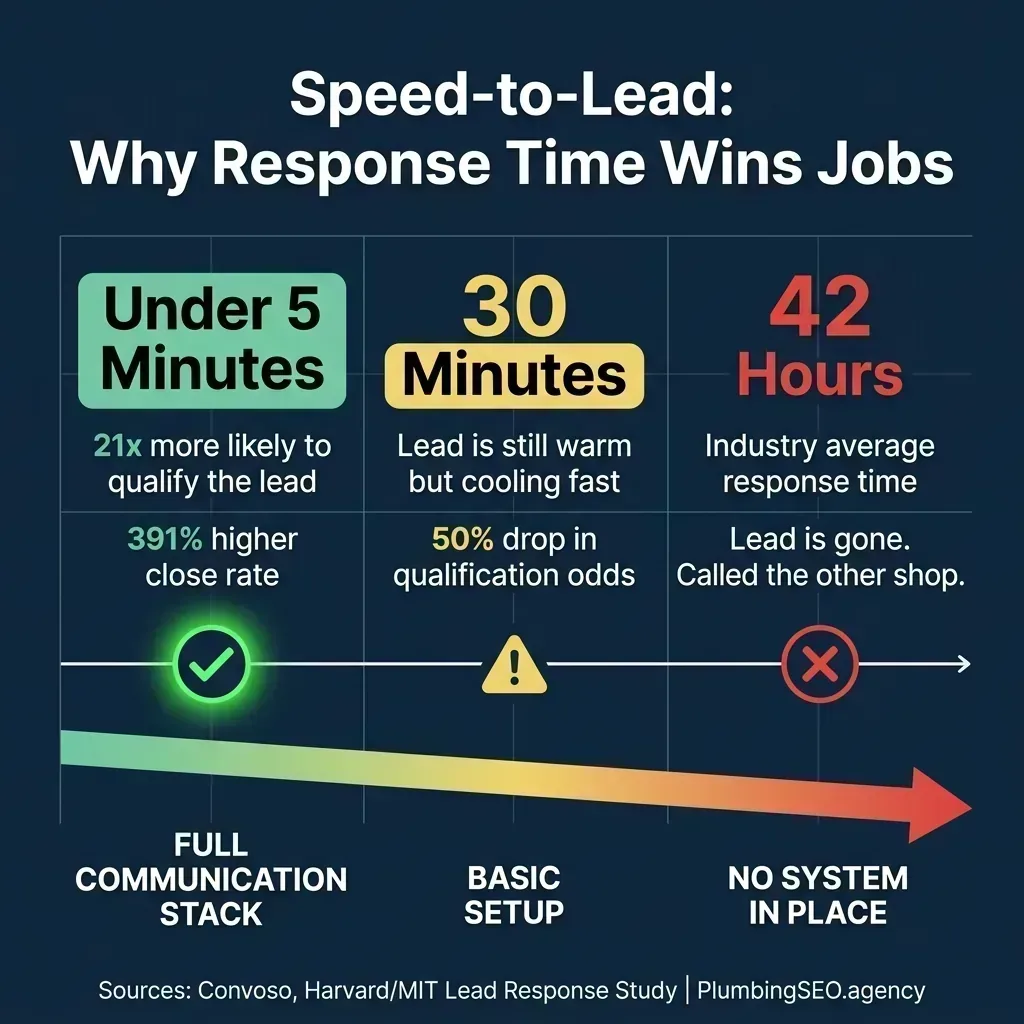
Speed kills in the wrong direction. The average home services business takes 42 hours to respond to a lead. That is not a response, that is a goodbye.
The data is hard to argue with. According to the Harvard/MIT Lead Response Study, businesses that respond within 5 minutes are 21 times more likely to qualify a lead than those that wait 30 minutes. Responding in under 2 minutes increases close rates by 391% compared to the industry average 42-minute response time. And 78% of customers hire the first company that responds.
Webchat makes that sub-5-minute response possible even when you are on a job, under a house, or running a saw. The chat captures the name, the need, and the contact info. A text message notification hits your phone. You can respond between tasks or have someone in the office handle it.
Text-Back for Missed Calls
This is the cheapest, highest-ROI automation in the entire stack. When a call goes to voicemail, the system sends an automatic text message within 30 seconds: "Hey, we missed your call. We are currently on a job. Can you share what you need and we will get back to you ASAP?" That one text keeps the lead warm instead of letting them scroll to the next plumber on Google.
As one contractor on r/Construction put it: "If you miss a call while the saw is running, it texts them back saying you're on-site and to text photos of the job. That keeps the lead warm without you having to touch your phone with dusty hands."
Most CRM platforms (Housecall Pro, Jobber) include missed-call text-back as a built-in feature. If your CRM does not, standalone tools like Podium or GoHighLevel handle it for $97-289/month. For a tool that costs less than one service call, it recovers leads that would otherwise disappear completely.
Layer 4: CRM Integration Turns Leads Into Booked Jobs
Call tracking tells you where leads come from. Webchat captures leads who will not call. But if those leads end up on a sticky note, a whiteboard, or an overflowing voicemail box, none of it matters. The CRM is where leads become jobs.
For plumbing companies, the CRM landscape breaks down into three tiers based on company size:
Under 5 trucks: Jobber or Housecall Pro. Both are built specifically for home service businesses and handle scheduling, dispatching, invoicing, and customer management. On r/CRMSoftware, a user who works with thousands of home service businesses gave a direct answer: "Ignore the other answers. FieldPulse or Housecall Pro if you're smaller. ServiceTitan if you're running 20+ trucks." Housecall Pro starts around $60-80/month. Jobber starts at $50/month.
5-20 trucks: FieldPulse. A strong mid-tier option that handles CRM, dispatch, and finance without ServiceTitan's price tag. Multiple Reddit users flag it as the sweet spot for growing companies that are not ready for enterprise pricing.
20+ trucks: ServiceTitan. The industry standard for larger operations. It handles everything from dispatch to marketing attribution to pricebook management. The integration with call tracking is particularly strong. ServiceTitan can match call data to completed jobs and revenue, giving you true cost-per-acquired-customer metrics by channel. The trade-off is price and complexity. As one r/HVAC user put it: "ServiceTitan is the gold standard. Comes with one hell of a price tag too."
The critical piece is integration. Your call tracking platform needs to feed data into your CRM automatically. When a call comes in, the CRM should show the caller's name (if they are a returning customer), the marketing source, and the call recording. When your dispatcher books the job, that data feeds back to the call tracking platform so you know which marketing channel generated revenue, not just a call.
This is what contractors mean when they talk about "closed-loop reporting." The loop is: marketing generates a call, call tracking attributes it, the CRM books the job, the job completes, revenue is recorded, and the revenue is attributed back to the original marketing source. Without CRM integration, the loop stays broken at the booking step. You know a call came in. You do not know if it became money.
One thing we hear consistently from plumbing owners who work with us: the switch from spreadsheets to a CRM felt like overkill at first. But once they could see exactly which marketing channels generated which booked jobs, their entire approach to measuring marketing ROI changed. Instead of guessing, they could point to the numbers.
Layer 5: After-Hours Automation Catches the 41% You Are Sleeping Through
According to Jobber's data, 41% of jobs booked online come in after business hours, with a significant share arriving between 1am and 4am. Homeowners are not waiting for 8am to decide they need a plumber. A burst pipe at midnight, a backed-up sewer at 6am on a Saturday, a water heater that quit on a holiday. These are the calls that pay 1.5-3x the normal rate. And they are the ones most plumbing companies miss.
After-hours automation is not about replacing humans. It is about making sure a lead does not evaporate between 5pm and 8am. The system works in layers:
- Missed-call text-back fires within 30 seconds of a missed call. "Hi, thanks for calling [Your Company]. We are currently after hours but want to help. Reply with your name and the issue, and we will call you first thing in the morning." This one automation alone can recover 40-60% of after-hours leads that would have gone to voicemail and disappeared.
- Webchat stays live 24/7. Your chat widget does not go home at 5pm. Someone browsing at 11pm can still type their question and leave contact info. The chat logs in your CRM so your team can follow up first thing in the morning.
- Emergency routing is for companies that offer 24/7 service. Call tracking platforms like CallRail and Switch.monster support time-based routing rules. During business hours, calls ring the office. After hours, they route to the on-call tech or an answering service. No more relying on the tech to check voicemail.
On r/Plumbing, one user nailed the problem: "Many customers reach out late at night or early in the morning, especially during emergencies. Without a system to catch those, the leads go unanswered." Another user on r/smallbusiness tracked their missed call data and found they were leaving $11,800 in recoverable revenue on the table every quarter from after-hours calls alone.
The plumbing companies that respond by 8:01am to a lead that came in at midnight do not just win that job. They win the customer for life. Because the homeowner remembers: "I reached out late and they actually got back to me. Everyone else was a black hole."
What Each Stack Level Costs (And What You Lose Without It)
Here is the real question most plumbing owners are asking: "Do I need all five layers?" The honest answer is no. You can start with two or three and add layers as your company grows. But you need to understand what you are trading off at each level.
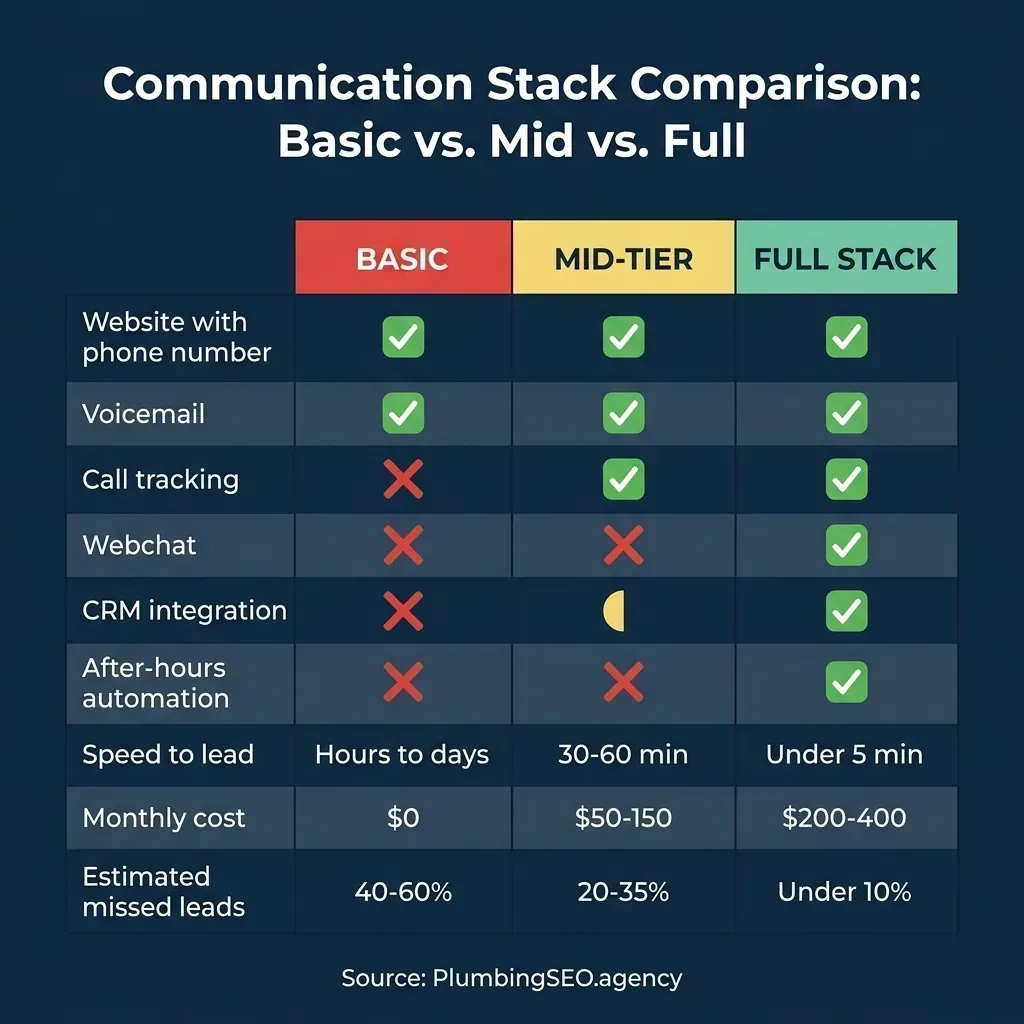
The jump from Basic to Mid-Tier is a high-ROI upgrade most plumbing companies can make. Call tracking alone tells you where money is leaking.
The math is worth spelling out. A plumbing company spending $3,000/month on marketing and missing 40% of leads is losing roughly $4,800/month in potential revenue (assuming $300 average ticket and 40 missed leads). Spending $200-400/month on a full communication stack to recover even half of those leads generates $2,400/month in new revenue. That is a 6-12x return on the stack investment.
For a reality check on how much you should be spending overall, our guide to how much plumbing companies should actually spend on SEO breaks down the full budget math.
Where to Start Based on Your Company Size
Solo plumber or 1-2 trucks: Start with call tracking (Switch.monster's free tier) and missed-call text-back (built into Jobber or Housecall Pro). Total cost: under $60/month. This plugs the two biggest lead leaks immediately.
3-10 trucks: Add webchat (Podium Essentials at $289/month or a simpler option for less) and connect your call tracking to your CRM. At this size, you are likely spending $2,000-5,000/month on marketing, so the communication stack pays for itself if it recovers even 5-10 additional jobs per month.
10+ trucks: Full stack including ServiceTitan with integrated call tracking, after-hours routing to a dedicated dispatcher or answering service, and a webchat-to-text system. At this scale, every missed lead represents significant revenue, and the cost of the stack is a rounding error compared to the marketing budget.
The key principle: start with whatever plugs your biggest leak first. If you do not know where your leads come from, start with call tracking. If you know leads come in but nobody answers after 5pm, start with after-hours automation. If your website gets traffic but nobody calls, start with webchat. Build from the leak, not from the tool.
Frequently Asked Questions
A mid-tier stack (call tracking + CRM) runs $50-150/month. A full stack with webchat, after-hours automation, and CRM integration runs $200-400/month. The specific cost depends on your CRM choice (Jobber at $50/month vs ServiceTitan at $300+/month) and whether you choose free options like Switch.monster for call tracking or paid options like CallRail at $45/month. The ROI typically runs 6-12x the investment because the stack prevents far more in lost revenue than it costs.
CallRail is the most popular and well-integrated option at $45/month. Switch.monster is a strong free alternative that lets you own your phone numbers through your own Twilio account. For plumbing companies just starting with call tracking, Switch.monster removes the cost barrier. For companies already running Google Ads and needing deep integration with ServiceTitan, CallRail is the safer choice. Both support Dynamic Number Insertion, call recording, and source attribution.
Yes, if you want to capture leads from the 90%+ of visitors who leave without contacting you. Industry data shows only 5-10% of plumbing website visitors convert to leads. Live chat increases that rate by 30-40%. The real power is in webchat-to-text tools like Podium, which convert the chat into an ongoing text conversation so the lead stays warm even after they leave your site. Not every homeowner wants to call, especially after hours.
It depends on your size. Solo plumbers and small teams (1-5 trucks) do well with Jobber ($50/month) or Housecall Pro ($60-80/month). Growing companies (5-20 trucks) should look at FieldPulse. Larger operations (20+ trucks) typically need ServiceTitan for its advanced dispatching, marketing attribution, and pricebook management. The most important factor is whether the CRM integrates with your call tracking platform so you get closed-loop reporting from lead to booked job to revenue.
Call-tracking data shows that home service businesses miss an average of 27% of inbound calls, with small and mid-sized businesses missing up to 62%. Industry research estimates the average plumbing company loses between $50,000 and $120,000 annually from missed calls alone. The problem worsens dramatically after hours, when 41% of online job bookings occur but most companies have no one answering the phone.
Missed-call text-back is an automation that sends an instant text message to anyone whose call goes to voicemail. Within 30 seconds of the missed call, the customer gets a text like: "Hi, thanks for calling. We are currently on a job. Reply with your name and what you need, and we will get back to you ASAP." This keeps the lead warm instead of losing them to the next plumber on Google. Most CRM platforms like Housecall Pro and Jobber include this feature built-in. Standalone tools like Podium also offer it.
Not Sure Where Your Leads Are Leaking?
Our free SEO audit includes a communication stack review that identifies which layers are missing and how many leads you are losing as a result. When you partner with a plumber SEO agency that understands lead flow, nothing slips through the cracks. Most plumbing companies have at least two gaps that are costing them jobs every week.
Get My Free Communication Stack Audit