
- For most full-service plumbing companies, the primary Google Business Profile category should be Plumber. Do not get cute unless call data proves another core service is better.
- Secondary categories should describe real work you actually sell, staff, review, and explain on your website. A stuffed category list looks like a truck packed with parts you do not use.
- Categories open the door, but calls come from the whole local SEO system: service pages, reviews, photos, hours, service areas, and a clean path to call you.
If your Google Business Profile category is wrong, Google can misunderstand what kind of calls your shop should get. That is a quiet leak. The phone may still ring, but it can ring for the wrong jobs, the wrong service area, or not enough of the high-intent searches that keep trucks moving.
This guide is for plumbing owners choosing Google Business Profile categories for plumbers. The short answer is simple: use Plumber as the primary category when plumbing is the main business. Then add a small set of secondary categories only when they match real services you perform and can prove on your website.
That sounds basic, but it matters. Google says business categories help connect companies with customers searching for their products or services, and the categories you select can affect local ranking. Google also says local results are mainly based on relevance, distance, and prominence. Categories sit right in that relevance bucket. If the category is off, the rest of your local SEO has to drag extra weight uphill.
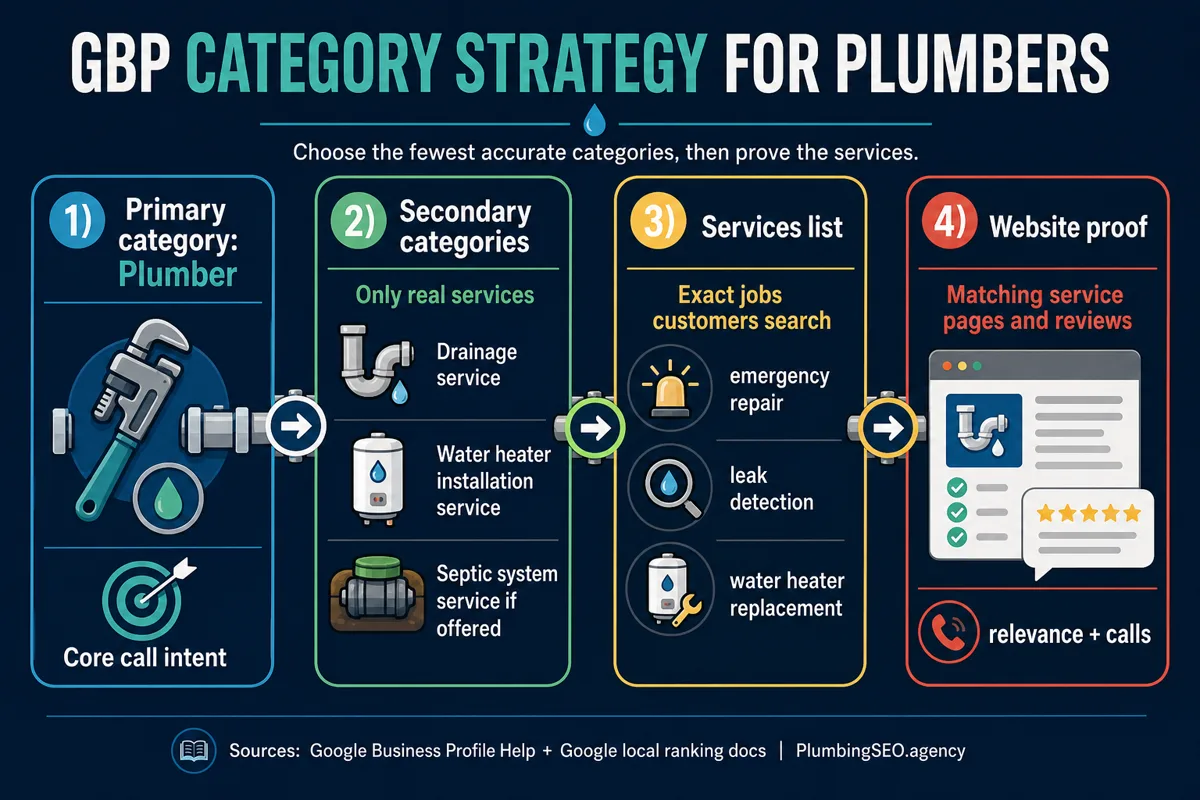
Start with the job you want Google to understand
Google does not let you create your own category. You have to choose from the list it gives you. Google also tells businesses to choose a specific primary category that best describes the business, and to use additional categories only for special departments or services.
For a plumbing company, that means the primary category is not the place to show every job you can handle. It is the place to tell Google what the company is, in plain language. If you are a full-service plumbing company, that is usually Plumber.
Think of the primary category like the main lettering on the side of the truck. If the truck says Plumber, homeowners know who to call when the water heater quits, the drain backs up, or the kitchen faucet starts acting like a lawn sprinkler. If the truck says something too narrow, like one specialty, you may miss the bigger pile of plumbing calls.
| Business situation | Best primary category | Why it fits |
|---|---|---|
| Full-service residential plumbing company | Plumber | Matches the broad call intent for plumber near me, emergency plumber, repairs, and installations. |
| Drain-only company with no general plumbing work | Drainage service, if available and accurate | The business model is narrower than full-service plumbing, so the primary category should match the actual core service. |
| Septic company that does septic first, plumbing second | Septic system service, if that is the main revenue line | The primary category should follow the work you most want to rank for and actually perform. |
| Multi-trade company with plumbing, HVAC, and electrical | Pick the most important division for this profile | One profile trying to be everything can blur relevance. Sometimes separate eligible locations or brands need a deeper review. |
Primary category: why “Plumber” usually wins
In my opinion, most plumbing companies should not overthink the primary category. If you take normal plumbing calls, set it to Plumber and build the rest of the profile around that choice.
A study from YDOP looked at 26,519 plumbing Google Business Profiles in the United States and called out primary category as a major best practice for plumbers. Their guidance lines up with the practical view from local SEO operators: when the customer searches for a plumber, Google needs a clean reason to treat you as one.
There are exceptions. If you are truly a drain cleaning company, septic contractor, water damage company, or remodeler first, the primary category may need to follow that business model. But do not change the primary category because one week was slow or because a competitor used a fancy label. That is not strategy. That is turning the wrench harder after the fitting already cracked.
If you are unsure, check three things before changing it:
- Call mix: Which service brings the calls you actually want?
- Revenue mix: Which service keeps payroll and trucks covered?
- Proof mix: Which service has matching pages, reviews, photos, and completed jobs?
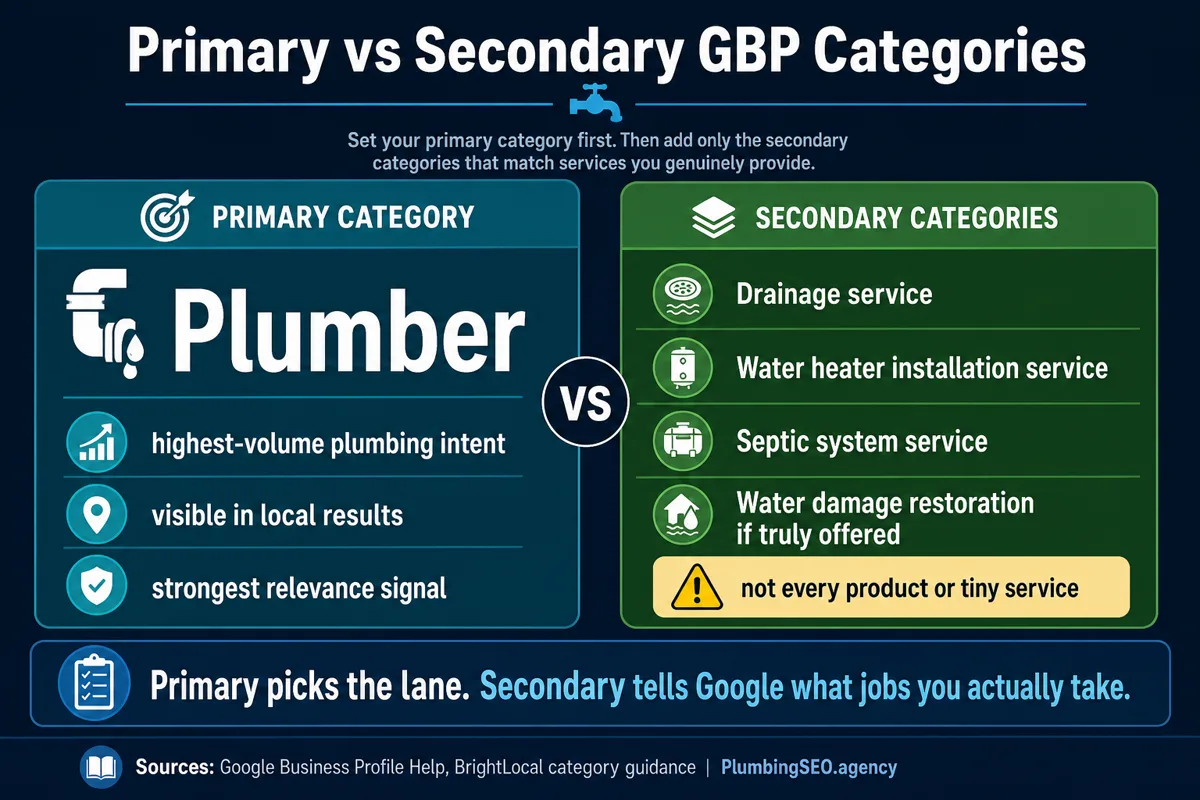
Secondary categories: add real services, not every possible keyword
Secondary categories are useful, but they are not magic. Google’s own category guidance says to use a few categories from the provided list, not a category for every product or service. That is the part many businesses miss.
For plumbers, good secondary categories may include services like drainage service, septic system service, water damage restoration, or water softening equipment supplier when those are real business lines. The word “real” is doing the work there. If you do not sell it, staff it, answer calls for it, show it on the website, and have customers mention it in reviews, do not add it just because a competitor did.
Here is the practical test I use: if a dispatcher got three calls tomorrow from that category, would you be happy to book them? If the answer is no, leave it out.
Categories, services, and website pages are not the same thing
A lot of plumbing owners mix up three different GBP areas:
- Categories describe the type of business and major service lines.
- Services describe individual jobs customers search for, such as slab leak detection, water heater replacement, sewer camera inspection, or emergency pipe repair.
- Website pages prove those services in more detail and give Google a stronger reason to trust the match.
Do not try to make categories do all three jobs. That is how profiles get bloated. Put the main business in the primary category. Put real major lines in secondary categories. Put the longer list of jobs in services and on service pages.
If your local visibility is weak, category edits alone are rarely enough. This is where a stronger local SEO plan for plumbers helps. The category should match the profile, the website, the reviews, and the service area. When those signals line up, Google has fewer reasons to guess.
| Item | Where it belongs | Plumber example |
|---|---|---|
| Main business identity | Primary category | Plumber |
| Major service line | Secondary category | Drainage service, if drain calls are a real offer |
| Specific customer job | GBP services list | Emergency leak repair, toilet installation, water heater replacement |
| Proof and conversion | Website service page | A water heater repair page with photos, FAQs, pricing cues, and call buttons |
A simple category audit for plumbing companies
Before you change anything, write down the current primary category, secondary categories, top calls, top profitable jobs, and top service pages. Do not work from memory. Memory is how you end up optimizing for the one annoying call from last Tuesday instead of the work that actually pays the bills.
Then use this audit:
- Confirm the primary category. If plumbing is the core business, Plumber should usually be first.
- Remove secondary categories that are not real offers. If you do not want the calls, do not invite them.
- Match each secondary category to a page or page section. A category with no website proof is weak.
- Match each important service to reviews and photos where possible. Customers and Google both look for proof.
- Track calls after changes. A category change should be judged by qualified calls and booked jobs, not by a pretty screenshot.
Google notes that changing a category can sometimes trigger reverification. That does not mean you should never change categories. It means you should change them on purpose, document what you changed, and avoid random testing when the phone is already busy.
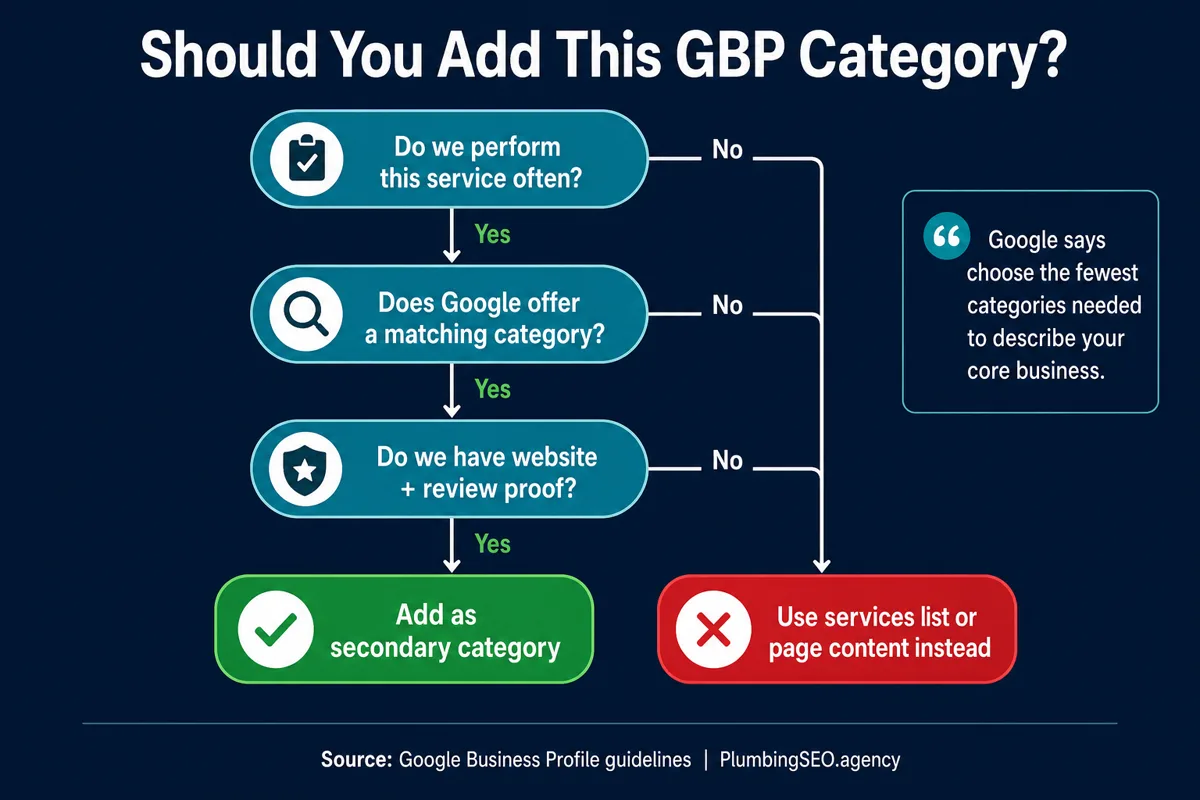
Common mistakes that cost plumbers calls
Mistake 1: Picking a narrow primary category because one service has a higher ticket
Water heater replacement might be profitable. Sewer line repair might be profitable. But if your company is a full-service plumbing shop, making a narrow service the primary category can reduce the broad plumbing relevance you need for everyday calls.
Mistake 2: Adding every category that sounds remotely related
Google’s guidelines say to choose the fewest categories needed to describe the core business. More is not always better. If the list starts looking like a parts catalog, clean it up.
Mistake 3: Ignoring the website after changing GBP
If you add a drain-related secondary category but your website barely mentions drain cleaning, you have a mismatch. Build or improve the supporting page. Add useful photos. Explain the service area. Show the type of jobs you want more of.
Mistake 4: Treating categories as a one-time setup
Google changes categories over time. Third-party category lists also update often. Dalton Luka’s 2026 category list reports more than 4,000 GBP categories at the time of writing. You do not need to memorize the list. You do need to review your profile when your services, market, or Google’s options change.
How categories affect call quality
The best category setup does not just chase more impressions. It helps the right customer find you before they call the other shop. A full-service plumber wants broad plumbing calls. A drain specialist wants drain calls. A septic company wants septic calls. A water heater installer wants installation and replacement calls, not every clogged toilet across town.
That is why categories should be tied to dispatch reality. If your office is tired of calls you cannot book, check whether your profile is inviting the wrong work. If a profitable service is not getting calls, check whether the profile, services list, service page, reviews, and internal links all point in the same direction.
Related reading: if you want the bigger local ranking picture, read our Google Maps SEO for plumbers guide. If reviews are the weak point, our Google review compliance guide explains what not to do when asking customers for feedback.
Recommended GBP category strategy for plumbers
Here is the clean version I would use for most plumbing companies:
- Primary category: Plumber.
- Secondary categories: two to five major services that are real, profitable, staffed, and backed by pages or proof.
- Services list: detailed customer jobs, written the way homeowners search.
- Website support: service pages, local pages, FAQs, photos, and internal links that match the profile.
- Measurement: qualified calls, booked jobs, service mix, and Maps visibility by service area.
Do that before chasing tricks. Local SEO for plumbers is not about making Google guess harder. It is about making the right answer obvious.
Sources used
This guide cites Google’s public documentation for managing business categories, Google’s explanation of local ranking factors, and Google’s Business Profile guidelines. It also references category research from BrightLocal, plumber GBP findings from YDOP, and category-list context from Dalton Luka.
Google Business Profile Category FAQs for Plumbers
For most full-service plumbing companies, the best primary category is Plumber. If your business is not full-service and is mainly septic, drains, restoration, or another specialty, choose the category that best describes the real core business.
Add only the few secondary categories that describe major services you genuinely provide. Two to five accurate categories is usually cleaner than adding every related option you can find.
Yes, a poor category change can hurt relevance for important searches. Google also says category edits may trigger reverification. Make changes deliberately, document them, and judge results by qualified calls and booked jobs.
Use an emergency-related category only if Google offers an accurate one in your market and emergency plumbing is a real service you staff. Otherwise, show emergency availability through hours, services, content, photos, and service pages.
No. GBP services help describe what you do inside the profile, but service pages give stronger proof, conversion copy, FAQs, photos, and internal links. Use both together.
Review categories when you add or remove major services, expand into a new market, see call quality change, or notice Google has added better category options. For stable shops, a quarterly check is usually enough.
Want your GBP categories checked before you change them?
We will review your Google Business Profile, categories, service pages, and local SEO signals so you can fix the leaks without inviting the wrong calls.
Run My Free SEO Leak Check