
- GBP is a call path, not just a listing: Google tracks views, searches, calls, website clicks, directions, messages, bookings, products, menus, and offers inside Business Profile performance.
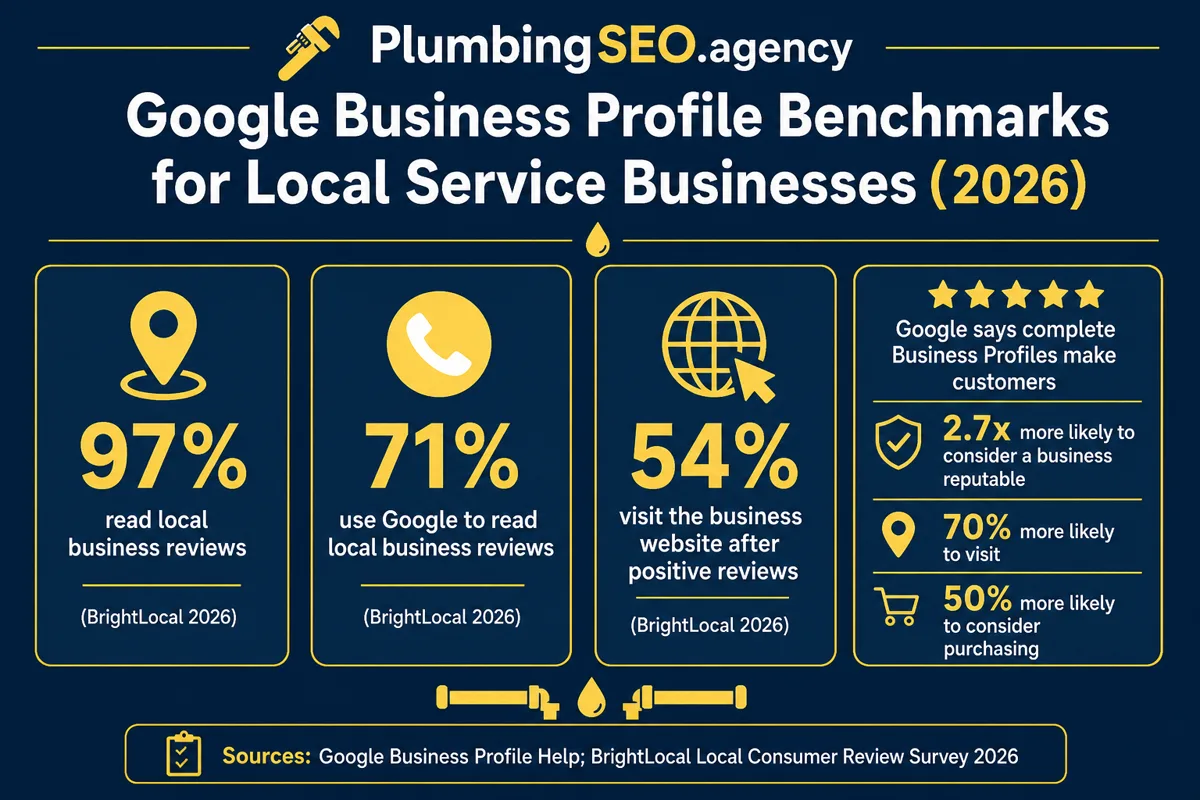
- Reviews are the trust bottleneck: BrightLocal reports that 97% of consumers read local business reviews in 2026, 71% use Google for reviews, and 31% will only use a business with 4.5+ stars.
- Completeness still matters: Google says complete Business Profiles make customers 2.7x more likely to consider a business reputable, 70% more likely to visit, and 50% more likely to consider purchasing.
For plumbers, HVAC contractors, electricians, roofers, and other local service businesses, Google Business Profile is often the first conversion screen a homeowner sees. It is where they compare star ratings, check hours, tap to call, request directions, read recent reviews, and decide whether your company feels safer than the next listing.
This statistics roundup translates current Google Business Profile, local search, and review data into practical benchmarks for service-area businesses. Use it as a scorecard: what to track monthly, where calls leak, and which profile fixes usually deserve attention before another ad campaign.
Key Takeaways: The Benchmarks That Matter First
- Google says Business Profile performance can show profile views, searches, and actions from Search and Maps.
- Google's performance report tracks calls, website clicks, direction requests, messages, bookings, product views, menu clicks, and offer activity when those metrics apply.
- Performance data is available only for verified Business Profiles, so verification is the first benchmark.
- Google states that Business Profile views count unique visitors and are not the same as total Google exposure.
- Google says local results are mainly based on relevance, distance, and prominence.
- Google says complete and accurate business information makes a profile more likely to show for relevant local searches.
- Google explicitly recommends keeping hours up to date, responding to reviews, and adding photos and videos.
- BrightLocal reports 97% of consumers read reviews for local businesses in 2026.
- BrightLocal reports 41% of consumers always read reviews when browsing for businesses, up from 29% the prior year.
- BrightLocal reports 71% of consumers use Google to read local business reviews.
- BrightLocal reports the average consumer uses six different review sites when choosing businesses.
- BrightLocal reports 74% of consumers only care about reviews written in the last three months.
- BrightLocal reports 31% of consumers will only use a business with 4.5+ stars.
- BrightLocal reports 68% of consumers will only use a business with four or more stars.
- BrightLocal reports 54% of consumers check the business website after reading positive reviews.
- BrightLocal reports 66% of consumers do further research after reading a positive review, while 34% are ready to buy or book.
- BrightLocal reports 83% of people asked to leave a review went on to leave one in 2026.
- Google-cited data says complete Business Profiles make customers 2.7x more likely to consider a business reputable.
- Google-cited data says customers are 70% more likely to visit and 50% more likely to consider purchasing from businesses with complete profiles.
- For plumbing companies, the operational benchmark is not impressions alone. It is the monthly mix of qualified calls, website visitors, messages, bookings, and review-driven trust.
Table of Contents
1. Visibility and Ranking Benchmarks
A Google Business Profile does not rank because one field is perfect. Google's public guidance describes local ranking as a mix of relevance, distance, and prominence. For a service-area plumber, that means the profile must clearly describe the work, align with the service area, and show enough proof that Google and homeowners can trust it.
| Benchmark | What it means for a service business | Source |
|---|---|---|
| Relevance | The profile should match the actual query: plumbing repair, water heater replacement, drain cleaning, emergency service, and the cities served. | Google Business Profile Help |
| Distance | Service-area businesses still need realistic location and coverage signals; chasing cities with no proof is weaker than building local service pages and citations. | Google Business Profile Help |
| Prominence | Reviews, links, directories, articles, and overall web presence support whether the company appears established. | Google Business Profile Help |
| 46% local intent | Local searches remain a massive demand pool, so GBP visibility is not optional for service businesses. | BrightLocal local SEO statistics |
| 80% weekly local search | US consumers regularly search online for local businesses; weekly GBP reporting should be normal for active contractors. | BrightLocal local SEO statistics |
If your service pages are thin, your categories are vague, and your reviews mention only generic praise, the profile gives Google less to match. That is why GBP work should connect to plumbing SEO strategy, not live as a disconnected checklist.
2. Calls, Clicks, Directions, and Booking Benchmarks
Google's own performance documentation is useful because it separates visibility from action. A profile can be seen often and still underperform if homeowners do not tap to call, click the website, send a message, or book.
| GBP metric | What to inspect monthly | Plumber-owner action |
|---|---|---|
| Searches | Terms people used when the profile appeared. | Look for missing service categories and city-service page gaps. |
| Views | Unique visitors who viewed the profile on Search and Maps. | Compare views with calls and website clicks, not in isolation. |
| Calls | Clicks on the call button. | Confirm the correct tracking or main number and answer-rate process. |
| Website clicks | Profile visitors who clicked to your site. | Send them to a fast local landing page with proof and a clear phone CTA. |
| Directions | Direction requests, adjusted by Google for issues such as spam. | Most relevant for showrooms or shops; service-area plumbers should not overvalue this metric. |
| Messages and bookings | Conversations or completed bookings when enabled. | Only enable if someone can respond quickly and consistently. |
The practical KPI is conversion mix. For example, a healthy emergency-plumbing profile may favor calls, while a remodel or water-treatment offer may push more website clicks before the homeowner calls. Tie GBP reporting to call tracking and the same lead-quality review you use for plumbing SEO statistics and campaign reporting.
3. Review and Trust Benchmarks
Reviews are where many local service profiles win or leak calls. A homeowner with a flooded bathroom does not study your brand story first; they scan rating, volume, recency, response quality, and whether the review language sounds like their problem.
| Review benchmark | 2026 data point | What to do with it |
|---|---|---|
| Review usage | 97% of consumers read reviews for local businesses. | Make review generation a weekly operational habit, not a quarterly marketing project. |
| Google review reliance | 71% use Google to read local business reviews. | Prioritize Google reviews while still monitoring Yelp, Facebook, BBB, and vertical directories. |
| Always reading | 41% always read reviews when browsing for businesses. | Assume the prospect sees your worst recent review before they call. |
| Freshness | 74% only care about reviews written in the last three months. | Monthly review velocity beats one big review push followed by silence. |
| Star threshold | 31% will only use a business with 4.5+ stars; 68% require four or more stars. | Track rating recovery by technician, job type, and dispatch issue. |
| Post-review behavior | 54% visit the business website after reading positive reviews. | Your website must reinforce the same proof: service areas, licensing, FAQs, photos, and easy calls. |
| Review requests | 83% of people asked to leave a review went on to leave one in 2026. | Build a polite post-job ask into dispatch or invoicing workflows. |
| Fake review penalty expectation | 97% think businesses should face punishment for fake reviews. | Do not buy reviews; protect the profile with authentic customer feedback. |
4. Profile Completeness Benchmarks
Google's guidance is straightforward: complete and accurate business information helps customers know what you do, where you are, and when they can reach you. For service businesses, completeness also prevents wasted clicks from wrong-area calls, closed-hour confusion, and unclear services.
For plumbers, completeness includes the obvious fields plus the fields that reduce bad leads: service categories, emergency availability, service-area boundaries, appointment URL, business description, products or services where appropriate, and photos that prove recent local work.
5. Photo, Post, and Recency Benchmarks
Google recommends adding photos and videos and keeping business information current. The deeper reason is trust: local service buyers want proof the company is active, nearby, and capable of doing the work they need this week.
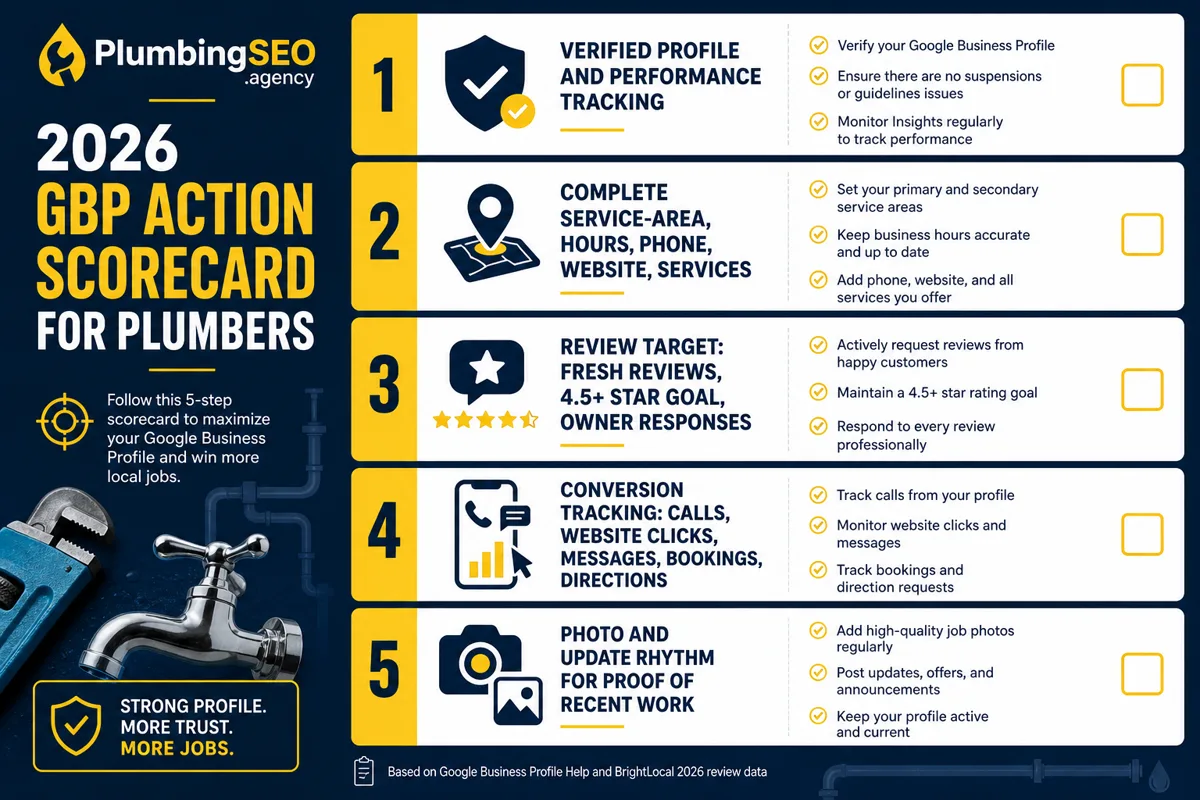
- Upload real job photos: water heater installs, drain equipment, trucks, team members, and completed repairs.
- Refresh hours before holidays, storms, seasonal demand spikes, and staffing changes.
- Use updates for offers, announcements, hiring, service expansions, and emergency reminders.
- Audit photo quality monthly so the gallery does not lead with blurry, old, or irrelevant images.
- Match GBP content with the proof on your website and local SEO statistics reporting.
6. The 72+ Point Google Business Profile Scorecard
The table below converts the research into a working benchmark checklist. Some items are numeric statistics. Others are Google-defined metrics or operational checkpoints that every local service business should review before deciding GBP is “done.”
| # | Benchmark | Category | Source or basis |
|---|---|---|---|
| 1 | Profile is verified before performance reporting | Foundation | Google Business Profile Help |
| 2 | Business name matches real-world branding | Foundation | Google ranking guidance |
| 3 | Primary category matches the core service | Foundation | Google relevance guidance |
| 4 | Secondary categories cover real services only | Foundation | Google relevance guidance |
| 5 | Phone number is accurate and answered | Conversion | Google calls metric |
| 6 | Website URL points to a relevant local page | Conversion | Google website-click metric |
| 7 | Hours are current | Foundation | Google profile guidance |
| 8 | Holiday hours are reviewed before demand spikes | Foundation | Google profile guidance |
| 9 | Service area is realistic and documented | Local visibility | Google distance guidance |
| 10 | Address rules are followed for service-area businesses | Compliance | Google profile guidance |
| 11 | Business description names core services clearly | Relevance | Google relevance guidance |
| 12 | Services list includes emergency plumbing where offered | Relevance | Google relevance guidance |
| 13 | Services list includes water heater work where offered | Relevance | Google relevance guidance |
| 14 | Services list includes drain cleaning where offered | Relevance | Google relevance guidance |
| 15 | Services list includes leak detection where offered | Relevance | Google relevance guidance |
| 16 | Profile views are reviewed monthly | Performance | Google views metric |
| 17 | Search terms are reviewed monthly | Performance | Google searches metric |
| 18 | Calls are reviewed monthly | Performance | Google calls metric |
| 19 | Website clicks are reviewed monthly | Performance | Google website-click metric |
| 20 | Direction requests are interpreted carefully for service-area businesses | Performance | Google directions metric |
| 21 | Messages are enabled only when response coverage exists | Conversion | Google messages metric |
| 22 | Bookings are enabled only when routing is reliable | Conversion | Google bookings metric |
| 23 | Products or services are monitored where applicable | Conversion | Google products metric |
| 24 | Offers are used only for real promotions | Conversion | Google offers metric |
| 25 | Performance data is compared by date range | Reporting | Google performance guidance |
| 26 | Profile views are not treated as total Google exposure | Reporting | Google views definition |
| 27 | Calls are compared with booked jobs | Reporting | Operational benchmark |
| 28 | Website clicks are compared with landing-page conversions | Reporting | Operational benchmark |
| 29 | Search queries are mapped to missing service pages | SEO | Operational benchmark |
| 30 | Profile actions are separated from ad-driven results | Reporting | Google performance note |
| 31 | 97% consumer review usage informs review priority | Reviews | BrightLocal 2026 |
| 32 | 71% Google review usage informs platform priority | Reviews | BrightLocal 2026 |
| 33 | 41% always-read-review rate informs trust expectations | Reviews | BrightLocal 2026 |
| 34 | Six review-site average informs reputation monitoring | Reviews | BrightLocal 2026 |
| 35 | 74% three-month freshness threshold informs review velocity | Reviews | BrightLocal 2026 |
| 36 | 31% 4.5+ star threshold informs rating goal | Reviews | BrightLocal 2026 |
| 37 | 68% four-star threshold informs minimum trust floor | Reviews | BrightLocal 2026 |
| 38 | 46% positive-review-description factor informs review prompts | Reviews | BrightLocal 2026 |
| 39 | 44% last-month review factor informs recency tracking | Reviews | BrightLocal 2026 |
| 40 | 42% high-star-rating factor informs quality control | Reviews | BrightLocal 2026 |
| 41 | 37% owner-response factor informs response SLA | Reviews | BrightLocal 2026 |
| 42 | 54% website-after-review behavior informs site proof | Reviews | BrightLocal 2026 |
| 43 | 66% further-research behavior informs content depth | Reviews | BrightLocal 2026 |
| 44 | 34% ready-to-buy behavior informs fast call CTA | Reviews | BrightLocal 2026 |
| 45 | 93% purchase-after-review history reinforces review value | Reviews | BrightLocal 2026 |
| 46 | 27% spending-over-$1,000 after reviews matters for big jobs | Reviews | BrightLocal 2026 |
| 47 | 83% review-request follow-through supports asking every satisfied customer | Reviews | BrightLocal 2026 |
| 48 | 28% always-write-if-asked supports technician review asks | Reviews | BrightLocal 2026 |
| 49 | 97% fake-review punishment expectation argues against buying reviews | Reviews | BrightLocal 2026 |
| 50 | 57% platform-ban preference raises fake-review risk | Reviews | BrightLocal 2026 |
| 51 | 46% search-removal preference raises fake-review risk | Reviews | BrightLocal 2026 |
| 52 | Complete profile improves reputation consideration 2.7x | Completeness | Google-cited data via BrightLocal |
| 53 | Complete profile improves visit likelihood 70% | Completeness | Google-cited data via BrightLocal |
| 54 | Complete profile improves purchase consideration 50% | Completeness | Google-cited data via BrightLocal |
| 55 | 46% local-intent query benchmark supports local investment | Search demand | BrightLocal local SEO statistics |
| 56 | 80% weekly local-business search supports weekly monitoring | Search demand | BrightLocal local SEO statistics |
| 57 | 32% daily local-business search supports always-on visibility | Search demand | BrightLocal local SEO statistics |
| 58 | 46% near-me modifier behavior supports city/service relevance | Search demand | BrightLocal local SEO statistics |
| 59 | 72% Google local information search supports GBP priority | Search demand | BrightLocal local SEO statistics |
| 60 | 66% trust Google for local info supports profile accuracy | Search demand | BrightLocal local SEO statistics |
| 61 | 45% trust Google Maps for local info supports Maps optimization | Search demand | BrightLocal local SEO statistics |
| 62 | 45% default to Google for local searches | Search demand | BrightLocal local SEO statistics |
| 63 | 15% default to Google Maps for local searches | Search demand | BrightLocal local SEO statistics |
| 64 | 47% would find an alternative if a business appears closed | Hours | BrightLocal local SEO statistics |
| 65 | 68% AI contact-info match benchmark supports citation consistency | AI visibility | BrightLocal local SEO statistics |
| 66 | Photos and videos are added regularly | Proof | Google ranking guidance |
| 67 | Owner replies are specific, not templated | Reviews | Google and BrightLocal guidance |
| 68 | Negative reviews get a documented service recovery process | Reviews | Operational benchmark |
| 69 | Top services have matching website pages | SEO | Operational benchmark |
| 70 | Top cities have matching service-area proof | SEO | Operational benchmark |
| 71 | Profile UTM tagging separates GBP traffic in analytics | Reporting | Operational benchmark |
| 72 | Monthly report ties views, calls, clicks, reviews, and booked jobs together | Reporting | Operational benchmark |
| 73 | Storm or seasonal demand updates are posted before the rush | Operations | Operational benchmark |
| 74 | Competitor review gaps are checked without copying their profile | Operations | Operational benchmark |
| 75 | Profile edits are logged so performance changes have context | Reporting | Operational benchmark |
| 76 | Lead quality is reviewed, not just lead volume | Conversion | Operational benchmark |
7. Methodology and Sources
This roundup uses public source material from Google Business Profile Help, BrightLocal's 2026 Local Consumer Review Survey, BrightLocal's local SEO statistics resource, and related local search benchmark pages found during current research. Statistics were included only when the source page provided a clear data point or Google-defined metric. Operational benchmarks are labeled as such and are recommendations for plumbing and home-service businesses, not third-party survey percentages.
| Source | Used for | URL |
|---|---|---|
| Google Business Profile Help: performance and insights | Metric definitions for views, searches, calls, website clicks, directions, messages, bookings, products, menus, and offers. | Google Help |
| Google Business Profile Help: local ranking | Relevance, distance, prominence, completeness, reviews, photos, and update guidance. | Google Help |
| BrightLocal Local Consumer Review Survey 2026 | Review usage, star rating, recency, response, fake review, and post-review behavior statistics. | BrightLocal research |
| BrightLocal local SEO statistics | Local search demand, trust platforms, complete profile impact, and review summary statistics. | BrightLocal statistics |
Frequently Asked Questions
The most useful benchmarks are review usage, review recency, star-rating thresholds, complete-profile impact, and profile action metrics. For plumbers, the practical dashboard should include views, searches, calls, website clicks, messages or bookings, review velocity, rating, and booked-job quality.
Use the numbers as a prioritization tool. Verify and complete the profile first, then track monthly action metrics, build a steady review request process, refresh photos, and connect GBP reporting with website conversions and phone-answer data.
Calls, website clicks, search terms, and review quality matter most for most plumbers. Direction requests can matter for showrooms, but service-area companies should avoid treating directions as the main conversion metric.
There is no universal number, because competitors and markets vary. The better benchmark is current review velocity, recency within the last three months, rating quality, and whether reviews mention actual services and locations.
Usually yes for foundational fixes. Paid ads can still be useful, but a weak profile, stale reviews, bad hours, and a poor website can waste paid traffic. Fix the trust and call path first, then use ads where speed or seasonal demand justifies it.
Want to Know What Your Google Business Profile Is Leaking?
We will review your profile, reviews, service-area signals, website click path, and call tracking so you can see which fixes are most likely to turn local visibility into booked plumbing jobs.
Run My Free SEO Leak Check