
- If you do not serve customers at your shop, hide the address in Google Business Profile. Do not use a fake office, PO box, or buddy's address.
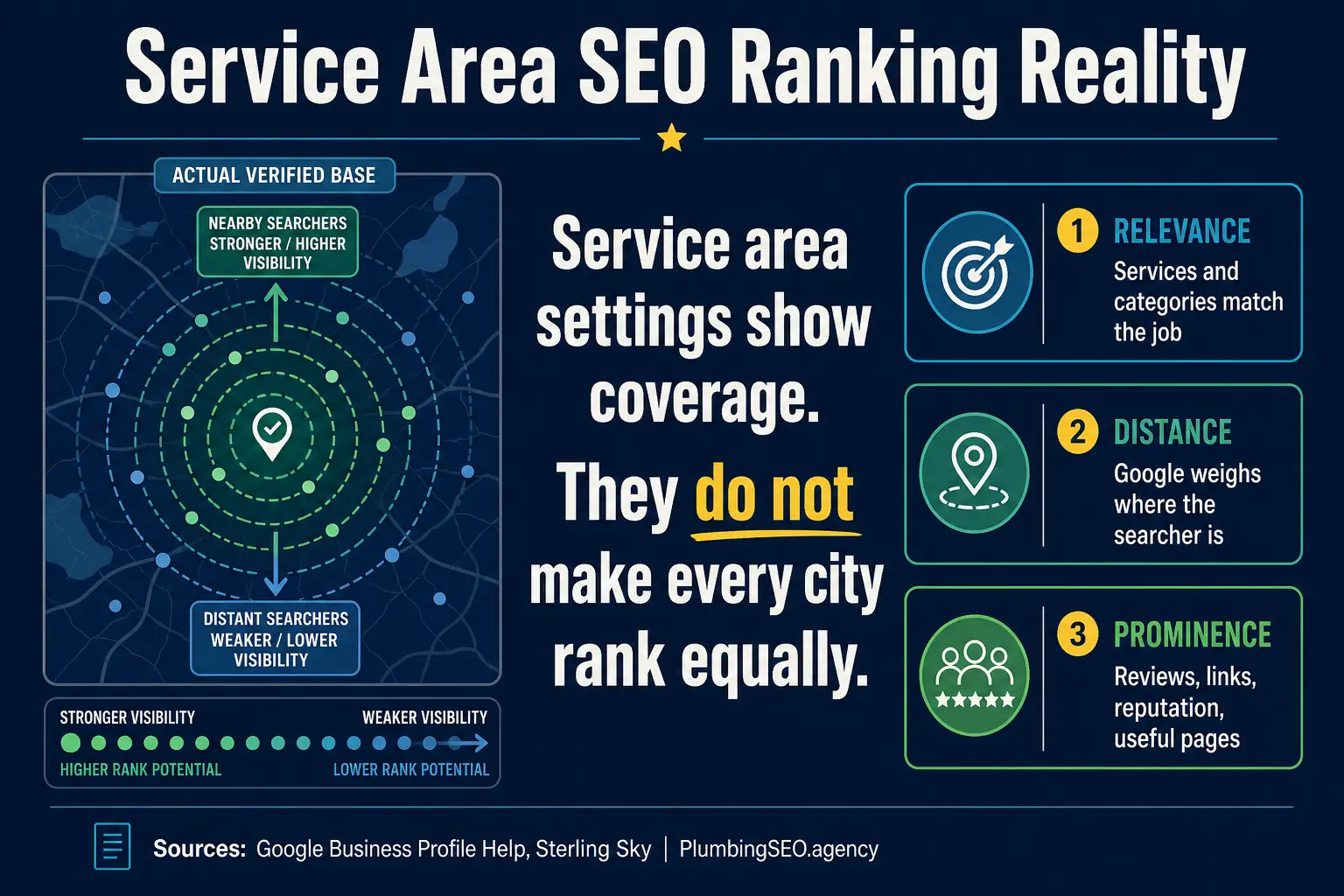
- Your service area settings help customers understand coverage, but rankings still depend on relevance, distance, and prominence.
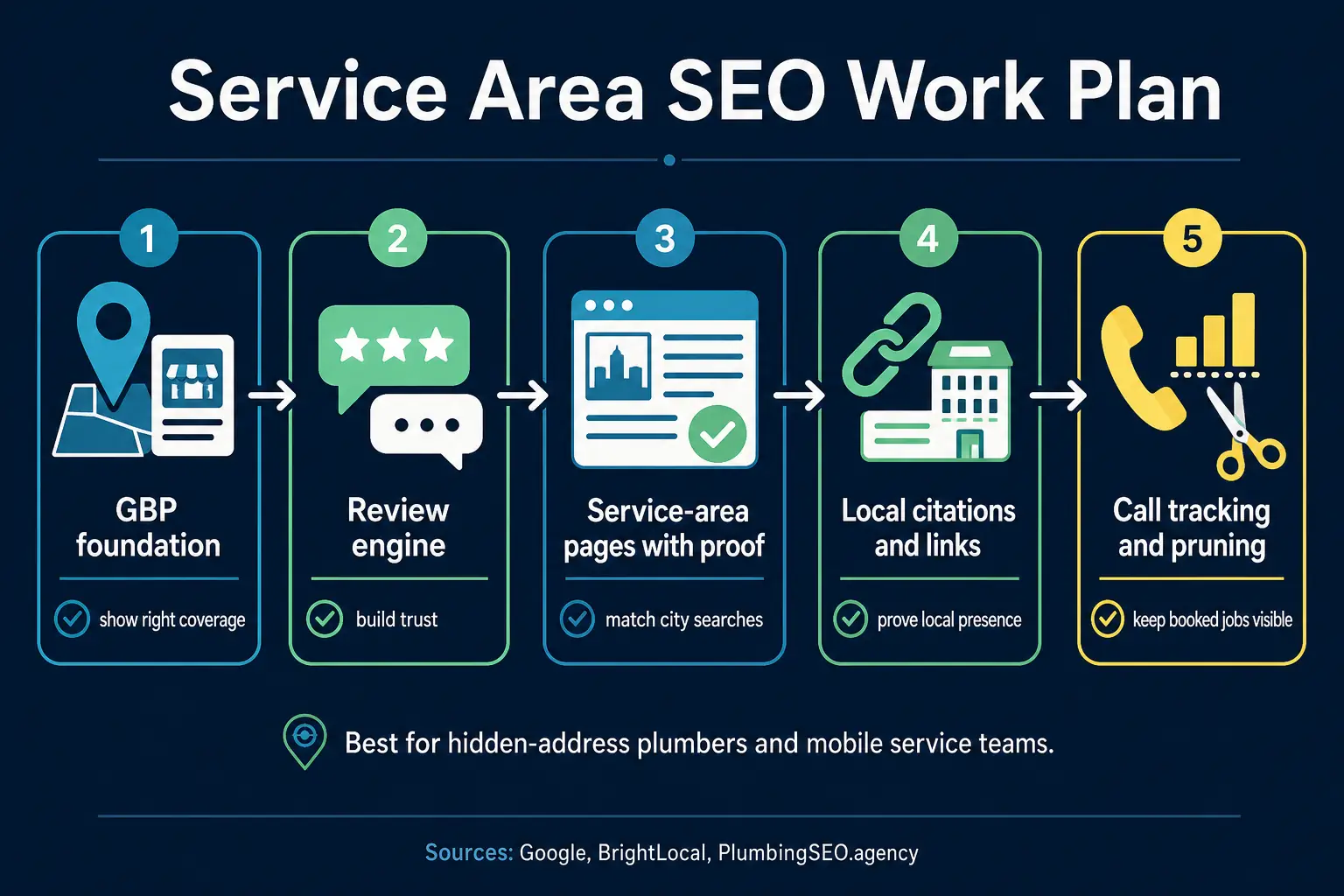
- The winning plan is GBP accuracy, city-specific proof pages, reviews from real jobs, and tracking calls by service area.
If you run a plumbing company from a shop customers never visit, a home office, or a small warehouse behind the trucks, service area SEO can feel backwards. You serve the whole metro. Google still acts like the customer wants somebody nearby. Meanwhile, the shop with a public address across town keeps showing up in Maps.
Here is the practical truth. You can rank without showing a storefront address, but you cannot make Google ignore location. For a plumber, the job is to set up your service-area business profile correctly, build proof for the cities you actually serve, and give Google enough confidence that your company is the right match when a nearby homeowner needs help.
That does not mean making 40 thin city pages and hoping one sticks. That is like throwing fittings in the truck bed and calling it inventory. It might look busy, but it does not help when the call comes in.
Can plumbers rank without showing a storefront address?
Yes. Google allows service-area businesses when the company visits customers directly instead of serving them at a customer-facing address. Google even lists plumbers as an example of a service-area business. If customers cannot walk in, you should remove the public address and set accurate service areas.
The part that trips owners up is ranking. Hiding the address does not remove distance from the local algorithm. Google says local results are based mainly on relevance, distance, and prominence. That means your profile can be valid, but still struggle in far-away neighborhoods if Google sees stronger, closer competitors.
In my opinion, this is where a lot of plumbing SEO gets sold wrong. The agency says, "We will add every city to your service area." The owner hears, "We will rank in every city." Those are not the same thing. One is a profile setting. The other is earned visibility.
Start with the correct Google Business Profile setup
The foundation is boring, but boring foundations keep houses standing. If your Google Business Profile is set up wrong, every other local SEO fix has to fight uphill.
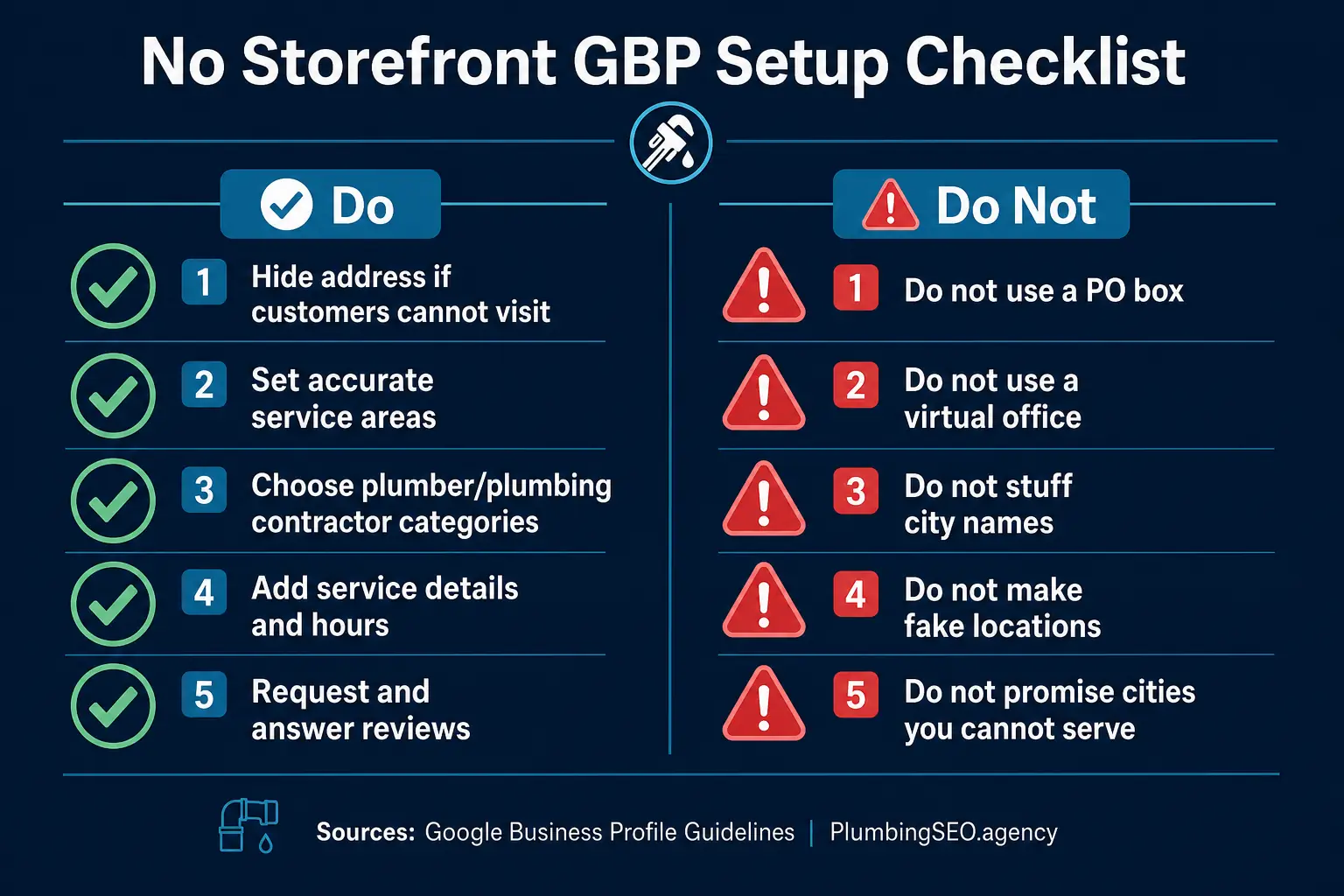
Use the service-area business setup when your plumbing company goes to customers and does not receive customers at the listed address. Google says service-area businesses can set the areas they serve, and that businesses without permanent on-site signage are not eligible as storefronts. Google also says PO boxes, remote mailboxes, and virtual offices are not acceptable addresses for a Business Profile.
The setup checklist
- Hide the address if customers cannot visit. Do not show a home address just because you think it helps ranking.
- Set service areas you truly cover. Think dispatch reality, not ego. If the drive hurts margin, do not build the whole strategy around that city.
- Choose the right primary category. Most plumbing companies should start with the most accurate plumbing category, then use secondary categories only when they match real services.
- Complete services, hours, phone, and website fields. Missing information leaks trust before the customer ever calls.
- Use photos that prove real work. Trucks, equipment, job photos, uniforms, and team photos help customers believe the listing is real.
If you need a deeper category walkthrough, read the Google Business Profile category guide for plumbers. Categories are not decoration. They tell Google what kind of jobs you deserve to show for.
Service areas are not magic ranking zones
One of the clearest findings from local SEO testing is that the service area field is more useful for customers than for rankings. Sterling Sky has reported that the listed service area does not currently impact rankings for service-area businesses, and that rankings are still tied to the address used to verify the listing. That matches what plumbing owners see every day. The farther the searcher is from the business base, the harder Maps visibility usually gets.
That does not mean the service area field is useless. It helps customers understand where you work. It can reduce wrong-area calls. It gives your profile a cleaner public presentation. Just do not expect it to carry a whole local SEO campaign by itself.
| Local SEO piece | What it helps | What it will not do alone |
|---|---|---|
| Hidden-address GBP | Keeps the profile compliant when customers do not visit | Remove distance from Maps ranking |
| Service area settings | Shows customers where the company works | Force ranking in every listed city |
| City service pages | Builds organic relevance for city plus service searches | Fix a weak or fake GBP setup |
| Reviews from real jobs | Builds trust and prominence around services | Replace service pages, links, or profile accuracy |
| Call tracking | Shows which cities and pages turn into booked jobs | Improve rankings without follow-up action |
Build city pages that prove you belong there
For a hidden-address plumber, the website has to carry more of the service-area proof. BrightLocal describes service area pages as local landing pages that help service-area businesses appear for searches in specific cities or neighborhoods without a brick-and-mortar location. For plumbing companies, that only works when the page is more than a swapped city name.
A useful service-area page should make a homeowner think, "These people actually work near me." It should also make Google see a clear connection between the plumbing service, the city, and your company.
What to include on a plumbing service-area page
- Specific services for that area. Emergency repair, drain cleaning, water heaters, leak detection, repiping, sewer line work, or whichever jobs you actually want there.
- Local proof. Neighborhoods served, nearby landmarks, service notes, permitting realities, common housing types, or real job examples with private details removed.
- Helpful decision copy. Tell the homeowner when to call, what to expect, and how dispatch works.
- Internal links. Link from the city page to the main service page and from relevant blog posts back to the city or service page.
- Conversion basics. Phone number, click-to-call button, service hours, trust proof, and a simple next step.
The goal is not to create a fake location page. The goal is to create a real service-area page that says, "We drive here, we do this work here, and we understand what customers here need." If you are building this around a full local strategy, the Local SEO for Plumbers service explains how we connect GBP, pages, reviews, and call tracking into one plan.
Use reviews to build prominence across the area
Google says review count and score can factor into local ranking, and that positive reviews and helpful replies can help a business stand out. For plumbers, reviews also do something more practical. They help the nervous homeowner pick up the phone.
Ask for reviews after completed jobs, especially in the cities you want more calls from. Do not pay for reviews. Do not script fake city stuffing into every review request. Ask naturally. A good review might mention the service and the city because that is what happened: "They replaced our water heater in Plano the same day." That is real. That helps customers. That helps search engines understand your footprint without making the profile look spammy.
Also answer reviews like an owner, not a robot. Thank the customer, mention the service if it fits, and keep private details private. Reviews are public jobsite notes. Treat them that way.
Make citations and local links match the real business
Citations get tricky for hidden-address plumbers because some directories still want a visible street address. Do not solve that by publishing a fake address. Use platforms that support service-area businesses, keep the business name and phone consistent, and make sure your website clearly explains the area you serve.
Local links are often stronger than generic directory noise. A chamber of commerce page, supplier mention, community sponsorship, local nonprofit, neighborhood association, or trade partner can all reinforce that your company is real in the market. It is not glamorous work. Neither is crawling under a house. Both can pay.
Track calls by service area, not just rankings
Ranking reports can make a hidden-address plumber feel worse than the business actually is. You may rank well near your verified base, weaker across town, and still book profitable jobs from organic pages. That is why call tracking matters.
Track which pages produce phone calls, which calls become booked jobs, and which cities create profitable work. Then prune the plan. If a far suburb keeps sending tire-kicker calls or low-margin jobs, stop chasing it just because it looks good on a map. If a nearby city books water heater installs at a strong rate, build more proof there.
For the money side, pair this with plumber cost-per-lead benchmarks so you are judging SEO by booked work, not by pretty charts.
A practical 90-day plan for service area SEO
You do not need to fix everything in one week. You need to fix the right things in the right order.
Days 1 to 30: Clean foundation
- Confirm whether the GBP should be service-area or hybrid.
- Hide the address if customers cannot visit.
- Clean categories, services, hours, photos, appointment links, and phone numbers.
- Make sure the website clearly states the real service area.
- Set up call tracking without breaking NAP consistency.
Days 31 to 60: Build service-area proof
- Create or improve the most important city and service pages.
- Add real job proof, FAQs, and dispatch details.
- Build internal links from relevant blogs and service pages.
- Start a steady review request process after completed jobs.
Days 61 to 90: Measure and tighten
- Review calls by city, service, and source.
- Improve pages that get impressions but few calls.
- Add local links or citations where proof is thin.
- Stop chasing service areas that do not produce profitable work.
If you want the longer expectation-setting version, read why plumbing SEO takes 90 days. Service area SEO is usually a crawl, walk, run job. Anybody promising instant Maps coverage across a whole metro is selling magic fittings.
What I would fix first
If a plumber asked me where to start, I would not start with 25 new city pages. I would start with risk and money.
- Fix profile compliance first. A risky address can wipe out the whole listing.
- Fix category and service relevance next. Google needs to understand what jobs you do.
- Build pages for the best nearby service areas. Start where distance and dispatch already make sense.
- Ask for better reviews from real jobs. Real customers beat manufactured local signals.
- Track booked calls. If the phone tells a different story than the ranking report, believe the phone.
Service area SEO for plumbers is not about hiding from Google. It is about being honest about how the company operates, then building enough proof that customers and search engines trust you in the places you actually serve. Do that well, and the phone has a much better chance of ringing from the right neighborhoods, not just the closest ones.
Service Area SEO FAQs for Plumbers
Yes. A plumber can use a service-area Google Business Profile when customers are served at their location instead of at a public storefront. The profile still needs accurate services, categories, reviews, and website proof to compete locally.
Not by itself. Service areas help customers understand coverage, but local rankings still depend heavily on relevance, distance, and prominence. Adding cities you serve is useful. Treating the field like a ranking switch is not.
No. Google says virtual offices and remote mailboxes are not eligible Business Profile addresses unless the business is staffed and operates there during stated hours. A fake address can lead to suspension.
Useful service-area pages help most. They should include city-specific service details, real job proof, internal links, FAQs, and clear calls to action. Thin pages with only the city name changed are weak.
Start with the cities that are close enough to serve profitably and valuable enough to justify unique content. A few strong pages usually beat dozens of thin pages that do not prove real service-area presence.
Measure phone calls, booked jobs, service type, city, close rate, and revenue. Rankings matter, but a plumbing SEO plan should be judged by the calls and jobs it puts on the board.
Want service-area SEO that does not risk your Google listing?
We will check your Google Business Profile, service-area pages, reviews, and call tracking so you can see where local calls are leaking.
Run My Free SEO Leak Check