
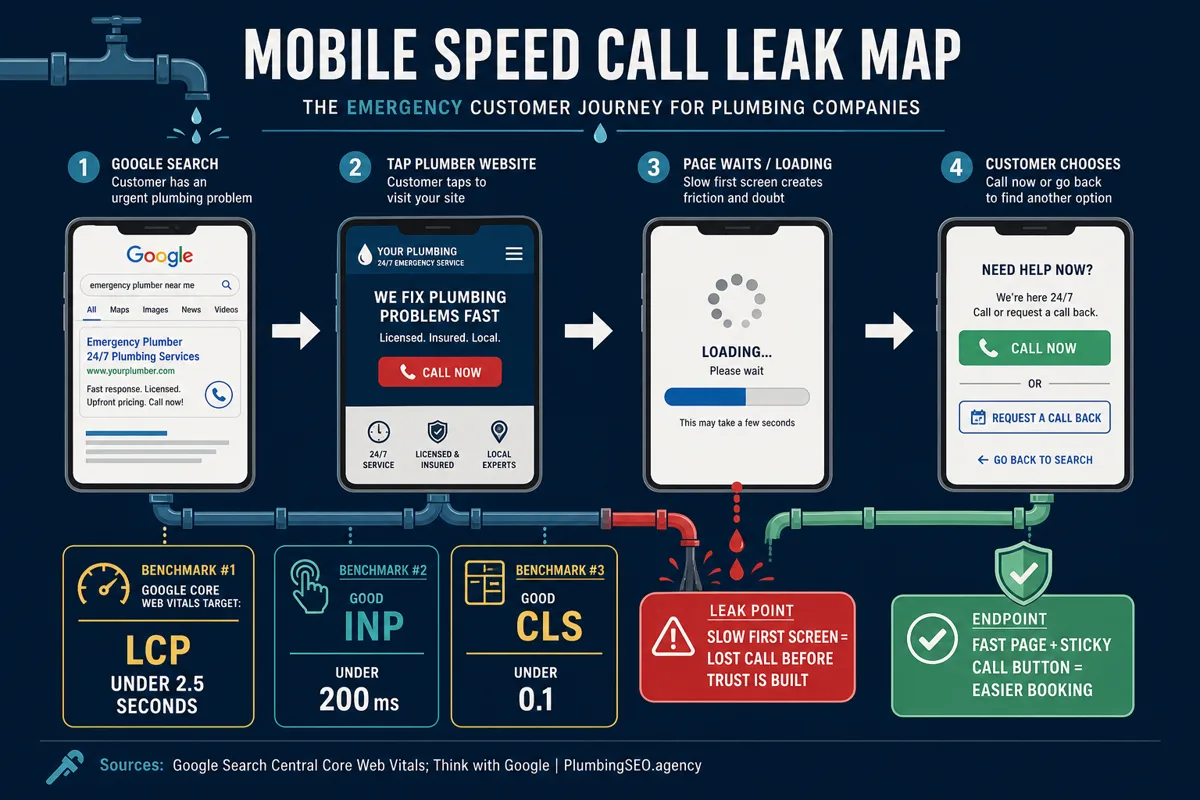
- Most speed problems are call problems first. If the mobile page stalls, the homeowner may hit back before they ever see your phone number.
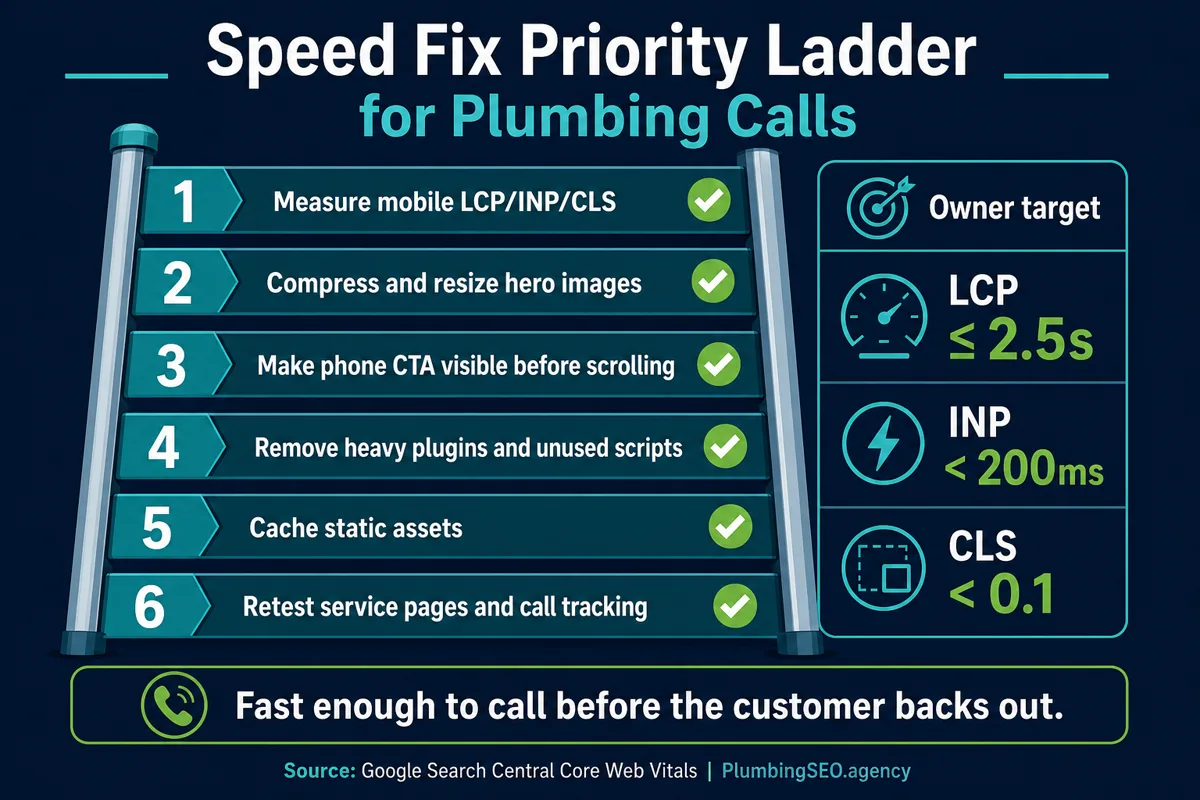
- Aim for Google's good experience targets: LCP under 2.5 seconds, INP under 200 milliseconds, and CLS under 0.1 on the pages that win calls.
- Fix the first screen before chasing fancy features. Compress images, cut scripts, show a tappable phone button, and retest on a real phone.
If a homeowner has water around the heater, a backed-up toilet, or a shower that will not drain, they are not calmly browsing your website with a cup of coffee. They are on a phone, probably annoyed, and they want to know one thing fast: can this company help me now?
That is why plumber website speed matters. A slow site does not just make a bad technical report. It makes the call leak away before trust is built. The customer taps your result, waits, sees a blank screen or a jumping layout, then goes back and calls the next shop. Nobody tells you that happened. The phone just stays quiet.
The practical goal is simple. Your plumbing website design should load the first useful screen quickly, make the phone number easy to tap, and help Google understand that users have a clean mobile experience.
What speed really means for a plumbing company
Website speed is not only the total time until every image and script finishes. For a plumbing owner, the important question is: how quickly can a customer understand who you are, where you work, and how to call?
Google defines Core Web Vitals around real user experience. For a good experience, Google recommends Largest Contentful Paint within 2.5 seconds, Interaction to Next Paint under 200 milliseconds, and Cumulative Layout Shift below 0.1. In plain English: the main content should show quickly, taps should respond, and the page should not jump around while the customer is trying to call.
Those numbers matter most on the pages that get calls: the homepage, emergency service pages, drain cleaning pages, water heater pages, city pages, and paid landing pages. A blog post can be a little heavier. A page asking for an emergency call cannot act like it is pulling a permit at city hall.
How slow mobile load time hurts calls
A slow plumbing website usually hurts in three places at once. First, it makes the first impression feel shaky. Second, it hides the call path. Third, it makes every paid click and organic visit work harder than it should.
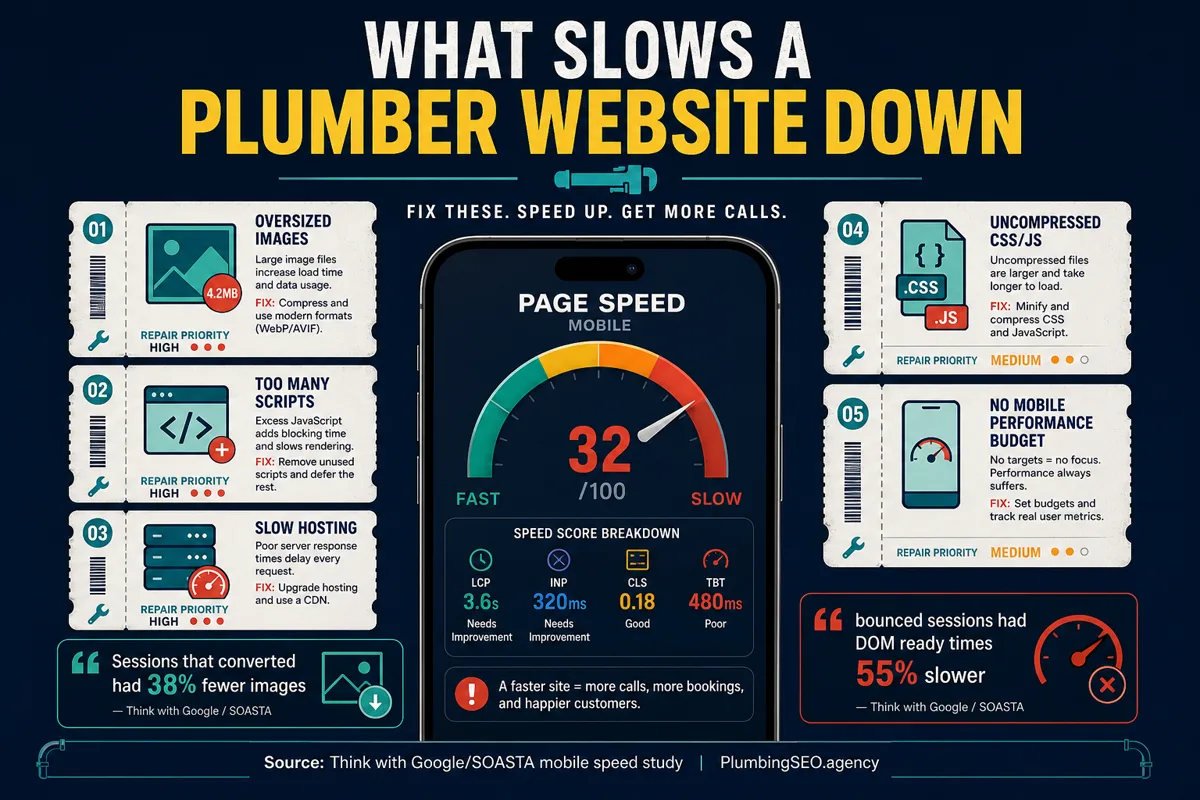
Think with Google reports that mobile speed affects both conversion and bounce behavior, and their mobile speed research found that bounced sessions had DOM ready times 55 percent slower than nonbounced sessions. The same study found converted sessions had 38 percent fewer images than sessions that did not convert. That does not mean every plumbing page should be plain. It means every image and script needs to earn its keep.
How speed affects plumber SEO
Speed is not the only reason a plumbing website ranks. Relevance, service pages, local signals, reviews, links, technical structure, and content quality all matter. But speed can decide whether visitors stay long enough to prove the page is useful.
Google says Core Web Vitals measure real-world loading, responsiveness, and visual stability, and that good page experience aligns with what its core ranking systems seek to reward. That is the key phrase for plumbers. Speed is not a magic ranking switch. It is part of making the page easier for real customers to use.
If your emergency page is slow on mobile, it can also distort your other marketing numbers. Your rankings may look acceptable. Your ad clicks may look normal. But calls stay low because the page loses people between the click and the phone tap. The report may look good, but the phone tells the truth.
The call-first speed checklist
Do not start by chasing a perfect score on every testing tool. Start with the job the page has to do. A plumbing service page needs to load, prove trust, show service area fit, and make the call button obvious. Then you improve the technical pieces that support that path.
| Speed issue | What the customer feels | First fix |
|---|---|---|
| Oversized hero image | The first screen loads slowly before the offer is visible. | Resize, compress, and serve WebP or AVIF. |
| Too many scripts | The page looks loaded, but taps and forms lag. | Remove unused widgets and defer non-critical scripts. |
| Weak mobile CTA | The customer has to hunt for the phone number. | Add a tappable phone link and sticky mobile call option. |
| Layout shift | The call button moves while the customer is about to tap. | Set image dimensions and reserve space for banners. |
| Slow hosting or no cache | Every page feels heavy, especially on weaker connections. | Use page caching, CDN delivery, and cleaner assets. |
For plumbing companies, the fastest win is usually not a full rebuild. It is cleaning the first screen, reducing image weight, and making sure the phone CTA works before the page asks the customer to read anything.
Need the website speed leak checked?
Run the page through a plumber-first audit. We look at mobile speed, call path, trust proof, service pages, and whether the site is built to turn searches into calls.
Get a free SEO leak checkWhat to fix first if calls are the goal
Here is the order I would use if a plumbing owner asked where to start. Measure the mobile experience on the pages that bring calls. Then remove the heaviest things above the fold. Then make the call path impossible to miss. Only after that would I tune lower-priority pages.
Use the right tests, not just one score
Start with PageSpeed Insights for mobile Core Web Vitals, then check the site on an actual phone with regular service, not just office Wi-Fi. Open the homepage. Open an emergency service page. Tap the phone button. Try the form. Watch whether anything jumps after the first screen loads.
Cloudflare explains that performance affects conversion because faster pages make the desired action easier. For plumbing websites, that desired action is usually a call, form, booking, or text conversation. A faster page is not valuable because it wins a trophy. It is valuable because it removes friction from the next job on the board.
When a rebuild makes more sense than patching
Sometimes speed fixes are small. Sometimes the old site is a pile of plugins, stock photos, bloated themes, and tracking scripts stacked like fittings in the wrong bin. You can keep tightening it, but it still leaks.
A rebuild makes sense when the site is slow and also has weak mobile calls, thin service pages, no clear service area structure, poor trust proof, or no tracking. In that case, speed is part of the larger website problem. You are not just trying to shave milliseconds. You are building a better dispatcher.
If that is where your site is, start with the pages that matter most: homepage, emergency plumbing, drain cleaning, sewer repair, water heater repair, and your highest-value city pages. A good plumbing SEO process will connect technical speed, service-page structure, internal links, and call tracking instead of treating speed as a one-off cleanup job.
Bottom line
Plumber website speed affects calls because the customer is impatient for a good reason. They have a problem. They want help. If your mobile page loads fast, looks trustworthy, and gives them a clean call path, you have a better shot at the job. If it stalls, jumps, or hides the number, the next plumber is one back-button away.
Fix speed like you would fix a leak. Find the biggest loss, stop it first, then check the whole system so it does not come back next month.
FAQ: Plumber website speed
Aim for the main visible content to load in 2.5 seconds or less, with taps responding quickly and no major layout jumping. For call-heavy service pages, faster is better because homeowners often need help right away.
Speed is one part of page experience, not the whole ranking system. It supports SEO by improving user experience, reducing friction, and helping mobile visitors stay on the page long enough to call or read.
The common problems are oversized images, heavy themes, too many plugins, render-blocking scripts, slow hosting, and widgets that load before the phone CTA is usable.
If your call pages are slow on mobile, fix the worst speed leaks first. New content helps less when the pages already getting traffic do not load quickly or make calling easy.
Test the homepage, emergency plumbing page, top service pages, city pages, and any paid landing pages. Those pages are closest to calls and booked jobs.
Want a faster plumbing website that turns mobile searches into calls?
We build and tune plumbing websites around speed, trust, service pages, and call tracking so the phone has a better chance to ring.
See plumbing website design