
- Trust signals only work when they answer real buyer fears: are you licensed, reviewed, local, affordable, and willing to stand behind the job?
- Put proof next to decision points. Reviews, license language, real photos, financing terms, and guarantees should sit near calls to action, not only on a hidden about page.
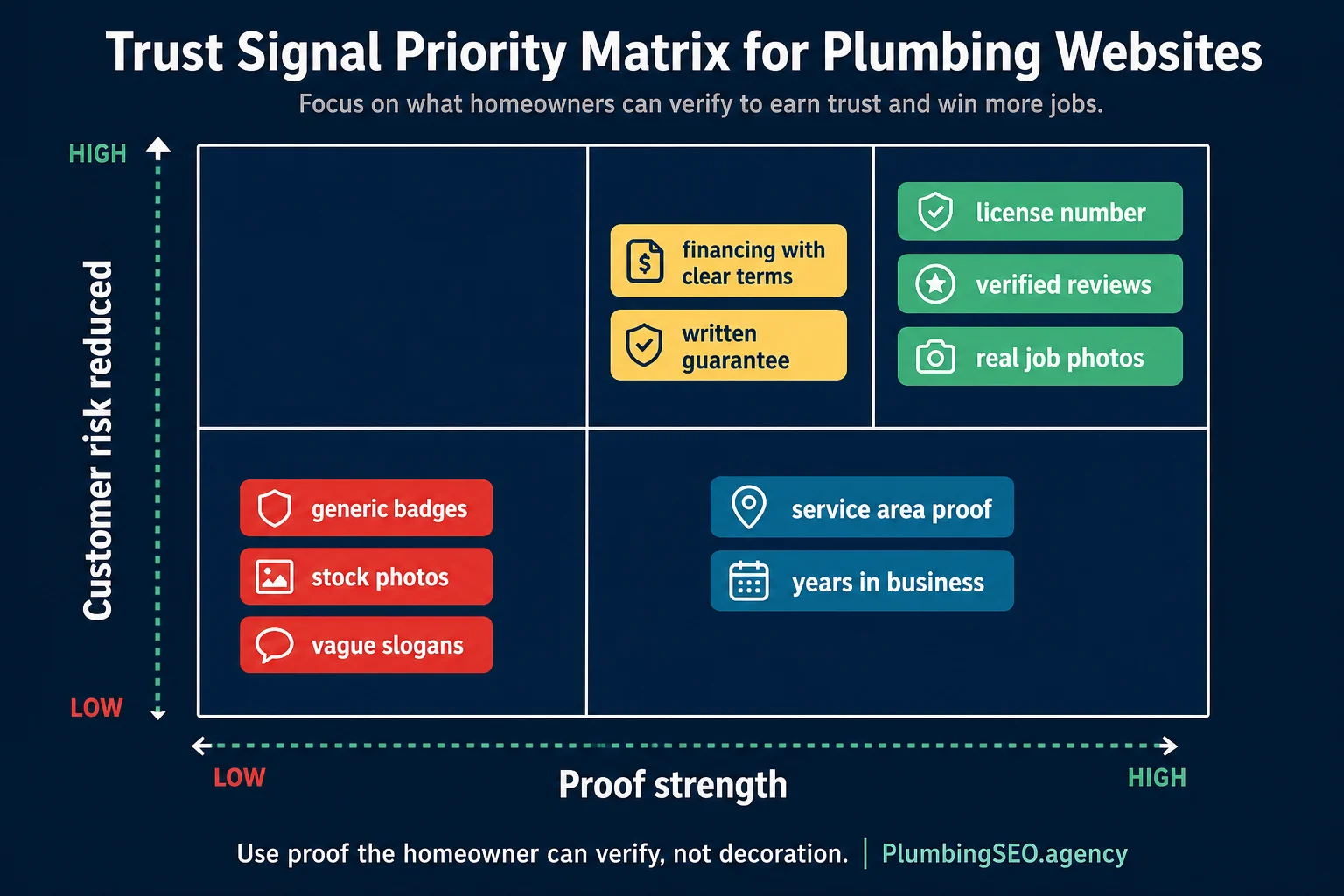
- Use verifiable details. A real license number, recent review, job photo, clear APR note, and written warranty beat generic badges every time.
A plumbing website does not lose calls only because the button is the wrong color. It loses calls when a homeowner cannot tell whether the company is legitimate, nearby, fairly priced, and safe to invite into the home.
That is why plumbing website trust signals matter. The visitor may have a leaking ceiling, a backed-up drain, or a water heater that just quit. They are not comparing design awards. They are trying to reduce risk fast.
The strongest plumber websites do that with proof a customer can verify: licenses, insurance language, review quality, real team and job photos, financing terms, guarantees, service-area proof, and a clear call path. If your site already gets traffic but calls feel soft, your problem may be trust placement rather than traffic volume.
Why trust signals matter more for plumbers than most local businesses
Plumbing is a high-trust service because the customer is not just buying labor. They are letting a stranger into a kitchen, bathroom, basement, utility closet, or rental property. They are worried about damage, overcharging, missed appointments, and whether the repair will hold.
Google's own quality guidance says its systems look for signals that help determine experience, expertise, authoritativeness, and trustworthiness, and that trust is the most important part of that mix. That does not mean a badge magically ranks a page. It means a useful page should make its proof clear, sourced, and believable. See Google's guidance on helpful, reliable, people-first content.
Search results also condition homeowners to check proof quickly. Local pack listings show ratings, review counts, photos, service categories, hours, and sometimes screening badges. If your website feels thinner than your Google Business Profile, the site creates doubt instead of removing it.
The question is not "Do we have trust signals somewhere?" The question is "Does a rushed homeowner see enough proof before the call decision?"
The five trust signals every plumber website should make obvious
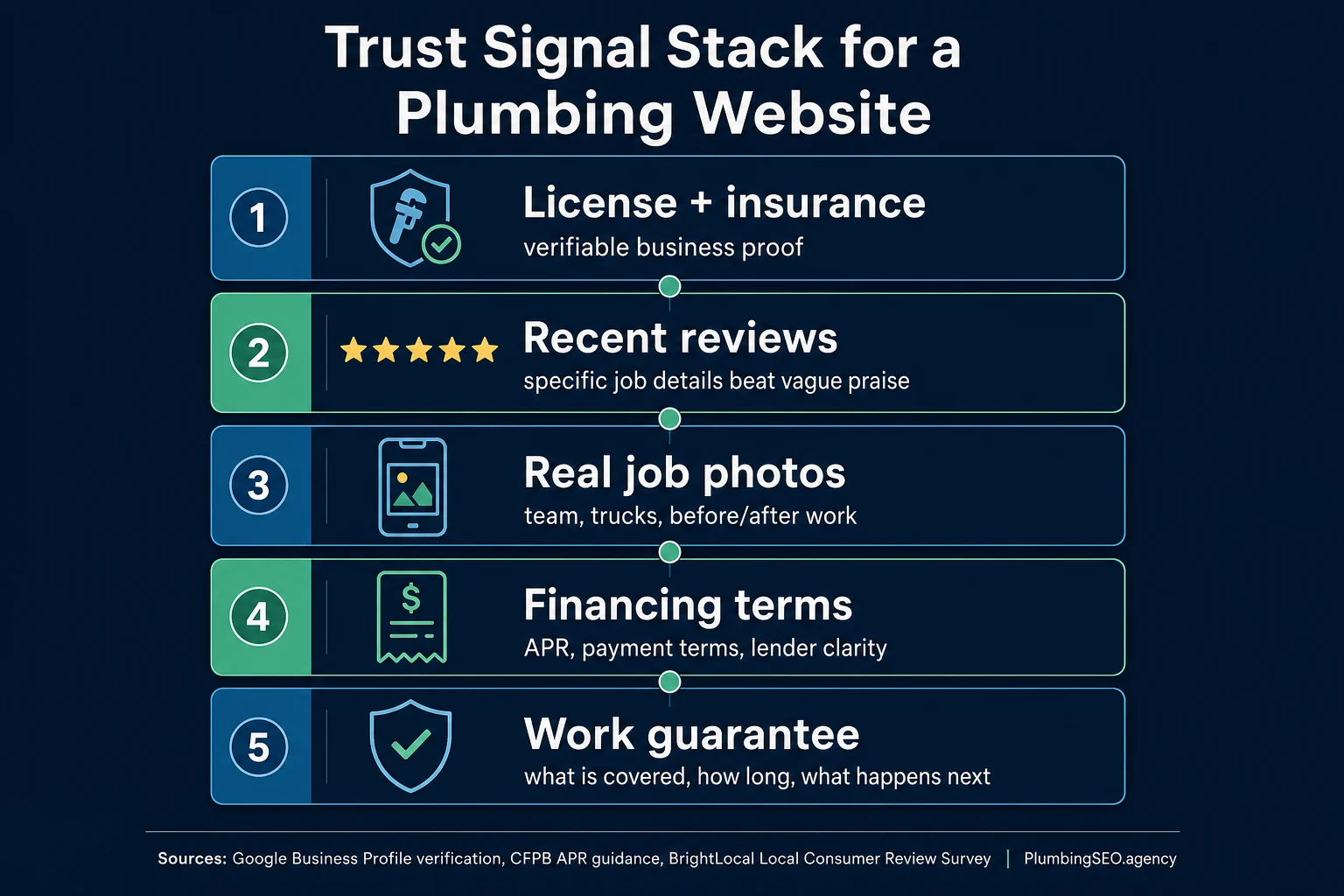
Start with the proof that reduces the biggest call friction. For most plumbing companies, these five signals carry the most weight because they answer the fears customers already have.
| Trust signal | Customer fear it reduces | Better website proof |
|---|---|---|
| License and insurance | Are they legitimate and allowed to do this work? | License number, state or local reference, insured wording, and matching business name. |
| Reviews | Will they show up, communicate, and do clean work? | Recent, specific reviews near CTAs, with links to the review source where practical. |
| Real photos | Is this a real local team or a generic lead seller? | Technicians, trucks, uniforms, job photos, and recognizable service-area context. |
| Financing | Can I afford a bigger water heater, sewer, or repipe job? | Clear lender language, APR or promotional term clarity, approval caveats, and no vague payment promises. |
| Guarantee | What happens if the repair fails or I am unhappy? | Written warranty or satisfaction language that says what is covered, for how long, and how to claim it. |
Do not treat this as a badge collection exercise. A page with seven logos and no real explanation still feels thin. A page with one exact license line, two recent reviews, and a real photo of the team can feel much stronger.
1. License and insurance proof: make legitimacy verifiable
For plumbers, "licensed and insured" is not filler copy. It is one of the first trust filters a serious homeowner uses. If you can legally display your license number, put it in the footer, service pages, and high-intent landing pages. If licensing varies by city, county, state, owner, or technician, make the wording accurate instead of broad.
Google Local Services Ads show why this matters. Google's screening and verification requirements include checks for business registration, insurance, and applicable licenses in certain categories and regions. Your website should support the same basic buyer question: can this business prove it is real?
Strong license proof
- Exact license number where allowed
- Business name matches the license or DBA
- Insurance wording is specific and current
- License proof appears near call and quote CTAs
Weak license proof
- Generic "fully licensed" claim with no details
- Old badge image that cannot be verified
- Conflicting business names across site and profile
- Proof hidden only on a footer or PDF
If you serve multiple locations, audit your license language carefully. The wrong promise is worse than no promise because it can create compliance risk and customer distrust. Keep the message plain: what credential applies, who holds it, and what service area it supports.
2. Reviews: show quality, recency, and job detail
Reviews are not just reputation management. They are conversion assets. BrightLocal's Local Consumer Review Survey reports that reviews still influence nearly all local buying decisions, and its 2026 summary highlights how much star ratings and review recency matter to consumers.
That does not mean every page needs a wall of testimonials. It means your highest-intent pages need the right review at the right moment. A review saying "fixed our burst pipe at 10 p.m. and explained the shutoff" is more persuasive on an emergency page than a generic five-star quote.
Use specific reviews that match the page intent:
- Emergency plumbing page: response time, cleanup, calm communication, after-hours help.
- Water heater page: option explanation, same-day replacement, code-safe install, financing experience.
- Sewer page: camera inspection clarity, second opinion, before and after proof, warranty confidence.
- Homepage: broad reliability, professionalism, local recognition, repeat customers.
Also keep review acquisition clean. Google's review ecosystem is strict about fake, manipulative, or policy-violating reviews. If you need templates for compliant replies and customer follow-up, use our plumber review response templates as a starting point.
3. Real photos: prove the company is local and active
Stock photos are easy, but plumbing buyers can feel when a site is generic. Real photos lower risk because they show the truck, uniforms, technicians, tools, job types, and neighborhoods a customer might actually see.
The best photo library is built during normal work. Ask technicians to capture approved, safe, non-private images after cleanup: labeled trucks, uniforms, water heater installs, drain equipment, clean mechanical rooms, and before or after shots where the homeowner has given permission.
Then use those images in the right places. A homepage needs broad team and truck proof. A drain page needs drain equipment and cleanout context. A sewer page needs camera, excavation, or lining proof. Your Google profile should use the same discipline, which is why we also recommend reading our guide to Google Business Profile photos for plumbers.
4. Financing: build trust by being clear, not clever
Financing is a major trust signal for higher-ticket plumbing work, especially tankless water heaters, sewer line replacement, whole-home repipes, trenchless work, and remodel plumbing. But vague financing copy can create distrust fast.
Use financing language that helps the customer understand the next step without overpromising approval. The Consumer Financial Protection Bureau explains APR as a standard way to compare the cost of credit, and notes that lenders must disclose APR before a consumer agrees to use credit. Your website does not need to become a finance textbook, but it should avoid mystery-payment language.
| Financing copy | Why it works or fails | Better plumbing-site version |
|---|---|---|
| "Low monthly payments available" | Too vague. It raises questions about rate, lender, and approval. | "Financing options available through [lender]. Approval and terms depend on credit." |
| "0% financing" | Risky if the term, qualifications, or deferred interest rules are not clear. | "Promotional financing may be available for qualifying customers. See current terms before approval." |
| "Easy payments on big jobs" | Friendly but not specific enough for a nervous buyer. | "Ask about financing for water heater, sewer, and repipe projects before work begins." |
The rule is simple: do not make the homeowner hunt for the catch. Financing should reduce anxiety, not add a new layer of uncertainty.
5. Guarantees: say what you stand behind
A guarantee is powerful because it answers the fear behind many plumbing calls: "What if this happens again?" But it only works if the customer understands the promise.
Write guarantee copy like a dispatcher would explain it on the phone. What work is covered? Is labor included? Are parts covered by manufacturer warranty? Does drain cleaning have limits? What happens if the customer calls back after the visit?
Name the service or repair types covered instead of saying "all work" if exceptions exist.
Use a clear period, such as 30 days, one year, or manufacturer-backed parts coverage.
Tell the customer who to call, what information helps, and how follow-up is handled.
Disclose exclusions in human language so the promise feels honest, not slippery.
The Federal Trade Commission reminds businesses that advertising claims must be truthful, not deceptive or unfair, and evidence-based. That standard applies to online claims too, including guarantee, financing, and "best plumber" language. See the FTC's advertising and marketing guidance.
Where to place trust signals on a plumbing website
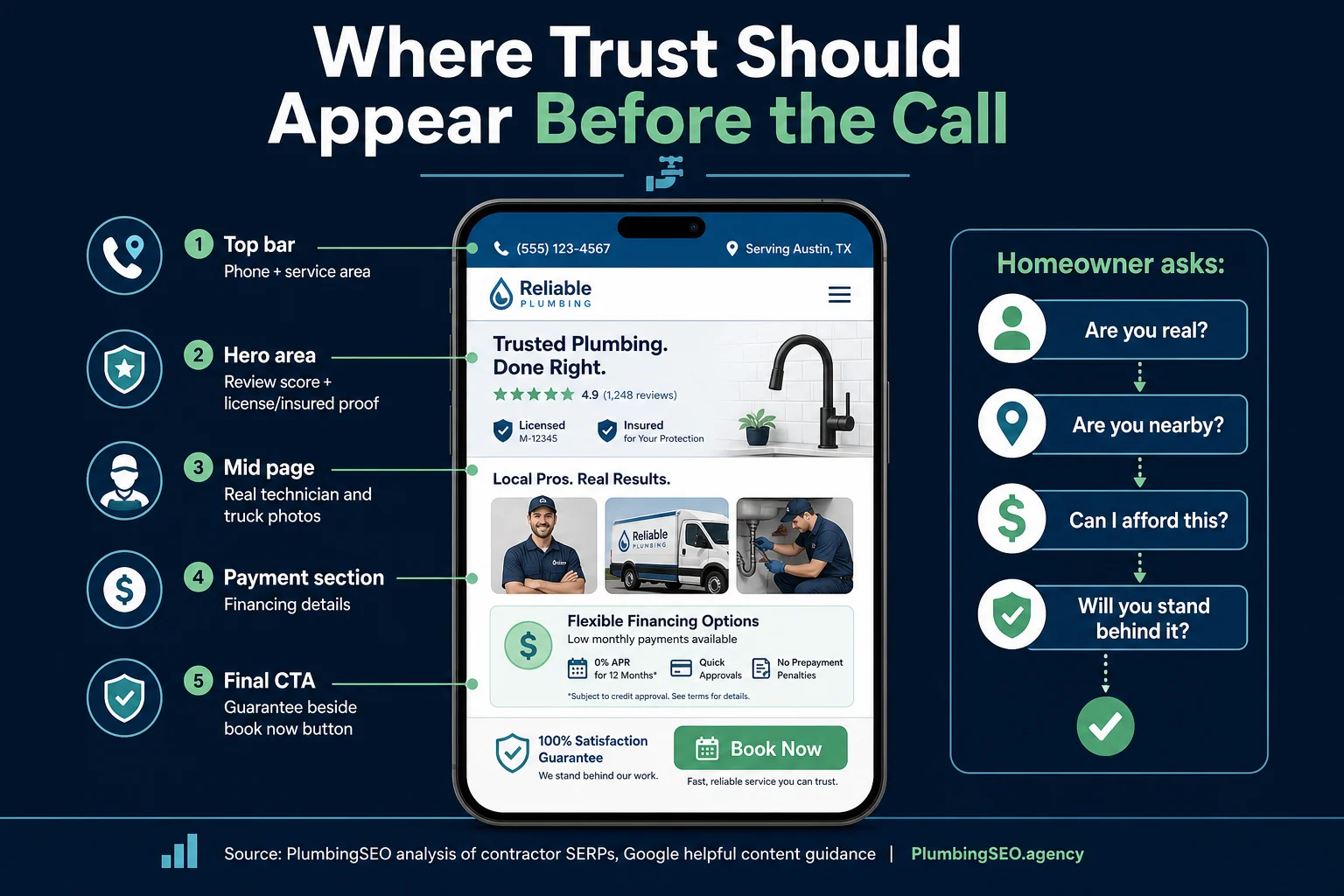
Placement matters because trust is a timing problem. A homeowner needs proof before they make the next click, not after they have already bounced. Put the strongest proof near the action you want them to take.
| Page area | Best trust signal | Why it belongs there |
|---|---|---|
| Header and mobile sticky bar | Phone, service area, emergency cue | The visitor can confirm you are reachable and relevant before scrolling. |
| Hero section | Rating snapshot, license line, real team or truck image | This is the first trust decision and should not feel anonymous. |
| Service page body | Job-specific reviews, before and after photos, process explanation | The proof matches the exact repair or installation the visitor needs. |
| Pricing or financing block | Payment options, approval caveats, clear estimate process | Cost anxiety is usually highest before the form or phone call. |
| Final CTA | Guarantee, cleanup promise, response expectation | The last objection should be answered before the customer leaves. |
If your current site spreads proof across a reviews page, an about page, and a footer, consider pulling the best pieces into the pages that actually convert. Our plumbing website design service is built around that exact idea: every major service page should reduce doubt and create a clear call path.
A quick trust audit for plumber websites
Use this audit before redesigning your site or spending more on ads. If several answers are no, the site may be leaking calls even when rankings and clicks look healthy.
- First screen: Can a mobile visitor see who you serve, how to call, and one proof point without opening the menu?
- License proof: Does the site show accurate license or insurance language where customers make contact decisions?
- Review quality: Are reviews recent, specific, and matched to the service page topic?
- Photo proof: Do photos show your actual people, trucks, or jobs instead of generic stock images?
- Financing clarity: Are financing offers careful about lender, APR, approval, and promotional terms?
- Guarantee clarity: Does the warranty or satisfaction promise explain coverage, timing, and next steps?
- Page speed: Do images and badges load fast enough on mobile that trust proof appears before the visitor leaves?
- Internal path: Does the page send careful shoppers to deeper service, review, or FAQ content?
That last point is where many sites fall apart. Trust proof is not only visual. It is also structural. The homepage should route visitors to deeper proof, the emergency page should make calling easy, and each service page should answer the specific fear behind that job. If the page feels cluttered, start with our plumbing website homepage checklist and tighten the first-screen decision path.
Common trust-signal mistakes that cost calls
Most trust issues are not dramatic. They are small points of friction that stack up until a homeowner calls someone else.
Call leaks
- Review carousel loads slowly or never appears on mobile.
- Financing says "as low as" without terms or caveats.
- License claim is vague, outdated, or inconsistent with the business name.
- Guarantee sounds bold but has no details.
- Photos look like the same stock plumber every competitor uses.
Trust fixes
- Use static review excerpts with links to the source.
- Add clear financing language before the quote form.
- Write license and insurance proof in exact wording.
- Explain warranty coverage in a short FAQ.
- Build a real photo library from completed jobs.
For emergency traffic, do this even more aggressively. A homeowner with a leak is comparing fast: call button, area served, proof, response expectation. Our emergency plumbing landing page checklist shows how to keep that decision path short.
The practical takeaway
Plumbing website trust signals are not decoration. They are answers to objections. If the customer is asking "Are you real?" show a license and local proof. If they ask "Will you do clean work?" show reviews and photos. If they ask "Can I afford this?" explain financing honestly. If they ask "What if it fails?" show the guarantee.
When those answers appear before the call decision, the website feels less like a brochure and more like a calm dispatcher. That is the page that wins more calls.
Frequently Asked Questions
Trust signals are the proof elements that help a homeowner believe a plumbing company is real, qualified, local, and safe to call. Examples include license numbers, insurance language, recent reviews, real job photos, financing details, guarantees, service-area proof, and clear contact information.
Put accurate license and insurance language in the footer, homepage proof section, service pages, and high-intent landing pages. If you can display a license number, show it where allowed. The wording should match the legal business name and actual service area.
Yes. Google reviews can support trust on your website when they are recent, specific, and placed near decision points. Use excerpts that match the page topic, such as emergency response reviews on emergency pages and installation reviews on water heater pages.
Stock photos are better than broken image blocks, but real photos are much stronger. Use actual trucks, technicians, uniforms, tools, finished work, and safe before and after images whenever possible. Real photos make the company feel local and verifiable.
Financing copy should name the lender or program when possible, avoid vague payment promises, and make approval and terms clear. If you mention a promotional rate or monthly payment, confirm the required disclosures with the financing provider before publishing.
A trustworthy guarantee says what is covered, how long it lasts, what is excluded, and what the customer should do if there is a problem. Clear limits are better than a huge promise that sounds good but cannot be explained by the office team.
Want your plumbing website to feel trustworthy before the first call?
We will audit your trust signals, mobile call path, service pages, reviews, photos, and conversion leaks so you know what to fix first.
Run My Free SEO Leak Check