
- A plumbing case study page does not need a customer's full name or address to work. It needs the job problem, the fix, the proof, and a safe next step.
- Use privacy-safe proof: general neighborhood, job type, before-and-after photos with identifiers removed, permissioned review quotes, and call or booking impact.
- Build every case study around consent first. If you cannot prove permission, anonymize the story and avoid exact addresses, faces, license plates, invoice screenshots, and private home details.
If you have good plumbing jobs sitting in your photo roll, invoices, call logs, and text messages, you already have proof. The problem is that most owners leave that proof buried because they do not want to expose a customer's name, house, address, or messy situation.
That caution is right. A customer did not hire you so their sewer backup, bathroom wall, or invoice could become internet content. But hiding every job story is not the answer either. People choosing a plumber want reassurance before they call. BrightLocal's Local Consumer Review Survey reports that 97% of consumers read reviews for local businesses, and 41% always read reviews when browsing for businesses. A plumbing case study page gives that trust a stronger home than a loose review alone.
The way I see it, a good case study page should answer one owner-side question: "Can this plumbing company solve my kind of problem without making my life harder?" You can answer that without revealing private customer data.
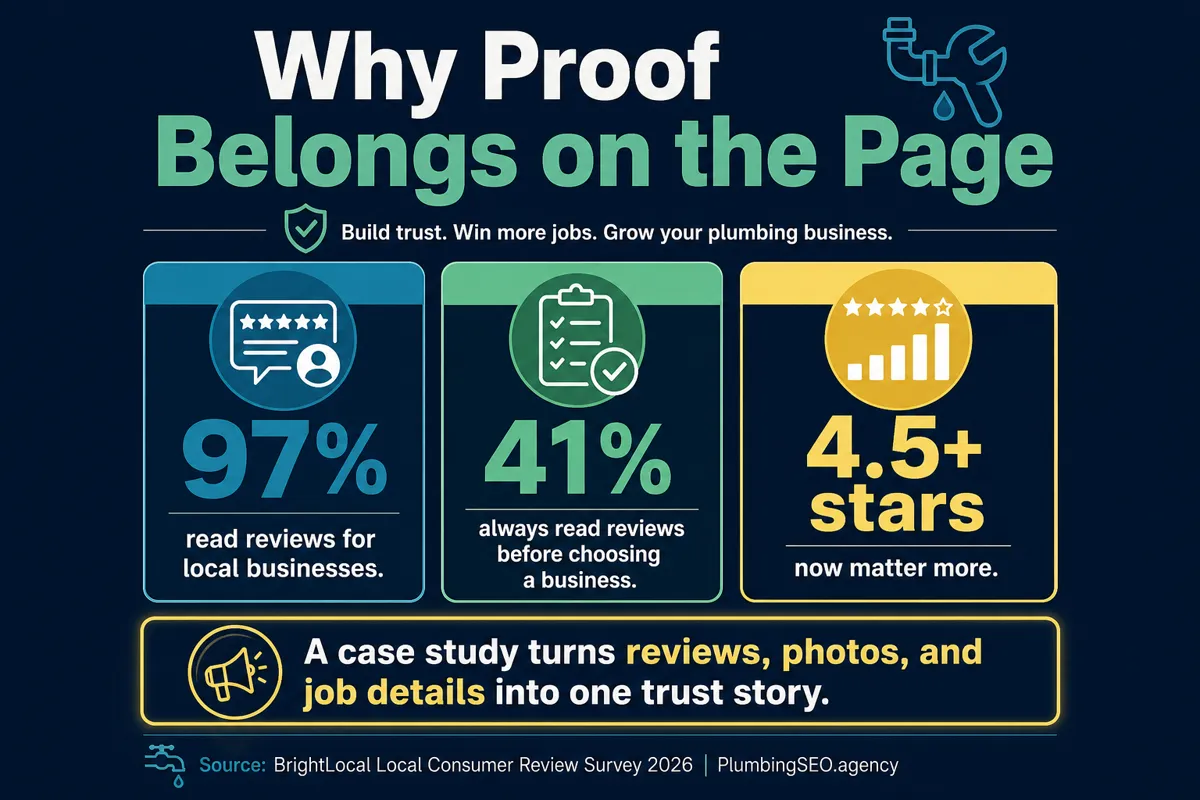
What a plumbing case study page is supposed to prove
A plumbing case study page is not a trophy wall. It is a job story that helps the next customer trust you faster. For plumbing companies, that usually means showing four things:
The real problem
What was wrong, why it mattered, and what the customer was worried about. Keep it general enough to protect the homeowner.
The work performed
What your crew inspected, repaired, replaced, cleaned, or installed. This helps visitors recognize their own situation.
The visible proof
Photos, review snippets, timeline, equipment, materials, or documented steps. Proof beats adjectives every time.
The business outcome
For marketing case studies, show calls, booked jobs, lead quality, or cost per lead. For service jobs, show the homeowner outcome.
For the website side, these pages also help your plumbing web design do more than look nice. They give visitors proof that the business is real, local, careful, and capable before they tap the call button.
The privacy problem: proof can accidentally show too much
Plumbing work happens inside homes, basements, commercial kitchens, mechanical rooms, crawlspaces, yards, and alleyways. Photos often catch more than the pipe. They can show a street number, family photo, kid's room, vehicle plate, invoice, gate code, or the customer's full name on paperwork.
That is why a privacy-safe workflow matters. You do not need to scare yourself out of publishing proof. You just need a line between what helps a future customer and what exposes the last one.
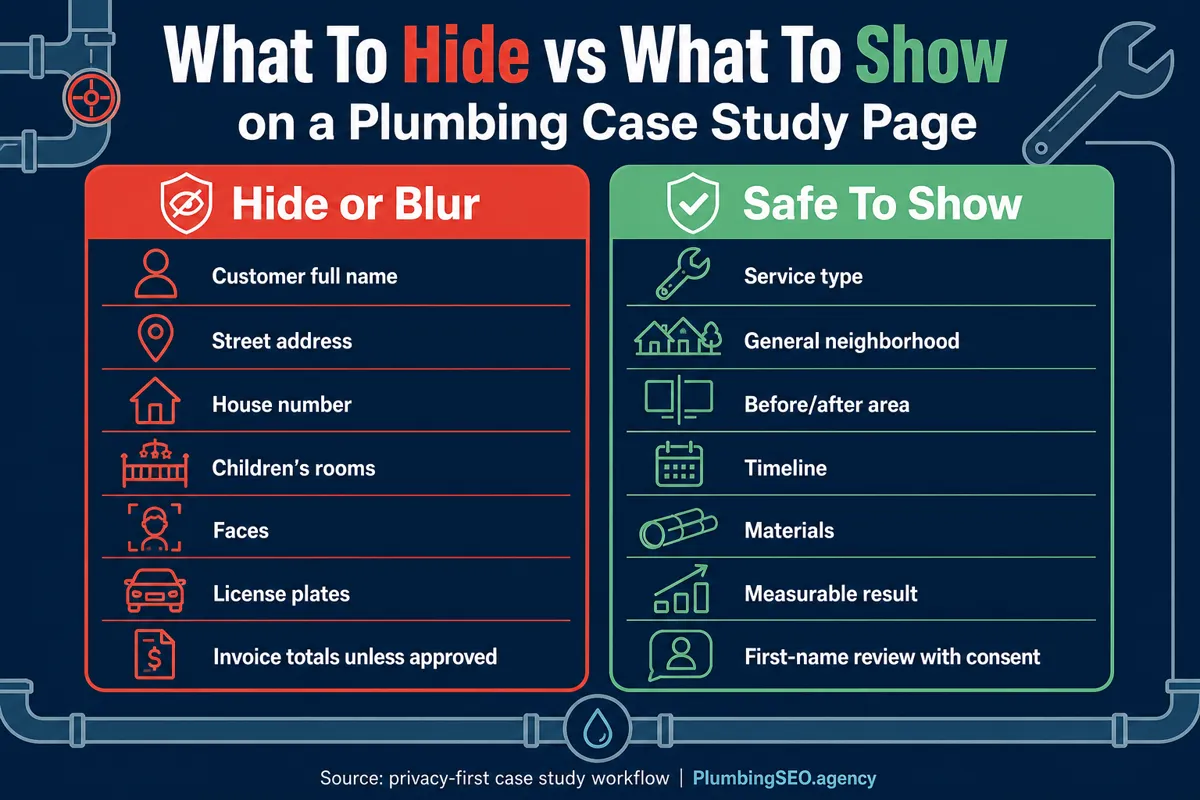
Use this simple permission rule
Before a job story goes live, sort the proof into three buckets:
| Proof item | Use it when | Protect it by |
|---|---|---|
| Customer name | The customer gave clear written approval | Using first name only if full name is not needed |
| Address or street | Almost never needed for public proof | Replacing with city, area, or neighborhood |
| Before-and-after photos | The image shows useful work proof | Blurring faces, plates, house numbers, and private rooms |
| Review quote | The quote is real and permissioned | Keeping the wording honest and not editing the meaning |
| Marketing results | The claim is backed by tracking data | Using ranges or percentages if exact data is sensitive |
The FTC's review guidance says reviews should reflect honest opinions from people who actually used the product or service. The same spirit should guide case studies. Do not fake the job. Do not polish a result until it means something different. Do not imply a customer approved a testimonial if they did not.
A privacy-safe plumbing case study format
Here is the format I would use for most plumbing companies. It gives enough proof to help the next customer while keeping the last customer protected.
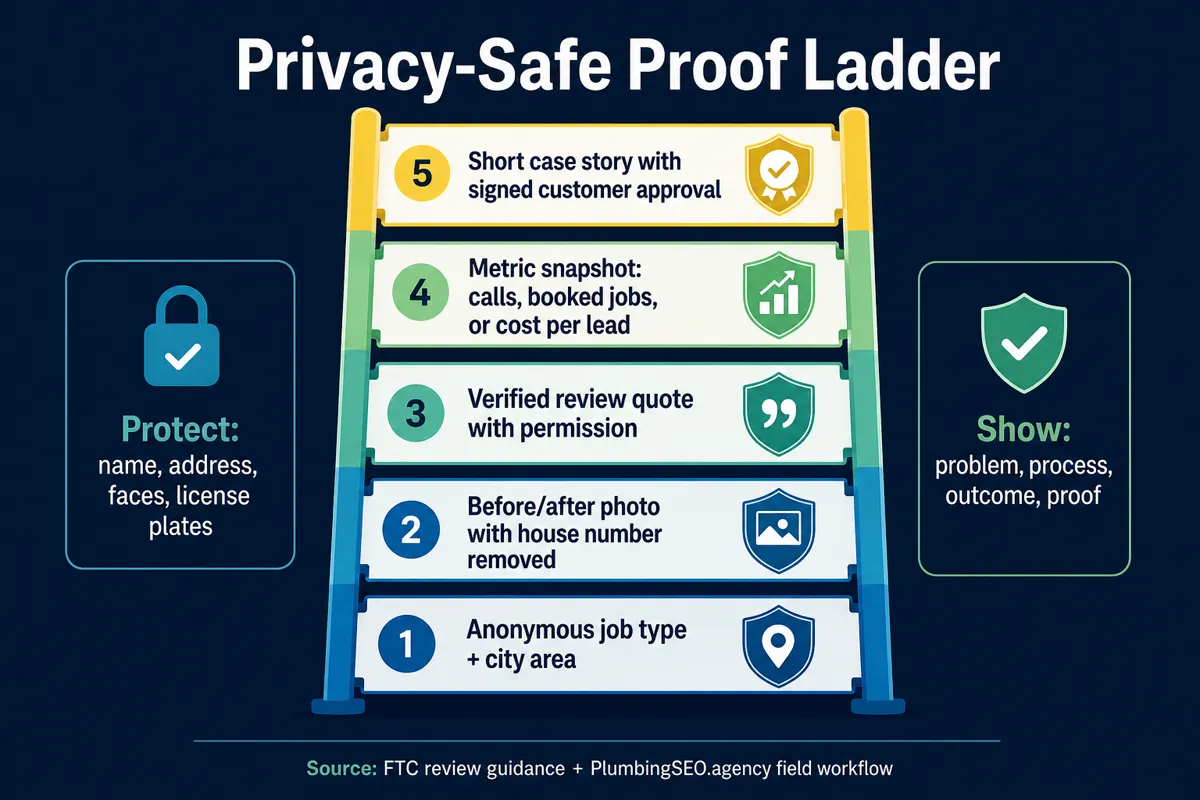
1. Anonymous job snapshot
Start with a simple setup. Example: "Tankless water heater replacement for a two-bath home in the north side of the service area." That tells the reader what kind of job it was without handing out a home address.
2. The customer's problem in plain English
Skip drama. Say what mattered. No hot water during busy mornings. Repeated drain backups. Low water pressure. A leak that kept returning. A remodel that needed code-aware rough-in. The owner or homeowner reading the page should think, "That sounds like my problem."
3. The inspection and fix
Show the process. Did the crew camera-inspect the line, isolate the leak, replace a failed valve, reroute a section, descale a tankless unit, or clean up a bad previous repair? This is where good plumbers separate themselves from cheap guesses.
4. The outcome
For service work, the outcome might be restored hot water, no more backup calls, a passed inspection, or a cleaner install. For marketing pages, it might be more phone calls, better booked-job quality, lower cost per lead, or a stronger quote path. Competitor plumbing marketing case studies commonly show numbers like lead flow increases, cost-per-lead changes, and revenue outcomes. Use those kinds of metrics only when you can back them up.
5. Permissioned proof
Add one or two proof elements. A cropped photo. A first-name review. A call-tracking screenshot with private details removed. A short quote from the customer. If permission is fuzzy, do not use the identifying detail. In the real world, nobody wants to explain to a customer why their house number is showing on a blog post. That is a callback you do not need.
What to measure if the case study supports your website and SEO
If the page supports a plumbing website redesign or SEO campaign, the proof should connect to calls and booked work, not just rankings. A rank chart might make an agency happy. A full board keeps the company alive.
For a plumbing company site, a case study can also strengthen nearby trust pages. If you are building the whole proof stack, pair this with plumbing website trust signals, a stronger plumber About page, and a review plan that turns happy customers into local proof.
Real examples of safe wording
The wording below is not fancy. That is the point. A customer in a rush does not need a novel. They need enough proof to trust the next click.
| Weak version | Safer, stronger version |
|---|---|
| "We helped a customer with a plumbing issue." | "We replaced a failed pressure reducing valve for a homeowner in our west service area after repeated high-pressure fixture problems." |
| "The customer was happy." | "The homeowner approved a first-name review and said the crew explained the repair before starting work." |
| "We got great SEO results." | "Call tracking showed more booked plumbing calls after the new service page and proof section went live." |
| "Here are photos from the job." | "Photos show the repaired section only. House numbers, personal items, and vehicle plates were removed before publishing." |
Where to put case studies on a plumbing website
A case study page can stand on its own, but it should also help the rest of the site. Put proof where a nervous customer is deciding whether to call.
Service pages
Add one short proof block to drain cleaning, water heater, repipe, sewer, or emergency pages. Link to the full case study for readers who want details.
Estimate and booking pages
Show a privacy-safe example near the form. This reassures the customer that real jobs turn into real outcomes, not just another form submission.
About page
Use proof to support the owner story. The About page says who you are. Case studies show how the company actually works.
Review and reputation pages
Connect reviews to job stories. A review says the customer was happy. A case study explains why.
Just keep the links natural. If a case study is about a water heater install, link it from the water heater page. If it is about website conversion proof, link it from your web design or reputation SEO content. Do not stuff every page with every case study. That is not internal linking. That is dumping fittings in the truck bed and calling it inventory.
Case study page checklist before publishing
Before the page goes live, run this checklist. It is boring in the best way. Boring checklists save bad phone calls.
- Consent: written approval exists for any name, quote, photo, or result that could identify the customer.
- Identity: address, house number, faces, license plates, invoices, gate codes, and private rooms are removed or blurred.
- Accuracy: claims match the work order, tracking data, review, or approved customer statement.
- Outcome: the page explains what changed for the customer or business, not just what your crew did.
- Next step: the reader has a clear phone, form, estimate, or audit path after reading.
- Internal link: the case study supports the right service page, not a random page you wanted to push.
Bottom line: privacy-first proof is stronger proof
Plumbing case study pages work because they lower doubt. They show the job, the process, and the result. But the best proof does not make the last customer regret saying yes.
Use general locations. Blur personal details. Ask permission before quoting. Keep result claims honest. Then connect the case study to the pages where it can help customers choose you: service pages, estimate pages, About pages, and web design pages that need proof to turn visits into calls.
If your site already has the work but not the proof, start with one job story. One clean, permissioned, useful case study beats ten vague claims about quality service. The phone tells the truth, and so does a well-built proof page.
FAQ: Plumbing Case Study Pages
Yes. An anonymous case study can still work if it shows the job type, general service area, problem, process, outcome, and privacy-safe proof such as cropped photos or a first-name review with permission.
Avoid full names, street addresses, house numbers, faces, license plates, invoices, payment details, gate codes, and private rooms unless the customer clearly approved that exact use.
They can. Case studies add useful, local, experience-based content that supports service pages, improves trust, and gives internal links a natural destination. They should still be written for customers first.
Yes, when the photos are useful and privacy-safe. Crop or blur anything that identifies the customer, home, vehicle, child, paperwork, or exact address. Show the repair area, not the customer's personal life.
Use metrics tied to business outcomes: calls, qualified leads, booked jobs, cost per lead, form starts, quote requests, and service-area visibility. Do not publish exact client data unless it is approved and accurate.
Link each case study to the closest matching service, web design, About, or reputation page. A sewer repair case study should support sewer content. A website conversion case study should support web design or SEO content.
Want proof pages built into your plumbing website?
We can help you turn real jobs, reviews, and call data into privacy-safe pages that support trust, SEO, and booked plumbing calls.
See Plumbing Web Design