
- A strong plumber about page is not a company biography. It is proof that the owner, team, licenses, service area, and standards are real enough to trust before a homeowner calls.
- The best examples connect an owner story to job-specific proof: real trucks, real technicians, local service areas, license details, reviews, guarantees, and clear emergency or estimate calls to action.
- Use the page to support E-E-A-T signals, then route visitors toward the next step with visible phone links, booking buttons, service links, and schema that matches the visible content.
If a homeowner is comparing two plumbing companies, your About page may be the page that breaks the tie. The homepage says what you do. The service page says whether you fix their problem. The About page answers a quieter question: Do I trust these people inside my house?
That is why plumber about page examples matter for SEO and calls. Google's helpful content guidance asks site owners to show first-hand experience, expertise, and a clear reason to trust the content. For a plumbing company, those signals are not abstract. They are owner stories, licenses, training, real job photos, service-area roots, review proof, and a call path that feels safe.
This guide shows how to build an About page that supports E-E-A-T, reassures nervous homeowners, and sends qualified visitors toward a phone call or estimate request. It also links naturally to your own company story, service pages, and proof assets instead of leaving the page as a dead-end biography.
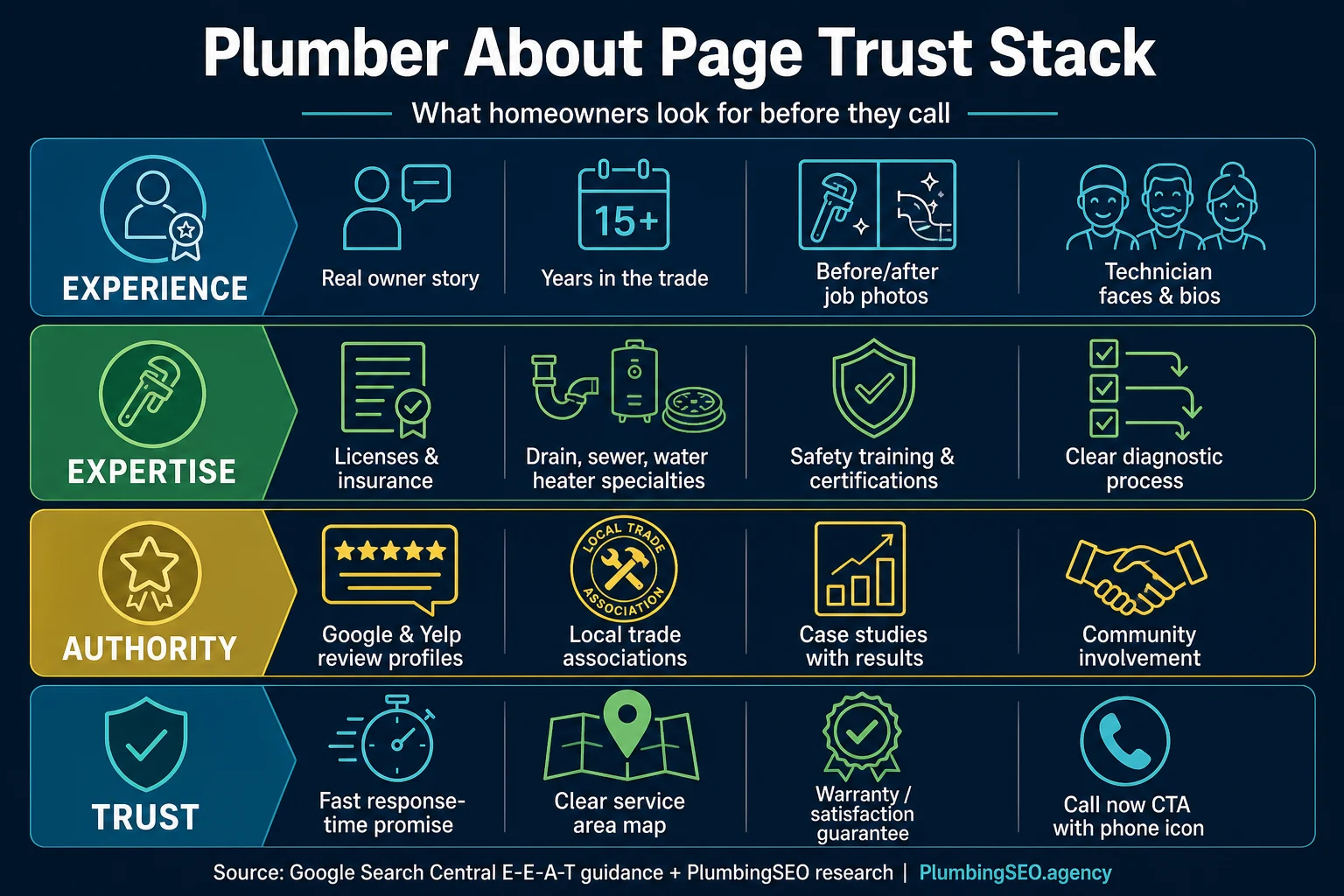
What a plumber About page should accomplish
A good About page does more than say, "family owned and operated." Almost every local contractor says that. The page should make the company feel specific, verifiable, and easy to contact.
For a plumbing website, the About page has five jobs:
- Humanize the business: show who owns it, who answers the phone, and who may arrive at the door.
- Prove local relevance: name the service area, neighborhoods, local roots, and community familiarity.
- Support E-E-A-T: demonstrate experience, expertise, authority, and trust with visible proof.
- Reduce risk: show licenses, insurance, background checks, warranties, financing, and review signals where applicable.
- Move visitors forward: give clear phone, booking, and audit paths instead of ending with a vague brand paragraph.
The page should also help Google and users understand the entity behind the website. If the business name, address or service area, phone number, owner details, social profiles, and review footprint line up across the site and web, the company looks less generic and more credible.
Example 1: The owner-origin story that proves experience
The most common bad About page starts like this: "We are a trusted plumbing company committed to quality service." It could belong to any plumber in any city. A stronger example ties the owner's story to field experience and customer outcomes.
Weak version: "ABC Plumbing is a locally owned company providing reliable plumbing services."
Better plumber About page example: "After 14 years running service calls across north Dallas, Miguel started ABC Plumbing because he was tired of seeing homeowners wait all day for unclear pricing. Today, every ABC technician follows the same three-part visit: diagnose the issue, show the options, and get approval before work starts."
That paragraph works because it gives the visitor something concrete. It names the owner, gives years of experience, ties the origin story to a customer frustration, and explains a process. It sounds like a real company because it contains details only that company would know.
Use this structure:
- Name the owner or leadership team.
- State plumbing experience in real terms, such as years, licenses, specialties, or field background.
- Explain why the company exists beyond "great service."
- Connect the story to a homeowner benefit, such as cleaner work, clearer pricing, faster emergency response, or better communication.
Example 2: The license and standards section
Trust is not only emotional. Plumbing is a high-stakes service category. A homeowner may be dealing with water damage, sewer backups, gas lines, water heaters, or expensive fixture work. Your About page should make it easy to verify that the company is qualified.
A useful standards section can include:
- License numbers where legally appropriate.
- Insurance or bonding language if accurate.
- Technician training or continuing education.
- Specialties such as tankless water heaters, leak detection, repipes, drains, or sewer camera inspections.
- Code-compliance language that reflects actual practice.
- Safety, cleanup, shoe cover, background-check, and communication standards.
Example copy: "Every service call is handled by a licensed plumbing professional or supervised apprentice. Before work begins, we explain the diagnosis, show the repair options, and document the work area so you know what was fixed and why."
Do not overclaim. If the company is not 24/7, do not say emergency service around the clock. If only some technicians hold a specific certification, say that accurately. E-E-A-T is helped by precise proof and harmed by generic claims that cannot be verified.
Example 3: The local roots section
Plumbing searches are local. A homeowner does not just want "a plumber." They want someone who understands their city, water conditions, housing stock, neighborhoods, permitting, and response-time reality.
A local roots section can mention:
- Core cities and suburbs served.
- Common local plumbing problems, such as hard water, slab leaks, older sewer lines, or storm-related backups.
- Neighborhoods, landmarks, or communities where the team regularly works.
- Local memberships, sponsorships, charity work, or community involvement.
Example copy: "Our team works across homes built in the 1960s, new subdivisions with tankless systems, and older neighborhoods where sewer lines need careful camera inspection before digging. That local mix shapes how we diagnose problems and explain repair options."
This supports local relevance without stuffing city names. If you need a broader city and suburb content strategy, connect the About page to your service area SEO plan and your highest-priority city pages.
Example 4: The proof-first team section
Many plumber About pages show a stock photo of a smiling technician holding a wrench. That does little for trust. Real photos can do much more when they show the actual team, wrapped trucks, uniforms, tools, job sites, and clean work habits.
A strong team section might show:
- Owner headshot with a short personal note.
- Dispatcher or office team photo, especially if they handle urgent calls.
- Technician group photo in front of branded trucks.
- Real job photos tied to services, not random stock images.
- Alt text that describes the image naturally.
For example, instead of alt text like "best plumber near me," use: "ABC Plumbing technician inspecting a water heater in a Dallas garage." That helps accessibility, keeps the page honest, and gives search engines useful context.
If the company has strong job photos, link the About page to a gallery, service pages, and relevant proof posts. For more detail, see our guide to before-and-after photos for plumbing SEO.
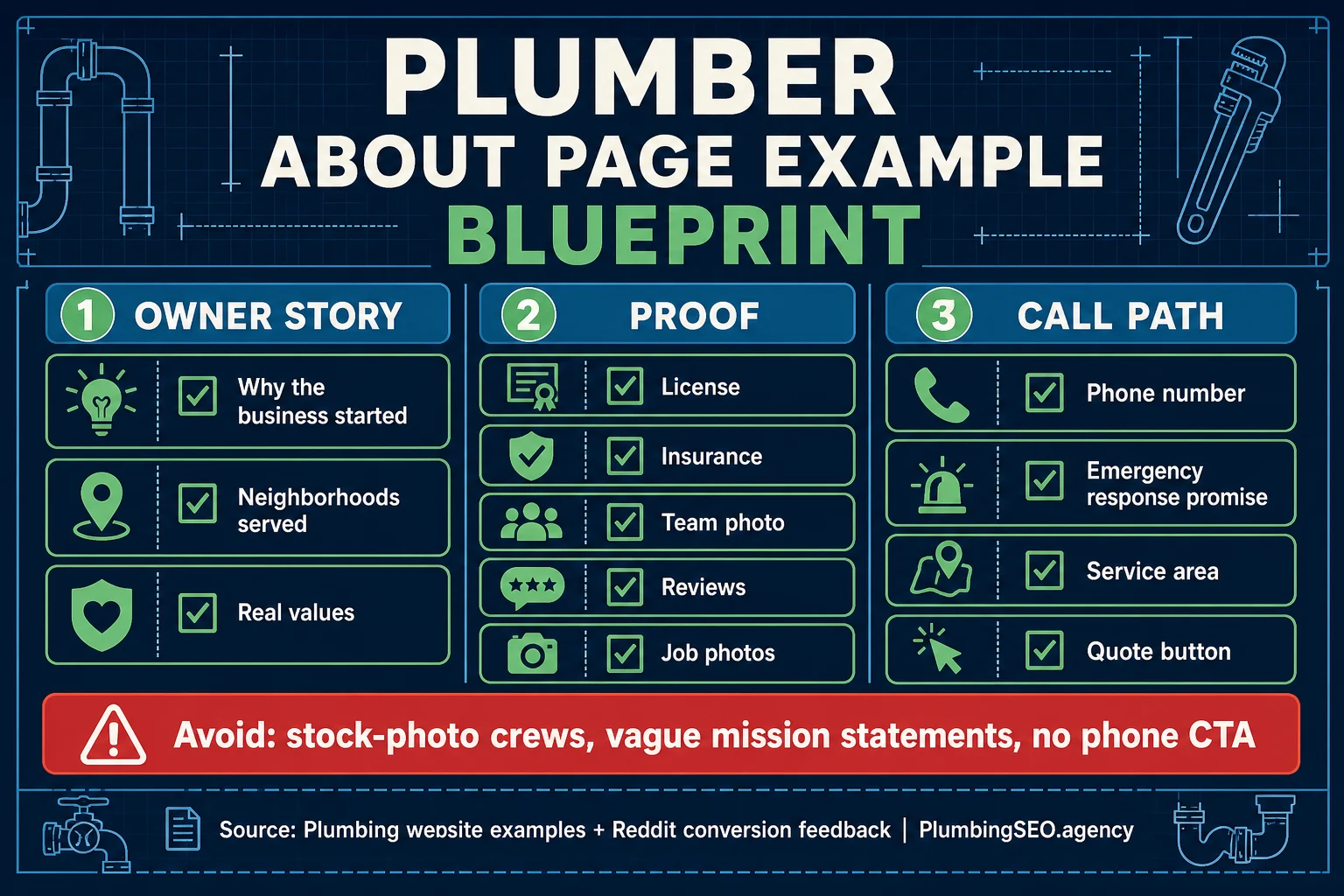
Example 5: The review and reputation bridge
Your About page should not duplicate your reviews page, but it should borrow credibility from your reputation. A homeowner who is nervous about hiring a plumber wants to know whether other local customers trusted you and what happened after the call.
Add a short reputation block with:
- A link to Google reviews or a review page.
- A few short review themes, such as punctuality, clean work, clear pricing, or emergency response.
- One or two real testimonials if you have permission and they are visible elsewhere.
- A response philosophy that shows how the owner handles issues.
Example copy: "Most of our reviews mention the same things we care about internally: showing up when promised, explaining the repair before the invoice, and leaving the work area cleaner than we found it."
That sentence connects reputation to operating standards. It is stronger than dropping in a review widget with no explanation. For a deeper reputation strategy, use our guide to reputation SEO for plumbers.
Example 6: The service proof map
An About page can also help visitors choose the next page. If someone lands on your story while researching the company, they may still need water heater repair, drain cleaning, leak detection, sewer repair, or emergency help. Do not make them restart from the navigation menu.
Add a "What we help with" section that links to core service pages. Keep it concise and useful:
- Emergency plumbing for urgent leaks, backups, and burst pipes.
- Water heater repair and replacement.
- Drain cleaning and camera inspections.
- Sewer line diagnosis and repair.
- Leak detection, slab leaks, and repipes.
For PlumbingSEO.agency, this is why our About page and blog content naturally support the main plumbing SEO service page. The About page builds entity trust, while service pages capture the commercial demand.
Example 7: The call path that matches visitor confidence
The About page should not only say who you are. It should tell the visitor what to do next based on their level of urgency.
Use multiple call paths:
- Urgent visitor: sticky phone number, click-to-call button, emergency service note.
- Comparison shopper: estimate or consultation button, proof links, service pages.
- Trust checker: license details, owner story, review links, guarantee language.
- Commercial client: project form, service territory, credentials, case examples.
A clear CTA does not make the page salesy. It prevents trust from leaking. If a visitor finishes the About page and believes you are credible, the phone number or booking path should be visible before that confidence fades.
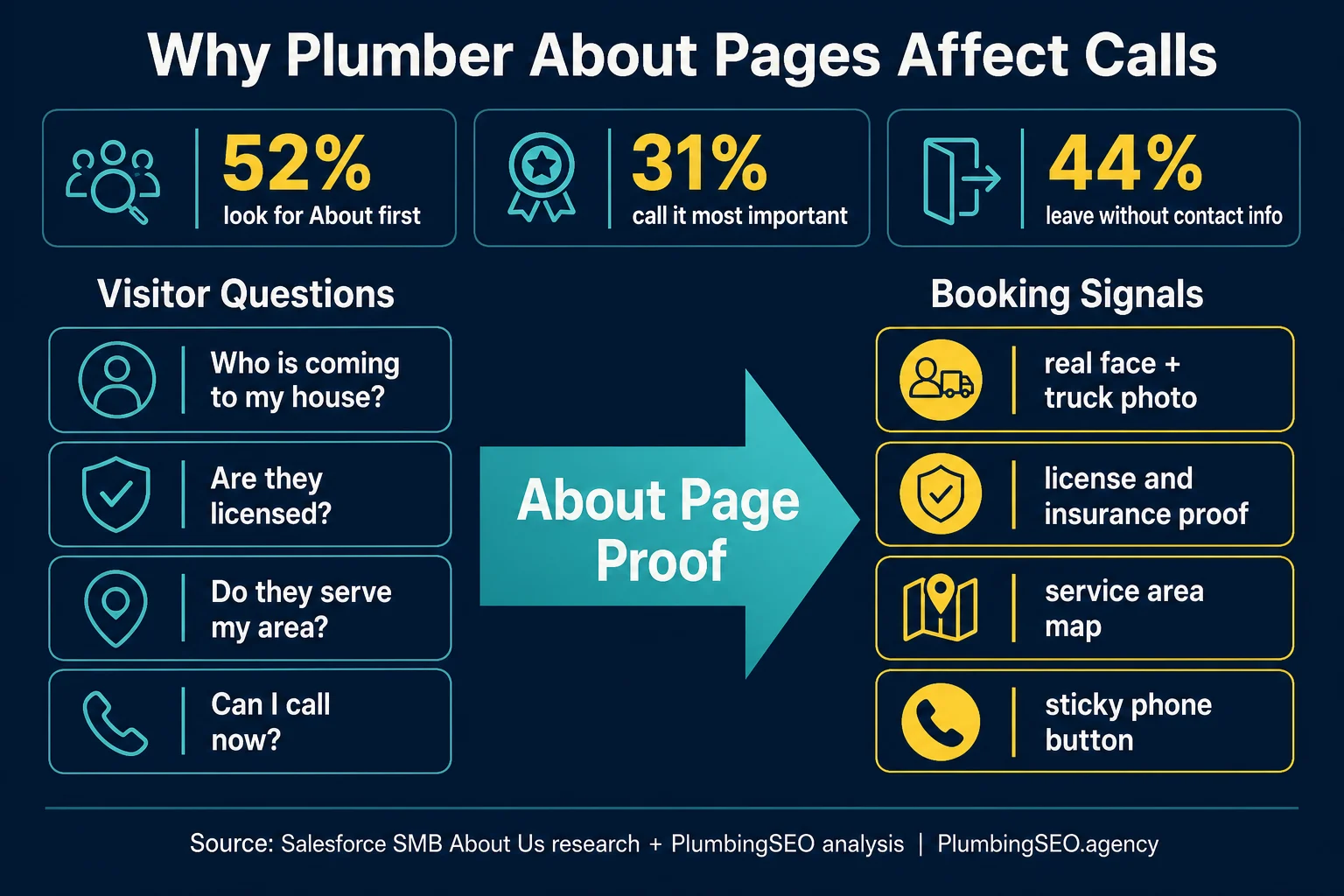
Plumber About page example structure you can copy
Here is a simple structure that works for most local plumbing companies:
| Section | What to include | Why it helps calls |
|---|---|---|
| Hero | Company positioning, city or service area, phone CTA | Confirms the visitor found the right local plumber |
| Owner story | Founder name, field experience, why the company exists | Makes the company feel real and accountable |
| Standards | Licenses, training, process, cleanup, pricing approach | Reduces perceived risk before the call |
| Local roots | Service area, local issues, communities served | Supports local relevance and homeowner familiarity |
| Team and photos | Real team, trucks, uniforms, job photos | Replaces stock-image doubt with visual proof |
| Reputation | Review themes, testimonials, guarantee language | Shows other customers trusted the company |
| Next steps | Phone, booking, service links, estimate CTA | Turns trust into measurable leads |
How this supports E-E-A-T without stuffing SEO terms
E-E-A-T is not a single ranking tag you add to the page. It is a set of trust signals that help users and search systems evaluate whether the business and content deserve confidence. For a plumber, the About page is one of the best places to show those signals naturally.
- Experience: years in the trade, job photos, real problem examples, local conditions.
- Expertise: licenses, training, specialties, diagnostic process, code-aware language.
- Authoritativeness: awards, memberships, review footprint, media mentions, community presence.
- Trust: transparent contact information, accurate claims, guarantees, policies, privacy, and proof.
Google's search quality documentation treats trust as especially important when content can affect people's money, safety, or well-being. Plumbing service decisions often involve expensive repairs and home safety. That makes visible, honest proof more important than clever copy.
If you add structured data, make sure it matches what users can see on the page. LocalBusiness, Organization, Person, Review, and FAQ markup can support clarity, but schema should not invent claims. See our plumbing schema markup examples before adding code sitewide.
Common About page mistakes that cost plumbers calls
Most weak About pages fail for one of these reasons:
- They sound interchangeable: no owner name, local details, photos, or proof.
- They bury the phone number: the visitor trusts the company but cannot easily call.
- They use stock images: the page looks polished but not believable.
- They overuse "family owned": the phrase is fine, but it needs a real story behind it.
- They ignore service links: visitors cannot move from trust to a specific repair page.
- They make unsupported claims: "best," "number one," or "certified" without proof can weaken trust.
- They have no schema or mismatched schema: markup either missing or claiming things the page does not show.
A practical rule: after reading the page, a homeowner should be able to answer who owns the company, where the company works, what standards the team follows, what proof exists, and how to call or book.
About page copy template for a plumber
Use this as a starting point, then replace every placeholder with real details:
[Company Name] was started by [Owner Name] after [number] years solving [main plumbing problems] across [service area]. We built the company around a simple standard: homeowners should understand the problem, the repair options, and the price before work begins.
Our team helps with [core services], and every visit follows our [process name or standard]. That means [proof point 1], [proof point 2], and [proof point 3]. We are based in [city] and serve [nearby areas], where we regularly see [local plumbing issue].
If you need help now, call [phone number]. If you are comparing options, read our reviews, meet the team below, and request an estimate when you are ready.
The template works because it combines story, process, proof, local relevance, and CTA. Do not publish it unchanged. The value comes from replacing generic statements with details from the owner and technicians.
What to ask the owner before writing the page
If you are writing this page for a plumbing company, interview the owner before touching the design. Ask questions that reveal useful proof:
- Why did you start the company?
- What did you dislike about how other plumbing companies treated customers?
- Which jobs does your team handle better than competitors?
- What standards do technicians follow on every call?
- Which neighborhoods, home types, or local plumbing issues do you know well?
- What do customers mention most often in reviews?
- What should a homeowner know before inviting a plumber into the house?
- What photos can we use that show the real team and work?
These answers usually produce better copy than any competitor swipe file. Competitor examples can show layout patterns, but the owner's real story is what makes the page defensible.
How to measure whether the About page is working
An About page can influence conversions even when it is not the first landing page. Track it like a trust page, not only like an SEO landing page.
Watch for:
- Entrances from branded and company-name searches.
- Clicks from service pages to the About page before a call.
- Phone clicks and form submissions after an About page view.
- Scroll depth through owner story, proof, and CTA sections.
- Internal clicks from About to service pages and pricing or audit pages.
- Changes in branded search behavior after reviews, GBP updates, or local PR.
For PlumbingSEO.agency, About page improvements belong inside a broader site trust system that includes the homepage, service pages, reviews, photos, and technical SEO. If the rest of the site leaks trust, the About page cannot carry everything alone. Start with the plumbing website homepage checklist and trust signal guide if the whole site needs cleanup.
Final takeaway
The best plumber About page examples do not win because they are long. They win because they are specific. They show a real owner, a real team, real service-area knowledge, real proof, and a clear path to call.
If your About page could belong to any plumber in any city, it is not carrying its weight. Rewrite it around the story and standards that make the company trustworthy, then connect that trust to the services and calls that grow the business.
Plumber About Page Examples FAQ
A plumber About page should include the owner story, service area, licenses or qualifications, team photos, real job proof, review themes, company standards, core services, and clear phone or booking calls to action.
Yes, indirectly. It helps users and search engines understand the business entity, local relevance, experience, expertise, and trust signals behind the site. It also supports conversions when visitors check credibility before calling.
Real photos are better. Stock photos can make a plumbing company look generic. Use owner photos, team photos, branded trucks, uniforms, job photos, and clean work examples whenever possible.
Long enough to answer trust questions clearly. For many local plumbers, 700 to 1,500 words can work if the page includes real story, proof, services, local relevance, and calls to action. Quality and specificity matter more than length.
Want a plumber website that proves trust before the call?
We help plumbing companies turn owner stories, proof, service pages, and local SEO into a site that earns more calls from search.
Run My Free SEO Leak Check