
- Your About page is where nervous homeowners decide if your company feels real enough to call, especially after they have already checked your reviews.
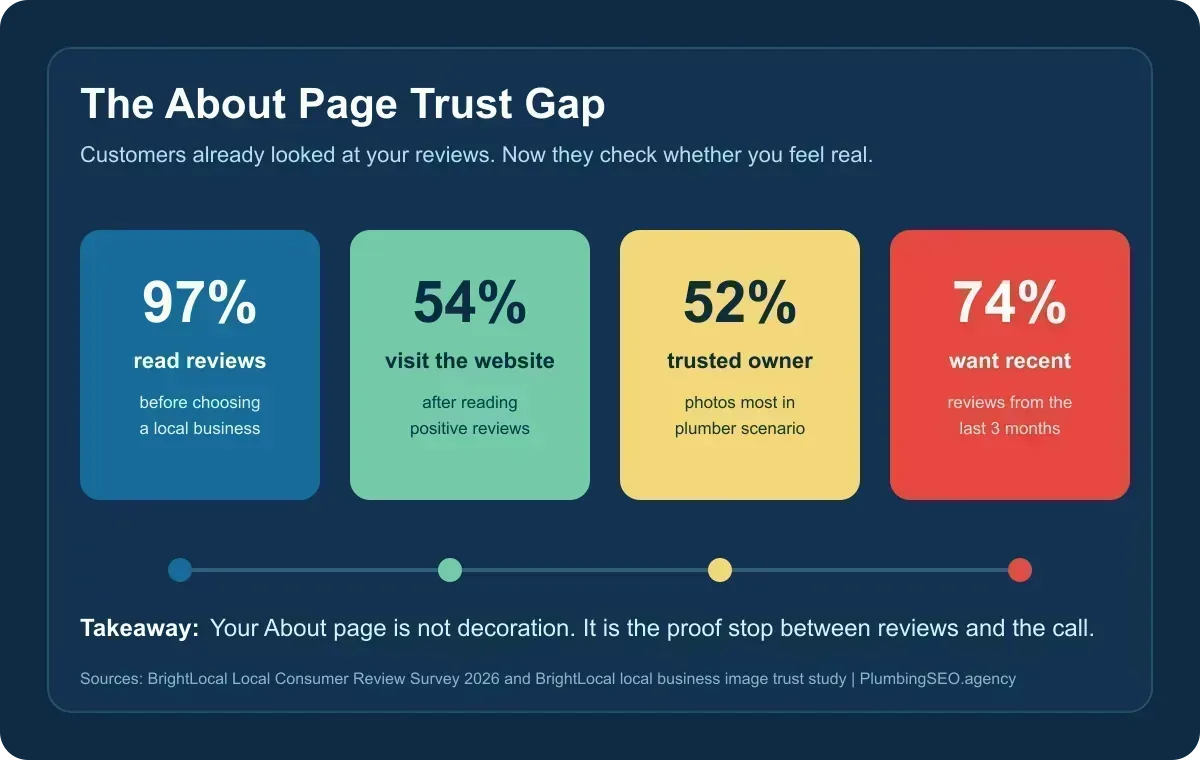
- BrightLocal's 2026 review survey found that 54% of consumers visit a business website after reading positive reviews. That page has to back up the trust your reviews started.
- The best plumbing About pages show real people, real service areas, credentials, standards, and a clear next step. Not a generic "we care about quality" paragraph.
The About page on a plumbing website gets treated like the junk drawer of the site. A little company history, a mission statement, maybe a photo from 2014, and off it goes.
That is a mistake.
In my opinion, your About page matters more than most plumbing owners think because it catches people at a very specific moment. They already found you. They probably read your reviews. They might have looked at your services. Now they are asking the quiet question that decides whether the phone rings: do I trust these people in my house?
That is not soft branding talk. That is the hand on the phone before the call.
A homeowner with a leaking water heater does not need your life story. They need enough proof to believe you are local, competent, insured, responsive, and not going to make the day worse. The About page is where you prove that with faces, standards, credentials, service-area clarity, and plain language.
The About Page Is a Trust Check, Not a Biography
Here is what most agencies miss: customers do not read an About page because they are bored. They read it because something still feels uncertain.
Maybe your Google reviews look good, but the homeowner wants to know who is actually coming to the door. Maybe they were referred by a neighbor, but they want to make sure you handle their part of town. Maybe your service page sounds fine, but every plumber in town says "honest, reliable, affordable." That copy has been worked harder than a shop vac on drywall dust.
BrightLocal's 2026 Local Consumer Review Survey found that 97% of consumers read reviews for local businesses. It also found that after reading positive reviews, 54% of consumers visit the business website. That means your website is not replacing reviews. It is where people go to verify them.
Your About page should answer the trust questions reviews cannot fully answer:
- Who owns the company?
- Who might show up at the house?
- What areas do you actually serve?
- Are you licensed, insured, trained, and established?
- What kind of work standards do you hold the crew to?
- What should the customer expect after they call?
The page does not need to be fancy. It needs to be specific. A plain photo of the owner beside a wrapped truck can do more work than six paragraphs about excellence, integrity, and customer satisfaction.
Where the About Page Fits in the Call Decision
Think through the path like a customer, not like a marketer.
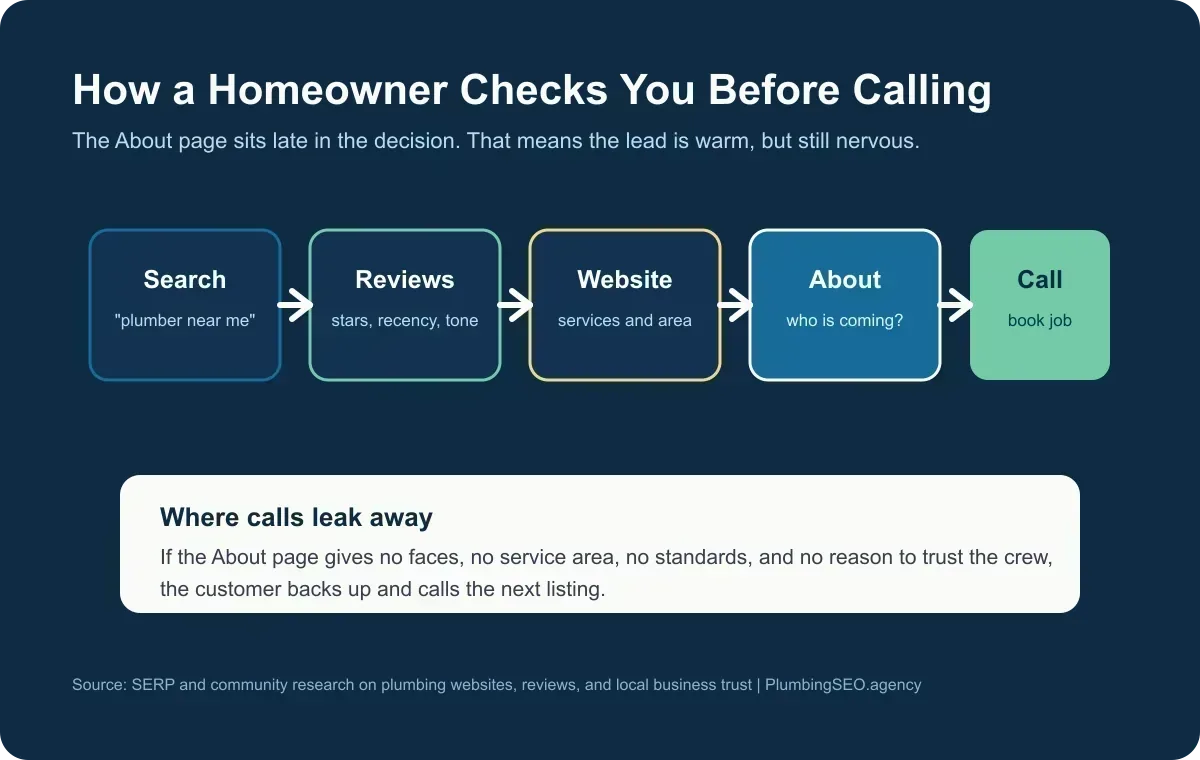
Someone searches for a plumber. They see the map pack. They compare reviews. They click through to your site. If your services and location match their problem, they are close. But close is not the same as booked.
This is where the About page earns its keep. It removes the last bit of doubt before a homeowner hands you access to their house, their pipes, and sometimes their bad day.
This lines up with what people say in the field. In a Reddit thread where a plumber asked whether a personal website was still worth it, several homeowners and tradespeople said a basic website helps them confirm that a contractor is real, local, and easy to contact. One homeowner said a page with your phone number, services, service area, and a real photo is already useful. That is not a full marketing plan. That is a trust floor.
If your About page is missing, thin, or stuffed with stock photos, the customer may not tell you why they backed out. They just hit back and call the next company. Quiet leak. No callback. No invoice.
What a Plumbing About Page Should Actually Show
A good plumbing About page is built like a proof stack. Each piece answers a different customer fear.
The first fear is simple: "Are these real people?" That is where owner photos, team photos, truck photos, and jobsite photos matter. BrightLocal's image trust study found that in a plumbing scenario, 52% of consumers trusted the website with a real owner photo most, while only 16% trusted the no-image version most. They also found nearly two thirds of consumers put more trust in a real owner photo than a stock-style plumber image.
That should settle the stock photo argument. Customers can smell fake from across the crawlspace.
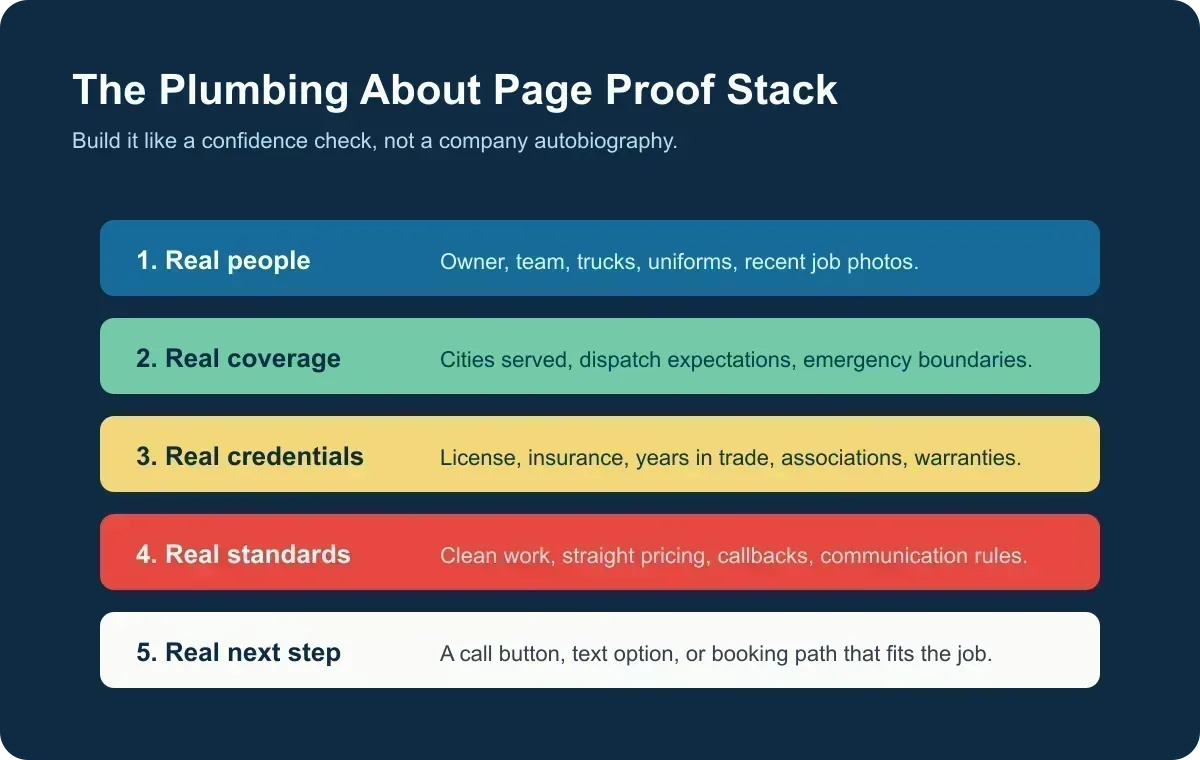
Here is what I would put on the page, in this order:
| About Page Element | What It Proves | How to Make It Specific |
|---|---|---|
| Owner or founder note | There is accountability behind the company | Name the owner, the market served, and the standard customers can expect |
| Real team and truck photos | The company is active and local | Use current photos with uniforms, wrapped vehicles, and real work settings |
| Service area explanation | The customer is inside your dispatch range | List core cities and explain emergency or after-hours coverage |
| License, insurance, and training | You are qualified for the work | Show license numbers where appropriate and name certifications plainly |
| Work standards | The customer knows how the job will be handled | Mention cleanup, communication, arrival windows, pricing, and callbacks |
| Review proof | Other customers had a good experience | Pull 2 or 3 short reviews that mention trust, cleanliness, speed, or professionalism |
| Clear call path | The next step is easy | Add call, text, and booking options without making the visitor hunt |
If you already have a strong plumbing website structure, the About page should support it. It should not be a disconnected page with a different tone, old photos, and a phone number hiding in the footer.
Weak About Pages All Make the Same Mistake
Most weak About pages talk about the company in a way that could fit any contractor in any city.
You know the lines:
- "We are committed to quality service."
- "Customer satisfaction is our top priority."
- "We treat every job with professionalism."
- "We are your trusted local plumbing experts."
None of those are wrong. They are just not enough. A customer cannot verify them. Google cannot learn much from them. And your dispatcher cannot book a job with them.
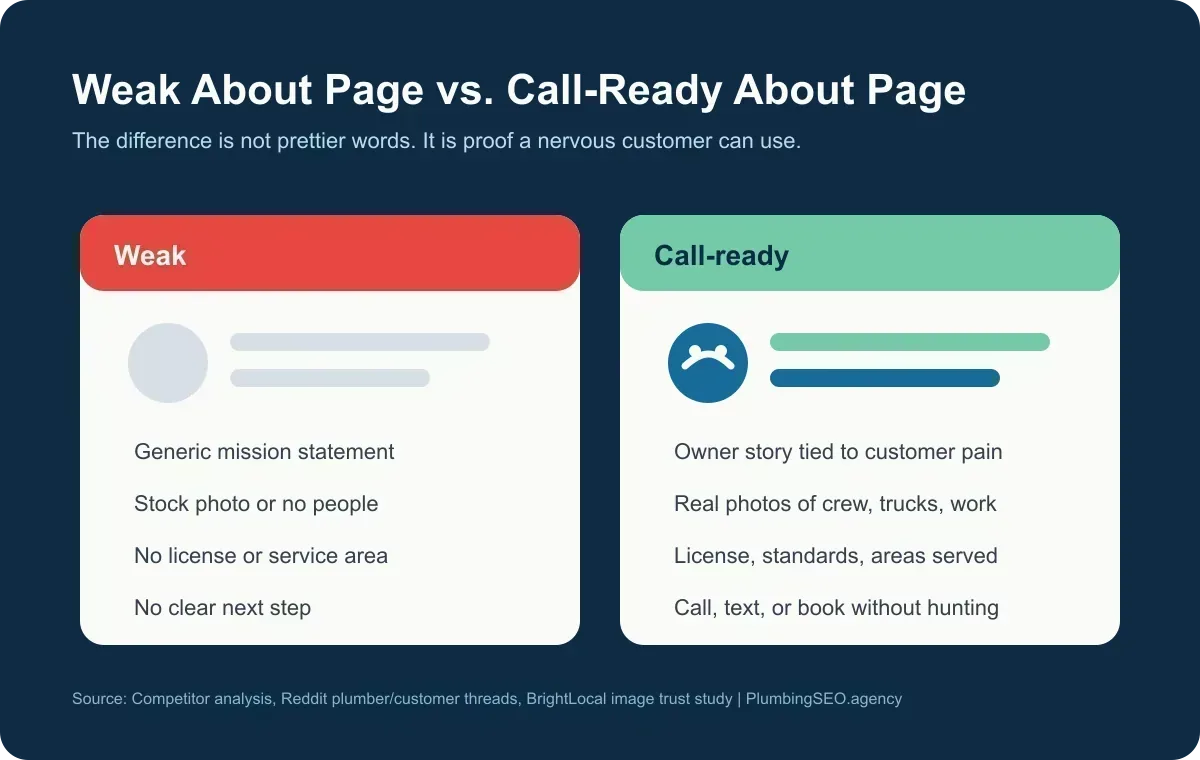
A strong About page is specific enough that a competitor could not copy it without lying. That is the test.
Talk about the neighborhoods you serve. Talk about why you built the company the way you did. Talk about what your techs check before leaving a home. Talk about the kind of customer experience you expect from the crew. Talk about what you do when something is not right.
For a plumbing owner, that matters because service is its own animal. Customers are not only buying a repair. They are buying the confidence that the repair will be handled cleanly, clearly, and without drama.
The SEO Value Is Real, but It Is Not Magic
Your About page probably may struggle to rank for "emergency plumber near me" by itself. That job belongs to your homepage, Google Business Profile, city pages, and service pages.
But the About page still helps SEO in three practical ways.
It strengthens your local entity
Search engines need to understand who the business is, where it operates, and whether its information is consistent. Your About page can reinforce the same name, address, phone, service areas, credentials, and business details that appear on your Google Business Profile and local citations. If your NAP is messy, fix that too. Our plumber citation guide walks through the directories worth checking.
It supports E-E-A-T signals
Experience, expertise, authoritativeness, and trust are not buttons you toggle. They show up through evidence. Real people, real credentials, real work photos, clear policies, and helpful answers all support the same idea: this is an actual business with real experience.
It improves conversion from traffic you already earned
This is the part that pays. If SEO gets you more visitors but the About page makes them feel uncertain, you are paying for visibility without helping the customer finish the decision. That is not growth. That is noise.
If the wider website is already leaking calls, start with our guide on why plumber websites do not get calls. The About page is one piece of that larger conversion system.
A Simple About Page Structure You Can Use
You do not need a 2,500-word company memoir. You need a tight page that gives people confidence and moves them toward contact.
Here is the structure I would use for most plumbing companies:
1. Start with the customer situation
Open with the reality of the work. "When a drain backs up or a water heater quits, you do not have time to gamble on who shows up." That sounds like a plumbing company that understands the customer. Better than "Founded on a commitment to excellence."
2. Introduce the owner and the crew
Name the owner. Show the team. Mention how long you have served the area. If you are family-owned, say what that means in practice. If you are veteran-owned, union-trained, woman-owned, or second generation, say it plainly and connect it to how customers are treated.
3. Explain your standards
This is where the page gets useful. Do you send licensed techs? Do you protect floors? Do you explain options before work starts? Do you text before arrival? Do you clean up? Do you stand behind repairs? Say it.
4. Show proof close to the claim
If you say you are trusted, show reviews. If you say you handle emergency work, show the services and response expectations. If you say you are local, show the actual cities and neighborhoods. If you say you do clean work, show real job photos.
5. End with a practical next step
Do not end with "learn more about our values." End with the next action. Call for urgent work. Text a photo of the issue. Book online for non-emergency jobs. Get the right kind of lead into the right path.
What to Remove From the Page
If your About page has been sitting untouched for years, do not just add more. Cut the parts that create doubt.
- Remove stock photos that pretend to be your team.
- Remove vague slogans that do not say anything specific.
- Remove awards, badges, or memberships that are outdated or unverifiable.
- Remove old service areas if you no longer dispatch there.
- Remove company history that has no connection to customer trust.
- Remove dead social links or embedded feeds that have not been updated in months.
Then replace the fluff with proof. A simple page with real photos, a clear story, service areas, reviews, licenses, and a phone number beats a glossy page that feels fake. Every time.
One Practical Rewrite Example
Here is the kind of rewrite that changes the page from filler to useful.
Generic
"We are a trusted plumbing company committed to providing high-quality service and customer satisfaction."
Specific
"We are a licensed plumbing crew serving North Austin and nearby communities. Every service call gets an arrival text, upfront options, floor protection, and a cleanup check before we leave."
The second version gives the customer something to picture. It tells them where you work, how the call will feel, and what standard the crew follows. That is the difference between copy and confidence.
The Bottom Line
Your plumbing website's About page matters because trust is often the last thing standing between a visitor and a call.
Do not write it like a corporate bio. Write it like a customer is standing at the kitchen counter with a leak under the sink, phone in hand, trying to decide whether your company is the one to call.
Show real people. Show the service area. Show credentials. Show standards. Show reviews. Then make the next step obvious.
That is how an About page helps keep the trucks moving.
Frequently Asked Questions
Yes. A plumbing About page helps homeowners confirm that your company is real, local, qualified, and safe to invite into their home. It is especially useful after someone reads your reviews and wants one more reason to call.
Include real owner or team photos, your service area, license and insurance information, years of experience, work standards, short customer reviews, and a clear call or booking option.
Yes. Real photos of the owner, crew, trucks, and recent work usually build more trust than stock photos. This matters in plumbing because customers are inviting your team into their home.
An About page can support SEO by reinforcing your business entity, service area, credentials, and trust signals. It usually may struggle to rank alone for high-intent plumbing keywords, but it can help visitors from SEO convert into calls.
Most plumbing About pages can work well at 600 to 1,200 words if the page is specific. The goal is not length. The goal is to answer trust questions with real proof and make the next step easy.
Avoid stock photos, vague mission statements, outdated awards, unsupported claims, hidden contact information, and old service-area details. Anything that makes the company feel less real should be fixed or removed.
Want a Plumbing Website That Feels Real and Gets Calls?
We will review the pages that should be earning trust, including your homepage, service pages, About page, reviews, and call paths.
Run My Free SEO Leak Check