
- Plumbing websites convert at 12-16% in some benchmark sets when built correctly, but that is a planning range, not a promise. If yours converts below 3%, the problem may be website structure, lead quality, market fit, or follow-up speed.
- There are 8 useful page types many plumbing websites should consider: Homepage, individual Service Pages, City/Area Pages, Reviews, Before/After Gallery, About Us, FAQ, and Contact. A solo plumber in a small town may only need a lean version; a multi-truck company serving several cities usually needs more depth.
- The specific elements on each page matter more than the design. Sticky click-to-call buttons, real team photos, embedded Google Reviews, and visible emergency availability are the conversion drivers that turn visitors into callers.
Why Most Plumber Websites Fail at the One Job They Have
Your plumbing website has exactly one job: turn visitors into phone calls. Not impress your competitors. Not win design awards. Not "build brand awareness." It needs to make a homeowner with a burst pipe or a clogged drain pick up the phone and call you instead of the next plumber in the search results.
And most plumber websites are terrible at it.
According to WebFX's 2026 Home Services Benchmarks, some plumbing businesses convert 12-16% of leads into paying customers. Treat that as a benchmark range to investigate, not a universal target for every company. Emergency-heavy companies, rural solo operators, new brands, and multi-location shops can all see different numbers depending on lead source, response time, pricing, and job mix.
Yet 68% of plumbing websites fail to load in under 3 seconds, 53% of users abandon sites without clear contact information, and 58% of plumbing websites do not even have an FAQ section. The result? Slow websites alone lose up to 40% of potential leads before a visitor reads a single word.
The gap between a plumbing website that converts and one that does not is rarely about aesthetics. It is about structure, speed, and trust signals. A beautiful website that hides the phone number, uses stock photos, and loads in 6 seconds will lose to an average-looking site that puts a click-to-call button in the header, shows real Google reviews, and loads in 1.5 seconds.
This guide breaks down the page types many plumbing websites need, what conversion elements belong on each page, and the specific data behind why each one matters. Think of it as an X-ray of a website that actually generates calls, then adapt it to your market, team size, and service area.
The 5-Second Decision: What Happens When a Visitor Lands on Your Site
Before diving into individual pages, it helps to understand what actually happens when someone lands on your plumbing website. The entire interaction follows a predictable pattern, and the window for making a good first impression is brutally short.
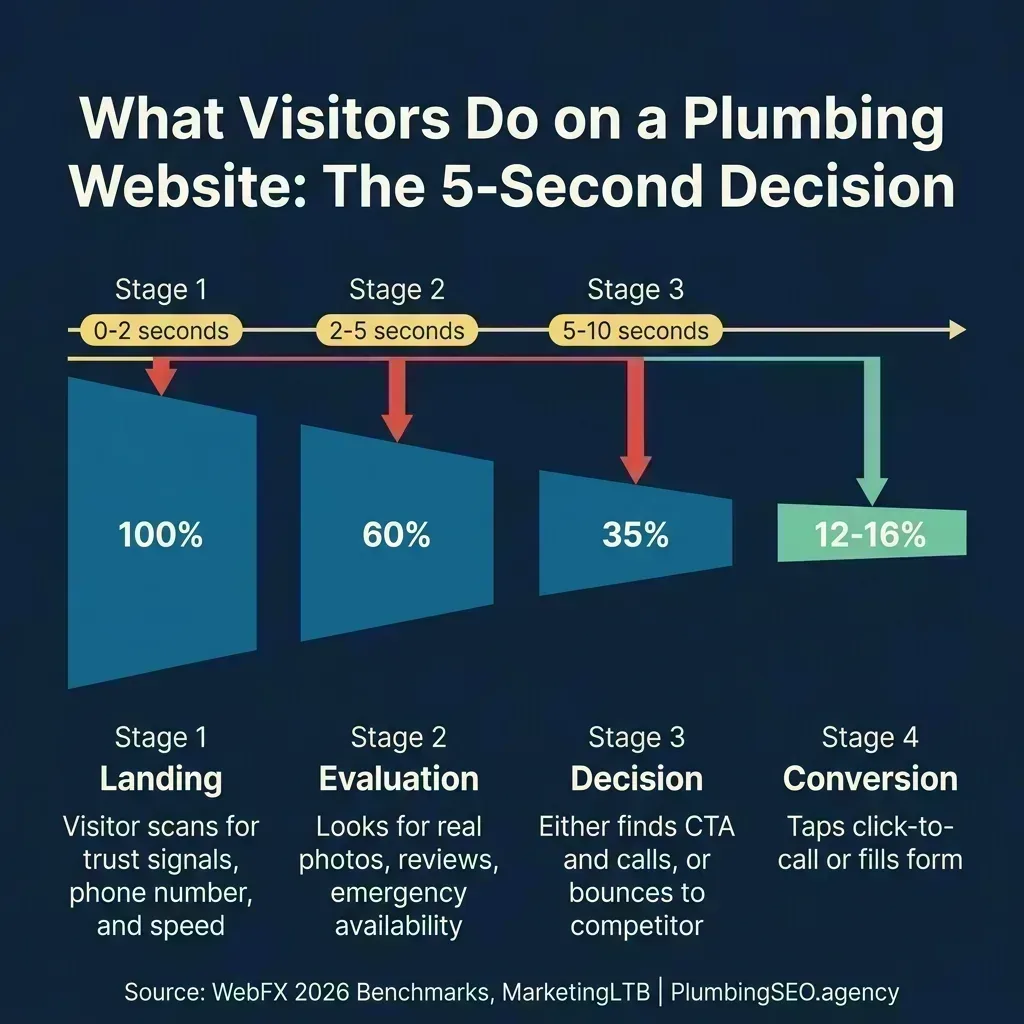
Within the first two seconds, a visitor scans for three things: Does this company look legitimate? Can I find a phone number? Is the page loading fast enough to bother waiting? If any of those checks fail, they hit the back button. According to Estatehub's 2026 benchmarks, 78% of customers go with the first company that responds, which means the visitor who bounces from your site is almost certainly calling your competitor next.
Between seconds two and five, the evaluation deepens. The visitor looks for social proof (reviews, badges, real photos), checks whether you offer the specific service they need, and scans for emergency or same-day availability. If your homepage is a wall of generic text about "comprehensive plumbing solutions using state-of-the-art equipment," this is where you lose them. As one plumber on r/Plumbing noted: "If the site is slow, vague about services, or looks outdated, people just bounce and call the next plumber in the search results."
Understanding this timeline changes how you think about every page on your website. Each page is not a brochure to be read. It is a conversion tool with about 5 seconds to do its job. With that context, let us look at what pages you actually need and what goes on each one.
The 8 Page Types Many Plumbing Websites Should Consider
Most plumbing websites are built as digital brochures: a homepage, a generic "Our Services" page, a contact page, and maybe a blog. That structure often fails both visitors and search engines. The 8 page types below are a strong starting framework, but they are not a law. A one-person plumber in a small town may combine some of them; a 30-truck company serving multiple cities may need many more service, city, and proof pages.
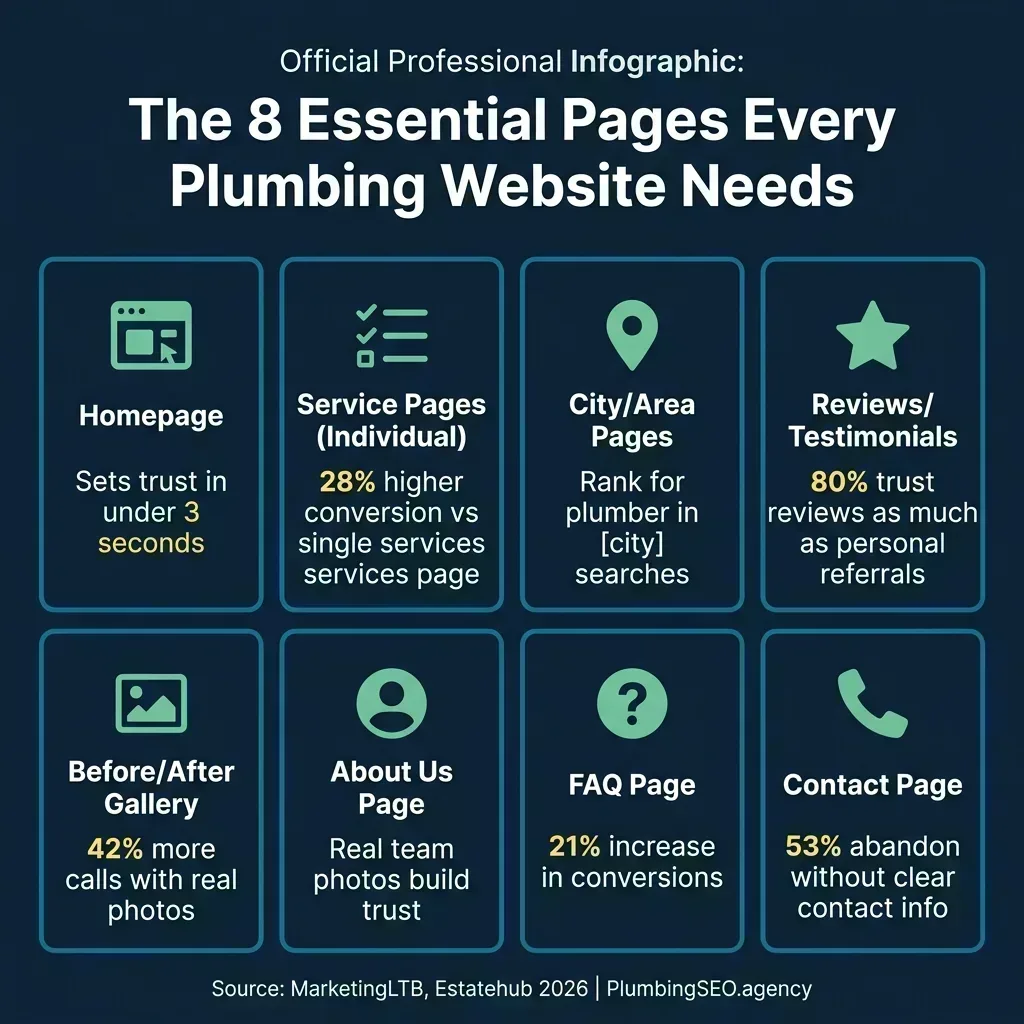
Think of these as modular building blocks, not a fixed checklist. What matters is not just having pages. It is what goes on them and how they connect to each other. A homepage that does not link to individual service pages loses the visitor who came looking for water heater repair. A service page without reviews loses the visitor who needs social proof before calling. The right architecture depends on your market, services, crew size, and service area.
Let us walk through each one and the specific conversion elements that make it work.
Page 1: The Homepage - Your 3-Second Trust Test
Your homepage is not your most important page for SEO. Your individual service and location pages will do more ranking work. But your homepage is the most important page for trust, and trust is what converts visitors into callers.
When a visitor lands on your homepage, they are running an unconscious checklist: Is this a real business? Do they serve my area? Can I reach them right now? Are other people happy with their work? Your homepage needs to answer all four questions above the fold, before a visitor scrolls.
What belongs on your homepage
- A clear headline that states what you do and where you do it. "Professional Plumbing Services in [City]" beats "Welcome to Our Website" every time. Match the search intent that brought them here.
- Your phone number in the header, clickable on mobile. 78% of mobile users expect a "call now" button. If yours is buried in the footer, you are losing the most urgent visitors.
- A hero section with a clear emergency CTA. "24/7 Emergency Plumbing - Call Now" with a tappable button. 60% of plumbing emergencies are searched after business hours, so your emergency availability must be visible immediately.
- Google Review stars and count. Display your star rating and total review count near the top. Businesses with 50+ reviews convert 3x more leads than those without, according to MarketingLTB's 2026 data.
- Service cards linking to individual service pages. Not a bullet list. Distinct, clickable cards for your core services: drain cleaning, water heater repair, sewer line replacement, emergency plumbing.
- Real photos of your team and trucks. Businesses with authentic photos receive 42% more calls than those with stock images.
- Your service area, listed clearly. City names, neighborhoods, or zip codes. Visitors who cannot confirm you serve their area will not call.
Think of your homepage as the front door of your business. If a customer walked up and the door was locked, the sign was missing, and there was no phone number posted, they would leave. Your homepage should feel like walking into a clean, well-organized office where someone is ready to help.
Page 2: Individual Service Pages - Where Rankings and Conversions Meet
This is where most plumbing websites fail hardest. Instead of dedicated pages for each service, they lump everything onto one "Our Services" page with a bullet list of 15 offerings. That approach ranks for nothing and converts nobody.
PushLeads reports that implementing service-specific pages increased conversion rates by 28% compared to a single services page. The reason is simple: when someone searches "drain cleaning [city name]," Google wants to show them a page specifically about drain cleaning, not a page that mentions it in a list of 15 services.
What goes on each service page
- A headline targeting "[service] in [city]" - This is your primary keyword. Be specific: "Water Heater Repair in Phoenix" not "Our Plumbing Services."
- A description of the problem and your solution. Write for the homeowner who has the problem right now. What causes it? What does the fix involve? How long does it take?
- Pricing expectations. 62% of customers expect pricing transparency online. You do not need exact prices, but ranges or "starting at" figures remove a major conversion barrier.
- Before/after photos from real jobs. Nothing builds credibility for a specific service like showing what you have actually done.
- Service-specific reviews. Pull reviews that mention the specific service. A review about a great drain cleaning job on your drain cleaning page converts better than a generic "Great plumber!" testimonial.
- A clear CTA at the bottom. "Need [service] now? Call us at [phone number]" with a clickable button.
Each service page should answer three questions: What do you do? Why should someone trust you to do it? What should the visitor do next? If you offer 8 core services and have enough demand/proof for each one, 8 individual service pages may make sense. If you are a small operator with a narrower offer, start with the services that actually drive revenue and expand as demand justifies it. As our plumbing keyword strategy guide explains, emergency keywords like "burst pipe repair" can convert at 12-18%, but only when they land on a page built specifically for that service.
Page 3: City and Service Area Pages - Ranking Where Your Customers Search
If you serve 8 cities with real demand, job history, and enough proof to make each page genuinely useful, 8 location pages may be the right move. If you are a solo plumber covering a small town and a few nearby communities, one strong service-area section may be enough at first. The rule is not "one page for every place you can drive to"; it is "build dedicated pages only where you can support them with unique local value."
A proper city page includes the city name in the title tag and H1, mentions specific neighborhoods or landmarks, references local infrastructure issues (older homes with galvanized pipes, areas with hard water), and includes a map showing your service boundaries. It should also link to your core service pages and display reviews from customers in that area.
This approach does double duty. It reassures visitors that you cover their area, and it creates landing pages that rank for "[service] in [city]" searches. Our multi-location plumbing SEO guide covers the hub-and-spoke architecture that makes this work at scale without creating thin or duplicate content.
Page 4: Reviews and Testimonials - Your Most Powerful Conversion Tool
This page does not need to be complicated, but it needs to exist and it needs to feel real. A dedicated reviews page that displays your Google Reviews embedded directly, with star ratings, dates, and customer names, does more for conversion than any amount of copywriting.
The data is clear: 80% of customers trust online reviews as much as personal recommendations. 79% of customers read at least 5 reviews before deciding. And businesses with 4.5+ star ratings dominate local search results.
But reviews should not live only on a dedicated reviews page. They should appear on your homepage, on every service page, and in your Google Business Profile. Think of a reviews page as the "deep dive" destination, while snippets of your best reviews appear everywhere else on the site. If your review count is low, our guide to getting more 5-star reviews covers the exact SMS templates that convert at 15-20%.
Page 5: Before/After Gallery - Visual Proof That Sells
Plumbing work is more visual than most plumbers realize. A gallery showing before/after photos of completed jobs (bathroom remodels, replaced water heaters, sewer line camera inspections) demonstrates competence in a way that words cannot. PushLeads found that plumbing clients with comprehensive project galleries see 40% higher engagement from visitors.
Each project entry should include a brief description of the problem, your solution, and the outcome. These do not need to be professionally photographed. A clear phone photo of a rusty water heater next to the shiny new one tells a compelling story. Authenticity converts better than polish.
Page 6: About Us - Putting Faces to the Business
A homeowner about to let a stranger into their house wants to see who is actually coming. When your "About" page shows the same stock model in a hard hat that appears on 50 other contractor websites, your credibility takes a hit. Show your real team, your branded trucks, your years of experience. Include licensing numbers and certifications.
One Reddit thread about home service websites captured the core issue: "Imagine visiting a plumbing contractor's website and they do not mention what they do and there are no testimonials for proof that they can do a good job." Your About page should answer: Who are you? How long have you been doing this? Why should I trust you inside my home?
Page 7: FAQ Page - The Silent Conversion Booster
This is one of the most underutilized pages in plumbing web design. 58% of plumbing websites do not have an FAQ section, yet FAQ pages increase conversions by 21%. If your current site is missing these conversion basics, our plumbing web design service builds them into the page architecture from the start. An FAQ page does three things simultaneously: it answers common questions before someone calls (reducing tire-kicker calls), it builds trust by demonstrating expertise, and it creates rich content for Google to index.
The best FAQ questions come directly from your real customer interactions. What do people ask your dispatcher most often? "How much does a water heater replacement cost?" "Do you offer financing?" "What is your response time for emergencies?" "Are your plumbers licensed and insured?" Each of these questions is also a long-tail keyword opportunity. And with proper schema markup, your FAQ answers can appear directly in Google search results as rich snippets.
Page 8: Contact Page - Removing Every Barrier to Reaching You
Your contact page should make it effortless to reach you in whatever way the visitor prefers. That means a prominent, clickable phone number. A simple form (name, phone, service needed, brief description). Your physical address for local SEO signals. Your business hours and emergency availability. And ideally, an embedded Google Map showing your location or service area.
Keep forms short. Every additional form field reduces submissions by approximately 4%. Ask for the bare minimum: name, phone number, and what they need. Some plumbers also add online booking systems, which increase conversions by 25% according to the same data. But the phone number must always be the primary and most visible option, because plumbing is a phone-call business, especially for emergencies.
The Conversion Elements That Go on Every Page
Beyond the specific content for each page type, there are recurring elements that usually belong across the site. These components build trust, reduce friction, and guide visitors toward the phone call. Treat them as conversion infrastructure, then adapt their placement to each page's job.
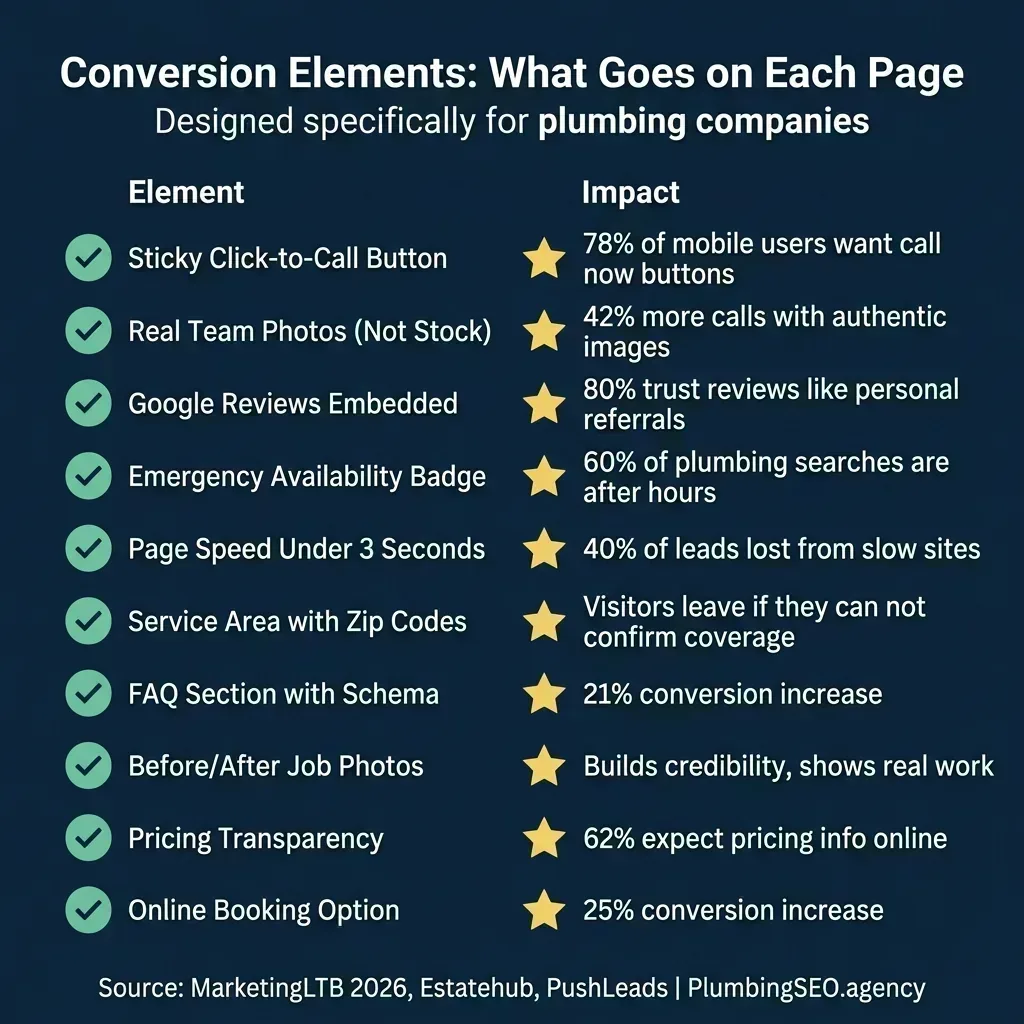
The most impactful of these elements is the sticky click-to-call button on mobile. With 64% of plumbing leads coming from mobile devices and 78% of those users wanting a "call now" button, this single element can transform your call volume overnight. Make the tap target at least 44x44 pixels, use a href="tel:..." link, and keep it visible as visitors scroll.
Page speed is the second highest-impact element. It is both a ranking factor and a direct revenue lever. According to WebFX, every additional second of load time reduces conversions by approximately 7%. If your site loads in 5 seconds instead of 2, you are losing roughly 21% of your conversions before anyone reads a word. Compress images to WebP format, remove unused plugins, and upgrade from shared hosting if your PageSpeed score is below 80 on mobile.
The third critical element is trust signals. This includes Google Reviews embedded on each page, licensing badges, insurance certifications, and "years in business" callouts. 44% of users leave a website that lacks trust signals. Trust badges alone increase conversions by 18%.
Putting It All Together: The Complete Anatomy
Here is what a high-converting plumbing website looks like when all the pieces are in place. Every section serves a specific purpose in the visitor's journey from "I have a plumbing problem" to "I am calling this company."
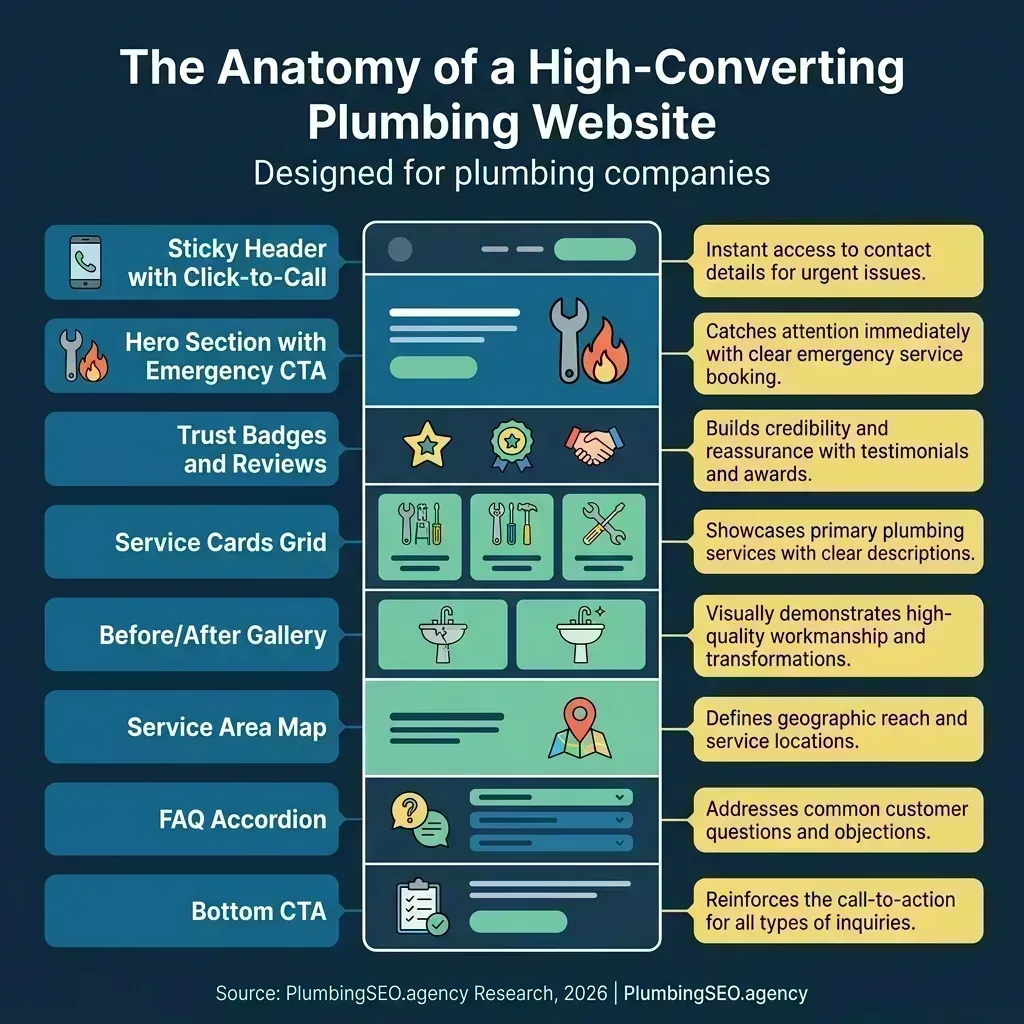
Notice how the structure is designed around speed and trust, not aesthetics. The most important conversion elements (phone number, emergency CTA, reviews) appear above the fold. Supporting content (service details, gallery, FAQ) builds deeper trust for visitors who need more convincing. And the page ends with a clear final CTA for anyone who has scrolled through and is ready to act.
Internal linking ties everything together. Your homepage links to service pages. Service pages link to related city pages. City pages link back to relevant service pages. Blog posts link to service pages where they naturally reference a topic. This architecture helps Google understand your site's structure and distributes ranking authority across your pages. If you want a data-driven view of how SEO and paid advertising fit into this picture, our SEO vs PPC comparison breaks down the numbers for plumbing companies specifically.
The Numbers Behind Every Decision
Benchmarks should inform decisions, not dictate them. Use the numbers below to spot friction and prioritize testing, then adjust for your lead source, service mix, market size, crew capacity, pricing, and response speed.
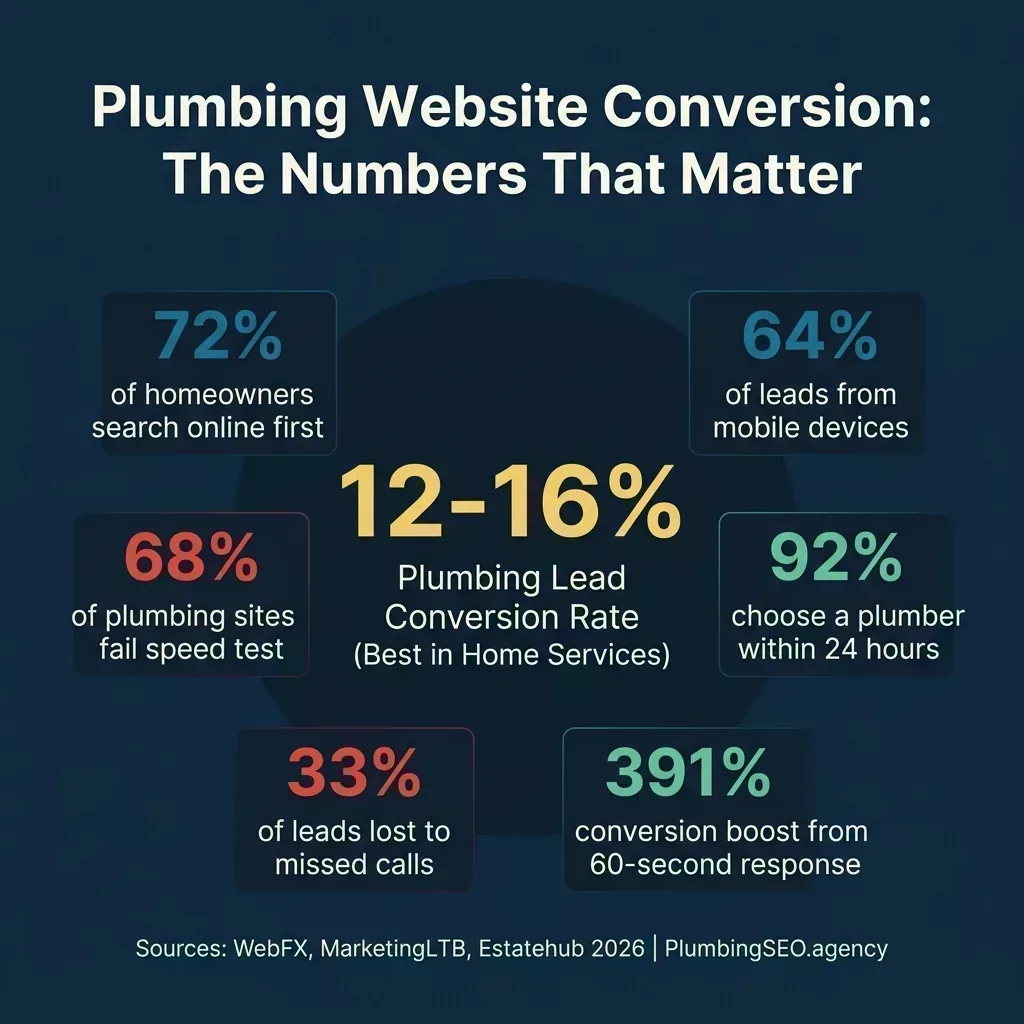
The biggest takeaway is speed: speed of your website, and speed of your response. Responding within 60 seconds increases conversions by 391%, according to Estatehub's 2026 benchmarks. That means your website needs to load fast enough to not lose visitors, and your business needs to answer the phone fast enough to not lose callers. 33% of plumbing leads are lost to missed calls. The best website in the world cannot help you if nobody picks up.
If you are wondering how much you should invest in getting your website right, our SEO budget guide breaks down realistic spending tiers and the returns you should expect at each level.
Want to See How Your Website Stacks Up?
We will audit your plumbing website against every element in this guide: page speed, trust signals, mobile conversion, site structure, and more. Free, with zero obligations.
Get My Free Website AuditFrequently Asked Questions
Most plumbing websites benefit from a core set of page types: a Homepage, individual Service Pages for major services, City/Area Pages where there is real local demand and proof, Reviews/Testimonials, Before/After Gallery, About Us, FAQ, and Contact. Small single-town operators may combine some of these; larger multi-city companies usually need deeper service and location architecture.
WebFX's 2026 benchmarks cite 12-16% as a strong plumbing lead-to-customer conversion range, but that is not a universal target. Emergency-heavy companies, small-town solo plumbers, new companies, and large multi-location shops may see different numbers. Use the benchmark to diagnose your site, lead quality, and response process rather than assuming every plumbing site should hit the same rate.
Yes. Individual service pages convert 28% better than a single "Our Services" page with a bullet list. Each page should target a specific keyword like "drain cleaning in [city]" and include a description of the service, pricing expectations, before/after photos, service-specific reviews, and a clear call-to-action.
Extremely important. 68% of plumbing websites fail to load in under 3 seconds, and slow sites lose up to 40% of potential leads. Every additional second of load time reduces conversions by approximately 7%. Test your speed at Google PageSpeed Insights and aim for a mobile score above 80.
A sticky click-to-call button on mobile is the high-impact conversion element. 64% of plumbing leads come from mobile devices, and 78% of mobile users expect a visible "call now" button. Place a tappable phone button in your mobile header that stays visible as visitors scroll. Use a tel: link so one tap initiates the call.
No. Real photos of your team, trucks, and completed jobs outperform stock photos significantly. Businesses with authentic photos receive 42% more calls. Homeowners want to see who is actually coming to their house. Even simple phone photos of your team and real job sites build more trust than professional stock images.
Is Your Plumbing Website Missing Critical Pages?
Our free audit checks your site against all 8 useful page types, tests every conversion element, reviews your page speed and mobile experience, and shows you exactly where visitors are dropping off before they call. A conversion-focused plumber SEO agency looks at the whole picture, not just rankings.
Get My Free Website Anatomy Audit