
- Google's AI Overviews now appear on roughly 58% of all search queries. For plumbers, this mainly affects informational queries ("how to fix a leak") while high-intent local queries ("emergency plumber near me") remain mostly untouched.
- The Google Maps Local 3-Pack still appears above AI Overviews for transactional searches, making Google Business Profile optimization and reviews more important than ever.
- The winning strategy is not to fight AI Overviews but to shift focus: double down on local SEO, get cited inside AI Overviews, and make every website visitor convert at a higher rate.
What Are Google AI Overviews and Why Should Plumbers Care?
If you have searched Google recently, you have probably noticed a new block at the top of search results: a multi-paragraph AI-generated answer that tries to directly answer your question before you click on anything. Google calls this feature "AI Overviews," and it launched broadly in mid-2024 through the Search Generative Experience (SGE) initiative.
For most search queries, AI Overviews pull information from multiple websites, synthesize an answer, and display it with small source citations underneath. The searcher gets their answer without ever visiting a website. According to Semrush's 2025 analysis, AI Overviews now trigger on approximately 58% of all search queries, up from under 20% when the feature first rolled out.
For plumbing companies, this is not a theoretical concern. It directly affects how many people click through to your website, call your number, and ultimately book a service call. But the impact is not uniform across all queries, and that distinction is exactly where the opportunity lives.
Here is how the new search funnel works for local service businesses:
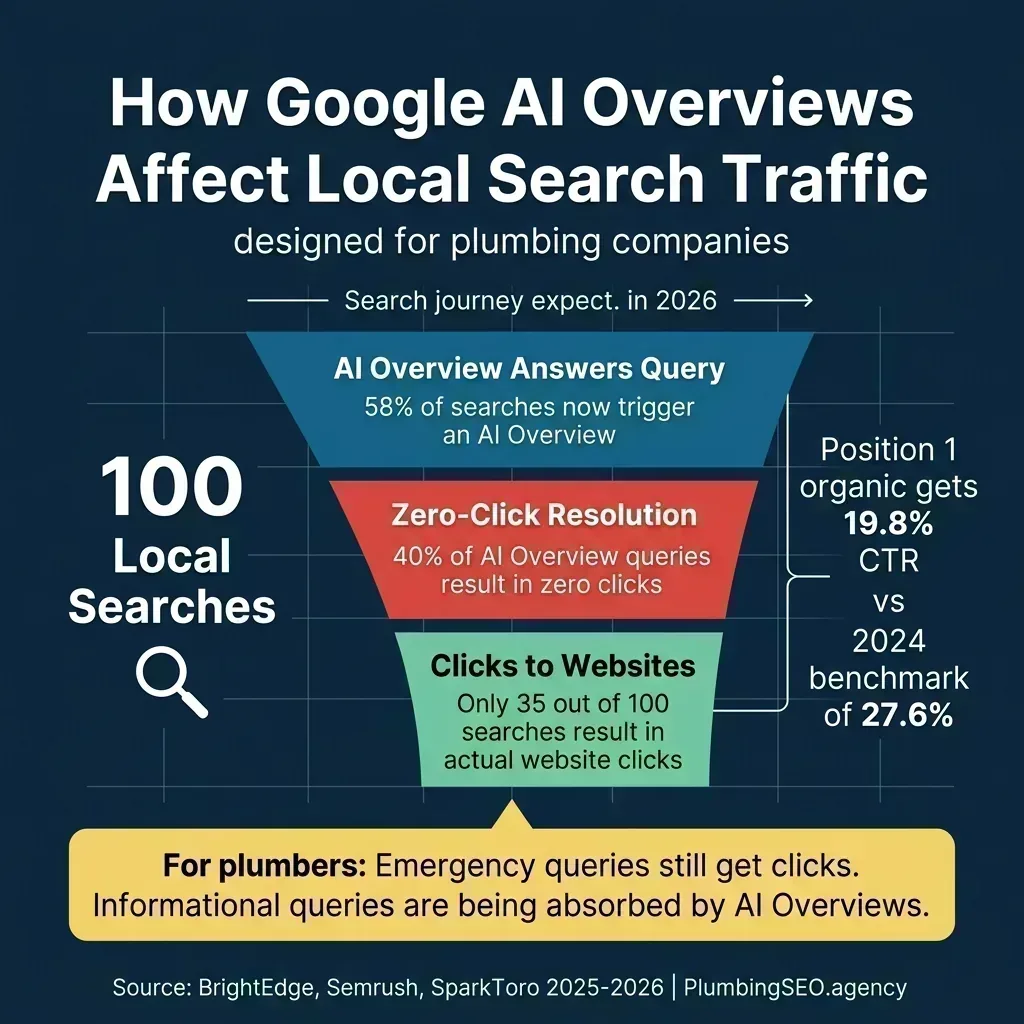
The 2026 search traffic funnel showing how AI Overviews reduce click-through rates for informational queries
The critical takeaway for plumbing company owners is not the overall click decline. It is which queries lose clicks and which remain profitable. A homeowner searching "why is my water heater making noise" might read the AI Overview and never visit your blog post. But a homeowner searching "emergency plumber Dallas" still needs to call someone, and Google's AI cannot fix their burst pipe.
Which Plumbing Queries Get Hit by AI Overviews (And Which Are Safe)
Not all keywords are created equal when it comes to AI Overview exposure. The pattern is clear: the more informational a query is, the more likely Google is to answer it with an AI Overview. The more transactional and local a query is, the less likely AI intervenes.
This split is particularly important for plumbers because your money keywords, the ones that generate actual phone calls, fall overwhelmingly on the "safe" side:
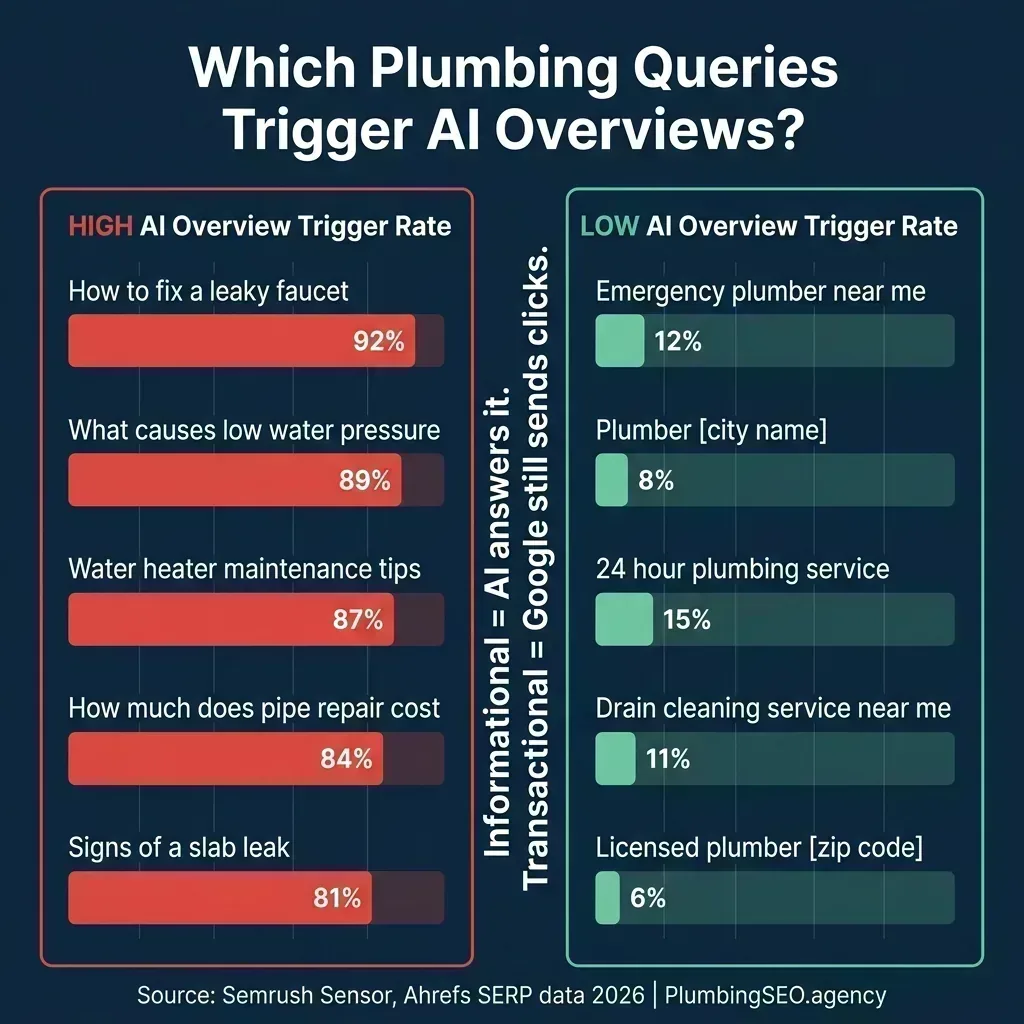
AI Overview trigger rates for informational vs. transactional plumbing queries
What does this mean practically? If you have been investing in blog content targeting questions like "how to unclog a drain" or "what is a sewer scope inspection," those pages will see declining organic traffic. Google is answering those questions directly. That is a real loss if you were using those pages to generate leads through on-page CTAs.
However, your core service pages targeting "plumber in [city]," "drain cleaning near me," and "24/7 emergency plumber" are largely unaffected. Google still needs to show local businesses for these queries because the searcher needs a human to show up at their house. No AI-generated summary can replace that.
If you want to understand how intent-based keyword targeting works in practice, our plumbing keyword strategy guide breaks down the exact framework for prioritizing the queries that actually generate calls.
Why the Google Maps 3-Pack Is Your Best Defense Against AI Overviews
Here is one of the most important piece of good news for plumbing companies in the AI Overview era: the Local 3-Pack (Google Maps results) still appears above or alongside AI Overviews for "near me" and local service queries. Google has not replaced the Map Pack with AI answers for transactional local searches, and there are strong signals they will not.
The reason is straightforward. When someone searches "plumber near me" at 11 PM with water flooding their basement, they need a real business with a real phone number and real reviews from real customers. An AI-generated summary cannot dispatch a technician. Google understands this, which is why the Map Pack remains the dominant feature for local service queries.
Look at where plumber website traffic actually comes from today:
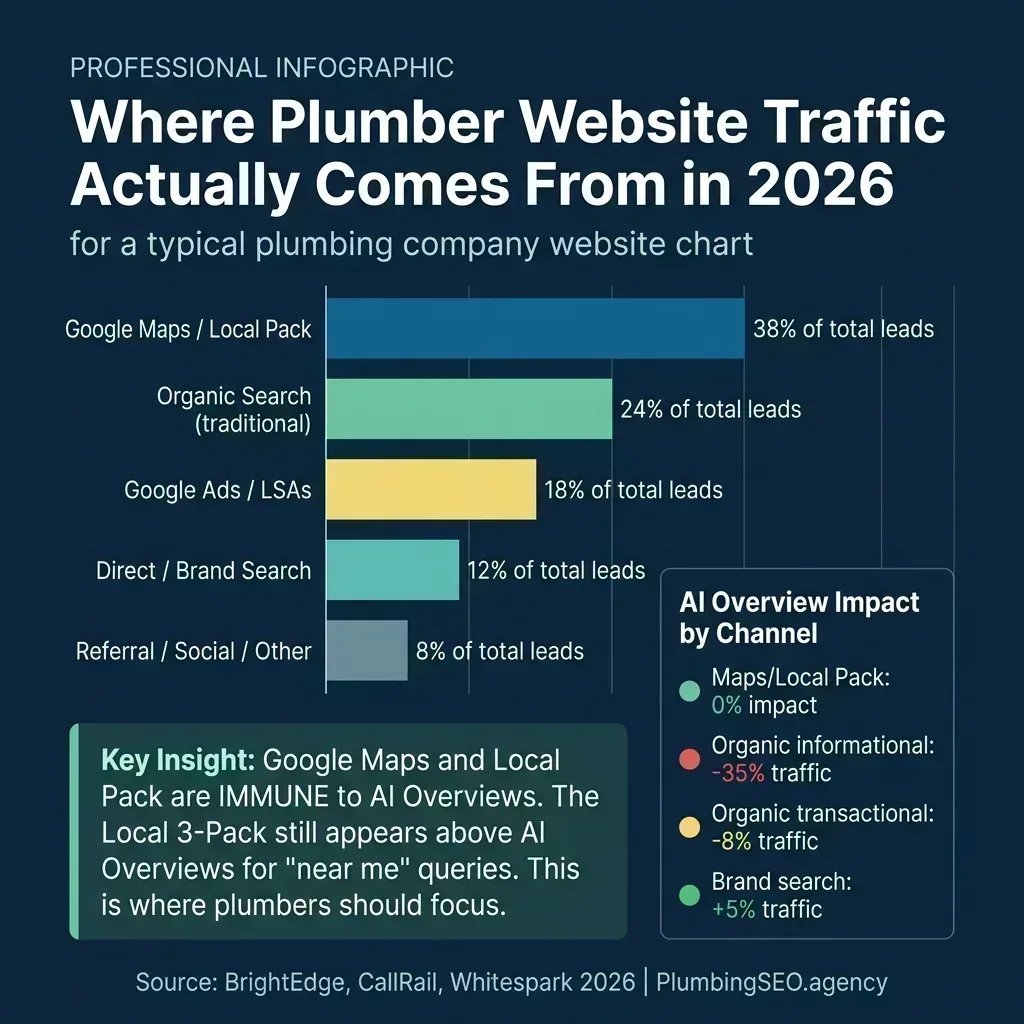
Lead source breakdown for plumbing companies in 2026, showing Maps immunity to AI Overview disruption
The 38% of leads coming through Google Maps are completely immune to AI Overview disruption. That channel operates on proximity, reviews, and GBP completeness, not on whether AI can answer a question. For plumbing companies, this means your Google Maps SEO strategy is now more important than it has ever been.
Compare that with organic search traffic (24% of leads), which is the channel most vulnerable to AI Overviews. Even within organic, the impact is concentrated on informational content. Your service pages targeting commercial intent keywords ("drain cleaning [city]," "water heater installation near me") still convert at high rates because the searcher needs a service provider, not an answer.
This is why smart plumbing companies are reallocating budget from blog-only content strategies toward review generation systems, GBP optimization, and conversion rate improvements on their existing pages. The traffic that still comes through is higher-intent than ever. Your job is to capture more of it.
The 5-Point AI-Proof SEO Strategy for Plumbing Companies
The plumbing companies that will thrive in the AI Overview era are not the ones fighting against the change. They are the ones adapting their strategy to capitalize on what still works while positioning themselves inside the AI results that are taking over informational queries.
After analyzing how AI Overviews interact with local service businesses, here is the framework that protects your lead flow:
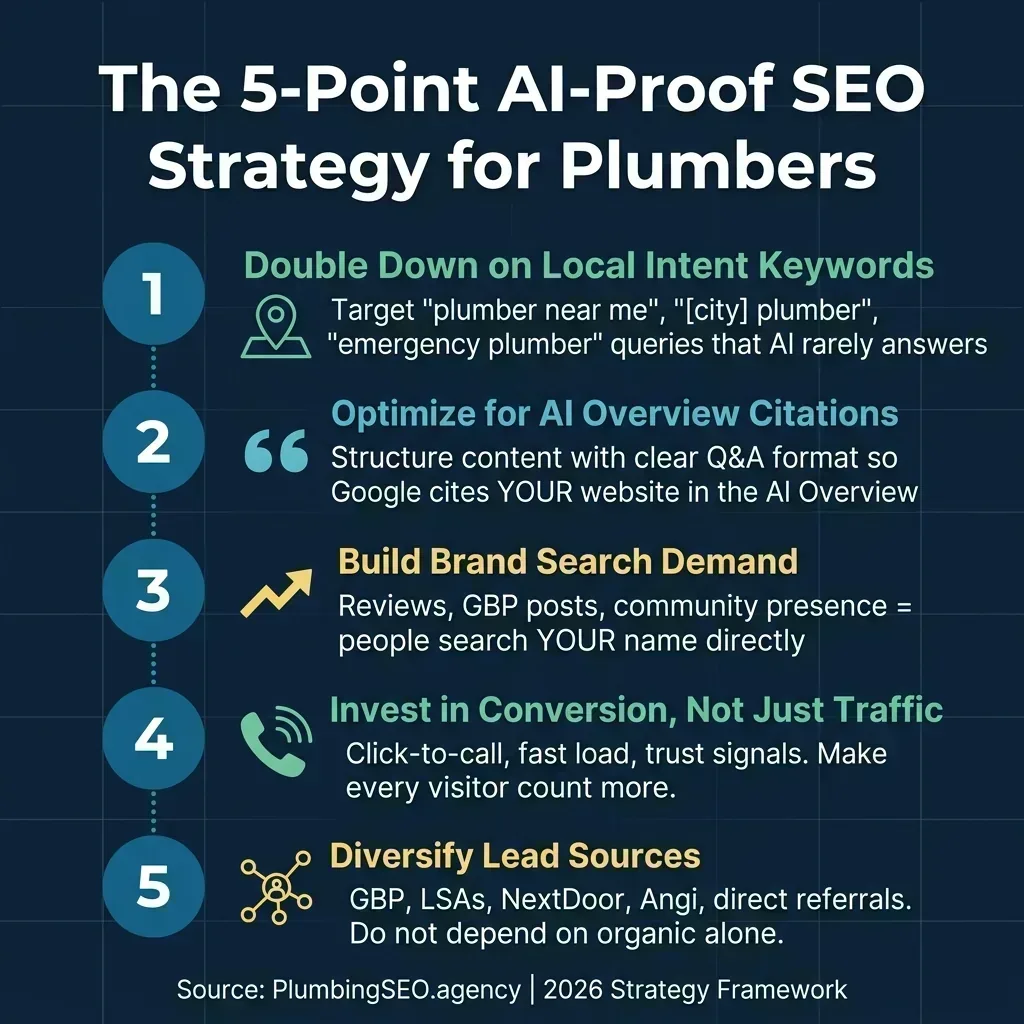
The 5-point strategy framework for protecting plumber lead flow from AI Overview disruption
1. Double Down on Local Intent Keywords
Stop chasing broad informational keywords that AI Overviews are absorbing. Redirect that effort toward the queries Google cannot answer with AI: location-specific, service-specific, intent-driven keywords that require a real business to respond.
Focus your content budget on service pages targeting "[service] + [city]" combinations, not blog posts answering generic plumbing questions. A page targeting "sewer line repair in Phoenix" can generate calls for years because Google cannot send an AI to fix a broken sewer line. A blog post on "how to know if your sewer line is broken" will increasingly get its traffic eaten by AI Overviews.
Our guide to building service pages that rank walks through the exact architecture that captures these high-intent queries.
2. Optimize for AI Overview Citations
Here is what most plumbing SEO articles miss: AI Overviews cite sources. If your content is structured clearly with direct answers to specific questions, Google may pull your website into the AI Overview itself, giving you visibility even when the user does not click through to a traditional organic result.
To get cited in AI Overviews, structure your content with clear question-and-answer formatting, use concise factual statements that AI can easily extract, and include specific data points that are harder for AI to generate on its own. Original research, local market data, and proprietary statistics are your best assets here.
Pages with proper schema markup are also more likely to be cited because structured data helps Google understand and extract your content programmatically.
3. Build Brand Search Demand
When someone searches your company name directly, AI Overviews are irrelevant. They are searching for you, not for a generic answer. Building brand recognition through consistent review generation, GBP posts, community involvement, and word-of-mouth creates a channel that is entirely immune to AI disruption.
Every plumber who has ever said "most of my business comes from referrals and repeat customers" already understands this principle. The online version is building enough brand equity that people search "[your company name] plumber" instead of "plumber near me." Data from SparkToro shows that brand searches have actually increased by 5% year-over-year, even as generic informational searches lose clicks to AI.
4. Invest in Conversion, Not Just Traffic
If AI Overviews reduce your total website visitors by 15-20% on informational pages, the solution is not just to recover that traffic. It is to make every remaining visitor more likely to call you. This means your website conversion rate becomes one of the most important metric in the AI era.
Practical steps: add click-to-call buttons on every page, ensure sub-3-second load times on mobile, display reviews prominently, and remove friction from your contact forms. If you are currently converting 3% of visitors to calls, improving that to 5% more than offsets a 20% traffic decline. Our guide to fixing plumber website conversion problems covers the 7 most common conversion killers and their data-backed fixes.
5. Diversify Your Lead Sources
Any plumbing company relying on a single lead channel is vulnerable, whether that channel is organic search, Google Ads, or Angi leads. AI Overviews are a reminder that Google can change the rules at any time, and businesses that depend entirely on one channel bear all the risk.
A healthy lead mix for a plumbing company in 2026 looks like: Google Maps / GBP (30-40%), organic search (20-25%), Google Ads or Local Services Ads (15-20%), direct and brand search (10-15%), and referral or community sources (10-15%). If any single channel disappears tomorrow, you should still have enough leads to sustain the business. Our SEO vs PPC comparison helps you balance paid and organic strategies for exactly this reason.
What About Your Blog? Is Plumbing Content Marketing Dead?
No. But the purpose of blog content is shifting. In the pre-AI era, blog posts served two functions: (1) capture informational search traffic and (2) convert that traffic into leads through on-page CTAs. AI Overviews are disrupting function #1, but that does not mean blog content is worthless.
Blog content in 2026 serves different strategic purposes:
| Blog Content Purpose | AI Overview Impact | Still Worth Doing? |
|---|---|---|
| Answering basic "how-to" questions | Heavy decline (AI answers these directly) | Only if structured for AI citation |
| Building internal link authority to service pages | No impact (links work regardless of traffic) | Yes, high value |
| Establishing expertise and trust (E-E-A-T) | Minimal impact (Google still evaluates site quality) | Yes, critical for rankings |
| Providing data/research that AI cannot generate | Positive impact (AI cites original sources) | Yes, highest value in AI era |
| Targeting long-tail local queries | Low impact (local queries rarely trigger AI) | Yes, strong ROI |
The key shift: stop writing blog posts that merely answer common questions and start creating content that provides original insights, local market data, and expert analysis that AI cannot replicate. A post like our 75+ plumbing SEO statistics roundup is a good example. It aggregates data from dozens of sources into one resource that AI Overviews regularly cite rather than replace.
A Realistic Timeline: When Will AI Overviews Fully Impact Plumber Websites?
AI Overviews are not a future threat. They are already live and affecting traffic patterns today. But the full impact will unfold gradually over 2026 and into 2027. Here is a realistic timeline based on current rollout data and Google's stated plans:
- May-August 2026: AI Overviews trigger on 55-65% of all queries. Informational plumbing queries see 20-35% organic traffic decline. Local transactional queries remain stable.
- September-December 2026: Google refines AI Overviews with better source citation and adds commercial features (ads within AI Overviews). Some traffic recovery for well-cited pages.
- 2027: AI Overviews become the default search experience. Plumbers who adapted early see stable or growing lead volume. Those who did not have lost significant informational traffic with no strategy to compensate.
The window to adapt is now. Plumbing companies that start shifting their SEO strategy today will be in a strong position by the time AI Overviews become fully entrenched. Those who ignore it and keep running the same 2023 SEO playbook will find themselves wondering why their blog traffic is down 30% with no clear explanation.
If you want a professional assessment of how your specific website and keyword portfolio is exposed to AI Overview disruption, our SEO audit process now includes an AI readiness evaluation as part of the standard review.
Frequently Asked Questions
No. AI Overviews primarily affect informational queries, not the transactional and local queries that generate actual phone calls for plumbing companies. The Google Maps Local 3-Pack still appears prominently for "near me" and service-based searches, and those results are not replaced by AI answers. SEO for plumbers is shifting, not dying. The focus is moving from informational blog content toward local SEO, conversion optimization, and being cited within AI Overviews.
Structure your content with clear question-and-answer formatting, include specific data points and statistics, use proper schema markup (Article and FAQ schema), and create original research or local market data that AI cannot generate on its own. Pages that rank in the top 10 for a query are far more likely to be cited in the AI Overview for that same query. Strong E-E-A-T signals (expertise, experience, authoritativeness, trustworthiness) also improve citation likelihood.
No, but you should shift what kind of blog content you produce. Simple "how-to" articles that AI can easily answer will see declining traffic. Focus instead on original data, local market analysis, expert guides with proprietary insights, and content that builds internal link authority to your service pages. Blog content that targets long-tail local queries is also still effective because those queries rarely trigger AI Overviews.
No. Google Maps rankings and the Local 3-Pack operate independently from AI Overviews. Your position in Maps is determined by proximity, relevance, and prominence (reviews, GBP completeness, citations). AI Overviews do not replace Map Pack results for local service queries. In fact, for "near me" searches, the Map Pack appears above or alongside any AI Overview that may appear.
The impact varies dramatically by query type. Informational plumbing queries (how-to, troubleshooting) may see 20-35% organic traffic decline. Transactional local queries (plumber near me, emergency plumber, drain cleaning service) are seeing 0-8% decline. Overall, a plumbing company with a balanced SEO strategy focusing on local intent should expect minimal impact on actual leads, even if total blog page views decline. The traffic that converts into calls is largely protected.
Not necessarily. Google Ads still appear above AI Overviews, so paid visibility is not directly affected. However, Google is testing ad placements within AI Overviews, which could change the economics. The best approach is a balanced strategy: organic SEO for long-term lead flow, Google Ads or Local Services Ads for immediate visibility, and Google Maps optimization as your stable foundation. Relying exclusively on any single channel is risky.
Not Sure How AI Overviews Are Affecting Your Plumbing Website?
We will audit your site's AI readiness, keyword exposure, and local SEO foundation. Free, no strings attached.
Get Your Free AI-Readiness Audit