
- A real plumbing SEO audit is not a generic checklist or an automated PDF. It is a 7-layer investigation covering your Google Business Profile, technical site health, on-page content, citations, reviews, backlinks, and competitor landscape.
- If you are comparing plumbing website SEO audit services, the key question is intent: a free leak check should identify the largest call leaks; a professional audit should document the deeper implementation roadmap.
- The highest-value findings usually connect multiple layers. A thin water-heater page, weak GBP category setup, missing schema, and inconsistent citations can look like separate issues, but together they explain why competitors keep winning calls.
- When you are ready for a documented roadmap, the dedicated plumbing website SEO audit service is the commercial audit path. If you only need a fast first-pass diagnosis, start with the free audit.
- A professional audit delivers a prioritized 90-day action plan that tells you exactly what to fix first, what it costs, and how much traffic and calls you can realistically expect to gain.
Need a Professional Plumbing Website SEO Audit?
If you need a documented audit of your plumbing website, Google Maps presence, service-page gaps, competitors, and call leaks, use the professional plumbing website SEO audit service. If you are not sure yet, the free plumbing SEO audit is the right first checkpoint.
See the Professional Audit ServiceWhy Most "Free SEO Audits" Are Not Actually Audits
You have probably been offered a "free SEO audit" before. Maybe an agency cold-emailed you a PDF. Maybe you ran your URL through one of those instant grading tools. Maybe a sales rep showed you a screenshot of errors on your site during a Zoom call.
Here is the problem: those are not audits. They are sales presentations disguised as audits.
An automated tool can tell you that your site has 14 broken links and a slow page speed score. What it cannot tell you is whether those broken links are actually costing you traffic, whether your page speed matters in a market where every competitor is equally slow, or whether the real reason your phone is not ringing is that your Google Business Profile is categorized wrong and your NAP citations are inconsistent across 50 directories.
A genuine SEO audit for a plumbing company takes 10 to 20 hours. It requires someone who understands both SEO and the plumbing industry to interpret the data, not just export it. That is why our core plumber digital marketing strategy starts with cleanup, tracking, and priority fixes before ongoing content work begins. On the SEO community site r/SEO, one practitioner put it plainly: "99% of an audit's work is done by the tool. But knowing how to read the results and create a strategy from them is what separates a $500 report from a $3,000 one."
This article shows you what that real process looks like. Not the sales pitch version. The actual steps, tools, and deliverables we use when a plumbing company hires us to figure out why their website is not generating calls.
If you are not ready for a paid project yet, that is normal. Use our free plumbing SEO audit first. It gives you a manual, high-level read on the biggest website, Google Maps, service-page, and conversion leaks so you can decide whether a deeper professional audit is worth it.
Our 7-Layer Plumbing SEO Audit Framework
Every plumbing company is different. A one-truck operation in a small town faces different challenges than a 15-van company competing in a major metro area. But the audit structure is consistent. We use the same 7-layer framework for every plumbing client, adjusting depth and priority based on market competitiveness and the company's current online presence.
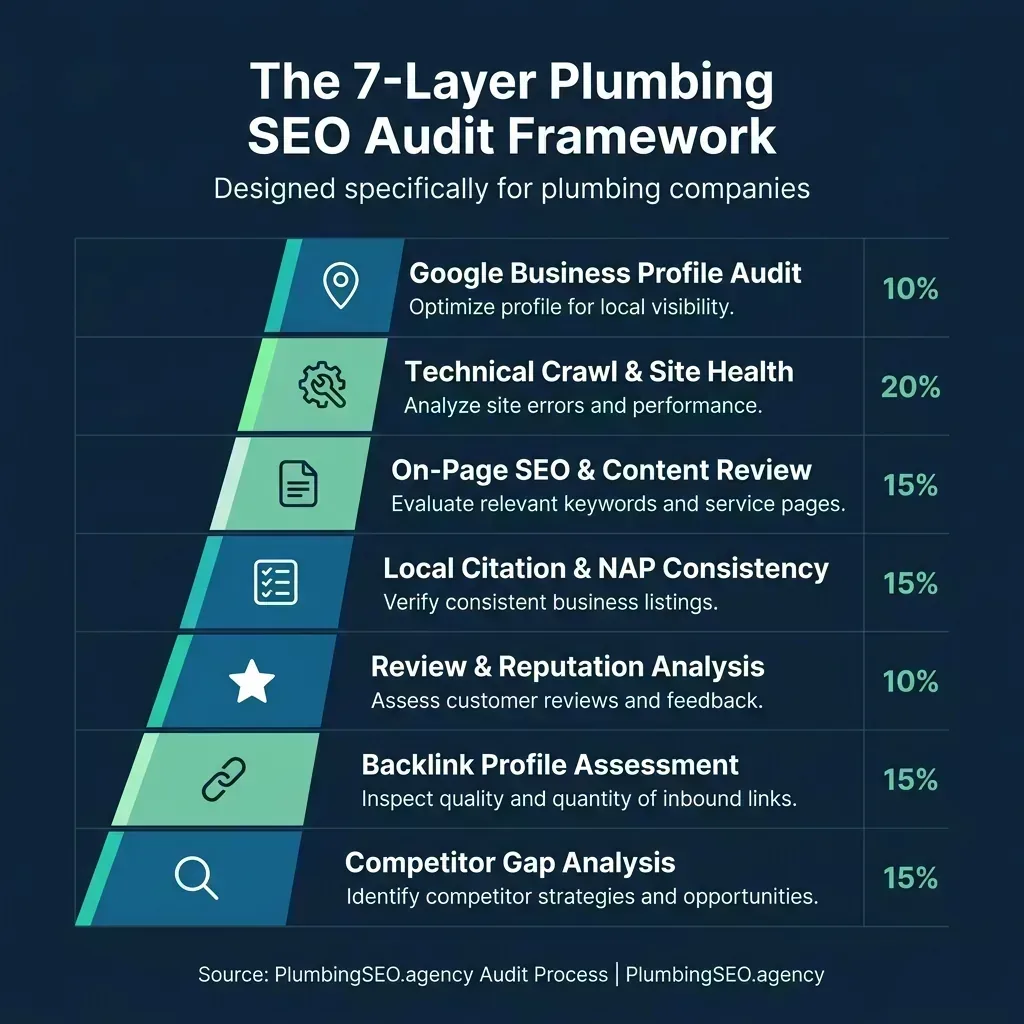
Each layer represents a distinct area of investigation. Skipping any one of them leaves blind spots that can silently kill your rankings.
Think of it as a diagnostic process, similar to how a plumber approaches a complex leak. You would not just look at the visible drip and call it fixed. You would trace the pipe, check the joints, test the pressure, inspect the surrounding structure. An SEO audit follows the same logic: surface-level symptoms like "my site is slow" or "we are not on page one" are just the starting point. The real work is tracing those symptoms back to their root causes.
What separates this from a generic SEO checklist is the plumbing-specific context. We know that "water heater installation" searches spike in January while "sump pump repair" peaks during spring storms. We know that a plumbing company's Google Business Profile category selection matters more than most agencies realize. We know that the citation sources that actually move the needle for plumbers are not the same ones that matter for restaurants or dentists. That industry knowledge changes how we interpret every data point in the audit.
Let us walk through each layer.
How This Audit Process Separates Research Intent from Buyer Intent
Plumbing company owners search for audit help from different stages of urgency. One owner may be trying to learn what a plumbing SEO audit includes. Another may already know something is wrong and wants a professional to inspect the site before another month of slow calls. The page you are reading is built for the first need: it explains the process in plain language so you can understand what should happen before anyone sells you fixes.
The commercial audit path is intentionally separate. If you already need a documented diagnosis with findings, screenshots, competitor benchmarks, and an implementation order, go to the plumbing website SEO audit service. Keeping that service page as the destination for paid-audit intent makes the site easier for owners to use and keeps Google from seeing several nearly identical audit pages competing with one another.
That distinction also protects the quality of the audit itself. Educational content can explain the framework, warning signs, and questions to ask. A service page can explain scope, deliverables, next steps, and how the audit turns into calls. When the two jobs are separated, you get a cleaner decision path: learn the process here, request the free leak check if you want a first read, or choose the paid audit service when you need the complete roadmap.
Layer 1: Google Business Profile Audit
This is where we start every audit, and for good reason. For most plumbing companies, the Google Business Profile is one of the most important digital assets they own. According to BrightLocal's 2024 research, businesses with optimized Google Business Profiles see up to 70% more direct calls and direction requests from local searches. That is not a ranking signal you can afford to leave unoptimized.
Here is exactly what we check:
- Primary and secondary categories. Many plumbing companies only have one category selected. We check whether you are missing high-value secondary categories like "Water Heater Installation Service," "Drain Cleaning Service," or "Gas Plumber." Each category you add tells Google about services you offer that might trigger different search queries.
- Service list completeness. Google lets you add individual services with descriptions. Most plumber profiles have either nothing listed or a generic copy-paste from their website. We audit whether every service you offer is explicitly listed with keyword-rich descriptions.
- Photo count and recency. Google's own data shows that businesses with more photos get 42% more direction requests. We look at how many photos you have, when the last one was uploaded, and whether they show real work (not stock photos).
- Review velocity and response rate. Not just how many reviews you have, but how fast you are getting new ones and whether you are responding. An active, growing review profile signals to Google that your business is alive and engaged. If you do not have a system in place, our guide to building a plumber review collection system covers how to fix that.
- Q&A section. This is the most overlooked feature on GBP. Anyone can ask a question on your profile, and anyone can answer it, including competitors. We check for unanswered questions and whether you have proactively seeded the Q&A with common questions your customers ask.
- Posts and updates. Google Business Profile posts are a ranking signal, not a vanity metric. We track whether you are posting regularly and whether those posts include calls to action, service highlights, and seasonal offers.
The GBP audit alone typically reveals 5 to 15 fixable issues per client. In competitive metros, getting your profile fully optimized can shift you from outside the local 3-Pack into it within weeks.
Layer 2: Technical Crawl and Site Health
This is the layer where most automated "audit" tools live, and it is also the layer where they stop. We use professional crawling tools to scan every page of your website and generate a complete technical health report. But unlike an automated export, we interpret the results through a plumbing-specific lens.
According to Semrush's research, 67% of local businesses have never performed a technical SEO audit. That number is likely even higher for plumbing companies, where the website was often built years ago by a friend or a cheap freelancer and has not been touched since.
Here is what we are looking at during the technical crawl:
- Crawlability and indexability. Can Google actually find and store every page on your site? We check for pages accidentally blocked by your robots.txt file, pages returning errors, and pages that are not included in your sitemap. A surprisingly common problem: plumber websites that have a "Services" page but no individual service pages for drain cleaning, water heater repair, or sewer line replacement. Google cannot rank a page that does not exist.
- Page speed and Core Web Vitals. We test every key page on your site using Google PageSpeed Insights and track the three Core Web Vitals metrics: Largest Contentful Paint (how fast your page loads), First Input Delay (how quickly it responds to clicks), and Cumulative Layout Shift (whether things jump around as the page loads). Over 80% of consumers use mobile devices for local searches, so mobile performance is not optional.
- Broken links and redirect chains. Every broken link is a dead end for both users and Google's crawler. We find every 404 error, every redirect that chains through multiple hops, and every internal link pointing to a page that has moved or been deleted.
- HTTPS and security. Is your entire site served over HTTPS? Are there mixed content warnings? Google has used HTTPS as a ranking signal since 2014, but we still find plumbing sites serving pages over insecure HTTP connections.
- Mobile responsiveness. Not just "does the site resize on mobile" but does the call-to-action button work on a thumb? Can someone fill out a contact form on a phone screen without zooming? If your plumber website is not getting calls, a poor mobile experience is often the culprit.
The technical crawl typically takes 2 to 4 hours depending on site size. For a 15-page plumber website, we usually uncover 30 to 60 individual issues. Not all of them are critical. Part of the value of a professional audit is knowing which issues actually affect your rankings and which ones are noise.
Layer 3: On-Page SEO and Content Review
This layer examines what your website actually says and how it says it. On-page SEO is where most plumbing companies leave the biggest opportunities untouched, because the problems are invisible to someone who does not know what to look for.
We review every page on your site for these elements:
- Title tags and meta descriptions. Your title tag is one of the most important on-page ranking signals. We check whether every page has a unique, keyword-optimized title that includes your primary service and city. A title like "Home | ABC Plumbing" is a wasted opportunity. "Emergency Plumber Dallas | 24/7 Same-Day Service | ABC Plumbing" tells Google exactly what you do and where you do it.
- Heading structure. Does every page have one H1 tag? Are H2s and H3s used logically to organize content? We frequently find plumber websites where the entire page is a wall of text with no headings, or where multiple H1 tags confuse Google about what the page is really about.
- Service page depth. This is the most critical content issue for plumbing companies. Having one generic "Services" page that lists everything you do is like having one page in the Yellow Pages for every category. We audit whether you have dedicated pages for each core service: drain cleaning, water heater installation, sewer line repair, gas line work, bathroom remodeling, and so on. If your keyword strategy has gaps, this is where we find them.
- Content quality and depth. Does each service page have enough content for Google to understand what it is about? A page with 100 words and a phone number is not going to rank. We benchmark your content depth against the top-ranking competitors in your market and identify where you need to go deeper.
- Schema markup. As we covered in our guide to schema markup for plumbers, most plumber websites have zero structured data. During the audit, we check for LocalBusiness, Service, AggregateRating, FAQPage, and Article schema. Missing schema means missing out on rich results and AI search visibility.
- Image optimization. Are your images compressed? Do they have descriptive alt text? Are they served in modern formats like WebP? Large, unoptimized images are one of the top causes of slow page speed on plumber websites.
The on-page review is where we find the issues that have the most direct, fixable impact on rankings. A plumbing company that creates 8 to 12 dedicated service pages, each with proper title tags and 500+ words of useful content, will often see measurable ranking improvements within 60 to 90 days.
Layer 4: Local Citation and NAP Consistency Audit
Your business name, address, and phone number (NAP) appear across dozens of online directories: Google, Yelp, Angi, HomeAdvisor, BBB, Yellow Pages, and many more. Google cross-references these listings to verify that your business is real and that the information is accurate. When your NAP data is inconsistent across directories, Google loses confidence in your business information, and that directly impacts your local rankings.
We audit your citation profile by checking the top 50+ directories that matter for plumbers. Here is what we are looking for:
- NAP consistency. Is your business name spelled exactly the same everywhere? Is the phone number the same on your website, your Google Business Profile, and your Yelp listing? Even small differences like "St." vs "Street" or a tracking phone number vs your main line can create inconsistencies that Google penalizes.
- Missing citations. Which high-authority directories do you not appear on at all? For plumbers, industry-specific directories like Angi, HomeAdvisor, and Plumbing-Heating-Cooling Contractors Association (PHCC) carry more weight than generic business directories.
- Duplicate listings. Duplicate Google Business Profiles or duplicate directory listings confuse Google and can split your review count. We identify and flag every duplicate for removal or merging.
- Outdated information. If you moved offices, changed your phone number, or rebranded, outdated citations can linger for years. We find every instance of old information and map a correction plan.
Citation issues are among the most common problems we uncover. In our experience, over 70% of plumbing companies have at least 5 significant NAP inconsistencies across their citation profile. The good news is that these are relatively straightforward to fix, though the process can be tedious since each directory has its own update process.
What We Actually Find: The Data from Hundreds of Plumbing Site Audits
After auditing plumbing company websites across the country, patterns emerge. The same issues show up again and again, regardless of company size, market, or how "professional" the website looks from the outside. A site can look polished and modern while being almost invisible to Google.
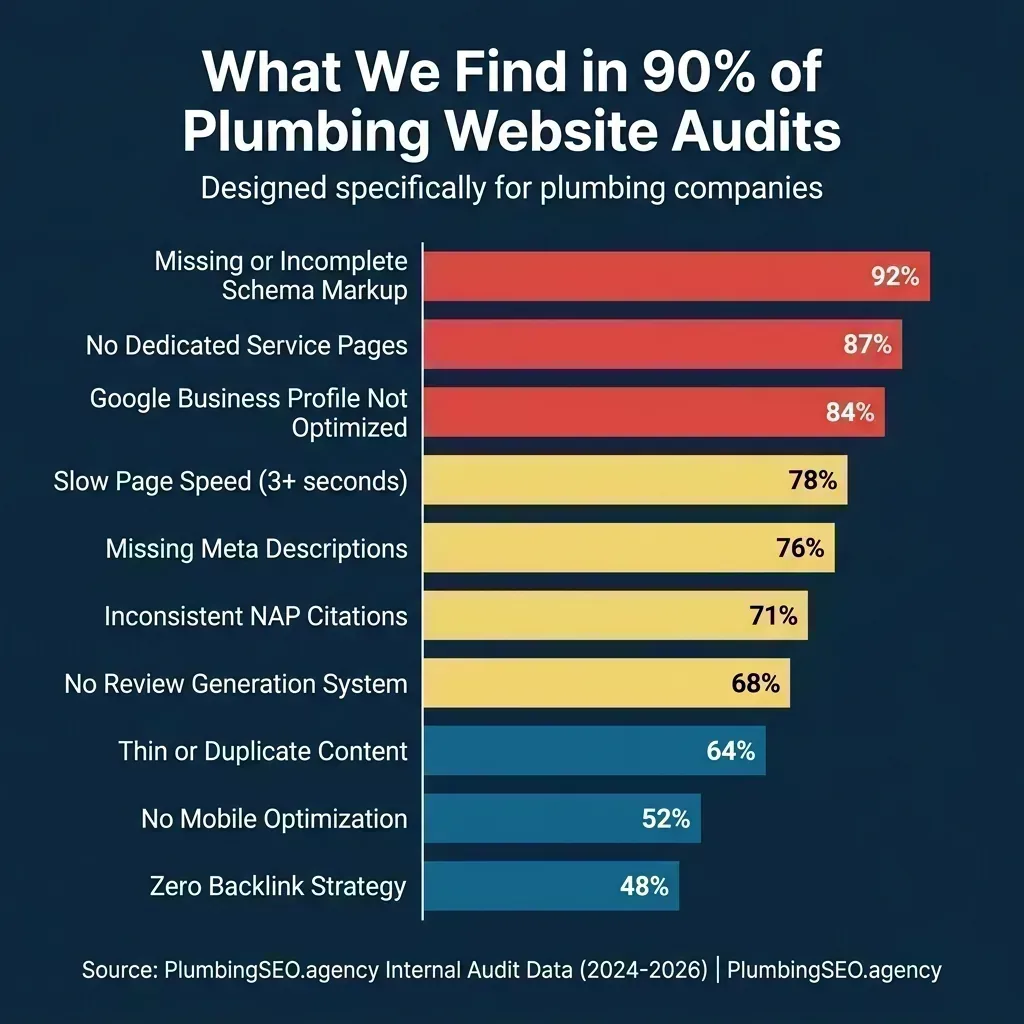
These are not edge cases. They are the norm. If you have not had a professional audit, chances are your site has most of these issues.
What makes this data useful is not the individual percentages, it is the pattern. The most common problems are also the most impactful to fix. Schema markup and dedicated service pages are both high-impact, relatively low-cost fixes that most competitors have not implemented. That is why an audit focused on plumbing companies specifically produces better results than a generic SEO review. We know which findings matter most in this industry because we see the same gaps every week.
The takeaway for plumbing company owners: if your site "looks fine" but is not generating calls, the problems are almost certainly in this list. Visual quality and SEO health are two completely different things.
Layers 5, 6, and 7: Reviews, Backlinks, and Competitor Analysis
The final three layers of the audit round out the complete picture. Each one adds context that the earlier layers cannot provide on their own.
Layer 5: Review and Reputation Analysis
We analyze your review profile across Google, Yelp, and any industry-specific platforms where plumbing customers leave feedback. But we go beyond the star count. We look at review velocity (how many new reviews you get per month), keyword content within reviews (do reviewers mention specific services?), and your response patterns.
According to BrightLocal's data, 61% of local businesses now use review management software. If you are not actively collecting and responding to reviews, your competitors likely are. We also check whether your review collection system is generating keyword-rich responses. On r/localseo, practitioners consistently note that keyword-rich review responses written from the business owner's side are one of the most underused ranking signals in local SEO.
Layer 6: Backlink Profile Assessment
Backlinks are links from other websites pointing to yours. Google treats them as votes of confidence. But not all votes are equal. A link from your local Chamber of Commerce or a supplier's website carries far more weight than a link from a random blog directory.
We audit your backlink profile for quality, quantity, and risk. According to Ahrefs' research, competitors that outrank small businesses typically have 2.3 times more referring domains on average. We identify how many unique domains link to your site, whether any of those links are from toxic or spammy sources that could trigger a Google penalty, and where the biggest link gaps are between you and the plumbers ranking above you.
For plumbing companies specifically, the most valuable backlinks tend to come from local news coverage, supplier partnerships, community sponsorships, and trade association memberships. A backlink from your local newspaper's "best plumbers" article is worth more than 50 directory submissions.
Layer 7: Competitor Gap Analysis
The plumbers ranking above you in your market are not there by accident. The competitor analysis tells you what the market is currently rewarding and gives you a concrete improvement roadmap rather than a generic checklist.
We search for your 3 to 5 most important services in your primary city and identify who is ranking in the Map Pack and the top 5 organic results. For each competitor, we compare review count and recency, number of indexed pages (using Google's site: search command), backlink profile, and Google Business Profile completeness.
The goal is not to copy competitors. It is to identify the gap between your current state and what the market requires to rank. In some markets, the gap is small and addressable in a few months. In competitive metros like Houston, Chicago, or Los Angeles, the gap may be significant enough that closing it requires sustained, strategic effort across multiple layers simultaneously. As one Authority Specialist audit guide puts it: "A plumbing site with 15 pages and 12 Google reviews is not necessarily in bad shape if it is in a small market. The same profile in a major metro competing against companies with 400 reviews and 80 pages is a significant gap."
What a Real Audit Transforms: Before and After
Numbers talk. Here is what actually changes when a plumbing company takes their audit findings seriously and implements the prioritized fixes over 90 days.
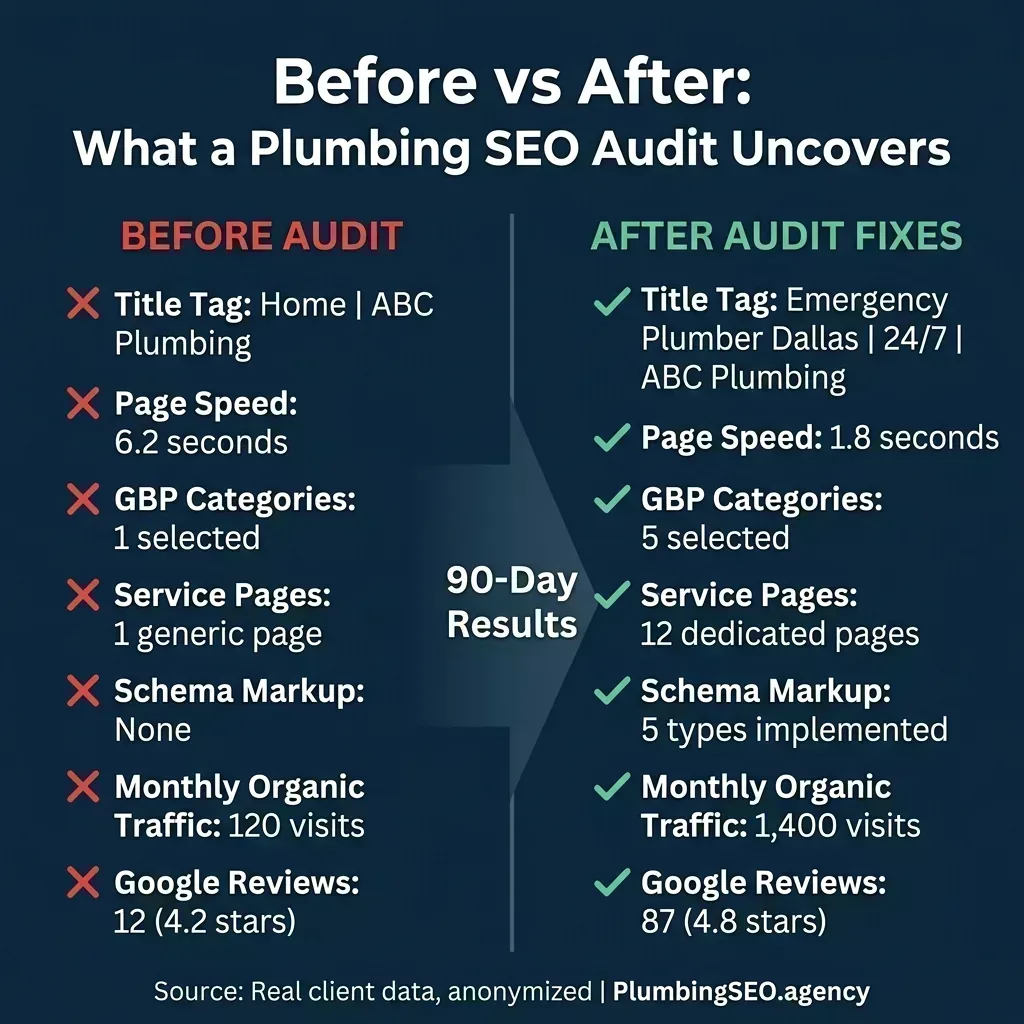
Real anonymized client data. The audit identified the problems. The implementation plan prioritized the fixes. The results followed.
The important detail here is the word "prioritized." An audit that dumps 200 findings on your desk without telling you what to fix first is not helpful. The plumbing company in this example did not fix everything at once. They started with the three highest-impact items (Google Business Profile optimization, dedicated service pages, and schema markup), then moved to secondary items (page speed, citations, review collection) in month two. By month three, they were working on content depth and backlink acquisition. That sequencing is what makes the difference between an audit that collects dust and one that generates results.
Free Plumbing SEO Audit vs Paid Website Audit Service: Which One Do You Need?
The phrase "plumbing SEO audit" can mean two very different things. Some owners need a fast second opinion because calls are down, rankings feel stuck, or a past SEO provider left them unsure what is broken. Others need a complete paid diagnostic because they are about to invest in a rebuild, enter a new market, or replace a failing agency. Mixing those two needs creates confusion.
Our free plumbing SEO audit is built for the first scenario. It is a manual leak check that reviews the highest-signal areas: whether your most important pages are indexable, whether your Google Business Profile is likely under-serving local demand, whether your service-page architecture is missing obvious pages, whether calls have clear conversion paths, and whether competitors are exposing a simple gap you can fix quickly.
The paid plumbing website SEO audit service is the deeper path. Use it when the risk of guessing is expensive: a multi-location plumbing company with overlapping service areas, a contractor preparing a site migration, a business with months of flat Search Console data, or a company spending heavily on SEO without knowing what is being fixed. In that case, the audit turns the leak check into a documented 7-layer roadmap with screenshots, benchmarks, implementation order, and accountability.
- Choose the free audit if you want to know why your plumbing website is not producing enough calls and need the highest-impact next step.
- Choose the professional audit service if you need every technical, local, content, citation, backlink, and competitor issue documented before a major SEO investment.
- Choose the process guide you are reading now when you want to understand what a credible audit should include before you talk to any provider.
That routing matters for SEO and for plumbing company owners. Instead of forcing every audit searcher into the same offer, this guide teaches the process, the free SEO audit conversion page catches owners who want a first-pass leak check, and the paid audit page handles owners who are ready for a complete roadmap.
DIY Audit vs Professional Audit: When Each Makes Sense
Not every plumbing company needs to hire an agency for a full audit. Some issues are genuinely straightforward to identify and fix yourself. But there is a clear line between what free tools can surface and what requires professional expertise to uncover and act on.
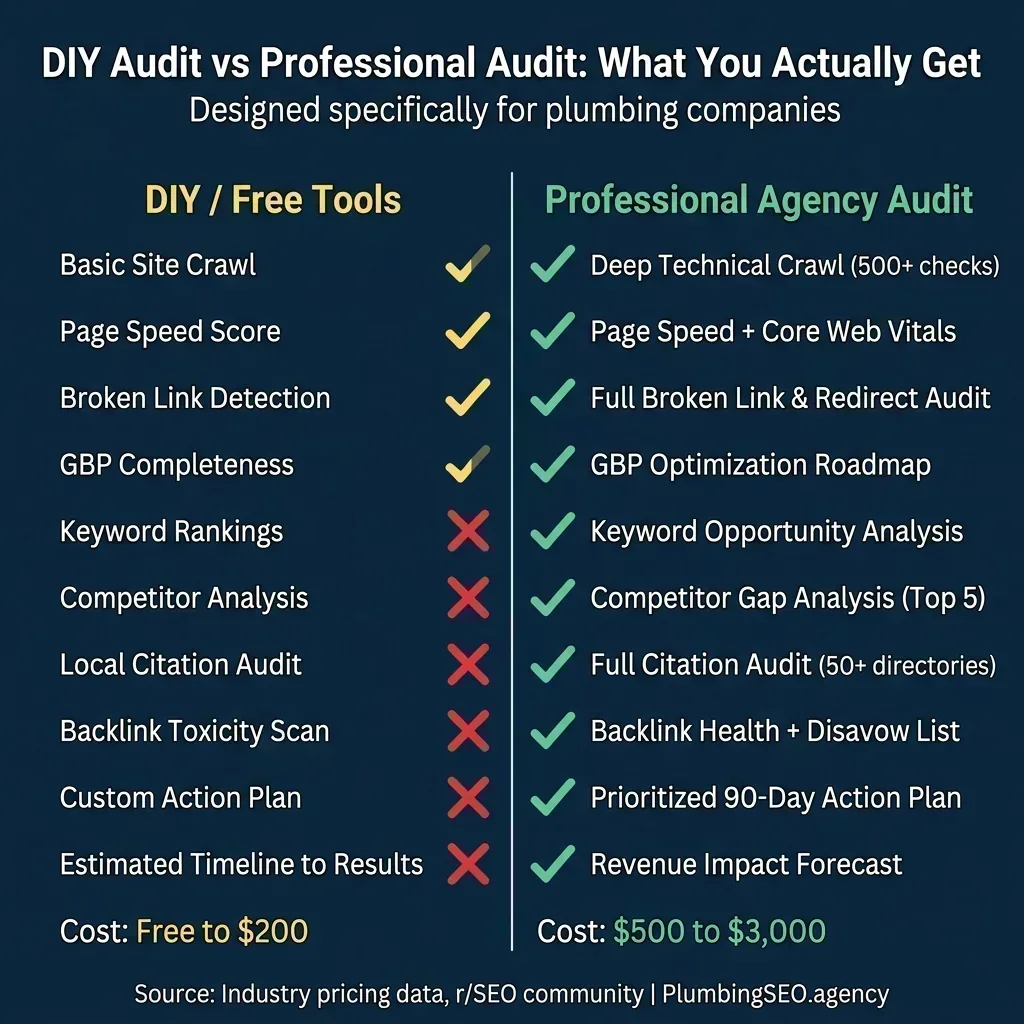
Free tools can catch surface-level issues. A professional audit uncovers the strategic gaps that actually determine whether your phone rings.
If you are a one-truck plumbing company in a small town with limited competition, a DIY approach using Google Search Console, PageSpeed Insights, and a manual review of your Google Business Profile can catch the most obvious problems. Fix your title tags, add some photos to your GBP, and respond to reviews. That might be enough.
But if you are in a competitive market, if your website was built more than 3 years ago, if you have been paying for SEO and not seeing results, or if you have no idea why your competitors are ranking above you, a professional audit is the fastest path to clarity. The difference is not just the tools used. It is the interpretation. Knowing that your page speed score is 42 is one thing. Knowing whether fixing it will actually move the needle in your specific market, given your competitors' scores and your content depth, is something else entirely.
On the r/SEO community, one experienced auditor described the difference this way: "A $500 audit exports what the tool says. A $3,000 audit tells you what the data means for your specific business and what to do about it in what order." For a plumbing company evaluating how much to invest in SEO, understanding this distinction matters.
What the Final Audit Deliverable Looks Like
When we complete a professional plumbing website SEO audit, the client receives a structured report with four sections. This is the difference between a quick free leak check and the paid audit service: the deliverable is meant to guide implementation, not just identify symptoms.
- Executive Summary. A one-page overview written in plain language, not SEO jargon. It answers three questions: Where are you now? Where should you be? What is the gap?
- Findings by Layer. Detailed findings organized by the 7 audit layers, with severity ratings (critical, important, low priority) so you know what to tackle first. Every finding includes a screenshot or data point, not just a description.
- Prioritized 90-Day Action Plan. A sequenced list of exactly what to fix, in what order, with estimated time and cost for each item. Month 1 focuses on high-impact, quick wins. Month 2 addresses medium-term improvements. Month 3 tackles strategic growth initiatives.
- Competitive Benchmark. How you compare to the top 3 to 5 competitors in your market across every measurable dimension: page count, review count, backlink profile, page speed, content depth, and schema implementation.
The entire report is designed to be actionable whether you implement the changes yourself, hand them to your web developer, or hire us to execute the plan. It is not a sales pitch for ongoing services. It is a diagnostic document that gives you complete clarity on your website's SEO health and a clear path forward.
If you are deciding whether you need that level of depth, start with the free audit request. If you already know you need the full report, benchmarks, and implementation order, go straight to the professional plumbing website SEO audit service.
If you are curious about what happens after the audit, our breakdown of how we execute SEO for plumbing companies walks through the implementation side. But the audit always comes first. You do not prescribe treatment without a diagnosis.
Frequently Asked Questions
A thorough plumbing SEO audit typically takes 10 to 20 hours of professional work, spread over 5 to 7 business days. The time varies based on the size of your website, the number of service areas you cover, and the competitiveness of your market. Automated "instant audit" tools take seconds but miss the strategic analysis that makes an audit actually useful.
Professional SEO audits for plumbing companies typically range from $500 to $3,000 depending on depth and scope. A basic audit focusing on technical issues and quick wins falls on the lower end. A comprehensive audit covering all 7 layers including competitor analysis and a 90-day action plan falls on the higher end. Free audits offered by agencies are usually abbreviated versions designed as sales tools, not full diagnostic reviews.
You can cover some ground with free tools like Google Search Console, Google PageSpeed Insights, and a manual review of your Google Business Profile. These will catch surface-level issues like broken links, slow pages, and missing profile information. However, free tools cannot provide competitor analysis, backlink health assessments, keyword opportunity mapping, or a prioritized action plan. If you are in a low-competition market, a DIY approach may be sufficient. In competitive metros, the strategic depth of a professional audit pays for itself.
A full audit covering all 7 layers is worth doing once or twice a year. Between full audits, a lighter monthly check using Google Search Console (coverage errors, traffic trends, new manual actions) will catch most issues. If you have recently changed your website, updated your business address, or noticed a sudden traffic drop, run a full audit immediately regardless of when you last did one.
Start with the free plumbing SEO audit if you need a quick, manual read on your biggest ranking and call leaks. Pay for a full audit when you need a complete documented roadmap across technical SEO, Google Business Profile, service pages, citations, reviews, backlinks, and competitors before a larger SEO investment.
A professional plumbing website SEO audit service should include Google Business Profile review, technical crawl, on-page content review, service-page gap analysis, citation and NAP consistency checks, review/reputation analysis, backlink assessment, competitor benchmarking, and a prioritized action plan. The value is not just finding errors; it is deciding what to fix first so the work can produce more qualified plumbing calls.
No. The free audit is a first-pass leak check that identifies the biggest visible problems and next step. The paid audit service is a deeper diagnostic with documentation, screenshots, competitor comparisons, implementation order, and a 90-day roadmap. Use the free audit when you want direction; use the paid audit when you need the full plan.
The audit itself is a one-time diagnostic. Implementing the findings and maintaining your rankings is an ongoing process. Some fixes are one-time (like correcting schema markup or fixing broken links). Others require continuous effort (like content creation, review collection, and link building). Many plumbing companies choose to handle the quick fixes themselves and bring in professional help for the ongoing strategic work. The audit gives you clarity on what needs to happen, and then you decide how to execute it.
Want to See What Your Plumbing SEO Audit Would Uncover?
As a dedicated plumbing SEO agency, our free plumbing SEO audit runs a high-level manual scan of your website, Google Business Profile, service pages, and call paths. If you need the complete documented roadmap instead, review the professional plumbing website SEO audit service.
Review the Professional Audit Service