
- 78% of emergency searchers call the first site that loads fast. Every 100ms of lag costs you roughly 1% of conversions.
- The highest-converting plumbing sites are often "hideous" to designers—focusing purely on giant headlines, obnoxious call buttons, and zero distractions.
- Most DIY and cheap template plumbing sites average a brutal 8.6 seconds to load on mobile devices. A custom, mobile-first design should aim for under 2.0 seconds.
The Mobile Emergency Truth: What Users Actually Do
Picture this scenario: It is 10:00 PM on a Friday. A homeowner discovers their water heater is actively flooding the basement. They grab their phone in a panic, water soaking into their socks, and search "emergency plumber near me." What do they want right now? They want a phone number, and they want it fast.
What they do not want is to admire a beautifully animated wave graphic on your homepage, read a 500-word history of how your grandfather started the plumbing business in 1982, or try to navigate a tiny hamburger menu to find your service area.
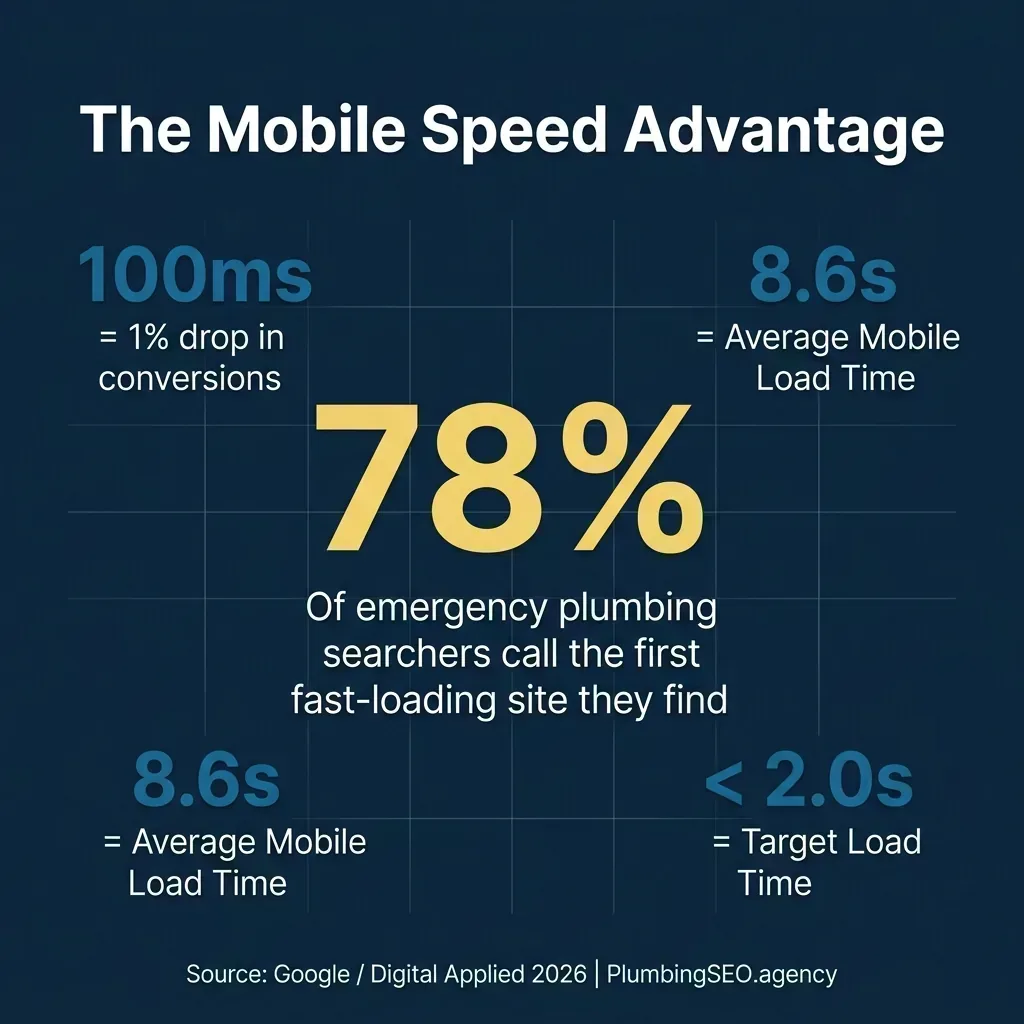
Speed is everything. 78% of people with an active plumbing emergency will simply call the first business whose website loads quickly.
A recent 2026 data analysis by Digital Applied found that 78% of emergency searchers call the first fast-loading site they find. They do not compare three different companies. They click the first result, and if it does not load almost instantly, they hit the "Back" button and click the next one.
If your website is taking 5 seconds to load on a 4G connection, you are effectively paying for local SEO or Google Ads to drive traffic to a site that instantly frustrates your best customers. Your marketing budget is bleeding out before the customer even sees your logo.
5 Ways Plumbing Sites Fail the Mobile Test
We audit hundreds of plumbing websites every year. When we look at their analytics, we constantly see a massive disconnect: they get great traffic from desktop computers, but their mobile bounce rate is north of 80%, and mobile phone calls are practically nonexistent. When users are stressed, small frictions become massive roadblocks. Here are the top five reasons why:
1. Brutal Load Speeds
This is the number one killer of mobile plumbing leads. Many plumbers build their sites using heavy DIY builders like Wix or Squarespace, or they hire cheap offshore developers who use bloated WordPress themes. These sites might look okay on a massive desktop monitor in an office over gigabit Wi-Fi, but on a smartphone in a wet basement with two bars of service, they take 8-10 seconds to render. Homeowners will not wait.
2. The Buried Phone Number
Your phone number should not be an easter egg hunt. We frequently see mobile sites where the phone number is either hidden inside the menu, located at the very bottom of the footer, or worst of all, presented as an image rather than text so the user cannot tap it to call. If someone has to hunt for your phone number, they will just go back to Google.
3. Massive "Contact Us" Forms
Mobile users do not want to fill out a 12-field form asking for their life history, address, zip code, and a detailed essay on their plumbing issue. They just want to get someone on the line. Forms that are too long to comfortably fill out on a smartphone screen kill your conversion rate.
4. The Pop-up Nightmare
You land on a plumbing site, and before you can even read the phone number, the entire screen is blocked by a "Get $25 Off Your Next Service!" pop-up. The "X" to close it is impossibly small, and tapping it accidentally clicks the ad. This is a surefire way to make an angry, stressed-out homeowner abandon your site instantly.
5. Tiny Text and Poor Contrast
Mobile screens are small, and plumbing emergencies often happen in poorly lit areas (basements, under sinks, crawlspaces). Using tiny light-gray text on a white background might look sleek and modern to a web designer, but to a homeowner trying to read your service hours at midnight, it is illegible.
The "Hideous" Secret to High Conversions
One of the hardest pills for business owners to swallow is that beautiful design often hurts conversion rates in emergency services.
A recent case study from Mammoth Marketing highlighted exactly this dynamic. They took over a campaign for a new plumbing company and generated 196 leads in 60 days from $11,100 in ad spend. That is over $100k in pipeline opportunity in two months.
How did they do it? By building intentionally "hideous" landing pages.
As they put it: "We prioritize function over fashion every single time. Because in a plumbing emergency, customers don't want a lifestyle blog; they want a solution."
Their high-conversion formula relies entirely on removing friction and maximizing immediate action:
- Giant Headlines: The core offer and service are impossible to miss.
- Obnoxious Buttons: Using the brightest, most "clickable" colors on the internet so the user knows exactly how to get help.
- Zero Distractions: No family photos, no company history, and no fluff above the fold. Just a value-based proposition and a way to call.
- Immediate Trust Signals: Five-star review badges and certifications are placed front and center, ensuring the customer feels safe before they even scroll.
The result? These "medical precision" pages push conversion rates from the industry average of 2-5% up to a staggering 30% to 60%. When a page converts at 60%, your cost-per-lead plummets, and your return on investment skyrockets.
The Data: What Slow Speeds Actually Cost You
Let's talk numbers. The difference between a fast site and a slow site isn't just user experience—it is hard, measurable revenue.
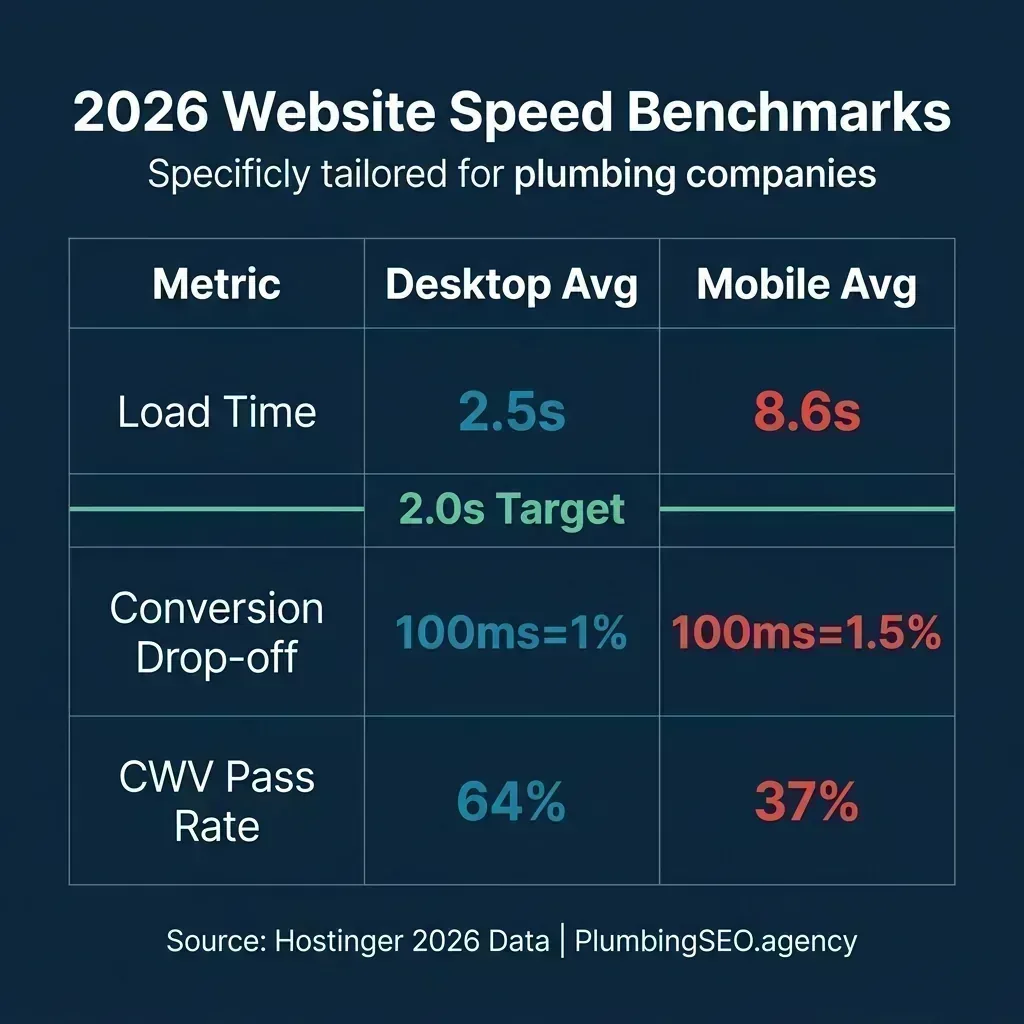
Industry average load times are drastically slower on mobile. If you want an edge, aim for under 2.0 seconds.
According to 2026 data from Digital Applied and Hostinger, the average website takes 2.5 seconds to load on desktop, but a brutal 8.6 seconds on mobile. Meanwhile, the industry target is 2.0 seconds.
Why does this matter? Because every 100 milliseconds of load time costs you approximately 1% in conversions.
If your site takes 5 seconds to load instead of 2 seconds, you are effectively burning 30% of your potential leads. Furthermore, Google's Core Web Vitals (CWV) metrics heavily penalize slow sites. In 2026, 91% of sites ranking in position 1 pass all three CWV metrics, while only 47% of page 2 results pass. If your site is slow, it won't just convert poorly—it will be invisible.
The 5-Second Mobile Emergency Test: Anatomy of a Good Site
If your current website is bleeding mobile leads, how do you fix it? The answer is to design specifically for the stressed-out mobile user. At BuiltRight Digital and other top agencies, the standard for a high-converting mobile layout revolves around removing all obstacles between the user and the phone call.
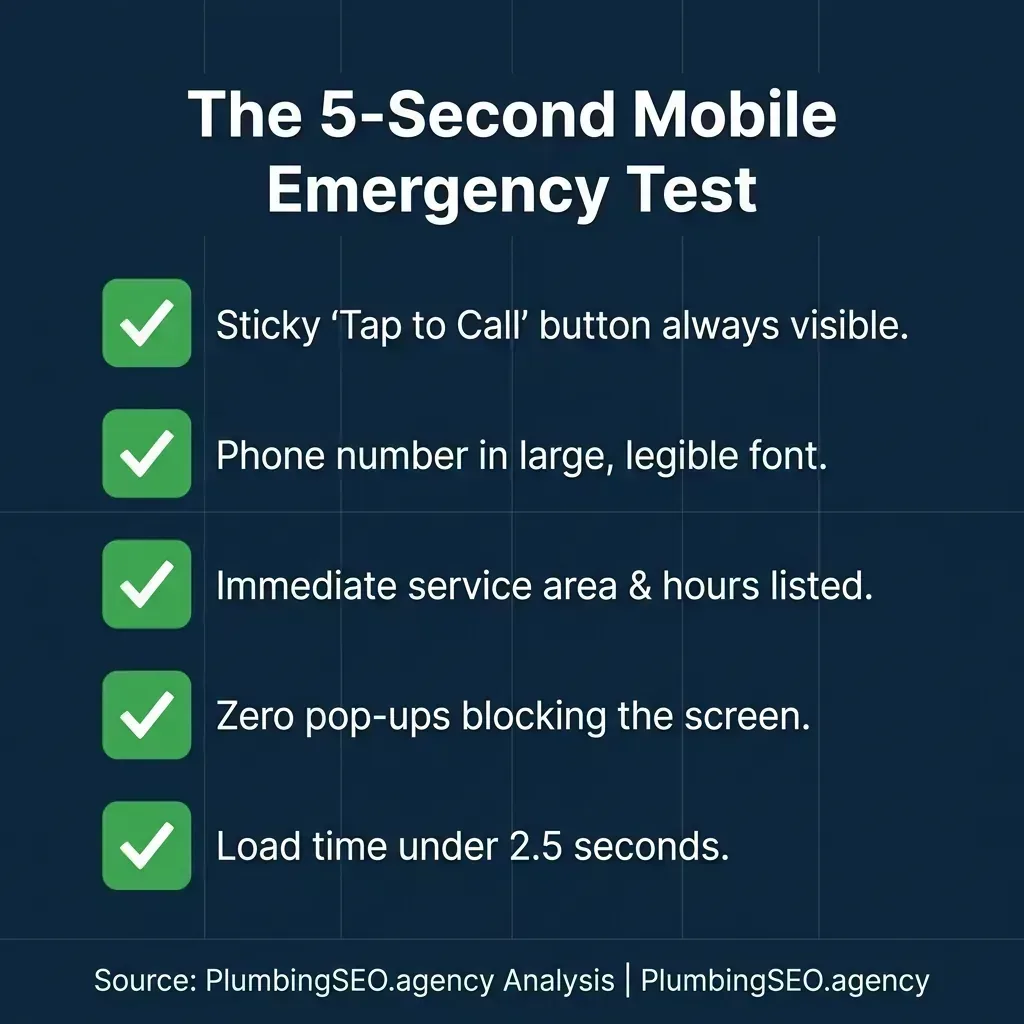
Pass this 5-point test, and your mobile conversion rate will skyrocket.
Here are the non-negotiable features every successful plumbing website must have on mobile:
- The "Sticky" Click-to-Call Button: This is a button that stays locked to the bottom or top of the smartphone screen no matter how far down the user scrolls. They never have to hunt for the number.
- Dynamic Tracking Numbers: If you aren't tracking where your calls come from, you are flying blind. Tools like CallRail allow you to swap in dynamic numbers so you know exactly which ads or organic searches are driving revenue.
- Live Chat for Non-Emergencies: While emergencies demand phone calls, a homeowner planning a remodel might prefer chat. Adding an unobtrusive live chat widget can capture leads who are still in the research phase.
- Immediate Trust Badges: Display your Google Guaranteed badge, your BBB rating, or your number of 5-star reviews right below the main headline. Do not make them scroll to find out if you are reputable.
- Service Area Up Front: Nothing is more frustrating than reading a site for three minutes only to realize the plumber doesn't service your zip code. State your service area immediately.
The Cost Comparison: DIY Builders vs. Custom Mobile-First
Many plumbing business owners try to save money by using drag-and-drop website builders like Wix, Squarespace, or GoDaddy. While these platforms are cheap upfront, they are notoriously heavy on code, which destroys mobile load times.
As Nation Media Design found in their case study with DrainGo Plumbing, investing in a custom, mobile-responsive framework and technical SEO optimization increased active users by 85% and reduced the cost per acquisition to $51.50 (an industry-leading rate). The conversion rate hit 12.60%, massively outperforming the industry average of 2.35%.
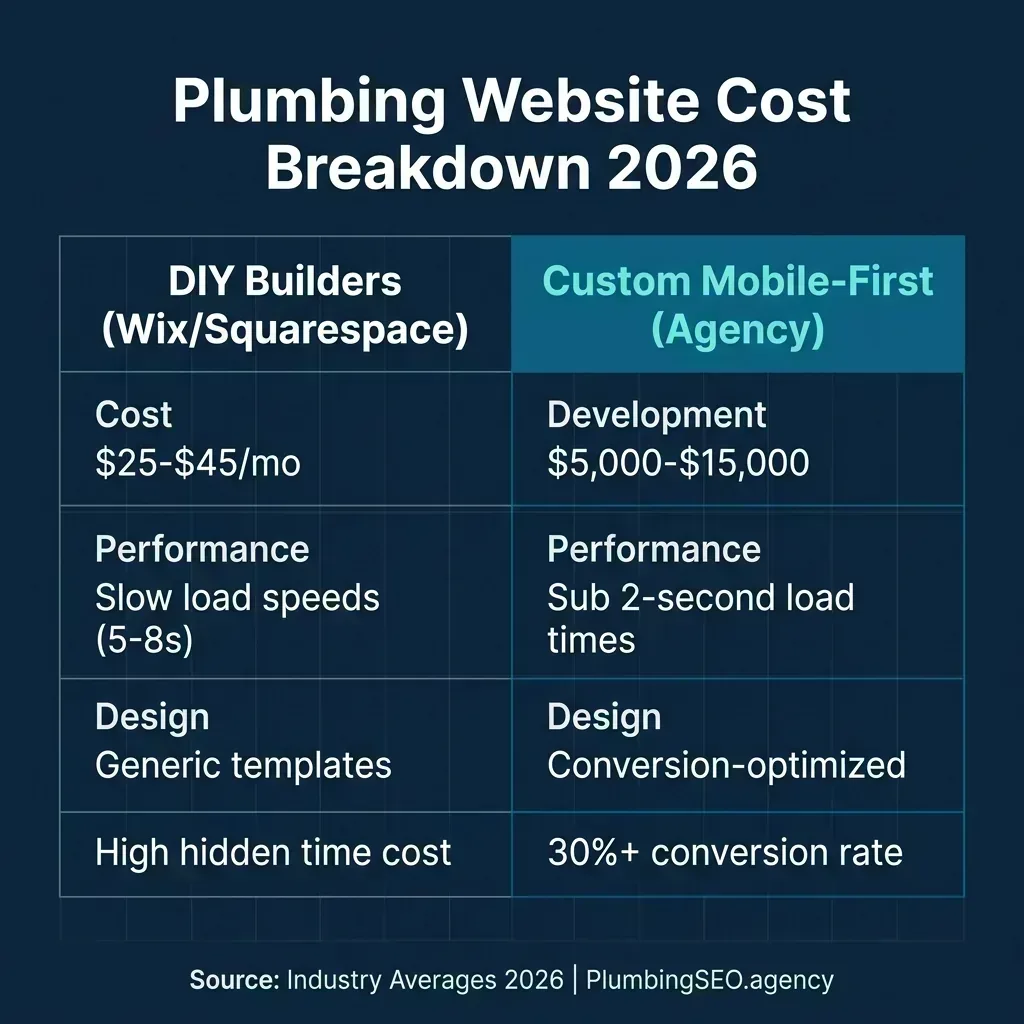
The DIY builder looks cheap on paper, but the lost revenue from slow load speeds makes it the most expensive option.
Wix / Squarespace Templates
- Upfront Cost: $25 - $45 per month
- Load Speed: Typically 5 to 8+ seconds on mobile
- Customization: Limited, generic "local business" feel
- The Hidden Cost: You lose 40-60% of potential leads because the site is too slow and not optimized for conversions. You also spend dozens of your own unbilled hours trying to make it look right.
Custom Mobile-First (Agency)
- Upfront Cost: $5,000 - $15,000 one-time build
- Load Speed: Under 2.0 seconds
- Customization: Built specifically around your service areas, highly functional landing pages.
- The True Value: Conversion rates jump from 2% to 20-30%+. The site pays for itself in booked jobs within the first 3 to 6 months.
If you are an established plumbing business running multiple trucks, a custom website is not an expense—it is a piece of revenue-generating equipment. You would not send your technicians out in a broken-down van that stalls at every red light. Do not send your paid marketing traffic to a broken-down website that stalls on every smartphone.
Benefits of Responsive Website Design for Plumbers
The benefits of responsive website design go beyond just looking good on a phone. A responsive plumbing website automatically adapts to any screen size, ensuring your phone number, service areas, and call-to-action buttons are always visible and tappable. Google prioritizes mobile-friendly sites in search rankings, so responsive design directly improves your SEO performance. Responsive sites also load faster because they serve optimized assets for each device, reducing bounce rates by up to 50%. For plumbers specifically, where 78% of emergency searches happen on mobile, a responsive website is the difference between getting the call and losing it. If you are investing in PPC advertising to drive traffic, sending those expensive clicks to a non-responsive site is like paying for leads and then hanging up the phone.
Conclusion: Is Your Website a Tool or a Toy?
If your website exists just to look pretty, it's a toy. If it exists to make the phone ring when a homeowner has a busted pipe at 11:00 PM, it's a tool. A high-converting mobile website is the sharpest tool in your marketing arsenal.
Before you spend another dollar on Google Ads, Local Service Ads, or SEO, run the 5-Second Mobile Emergency Test on your own site. If you fail, that is where your marketing budget is leaking.
Frequently Asked Questions
Your plumbing website should load in under 2.5 seconds on mobile, with a target of sub-2.0 seconds. Every 100 milliseconds of delay costs you approximately 1% in conversion rate. Emergency searchers will not wait for slow sites.
Yes, but it is not recommended for growth. DIY builders like Wix and Squarespace are notoriously slow and bloated on mobile, averaging 5-8 seconds to load. You save money upfront ($25-$45/mo), but you lose thousands in missed emergency calls due to poor load speeds and unoptimized mobile layouts.
The "Sticky" Click-to-Call button is the most critical feature. It keeps your phone number immediately visible and tappable at all times, no matter how far down the page a user scrolls. This removes friction for emergency searchers.
A professional, custom mobile-first website for a plumbing company typically costs between $5,000 and $15,000. This investment pays for itself quickly by increasing conversion rates from the industry average of 2-5% up to 20-30% or higher.
The benefits of a responsive website for plumbing companies are significant and directly impact your bottom line. A responsive site automatically adapts to any screen size, meaning your phone number, service areas, and call-to-action buttons are always visible and tappable whether the customer is on a phone, tablet, or desktop. Google prioritizes mobile-friendly sites in search rankings, so a responsive design directly improves your SEO performance. Responsive sites load faster because they serve optimized assets for each device, reducing bounce rates by up to 50%. For plumbers specifically, where 78% of emergency searches happen on mobile, a responsive website is not a luxury. It is the difference between getting the call and losing it to a competitor whose site loads properly on a smartphone.
Does Your Mobile Site Pass the Test?
We will review your current website, test its mobile load speed, check its conversion features, and tell you honestly if it's costing you leads. No sales pitch. Just data.
Run My Free Mobile Leak Check