
- Emergency keywords like "emergency plumber near me" convert at 12-18%, while generic terms like "plumbing" (6 million searches) bring almost zero calls. Target intent, not volume.
- The average plumbing Google Ads click costs $15-$55. Ranking organically for the same keywords saves you $183 per lead (the current non-branded PPC average). Keywords are money, and this list shows you where to spend your time.
- A structured plumbing website should target 50-150 keywords across service pages, city pages, and blog content. This post gives you the exact list, organized by what gets phones ringing fastest.
Why Most Plumbing Keyword Lists Are Useless
If you have searched for the best plumber keywords or a reliable plumbing keywords list before, you have probably seen the same recycled list of 50 or 100 generic terms. "Plumbing." "Plumber." "Water heater." Maybe a monthly search volume column slapped on the side.
Here is the problem. A keyword with 6 million monthly searches and zero buying intent is not a keyword. It is a vanity metric. Ranking #1 for "plumbing" nationally will not book a single drain cleaning job in your city.
The keywords that actually get your phone ringing are specific, local, and high-intent. They look less impressive on a spreadsheet. "Emergency plumber near me" only gets 165,000 searches per month compared to "plumbing" at 6.1 million. But those 165,000 searches are from homeowners with water on the floor and a credit card in hand. That is the difference between traffic and revenue.
This post is the ultimate plumbing SEO keywords list built for plumbing company owners who care about calls, not clicks. We analyze the top plumbing keywords with real search volume data, actual CPC benchmarks, and a clear explanation of where they belong on your website. No filler. No guessing.
The Top Plumbing Keywords by Search Volume (2026 Data)
Before we sort these plumbing keywords by intent and money-making potential, here is the raw picture of what people are actually searching for when they need a plumber. These numbers come from Ahrefs, PlumberSEO.net, and Loopex Digital's 2026 keyword research data.
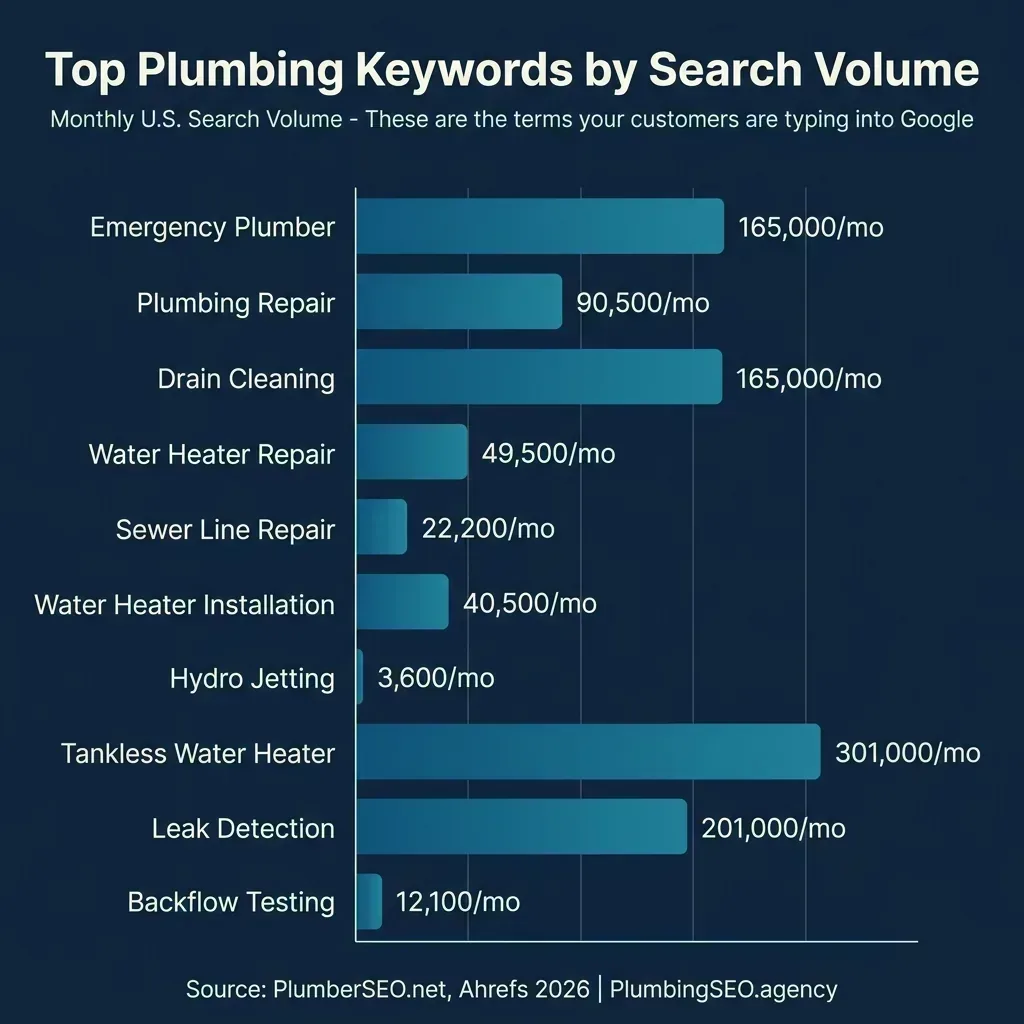
A few things jump out when you look at these numbers as a plumbing owner rather than an SEO analyst. The highest-volume terms (tankless water heater, leak detection) are often informational. The person typing "tankless water heater" might be shopping for a unit at Home Depot, not calling a plumber. The terms that bring actual service calls, like "emergency plumber" and "drain cleaning," have lower raw volume but dramatically higher conversion rates.
In my opinion, most plumbing companies waste their first six months of SEO chasing the big numbers. They want to rank for "water heater" because it sounds impressive. Meanwhile, the shop across town quietly ranks for "water heater repair" plus their city name and books three jobs a week from that one page. The report may look good, but the phone tells the truth.
| Keyword | Monthly Searches | Intent Type | Best Page Type |
|---|---|---|---|
| emergency plumber | 165,000 | Emergency | Emergency service page |
| drain cleaning | 165,000 | Transactional | Service page |
| plumbing repair | 90,500 | Transactional | Service page |
| water heater repair | 49,500 | Transactional | Service page |
| water heater installation | 40,500 | Transactional | Service page |
| sewer repair | 22,200 | Transactional | Service page |
| commercial plumbing | 18,100 | Commercial | Commercial service page |
| backflow testing | 12,100 | Transactional | Service page |
| tankless water heater installation | 6,600 | Transactional | Service page |
| hydro jetting | 3,600 | Transactional | Service page |
| slab leak repair | 1,600 | Emergency | Service page |
| trenchless sewer repair | 2,900 | Transactional | Service page |
Each of these keywords becomes even more powerful when you add your city name. "Drain cleaning" is competitive nationally. "Drain cleaning Dallas" is a keyword you can actually rank for and turn into booked jobs. That is the formula you will see throughout this guide: service keyword + your city = the exact term to build a page around.
Search Intent: The Real Reason Some Keywords Make Money and Others Don't
If there is one concept in this entire post worth remembering, it is this: search intent matters more than search volume. A keyword with 500 monthly searches and high buying intent can outperform a keyword with 50,000 monthly searches and zero buying intent every single time.
Here is how intent breaks down for plumbing keywords. This is the framework we use when deciding which keywords to prioritize for every plumbing client.
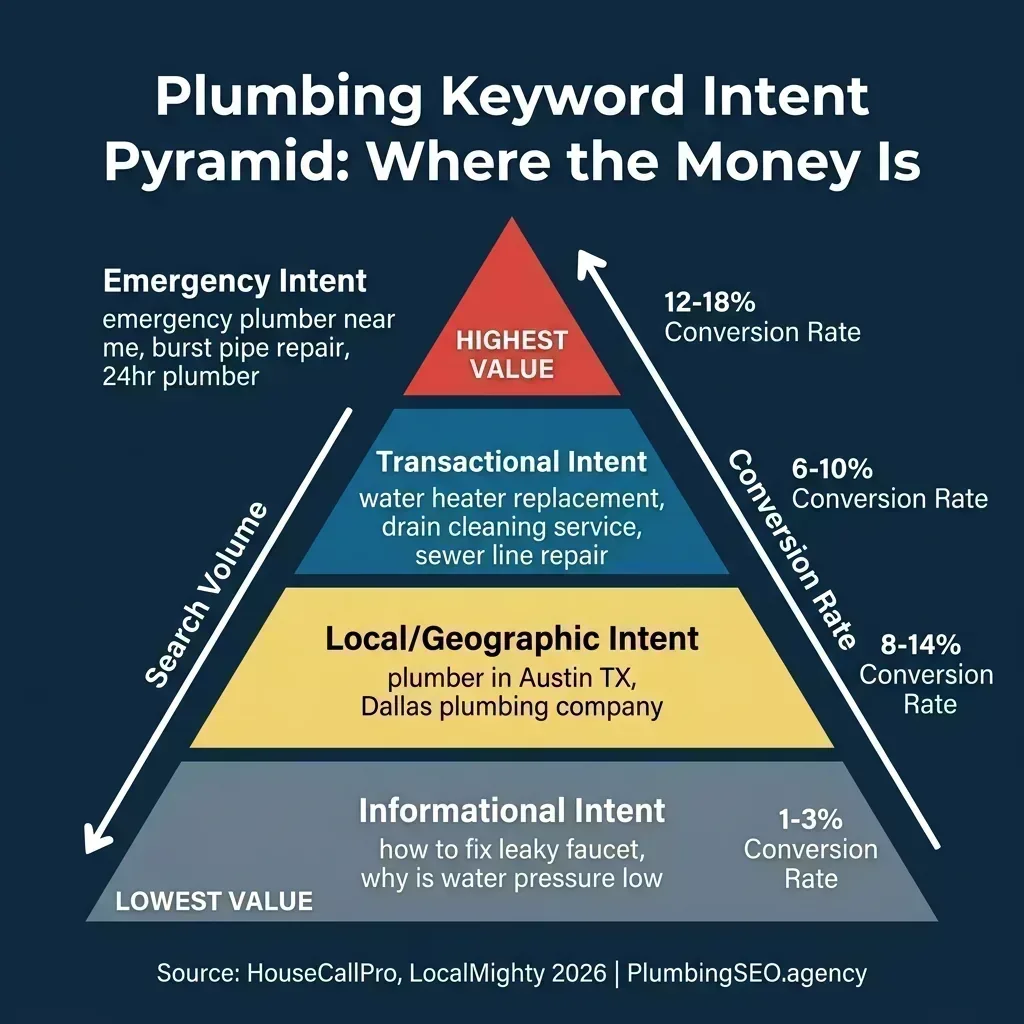
Think about it from the customer's side. Someone searching "emergency plumber near me" at 10pm has water pouring through the ceiling. They are not comparing prices. They are not reading blog posts. They are calling the first result that looks trustworthy and available. That is why emergency keywords convert at 12-18%, according to HouseCallPro's 2026 data.
On the other end, someone searching "how to fix a running toilet" is trying to avoid calling a plumber. They might eventually need one if the YouTube video does not work out, but that is a long, uncertain path to a service call.
The practical takeaway for a plumbing owner: build your emergency and transactional service pages first. Those are the pages that put jobs on the board. Blog content targeting informational keywords is a long-term play for building authority, and it has value, but it should not be where you start. If you are spending $1,500 a month on SEO and your agency is writing blog posts instead of building service pages, you have a prioritization problem. For a deeper look at how to structure keywords on your service pages, we cover the full framework in our companion guide.
What These Keywords Cost on Google Ads (And Why SEO Is the Better Play)
Every keyword on this list has a price tag attached to it. When a plumbing company runs Google Ads targeting these terms, they pay every time someone clicks. And in plumbing, those clicks are not cheap.
Here is the reality of plumbing PPC costs in 2026, based on SearchLight Digital's Q1 2026 benchmark covering 524 plumbing contractors and $14.6 million in ad spend.
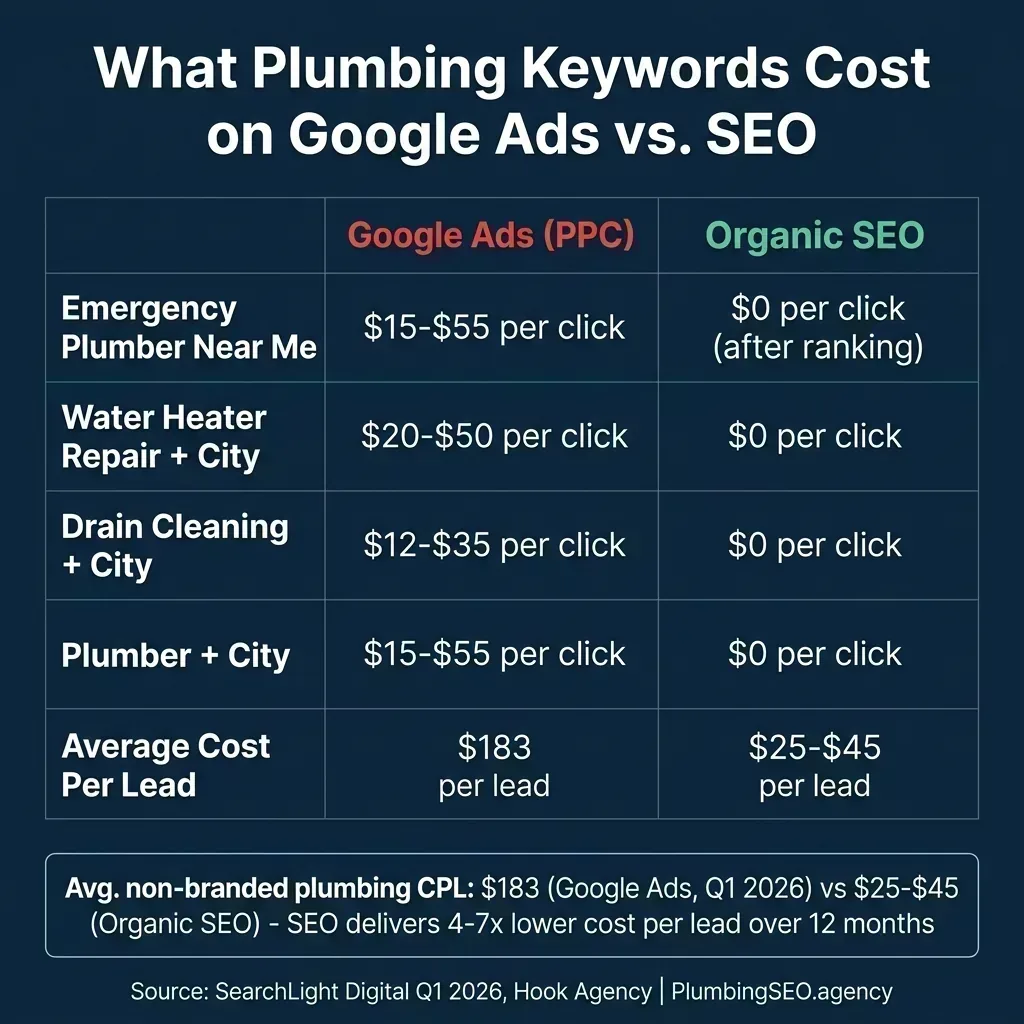
The way I see it, those numbers tell you everything you need to know about why keyword-focused SEO is worth the investment for plumbing companies. The average non-branded plumbing cost per lead on Google Ads is $183. The median plumbing contractor in SearchLight's dataset spends $14,206 per month total on Google Ads. That is $170,000 a year just to keep the ads running.
Organic SEO has a setup cost and a monthly cost to maintain, but once your service pages rank for these keywords, every click is free. You are not paying Google $30 every time someone searches "water heater repair" and clicks your listing. The math on SEO vs. PPC for plumbing companies gets more lopsided the longer you run the numbers.
Here is a number that should make every plumbing owner pay attention: water heater campaigns specifically average $256 per lead on Google Ads, according to SearchLight's data. That is the highest of any plumbing subcategory. If you can rank organically for "water heater repair" and "water heater installation" plus your city name, you are essentially earning $256 in value every time that page generates a call. Over a year, that is the equivalent of $3,000+ in free advertising per month from a single well-optimized service page.
The 6 Keyword Categories Every Plumber Needs to Cover
The biggest mistake plumbing companies make with keywords is not covering enough categories. They will build a homepage and maybe a "Services" page, then wonder why they are invisible on Google. Here are the six keyword categories your website needs to rank for, in the order you should build them.
1. Emergency Keywords (Build These First)
These are your highest-converting keywords. A homeowner with a burst pipe or sewage backup at 2am is not price shopping. They are calling whoever shows up first.
- emergency plumber near me (165,000/mo)
- 24 hour plumber + [city]
- burst pipe repair + [city]
- plumber open now
- water leak emergency + [city]
- slab leak repair (1,600/mo)
Where these go: Dedicated emergency service page, prominently linked from your homepage. Phone number above the fold. Response time clearly stated.
2. Core Service Keywords (Your Bread and Butter)
One page per service. Not a combined "all services" page. Each service needs its own URL, its own H1, its own content. This is the foundation that most plumbing websites get wrong, and it is the single biggest ranking opportunity we see when auditing sites.
- drain cleaning + [city] (165,000/mo base)
- water heater repair + [city] (49,500/mo base)
- water heater installation + [city] (40,500/mo base)
- sewer line repair + [city] (22,200/mo base)
- hydro jetting + [city] (3,600/mo base)
- tankless water heater installation + [city] (6,600/mo base)
- gas line repair + [city] (2,400/mo base)
- backflow testing + [city] (12,100/mo base)
- trenchless sewer repair + [city] (2,900/mo base)
Where these go: Individual service pages. If you want to understand the anatomy of a service page that actually converts, read how we build service pages that rank.
3. Local/Geographic Keywords (Expand Your Coverage)
These are the keywords that capture customers in the cities and neighborhoods you serve. They are the reason city pages exist, and they are the category most plumbing websites completely ignore.
- plumber in [city] (900-2,000/mo per city)
- [city] plumbing company
- licensed plumber [city]
- plumber near me (implicit local)
- [neighborhood] plumber
An electrician on Reddit put it well: "Don't just think about ranking for 'plumbing near me,' but also think about ranking for terms like 'drain snaking near me' and whatever other services you want to rank for. I was able to list off over 50 services my electrical company does." The same principle applies. Your service list is your keyword list. Add your city to each one. If you are working in multiple cities, our guide on city pages for plumbing companies walks through the full framework.
4. Commercial Plumbing Keywords
If you serve commercial clients, these are a separate keyword set. Commercial searches have different intent and often higher ticket values.
- commercial plumbing + [city] (18,100/mo base)
- commercial plumber + [city] (14,800/mo base)
- commercial drain cleaning
- grease trap cleaning + [city]
- commercial water heater service
Where these go: A dedicated commercial services page, separate from your residential services. The language, trust signals, and conversion triggers are different for commercial buyers.
5. Cost and Pricing Keywords
People searching for costs are further along in the buying process than you might think. They have already decided they need the service. They are trying to set expectations before they call.
- how much does a plumber cost
- drain cleaning cost + [city]
- water heater replacement cost
- sewer line repair cost
- plumber cost to replace toilet (long-tail)
Where these go: Pricing sections on your service pages, or a dedicated pricing/cost guide. These convert at 5-8% because the searcher is already past the "do I need a plumber?" stage. For context on what SEO itself should cost, we break down plumbing SEO pricing in detail.
6. Informational Keywords (Long-Term Authority)
These are your blog content keywords. They build topical authority, earn backlinks, and create a pipeline of future customers. But they are the last priority, not the first.
- how to fix a running toilet (29,000/mo)
- how to unclog a toilet with a plunger (6,400/mo)
- water heater not heating (2,300/mo)
- sewage smell in house (1,700/mo)
- how to thaw frozen pipes (1,100/mo)
Where these go: Blog posts only. Never on service pages. A service page targeting informational keywords is like putting a "do it yourself" sign on your truck. It defeats the purpose.
Keywords to Avoid: The Traps That Waste Your SEO Budget
Not every keyword that shows up in a research tool belongs on your website. Some keywords actively waste your time and money. Here is the short list of terms that plumbing companies should stop chasing, based on what we see in audits and what practitioners on r/SEO and r/localseo consistently warn about.
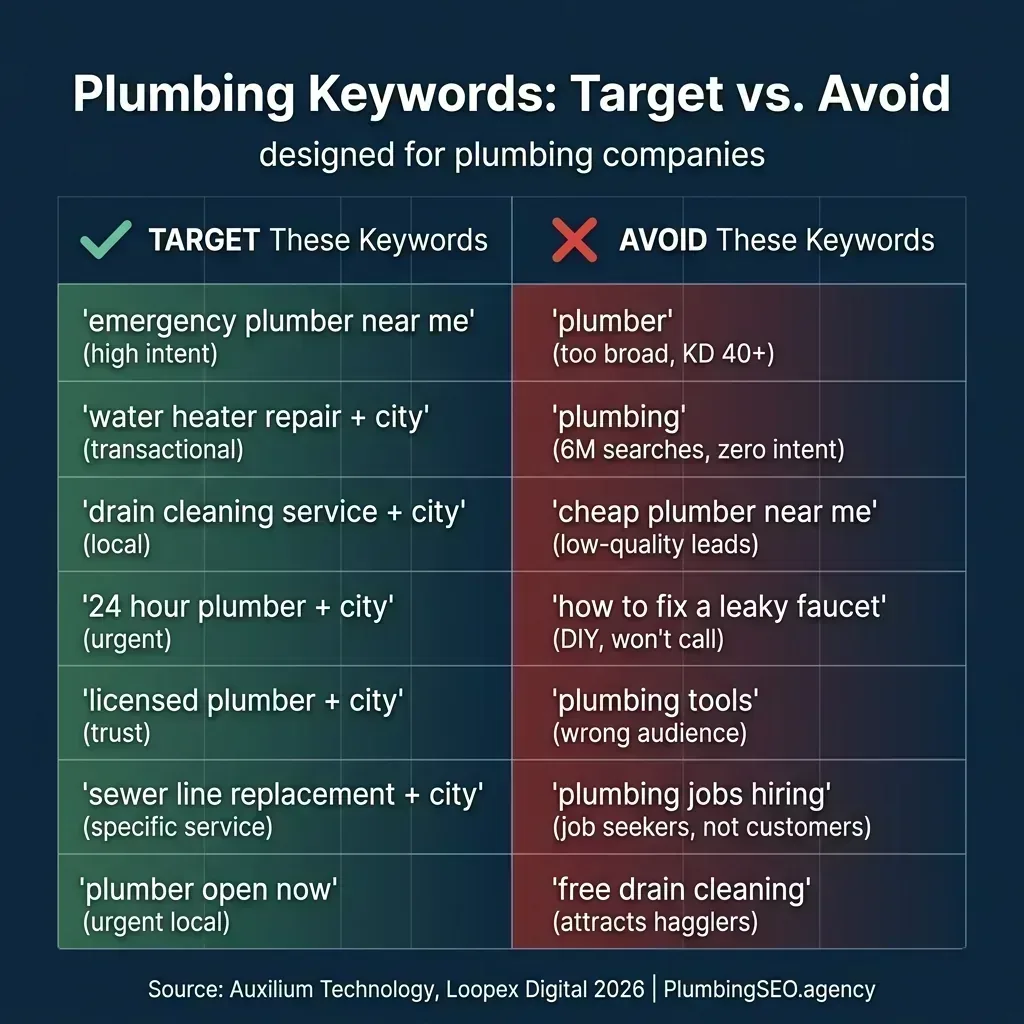
Here is the problem with "cheap plumber near me" that most keyword lists will not tell you. Yes, it has search volume. Yes, people are typing it. But the people typing it are pre-qualifying themselves as the customers who will haggle over every line item, leave a bad review if the job costs more than $50, and call three other shops before deciding. That is not growth, that is noise.
The same goes for "plumbing jobs hiring" and "plumbing tools." These attract job seekers and DIY shoppers, not customers with a leaking pipe and a need for professional help. Every page you build around the wrong keyword is a page that could have been built around the right one.
One more trap: targeting keywords with a Keyword Difficulty (KD) above 40-50 when your website is new. Terms like "plumber" (KD 40+) and "plumbing" (KD 60+) are dominated by national directories like Yelp, Angi, and HomeAdvisor. A local plumbing website will not outrank them for years, if ever. Focus on the local, long-tail versions of those keywords instead. "Plumber" is unwinnable. "Plumber in [your city]" is very winnable.
How to Pick the Right Keywords for Your Market
The keyword list above is a starting point. The keywords that will actually work for your plumbing company depend on your city, your services, your competition, and how established your website is. Here is the practical process for narrowing the big list down to the 20-30 keywords that will move the needle for your specific business.
Step 1: List Every Service You Offer
Sit down and write out every service your trucks roll on. Not just the big ones like drain cleaning and water heater repair. Include the niche services too. Backflow testing, gas line work, sump pump repair, garbage disposal installation, water softener service. Each one is a potential service page, and each one is a keyword you can rank for.
Most plumbing companies offer 15-25 distinct services. If your website only has 3-4 service pages, you are leaving a lot of visibility on the table. As one practitioner on r/SEO put it: "I was able to list off over 50 services my electrical company does." Plumbing is the same way. You do more than you think.
Step 2: Add Your City to Each Service
Take each service and append your primary city. Then do the same for every city and suburb you serve. This is the local keyword formula:
[Service] + [City] = one dedicated page on your website.
"Drain cleaning" is a national keyword you may struggle to rank for. "Drain cleaning Houston" is a local keyword you can own. "Drain cleaning Katy TX" is a hyperlocal keyword you can probably rank for within 60 days.
The neighborhood-level approach is something that top local SEO practitioners are advocating strongly in 2026. Instead of just targeting "plumber in Austin," go deeper: "plumber Hyde Park Austin," "plumber 78701." Lower competition, higher intent, better conversion. These hyperlocal terms almost never show up in standard keyword tools, but they get typed into Google every day by real customers.
Step 3: Check What Is Actually Ranking
Open an incognito browser window and search each of your target keywords. Look at what is currently ranking. If directory sites (Yelp, Angi, Thumbtack) dominate the results, that keyword might be hard to crack. If local plumbing company websites are ranking, you have a real shot.
Pay attention to what the top results have that you do not. Better content? More reviews showing in the snippets? Schema markup generating star ratings? Those are the gaps to fill. Most plumbing competitors in mid-size markets are still running thin, dated websites. A well-built service page with real local proof can jump past them in months, not years.
Step 4: Use Google Search Console After 90 Days
Google Search Console is free, and after your pages have been live for 60-90 days, it will tell you exactly which queries are driving impressions. You will find keywords you did not even target that are bringing traffic. Those are your expansion opportunities. You will also find keywords where you are showing up on page 2 or 3. Small content improvements on those pages can push them to page 1, where the calls actually happen.
This is the iterative process that separates plumbing websites that grow steadily from the ones that publish pages and never look at them again. Build, measure, improve. Repeat. If that sounds like more work than you want to handle yourself, the agency vs. in-house decision is worth thinking through.
Find Out Which Keywords You Are Missing
We will audit your current page structure, identify keyword gaps vs. your local competitors, and map out exactly which service and city pages would move your rankings fastest.
Get My Free Keyword AuditFrequently Asked Questions
Strong keyword targets for a plumbing company are high-intent, localized terms that signal someone is ready to hire. Start with emergency keywords ("emergency plumber near me," "24 hour plumber [city]"), then build service-specific pages ("drain cleaning [city]," "water heater repair [city]"). These convert at 6-18%, compared to 1-3% for informational keywords. Add your city name to every service keyword for maximum local impact.
A structured plumbing website should target 50-150 keywords across service pages, city pages, and blog posts. This typically breaks down to one primary keyword per service page (8-15 pages), one per city page (5-10+ pages depending on your service area), and supporting long-tail keywords on blog content. Quality and intent matter more than raw keyword count.
Plumbing keywords on Google Ads typically cost $15-$55 per click for non-branded terms, with the average non-branded cost per lead at $183 as of Q1 2026 (based on SearchLight Digital's analysis of 524 plumbing contractors). Water heater campaigns are the most expensive at $256 per lead. Emergency keywords like "plumber near me" command the highest CPCs due to their urgency and conversion potential.
Yes, but not in the way most people think. You cannot directly optimize a page for "near me" because Google determines proximity automatically based on the searcher's location. What you can do is make sure Google understands where you operate by building city pages, maintaining consistent NAP (Name, Address, Phone) data, and optimizing your Google Business Profile. When someone near you searches "plumber near me," Google will surface your site if these local signals are strong.
Avoid generic broad terms ("plumber," "plumbing"), low-quality modifiers ("cheap plumber near me," "free drain cleaning"), irrelevant terms that attract the wrong audience ("plumbing jobs hiring," "plumbing tools"), and any keyword with a Keyword Difficulty above 40-50 if your website is relatively new. Focus your time on localized, service-specific keywords that match the intent of someone ready to hire a plumber.
New service pages typically take 60-90 days to stabilize in rankings and 3-6 months to reach significant traffic. Emergency and location-specific pages can rank faster (2-4 weeks) in less competitive markets. Blog content targeting informational keywords often takes 6-12 months. The fastest wins come from optimizing existing pages that already rank on page 2-3 of Google.
See Exactly Which Keywords Your Competitors Are Ranking For
Our free SEO audit analyzes your current page structure, identifies keyword gaps, and maps the exact service and city pages you need to outrank your local competition. Keyword strategy is foundational to how we operate as a plumber SEO agency — every campaign starts here.
Get My Free SEO Audit