
- Your Google Business Profile and reviews drive more calls than any other channel. If you only do two things, complete your GBP and ask every customer for a review.
- Most plumbing companies spend 8-15% of revenue on marketing. Start with what you can track, cut what you cannot measure, and reinvest in what rings the phone.
- You do not need all 19 tips running at once. Pick three that you are not doing yet, nail them for 90 days, then add more. Consistency beats complexity every time.
If you run a plumbing company, you already know the work is there. Pipes burst, drains clog, water heaters quit on the coldest night of the year. The demand never stops. But when the phone slows down, it is usually not because people stopped needing plumbers. It is because they cannot find you.
That is a digital marketing problem, not a plumbing problem. And the good news is it is fixable.
Over 75% of plumbing leads now start with a local mobile search, according to AMRA research. The businesses showing up in those searches get the calls. Everyone else gets silence.
We put together 19 digital marketing tips, organized by category, that actually move the needle for plumbing companies. These are not trendy marketing theories. They come from real search data, competitor analysis, and what plumbers in the field say is working right now.
Here is how the 19 tips break down:
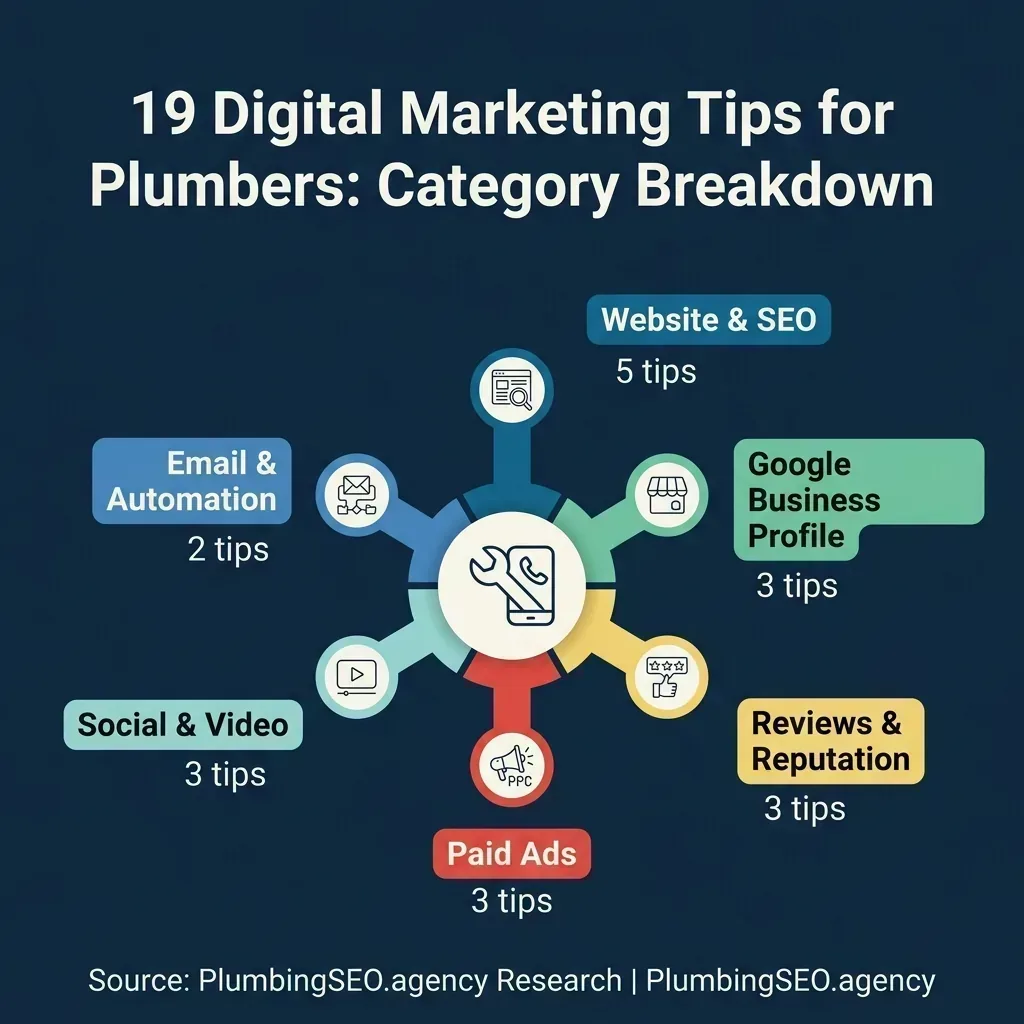
How the 19 tips are organized. Start wherever your biggest gap is.
No need to tackle all six categories at once. Figure out where you are weakest and start there. A plumber with a solid website but zero reviews has a different priority list than one with 200 reviews but no website to speak of.
Website and SEO: Tips 1 Through 5
Your website is the place where every other marketing effort either pays off or falls apart. You can run the best Google Ads in the world, but if someone clicks through to a slow, confusing site with no phone number above the fold, that click was wasted money.
Tip 1: Build a Mobile-First Website That Loads in Under 3 Seconds
Most homeowners search for a plumber on their phone. Not at a desk, not on a laptop. On a phone, probably while standing in a puddle. According to BrightLocal data, 88% of consumers who do a local search on their smartphone visit or call within 24 hours. If your site takes five seconds to load on a phone, a good chunk of those people are gone before they even see your number.
What mobile-first actually means for a plumbing site:
- Phone number tappable at the top of every page
- Page loads in under 3 seconds on a 4G connection
- No pinch-to-zoom needed to read anything
- Contact form is short (name, phone, what is wrong)
One plumber on Reddit described it plainly: "We redesigned our site and the only real change was making it faster and putting the phone number at the top. Calls went up 20% that month." That tracks with what we have seen across dozens of plumber websites.
Tip 2: Create Individual Service-Plus-City Landing Pages
Google ranks pages, not websites. If you have one page that says "we do plumbing in the greater metro area," you are competing against shops that have a dedicated page for "drain cleaning in Oceanside" and another for "water heater repair in Carlsbad."
The plumbers who rank for specific searches often have specific pages built for those searches. This does not mean creating 200 doorway pages with the city name swapped in. It means building real pages with unique content about the service in that location.
A solid service page needs: a clear H1 with the service and city, photos from actual jobs in that area (not stock), a description of how you handle that service, your hours and response time, and a phone number. If you want the full breakdown, we wrote a guide on how we build service pages that rank.
Tip 3: Publish Blog Content That Answers Real Customer Questions
You are not blogging to impress search engines. You are blogging to catch people early in their search. When a homeowner types "why is my water bill so high" into Google, they are not ready to call a plumber yet. But they might be after reading your article that explains the five most common causes and when it is time to call a pro.
Target long-tail keywords that real people search. "How to detect a slab leak" is a better blog topic than "residential plumbing services" because someone searching the first phrase has a real problem they need solved.
HubSpot data shows businesses that blog get 55% more website visitors. For a local plumber, that translates into more people who have already started trusting you before they even pick up the phone. If you want to nail this from a keyword standpoint, check our plumbing website keyword strategy guide.
Tip 4: Add Schema Markup to Every Page
Schema markup is invisible code that tells Google exactly what your business does, where it operates, what services you offer, and what your reviews look like. Without it, Google has to guess. With it, you give Google a cheat sheet.
For plumbing sites, the five essential schema types are LocalBusiness, Service, FAQ, AggregateRating, and BreadcrumbList. We cover the exact implementation in our schema markup guide for plumbers.
Most plumber websites do not have schema at all. That means adding it gives you a direct edge over shops that have not gotten around to it. It is not glamorous work, but it moves rankings.
Tip 5: Fix Your Page Speed (Seriously)
We already mentioned speed in Tip 1, but it deserves its own callout because it is the single easiest thing to mess up and the hardest thing for most plumbers to diagnose on their own.
The most common speed killers on plumber websites: oversized images (especially hero photos of the team), too many plugins or scripts, cheap shared hosting, and uncompressed files. Run your site through Google PageSpeed Insights. If your mobile score is below 70, you are losing visitors before they even see your content.
The fix does not require a rebuild. Compress images, move to better hosting, and strip out plugins you are not using. That alone can shave seconds off load time. For the full rundown, read our technical SEO checklist for plumbing websites.
Google Business Profile: Tips 6 Through 8
If there is one thing nearly every Reddit thread and competitor article agrees on, it is this: your Google Business Profile is one of the most important digital asset for a local plumber. The Local 3-Pack captures 44% of all clicks for service searches, according to Semrush research. If you are not in that pack, you are invisible to nearly half the people searching.
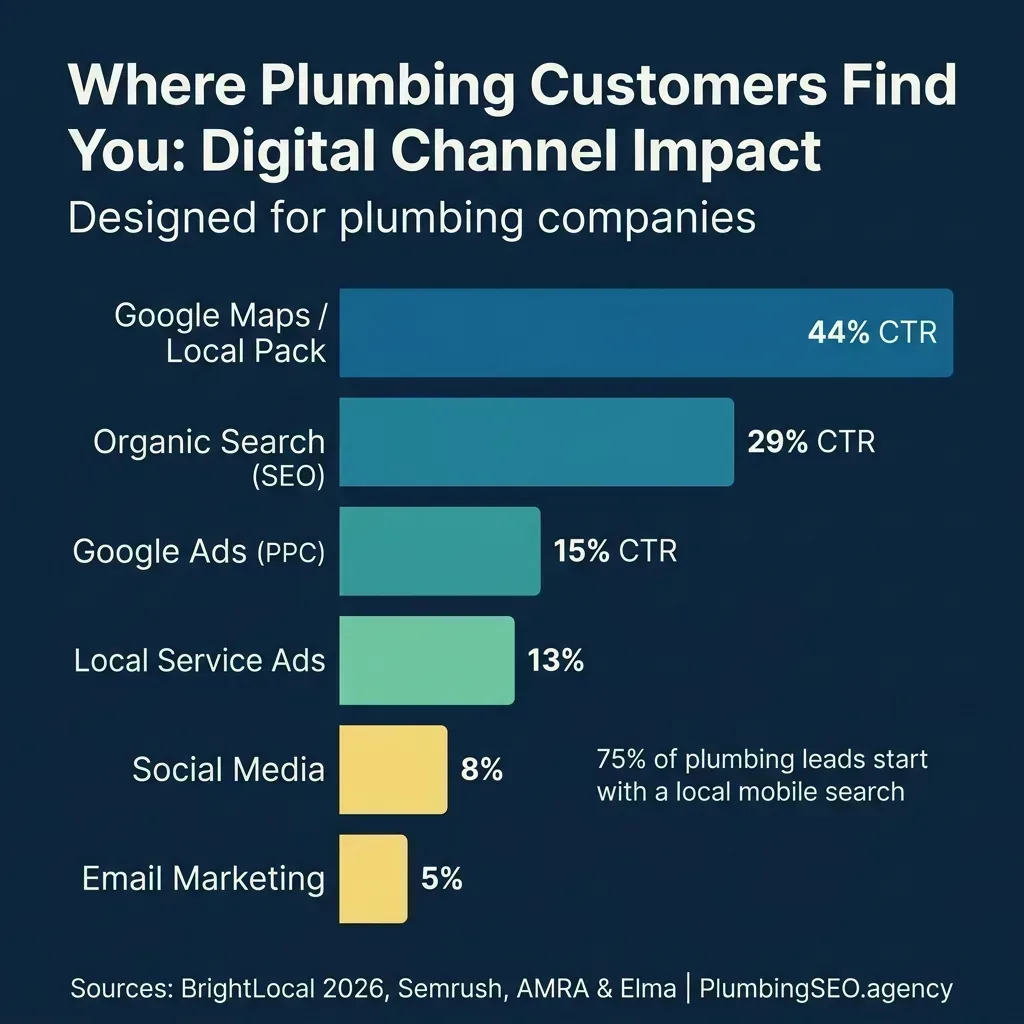
Google Maps dominates for local plumbing searches. That is where the calls come from.
The numbers make the priority clear. Your GBP is not optional. It is the front door of your business for most people searching.
Tip 6: Complete Every Single Field in Your Google Business Profile
This sounds basic, and it is. But according to Google's own data, businesses with a complete profile get 7x more clicks than incomplete ones. That means filling in every service you offer, adding your service area, setting accurate hours (including holiday hours), writing a business description, and selecting every relevant category.
One Reddit user who works with trades put it this way: "Google Business Profile is free and gets you in the map pack. Fill out EVERYTHING. Photos of your truck, your work, your team. Post once a week. Respond to every review." That is about as straightforward as marketing advice gets.
For a deeper dive, check our guide on how to write a GBP description that actually helps you rank.
Tip 7: Post Real Photos Every Week
Stock photos kill trust on a Google Business Profile. Homeowners want to see your actual trucks, your actual team, and your actual work. Before-and-after shots of completed jobs are gold. Photos of your crew on a jobsite tell potential customers that real people will show up at their door.
One plumber reported that after switching from stock photos to real jobsite photos and posting weekly, their GBP profile views jumped noticeably within a month. We go deeper on this in our guide to the 7 photos Many plumbing companies should consider have on their GBP.
Tip 8: Answer Every Question in Your GBP Q&A Section
Most plumbers do not even know the Q&A section exists on their Google Business Profile. But customers use it, and so do competitors. If someone posts a question and you do not answer it, anyone can, including a rival shop or a random person with bad information.
Proactive approach: post and answer your own common questions. "Do you offer 24/7 emergency service?" "What areas do you serve?" "Do you provide free estimates?" This gives potential customers instant answers and signals to Google that your listing is active and responsive. For more on managing your profile like a pro, read about our Google Maps SEO strategy for plumbers.
Reviews and Reputation: Tips 9 Through 11
Reviews are the digital version of word of mouth, except they are permanent and visible to everyone searching. BrightLocal research from 2026 shows that businesses responding to at least 32% of reviews see an 80% higher conversion rate than those responding to just 10%. And consumers now spend an average of 13 minutes and 45 seconds reading reviews before choosing a local business.
For a plumber, that means reviews are not something to worry about later. They are happening right now, and they are directly affecting whether the phone rings.
Tip 9: Text the Review Link Right After the Job
The best time to ask for a review is right after you fixed the problem and the customer is grateful. Not a week later when they have forgotten your name. Not in a follow-up email that sits unread.
A simple text message with a direct Google review link works better than anything else. "Thanks for choosing us today. If we did a good job, would you mind leaving us a quick review? [link]" That is it. No long paragraphs, no guilt trips.
One Reddit user summed it up: "We started asking every customer for a Google review. Once we had enough reviews we moved up naturally in the local map pack and the phone rang more and more." Review velocity matters for rankings. Consistency is the game. For a complete system, check our guide on how to get more 5-star reviews for your plumbing business.
Tip 10: Respond to Every Single Review (Especially the Bad Ones)
Responding to positive reviews is easy and most people skip it. That is a mistake. A quick "Thanks, we appreciate you trusting us with the job" takes 30 seconds and shows future customers that you care.
Responding to negative reviews is harder but more important. According to BrightLocal, 88% of customers are more likely to use a business that replies to all its feedback, both positive and negative. The goal with a negative review response is not to win an argument. It is to show every future reader that you handle problems professionally.
We have a full framework with ready-to-use templates in our guide on how to respond to a negative Google review.
Tip 11: Embed Reviews on Your Website
Your Google reviews should not live only on Google. Pull your best reviews onto your website, especially on your homepage, service pages, and contact page. This builds trust at the exact moment a visitor is deciding whether to call you or go back to Google and click the next result.
A simple review widget or even manually pasting a few testimonials with the customer's first name and star rating makes a difference. 9 out of 10 people check online reviews before choosing a business, according to Qualtrics research. Make it easy for them to see yours without leaving your site.
Paid Advertising: Tips 12 Through 14
Paid ads are the accelerator, not the engine. If your website converts and your reviews are solid, paid ads pour fuel on a working fire. If your website is broken and your reviews are thin, paid ads just burn money faster.
Here is where the average plumber's marketing budget goes:
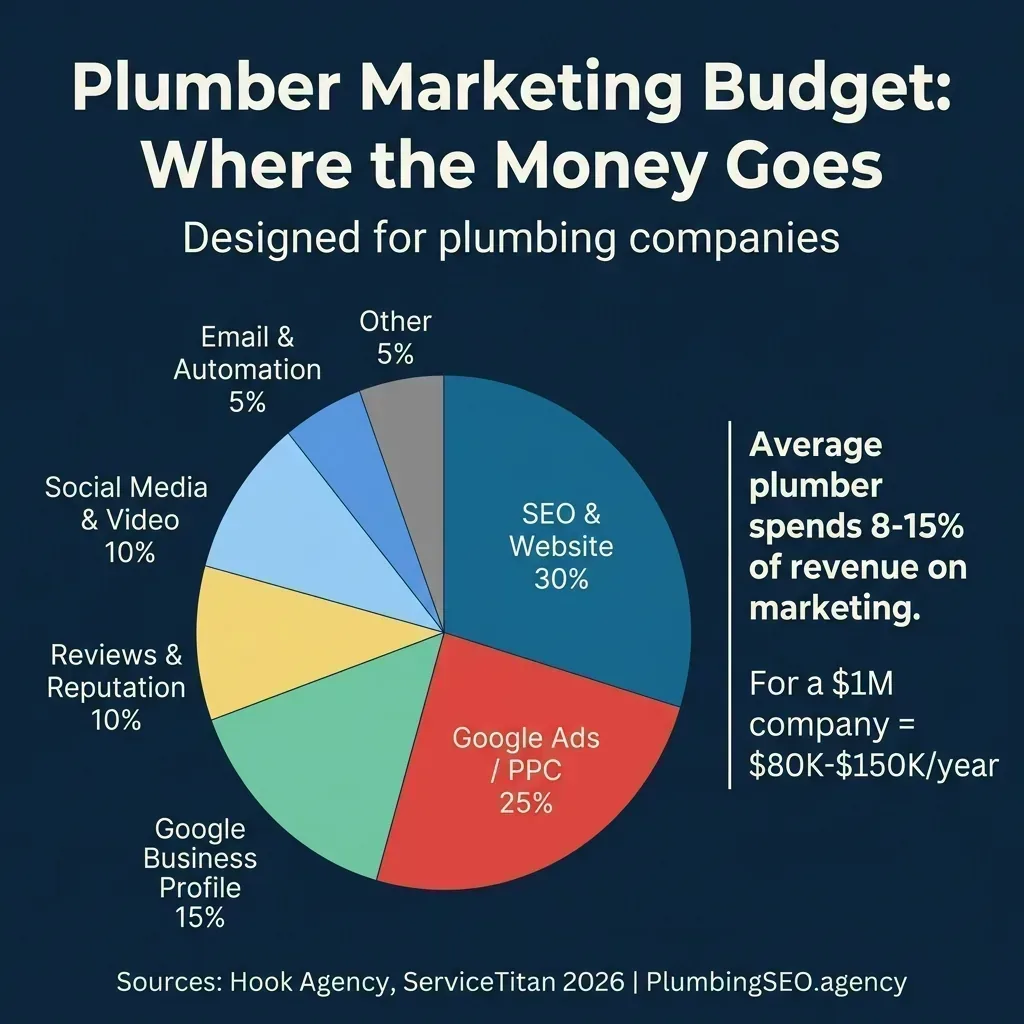
Most plumbing companies allocate 8-15% of revenue to marketing. The split above shows where that money typically goes.
The point is not to copy this exact split. It is to think about where your money goes and whether you are measuring what comes back. A lot of plumbers spend on ads but have no idea which ones are bringing calls. That is like running three trucks but never checking which routes are profitable.
Tip 12: Start with Local Service Ads (Google Guaranteed)
If you are going to spend money on one type of ad, Local Service Ads should be first in line. Unlike regular Google Ads where you pay per click (whether or not that click turns into a call), LSAs charge you per lead. Someone has to actually contact you before you pay.
LSAs also put you at the very top of Google, above even regular paid ads, with a "Google Guaranteed" badge that builds trust. For a new plumbing company or one just starting with paid ads, LSAs remove most of the risk. One marketing company on Reddit recommended it plainly: "Skip standard Google Ads for now and go straight to Local Services Ads. You only pay when you actually get a valid call or lead."
For a complete breakdown, read our guide on everything you need to know about Local Service Ads for plumbing.
Tip 13: Target Emergency and High-Intent Keywords in Google Ads
If you run Google Ads alongside LSAs, do not waste budget on broad terms like "plumber" or "plumbing company." Those searches might come from someone doing research for a school project. Instead, target high-intent keywords that signal urgency: "emergency plumber near me," "water heater repair [city]," "burst pipe plumber [city]."
These searches cost more per click, sometimes $40-$100 per lead depending on the market. But the conversion rate is significantly higher because the person searching has an active problem that needs solving today. SearchLight Q1 2026 data shows non-branded Google Ads averaging $167 per plumbing lead. Expensive, yes. But if that lead books a $1,500 job, the math works.
For a data-driven comparison of organic versus paid, check our SEO vs PPC comparison for plumbers.
Tip 14: Use Call-Only Ads for Mobile Searchers
Call-only ads strip out the website visit entirely. When someone taps the ad, it dials your phone number directly. For emergency plumbing searches on mobile, this is often the highest-converting ad format because it eliminates friction. The person has a problem, they see your ad, they tap, you answer.
The key is actually answering. One Reddit commenter put it bluntly: "A number of jobs just go to the first guy who picks up the phone first. That is the reality." If you are paying for call-only ads and sending people to voicemail, you are paying for nothing. Make sure someone is ready to answer, or use a call answering service during peak hours.
Social Media and Video: Tips 15 Through 17
Social media is not where most plumbing leads come from. The data is clear about that. But it is where trust gets built over time, and it is where potential customers see who you are before they ever call. Think of social as a long game, not a lead machine.
One Reddit commenter summed up the opportunity: "On-the-job vlogging is the biggest thing that could transform a business like this. People eat that stuff up. It is pretty high effort, but there are so many examples of small businesses blowing up because of it."
Tip 15: Post Before-and-After Job Photos on Social Media
You already do the work. You already see the transformation. Take a photo before the job and one after. Post it to Facebook and Instagram with a short caption. "Replaced a 15-year-old water heater in [city] today. Customer has hot water again." Done.
This is not about going viral or getting thousands of followers. It is about having a visible, active presence so that when someone in your area searches your name or asks a friend for a plumber recommendation, your profiles look real, professional, and busy. Empty or outdated social profiles are worse than not having them at all.
Tip 16: Record 60-Second Plumbing Tip Videos
Video marketing boosts landing page conversions by up to 86%, according to Unbounce and Forbes data. But you do not need to produce a documentary. Grab your phone, explain something useful in 60 seconds, and post it.
Good topics: "How to shut off your main water valve," "Three signs your water heater is about to fail," "When a dripping faucet means a bigger problem." These videos serve two purposes: they show people you know what you are doing, and they catch long-tail search traffic on YouTube. According to Wistia research, visitors spend 2.6x longer on websites with video content.
One plumber marketing strategist on Reddit suggested a framework from the book "They Ask, You Answer": identify the 20 most common questions your customers ask, then answer each one in a short video. "When many people see how complicated it is, they will just want to hire you to do it for them." The cost is zero, but you have to actually do the work.
Tip 17: Claim and Use Your Nextdoor Profile
Nextdoor is the one platform most plumbers overlook, and it is specifically designed for local recommendations. When someone's toilet is running at 10 PM, the first place many homeowners turn is their neighborhood Nextdoor group: "Anyone know a good plumber?"
Claim your business page, keep it updated, and respond to local posts where plumbing comes up. This is old-fashioned neighborhood networking in digital form. As one Reddit user put it: "First place I go when I need a plumber is Nextdoor." It is not going to replace Google, but it is free and it builds trust in your exact service area.
Email and Automation: Tips 18 and 19
Email marketing does not sound exciting next to Google Ads or TikTok videos. But it is high-ROI channels that exists, and most plumbers ignore it entirely. An open rate of 20-30% is healthy for plumbing businesses according to Jobber, with conversion rates of 2-5%. For automated email sequences, Omnisend reports conversion rates as high as 70.5%. The math is simple. Small effort, steady returns.
Tip 18: Send Seasonal Maintenance Reminder Emails
Your past customers already trust you. They already let you into their home. Staying in front of them is the easiest way to get repeat business and referrals.
Set up a simple quarterly email. In fall: "Time to flush your water heater before winter." In spring: "Schedule a drain check before heavy rains." In summer: "Is your irrigation system ready?" These are not sales pitches. They are genuinely useful reminders that keep your name at the top of someone's mind.
Keep emails short, useful, and infrequent. One solid email a month is better than five fluffy ones nobody opens. If someone's sink breaks three months from now, they are going to call the plumber whose name just showed up in their inbox, not the one they have to search for.
Tip 19: Automate Post-Job Follow-Ups
After a job is done, most plumbers move on to the next call. That is understandable, there is always a next call. But a simple automated follow-up sequence can turn one job into recurring revenue without any manual effort.
Day 1: "Thank you for choosing us. Here is a review link if we earned it." Day 7: "Just checking in. Everything still good with the repair?" Day 90: "It has been three months. Time for a quick maintenance check?" Tools like Jobber, ServiceTitan, or even basic email platforms like Mailchimp can automate this. Set it up once, and it runs on autopilot.
The combination of asking for reviews, checking in, and prompting maintenance keeps your customer base active without you lifting a finger after the initial setup. For more on making sure no lead falls through the cracks, read our guide on the tech stack that prevents lost leads.
The Full Checklist: All 19 Tips at a Glance
Here is every tip in one view. Print this out, tape it to the office wall, and check things off as you go. You do not need to do everything at once, but you should know what you are not doing yet.
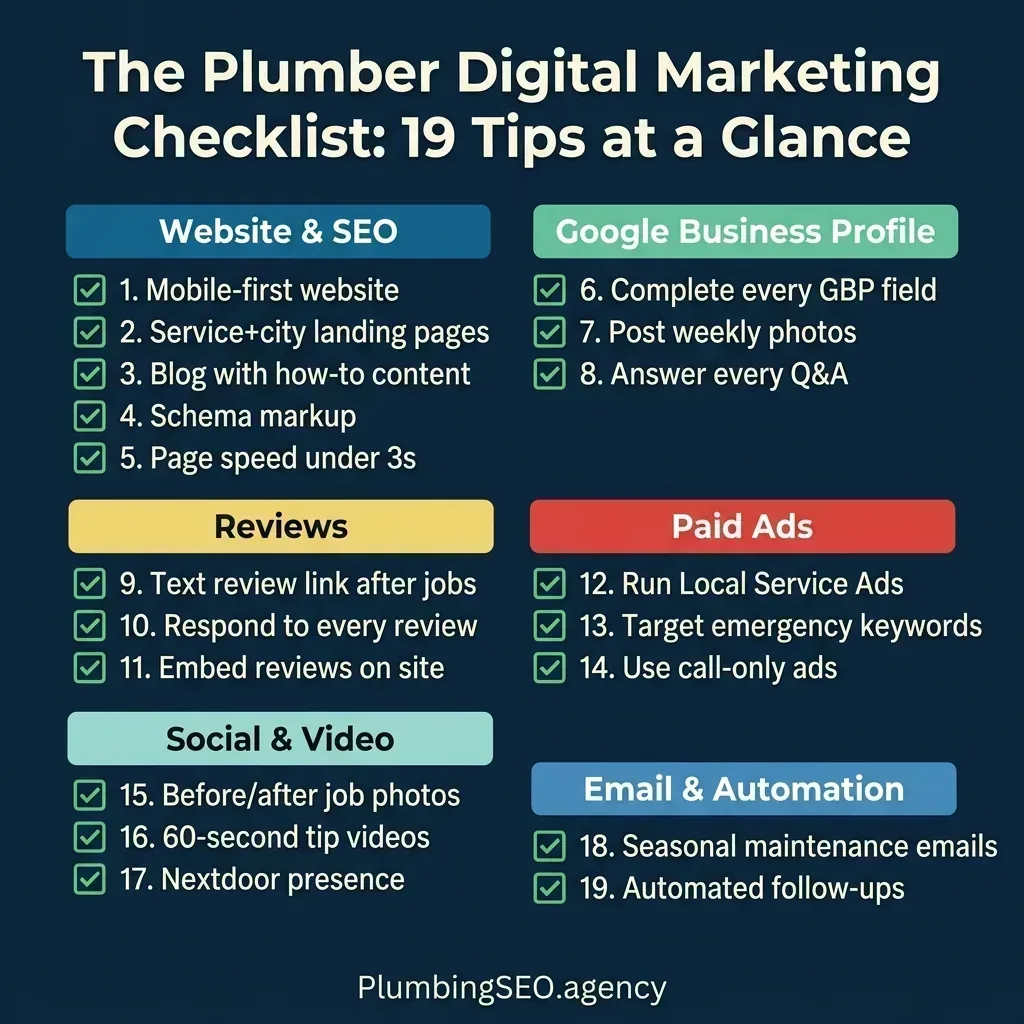
The full 19-tip checklist. Start with what you are missing, not what is trendy.
Where to Start If You Are Doing None of This
If your head is spinning from 19 tips and you are not sure which to tackle first, here is the honest priority order:
- Google Business Profile (Tips 6-8). Free, high impact, drives the most calls. Do this today.
- Reviews (Tips 9-11). Start asking after every job. Momentum builds fast once you have a system.
- Website basics (Tips 1, 2, 5). Make sure your site loads fast, your phone number is visible, and you have service pages for what you do and where.
- Local Service Ads (Tip 12). When you are ready to spend money, start here because you only pay for actual leads.
- Everything else. Layer on social, video, email, and content marketing as you have time and capacity.
The way I see it, the biggest mistake plumbers make with digital marketing is trying to do everything at once, doing all of it poorly, and then concluding that "marketing does not work." It works. It just works when you focus on the things that move the needle for your specific situation and do them well before moving on.
Track What Works and Cut What Does Not
None of these tips matter if you do not measure what is actually ringing the phone. Call tracking is not optional. You need to know whether that call came from your Google listing, your website, a paid ad, or a Nextdoor post.
The basics of tracking for a plumbing company:
- Call tracking: Assign unique numbers to each channel and know exactly where leads come from.
- Cost per lead: Total spend divided by number of leads. If you spent $5,000 and got 100 leads, that is $50 per lead.
- Customer lifetime value: One customer is not one job. If your average customer calls back three times over five years, they might be worth $2,000 or more.
If a channel costs more per lead than the job is worth, cut it. If a channel is bringing in calls that book, invest more. That is the whole game. For a complete framework, read our guide to measuring marketing ROI for plumbers.
Frequently Asked Questions
What is the best way to market a plumbing business?
The most effective approach combines a complete Google Business Profile, consistent review collection, a mobile-friendly website with service-specific pages, and targeted paid ads like Local Service Ads. Start with what drives the most calls (GBP and reviews), then layer on SEO, content marketing, social media, and email as you grow. The key is tracking results so you know which channels are actually booking jobs.
How much should a plumber spend on digital marketing?
Marketing budget ranges vary widely by market and growth stage. Many contractor-budget benchmarks place service-business marketing spend somewhere around 5-15% of revenue, but the useful number is the one tied to tracked calls, booked jobs, and profit. For a $1 million plumbing business, that range could mean anything from a lean $50,000 plan to a much more aggressive $150,000 growth push.
Is SEO worth it for plumbing companies?
Yes. SEO can be a high-ROI long-term marketing strategy for plumbers when the site, Google Business Profile, reviews, and service-area pages are maintained. Results often take 3 to 6 months to build, and SEO can deliver a lower cost per lead than paid advertising once it gains traction. Treat click-share and timeline numbers as benchmarks that vary by market and query type.
What is the best social media platform for plumbers?
For lead generation, Nextdoor is often the most effective social platform for local plumbers because it connects you directly with neighborhood homeowners. Facebook works well for community visibility and paid local ads. Instagram is useful for showcasing before-and-after job photos. YouTube builds long-term trust through educational content. The best approach is picking one or two platforms and staying consistent rather than spreading yourself thin across all of them.
How do I get more Google reviews for my plumbing business?
The most effective method is texting a direct Google review link to customers immediately after completing a job, while the experience is still fresh. Keep the message simple and grateful. Do not incentivize reviews (Google prohibits it), but make it as easy as possible for happy customers to leave one. Responding to every review, both positive and negative, also encourages more people to share their experience.
Do plumbers need a website in 2026?
Yes. While a Google Business Profile can generate calls on its own, a website is important for converting visitors from paid ads, organic search, and social media. It also gives you control over your brand message and allows you to showcase services, reviews, and service areas. In 2026, 94% of web pages get zero organic traffic, so having a website alone is not enough. It needs to be mobile-friendly, fast-loading, and optimized for the specific services and cities you serve.
Not Sure Where Your Plumbing Website Is Leaking Calls?
We will run a free SEO audit on your plumbing website and show you exactly where you are losing visibility, calls, and customers to competitors. No contracts, no obligations, just honest answers.
Run My Free SEO Leak Check