
- Most plumbers should buy the foundation first: call/form tracking, a clean Google Business Profile, review requests, and a website that makes it easy to call or book. Do not pour ad money into an untracked, slow, unclear site.
- Use PPC or Local Services Ads when you need calls now, but pair them with tracking and landing-page conversion. Use local SEO, service pages, internal links, and reviews to build compounding calls over time.
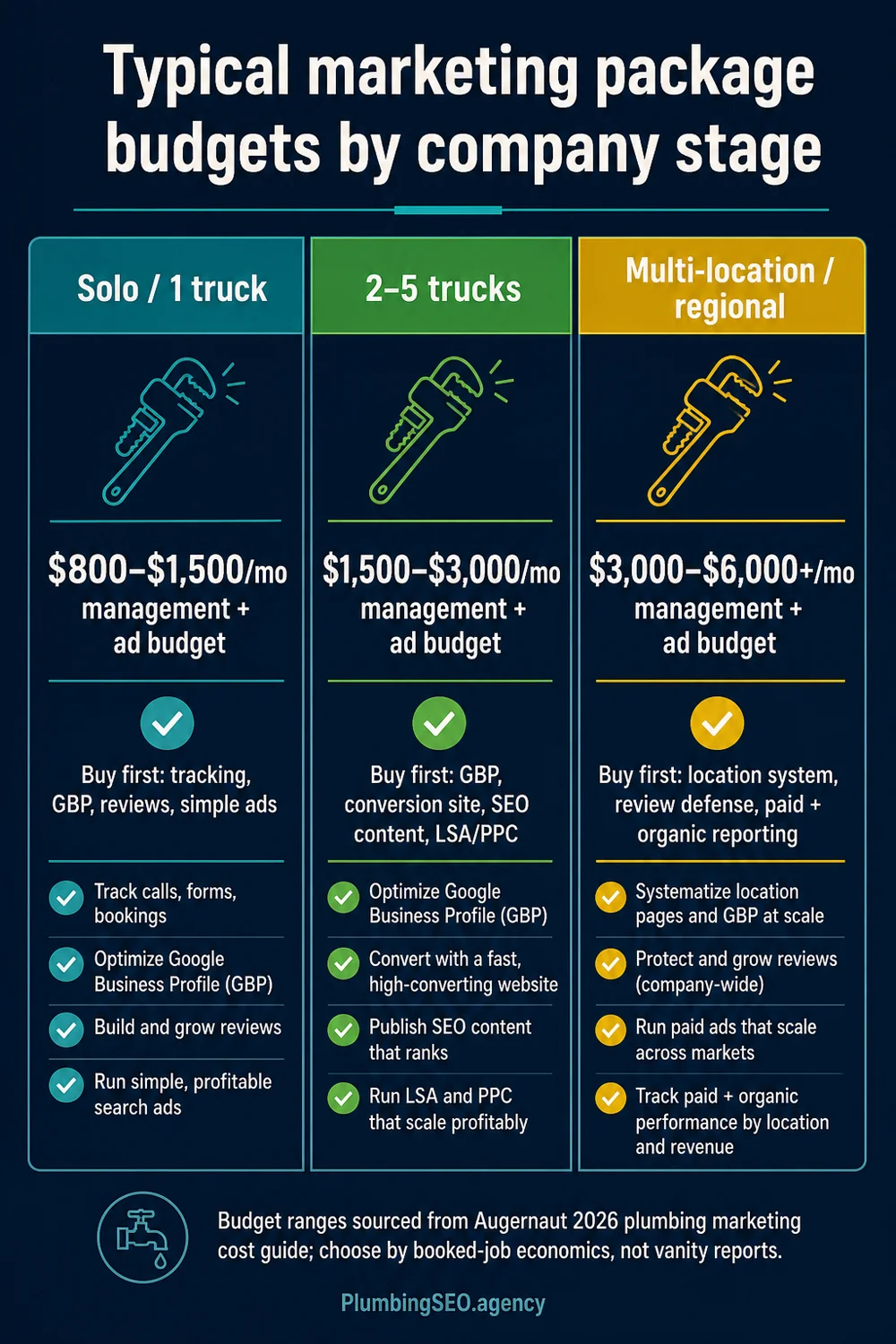
- A practical plumbing marketing package often starts around $800–$1,500/month for a one-truck foundation, $1,500–$3,000/month for a 2–5 truck growth system, and $3,000–$6,000+/month for multi-location work, plus ad budget.
Most plumbing marketing packages sound similar on a sales call: SEO, Google Ads, social posts, reviews, maybe a new website, maybe a dashboard. The problem is that a plumbing owner does not need a menu. You need the next right buy that turns into more qualified calls and booked jobs.
That answer changes by stage. A one-truck company with no tracking should not start with a giant content retainer. A five-truck company with a decent website but weak Google Maps visibility may need local SEO and review operations first. A company with full trucks next week may need paid ads for immediate demand, but only if the calls are tracked and the landing page can convert.
Use this guide as a buying order. It compares the common plumbing marketing package options, explains what to buy first by budget and company stage, and shows what to skip until the basics are fixed.
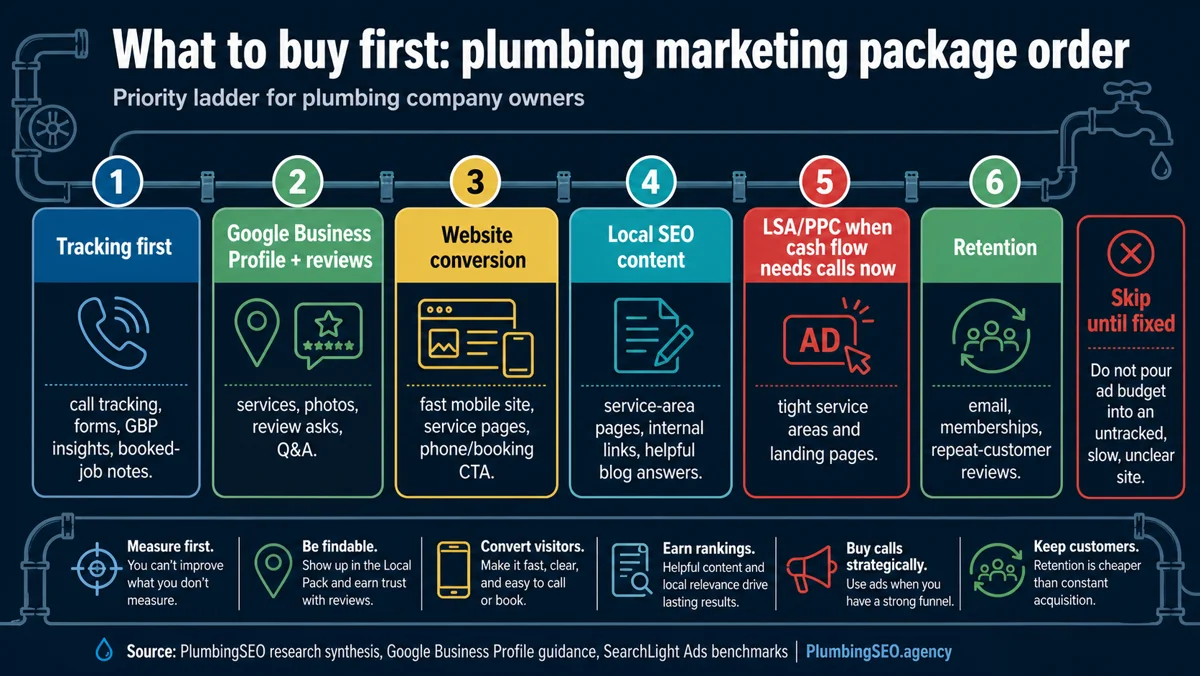
The quick answer: what should a plumber buy first?
If nothing is measured yet, buy tracking first. If the Google Business Profile is thin, neglected, or review-poor, buy GBP and review work next. If the website is slow, vague, hard to call from, or missing service pages, fix conversion before sending more traffic. Then layer in local SEO content and paid acquisition based on call urgency.
| Package option | Buy it first when | Wait when | Primary KPI |
|---|---|---|---|
| Tracking and attribution | You cannot separate Google calls, form leads, booked jobs, and spam. | Almost never. This is the scoreboard. | Calls, forms, booked jobs, cost per booked job |
| Google Business Profile + reviews | Maps visibility, reviews, categories, services, photos, or Q&A are weak. | The profile is already strong and the site is the bigger leak. | Maps calls, direction requests, review velocity, local visibility |
| Website conversion | Mobile pages are slow, calls are hard, service pages are thin, or forms fail. | The site already converts and the market needs more demand. | Visitor-to-call rate, form conversion, booked-call rate |
| Local SEO + service content | You need compounding visibility in services and cities you actually serve. | You need calls this week and have no paid/LSA plan. | Organic calls, Maps support, rankings by service area |
| PPC / Local Services Ads | You need demand now and can answer, track, and qualify calls. | The website is unclear, tracking is missing, or the office misses calls. | Cost per qualified call and cost per booked job |
| Retention and repeat-customer marketing | You already have customers, memberships, inspections, or seasonal service opportunities. | You have no clean customer list or follow-up process. | Repeat jobs, membership revenue, reactivation calls |
That order is why a generic bundle can be risky. The right package depends on the leak in your current system. If you want a deeper breakdown of SEO-only plan shape, compare plumbing SEO packages vs custom SEO plans. This article is broader: it covers the full marketing mix a plumbing company may buy.
What plumbing marketing packages usually include
A plumbing marketing package is usually a bundled monthly scope. Some agencies sell one channel, such as Google Ads management or local SEO. Others sell a full system with website updates, GBP management, reviews, content, paid ads, reporting, and strategy. The labels are less important than the deliverables.
For plumbing companies, a useful package should answer five questions:
- Where will calls come from? Maps, organic search, Local Services Ads, PPC, referrals, repeat customers, or a mix?
- What gets fixed first? Tracking, GBP, reviews, site speed, service pages, forms, call handling, or landing pages?
- What is included each month? Pages, posts, links, citations, reports, photos, ad testing, review requests, or conversion work?
- How will booked jobs be measured? Call volume is not enough if half the calls are wrong numbers, vendors, or jobs you do not want.
- What should be skipped for now? A good package should also tell you what not to buy yet.
Google says local results are influenced by relevance, distance, and prominence in its local ranking guidance. That is why Maps work, reviews, service relevance, and website proof matter so much for plumbers. You are not just buying traffic. You are buying trust signals that help a nearby homeowner choose you.
Marketing package budgets by plumbing company stage
Public pricing varies, but recent plumbing marketing cost research from Augernaut says many plumbing companies spend about $800–$3,500 per month on marketing management, with ad budget on top. That is a wide range because a solo operator and a regional plumbing company are not buying the same amount of labor.
| Company stage | Typical management budget | What to buy first | What to avoid |
|---|---|---|---|
| Solo / 1 truck | $800–$1,500/month plus ad spend | Tracking, GBP cleanup, reviews, basic website conversion, small paid tests | Huge content plans, broad social packages, long contracts before measurement |
| 2–5 trucks | $1,500–$3,000/month plus ad spend | GBP + reviews, service pages, local SEO content, conversion fixes, LSA/PPC if call volume is needed | SEO-only plans with no call tracking or landing-page accountability |
| Multi-location / regional | $3,000–$6,000+/month plus ad spend | Location systems, review defense, paid + organic reporting, service-area expansion, stronger internal linking | One-size-fits-all packages that ignore location-level performance |
The budget should also respect job economics. If a water heater, sewer repair, or repipe has enough gross profit, a higher cost per booked job can still make sense. If the job is low-margin, the same lead cost may be a problem. Before signing a package, use a simple model like the plumbing SEO ROI calculator and ask how many extra booked jobs the package needs to pay for itself.
Maps, ads, SEO, website, and retention: which package fits the job?
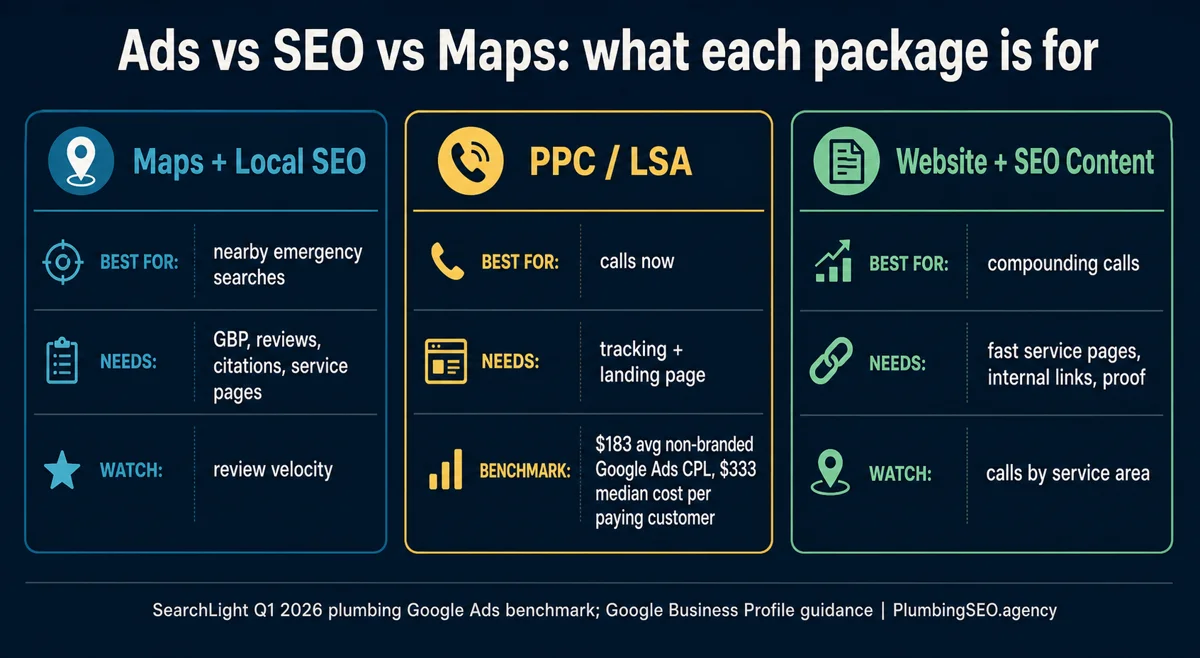
Every channel has a job. Trouble starts when an agency sells one channel as the answer to every problem. SEO is not a faucet you turn on tomorrow. Ads are not a substitute for a weak website. Google Maps visibility will not save you if reviews are stale and calls go unanswered.
Buy tracking before you buy more traffic
Tracking is not glamorous, but it is the first purchase because it protects every purchase after it. At minimum, a plumber should know which channels generated calls, which calls were qualified, which calls booked, and which booked jobs were worth real money. If your dashboard stops at clicks or rankings, you are still guessing.
Tracking should include call tracking numbers used carefully, form tracking, GBP insights, landing-page events, and notes from the office or CRM. The goal is not a vanity report. The goal is to know which package produces booked jobs.
Buy GBP and reviews when local trust is the leak
For emergency plumbing, drain cleaning, water heaters, sewer work, and similar local searches, the Google Business Profile is often the front door. A package that improves GBP categories, services, photos, service areas, review requests, review responses, Q&A, and local citations can be the highest-leverage first buy.
This is especially true when competitors have fresher reviews, stronger photos, clearer services, and cleaner local signals. If Maps is the battleground, start with a dedicated local SEO for plumbers plan before buying broad content for topics nobody nearby is searching.
Buy website conversion when traffic is already leaking
If people visit but do not call, more traffic just makes the leak more expensive. Website conversion work should improve mobile speed, above-the-fold phone visibility, service-page clarity, emergency CTAs, form reliability, trust proof, and internal links. If the site needs more than cleanup, a plumbing web design project may be the better first package than month-to-month ads.
For a plumber, conversion is practical. Can a homeowner understand what you do in five seconds? Can they call with one tap? Can they see service-area proof? Can they tell you handle the exact problem they have? If not, fix that before scaling paid traffic.
Buy local SEO content when you need compounding visibility
Local SEO and content packages make sense when the foundation is in place and the company needs more visibility across profitable services and service areas. The work should include service pages, city or service-area proof where appropriate, internal links, GBP-to-site alignment, technical cleanup, and content that answers real customer questions.
The danger is paying for generic blogs while money pages stay weak. Ask whether the package strengthens actual service intent: drain cleaning, sewer repair, emergency plumbing, water heaters, slab leaks, repiping, commercial plumbing, and the cities you serve. For the SEO-specific deliverable list, see what professional plumbing SEO services should include.
Buy PPC or Local Services Ads when you need calls now
Paid search and Local Services Ads can help when you need calls quickly, are entering a new market, or need to smooth seasonality. They also expose problems fast. A weak offer, slow landing page, poor intake process, or wrong service-area targeting can burn money quickly.
If you choose ads first, keep the first package tight: focused services, focused service areas, negative keywords, call tracking, landing-page testing, and weekly lead-quality review. Paid traffic should not be judged by spend or clicks. It should be judged by qualified calls and booked jobs.
Buy retention when you already have customer demand
Retention packages are often underpriced in the owner’s mind because they do not feel as exciting as new leads. But if you have past customers, memberships, inspections, or seasonal maintenance opportunities, email/SMS follow-up, review requests, reactivation campaigns, and membership promotion can reduce the need to rent every call from Google.
Retention is not the first buy for every company. It belongs after the customer list, job tagging, and follow-up process are clean enough to use.
What to skip until the basics are fixed
A good plumbing marketing package should protect you from buying the wrong thing too early. Skip or delay these offers until the foundation is ready:
- Big ad budgets with no booked-job tracking. If you cannot see qualified calls and booked jobs, you cannot judge the spend.
- Broad social posting packages sold as lead generation. Social proof can help, but generic posts rarely replace search demand for urgent plumbing problems.
- SEO content with no service-page plan. Blog posts should support the pages that book work, not distract from them.
- Cheap all-in-one packages with secret deliverables. Low price is not the issue; vague scope is. Read the red flags in the cheap marketing services for plumbers guide before signing.
- Long contracts before baseline measurement. A provider should be willing to show what is broken and what the first 90 days will fix.
- Reports that celebrate rankings but ignore calls. Rankings matter because they should support demand. They are not the final score.
A practical 90-day package order
If I were helping a plumbing owner choose the first 90 days, I would structure the package around proof, not promises.
Days 1–30: measure and stop obvious leaks
Set up or audit tracking, confirm forms work, check phone click events, clean GBP categories and services, inspect speed and mobile CTA issues, and review the highest-intent service pages. This is also where a free plumbing SEO audit can show whether the site is leaking calls before you commit bigger spend.
Days 31–60: strengthen the highest-return channels
If Maps is weak, push GBP, reviews, citations, and service-area relevance. If the website is the leak, fix conversion and important service pages. If calls are urgently needed, launch a tightly controlled LSA/PPC test with tracking and negative keyword review. If the company is already ranking but not converting, use the plumbing marketing budget guide to decide whether the next dollar belongs to ads, SEO, or conversion.
Days 61–90: expand what is working
Once the first month of tracking shows real signals, expand the winning channel. That may mean more service-area pages and internal links, more review requests, stronger location-level reporting, more ad budget, or a retargeting/retention layer. The package should get more specific as evidence improves.
Questions to ask before buying any plumbing marketing package
Before you sign, ask the provider these questions in plain English:
- What exactly will be completed in the first 30, 60, and 90 days?
- Which services and service areas are we prioritizing first?
- How will you track calls, forms, qualified leads, and booked jobs?
- What is the expected management fee and what ad budget is separate?
- What work is not included?
- What would make you recommend against ads, SEO, or a website rebuild right now?
- How do we cancel, pause, or change scope if the economics do not work?
- Which pages, GBP fields, reviews, citations, or campaigns will I be able to inspect?
If the answers are fuzzy, compare the contract structure against common digital marketing pricing models and contract traps for plumbers. The best package is not the one with the longest list. It is the one where the work, budget, and expected call economics are clear.
The package I would buy first
For most plumbing companies, the first package should be a foundation-and-call package: tracking, Google Business Profile cleanup, review generation, website conversion fixes, and a focused plan for either local SEO or paid calls depending on urgency. That foundation gives every later dollar a better chance of working.
If you already have that foundation, the next buy depends on the bottleneck. Need calls now? Use PPC or LSA carefully. Need stronger Maps and organic visibility? Invest in local SEO and service content. Have traffic but weak close rate? Fix the website and intake process. Already have customers but too little repeat work? Add retention.
PlumbingSEO’s own plumbing SEO pricing and packages are built around that same idea: diagnose the leak, fix the first bottleneck, then scale the channel that produces booked jobs. If a package cannot explain that sequence, it is probably selling activity instead of outcomes.
Plumbing Marketing Package Questions
Most plumbers should buy tracking, Google Business Profile cleanup, reviews, and website conversion before scaling ads or broad SEO. If calls are urgently needed, a small PPC or Local Services Ads test can run early, but only with tracking and a focused landing page.
Google Ads and Local Services Ads are better when the company needs calls quickly and can track lead quality. SEO is better for compounding Maps and organic visibility over time. Many plumbers need both, but the first buy depends on urgency, tracking, and website conversion.
A one-truck plumbing company might start around $800 to $1,500 per month for management plus ad budget. A 2 to 5 truck company often needs $1,500 to $3,000 per month. Multi-location or regional companies may need $3,000 to $6,000 or more, depending on competition and scope.
A useful package should clearly explain tracking, GBP work, review operations, website conversion, SEO content or service-page work, paid campaign management if included, reporting, and first-90-day priorities. It should also say what is not included.
Buy website work first when the current site is slow, confusing, hard to call from, missing core service pages, or not tracking forms and calls. SEO can send more visitors, but a weak website will leak those visitors before they book.
The biggest red flag is a package that promises leads or rankings without showing deliverables, tracking, service-area priorities, cancellation terms, and booked-job reporting. If you cannot inspect the work or judge call economics, the package is risky.
Not sure which package should come first?
Start with a free plumbing SEO leak check. We will look at your Maps presence, website conversion, tracking, reviews, and service-page coverage before recommending a bigger marketing package.
Run My Free SEO Leak Check