
- Retainers, PPC management, and pay-per-lead can all work. The danger is signing before you know who owns the assets, who pays for mistakes, and how a lead is defined.
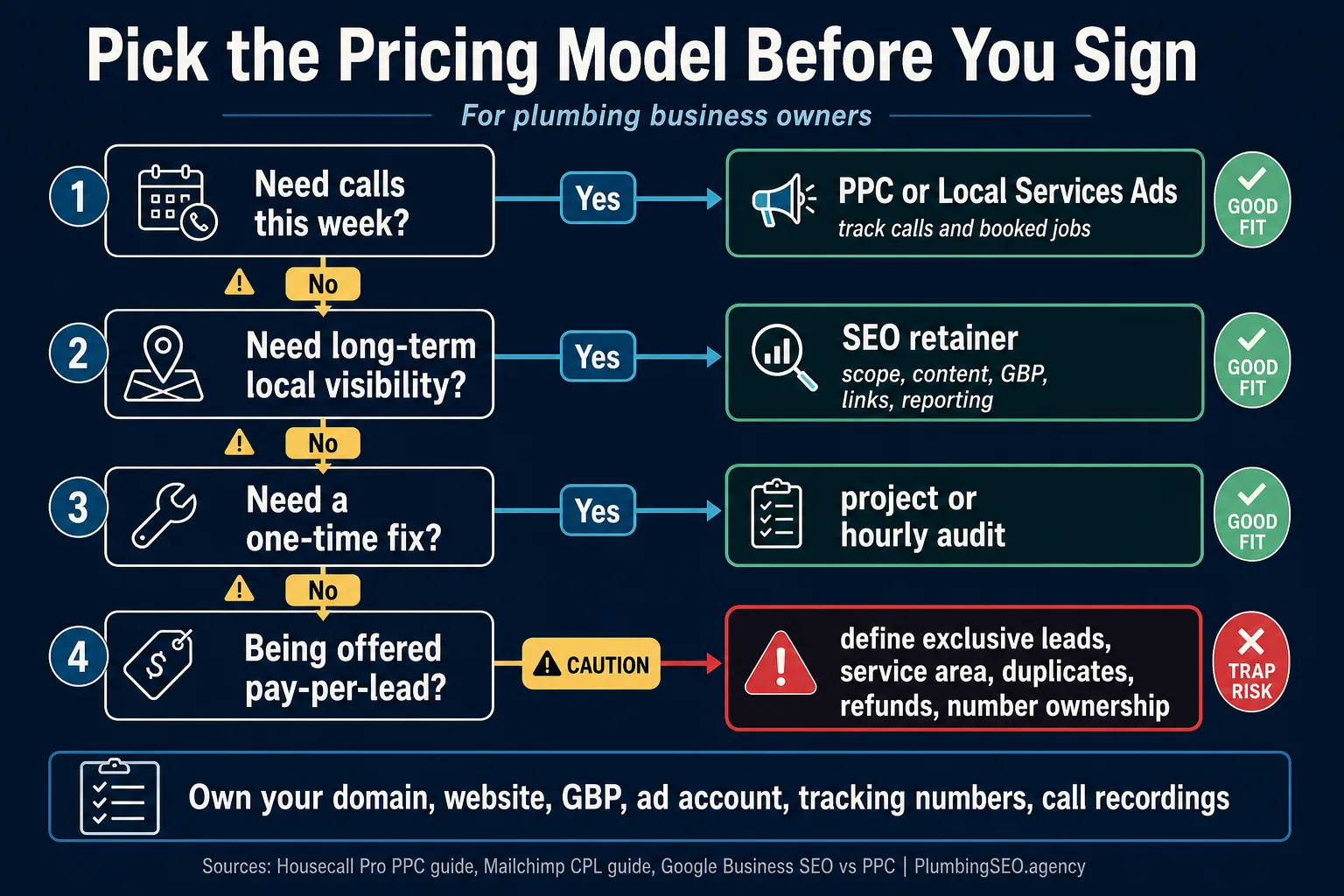
- For most plumbing companies, a clean mix works best: SEO retainer for long-term local visibility, PPC or Local Services Ads for urgent demand, and strict call tracking for both.
- Before you sign, ask for the scope, ad account ownership, tracking numbers, cancellation clause, duplicate-lead rules, and the exact report that connects spend to booked jobs.
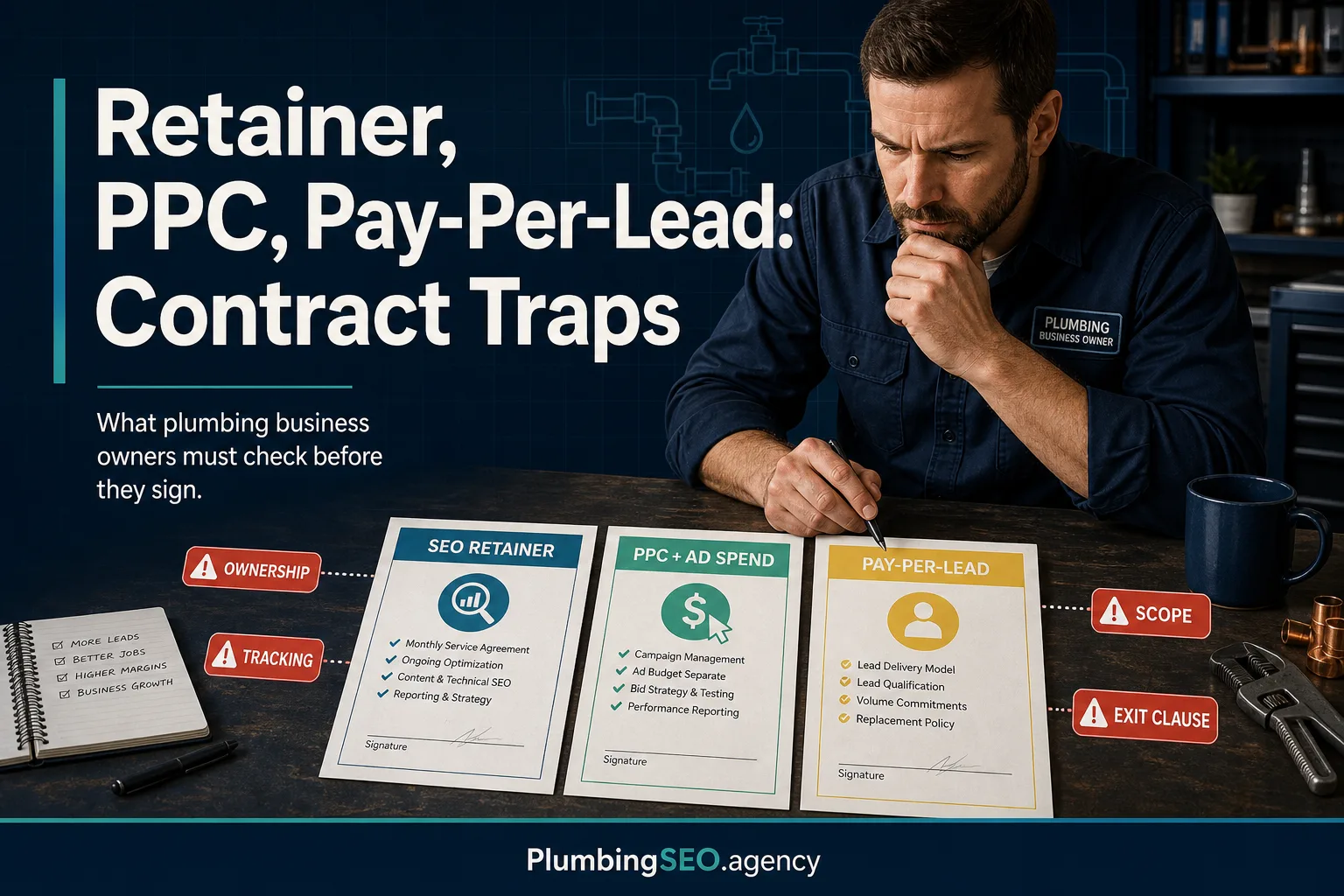
The real question is not what marketing costs. It is what the deal makes you responsible for.
A plumbing owner does not buy marketing because they enjoy reports. You buy it because slow weeks hit payroll, competitors sit above you on Google, and the phone needs to ring with the right jobs in the right service area.
That is why digital marketing pricing models for plumbers need to be judged differently than generic agency pricing. A retainer, PPC fee, pay-per-lead deal, hourly audit, or revenue-share offer can all sound reasonable on paper. In the real world, the details decide whether you get booked jobs or a box of fancy-looking numbers.
For background, general agency pricing guides describe models like hourly, project, package, retainer, performance-based, revenue-share, value-based, and hybrid pricing. The useful part for plumbers is not memorizing eight labels. It is understanding who carries the risk, who owns the assets, and what happens when calls do not turn into jobs.
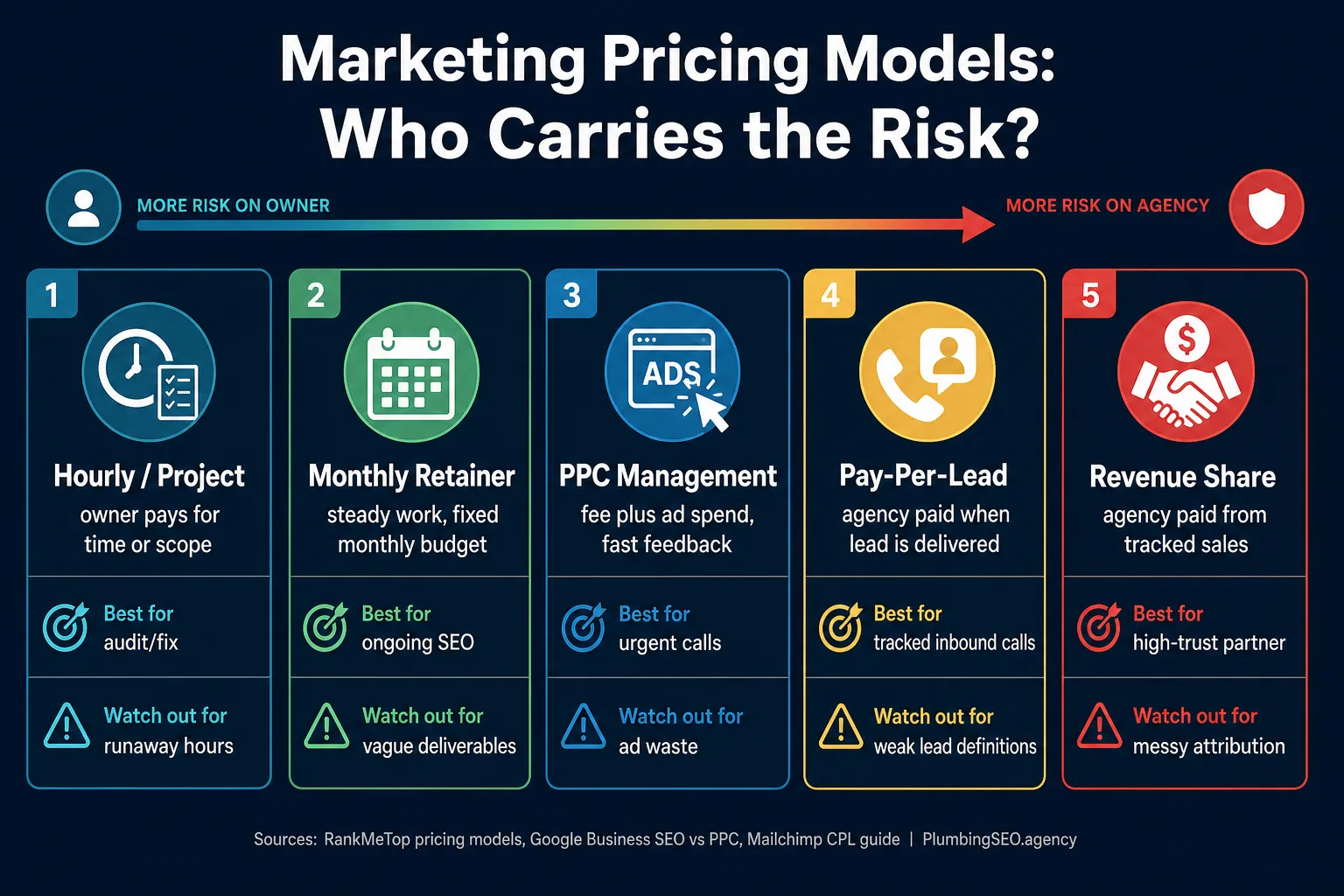
Five pricing models plumbing owners actually run into
Most offers you see will fall into one of these buckets. Some agencies combine them, and that is not automatically bad. The problem starts when the contract hides the moving parts.
| Model | How it works | Best fit for plumbers | Main trap |
|---|---|---|---|
| Hourly or project | You pay for time or a fixed scope. | Audits, tracking setup, landing page fixes, one-time cleanup. | Runaway hours or a project that finds problems but fixes nothing. |
| Monthly retainer | You pay a fixed monthly fee for ongoing SEO, content, GBP, reporting, or ads management. | Long-term local SEO and consistent marketing work. | Vague deliverables, vanity metrics, and contracts with no exit path. |
| PPC management | You pay ad spend plus a management fee or percentage. | Emergency calls, fast testing, new service areas, seasonal pushes. | Paying for clicks without knowing which calls became booked jobs. |
| Pay-per-lead | You pay when a lead is delivered, often by phone call, form, or LSA-style contact. | Shops with tight tracking and clear service-area rules. | Duplicate calls, non-exclusive leads, bad-fit jobs, and rented tracking numbers. |
| Revenue share | The agency takes a percentage of tracked sales or revenue. | Rare cases with clean booking, invoice, and attribution data. | Attribution fights. Plumbing jobs are messy, callbacks happen, and invoices change. |
Retainers are not bad. Lazy retainers are bad.
A monthly retainer is usually the cleanest way to build local SEO because the work compounds. Service pages need writing. Google Business Profile needs care. Internal links need planning. Reviews, local proof, tracking, and technical fixes do not happen in one Saturday afternoon unless somebody has been hiding a magic wrench.
The issue is scope. If the proposal says "monthly SEO" but does not name deliverables, cadence, owner access, and reporting, you are buying fog. A good retainer should show what gets worked on each month and why it connects to calls.
Use our plumbing SEO pricing guide when you want deeper monthly SEO ranges. For this decision, the contract checklist matters most:
- Which pages, GBP tasks, content pieces, technical fixes, and links are included?
- Do you own the website, domain, Google Business Profile, Search Console, Analytics, and call tracking numbers?
- Can you cancel without losing assets or data?
- Will reports show calls, qualified leads, and booked jobs, not just rankings?
PPC fees need to be separated from ad spend
PPC can be the right tool when you need calls this week. Google’s own business guidance frames PPC as useful for short-term traffic, while SEO builds longer-term presence. Housecall Pro’s plumber PPC guide makes the same practical point: ads work best for high-intent searches like emergency plumber, drain cleaning, water heater repair, and same-day service.
That does not mean every PPC contract is safe. Ask whether the agency fee is flat, a percentage of spend, or both. Ask who owns the Google Ads account. Ask whether call extensions, landing page calls, forms, and booked jobs are tracked. If they cannot answer cleanly, do not hand them a bigger budget.
A common setup is monthly ad spend plus management. That can be fair. What is not fair is hiding the fee inside the spend so you cannot tell how much reached Google and how much went to the agency. You would not accept an invoice that says "pipe stuff" for a repipe. Do not accept "marketing spend" without a breakdown.
Pay-per-lead sounds safe until the definition gets slippery
Pay-per-lead is attractive because it feels tied to results. Mailchimp’s cost-per-lead guide explains the basic math: total spend divided by leads generated. That is useful, but plumbers need one more layer. A cheap lead is worthless if it is outside your service area, a duplicate caller, a price shopper for a job you do not want, or a shared lead already sold to three shops.
Before accepting pay-per-lead, define a billable lead in writing. For plumbing, I would want the contract to answer these questions before anyone gets paid:
- Is the lead exclusive to your company?
- What service area counts?
- What happens with duplicate calls, spam, wrong numbers, and existing customers?
- Are emergency, install, and low-ticket service leads priced the same?
- Who owns the tracking number and call recordings?
- How fast can you dispute a bad lead?
The contract traps that cost plumbers real money
Bad pricing is not always the highest price. Sometimes the expensive mistake is the cheap deal that gives someone else control of your website, phone numbers, ad account, or local listings. Here are the traps I would check before signing anything.
- Asset ownership: You should own your domain, website files, Google Business Profile, ad account, analytics, Search Console, and call tracking numbers.
- No clear lead definition: If the contract charges per lead, it must define qualified, exclusive, service-area, duplicate, spam, and refund rules.
- No cancellation path: Long contracts are not automatically wrong, but no-exit contracts protect the vendor more than the plumbing company.
- Vanity reporting: Rankings and impressions are helpful, but the phone tells the truth. Track calls, booked jobs, and revenue where possible.
- Bundled spend: Separate agency fees from media spend. You need to know what went to Google, what went to software, and what went to labor.
- One-size-fits-all packages: A drain-cleaning-heavy shop, a remodel plumber, and a multi-location emergency company do not need the same plan.
What I would choose first
If the phone is quiet right now, I would not wait six months for SEO alone. I would fix tracking, build or clean up the highest-intent landing pages, and run tightly controlled PPC or Local Services Ads while the SEO foundation gets built. If the shop already has steady work but keeps losing Maps visibility, I would put more weight on a transparent SEO retainer.
The cleanest plan is usually hybrid: one accountable owner for tracking, one clear SEO scope, one paid-ad budget you can inspect, and one monthly report that shows what happened from search to call to booked job. For the local visibility side, start with the plumber SEO homepage and the local priorities in our advanced local SEO guide.
And if an agency gets offended because you ask ownership and tracking questions, that tells you plenty. Good partners welcome clean measurements. Bad partners prefer mud.
Sources used for this guide
This article uses current market examples plus source reviews from RankMeTop's pricing model overview, Google Business guidance on SEO vs PPC, Mailchimp's cost-per-lead explanation, and Housecall Pro's plumbing PPC guide.
FAQ: Digital marketing pricing models for plumbers
For most plumbing companies, the best setup is a transparent SEO retainer for long-term local visibility plus PPC or Local Services Ads when faster calls are needed. The model matters less than ownership, tracking, scope, and whether reports connect spend to booked jobs.
It can be safe if the contract defines exclusive leads, service area, duplicate calls, spam, disputes, lead recordings, and number ownership. Without those rules, pay-per-lead can turn into paying for noise instead of real plumbing jobs.
If you need calls immediately, start with controlled PPC or Local Services Ads while building SEO. If you already have steady work but want stronger Maps and organic visibility, a transparent SEO retainer may be the better first move.
It should include scope, monthly deliverables, account ownership, ad spend breakdown, call tracking ownership, reporting cadence, cancellation terms, lead-quality rules if applicable, and what happens to your assets when the agreement ends.
Compare the price to the work, not just to another quote. A fair price should match the deliverables, market competition, tracking setup, reporting quality, and the amount of ongoing work required to generate qualified calls.
Want a second set of eyes before you sign?
Send the proposal, pricing model, and contract terms. We will tell you what looks normal, what needs clearer tracking, and what could trap your plumbing company later.
Ask for a Marketing Contract Check